List of Data Providers: 12 B2B Data Vendors Compared for 2026
Every B2B data provider claims the biggest, freshest database. This list of data providers breaks down 12 vendors by data type, coverage, compliance and real pricing so you can shortlist the right one fast.
TL;DR
- No single B2B data provider wins every category. Pick based on the job: contact data, company data, intent data, or verification.
- Enterprise suites (ZoomInfo, Dun & Bradstreet, 6sense) cover the most ground but usually need annual contracts and a real budget.
- Mid-market and self-serve tools (Apollo, Lusha, Tomba, BookYourData, RocketReach) get you verified contacts within a day, and many have free tiers.
- Choose Cognism if your pipeline is mostly in Europe and GDPR worries you. Choose Crunchbase for funding signals. Choose HubSpot Breeze Intelligence if you already run HubSpot.
- Before you sign anything, test every shortlisted vendor on the same 100 records from your own ICP. Vendor-claimed database sizes tell you very little.
What is a data provider, and why does the list matter?#
A B2B data provider sells structured information about companies and the people who work there: emails, direct dials, job titles, firmographics, technographics, funding events, and buying-intent signals. You use that data for prospecting, lead routing, data enrichment of CRM records, territory planning, and scoring.
Buyers get this wrong because "data provider" covers very different products. A tool that finds a VP of Sales' email in two seconds has little in common with a platform that tells you which 400 accounts researched "SOC 2 automation" this week. They cost different amounts, sit in different parts of your stack, and fail in different ways.
So this list of data providers is sorted by job first and vendor second. Figure out which job you're hiring for, then compare vendors within that group.
What types of B2B data providers exist?#
Almost every vendor on the market fits into one of five groups. Some platforms span two or three, but each one is usually strongest in one.
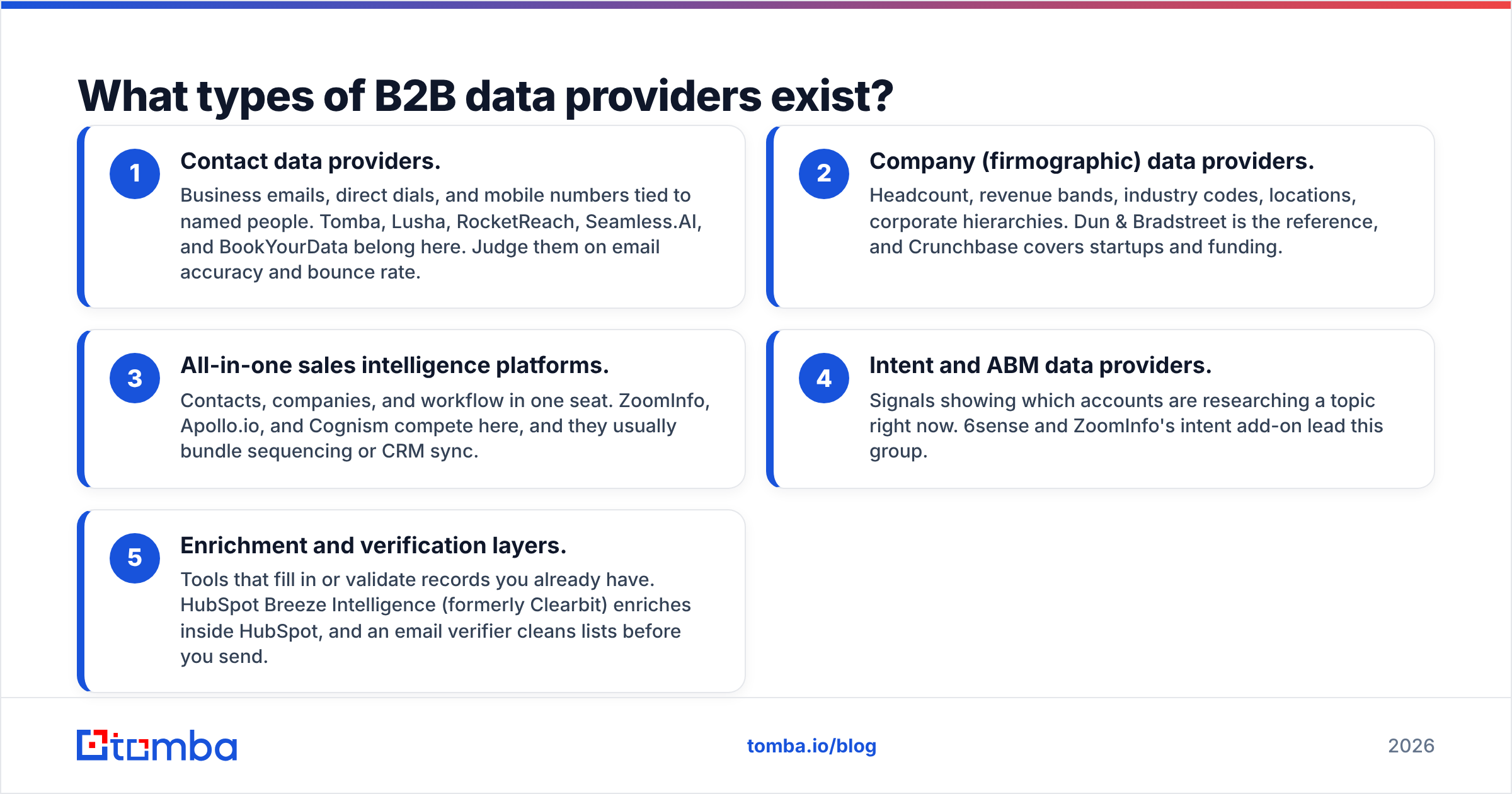
- Contact data providers. Business emails, direct dials, and mobile numbers tied to named people. Tomba, Lusha, RocketReach, Seamless.AI, and BookYourData belong here. Judge them on email accuracy and bounce rate.
- Company (firmographic) data providers. Headcount, revenue bands, industry codes, locations, corporate hierarchies. Dun & Bradstreet is the reference, and Crunchbase covers startups and funding.
- All-in-one sales intelligence platforms. Contacts, companies, and workflow in one seat. ZoomInfo, Apollo.io, and Cognism compete here, and they usually bundle sequencing or CRM sync.
- Intent and ABM data providers. Signals showing which accounts are researching a topic right now. 6sense and ZoomInfo's intent add-on lead this group.
- Enrichment and verification layers. Tools that fill in or validate records you already have. HubSpot Breeze Intelligence (formerly Clearbit) enriches inside HubSpot, and an email verifier cleans lists before you send.
If you only need contact details for outbound, groups 1 and 5 cover most of what you need. You probably don't need a six-figure intent platform yet.
Which data providers should be on your 2026 shortlist?#
Below are 12 vendors worth evaluating, each with its strongest use case. Pricing is public list pricing where the vendor publishes it, and "custom" means you'll need a sales call. Prices change often, so confirm on the vendor's site before you budget.
1. ZoomInfo#
ZoomInfo is still the default enterprise choice in North America. You get deep US contact coverage, org charts, technographics, intent data, and an AI layer (Copilot) that surfaces account signals. It's powerful, and it's expensive. Contracts are annual, pricing is custom, and seat-plus-credit packaging makes it hard to predict what you'll spend. It suits large sales orgs with RevOps staff who will actually use the depth.
2. Apollo.io#
Apollo packs a large contact database, a Chrome extension, sequencing, and a dialer into one self-serve product with a usable free plan. Paid seats start at roughly $49–$59 per user per month depending on billing cycle. It's the most common starting point for startups. The usual complaint is data quality in niche verticals and outside the US, so verify before you send at volume. If Apollo's credit limits bite, look at the options in our Apollo alternative comparison.
3. Cognism#
Cognism is the European specialist. Its phone-verified mobile numbers ("Diamond Data") and a compliance-first approach, including checks against do-not-call lists, make it strong for EMEA teams that cold call. Pricing is custom and annual. If most of your pipeline sits in the UK, DACH, or the Nordics, put it on the shortlist early.
4. Lusha#
Lusha became popular through its LinkedIn Chrome extension and remains one of the easiest tools for individual reps. There's a free tier with limited monthly credits, and paid plans are affordable for small teams. Coverage is strongest for SMB and mid-market contacts. You get less account-level intelligence than ZoomInfo, but onboarding is close to zero.
5. BookYourData#
BookYourData is built for list building. You filter by title, industry, geography, and company size, and you pay for the records you download instead of committing to a big annual seat. Contacts are verified in real time before delivery, and the company advertises an accuracy guarantee, which matters if bounce rate is your main worry. It fits agencies and lean outbound teams that want clean lists on demand without a long-term contract.
6. Tomba#
Tomba started as an email finder and has grown into a broader contact-data layer: domain search, email verification, catch-all verification, phone finder, and enrichment. Pricing is transparent. There's a free tier of 25 searches a month, then Starter at $49/mo, Growth at $99/mo, Pro at $249/mo, and custom Enterprise (full Tomba pricing). The API, Google Sheets add-on, and Chrome extension make it easy to drop into an existing workflow. It doesn't sell intent data, so pair it with a signal source if you need one.
7. Dun & Bradstreet#
D&B owns the D-U-N-S Number, the identifier many procurement, finance, and compliance teams use to recognize businesses. Its firmographic depth, corporate linkage (parent/subsidiary trees), and risk data are hard to match. It isn't a rep-level prospecting tool. You'd use it for master data management, territory design, and credit decisions.
8. Crunchbase#
Crunchbase is the go-to source for startup and venture data: funding rounds, investors, acquisitions, leadership changes. Pro plans are self-serve and relatively cheap. Use it as a trigger feed ("Series B closed last week"), then send those accounts to a contact provider to find the people.
9. HubSpot Breeze Intelligence (formerly Clearbit)#
HubSpot bought Clearbit in 2023 and folded it into Breeze Intelligence, which enriches contacts and companies inside HubSpot and helps with form shortening and buyer-intent signals. If you're on HubSpot, it's the lowest-friction enrichment you can add. If you're not, it's no longer a standalone option. Our Clearbit alternative guide covers the tools teams moved to.
10. 6sense#
6sense is an ABM and intent platform. It predicts which accounts are in-market and where they sit in the buying journey, then orchestrates ads and sales plays around them. It includes contact data, but that isn't why people buy it. Budget and implementation effort put it in enterprise territory.
11. Seamless.AI#
Seamless.AI searches for contacts in real time instead of relying only on a static database, and it sells on credit-based plans with a free trial. Reps like how fast it is. Accuracy varies by segment, so run it through a verifier before large sends.
12. RocketReach#
RocketReach offers lookups by name, company, or LinkedIn URL on tiered self-serve plans, plus an API. It's a solid all-rounder for recruiters and sales teams who need occasional lookups across many industries without a sales cycle.

How do these data providers compare side by side?#
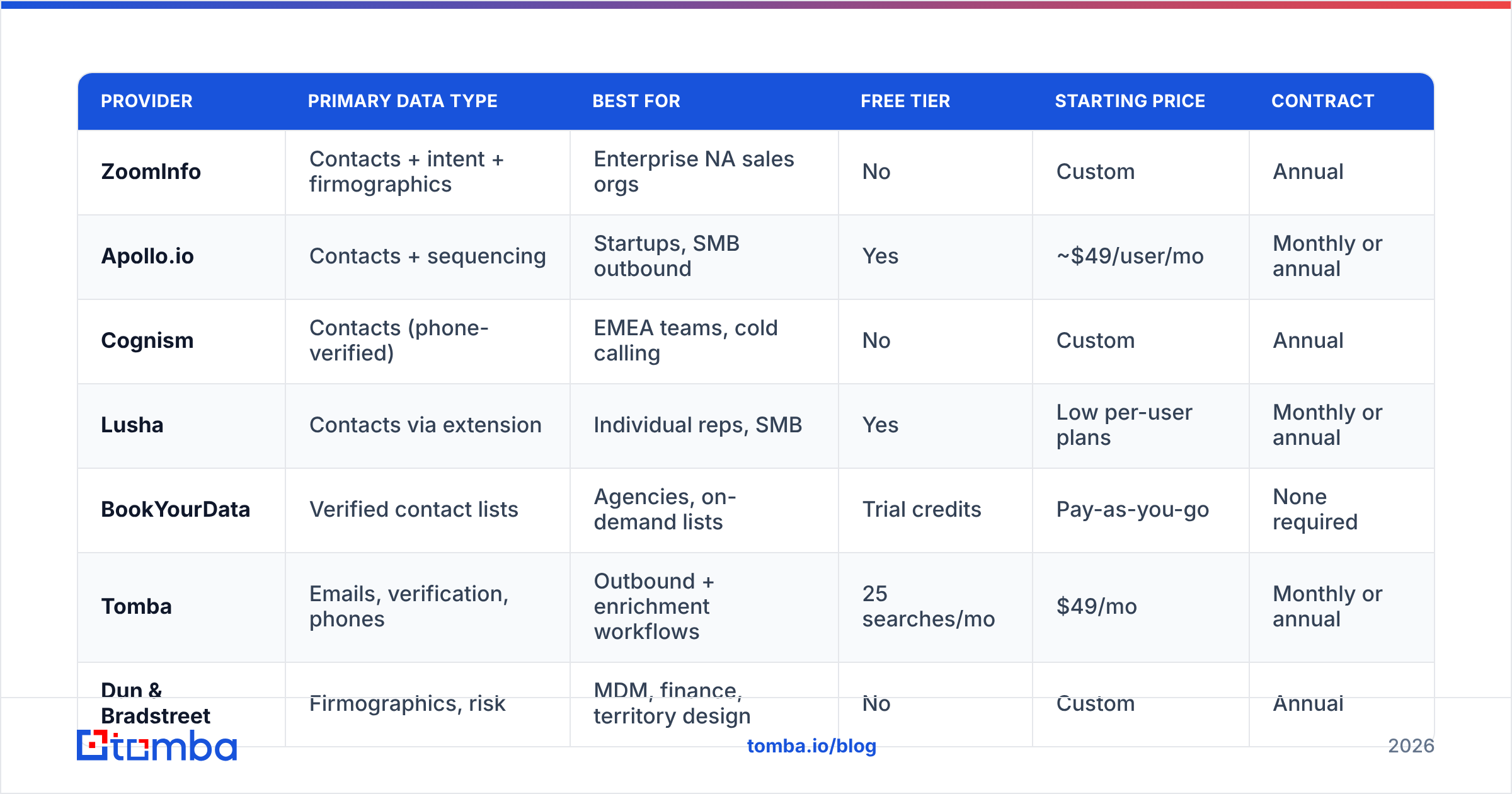
| Provider | Primary data type | Best for | Free tier | Starting price | Contract |
|---|---|---|---|---|---|
| ZoomInfo | Contacts + intent + firmographics | Enterprise NA sales orgs | No | Custom | Annual |
| Apollo.io | Contacts + sequencing | Startups, SMB outbound | Yes | ~$49/user/mo | Monthly or annual |
| Cognism | Contacts (phone-verified) | EMEA teams, cold calling | No | Custom | Annual |
| Lusha | Contacts via extension | Individual reps, SMB | Yes | Low per-user plans | Monthly or annual |
| BookYourData | Verified contact lists | Agencies, on-demand lists | Trial credits | Pay-as-you-go | None required |
| Tomba | Emails, verification, phones | Outbound + enrichment workflows | 25 searches/mo | $49/mo | Monthly or annual |
| Dun & Bradstreet | Firmographics, risk | MDM, finance, territory design | No | Custom | Annual |
| Crunchbase | Funding + company events | Trigger-based prospecting | Limited | Self-serve Pro | Monthly or annual |
| Breeze Intelligence | Enrichment inside HubSpot | HubSpot customers | No | HubSpot credits | Tied to HubSpot |
| 6sense | Intent + ABM orchestration | Enterprise ABM programs | Limited | Custom | Annual |
| Seamless.AI | Real-time contact search | High-volume SDR teams | Trial | Credit-based | Annual typical |
| RocketReach | Contact lookups + API | Recruiters, occasional lookups | Limited | Tiered self-serve | Monthly or annual |
Read the table by column, not by row. If "Contract" is a dealbreaker for you, half the list is already out. If you need a free tier to prove value to your boss, you're down to about five options.
How should you evaluate a data provider before buying?#
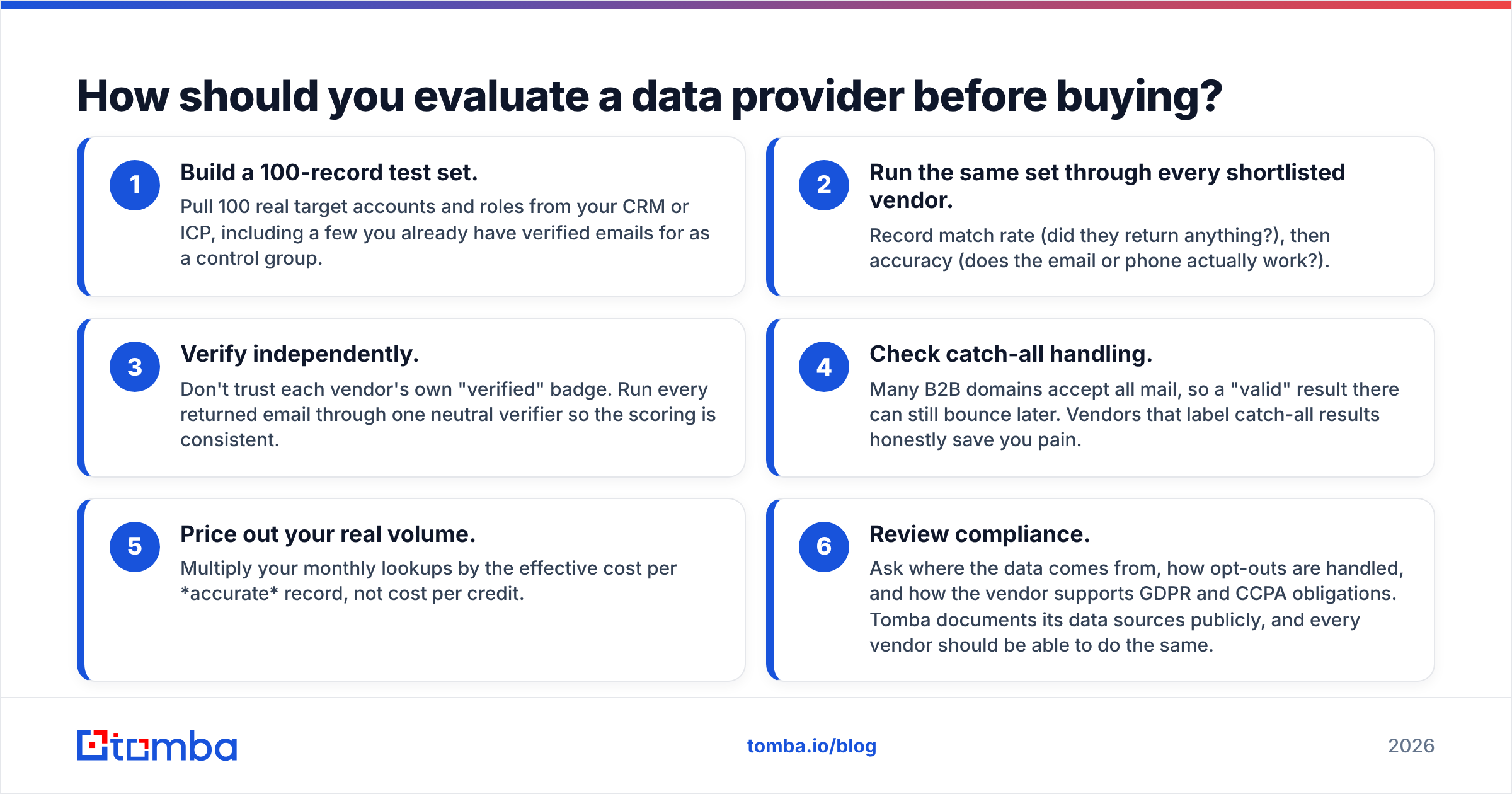
Vendor-claimed database sizes ("300M+ contacts!") are close to meaningless. What matters is how many accurate, reachable records they have for your ICP. Here's a test that takes an afternoon:
- Build a 100-record test set. Pull 100 real target accounts and roles from your CRM or ICP, including a few you already have verified emails for as a control group.
- Run the same set through every shortlisted vendor. Record match rate (did they return anything?), then accuracy (does the email or phone actually work?).
- Verify independently. Don't trust each vendor's own "verified" badge. Run every returned email through one neutral verifier so the scoring is consistent.
- Check catch-all handling. Many B2B domains accept all mail, so a "valid" result there can still bounce later. Vendors that label catch-all results honestly save you pain.
- Price out your real volume. Multiply your monthly lookups by the effective cost per accurate record, not cost per credit.
- Review compliance. Ask where the data comes from, how opt-outs are handled, and how the vendor supports GDPR and CCPA obligations. Tomba documents its data sources publicly, and every vendor should be able to do the same.
When the numbers come back, the vendor with the biggest database often isn't the one that covers your segment best.
Is one data provider enough, or should you stack several?#
For most teams, one strong contact provider plus a verifier is enough in year one. As outbound scales, coverage gaps start to cost you pipeline, and that's when stacking pays off.
The common pattern in 2026 is a waterfall. You query provider A, fall back to provider B when A returns nothing, and verify everything at the end. Tools like Clay made this popular, and you can build it yourself with any vendor that has an API. Waterfalls typically lift match rates well above what one source gets, especially in EMEA and in technical roles.
A practical stack for a 5–20 person outbound team:
- Signal layer: Crunchbase or an intent source to decide which accounts to target this week.
- Contact layer: One or two contact providers (for example Tomba plus Apollo, or BookYourData for bulk lists) to find the people.
- Verification layer: One verifier run on every record before it enters a sequence.
- CRM: Everything syncs back to HubSpot or Salesforce, so enrichment doesn't live in spreadsheets.

What are the hidden costs of B2B data providers?#
The sticker price is rarely what you end up paying. Watch for these:
- Credit expiry. Many plans reset credits monthly. Unused credits disappear, so buying annual volume up front can waste money.
- Per-field pricing. Some vendors charge one credit for an email and several for a mobile number. Check what a "full record" actually costs.
- Auto-renewal clauses. Enterprise contracts often auto-renew with 60–90 day cancellation windows. Set a calendar reminder the day you sign.
- Seat minimums. A "per user" price with a three-seat minimum is a different product than it looks like.
- Bounce damage. Cheap data that bounces at 10% costs more than expensive data, because it hurts your sending domain. Email deliverability damage takes weeks to repair.
- Integration effort. A provider without a native CRM sync or clean API means someone on your team spends hours a week moving CSVs.
Which data provider is best for your situation?#
Here's the short version, assuming you've done the test above:
- Enterprise, US-heavy, big RevOps team: ZoomInfo, optionally with 6sense for ABM.
- European pipeline, lots of phone outreach: Cognism.
- Startup that wants data and sequencing in one tool: Apollo.io.
- Lean team that wants transparent monthly pricing and an API: Tomba.
- Agency or team that buys targeted lists on demand: BookYourData.
- Individual reps prospecting from LinkedIn: Lusha or RocketReach.
- Funding-triggered outbound: Crunchbase feeding a contact provider.
- Already all-in on HubSpot: Breeze Intelligence for enrichment.
- Finance, procurement, or master data: Dun & Bradstreet.
Independent review sites like G2 are worth checking for recent reviews in your segment. Filter reviews by company size and region, because a 5-person agency and a 2,000-seat enterprise will rate the same tool very differently.
Frequently asked questions#
What is the largest B2B data provider?#
By breadth of product and customer count, ZoomInfo and Dun & Bradstreet are usually named the largest. But "largest" says nothing about how well a provider covers your market. Run a match-rate test on your own ICP.
Are free data providers accurate enough for outbound?#
Free tiers from Apollo, Lusha, Tomba, and others use the same underlying data as the paid plans. They just cap volume. That makes them good for testing. For production sending, verify every email regardless of source.
Is buying B2B contact data legal?#
In most jurisdictions, yes, for legitimate business outreach, but the rules vary. GDPR in the EU requires a lawful basis (often legitimate interest) plus easy opt-out. The US is generally more permissive, with CAN-SPAM governing email content. Always ask vendors how they source and maintain opt-outs.
How often does B2B data go stale?#
Contact data decays fast because people change jobs, companies rebrand, and domains change. Industry estimates commonly put B2B contact decay at 20–30% per year. Re-verify any list older than about 90 days before you send.
Where should you start?#
If your immediate need is reaching the right people at your target accounts, start with the contact layer and grow from there. Tomba Email Finder lets you find professional email addresses by domain, name, or company, with verification built in and a free tier of 25 searches a month. Run it against your 100-record test set alongside the other vendors on your shortlist, compare the accurate-match rates, and let the numbers decide.
Related guides#
// get started
Find, verify and enrich your first contacts today
Start on the free plan with 25 searches a month, then scale when your team is ready.
Free plan · No credit card required · GDPR & CCPA
// about the author