Listkit vs Startup Tracker (2026): Which B2B Data Tool Fits You?
Listkit builds verified outbound lead lists. Startup Tracker helps you find and monitor startups. We compare data, pricing, workflows, and who should buy which before you spend a dollar.
TL;DR
- Listkit is an outbound lead-list builder. You filter a large B2B contact database, export triple-verified emails, and load them into your sequencer. Paid plans reportedly start around $83/mo on annual billing in 2026.
- Startup Tracker is a startup discovery and monitoring tool. It pulls company profiles from public sources such as Crunchbase, AngelList, and Product Hunt, and it's aimed at scouts, investors, and founders watching a market.
- The two tools don't really compete. Listkit tells you who to email. Startup Tracker tells you which startups exist and what they're up to.
- If you sell to startups, the usual stack is to find target companies in Startup Tracker, then get contacts from Listkit or a dedicated email finder.
- Whichever you choose, verify every address before you send. Startup Tracker gives you no contact data, and even "verified" list data gets stale within months.
What is the real difference between Listkit and Startup Tracker?#
The short answer: Listkit is a contact database and Startup Tracker is a company database. People compare them because both show up when someone searches for "startup leads," but they answer different questions.
Here's an analogy. Startup Tracker is the map showing every new restaurant opening in your city. Listkit is the phone book with the owner's direct line. You can use the map without the phone book if all you do is watch the market. You can use the phone book without the map if you already know which restaurants you want. Selling to startups usually means you need both.
In technical terms:
- Listkit (listkit.io) sells credits against a B2B people database that third-party reviews in 2026 put at over 700M contacts. Every email is "triple-verified" before export. You filter by title, industry, headcount, location, technology, and intent signals, then export to CSV or push to your CRM.
- Startup Tracker (startuptracker.io) is a startup search engine founded in London in 2014. It aggregates and crawls profiles from public databases, covering product, market, founders, and traction. It offers a Chrome extension that shows you the profile of whatever startup website you're browsing, and it lets you crowdsource missing fields with an "Ask startup" button.
The mistake is buying either one expecting it to do the other one's job.
How do Listkit and Startup Tracker compare feature by feature?#
This is where the difference gets concrete. The table below uses publicly available information as of 2026. Pricing changes often, so check each vendor's site before you buy.
| Attribute | Listkit | Startup Tracker |
|---|---|---|
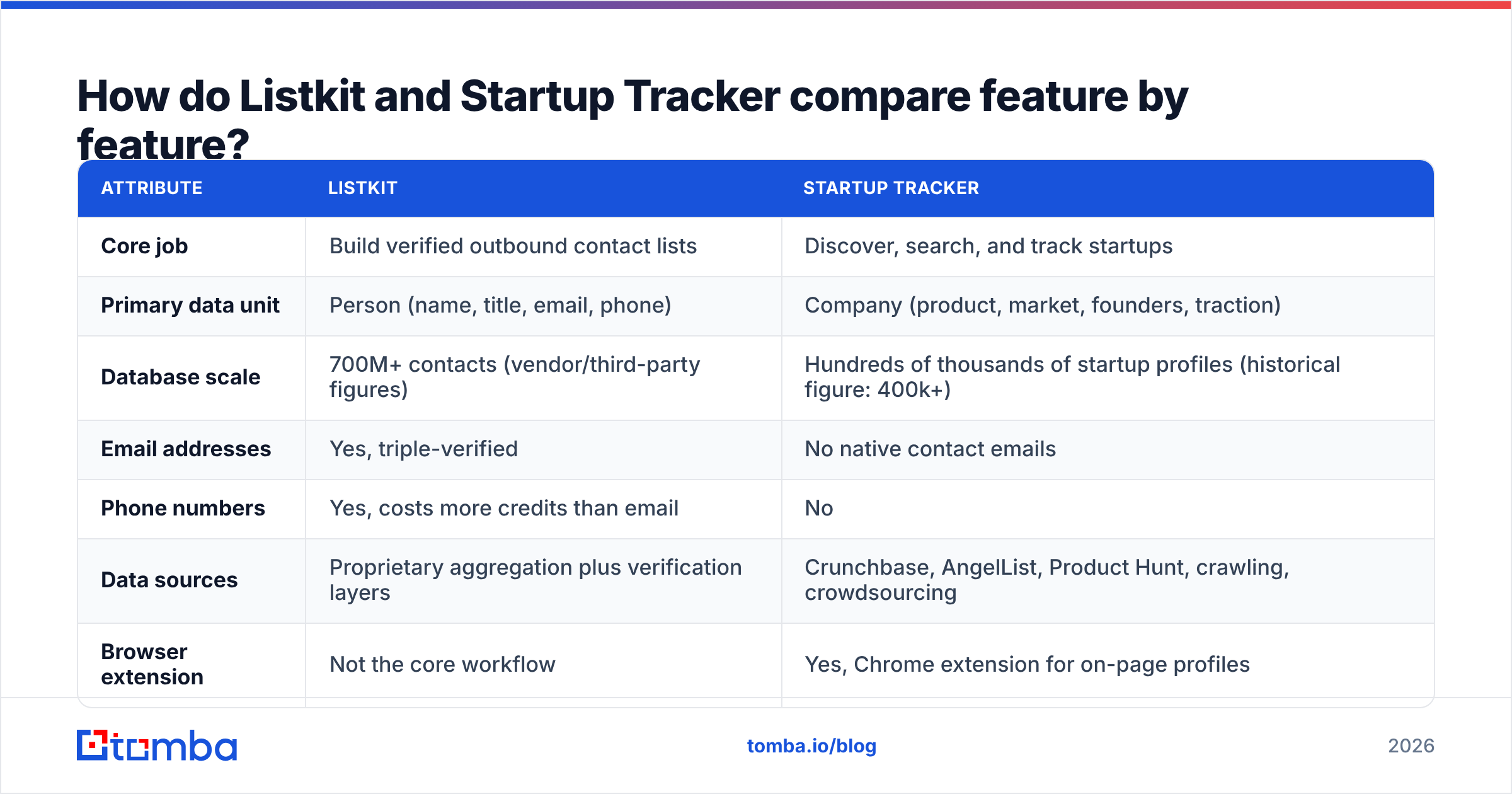
| Core job | Build verified outbound contact lists | Discover, search, and track startups |
| Primary data unit | Person (name, title, email, phone) | Company (product, market, founders, traction) |
| Database scale | 700M+ contacts (vendor/third-party figures) | Hundreds of thousands of startup profiles (historical figure: 400k+) |
| Email addresses | Yes, triple-verified | No native contact emails |
| Phone numbers | Yes, costs more credits than email | No |
| Data sources | Proprietary aggregation plus verification layers | Crunchbase, AngelList, Product Hunt, crawling, crowdsourcing |
| Browser extension | Not the core workflow | Yes, Chrome extension for on-page profiles |
| Intent data | Yes (quality varies by segment) | Traction and news signals, not buyer intent |
| CRM integrations | Yes | Limited; export and note-taking focused |
| Users | Unlimited users on all plans | Individual-focused |
| Pricing model | Credit-based; roughly $83 / $253 / $508 per month on annual plans | Freemium; paid tiers not consistently published |
| Best for | SDRs, agencies, cold email teams | VCs, scouts, founders, market researchers |
Two things in this table matter more than the rest.
- Credits are not leads on Listkit. Business emails cost 1 credit, phone numbers cost more, and a fully enriched contact can use far more. A 2,000-credit plan can end up as a few hundred fully enriched leads if you pull phones for everyone.
- Startup Tracker's data is only as fresh as its upstream sources. Pre-seed and seed companies change names, pivot, or shut down quickly. Aggregated profiles fall behind that, which is why the crowdsourcing button exists.

Which should you choose for your use case?#
Pick based on the job, not the feature list. Here's the decision framework we'd use:
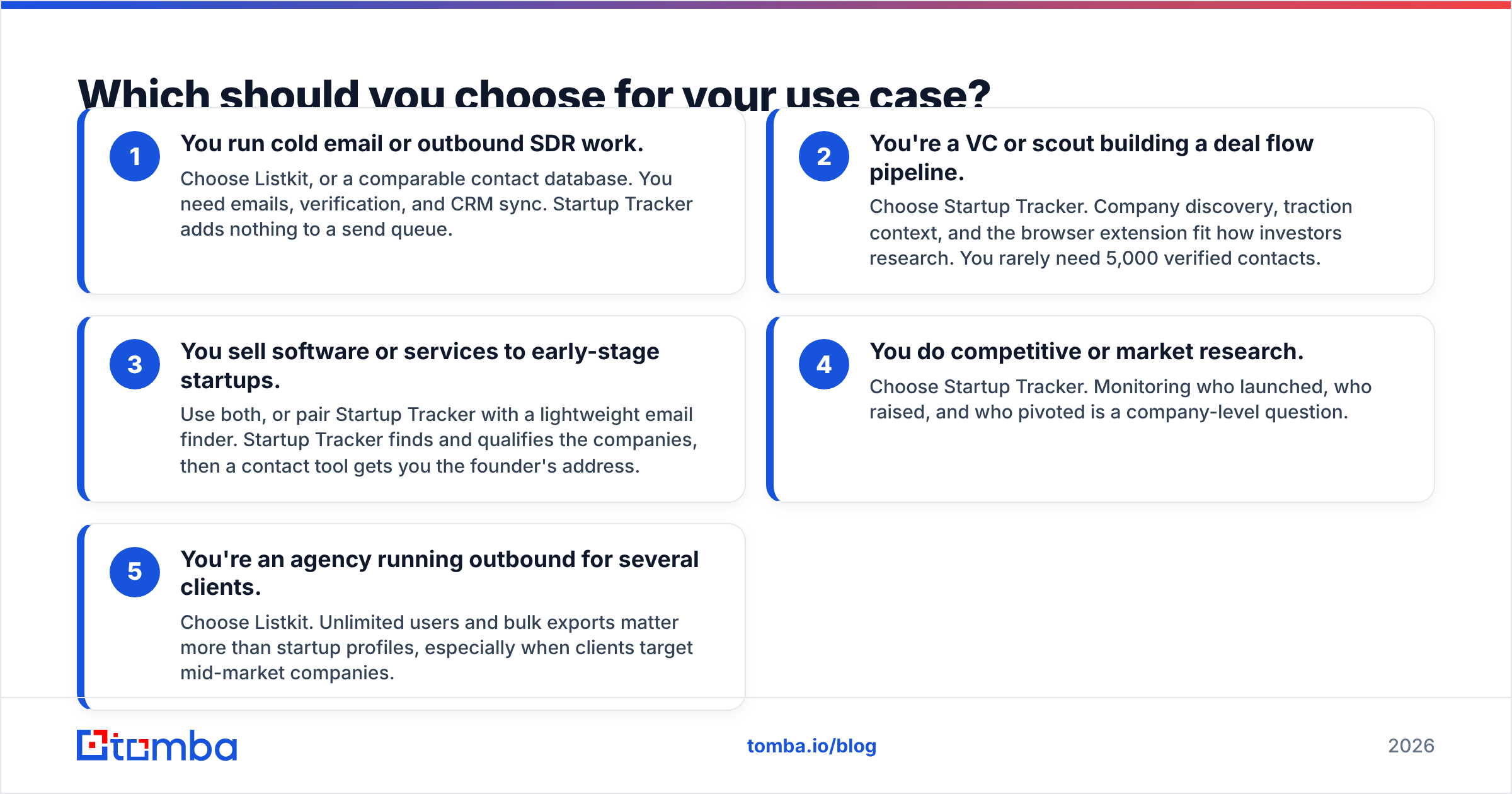
- You run cold email or outbound SDR work. Choose Listkit, or a comparable contact database. You need emails, verification, and CRM sync. Startup Tracker adds nothing to a send queue.
- You're a VC or scout building a deal flow pipeline. Choose Startup Tracker. Company discovery, traction context, and the browser extension fit how investors research. You rarely need 5,000 verified contacts.
- You sell software or services to early-stage startups. Use both, or pair Startup Tracker with a lightweight email finder. Startup Tracker finds and qualifies the companies, then a contact tool gets you the founder's address.
- You do competitive or market research. Choose Startup Tracker. Monitoring who launched, who raised, and who pivoted is a company-level question.
- You're an agency running outbound for several clients. Choose Listkit. Unlimited users and bulk exports matter more than startup profiles, especially when clients target mid-market companies.
How much does each tool actually cost?#
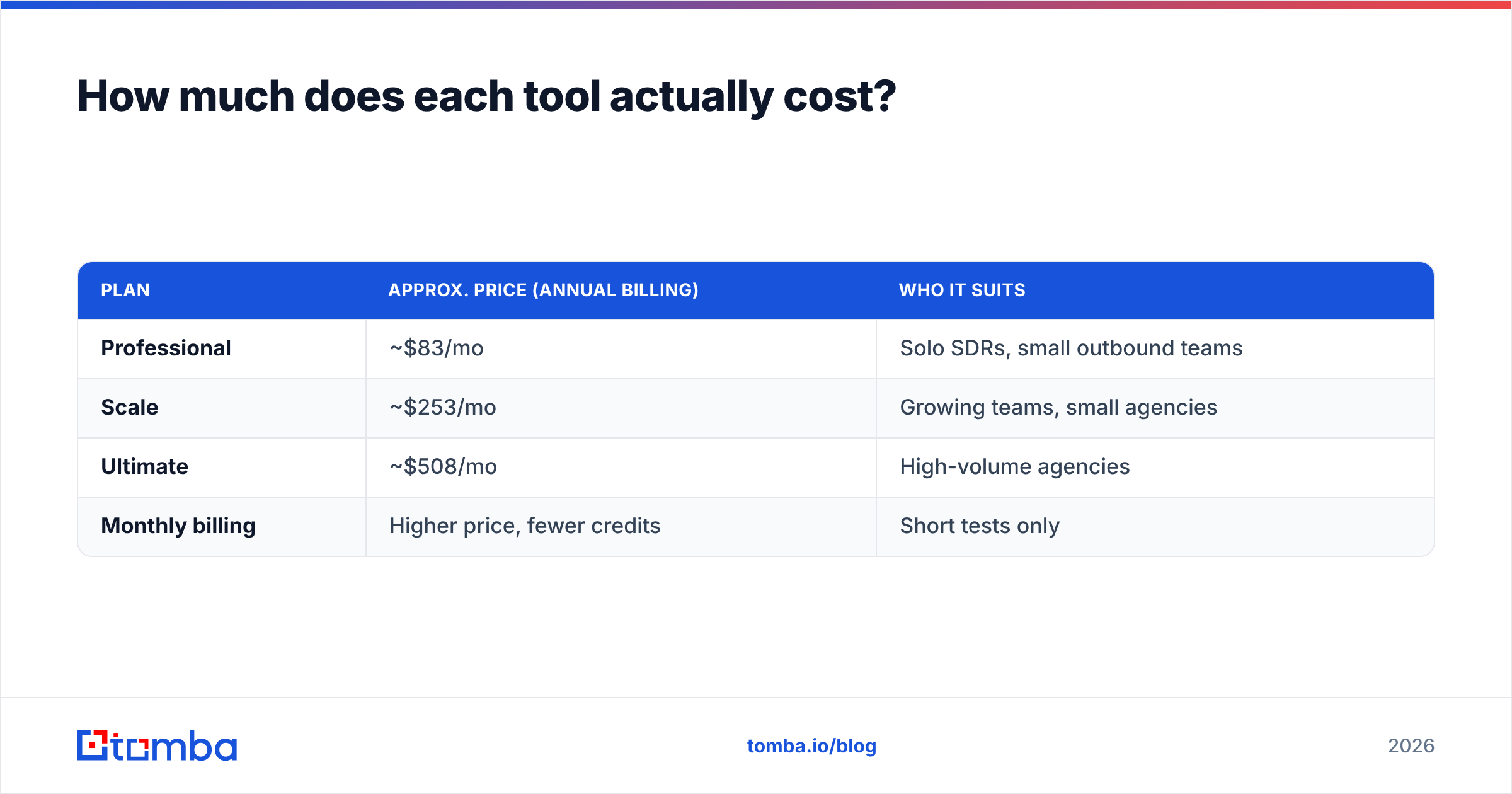
Listkit is the easier one to price. Third-party pricing breakdowns published in 2026 list three paid plans on annual billing:
| Plan | Approx. price (annual billing) | Who it suits |
|---|---|---|
| Professional | ~$83/mo | Solo SDRs, small outbound teams |
| Scale | ~$253/mo | Growing teams, small agencies |
| Ultimate | ~$508/mo | High-volume agencies |
| Monthly billing | Higher price, fewer credits | Short tests only |
Reviewers point out a few catches: credits don't roll over, monthly billing is much worse value than annual, and there's no traditional free trial beyond a limited free tier. Before you commit to a year, work out your cost per usable lead, not per credit. If you only need emails, the numbers look good. If you need phones for everyone, they get worse quickly.
Startup Tracker has historically used a freemium model: basic search and the extension are free, with advanced features behind a subscription. Current paid tier pricing isn't consistently published, so treat any number you see on a third-party site with caution and confirm it on startuptracker.io. For most individual scouts and founders, the free layer is enough to judge whether it fits.
On price alone, the two can't really be compared. You're paying Listkit for contacts you can send to, and you're paying Startup Tracker (if at all) for research time saved.
How good is the data in each tool?#
The quality risks are different, so you check them differently.
Listkit's risk is decay, not coverage. Triple verification at export time is a real strength, since fewer hard bounces protect your domain. But B2B contact data decays constantly because people change jobs, companies rebrand, and domains move. An address that was valid when you exported it in January may bounce by April. Reviewers also flag that intent data is uneven: good in some verticals, noisy in others. Treat intent as a tiebreaker, not a targeting strategy.
Startup Tracker's risk is completeness. Profiles are aggregated from public sources, so how deep they go depends on how public the startup is. A Series A company with press coverage and a Crunchbase listing will have a rich profile. A stealth pre-seed team may have little more than a name and a URL.
What this means in practice:
- With Listkit: re-verify any list older than 30–60 days before a campaign. A separate email verifier pass costs little compared with a burned sending domain.
- With Startup Tracker: cross-check founders and headcount against LinkedIn and the company's own site before you put a startup in a pipeline.
Can you use Listkit and Startup Tracker together?#
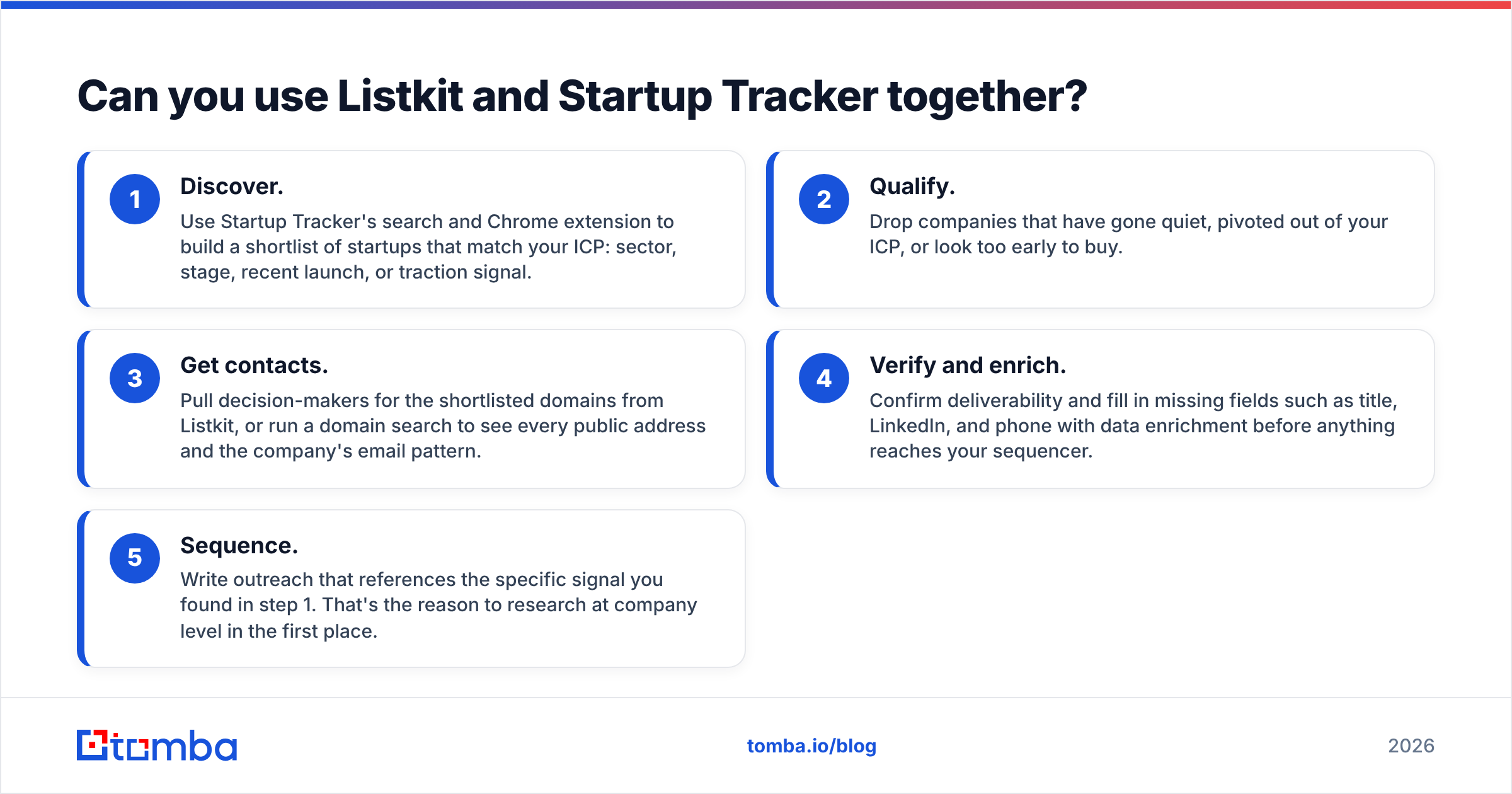
Yes, and for anyone selling into the startup ecosystem this is often the best setup. A clean workflow looks like this:
- Discover. Use Startup Tracker's search and Chrome extension to build a shortlist of startups that match your ICP: sector, stage, recent launch, or traction signal.
- Qualify. Drop companies that have gone quiet, pivoted out of your ICP, or look too early to buy.
- Get contacts. Pull decision-makers for the shortlisted domains from Listkit, or run a domain search to see every public address and the company's email pattern.
- Verify and enrich. Confirm deliverability and fill in missing fields such as title, LinkedIn, and phone with data enrichment before anything reaches your sequencer.
- Sequence. Write outreach that references the specific signal you found in step 1. That's the reason to research at company level in the first place.
The weak point in this workflow is usually step 3. Listkit is designed for broad filtered exports, and it's less convenient when you already have 40 specific startup domains and only need the founder and head of growth at each one. For that kind of targeted lookup, a domain-based email finder is usually faster and cheaper than spending list-builder credits.

What are the pros and cons of Listkit and Startup Tracker?#
Listkit, pros
- Triple-verified emails reduce bounce risk at export
- Large database with detailed filters (title, industry, headcount, tech, location)
- Unlimited users on every plan, which helps agencies and teams
- CRM integrations and quick CSV exports for cold email tools
Listkit, cons
- Credit math gets expensive once you add phone numbers and enrichment
- No credit rollover, and monthly plans are poor value
- Intent data quality varies
- Built for volume, so it's clunky for small, hand-picked account lists
Startup Tracker, pros
- Designed specifically for startup discovery
- Chrome extension gives you instant profiles while you browse
- Aggregates several public sources into one view
- Freemium access makes it cheap to try
Startup Tracker, cons
- No contact emails or phones, so it can't feed outbound by itself
- Profile depth depends on how public each startup is
- Limited CRM and sequencer integrations
- Small, founder-built product, so the roadmap is less predictable than a funded vendor's
If you're weighing wider options, peer-review sites like G2 are worth checking for recent user sentiment on both. Filter reviews by company size close to yours, because an agency's view of Listkit won't match a solo founder's.
Is Listkit better than Startup Tracker?#
For outbound sales, yes, clearly, because Startup Tracker doesn't give you contacts. For startup research and deal flow, no. Listkit's people database isn't built to show traction, product context, or who launched last week.
Our pick:
- Outbound team selling to SMB or mid-market: Listkit.
- Investor, scout, or analyst: Startup Tracker.
- Vendor selling to startups: Startup Tracker for discovery, plus a targeted email finder and verifier for contacts. Add Listkit only if you also need high-volume list building outside the startup niche.
Keep this rule in mind: data tools don't fix a vague ICP. If you can't write your ideal customer in one sentence (stage, sector, headcount, trigger), neither tool will rescue the campaign. Define the ICP first, then choose the tool that fills your specific gap.
What's the best way to get startup founder emails once you have the list?#
This is where most startup-focused outbound stalls. You have 50 good companies from Startup Tracker and no reliable way to reach the people who make decisions there.
Tomba Email Finder is built for this step. Give it a startup's domain, or a founder's name plus company, and it returns professional addresses with a confidence score and the public sources where each address appeared. You can then run them through verification in the same workspace. It's a good match for a Startup Tracker shortlist because you pay per lookup on the specific companies you picked, not for a large export you'll mostly throw away. You can test it on the free tier (25 searches a month) with your next batch of startup domains, and move to Starter at $49/mo when the workflow proves itself. See Tomba pricing for the full plan breakdown.
Related guides#
// get started
Find, verify and enrich your first contacts today
Start on the free plan with 25 searches a month, then scale when your team is ready.
Free plan · No credit card required · GDPR & CCPA
Get the Tomba newsletter
Product and data updates
// about the author