ListKit vs Stirista: B2B Data Provider Comparison for 2026
ListKit sells self-serve, credit-based lead lists for cold emailers. Stirista sells enterprise identity data and managed campaigns. Here's which one fits your team, what each really costs, and when neither is the right buy.
TL;DR
- ListKit is a self-serve B2B lead database for outbound teams. You pay for credits, export verified emails, and push them into your sequencer. Paid plans start around $83/mo on annual billing.
- Stirista is an enterprise data and identity company. It combines a B2B identity graph, consumer data, email deployment, and programmatic and CTV advertising, and it prices by quote. Third-party listings put the starting point near $5,000/mo.
- Pick ListKit if you're an SDR team, agency, or founder running cold email and want lists this week.
- Pick Stirista if you're a marketing org that needs identity resolution, audience onboarding, and multichannel campaigns handled at scale.
- If what you actually need is to find and verify specific contacts at accounts you already chose, a pay-as-you-go email finder is often cheaper than either.
What is ListKit?#
ListKit is a B2B contact database built for cold email. You filter by job title, industry, company size, location, and technology, then export contacts whose emails ListKit says are "triple-verified" before delivery. Most customers are outbound agencies, lead-gen freelancers, and small SDR teams feeding tools like Instantly or Smartlead.
The pricing is simple because every plan has the same features and you're only buying credit volume. According to ListKit's own credit documentation, a business email costs 1 credit, triple verification adds another, and a phone number costs 5. That puts a verified email at 2 credits.
In short, ListKit is a list-building vending machine. You choose the filters, pay in credits, and get a CSV.
What is Stirista?#
Stirista is a different kind of company. It describes itself as an identity company. Its core asset is the OMNA identity graph, which links business and consumer identities across emails, postal addresses, devices, and digital IDs. On top of that sit several products:
- A B2B identity graph that covers white-collar professionals, with firmographics, technographics, and intent signals
- Email list rental and deployment through its own ESP
- Programmatic, CTV/OTT, and display advertising matched to that identity data
- Data hygiene, onboarding, and append services for large CRM files
Stirista's buyers are usually brand marketers, agencies, and demand-gen teams at mid-market and enterprise companies. You don't sign up with a card and export 500 contacts. You talk to sales, scope a use case, and get a quote.
How do ListKit and Stirista differ at a glance?#
They overlap on one thing: both sell B2B contact data. Past that, they're built for different jobs.
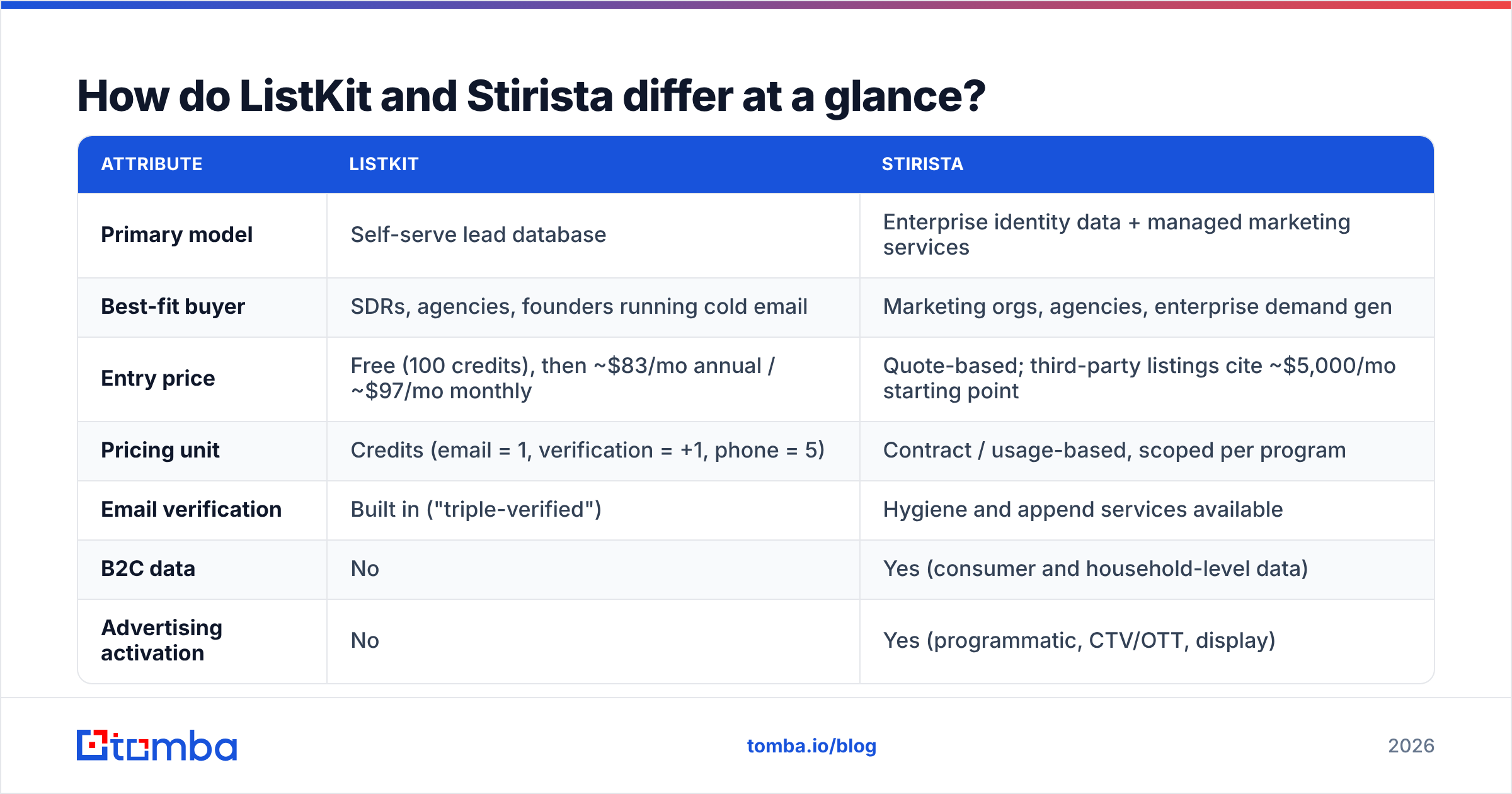
| Attribute | ListKit | Stirista |
|---|---|---|
| Primary model | Self-serve lead database | Enterprise identity data + managed marketing services |
| Best-fit buyer | SDRs, agencies, founders running cold email | Marketing orgs, agencies, enterprise demand gen |
| Entry price | Free (100 credits), then ~$83/mo annual / ~$97/mo monthly | Quote-based; third-party listings cite ~$5,000/mo starting point |
| Pricing unit | Credits (email = 1, verification = +1, phone = 5) | Contract / usage-based, scoped per program |
| Email verification | Built in ("triple-verified") | Hygiene and append services available |
| B2C data | No | Yes (consumer and household-level data) |
| Advertising activation | No | Yes (programmatic, CTV/OTT, display) |
| Email sending | No (export to your sequencer) | Yes (managed ESP deployment) |
| Time to first list | Minutes | Days to weeks (scoping + contract) |
| Contract flexibility | Monthly or annual | Typically annual / program-based |
The key row is "time to first list." ListKit is designed so you can have a list the same day you sign up. Stirista is designed so a large program stays accurate, compliant, and matched across channels for months.
How does pricing compare in real terms?#
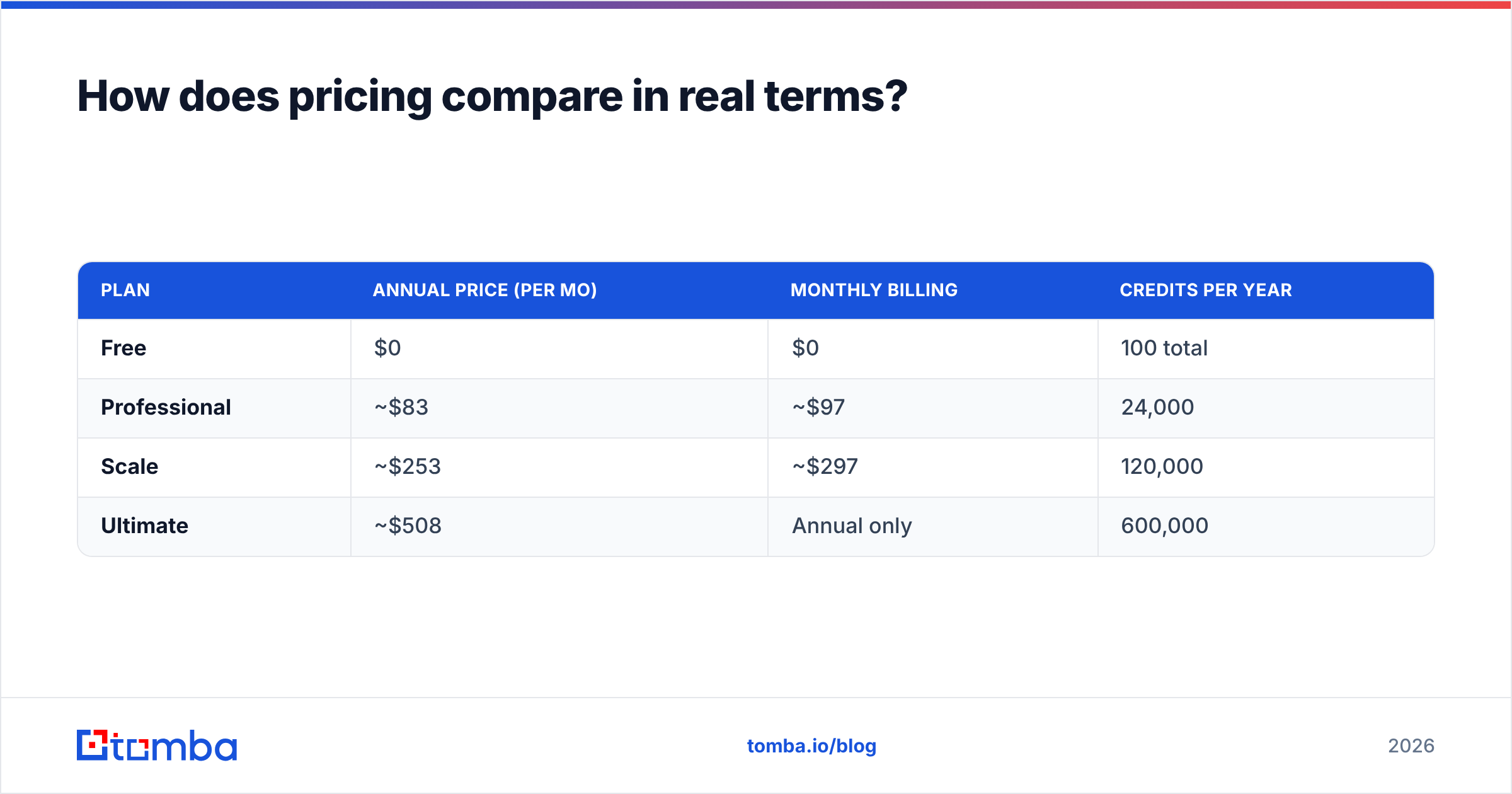
ListKit's published tiers (annual billing, effective monthly):
| Plan | Annual price (per mo) | Monthly billing | Credits per year |
|---|---|---|---|
| Free | $0 | $0 | 100 total |
| Professional | ~$83 | ~$97 | 24,000 |
| Scale | ~$253 | ~$297 | 120,000 |
| Ultimate | ~$508 | Annual only | 600,000 |
Take the Professional plan. At 2 credits per verified email, 24,000 credits gets you about 12,000 verified contacts a year, so roughly $0.08 per contact at list price. That's competitive for a cold-email list vendor. Monthly billing costs more and gives you far fewer credits, so plan to commit annually if you use ListKit seriously.
Stirista doesn't publish a rate card. Listings on software directories give an entry point near $5,000/mo, but your actual number will depend on:
- Channel mix: data licensing alone is priced differently from data plus email deployment plus CTV.
- Volume and match rates: onboarding a 2M-row CRM file is a different job from renting a 50K-contact audience.
- Data type: B2B only, B2C only, or blended identity.
- Term length: annual commitments usually get better unit economics.
Comparing cost per contact between these two is misleading. With ListKit you're paying for rows in a spreadsheet. With Stirista you're paying for an identity layer and usually for the activation that runs on it.

Which one has better data quality?#
Neither vendor publishes independent third-party accuracy audits, so be skeptical of any blog that gives you a precise bounce-rate number for either one. Here's what you can reasonably say.
ListKit verifies emails before you export them, and that's its main quality promise. It works well for the use case it targets, which is cold email where a bounce rate over 2-3% starts hurting your domains. Two weak spots are common to every self-serve database. Catch-all domains can't be fully confirmed through SMTP checks, and job-change decay means a record verified three months ago may already be stale.
Stirista puts its quality effort into identity resolution: linking the same person across email, postal, device, and business records, then refreshing those links. That's valuable when you're matching a CRM file to ad inventory or suppressing existing customers across channels. It helps less if your only question is whether this VP of Sales's email will bounce tomorrow.
Whichever vendor you pick, run every export through an independent email verifier before it goes into a sequence. Vendor-side verification is a snapshot, and your sender reputation depends on the state of the data on the day you send.
Which is better for cold email outreach?#
ListKit, clearly. It was built for this.
The typical ListKit workflow looks like this:
- Build an ICP filter: titles, seniority, headcount band, industry, geography, tech stack.
- Preview and pull: spend credits only on the contacts you export.
- Verify: ListKit's built-in verification, plus your own pass if you're careful.
- Push to your sequencer: Instantly, Smartlead, lemlist, or a CSV import.
- Personalize and send: segment by role or trigger and write to each segment.
Stirista can support email outreach, but mostly as list rental and managed deployment from its own infrastructure. That's closer to email marketing to a licensed audience than to one-to-one SDR prospecting from your own domains. If your reps want to send from their Google Workspace inboxes and track replies in a CRM, Stirista isn't the natural tool.
Which is better for enterprise and multichannel marketing?#
Stirista, clearly. ListKit has nothing comparable for:
- Identity resolution: matching anonymous or partial records to real people and businesses
- Audience onboarding: taking your first-party CRM list and making it addressable in programmatic and CTV
- B2B + B2C blending: useful when your buyer is also a consumer, as in financial services, automotive, or healthcare
- Managed execution: Stirista's teams can run the campaigns, not just provide the data
If you're a demand-gen leader running account-based advertising across display, connected TV, and email, and you need to reach the same buying committee on every surface, Stirista is in the conversation and ListKit isn't. Directories like Capterra list Stirista under marketing and data services rather than sales prospecting tools, which tells you a lot about how the market sees it.
What are the pros and cons of each?#
ListKit pros
- Transparent, published pricing with a free tier
- Same features on every plan, so you never hit a paywall for a filter
- Built-in verification aimed at cold-email deliverability
- Fast: list to sequencer in under an hour
ListKit cons
- Credits add up fast if you also want phone numbers (5 credits each)
- Monthly billing is a weak deal compared with annual
- No enrichment of your existing CRM beyond what you export
- No B2C data or ad activation
Stirista pros
- Deep identity graph linking business and consumer records
- Activation across email, programmatic, CTV, and display
- Handles large-file hygiene, append, and onboarding
- Managed services if you lack in-house ops capacity
Stirista cons
- Opaque, quote-based pricing with a high reported entry point
- Sales-led buying cycle, with no quick self-serve trial for most products
- Overkill for small outbound teams
- Less natural fit for rep-driven, one-to-one prospecting
Is there a cheaper way to cover the gap between them?#
Many teams end up in an awkward middle. Their target account list is already defined (from a CRM, an ABM platform, or intent data), and what they need is the right contacts at those accounts, verified, without buying a whole database or signing an enterprise contract.
That's the job an email finder does. Instead of filtering a database for lookalikes, you start from a company domain or a person's name and ask for their professional email. It's also where data decay matters most, because you're only paying for contacts you actually plan to email.
This is the category Tomba plays in. A Tomba Email Finder lookup takes a name plus a domain and returns a verified address. You can also use domain search to list known contacts at a company, and data enrichment to fill in title, LinkedIn, and company details on records you already have. Plans start with a free tier of 25 searches a month, then $49/mo Starter, $99/mo Growth, and $249/mo Pro. The full breakdown is on the Tomba pricing page.
This isn't a replacement for either vendor in its home turf. If you need 50,000 fresh contacts matching an ICP every quarter, a database like ListKit is faster. If you need CTV activation, you need someone like Stirista. But if you have 300 target accounts and want the right three people at each, an email finder usually beats both on cost.

How should you decide between ListKit and Stirista?#
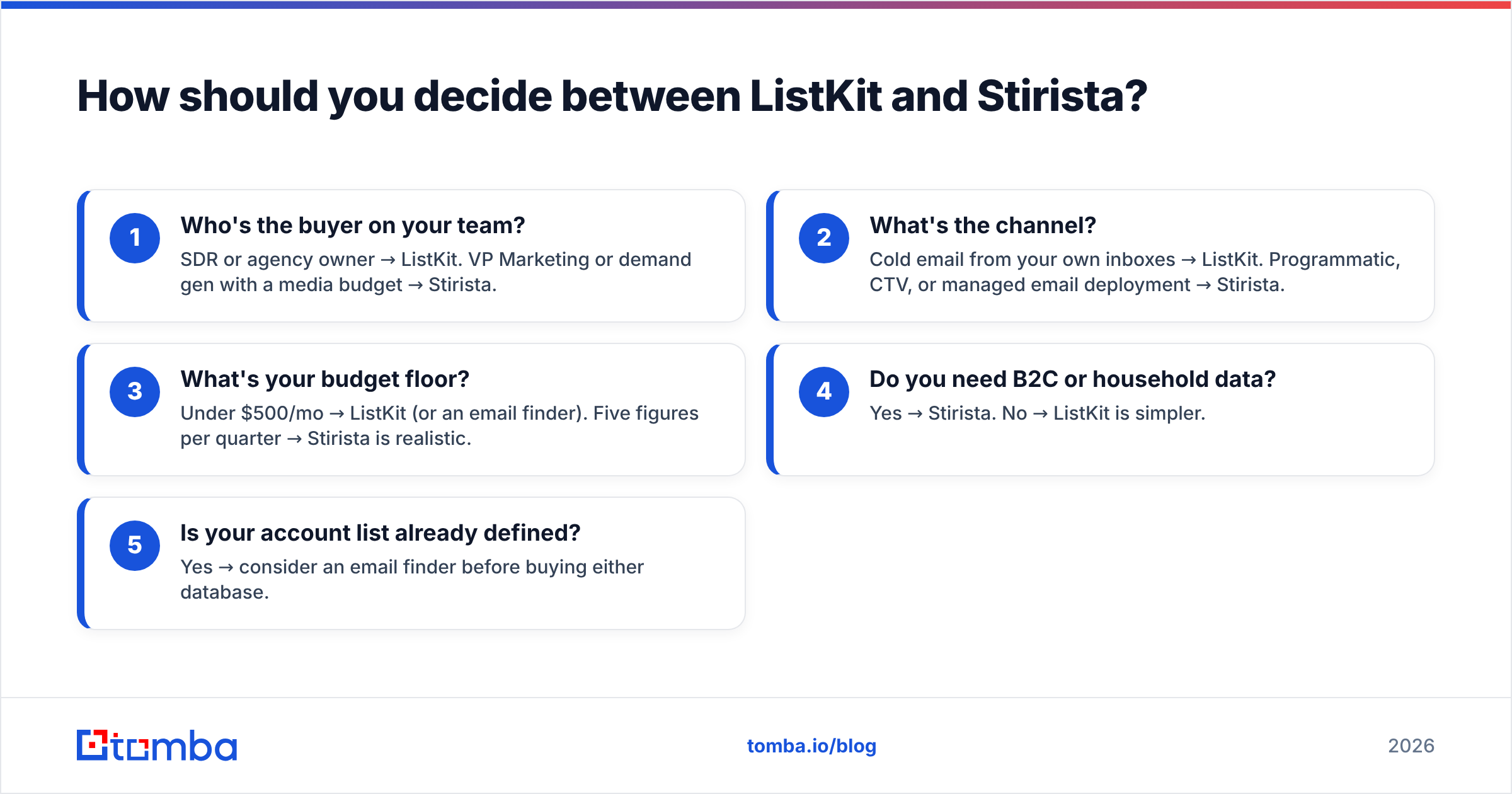
Answer these five questions honestly:
- Who's the buyer on your team? SDR or agency owner → ListKit. VP Marketing or demand gen with a media budget → Stirista.
- What's the channel? Cold email from your own inboxes → ListKit. Programmatic, CTV, or managed email deployment → Stirista.
- What's your budget floor? Under $500/mo → ListKit (or an email finder). Five figures per quarter → Stirista is realistic.
- Do you need B2C or household data? Yes → Stirista. No → ListKit is simpler.
- Is your account list already defined? Yes → consider an email finder before buying either database.
A quick rule of thumb:
| Your situation | Best fit |
|---|---|
| Solo founder testing cold email | ListKit free tier, then Professional |
| Outbound agency running 10+ client campaigns | ListKit Scale or Ultimate |
| Mid-market marketing team running ABM ads | Stirista |
| Enterprise with large CRM needing hygiene and onboarding | Stirista |
| SDR team with a defined target account list | Email finder + verifier |
| RevOps enriching existing CRM records | Enrichment tool, not a list database |
Frequently asked questions#
Is ListKit or Stirista cheaper? ListKit, by a wide margin, for list building. Its paid plans start around $83/mo on annual billing. Stirista is quote-based, with third-party listings citing a starting point near $5,000/mo, though that usually includes more than contact data.
Does Stirista offer a self-serve plan? Stirista has launched self-service data access products in the past, but its core business is sales-led and contract-based. Expect a scoping call before you get pricing.
Can I use Stirista data for cold email from my own domain? Check your license terms first. Rented and licensed audiences often come with restrictions on how and from where you can send. ListKit exports are designed specifically to be loaded into your own sequencer.
Do I still need an email verifier with ListKit? It's good practice. ListKit verifies before export, but emails decay every month, and catch-all domains are never fully certain. Re-verify any list more than a few weeks old before it goes out.
Which has better data coverage outside the US? Both are strongest in North America. Stirista's identity graph is heavily US-focused, and ListKit's coverage is broader but thins out in some regions. Test a sample in your target geography before committing.
The verdict#
ListKit and Stirista aren't really rivals. ListKit is a sharp, affordable tool for outbound teams who need verified cold-email lists quickly and prefer transparent credit pricing. Stirista is an enterprise identity and activation partner for marketing organizations running multichannel programs, and its pricing reflects that. Choose based on who runs the campaign and which channel it runs on, not on which database claims more contacts.
If neither fits because you already know which companies you want and just need the right people's verified emails, start with the Tomba Email Finder. Enter a name and a domain, get a verified professional address, and pay only for what you look up. The free tier includes 25 searches a month, and Starter is $49/mo when you're ready to scale.
Related guides#
// get started
Find, verify and enrich your first contacts today
Start on the free plan with 25 searches a month, then scale when your team is ready.
Free plan · No credit card required · GDPR & CCPA
// about the author