ListKit vs VCBacked: Broad B2B Data or Funded-Startup Leads?
ListKit sells credits against a 700M+ contact database. VCBacked sells unlimited exports of recently funded startups for $79/mo. Here's which one fits your outbound, and when using both makes sense.
TL;DR
- ListKit is a general B2B contact database (the vendor says 700M+ contacts) that charges in credits. It starts at a free tier with 100 credits, and the Professional plan is $97/mo billed monthly. Pick it if your ICP spans many industries and company stages.
- VCBacked is a narrow database of recently funded startups with founder emails. It charges a flat $79/mo, or $299/yr as listed, with unlimited CSV exports. Pick it if you sell to startups that just raised.
- The real question in ListKit vs VCBacked is scope, not price. ListKit is wide and flexible. VCBacked is narrow and built around a timing trigger.
- Many teams need both: a funding trigger to decide who to contact, and a broad database to reach the rest of the buying committee.
- Whichever you choose, verify emails again before sending. A clean export on Monday can bounce by the end of the month.
What are ListKit and VCBacked, in plain terms?#
Picture two stores. ListKit is a warehouse club: huge inventory, you pay per item, and you can build almost any list you want. VCBacked is a specialty shop that stocks one product line, startups that just closed a funding round, and charges a flat membership fee to take as much as you want.
ListKit is a B2B lead database and list builder. It advertises more than 700 million contacts, AI-assisted search, intent data built from daily buying signals, and a "triple-verification" step that checks each email when you export it. It has also added outbound infrastructure, including a done-for-you email engine and managed cold email setup on higher tiers. That puts it closer to a data-plus-sending platform than a pure database.
VCBacked is a funded-startup database. Every company in it has raised venture money, and each record comes with a founder or decision-maker email instead of a generic info@ address. You filter by funding stage, round size, investor, industry, city, country and funding date, then export to CSV. The vendor says new rounds are added within about 24–48 hours of the announcement, with 500+ new companies a month.
The two tools overlap only slightly. ListKit can find founders at funded startups if you filter well. VCBacked can't give you a VP of Operations at a 5,000-person manufacturer, because that company isn't in its dataset.
How do ListKit and VCBacked compare side by side?#
Here are the attributes that matter when you're putting together an outbound stack. Pricing and dataset figures come from each vendor's public pages and docs as of 2026. Confirm them at checkout, because both vendors change plans regularly.
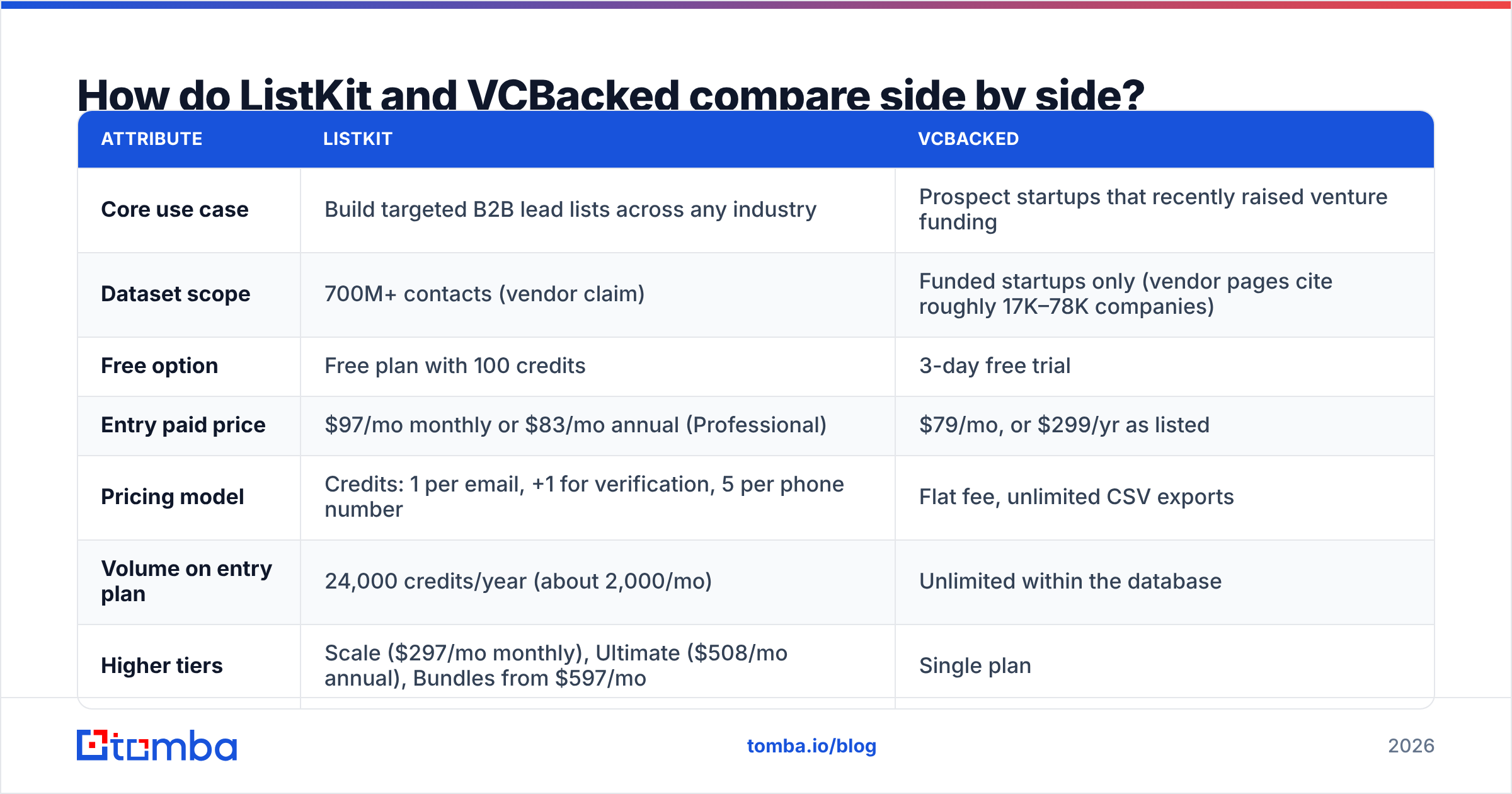
| Attribute | ListKit | VCBacked |
|---|---|---|
| Core use case | Build targeted B2B lead lists across any industry | Prospect startups that recently raised venture funding |
| Dataset scope | 700M+ contacts (vendor claim) | Funded startups only (vendor pages cite roughly 17K–78K companies) |
| Free option | Free plan with 100 credits | 3-day free trial |
| Entry paid price | $97/mo monthly or $83/mo annual (Professional) | $79/mo, or $299/yr as listed |
| Pricing model | Credits: 1 per email, +1 for verification, 5 per phone number | Flat fee, unlimited CSV exports |
| Volume on entry plan | 24,000 credits/year (about 2,000/mo) | Unlimited within the database |
| Higher tiers | Scale ($297/mo monthly), Ultimate ($508/mo annual), Bundles from $597/mo | Single plan |
| Contact types | Emails, direct dials, company data, intent signals | Founder/decision-maker emails, funding details, investors |
| Key trigger data | Intent signals | Funding round, amount, date, investors |
| Verification | Triple-verification at export (syntax, domain, mailbox) | Automated verification; vendor claims 95%+ accuracy |
| Outbound extras | Done-for-you email engine, CRM workflows on top tiers | CSV export for your CRM or sequencer |
| Best for | Agencies, SDR teams, multi-segment ICPs | Startup-focused SaaS, dev shops, recruiters, fractional execs |
The table shows the main tradeoff. ListKit gives you breadth and bills you per contact. VCBacked gives you depth in one segment and doesn't meter exports.
How does each pricing model actually work?#
On price, the two tools differ more in how they charge than in how much.
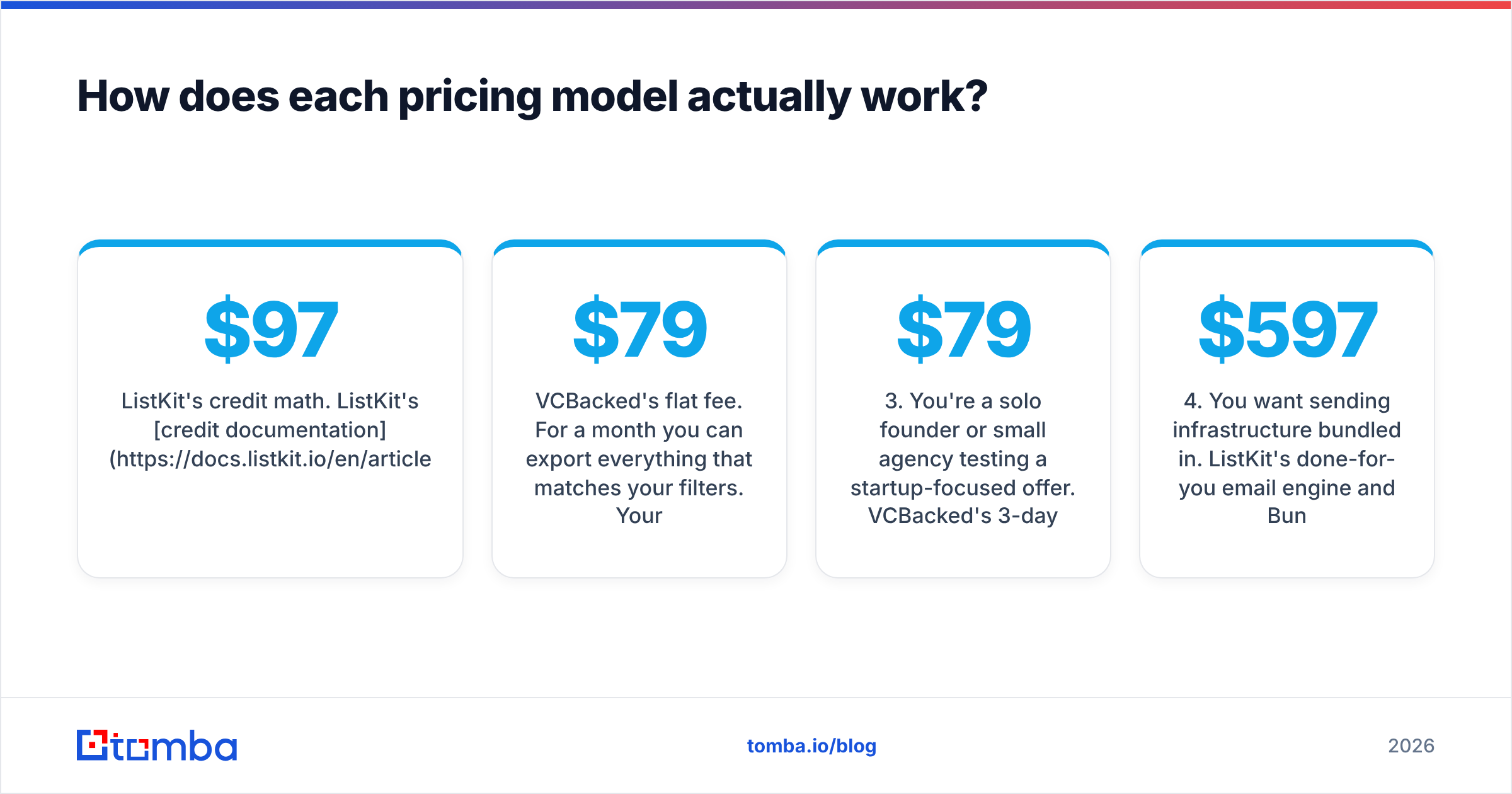
ListKit's credit math. ListKit's credit documentation says a business email costs 1 credit and triple-verification adds 1 more. A verified email therefore costs 2 credits, and a phone number costs 5. On the Professional plan (24,000 credits a year), that works out to about 12,000 verified emails a year, or around 1,000 a month. At $97/mo billed monthly, you pay roughly $0.10 per verified email. Credits spent on phone numbers or unverified pulls change that math quickly.
VCBacked's flat fee. For $79 a month you can export everything that matches your filters. Your real cost per contact depends on how many funded companies fit your ICP. If your market is Series A B2B SaaS in North America, you may export a few thousand contacts in month one and then a few hundred new ones each month after that. The flat fee works well at the start. After that, you're paying mostly for freshness: the new rounds that show up each week.
Which is cheaper? It depends on what you'd buy anyway:
- You need 5,000+ contacts a month across mixed segments. ListKit's higher tiers make sense. VCBacked can't supply that volume outside its niche.
- You only sell to funded startups. VCBacked is almost certainly cheaper per usable lead, and it adds the funding context ListKit doesn't lead with.
- You're a solo founder or small agency testing a startup-focused offer. VCBacked's 3-day trial plus $79 is a low-risk way to test. ListKit's free 100 credits (about 50 verified contacts) is enough to check data quality, but not enough to run a campaign.
- You want sending infrastructure bundled in. ListKit's done-for-you email engine and Bundles pricing (from $597/mo, sized by daily send volume) cover a job VCBacked doesn't attempt.
If you're comparing these against a plain email finder, look at Tomba pricing as a reference point. Tomba starts with a free tier of 25 searches a month and paid plans from $49/mo. It's a different job, though: you bring the company or person, and it finds the address.
Which data is fresher and more accurate?#
The two vendors handle freshness very differently.
VCBacked's product is freshness. Its main promise is that a company appears within about a day or two of announcing a round. That matters because the weeks right after a raise are when startups hire, buy tools and sign agencies. A founder who closed a Series A last Tuesday reads cold email with a different mindset than one who raised two years ago.
ListKit covers freshness in two ways. It layers daily intent signals over the contact data, and it re-verifies emails at the moment you export, not when the record was first collected. That second part is useful. Verifying at export catches mailboxes that died since the last crawl, so you don't pay credits for dead contacts.

Both vendors publish accuracy numbers: about 98% deliverability for ListKit's triple-verified emails and 95%+ for VCBacked. Treat both as the vendors' own claims, not independent benchmarks. In practice, accuracy depends on your segment. Startup domains cause particular trouble: a lot of them run catch-all mail servers, change domains after a rebrand, or shut down between rounds. If you're prospecting early-stage companies, expect more catch-all results than you would at enterprise accounts.
What should you check before choosing either tool?#
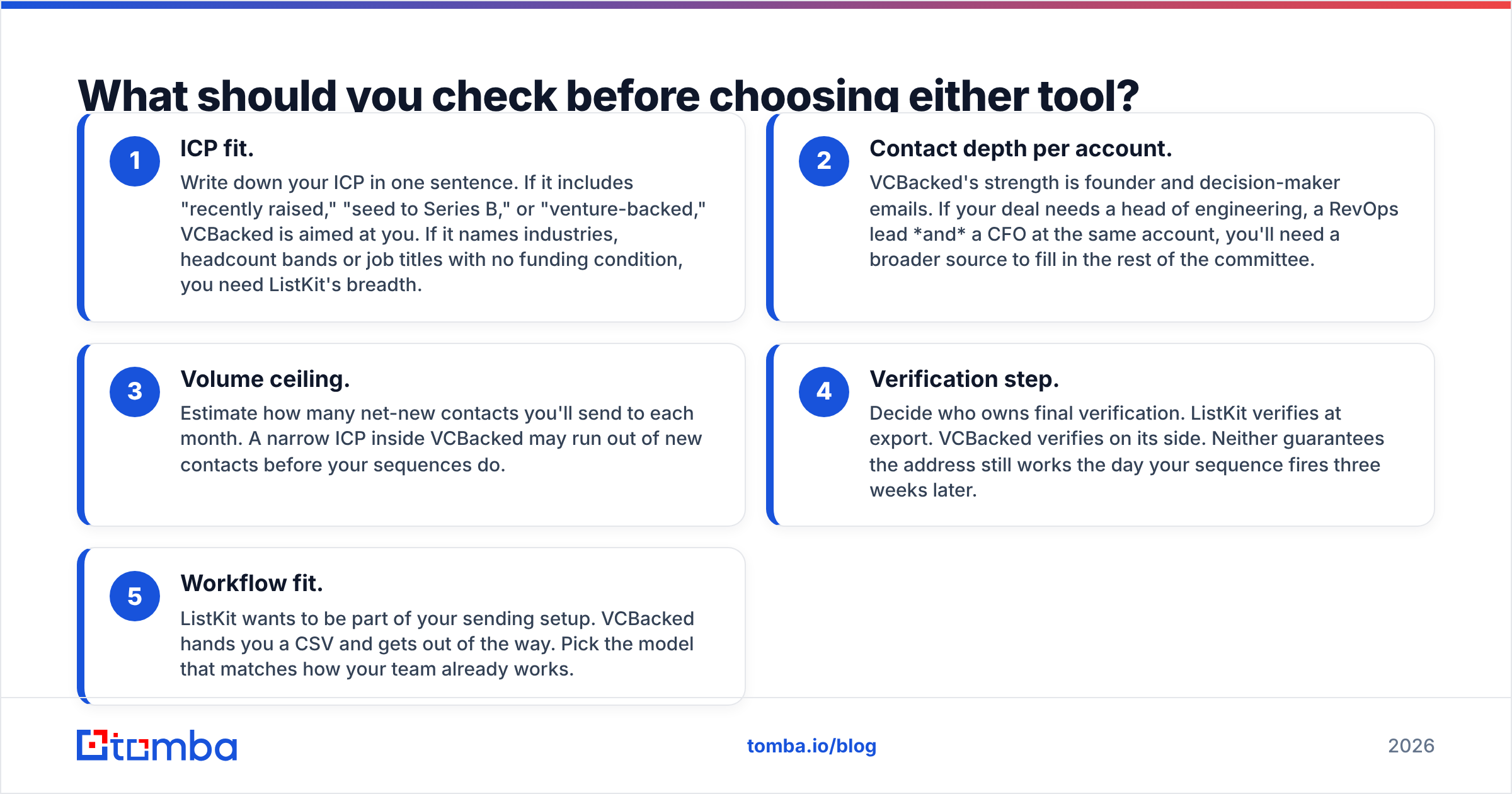
Before you commit, score each option on these five points. They matter more than any feature grid.
- ICP fit. Write down your ICP in one sentence. If it includes "recently raised," "seed to Series B," or "venture-backed," VCBacked is aimed at you. If it names industries, headcount bands or job titles with no funding condition, you need ListKit's breadth.
- Contact depth per account. VCBacked's strength is founder and decision-maker emails. If your deal needs a head of engineering, a RevOps lead and a CFO at the same account, you'll need a broader source to fill in the rest of the committee.
- Volume ceiling. Estimate how many net-new contacts you'll send to each month. A narrow ICP inside VCBacked may run out of new contacts before your sequences do.
- Verification step. Decide who owns final verification. ListKit verifies at export. VCBacked verifies on its side. Neither guarantees the address still works the day your sequence fires three weeks later.
- Workflow fit. ListKit wants to be part of your sending setup. VCBacked hands you a CSV and gets out of the way. Pick the model that matches how your team already works.
Is ListKit better than VCBacked?#
For most general outbound teams, yes. ListKit is the more complete tool. It covers more industries, more roles, phone numbers and intent data, and it offers sending infrastructure if you want it. Agencies running campaigns for several clients will find VCBacked too narrow to be their main data source.
For teams whose buyers are funded startups, no. VCBacked wins on relevance and cost. The funding trigger is the main reason those prospects are worth contacting right now, and VCBacked puts that trigger at the center of every record. You can build a similar list in a general database, but you'll spend credits and time rebuilding context VCBacked already gives you: round size, lead investor, date.
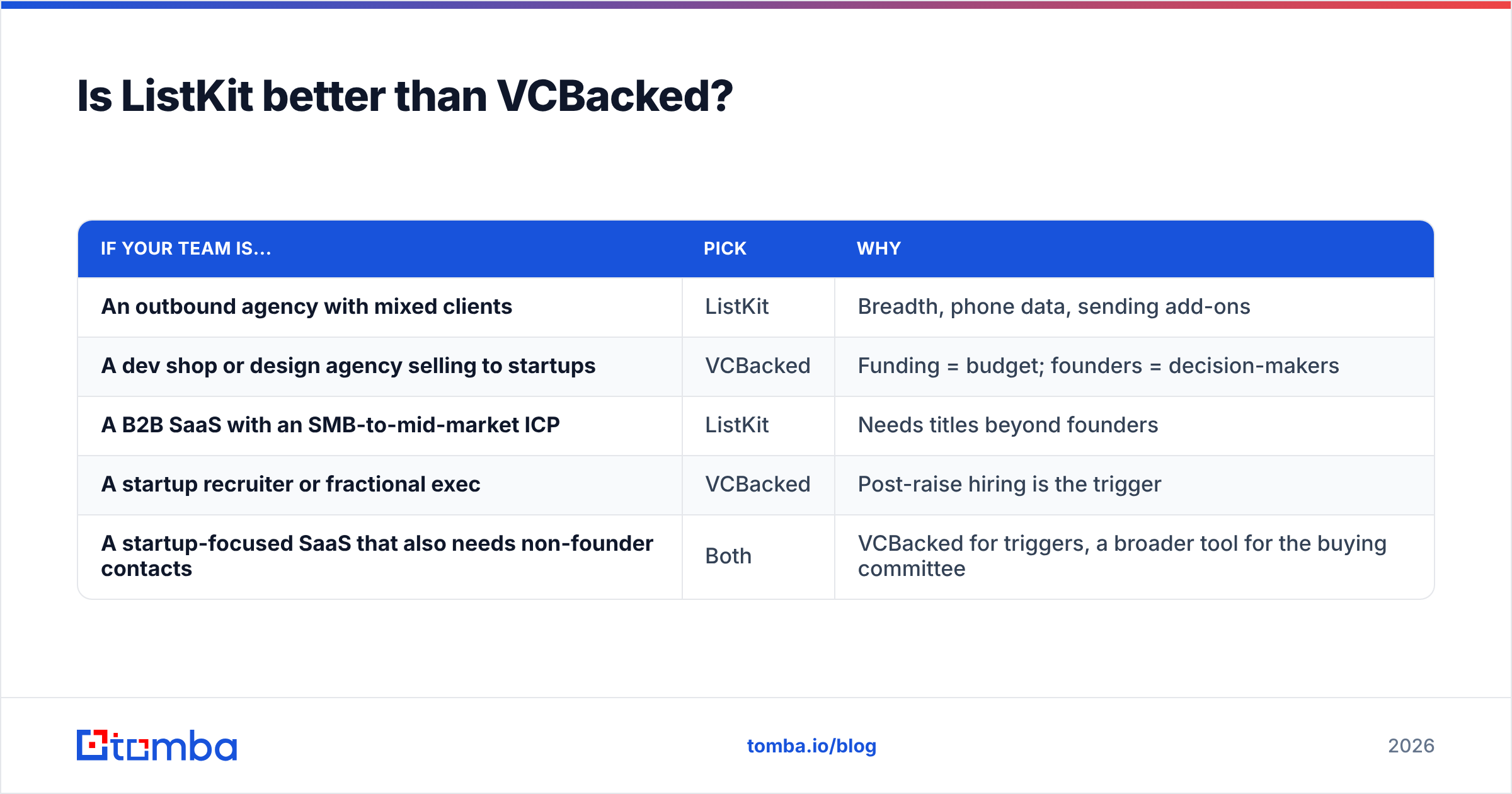
The honest verdict comes down to your ICP:
| If your team is... | Pick | Why |
|---|---|---|
| An outbound agency with mixed clients | ListKit | Breadth, phone data, sending add-ons |
| A dev shop or design agency selling to startups | VCBacked | Funding = budget; founders = decision-makers |
| A B2B SaaS with an SMB-to-mid-market ICP | ListKit | Needs titles beyond founders |
| A startup recruiter or fractional exec | VCBacked | Post-raise hiring is the trigger |
| A startup-focused SaaS that also needs non-founder contacts | Both | VCBacked for triggers, a broader tool for the buying committee |
Can you use ListKit and VCBacked together?#
Yes, and for startup-focused sellers this is often the strongest setup. A typical workflow:
- Trigger: Pull newly funded companies from VCBacked each week, filtered by stage, industry and geography.
- Expand: Take each company's domain and find the other people involved in the buying decision. That could mean running a domain search to list every public address at the company, or doing a targeted search in ListKit by title.
- Enrich: Add firmographic and role data so your personalization goes past "congrats on the raise." Contact enrichment fills in titles, LinkedIn URLs and company details from an email or domain.
- Verify: Run the whole list through one final check right before it goes into a sequence.
That last step is the one teams skip, and it costs them the most.

Startups change fast. A founder email that verified at export can bounce three weeks later if the company pivots, gets acquired, or moves to a new domain after a rebrand. Running a separate email verifier pass right before launch keeps your bounce rate low and protects your sending domain. Catch-all domains need extra handling, since a plain SMTP check can't confirm a real mailbox on them.
Which one should you choose in 2026?#
Choose ListKit if:
- Your ICP isn't defined by funding status.
- You need phone numbers, intent signals or high monthly volume.
- You want data and cold email infrastructure from one vendor.
- You're fine with credit-based billing and can plan your usage.
Choose VCBacked if:
- Your best customers are startups that just raised.
- You want founder emails with funding context on every row.
- You prefer a flat fee over per-contact metering.
- Your monthly volume is modest and focused.
Choose both if funding is your trigger but deals involve more than the founder. VCBacked tells you when to reach out. A broader database or email finder tells you who else to reach at that company.
Test either tool on the free option before paying. Export 50 contacts from your actual ICP, verify them independently, and send a small test batch. Your bounce and reply rates on that batch will tell you more than any vendor's accuracy number.
What's the best next step for filling the gaps?#
Neither ListKit nor VCBacked will cover every contact you need. VCBacked stops at founders and funded companies. ListKit stops at whatever its database has indexed. When you have a company domain or a person's name and need their work email, a dedicated finder closes the gap. Tomba Email Finder returns professional email addresses from a name plus domain or company, shows the public sources behind each result, and includes a confidence score. It fits alongside a funding-trigger list or a broad lead database without replacing either one. You can try it on the free tier with 25 searches a month, then move to Starter at $49/mo once it's part of your weekly workflow.
Related guides#
// get started
Find, verify and enrich your first contacts today
Start on the free plan with 25 searches a month, then scale when your team is ready.
Free plan · No credit card required · GDPR & CCPA
// about the author