ListKit vs Winmo: Pricing, Data, and Which One to Pick in 2026
ListKit sells verified lead lists by the credit. Winmo sells ad-industry intelligence by the five-figure contract. Here's how to tell which one your team needs before you sign.
TL;DR
- ListKit is a self-serve B2B lead database. You buy credits, filter by ICP, and export triple-verified emails for cold outbound. Paid plans start around $97/mo, and there's a free plan with 100 credits.
- Winmo is sales intelligence built for one market: people who sell to advertisers and their agencies. It maps brand-agency relationships, ad spend, and buying-cycle timing. Contracts are quote-only and usually start around $14K/year.
- These tools rarely compete head to head. If you sell into the ad and media industry, Winmo's context is hard to get anywhere else. If you sell to almost anyone else, ListKit's price per lead wins easily.
- Plenty of teams pair either tool with a standalone email finder and verifier. That fills gaps and double-checks contacts before a send.
What is the real difference between ListKit and Winmo?#
ListKit gives you lists. Winmo tells you where the money goes. Most "ListKit vs Winmo" searches come from buyers who think the two are interchangeable. They aren't. They solve different problems for different sellers.
ListKit is a horizontal B2B contact database. You define your ideal customer profile by industry, headcount, job title, location, tech stack, or intent signals, and ListKit returns contacts you can export straight into your sequencer. It's built for SDRs, agencies running outbound for clients, and founders doing their own prospecting. Its main selling point is triple-verified email data, which protects your bounce rate.
Winmo is a vertical sales intelligence platform. It tracks brands, the agencies that handle their media, creative, and PR, the decision-makers on both sides, and estimated ad spend. It also tries to predict when a brand is likely to review agencies or set budgets. The typical Winmo user is a media seller, an ad-tech rep, an agency new-business lead, or a sponsorship seller. For these people, knowing that "Brand X's agency of record is Y, and planning happens in Q3" matters more than getting 5,000 emails.
An analogy helps here. ListKit is a well-stocked wholesale warehouse: you pick what you need and pay by the unit. Winmo is a specialist broker who knows every buyer in one market by name, and charges a retainer for that.
How do ListKit and Winmo compare feature by feature?#
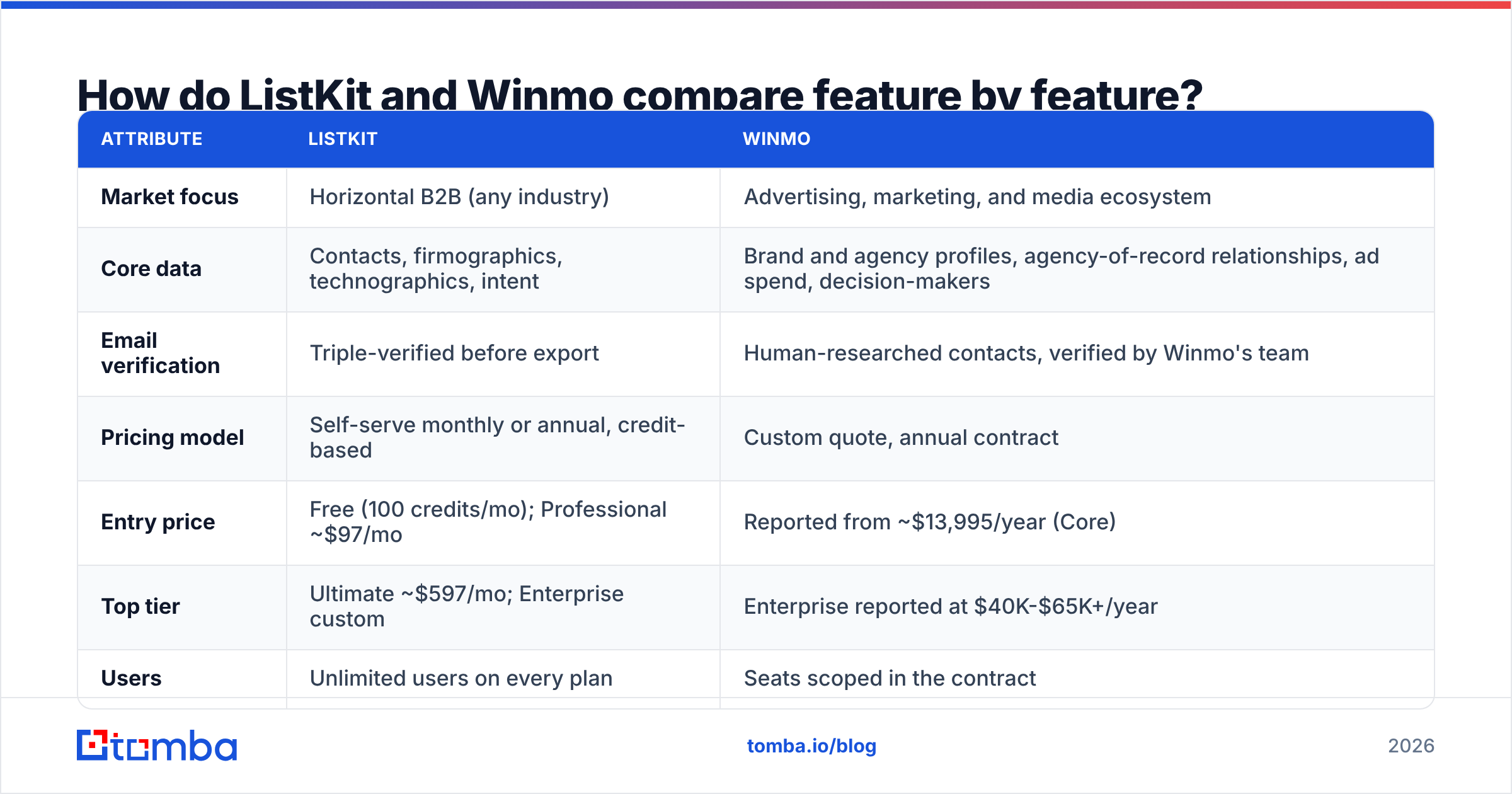
The table below compares the two on the attributes that usually decide a purchase.
| Attribute | ListKit | Winmo |
|---|---|---|
| Market focus | Horizontal B2B (any industry) | Advertising, marketing, and media ecosystem |
| Core data | Contacts, firmographics, technographics, intent | Brand and agency profiles, agency-of-record relationships, ad spend, decision-makers |
| Email verification | Triple-verified before export | Human-researched contacts, verified by Winmo's team |
| Pricing model | Self-serve monthly or annual, credit-based | Custom quote, annual contract |
| Entry price | Free (100 credits/mo); Professional ~$97/mo | Reported from ~$13,995/year (Core) |
| Top tier | Ultimate ~$597/mo; Enterprise custom | Enterprise reported at $40K-$65K+/year |
| Users | Unlimited users on every plan | Seats scoped in the contract |
| Timing signals | Intent data | Predictive spend and planning-cycle insights, trigger alerts |
| CRM integrations | Yes | Yes |
| Best for | High-volume cold outbound | Selling to national advertisers and agencies |
ListKit pricing comes from its published plans as of 2026. Winmo pricing is quote-only, and the figures above come from third-party reports such as Capterra's Winmo listing and buyer write-ups. Treat them as ranges, not list prices.
How much do ListKit and Winmo actually cost?#
For most teams, ListKit costs 10-40x less than Winmo per year. Price per useful contact is closer than that headline suggests, though, once you account for what each tool gives you.
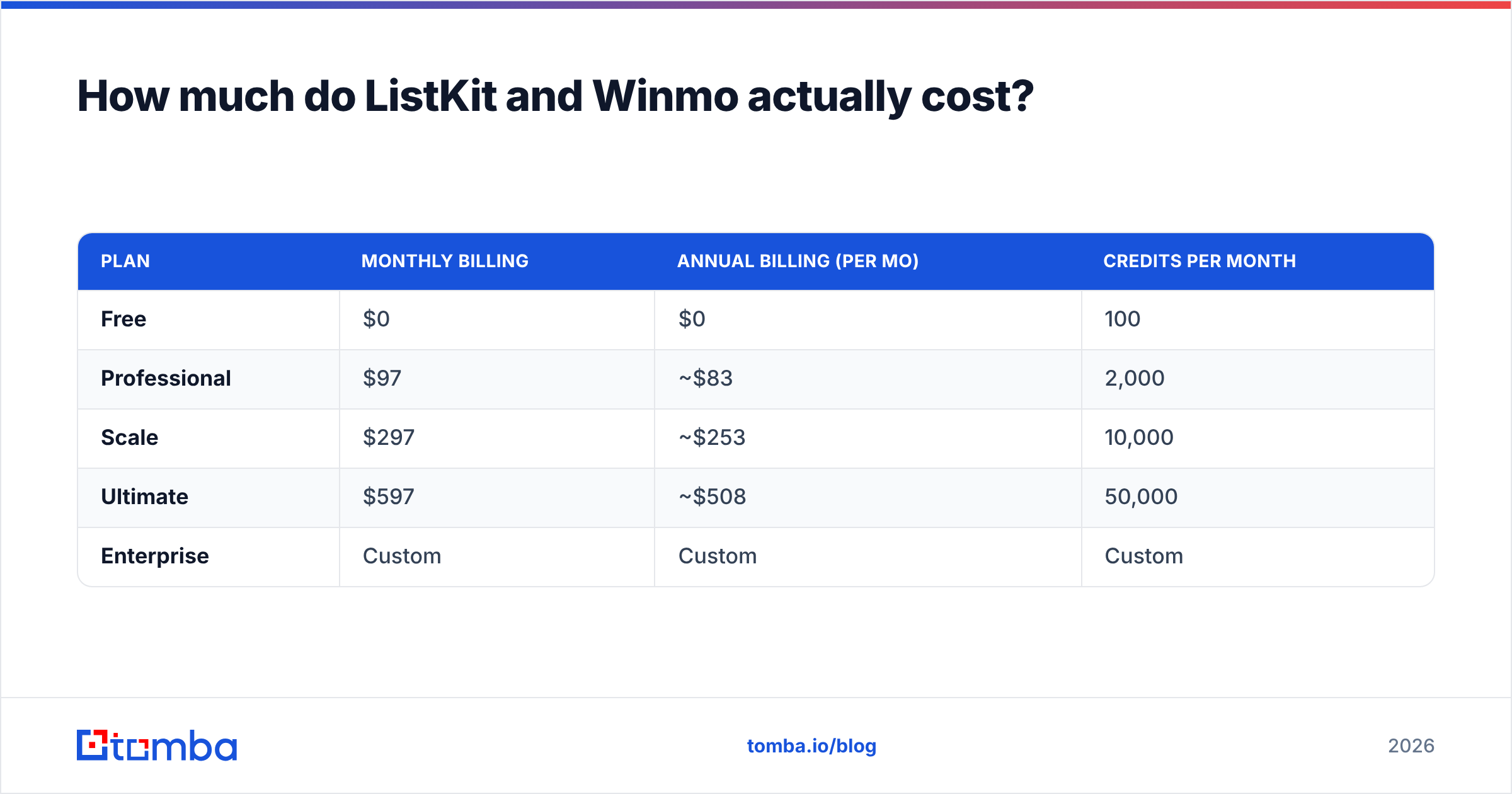
ListKit pricing breakdown#
| Plan | Monthly billing | Annual billing (per mo) | Credits per month |
|---|---|---|---|
| Free | $0 | $0 | 100 |
| Professional | $97 | ~$83 | 2,000 |
| Scale | $297 | ~$253 | 10,000 |
| Ultimate | $597 | ~$508 | 50,000 |
| Enterprise | Custom | Custom | Custom |
Credits cost different amounts depending on what you pull. A business email alone costs 1 credit. Adding a LinkedIn URL or intent signal costs 2-3 credits. A fully enriched record with a mobile number can cost 8-10 credits. So 2,000 credits on the Professional plan could mean 2,000 email-only leads or only about 200-250 fully enriched ones. Work out your real cost per lead from the fields you actually need, not the headline credit count.
Winmo pricing breakdown#
Winmo doesn't publish prices. Reported ranges look like this:
- Core: about $14K/year
- Standard: about $18K-$22K/year
- Explorer: about $25K-$40K+/year
- Enterprise: about $40K-$65K+/year
Add-on modules such as media insights, intent data, and outreach tools can raise the total a lot. Some buyers report the base subscription nearly doubling once the modules they want are added. Before you sign, ask for a line-item quote that separates the base platform from each module, and ask what renewal pricing looks like.
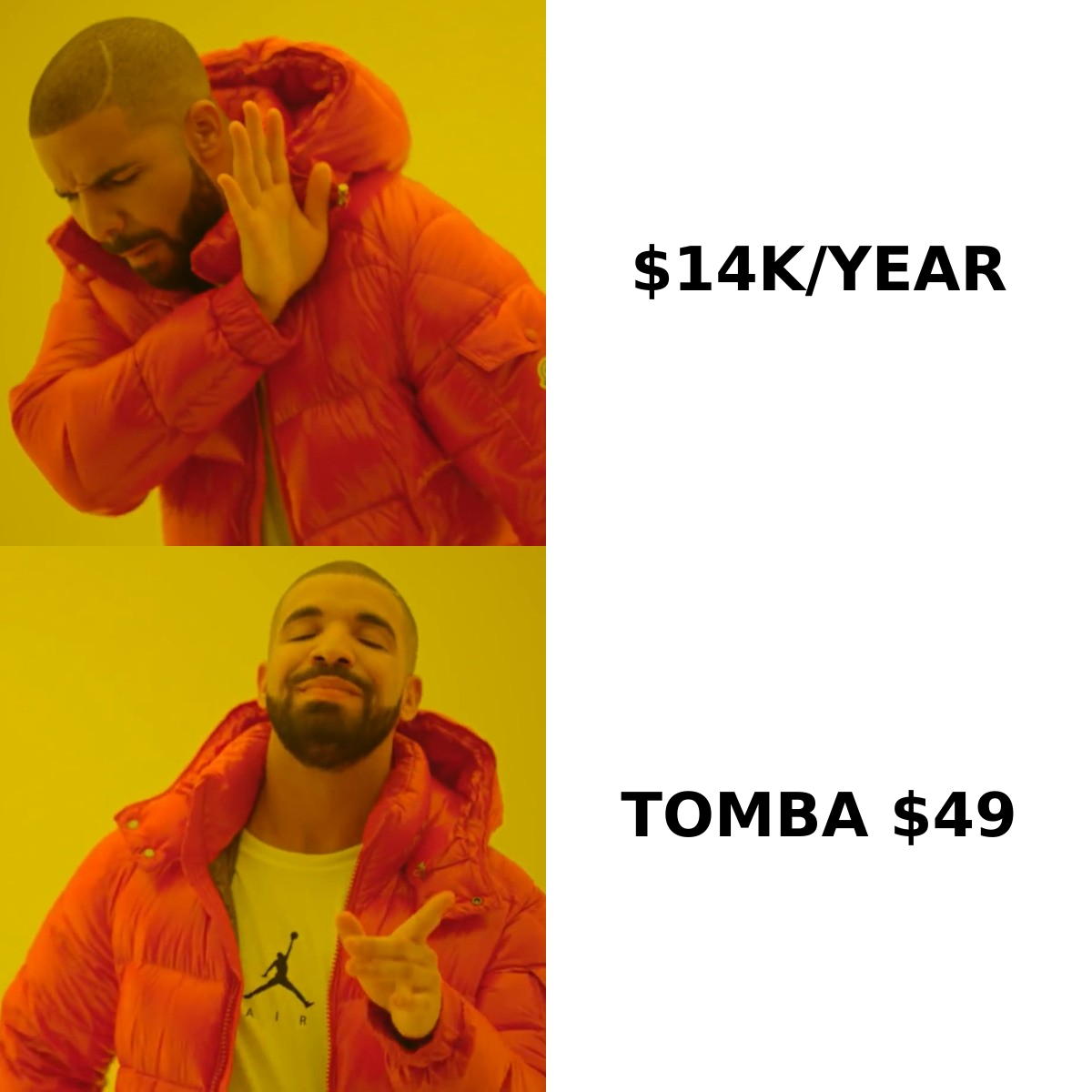
Winmo isn't overpriced for its audience, though. A single won agency account in media sales can be worth six or seven figures. If Winmo's spend and relationship data helps you land one extra deal a year, the subscription pays for itself. The math only breaks if you're buying Winmo for contact data alone.
Which tool has better data quality?#
ListKit wins on verification at volume. Winmo wins on depth of context within its niche. "Better data" means different things for each tool.
ListKit's key feature is its triple verification: each email passes several validation checks before export. That matters because cold-email bounce rates above roughly 2-3% can hurt your sender reputation quickly. For a team sending thousands of emails a week, a pre-verified database removes a whole step from the workflow.
Winmo's value is the relationships between contacts. A contact record in Winmo usually comes with:
- The brand's agency roster: who handles media buying, creative, and PR, and since when.
- Estimated ad spend: by channel, so you can size an account before you pitch.
- Trigger events: leadership changes, agency reviews, and new product launches that open a buying window.
- Planning-cycle timing: when a brand typically sets budgets, so you reach out before the money is committed rather than after.
You can't get that from a generic contact database, no matter how clean it is.
Whichever tool you use, run exports through an independent email verifier before a large send. Data decays at about 2% a month as people change jobs, and ad and agency roles have especially high turnover. A list that was verified at export can still hurt you if it sits in your CRM for a quarter.
Is ListKit better than Winmo for cold outbound?#
Yes, for general cold outbound ListKit is the better choice. Here's why:
- Self-serve speed. You can build a list and export it in minutes. Winmo is more of a research workspace than a list factory.
- Cost per contact. Even the top ListKit plan costs less per year than Winmo's entry contract, and it includes tens of thousands of monthly credits.
- Unlimited users. Adding SDRs doesn't raise your bill, which suits outbound agencies well.
- Horizontal coverage. SaaS, manufacturing, healthcare, professional services: ListKit's filters cover them all. Winmo deliberately doesn't.
The exception is when "cold outbound" means cold outreach to CMOs, media directors, and agency heads at national brands. There, Winmo's context changes your message. "I noticed you moved your media business to [agency] last spring" beats "I see you're a marketing leader at a 5,000-person company" every time.
Is Winmo worth it for agencies and media sellers?#
Yes, if the ad ecosystem is where your revenue comes from. Winmo was built for a workflow that general databases don't support:
- Media sellers (publishers, CTV, audio, OOH) need to know which agency and which planner controls a brand's budget, and when that budget gets allocated.
- Agency new-business teams need alerts when a brand puts its account up for review.
- Ad-tech and mar-tech vendors need to map both the brand-side marketer and the agency-side operator for a single deal.
- Sponsorship sellers need spend signals to qualify which brands can afford a package.
If none of those describe you, Winmo's biggest strength is irrelevant to your business and you'll overpay for data you won't use. Check peer reviews on G2 with this in mind. Satisfied Winmo customers almost always come from media, advertising, or agency sales.
What are the pros and cons of each?#
| ListKit | Winmo | |
|---|---|---|
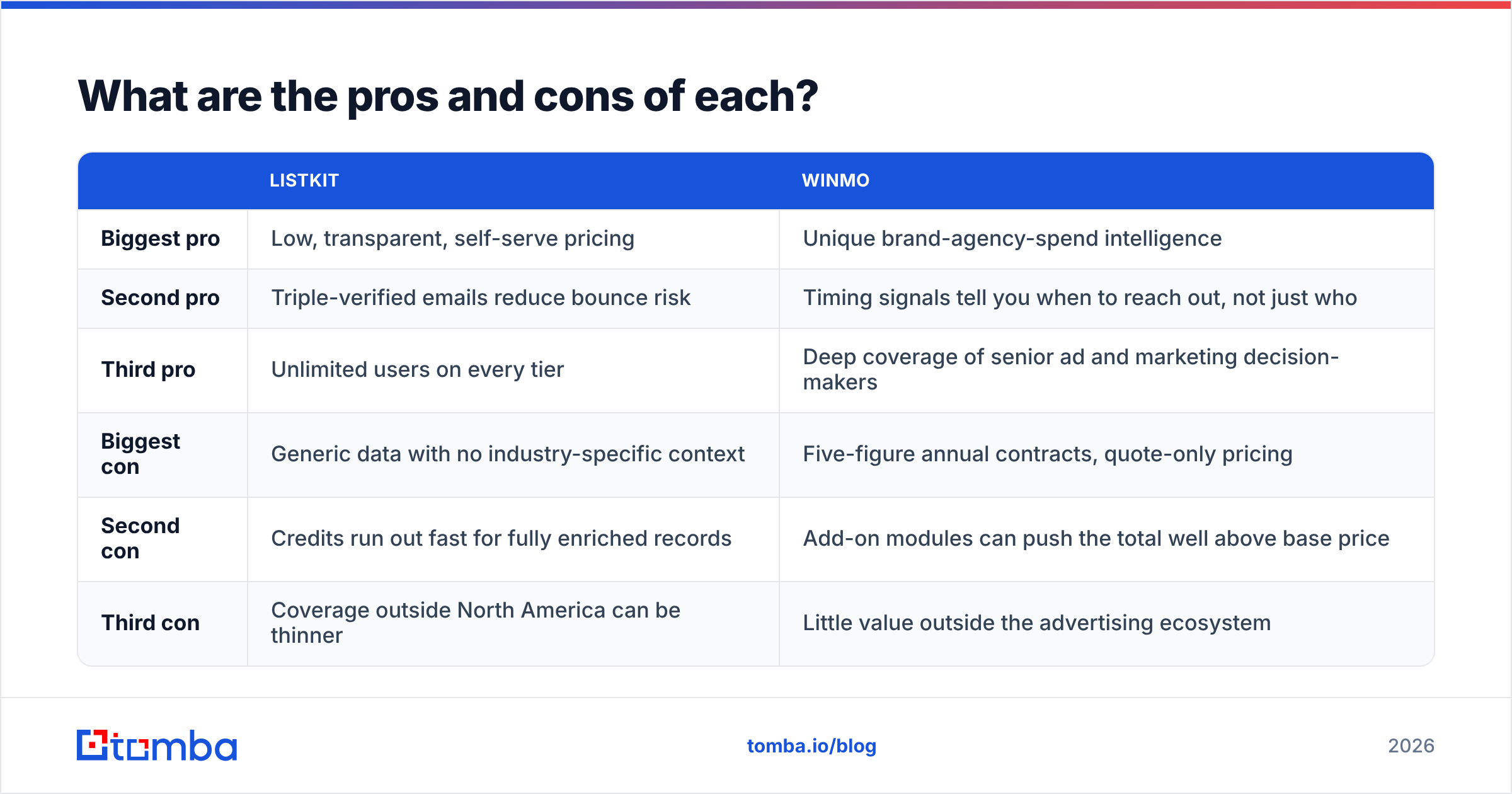
| Biggest pro | Low, transparent, self-serve pricing | Unique brand-agency-spend intelligence |
| Second pro | Triple-verified emails reduce bounce risk | Timing signals tell you when to reach out, not just who |
| Third pro | Unlimited users on every tier | Deep coverage of senior ad and marketing decision-makers |
| Biggest con | Generic data with no industry-specific context | Five-figure annual contracts, quote-only pricing |
| Second con | Credits run out fast for fully enriched records | Add-on modules can push the total well above base price |
| Third con | Coverage outside North America can be thinner | Little value outside the advertising ecosystem |
Can you use ListKit and Winmo together?#
Yes, and some agency-side teams do. A common setup:
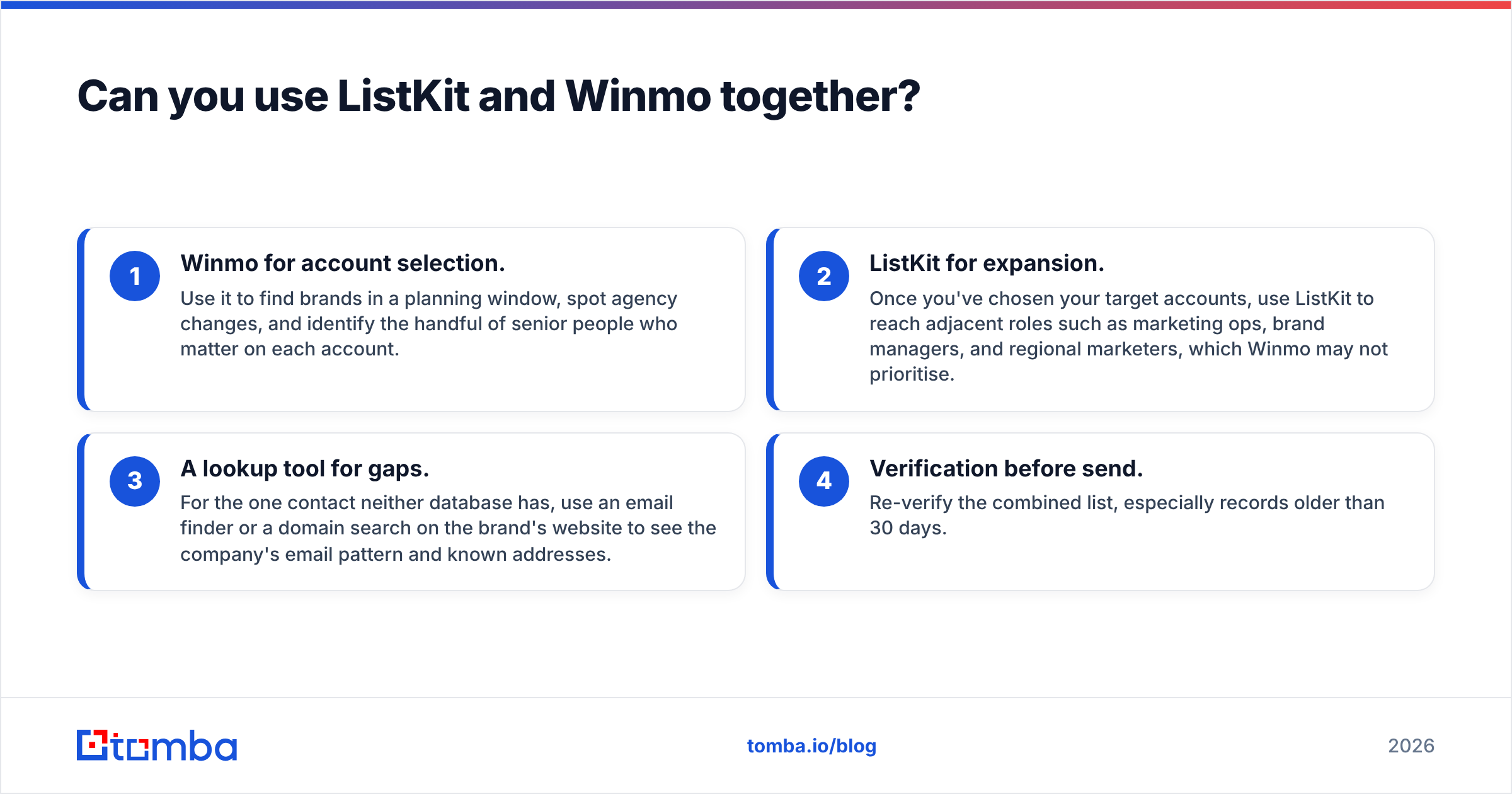
- Winmo for account selection. Use it to find brands in a planning window, spot agency changes, and identify the handful of senior people who matter on each account.
- ListKit for expansion. Once you've chosen your target accounts, use ListKit to reach adjacent roles such as marketing ops, brand managers, and regional marketers, which Winmo may not prioritise.
- A lookup tool for gaps. For the one contact neither database has, use an email finder or a domain search on the brand's website to see the company's email pattern and known addresses.
- Verification before send. Re-verify the combined list, especially records older than 30 days.
This layered setup costs more than either tool alone. In return, you get Winmo's context on the accounts that matter most and cheap volume everywhere else.

Which alternatives should you consider?#
If neither tool quite fits, here's how the rest of the market breaks down:
- All-in-one horizontal databases (Apollo, ZoomInfo): broader than ListKit, with more workflow built in and higher prices at the top. Worth a look if you want sequencing and data in one tool.
- Pure email finders and verifiers: best when you already know your target accounts and just need accurate addresses. You pay per lookup instead of for database access. Tomba sits here, alongside domain search, verification, and enrichment.
- Ad-intelligence tools: if you mostly want ad spend and creative tracking without the contact layer, dedicated ad-intelligence platforms may cover it for less than a full Winmo contract.
The deciding question is simple: do you need to find people, or understand accounts? Finding people is a commodity, so buy it cheaply. Understanding accounts in a specialised vertical is not, and it's worth paying for when that vertical is your whole market.
So which should you choose: ListKit or Winmo?#
Here's the short version:
- Choose ListKit if you run high-volume outbound to any B2B market, want transparent monthly pricing, and care most about verified emails at a low cost per lead.
- Choose Winmo if your buyers are brand marketers and agency executives, a single deal is worth tens of thousands of dollars or more, and knowing who works with whom and when they spend is your edge.
- Choose neither if you already know exactly which companies you want and only need the right email address for the right person. A dedicated finder-plus-verifier setup costs a fraction of either tool.
Compare total cost, not headline cost. That means ListKit credits at the enrichment level you actually use, and Winmo base plus the modules you'll really need. Then run a two-week pilot on a real campaign and measure bounce rate, reply rate, and meetings booked.
Where does Tomba fit in?#
If you've chosen your target accounts, whether from Winmo's agency maps, a ListKit export, or your own research, the last step is getting a deliverable address for the specific person you want. Tomba Email Finder handles that. Enter a name and company domain and you get a professional email with a confidence score. It works from the web app, the Chrome extension, or the API. Tomba has a free tier with 25 searches a month, and paid plans start at $49/mo (see Tomba pricing). You can fill the gaps any database leaves without committing to another five-figure contract.
Related guides#
Ready to find emails that actually work?
Join 150,000+ professionals who stopped guessing and started sending. Free credits on signup — no credit card required.
Get the Tomba newsletter
Practical outbound tactics and product updates — once every two weeks.
About the author