ListKit vs Zintlr: Pricing, Data Quality and Best Fit in 2026
ListKit sells lists of triple-verified emails to cold emailers who send at volume. Zintlr sells buyer context, like personality profiles and India-heavy coverage, for account-based selling. Here's how their pricing, credits and data compare, and when neither one is the right buy.
- ListKit is a list-building tool for high-volume cold email. It sells triple-verified emails in bulk and adds sending infrastructure on top. Its listed annual plans run from about $83/mo to $508/mo.
- Zintlr is a sales-intelligence tool built around buyer context. It offers personality profiles, buying committees and strong India/APAC coverage, with plans starting around $49/mo.
- Pick ListKit if your team sends thousands of cold emails a month to North American or European SMBs.
- Pick Zintlr if you run account-based deals where knowing how to talk to a buyer matters more than raw volume.
- If what you actually need is finding and verifying specific people's work emails without paying for a whole database, a dedicated email finder is usually cheaper than either one.
What is ListKit?#
ListKit is a B2B lead database built for cold email teams. You filter by title, industry, headcount, location and technographics, then export contacts. It verifies emails three times, running each address through several verification providers before it counts as deliverable. The pitch is simple: pull a big, clean list and load it into your sequencer without bounces damaging your domain.
In the last few years ListKit has also added more of the sending stack around the data. Its "Email Engine" and related features include an AI script writer and infrastructure for cold email volume. That makes it closer to a list-and-send bundle than a pure data vendor.
Its official site targets agencies and outbound teams. That audience explains most of its design choices: bulk exports, credit-based pricing and a focus on email deliverability rather than deep account research.
What is Zintlr?#
Zintlr is a sales-intelligence platform that started in India and now sells worldwide. It has the usual contact data (B2B database, LinkedIn email finder, Chrome extension), but that isn't what sets it apart. The differentiator is Personality Intelligence: behavioural profiles of prospects that suggest how to open, pitch and follow up with each person.
Other Zintlr features include Meeting Intel (pre-call briefs), Buyer Committee mapping (the other stakeholders at an account), Company Insights, and location-based discovery tools branded zBizLocator and zScout. Details are on Zintlr's official site.
In short, ListKit helps you reach more people, and Zintlr helps you do better with the people you already chose.
How do ListKit and Zintlr compare side by side?#
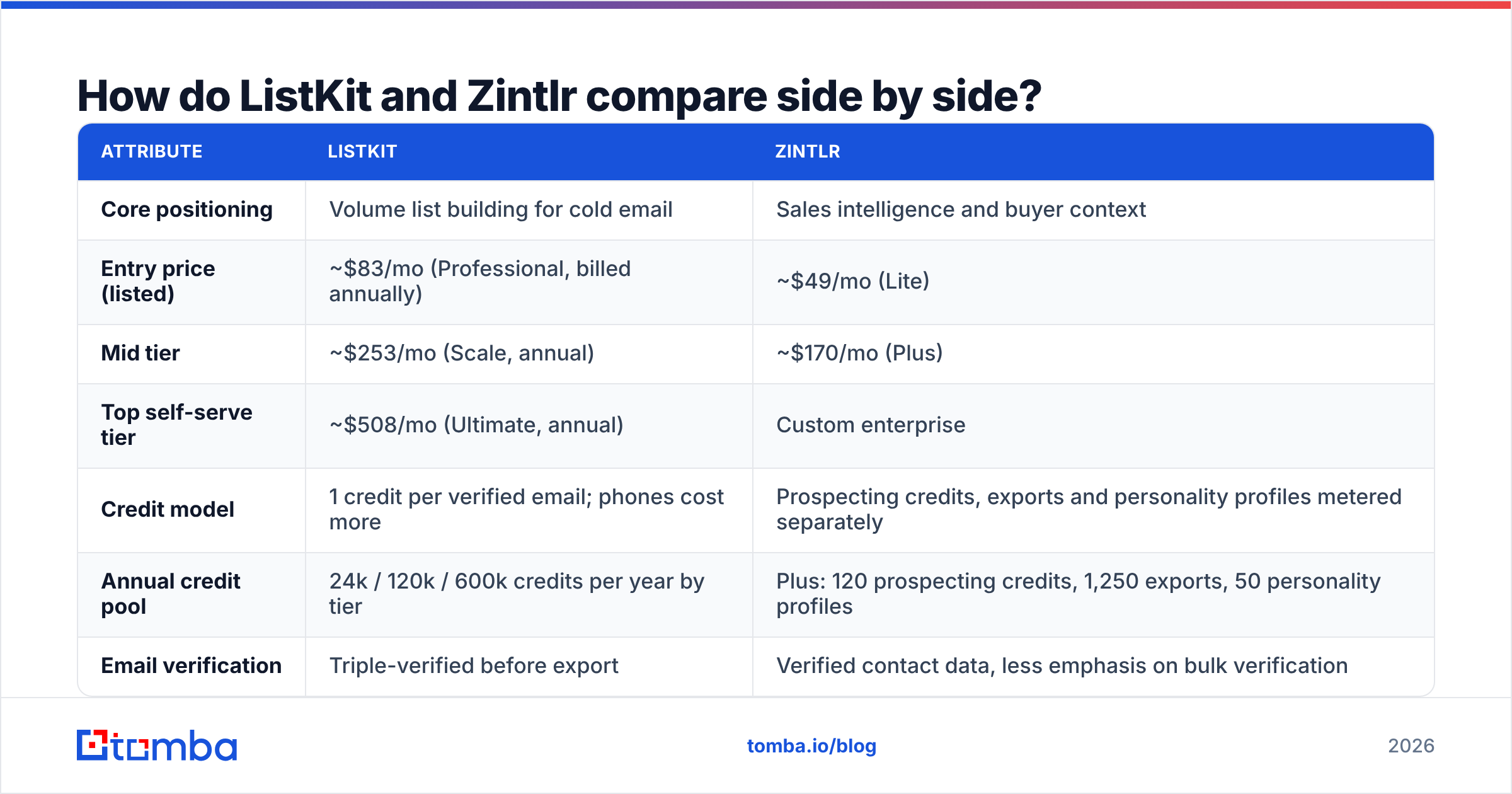
This table uses publicly listed plans and features at the time of writing. Both vendors change packaging often, so check their pricing pages before you buy.
| Attribute | ListKit | Zintlr |
|---|---|---|
| Core positioning | Volume list building for cold email | Sales intelligence and buyer context |
| Entry price (listed) | ~$83/mo (Professional, billed annually) | ~$49/mo (Lite) |
| Mid tier | ~$253/mo (Scale, annual) | ~$170/mo (Plus) |
| Top self-serve tier | ~$508/mo (Ultimate, annual) | Custom enterprise |
| Credit model | 1 credit per verified email; phones cost more | Prospecting credits, exports and personality profiles metered separately |
| Annual credit pool | 24k / 120k / 600k credits per year by tier | Plus: 120 prospecting credits, 1,250 exports, 50 personality profiles |
| Email verification | Triple-verified before export | Verified contact data, less emphasis on bulk verification |
| Standout feature | Bulk export plus cold email infrastructure | Personality Intelligence and Buyer Committee |
| Geographic strength | US, UK, EU SMB and mid-market | India and APAC, plus global coverage |
| Free trial | Limited trial credits | 14-day trial, no card required |
| Best for | Agencies, SDR teams sending at scale | AEs running ABM and enterprise deals |
The prices look close at the low end, but you're buying different things. ListKit's $83 buys you volume. Zintlr's $49 buys you depth on a small number of accounts.
How does the pricing really work once credits come in?#
Credit-based pricing is like a phone plan with a data cap. The headline number looks cheap, and the real cost depends on what you actually use.
ListKit's credit math. A triple-verified email costs one credit. Phone numbers cost more: independent breakdowns such as ListKit's G2 pricing page and third-party reviews list 3 to 5 credits per number found. A fully enriched contact can reach around 10 credits. If you only need emails, the Professional tier's 24,000 annual credits works out to roughly 2,000 contacts a month. If you want email plus mobile on every lead, that number drops fast.
Two more things to watch:
- Annual versus monthly. ListKit's best numbers are on yearly billing. Monthly plans give fewer credits for more money, so the "$83" figure assumes you commit for a year.
- Non-data spend. Features such as the AI script writer use credits too (reported at 100 credits per script). If your team uses them heavily, you'll have fewer credits left for leads.
Zintlr's metering. Zintlr splits usage into several buckets: prospecting credits, exports, personality profiles, and location-discovery credits. The Plus plan's 120 prospecting credits is small if you think in cold-email volume. It's reasonable if you work 30 to 60 target accounts a quarter and want real context on each buying committee.

The practical takeaway: work out your cost per usable contact, not per credit. Take your monthly target (for example, 1,500 contacts with verified emails and 300 with direct dials), price it on each tool, then add the features you'll actually use. The cheaper-looking plan often turns out more expensive.
Which tool has better data quality and coverage?#
This question depends more on geography than on the vendor.
ListKit's strengths:
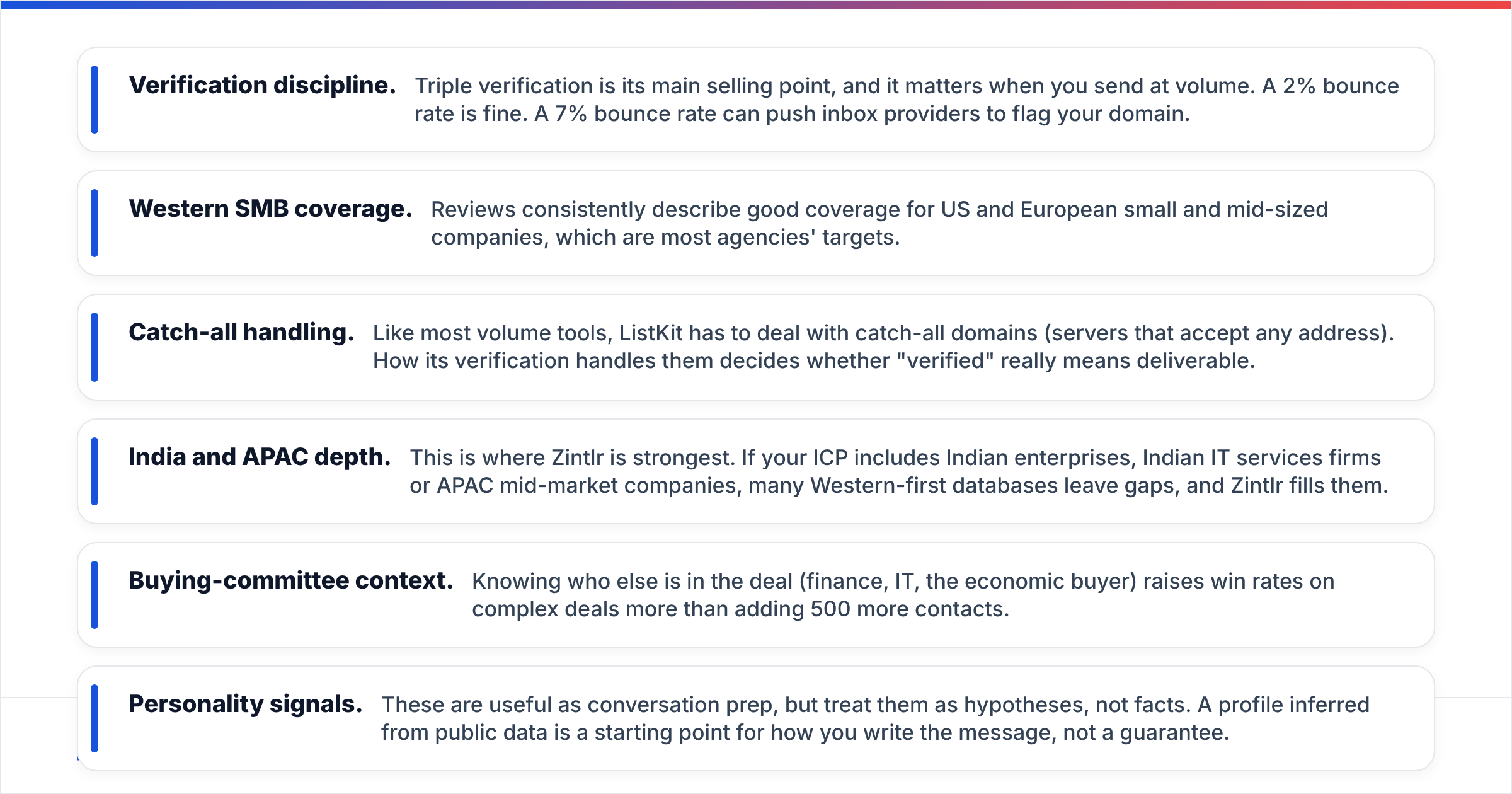
- Verification discipline. Triple verification is its main selling point, and it matters when you send at volume. A 2% bounce rate is fine. A 7% bounce rate can push inbox providers to flag your domain.
- Western SMB coverage. Reviews consistently describe good coverage for US and European small and mid-sized companies, which are most agencies' targets.
- Catch-all handling. Like most volume tools, ListKit has to deal with catch-all domains (servers that accept any address). How its verification handles them decides whether "verified" really means deliverable.
Zintlr's strengths:
- India and APAC depth. This is where Zintlr is strongest. If your ICP includes Indian enterprises, Indian IT services firms or APAC mid-market companies, many Western-first databases leave gaps, and Zintlr fills them.
- Buying-committee context. Knowing who else is in the deal (finance, IT, the economic buyer) raises win rates on complex deals more than adding 500 more contacts.
- Personality signals. These are useful as conversation prep, but treat them as hypotheses, not facts. A profile inferred from public data is a starting point for how you write the message, not a guarantee.
Where both have limits: neither one replaces ongoing hygiene. People change jobs all the time, so any list you export starts going stale right away. If a list has been sitting in your CRM for more than about 60 days, run it through an email verifier again before you send.
What are the pros and cons of each?#
ListKit pros
- Built for volume, with fast bulk exports into sequencers
- Triple verification lowers bounce risk
- Sending infrastructure bundled on higher tiers
- Clear filters for classic cold-email ICPs
ListKit cons
- Best pricing needs an annual commitment
- Phone and enrichment credits add up quickly
- Little buyer-level context beyond firmographics and title
- Weaker fit for India and APAC-heavy target lists
Zintlr pros
- Personality Intelligence helps personalise high-value outreach
- Buyer Committee mapping suits ABM and multi-threaded deals
- Strong India and APAC coverage
- Low entry price and a no-card 14-day trial
Zintlr cons
- Metering across several credit buckets is harder to predict
- Low prospecting-credit allowances for volume senders
- Personality data is inferred, so accuracy varies
- Less focused on bulk cold-email workflows
Which one should you choose for your use case?#
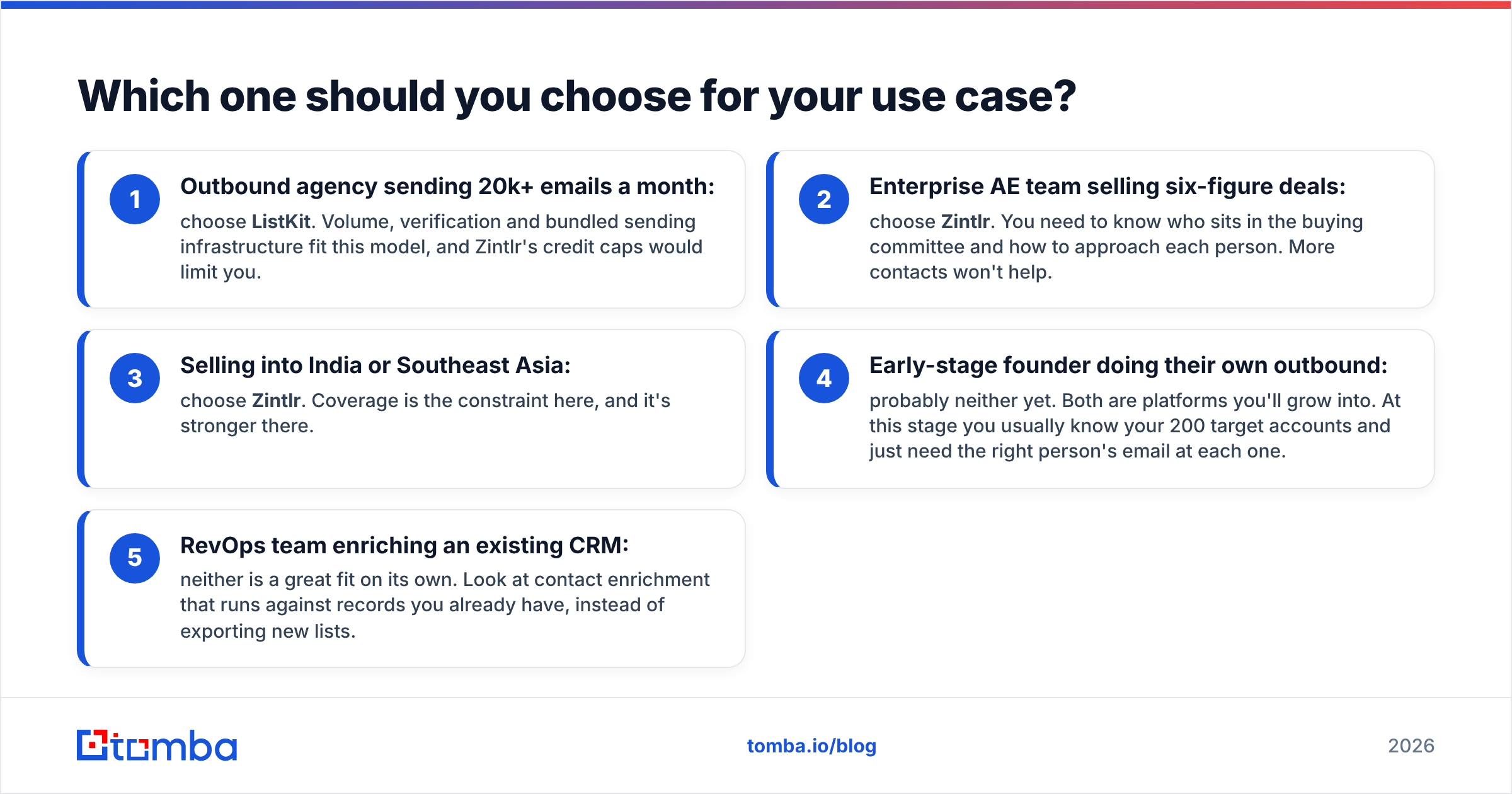
Map it to how your team actually works:
- Outbound agency sending 20k+ emails a month: choose ListKit. Volume, verification and bundled sending infrastructure fit this model, and Zintlr's credit caps would limit you.
- Enterprise AE team selling six-figure deals: choose Zintlr. You need to know who sits in the buying committee and how to approach each person. More contacts won't help.
- Selling into India or Southeast Asia: choose Zintlr. Coverage is the constraint here, and it's stronger there.
- Early-stage founder doing their own outbound: probably neither yet. Both are platforms you'll grow into. At this stage you usually know your 200 target accounts and just need the right person's email at each one.
- RevOps team enriching an existing CRM: neither is a great fit on its own. Look at contact enrichment that runs against records you already have, instead of exporting new lists.

Is there a leaner option than either tool?#
Often, yes, and it's worth checking before you sign an annual contract.
Many teams that shortlist ListKit or Zintlr don't actually need a prospecting database. They already know which companies they want. What they're missing is the verified work email of a specific VP at a specific domain. For that job, a database with filters and personality profiles is more than you need.
A dedicated email finder takes a name and domain (or just a domain) and returns the most likely verified address, with sources. It's metered per search, not per enriched contact. Tomba, for example, has a free tier of 25 searches a month, then Starter at $49/mo, Growth at $99/mo, Pro at $249/mo, and custom Enterprise pricing. The full breakdown is on Tomba pricing. That structure fits teams whose bottleneck is finding the right address, not finding the right accounts.
The honest trade-off: an email finder won't give you Zintlr's buying-committee maps or ListKit's bundled sending stack. If those are core to how you sell, buy the platform. If they aren't, you'd be paying for features you won't use.
A lot of mature teams mix tools. They use one source for account discovery (a database like ListKit or Zintlr, or their CRM's intent data), a separate finder for the specific contacts they couldn't reach, and a verifier as the final check before anything goes into a sequence.
ListKit vs Zintlr: what's the final verdict?#
Neither one is better overall. They answer different questions.
- ListKit answers "How do I fill my sequencer with thousands of deliverable contacts?" For cold-email teams in Western SMB markets, it's a strong, focused tool. Budget for annual billing and watch how quickly phone credits get used.
- Zintlr answers "How do I win this specific account?" For AEs running considered deals, and especially for India or APAC targets, its buyer context is worth more than raw contact counts.
Before you commit to either, check that the category matches your real bottleneck. List volume, account intelligence, and precise email lookup are three different problems, and paying for the wrong one is the most common data-tool mistake.
If your bottleneck is getting a verified work email for the decision-maker you've already identified, start with the Tomba Email Finder. Enter a name and company domain and you get a sourced, verified address. The free tier gives you 25 searches a month to test it against your own target list before you pay for a full database.
Related guides#
// get started
Find, verify and enrich your first contacts today
Start on the free plan with 25 searches a month, then scale when your team is ready.
Free plan · No credit card required · GDPR & CCPA
// about the author