Listmint vs SalesIntel: Catch-All Verifier or Full Data Platform?
Listmint and SalesIntel both promise fewer bounces, but they fix different problems. One checks the list you already have. The other sells you the list. Here's which one your team actually needs.
- Listmint and SalesIntel do different jobs. Listmint checks email lists you already have, and it's built around catch-all domains. SalesIntel is a B2B contact and intent-data platform where people re-verify the records.
- The pricing models are far apart. Listmint's public plans start around $99/mo for 20K standard checks plus 5K catch-all checks. Third-party reviews put SalesIntel team contracts at roughly $10K–$18K+ per year, billed annually.
- Pick Listmint if you already source leads from Apollo, Clay, scraping, or event lists and your problem is bounces from "accept-all" domains.
- Pick SalesIntel if you need a vetted database of North American B2B contacts with intent signals, and your budget and sales cycle fit an annual enterprise contract.
- If neither fits, a combined finder and verifier like Tomba covers finding and checking emails from $49/mo without an annual lock-in.
What is the real difference in Listmint vs SalesIntel?#
Most "vs" posts compare two tools that do the same thing. Listmint vs SalesIntel doesn't work that way, so decide which problem you're solving before you look at feature lists.
Think of it like a kitchen. SalesIntel sells you groceries. It's a database of contacts, companies, and buying signals you can search and export. Listmint is the food inspector. It takes the groceries you already bought from anywhere and tells you which ones are safe to serve.
Here's the technical version:
- Listmint is an email verification service built around catch-all domains. A catch-all (or "accept-all") server says yes to every address during an SMTP handshake. Standard verifiers can't separate real inboxes from fake ones on those domains, so they mark them "unknown" or "risky." Listmint's pitch is that it resolves many of those unknowns. It claims this turns 50%+ more of your list into sendable leads.
- SalesIntel is a sales intelligence platform. According to its own marketing and several 2026 reviews, it has 200M+ contact records and a team of human researchers who re-verify contacts on a rolling cycle of about 90 days. It also has an intent engine (Signal360) and a research-on-demand service for contacts the database doesn't have.
So the question isn't "which is better?" It's "do I need data, or do I need to clean data I already have?"
How do Listmint and SalesIntel compare feature by feature?#
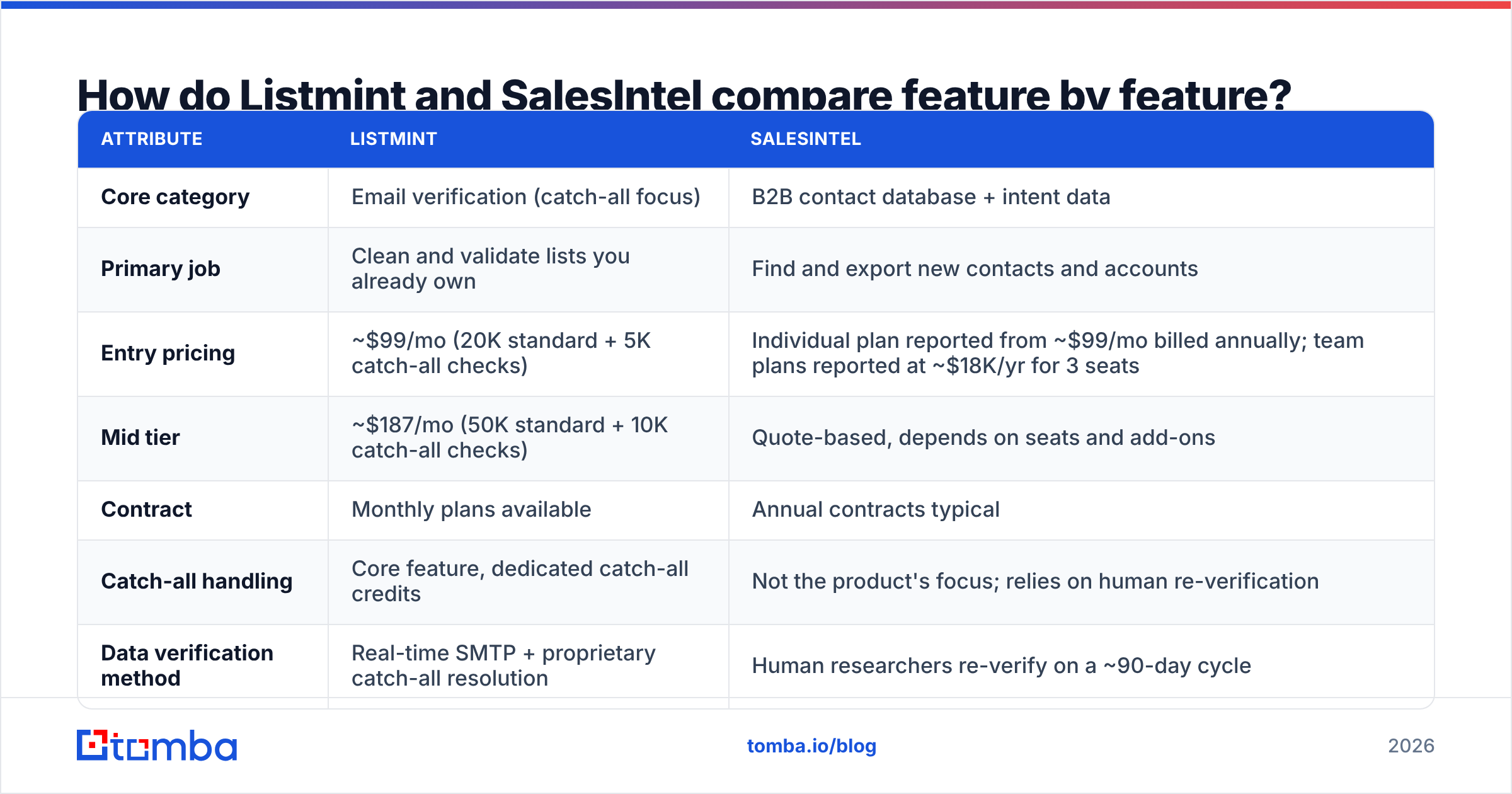
Here's the side-by-side. Pricing comes from public listings and third-party reviews as of 2026, so confirm current terms with each vendor before you commit.
| Attribute | Listmint | SalesIntel |
|---|---|---|
| Core category | Email verification (catch-all focus) | B2B contact database + intent data |
| Primary job | Clean and validate lists you already own | Find and export new contacts and accounts |
| Entry pricing | ~$99/mo (20K standard + 5K catch-all checks) | Individual plan reported from ~$99/mo billed annually; team plans reported at ~$18K/yr for 3 seats |
| Mid tier | ~$187/mo (50K standard + 10K catch-all checks) | Quote-based, depends on seats and add-ons |
| Contract | Monthly plans available | Annual contracts typical |
| Catch-all handling | Core feature, dedicated catch-all credits | Not the product's focus; relies on human re-verification |
| Data verification method | Real-time SMTP + proprietary catch-all resolution | Human researchers re-verify on a ~90-day cycle |
| Intent signals | No | Yes (Signal360: funding, hiring, tech changes, site visits) |
| Finds new contacts | No | Yes |
| Integrations | API, Clay data-provider integration | CRM integrations (Salesforce, HubSpot), browser extension |
| Best for | Agencies, cold emailers, RevOps teams with messy lists | Mid-market and enterprise sales teams needing vetted NA data |
One line in that table drives most buying decisions: Listmint can't give you a single new lead, and SalesIntel isn't built to clean the 40% of your Apollo export sitting in "unknown." Buying the wrong one leaves the real problem unsolved.
Where does each tool fit in an outbound workflow?#
A typical outbound data pipeline has five stages. Each tool plugs in at a different one:
- Sourcing. You build a target account and contact list. SalesIntel works here. Listmint doesn't.
- Enrichment. You fill in missing emails, titles, and phone numbers. SalesIntel covers this for its own records. You'd need an email finder or a waterfall tool like Clay for anything else.
- Verification. You check every address before it touches your sending domain. This is Listmint's whole job, especially the catch-all segment most verifiers give up on.
- Prioritization. You rank accounts by buying signals. SalesIntel's intent data helps here.
- Sending and monitoring. You run sequences and watch bounces. Neither tool is a sequencer, but clean input here protects your sender reputation.
Some mature teams run both: SalesIntel for sourcing and intent, then a catch-all verifier as a final check before sending. That's defensible. It's also two contracts, two budgets, and often more capability than a team under 10 reps will use.

Is Listmint worth it for catch-all verification?#
Listmint is worth it if catch-alls are a large share of your list. If they aren't, you're paying a premium for a feature you'll rarely use.
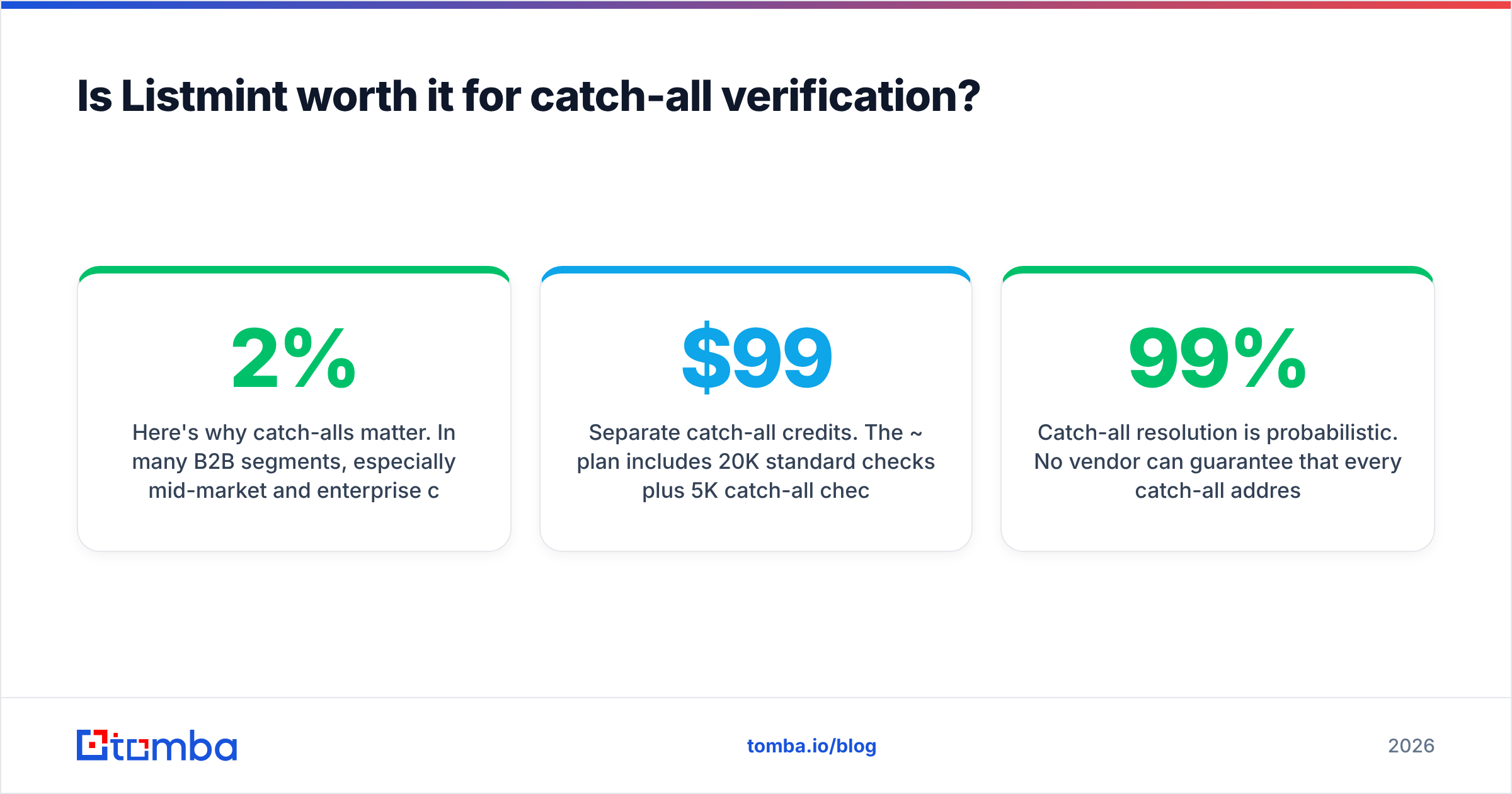
Here's why catch-alls matter. In many B2B segments, especially mid-market and enterprise companies on Microsoft 365 or Google Workspace with specific gateway setups, a big slice of domains are configured as accept-all. Send to those "unknown" addresses blind and your bounce rate can jump past the 2% line many inbox providers treat as a warning sign. Drop them all and you throw away real buyers.
Listmint's approach:
- Separate catch-all credits. The ~$99/mo plan includes 20K standard checks plus 5K catch-all checks. That tells you where the real compute cost sits.
- Real-time results. You can verify at the moment of capture or right before a sequence launches.
- Clay integration. Listmint is listed as a data provider in Clay, so you can use it in a waterfall without exporting CSVs.
Where Listmint falls short:
- It doesn't find anything. No contact search, no domain search, no enrichment. You need another tool upstream.
- Catch-all resolution is probabilistic. No vendor can guarantee that every catch-all address is valid, whatever the marketing says. Test it on a sample of your own list, then send a small batch and measure real bounces before you trust any accuracy claim, including the 99%+ Listmint cites.
- Specialist price per check. For a team that just needs routine verification, a general verifier costs less.
Is SalesIntel worth the enterprise price?#
SalesIntel is worth it if you have the budget and you sell into North America. Human-verified records and intent data are its reasons to exist. They're less compelling for small teams or buyers outside North America.
What you get:
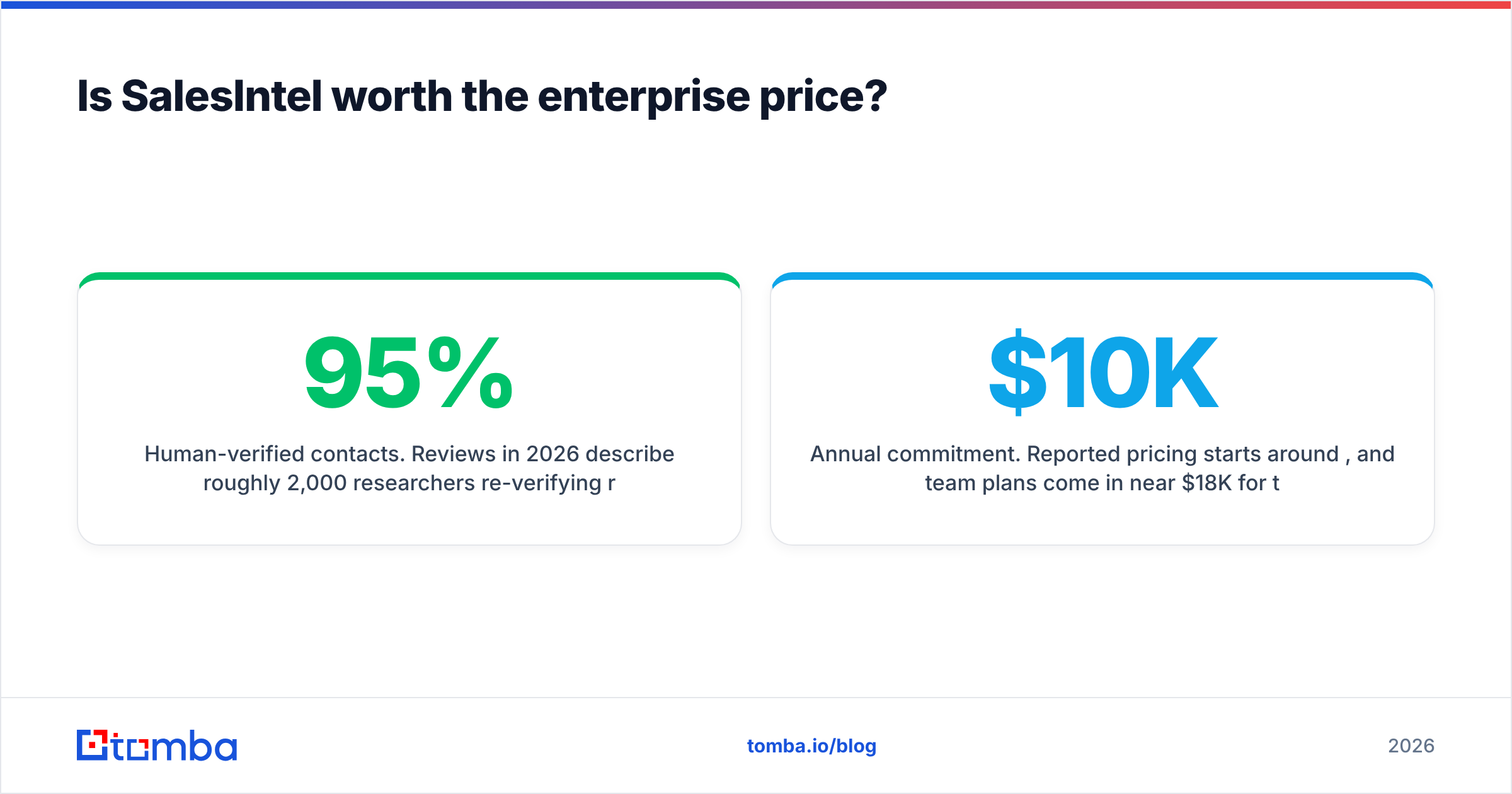
- Human-verified contacts. Reviews in 2026 describe roughly 2,000 researchers re-verifying records on a ~90-day cycle, backed by a stated 95% accuracy guarantee. Mostly machine-aggregated databases decay faster, so this matters.
- Research on demand. If a contact isn't in the database, SalesIntel's team can source or verify it, with turnaround measured in hours.
- Signal360 intent. Signals across dozens of categories and thousands of topics, including funding, hiring spikes, technology changes, and website visits. Useful for account prioritization if your reps actually act on it.
- Unlimited-access packaging. Recent packaging leans toward per-seat unlimited access instead of strict per-record credits. That's good for heavy users, but check the contract, because legacy credit mechanics still show up in some support docs.
What to watch:
- Annual commitment. Reported pricing starts around $10K/yr, and team plans come in near $18K for three seats. You're locked in whether or not your reps adopt it.
- Quote-based pricing. What you pay depends on negotiation, seats, and add-ons. Budget time for procurement.
- Coverage skews to North America. If you prospect heavily in EMEA or APAC, test coverage on your own ICP before signing.
- It's not a catch-all specialist. Human verification lowers bounce risk, but it doesn't solve catch-alls the way a dedicated verifier does.
For an outside view, compare SalesIntel's own product pages with independent user reviews on G2 or Capterra before your demo. Ask the rep specifically about re-verification recency for your target titles.
Which should you choose based on team size and use case?#
Match the tool to your situation:
- Solo founder or small agency, lists from Apollo, LinkedIn, or scraping: Listmint, or a general finder plus verifier. SalesIntel's contract size won't make sense.
- Cold email agency running many client campaigns: Listmint. Catch-all resolution directly protects client domains, and monthly billing matches client churn.
- Mid-market sales team selling into the US, 5+ reps, account-based motion: SalesIntel, if the intent data will actually drive rep prioritization. Otherwise you're paying for dashboards nobody opens.
- Enterprise RevOps with an existing data provider: Neither replaces the other. Consider Listmint as a pre-send check on top of whatever you already license.
- Budget-constrained team that needs to both find and verify: Neither tool alone. You want one platform that does both.
The last group is bigger than most vendor comparisons admit, and that's where the math changes.
What does the total cost look like in practice?#
Take a realistic small-team scenario: you need about 3,000 new contacts a month and you verify roughly 10,000 addresses a month across all sources.
- SalesIntel alone: covers sourcing, but it's an annual commitment in the five-figure range for a team. You'd still want a verification step for any leads that come from outside SalesIntel.
- Listmint alone: covers verification at ~$99/mo, but you still need a separate sourcing tool. That's often another $50–$150/mo per seat.
- Both: the strongest data quality, at a price that only makes sense past a certain pipeline size.
This is where teams get caught off guard. SalesIntel's annual renewal arrives, adoption is at 40%, and the cancellation window closed 60 days ago.

Before you sign any annual data contract, get three answers in writing: the notice period for non-renewal, whether unused credits or seats roll over, and what happens to exported data if you cancel.
Is there a simpler alternative that covers finding and verifying?#
If your honest answer to "data or cleaning?" is "both, on a small-team budget," look at a combined email finder and verifier.
Tomba sits in that space. It's not a SalesIntel-style intent platform, and it doesn't claim to be. What it does:
- Find emails by name plus company, or pull every public address at a company with domain search.
- Verify those addresses with the built-in email verifier. For accept-all domains, use the dedicated catch-all verifier, which is the same problem Listmint specializes in.
- Enrich with phone numbers, LinkedIn profiles, and company data.
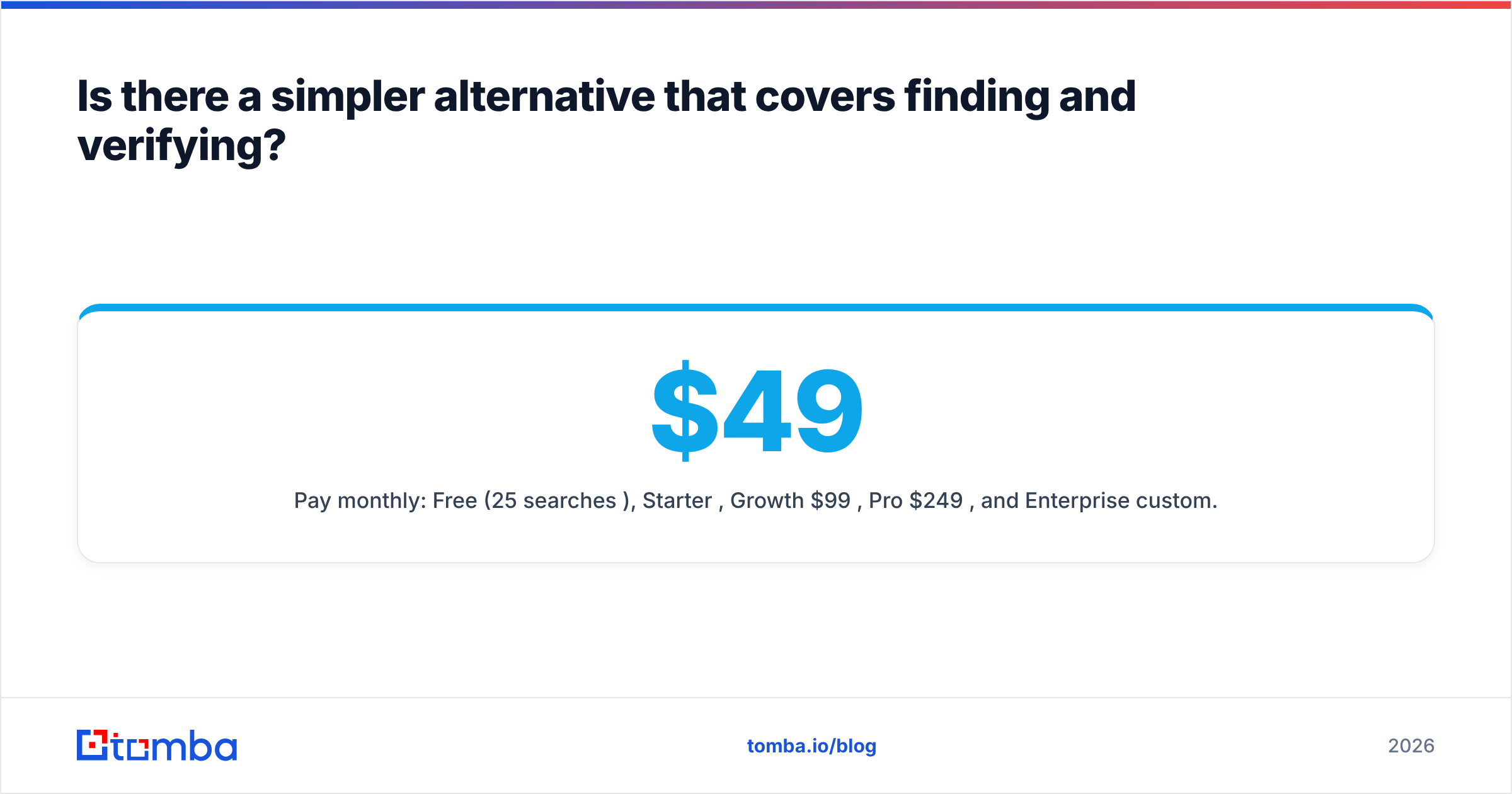
- Pay monthly: Free (25 searches/mo), Starter $49/mo, Growth $99/mo, Pro $249/mo, and Enterprise custom. Details are on the Tomba pricing page.
The honest trade-off: SalesIntel's human re-verification and Signal360 intent data are real advantages for enterprise account-based teams. And if catch-all resolution is your only problem, a specialist like Listmint may still win on that one job. For a team that needs a reliable source of emails plus a verification step, without an annual contract, one tool is simpler than two.
How should you test before committing?#
Whichever direction you go, run the same three-step test:
- Pull a 500-contact sample from your real ICP. Use your actual target titles, industries, and regions, not the vendor's demo list.
- Run it through the tool and record the results. For a verifier, note valid, invalid, catch-all, and unknown counts. For a database, note coverage (how many of your target accounts it has) and how recently each record was verified.
- Send a small, warmed-up batch and measure real bounces. This is the only accuracy number that counts. A verifier that marks 90% of your list "valid" and then bounces 6% has failed, whatever its landing page says.
Keep the spreadsheet. At renewal time, compare it against actual pipeline to see what each tool produced.
What's the bottom line on Listmint vs SalesIntel?#
These tools aren't really competitors. They sit at different points in the pipeline:
- Listmint is a catch-all verification specialist. It's affordable, billed monthly, and useful for agencies and cold emailers whose lists are full of "unknowns."
- SalesIntel is a human-verified B2B data and intent platform. It's expensive, sold on annual contracts, and it's strongest for North American mid-market and enterprise sales teams that will use its intent signals.
If you're a lean team that needs to find prospects and keep bounces down without two separate contracts, start with the Tomba Email Finder. Search by name, company, or domain, verify every result (catch-alls included), and pay monthly from $49, or try the free tier with 25 searches a month first. Run the 500-contact test above against your current setup and let your own bounce rate decide.
Related guides#
Ready to find emails that actually work?
Join 150,000+ professionals who stopped guessing and started sending. Free credits on signup — no credit card required.
Get the Tomba newsletter
Practical outbound tactics and product updates — once every two weeks.
About the author