Logistics Cold Calling Script: 7 Templates for Freight Sales
Most freight cold calls die in the first ten seconds on the words 'we have great rates.' Here are seven logistics cold calling script templates built around lanes, timing, and real shipper pain, plus the prep that gets you past the front desk.
TL;DR
- A logistics cold calling script works when it opens with a specific lane, mode, or shipping event. "We have competitive rates" doesn't work, because every shipper hears it a dozen times a week.
- Different buyers need different scripts. Manufacturers' shipping managers, e-commerce ops leads, 3PL procurement teams and carriers all care about different things.
- Aim for a 15-minute discovery call or a "send me your next RFQ" commitment. Don't try to close a contract on the first dial.
- Most calls are lost before anyone speaks. Dialing a main switchboard, calling the wrong title, or ringing a dead number wastes more time than a weak opener.
- Below you get seven copy-ready scripts, a comparison table showing which to use when, objection responses, and a prep checklist.
Why do most logistics cold calls fail in the first 10 seconds?#
Freight buyers get cold calls constantly. A shipping manager at a mid-size manufacturer may hear from brokers, asset carriers, 3PLs, freight audit firms and TMS vendors in the same week. Most of those calls sound the same: "Hi, I'm with XYZ Logistics, we're a full-service provider with competitive rates, do you have a minute?"
That opener tells the buyer three things, all bad:
- You haven't looked at what they ship.
- You're competing on price, so you'll disappear when a cheaper broker calls.
- The call is about you, not their freight.
Logistics buyers are practical. They care about on-time pickup, tender acceptance, claims, detention, and whether you answer the phone at 6 p.m. on a Friday when a load is stuck. Your script has to point at one of those problems quickly, and it has to sound like you know their business.
The fix is structural. A good logistics cold calling script is built around lanes and events, not company features.
What should a logistics cold calling script include?#
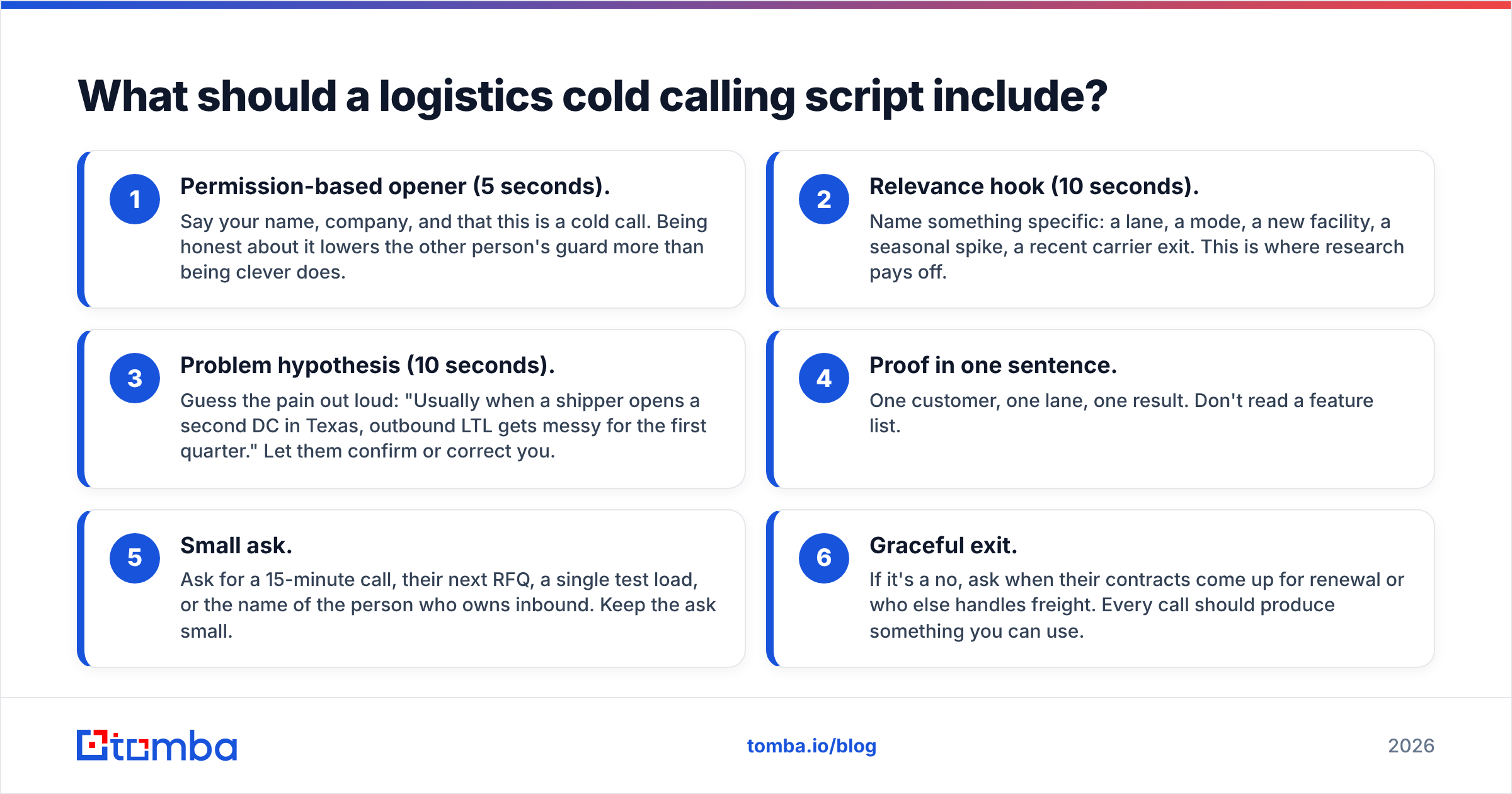
Before the templates, here is the skeleton every good freight call follows. Each part has one job. If a sentence doesn't do that job, cut it.
- Permission-based opener (5 seconds). Say your name, company, and that this is a cold call. Being honest about it lowers the other person's guard more than being clever does.
- Relevance hook (10 seconds). Name something specific: a lane, a mode, a new facility, a seasonal spike, a recent carrier exit. This is where research pays off.
- Problem hypothesis (10 seconds). Guess the pain out loud: "Usually when a shipper opens a second DC in Texas, outbound LTL gets messy for the first quarter." Let them confirm or correct you.
- Proof in one sentence. One customer, one lane, one result. Don't read a feature list.
- Small ask. Ask for a 15-minute call, their next RFQ, a single test load, or the name of the person who owns inbound. Keep the ask small.
- Graceful exit. If it's a no, ask when their contracts come up for renewal or who else handles freight. Every call should produce something you can use.
Keep the whole pitch under 45 seconds before you hand the conversation back. If you're talking for longer than that, the buyer has probably stopped listening.
Which logistics cold calling script should you use for each buyer?#
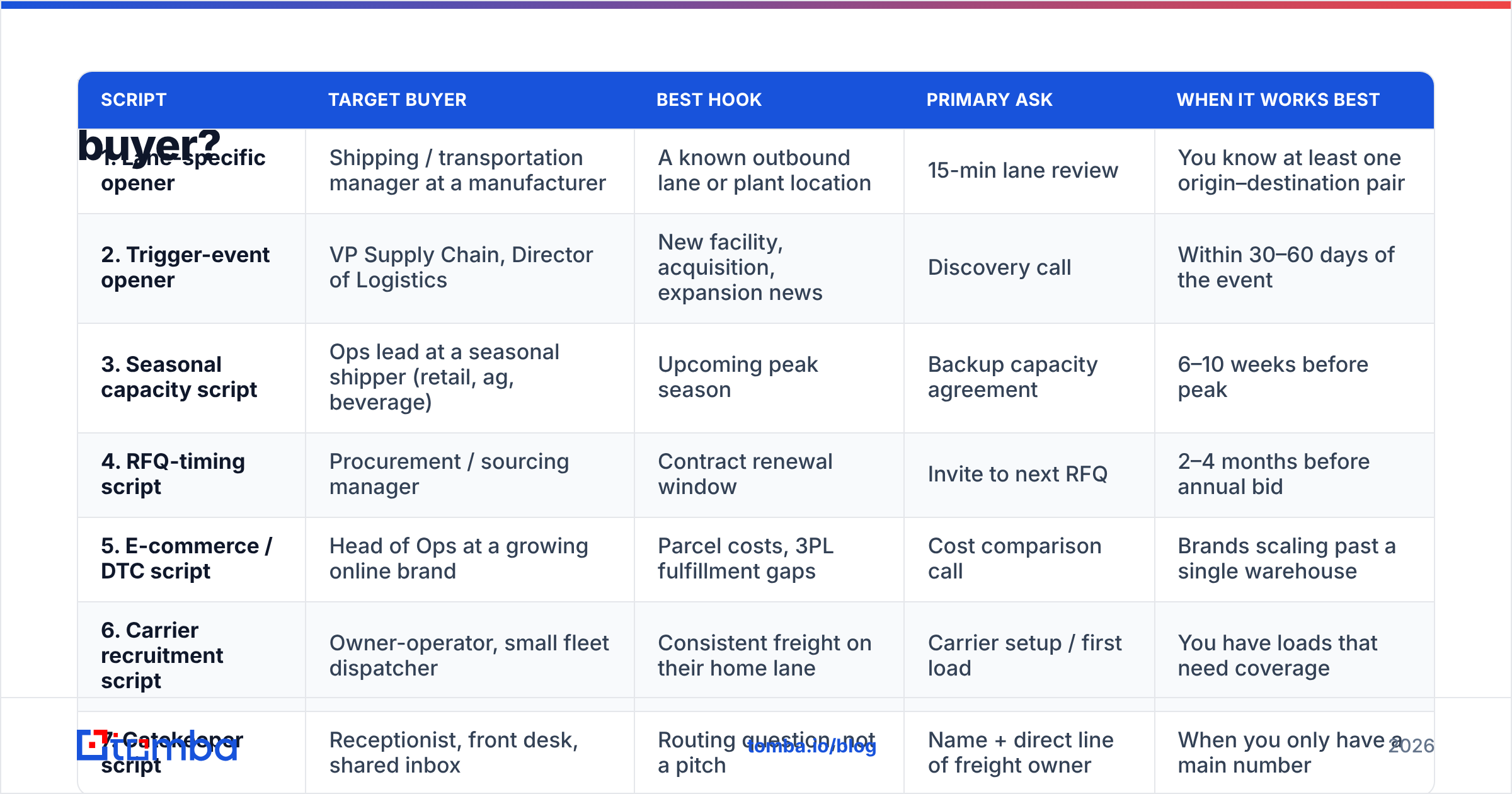
The biggest mistake is using one script for every call. A plant logistics manager and a DTC brand's operations lead have almost nothing in common apart from the word "shipping." Use this table to match the script to the buyer.
| Script | Target buyer | Best hook | Primary ask | When it works best |
|---|---|---|---|---|
| 1. Lane-specific opener | Shipping / transportation manager at a manufacturer | A known outbound lane or plant location | 15-min lane review | You know at least one origin–destination pair |
| 2. Trigger-event opener | VP Supply Chain, Director of Logistics | New facility, acquisition, expansion news | Discovery call | Within 30–60 days of the event |
| 3. Seasonal capacity script | Ops lead at a seasonal shipper (retail, ag, beverage) | Upcoming peak season | Backup capacity agreement | 6–10 weeks before peak |
| 4. RFQ-timing script | Procurement / sourcing manager | Contract renewal window | Invite to next RFQ | 2–4 months before annual bid |
| 5. E-commerce / DTC script | Head of Ops at a growing online brand | Parcel costs, 3PL fulfillment gaps | Cost comparison call | Brands scaling past a single warehouse |
| 6. Carrier recruitment script | Owner-operator, small fleet dispatcher | Consistent freight on their home lane | Carrier setup / first load | You have loads that need coverage |
| 7. Gatekeeper script | Receptionist, front desk, shared inbox | Routing question, not a pitch | Name + direct line of freight owner | When you only have a main number |
Use the table as a routing guide. Before you dial, find out who you're calling and why now. Then choose the script.
Script 1: How do you open a call with a lane-specific pitch?#
This is the most reliable script in freight sales because it shows you've done your homework. You need one real origin–destination pair, which you can get from the plant location, a public import record, or a facility list on their website.
"Hi Dana, it's Marcus with Ridgeline Freight. I'll be upfront: this is a cold call. Got 30 seconds for me to say why I called, and then you decide?
We run a lot of dry van out of the Memphis area into the Southeast, and I noticed your plant is in Olive Branch. Shippers on that lane have been telling us tender rejections go up whenever the Atlanta market tightens. Is that something you're dealing with, or is it covered?"
If they say it's covered:
"Makes sense. Most shippers I talk to have a primary carrier they like. Where we usually help is as the backup when the primary rejects. Would it be crazy to set us up so you've got a second option ready?"
Why it works: you named their geography, gave a believable pain, and asked a question they can answer easily. You never said "rates."
Script 2: How do you use trigger events in a freight cold call?#
Trigger events are your best source of timing. New distribution centers, acquisitions, new product lines, a plant closure, or a public expansion announcement all change a company's freight network. A changing network needs new carriers and new partners.
"Hi Priya, Sam from Northline Logistics. I saw the announcement about your new fulfillment center in Reno. Congrats. Usually when a shipper adds a western node, the first 90 days are messy on the inbound side: new lanes, carriers who don't know the dock, appointment scheduling that isn't dialed in yet.
I'm not assuming that's you. Who on your team is building out the carrier mix for Reno?"
Notice the ask. You're asking who owns the problem, not for a meeting. Even a gatekeeper-level answer gives you the next call.
Script 3: What's the best seasonal capacity cold calling script?#
Seasonal shippers such as beverage, lawn and garden, holiday retail and produce know when their capacity problems will hit. Call them 6–10 weeks before it happens.
"Hi Tom, Leah with Crestway Transportation. Quick one: I know beverage volume in the Midwest usually starts climbing in April. Last spring a lot of shippers I talk to got caught paying spot rates on reefer when their contract carriers maxed out.
Are you already lined up for peak, or would it help to have a backup carrier approved before you need one?"
The value here is insurance. Nobody wants to set up a new carrier in the middle of a crisis, so offer the setup work now while things are calm.
Script 4: How do you get invited to a shipper's next RFQ?#
Many shippers bid their freight annually or semi-annually. If you aren't on the invite list, you won't see that freight until next year. This script is short because the ask is so small.
"Hi Carlos, Dev from Summit 3PL. I'm not calling to pitch a rate today. I just want to find out if you run an annual freight bid, and if so, what it takes to get on the invite list. We're strong on LTL across the Northeast and I'd rather compete fairly in your RFQ than chase you with spot quotes."
Procurement people usually respond well to this because it respects their process. Log the renewal date in your CRM and set a reminder 60 days before it.
Script 5: How should you cold call e-commerce and DTC brands?#
DTC operations leads think in parcel zones, cost per order, split shipments and 3PL service levels. Truckload language won't mean much to them.
"Hi Maya, Jordan with Parcelpath Fulfillment. We work with apparel brands shipping somewhere around 2,000 to 10,000 orders a month. The pattern we see is that once you're shipping coast to coast from a single warehouse, zone 7 and 8 costs start eating margin.
Are you shipping everything from one location right now, or have you already split inventory?"
If they've split inventory, pivot to service levels and returns. If they haven't, you're having the conversation they probably need to have anyway.
Script 6: What script works for recruiting carriers?#
Brokers spend as much time calling carriers as shippers. Owner-operators care about three things: consistent freight on lanes near home, fast pay, and not being jerked around.
"Hey, is this Ray? This is Nina with Blue Line Brokerage. I saw you're running out of Joplin. I've got recurring dry van loads Joplin to Dallas, three a week, dock-to-dock, no touch. Is that a lane you'd want to run regularly?"
Put the load first and the details right after. Skip the company introduction until they ask. For carrier vetting, check authority status and safety data on the FMCSA site before you tender anything.
Script 7: How do you get past the gatekeeper at a logistics company?#
Receptionists at manufacturers and distributors route calls all day. Your job is to sound like a routing question, not a sales pitch.
"Hi, hoping you can point me in the right direction. Who handles outbound freight for the plant: is that a transportation manager or does it go through purchasing?"
Then:
"Great, and what's the best way to reach [name] directly? I'd rather not tie up the main line."
Keep it short and friendly, and don't lie about who you are. If you get a name but no extension, that's still a win, because you can find the direct contact yourself.
How do you handle common objections on logistics cold calls?#
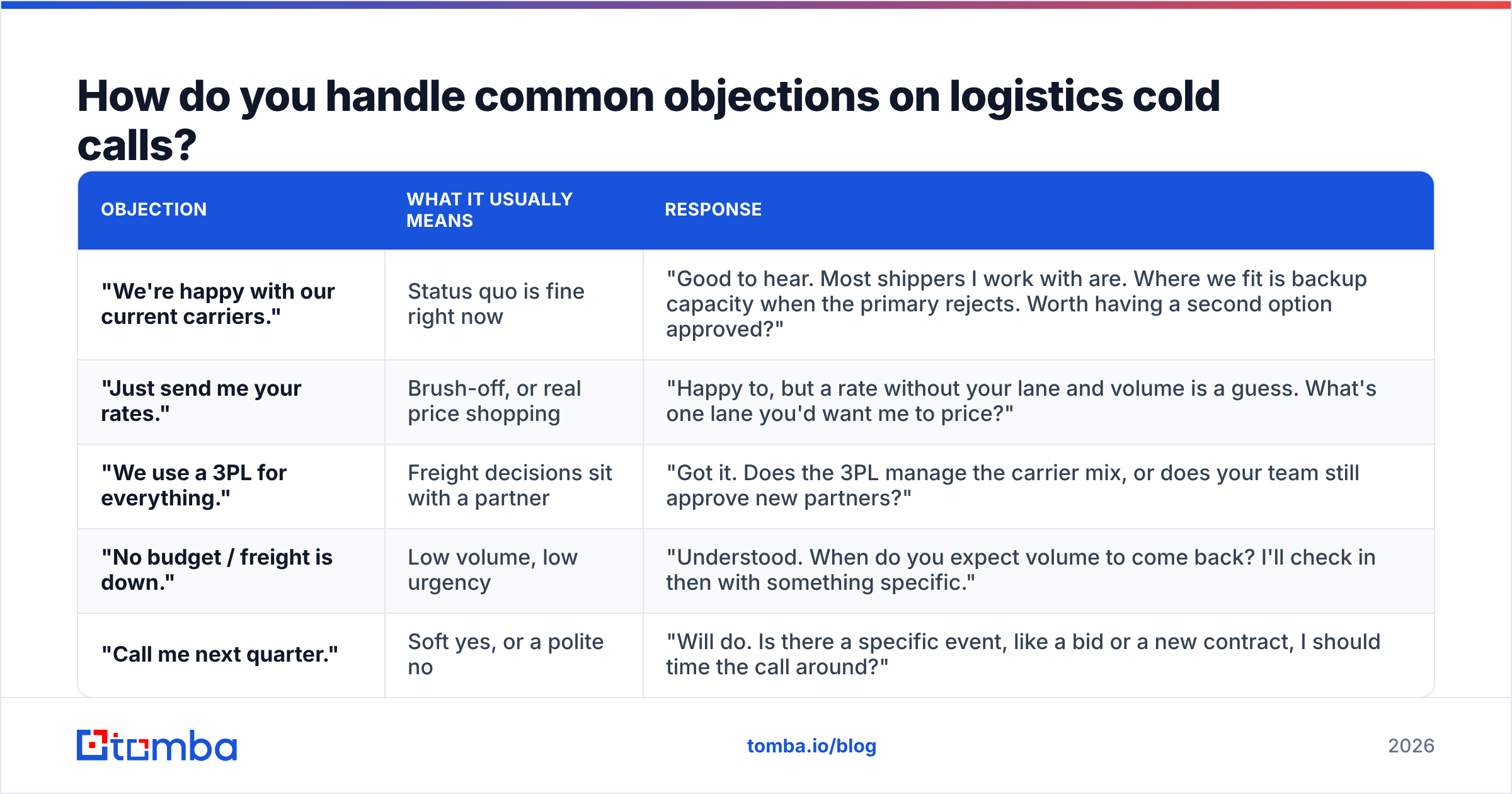
You'll hear the same five objections again and again. Prepare answers before you dial.
| Objection | What it usually means | Response |
|---|---|---|
| "We're happy with our current carriers." | Status quo is fine right now | "Good to hear. Most shippers I work with are. Where we fit is backup capacity when the primary rejects. Worth having a second option approved?" |
| "Just send me your rates." | Brush-off, or real price shopping | "Happy to, but a rate without your lane and volume is a guess. What's one lane you'd want me to price?" |
| "We use a 3PL for everything." | Freight decisions sit with a partner | "Got it. Does the 3PL manage the carrier mix, or does your team still approve new partners?" |
| "No budget / freight is down." | Low volume, low urgency | "Understood. When do you expect volume to come back? I'll check in then with something specific." |
| "Call me next quarter." | Soft yes, or a polite no | "Will do. Is there a specific event, like a bid or a new contract, I should time the call around?" |
The pattern is the same each time: agree, reframe, and ask a small question. Never argue about their current carrier. You're offering an option, not criticizing their decision.
What prep do you need before you dial?#
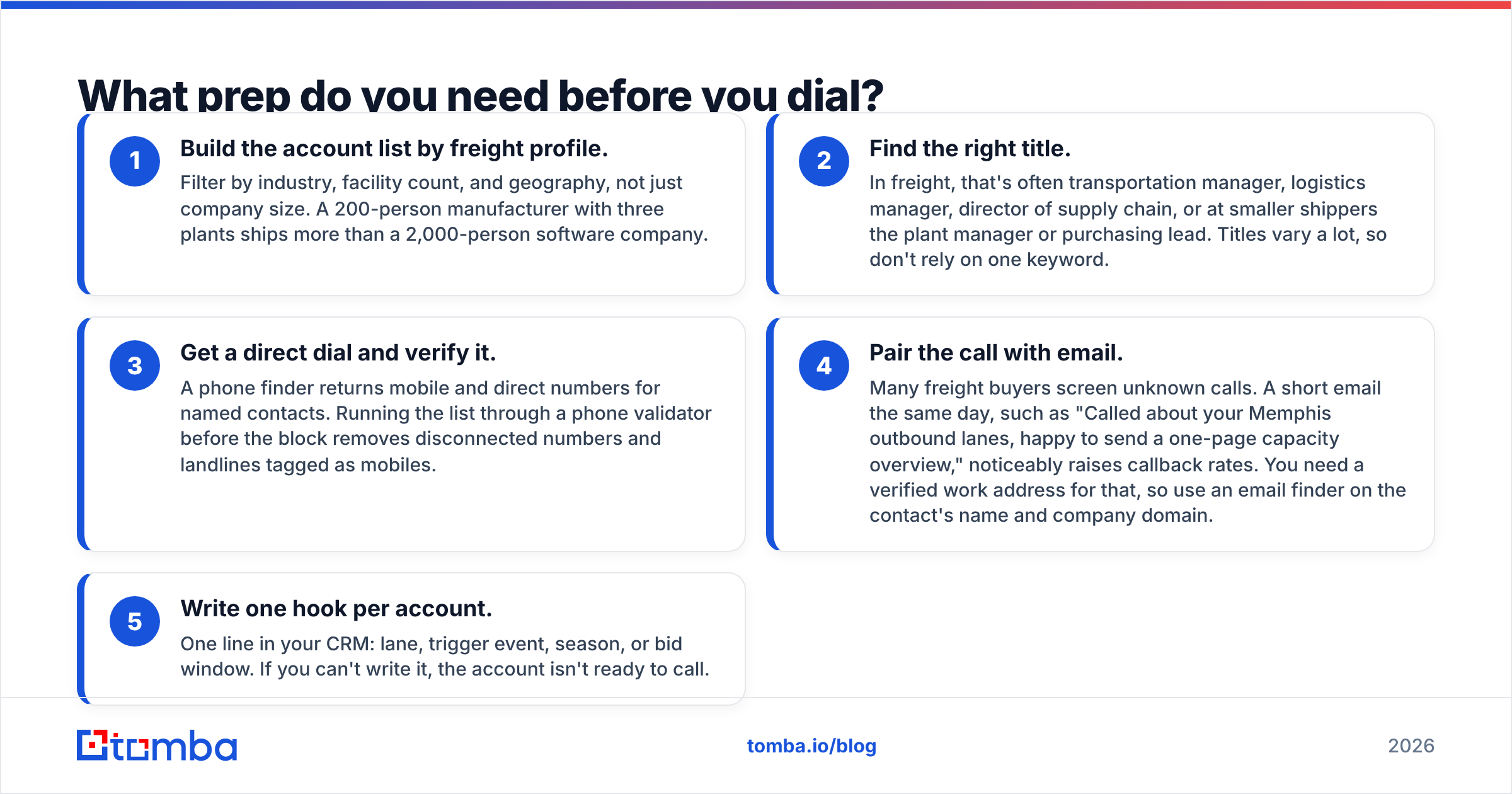
Scripts get attention, but prep decides your connect rate. A great opener does nothing if the number rings a front desk that transfers you to voicemail. Before every call block, work through this list:
- Build the account list by freight profile. Filter by industry, facility count, and geography, not just company size. A 200-person manufacturer with three plants ships more than a 2,000-person software company.
- Find the right title. In freight, that's often transportation manager, logistics manager, director of supply chain, or at smaller shippers the plant manager or purchasing lead. Titles vary a lot, so don't rely on one keyword.
- Get a direct dial and verify it. A phone finder returns mobile and direct numbers for named contacts. Running the list through a phone validator before the block removes disconnected numbers and landlines tagged as mobiles.
- Pair the call with email. Many freight buyers screen unknown calls. A short email the same day, such as "Called about your Memphis outbound lanes, happy to send a one-page capacity overview," noticeably raises callback rates. You need a verified work address for that, so use an email finder on the contact's name and company domain.
- Write one hook per account. One line in your CRM: lane, trigger event, season, or bid window. If you can't write it, the account isn't ready to call.
Outbound teams that separate research blocks from dialing blocks usually make more real conversations per hour, because context-switching mid-block kills momentum.
Is cold calling still legal and effective for logistics sales in 2026?#
Yes, with limits. In the US, B2B calls to business landlines are generally less restricted than consumer calls. But calling mobile numbers with autodialers or prerecorded messages falls under the Telephone Consumer Protection Act, and state rules vary. Dial manually or with compliant tooling, honor do-not-call requests immediately, and check with counsel if you call into Canada, the UK, or the EU, where rules are stricter.
On effectiveness: freight is still a relationship business. Shippers want to know who picks up when a load goes sideways, and a voice on the phone builds that trust faster than a sequence of emails. The teams that do well in 2026 run calls and email together: one call, one email, one LinkedIn touch, repeated over a couple of weeks. If you want background on how brokers, asset carriers and 3PLs differ, and which one you're pitching as, the third-party logistics overview on Wikipedia is a useful primer to share with new reps.
How do you measure whether your script is working?#
Track a few numbers per script, not just per rep:
- Connect rate. Dials that reach a human. Low connect rates point to a data problem, not a script problem.
- Conversation rate. Connects that last past 30 seconds. This tells you whether your opener and hook work.
- Meeting or RFQ rate. Conversations that produce the small ask. This tells you whether your problem hypothesis and ask work.
- Callback rate from paired email. Shows whether your follow-up email adds anything.
Change one variable at a time. Run the lane-specific opener for 100 connects, then test a different hook. Most reps rewrite the whole script after 20 bad calls and never learn which line was the problem.
What's the bottom line on logistics cold calling scripts?#
The best logistics cold calling script sounds like you already understand the buyer's freight. Lead with a lane, an event, or a season. Guess the pain out loud. Ask for something small. Match the script to the buyer: a DTC ops lead and an owner-operator shouldn't hear the same pitch.
Most lost calls come from the prep, not the script: wrong titles, switchboard numbers, and no follow-up email. Fix the data and the scripts above will work much harder for you.
If your call blocks keep landing on front desks and dead inboxes, start with the contact layer. Tomba Email Finder returns verified work emails for shipping managers, logistics directors and procurement leads from a name and company domain, so every call can be paired with a same-day email. You can start on the free tier with 25 searches a month before upgrading.
Related guides#
// get started
Find, verify and enrich your first contacts today
Start on the free plan with 25 searches a month, then scale when your team is ready.
Free plan · No credit card required · GDPR & CCPA
// about the author