Logistics Lead Generation: 9 Tactics to Fill a Freight Pipeline
Shippers rarely switch carriers or 3PLs on a whim, but they do switch. Here are nine logistics lead generation tactics that reach the right decision-maker before the RFP goes out, plus the data stack behind them.
TL;DR
- Logistics lead generation works best when you target trigger events (new facility, expansion, lane changes, carrier failures) instead of blasting generic "we move freight" emails.
- Your buyers are split across roles: logistics managers, VPs of supply chain, procurement, and sometimes the plant manager. Multi-threading is the default, not an extra.
- Outbound (email plus phone) is still the fastest channel for freight brokers and 3PLs. Content and RFP portals take longer but compound.
- Bad data wrecks you fast in this vertical. Warehouse and plant staff turn over often, and generic inboxes (dispatch@, shipping@) rarely reach the people who decide.
- Build a lean stack: an account source, an email finder, a verifier, a phone finder, and a sequencer. You don't need an enterprise platform to start.
What is logistics lead generation?#
Logistics lead generation is how freight brokers, 3PLs, carriers, warehousing providers, and freight-tech vendors find and qualify companies that ship goods, and then start conversations with them. The "lead" is usually a shipper (a manufacturer, distributor, e-commerce brand, or retailer), though for some providers it's another logistics company, such as a broker looking for capacity partners or a TMS vendor selling to third-party logistics providers.
Three things make it different from generic B2B lead gen:
- Buying is event-driven. A shipper with a stable carrier network isn't shopping. The same shipper after a missed delivery window, a new distribution center, or a rate increase is shopping hard.
- The buying committee is spread out. Transportation managers own the day-to-day, procurement owns the RFP, and finance owns the budget. Each one cares about something different.
- Relationships stick. Once you're in a shipper's routing guide, you can hold lanes for years. That makes the first foot in the door worth a lot, and it's why competition for those meetings is fierce.
Who are you actually trying to reach?#
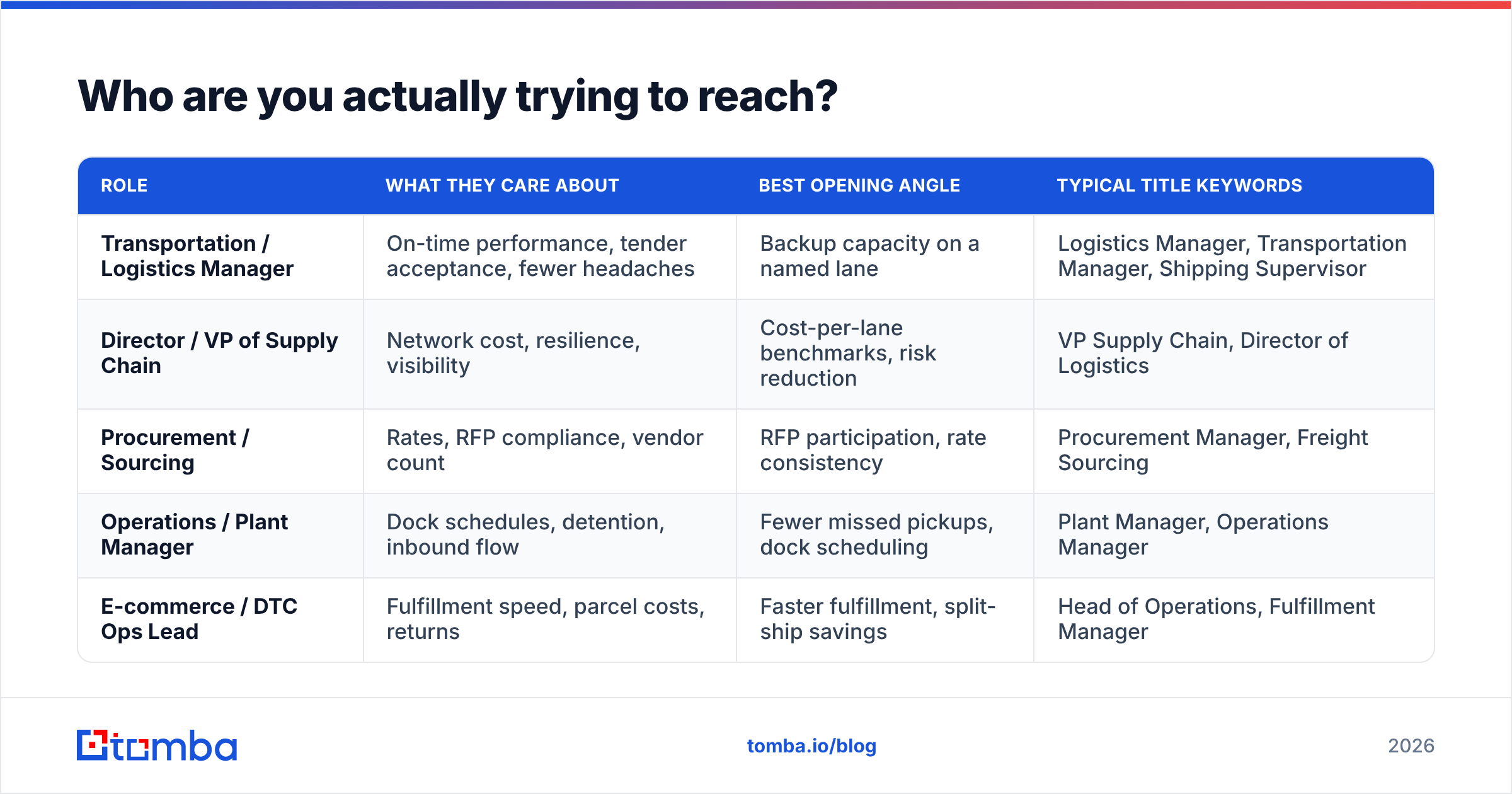
Before choosing channels, get specific about the person. "Shippers" is a market, not a persona. Here's how the main logistics buyer roles break down:
| Role | What they care about | Best opening angle | Typical title keywords |
|---|---|---|---|
| Transportation / Logistics Manager | On-time performance, tender acceptance, fewer headaches | Backup capacity on a named lane | Logistics Manager, Transportation Manager, Shipping Supervisor |
| Director / VP of Supply Chain | Network cost, resilience, visibility | Cost-per-lane benchmarks, risk reduction | VP Supply Chain, Director of Logistics |
| Procurement / Sourcing | Rates, RFP compliance, vendor count | RFP participation, rate consistency | Procurement Manager, Freight Sourcing |
| Operations / Plant Manager | Dock schedules, detention, inbound flow | Fewer missed pickups, dock scheduling | Plant Manager, Operations Manager |
| E-commerce / DTC Ops Lead | Fulfillment speed, parcel costs, returns | Faster fulfillment, split-ship savings | Head of Operations, Fulfillment Manager |
Pick one or two primary personas per campaign. A sequence written for a VP of Supply Chain will fall flat with a shipping supervisor, and the other way around.
Which logistics lead generation channels work best?#
No single channel wins every time. The right mix depends on your deal size, how much capacity you have, and how quickly you need pipeline. This is how the main channels compare:
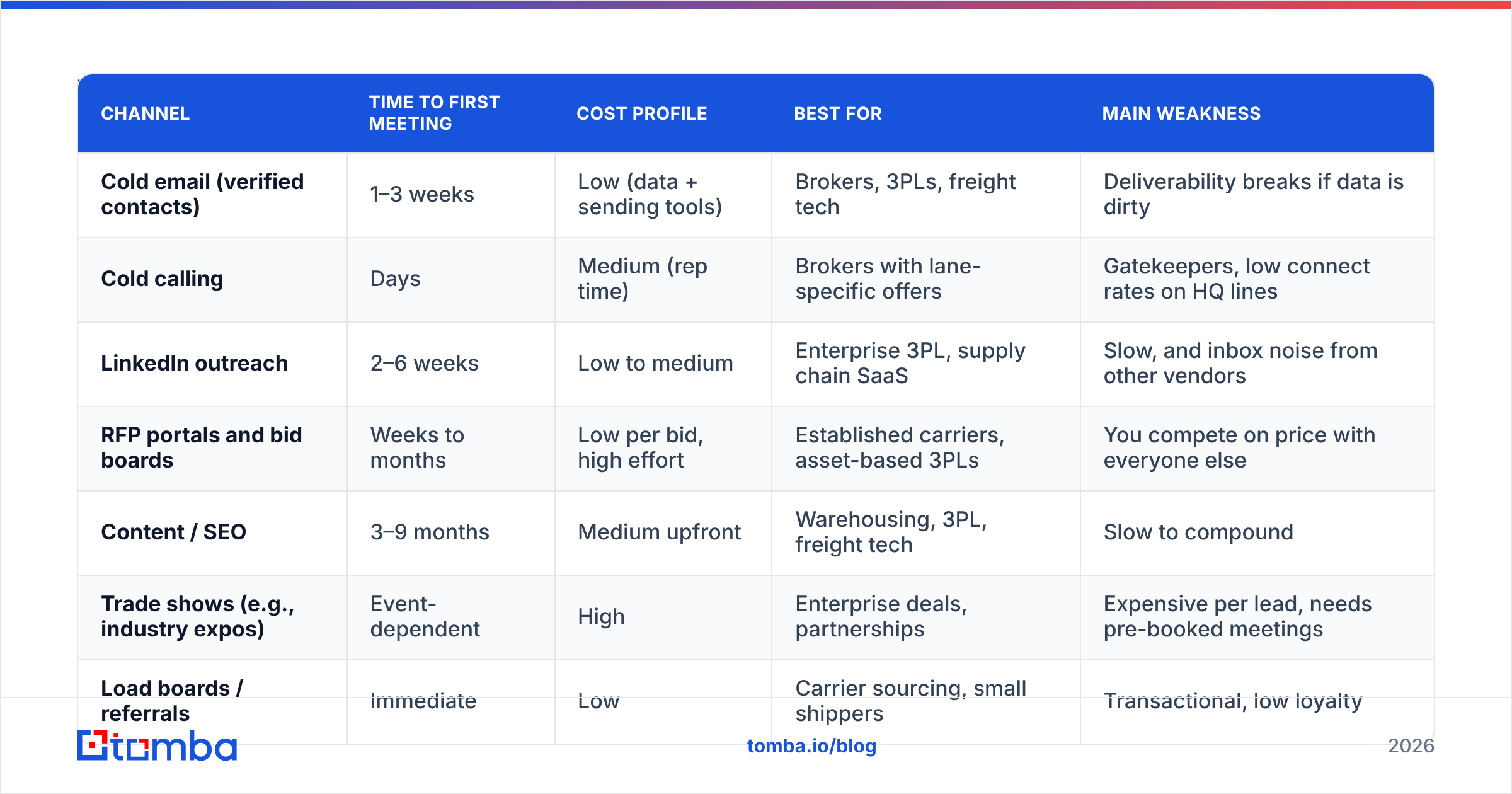
| Channel | Time to first meeting | Cost profile | Best for | Main weakness |
|---|---|---|---|---|
| Cold email (verified contacts) | 1–3 weeks | Low (data + sending tools) | Brokers, 3PLs, freight tech | Deliverability breaks if data is dirty |
| Cold calling | Days | Medium (rep time) | Brokers with lane-specific offers | Gatekeepers, low connect rates on HQ lines |
| LinkedIn outreach | 2–6 weeks | Low to medium | Enterprise 3PL, supply chain SaaS | Slow, and inbox noise from other vendors |
| RFP portals and bid boards | Weeks to months | Low per bid, high effort | Established carriers, asset-based 3PLs | You compete on price with everyone else |
| Content / SEO | 3–9 months | Medium upfront | Warehousing, 3PL, freight tech | Slow to compound |
| Trade shows (e.g., industry expos) | Event-dependent | High | Enterprise deals, partnerships | Expensive per lead, needs pre-booked meetings |
| Load boards / referrals | Immediate | Low | Carrier sourcing, small shippers | Transactional, low loyalty |
For most freight brokers and mid-size 3PLs, outbound email plus phone is the backbone, and content and events add to it. Freight-tech vendors usually lean further into content and LinkedIn because their deals are larger and their sales cycles longer.
What are the 9 logistics lead generation tactics that actually work?#
1. Build lists from trigger events, not industry codes#
A list of "all manufacturers in Ohio" is too broad. A list of manufacturers that announced a new plant, opened a DC, raised a funding round, or posted five warehouse jobs this month is a list of people with a problem right now.
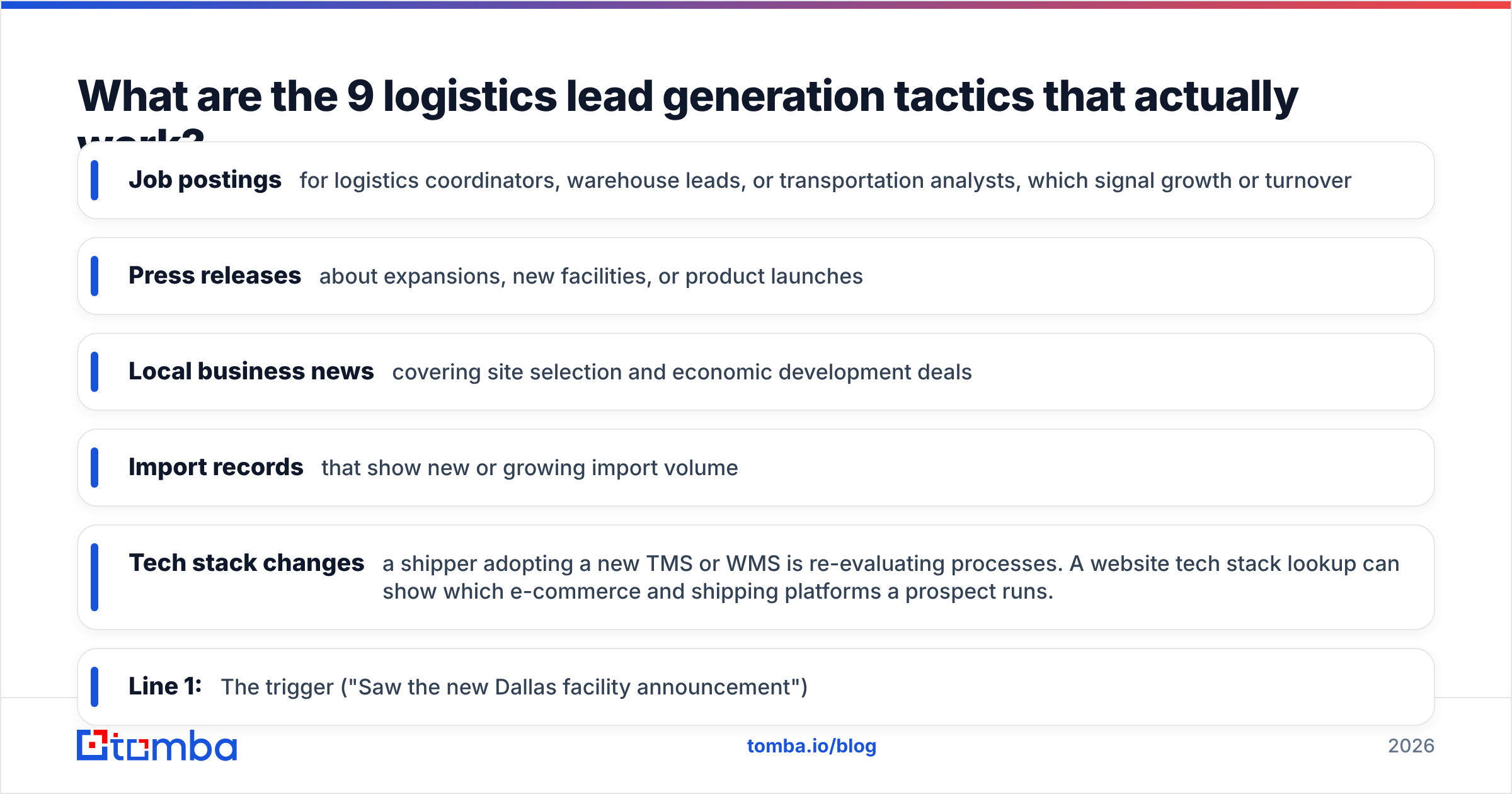
Where to find triggers:
- Job postings for logistics coordinators, warehouse leads, or transportation analysts, which signal growth or turnover
- Press releases about expansions, new facilities, or product launches
- Local business news covering site selection and economic development deals
- Import records that show new or growing import volume
- Tech stack changes: a shipper adopting a new TMS or WMS is re-evaluating processes. A website tech stack lookup can show which e-commerce and shipping platforms a prospect runs.
2. Map the account before you email anyone#
Once you have a target company, pull every relevant contact at the domain, not just the first name you find. A domain search returns the public professional emails tied to a company domain along with titles, so you can see whether the shipper has a dedicated transportation team or whether logistics sits under operations.
This matters because at a 200-person manufacturer, "logistics" might be one person with a plant manager title. At a 5,000-person distributor, it's a department with a director, three analysts, and a procurement partner.
3. Skip the generic inboxes#
Addresses like shipping@, logistics@, and info@ are where cold emails go to die. At best they reach a dispatcher who doesn't pick vendors. At worst they're catch-all or unmonitored.
Find named contacts instead. If you know the person's name and the company domain, an email finder can work out their address from the company's pattern. If you only have a LinkedIn profile, work from that. Generic inboxes are fine for things like carrier setup packets, but they aren't a prospecting channel.

4. Verify every list, every time#
This is the step that sets working logistics outbound apart from outbound that gets blocklisted. Staff turnover in warehousing and transportation roles is high, so contact data goes stale faster than in many other B2B verticals. A list you bought six months ago has decayed noticeably by now.
Run every contact through an email verifier before it goes into a sequence. Pay special attention to catch-all domains, which many older manufacturing and distribution companies run on legacy mail servers. Treat catch-all results as "risky" and send to them in smaller batches rather than dropping them all into your main campaign.
A high bounce rate doesn't just waste one send. It damages your sender reputation for every email that follows, including emails to your good leads.
5. Write lane-specific, not company-specific, emails#
"We're a full-service 3PL with 20 years of experience" says nothing. "We run daily reefer capacity Chicago to Atlanta and saw you just opened a DC in McDonough" gives the reader a reason to reply.
A structure that works for freight outreach:
- Line 1: The trigger ("Saw the new Dallas facility announcement")
- Line 2: The relevant capacity or capability ("We cover dry van out of DFW to the Southeast daily")
- Line 3: Proof ("Currently hauling for two other food distributors in the region")
- Line 4: A low-friction ask ("Worth being a backup on a couple of lanes?")
Asking to be a backup carrier or a secondary option is a much smaller commitment than asking to replace the incumbent. Many shippers will say yes to that because it costs them nothing.
6. Add the phone, especially for smaller shippers#
Freight is still a phone-heavy business. Logistics managers at small and mid-size shippers often answer their direct lines or mobiles, particularly early in the morning before the dock gets busy.
Direct dials beat HQ switchboards by a wide margin. A phone finder can surface direct numbers tied to a professional profile, which lets you run email-then-call sequences instead of relying on one channel.
A simple rhythm: email on day 1, call on day 2 referencing the email, follow-up email on day 4, call on day 7, breakup email on day 12.
7. Qualify shippers before a rep spends time on them#
Not every shipper is a good fit. Before a lead moves to a rep, check:
- Freight profile: Mode (FTL, LTL, reefer, flatbed, parcel), volume, and lanes that match your network
- Decision process: Routing guide, annual RFP, or spot-market buyer
- Pain signal: A trigger event, a known service failure, or growth
- Credit and payment behavior: Brokers get burned by slow-paying shippers, so check before you haul
For carrier-side prospecting, such as brokers vetting capacity partners, the FMCSA's SAFER system is the authoritative public source for authority status, safety ratings, and fleet size.
8. Use content to catch the shippers you missed#
Outbound reaches people who aren't looking yet. Content catches the ones who are. Useful formats for logistics include:
- Lane rate snapshots or seasonal capacity outlooks
- Guides to specific problems ("how to cut detention charges," "LTL vs. volume LTL")
- Case studies with real numbers (with the shipper's permission)
- Calculators such as freight class, dimensional weight, or landed cost
Content is slow. Give it two or three quarters before judging it. But once it ranks, it produces inbound leads that already know what you do.
9. Close the loop in your CRM#
Every lane conversation, RFP date, and "call me in Q3" should land in your CRM with a follow-up task. Shippers run RFPs on annual cycles, so a "not now" in March can become a real opportunity when their bid season opens. Reps who track RFP calendars for their accounts end up in rooms that cold outreach never reaches.
What does a lean logistics lead generation stack look like?#
You don't need a six-figure data platform to run this well. A practical stack has five layers:
- Account source: Where you find target companies. This could be industry directories, trade association member lists, import data, job boards, or a B2B contact database. Providers such as BookYourData, Apollo, and ZoomInfo all offer pre-built shipper lists at different price points and depths. Compare coverage for your region and verticals on review sites like G2 before you commit.
- Email finder: Turns a company plus a name (or just a domain) into a verified professional address.
- Email verifier: Cleans every list before sending. Non-negotiable.
- Phone finder / validator: Adds direct dials so you can run multichannel sequences.
- Sequencer + CRM: Sends the cadence, logs replies, and tracks follow-ups and RFP dates.
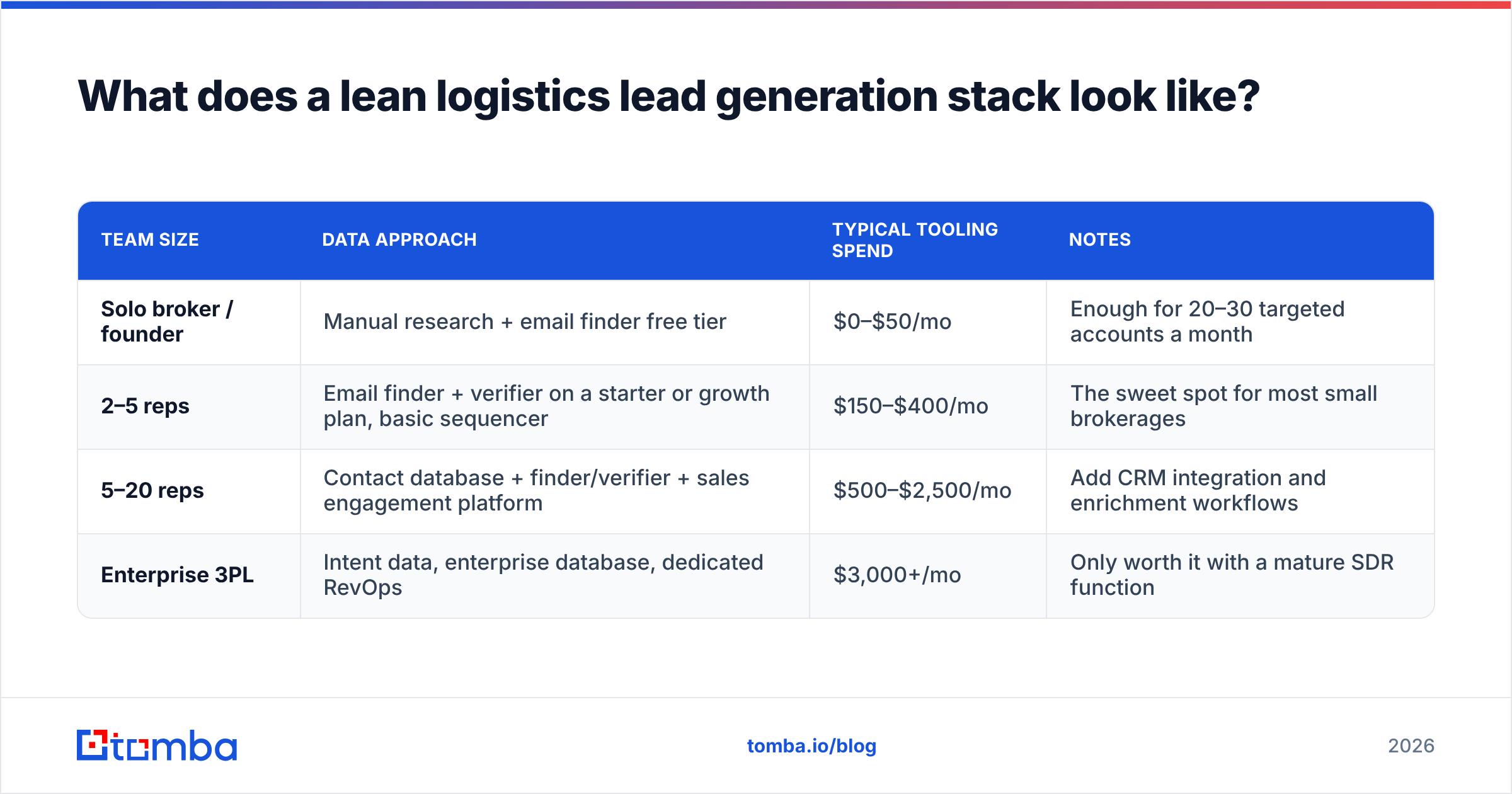
Here's how the cost of that stack roughly scales by team size:
| Team size | Data approach | Typical tooling spend | Notes |
|---|---|---|---|
| Solo broker / founder | Manual research + email finder free tier | $0–$50/mo | Enough for 20–30 targeted accounts a month |
| 2–5 reps | Email finder + verifier on a starter or growth plan, basic sequencer | $150–$400/mo | The sweet spot for most small brokerages |
| 5–20 reps | Contact database + finder/verifier + sales engagement platform | $500–$2,500/mo | Add CRM integration and enrichment workflows |
| Enterprise 3PL | Intent data, enterprise database, dedicated RevOps | $3,000+/mo | Only worth it with a mature SDR function |
For reference, Tomba's plans run from a free tier (25 searches a month) through Starter at $49/mo, Growth at $99/mo, and Pro at $249/mo. Full breakdown on the Tomba pricing page. Most small freight teams fit into the Starter or Growth tier.
How do you measure whether logistics lead generation is working?#
Vanity metrics like emails sent or connection requests accepted won't tell you much. Track these instead:
- Bounce rate: Keep it under 2–3%. Anything higher means your data or verification step is broken.
- Reply rate by persona: Split logistics managers from VPs from procurement. You'll often find one persona replies at several times the rate of the others.
- Meetings per 100 accounts: A cleaner metric than per-email numbers, because it rewards multi-threading.
- Lanes quoted: The real middle-of-funnel signal in freight. A meeting without a quote is a conversation, not an opportunity.
- First load / first shipment: Your true conversion event. Track days from first touch to first load.
- Lane expansion: How many accounts grow from one lane to three or more within six months.
If replies are strong but quotes are weak, your targeting is off (wrong lanes or modes). If quotes are strong but first loads are weak, it's usually a pricing issue, or the shipper is using you to benchmark their incumbent.
What mistakes kill logistics outreach?#
These come up again and again:
- Pitching everything. "We do FTL, LTL, intermodal, drayage, warehousing, and customs" reads like spam. Lead with the one service that fits the trigger.
- Buying a big list and blasting it. Old, unverified shipper lists produce bounces, spam complaints, and burned domains. Verify first, send in small batches, and warm up new sending domains. A warmup calculator helps you plan daily volume ramps.
- Single-threading. If your only contact at a shipper leaves (which happens a lot in this industry), your pipeline leaves with them.
- Ignoring RFP season. Many shippers bid freight once or twice a year. If you're not on the invite list by then, you're waiting another year.
- No follow-up. Most freight meetings come from the third to fifth touch, not the first.

Is outbound or inbound better for logistics companies?#
For most freight brokers and small-to-mid 3PLs, outbound should come first. It's the only channel that produces pipeline within weeks, and you control exactly which lanes and shippers you go after. Inbound through content, SEO, and referrals is worth building alongside it, but it rarely carries a young brokerage on its own.
Larger 3PLs and freight-tech vendors can rebalance toward inbound once they have brand recognition, because their deals are larger and buyers do more research before contacting a vendor. Even then, account-based outbound to named enterprise shippers stays part of the mix. HubSpot's guide to outbound vs. inbound lays out the trade-offs if you're building both motions at once.
Where should you start this week?#
If you're starting from zero, keep it small and specific:
- Pick one lane or region where you have real capacity or expertise.
- Build a list of 30–50 shippers in that area with a recent trigger event.
- Find two to three named contacts per account across transportation, supply chain, and procurement.
- Verify every address, then add direct dials where you can.
- Run a 12-day, 5-touch email-and-phone sequence with lane-specific copy.
- Log every reply and "not now" with a follow-up date in your CRM.
Review results after 30 days, then double down on the persona and trigger that produced the most quoted lanes.
The biggest single factor in logistics lead generation is data: reaching the actual transportation manager, not a dispatch inbox, with an address that won't bounce. Tomba Email Finder finds and verifies professional emails from a shipper's domain or a contact's name, so you can map the logistics team at a target account in minutes and go into your sequence with a clean list. Start on the free tier with 25 searches, test it on your next lane-specific campaign, and upgrade once you see which shippers reply.
Related guides#
Ready to find emails that actually work?
Join 150,000+ professionals who stopped guessing and started sending. Free credits on signup — no credit card required.
Get the Tomba newsletter
Practical outbound tactics and product updates — once every two weeks.
About the author