Logvalid Alternatives: 7 Email Verifiers Compared for 2026
Logvalid is cheap and simple. Once you hit catch-all domains, need a real API, or want to find emails as well as verify them, it starts to fall short. Here are seven alternatives and what each one is best at.
- Logvalid is a lightweight, low-cost email verifier. It gives you 500 free credits, and paid usage starts at about $1 for 2,000 credits according to its Capterra listing. For occasional small-list cleaning, that's hard to beat.
- Teams usually move on for three reasons: they need deeper catch-all handling, a documented API with integrations, or a single tool that both finds and verifies emails.
- Best all-round replacement for outbound teams: Tomba. It puts the email finder, email verifier and catch-all verifier on the same credits and workflow.
- Best for high-volume list hygiene only: MillionVerifier or EmailListVerify, which have the lowest per-check cost at scale.
- Best for compliance-heavy or enterprise senders: ZeroBounce or Kickbox, which offer richer scoring and extra deliverability tooling.
What is Logvalid, and why look for alternatives?#
Logvalid is a cloud-based email verification service. You upload a list or paste addresses, and it flags invalid, disposable and risky emails so you don't send to them. It's aimed at marketers, e-commerce stores, SaaS companies and nonprofits that want cleaner lists without a big contract. Its G2 seller page and Capterra listing both describe usage-based pricing plus a free tier.
That simplicity is the appeal, and it's also the ceiling. Once verification is part of a real outbound or lifecycle program, a few gaps tend to show up:
- Catch-all domains. Many B2B domains accept every address at the SMTP level, so a basic verifier can only return "accept-all" or "unknown." If 20-30% of your B2B list comes back that way, you're guessing on a big share of it.
- Integration depth. Growth and RevOps teams want verification to happen on its own inside the CRM, the sequencer or a Google Sheet, not through CSV uploads.
- Tool sprawl. If you use one product to find emails and a second to verify them, you pay twice, reconcile two exports, and lose context between the steps.
- Reporting and scoring. Larger senders want activity data, abuse and spam-trap flags, and confidence scores, not just valid or invalid.
None of this makes Logvalid a bad product. It means you should pick a tool that matches the job. The rest of this guide goes through the alternatives that fill those gaps.
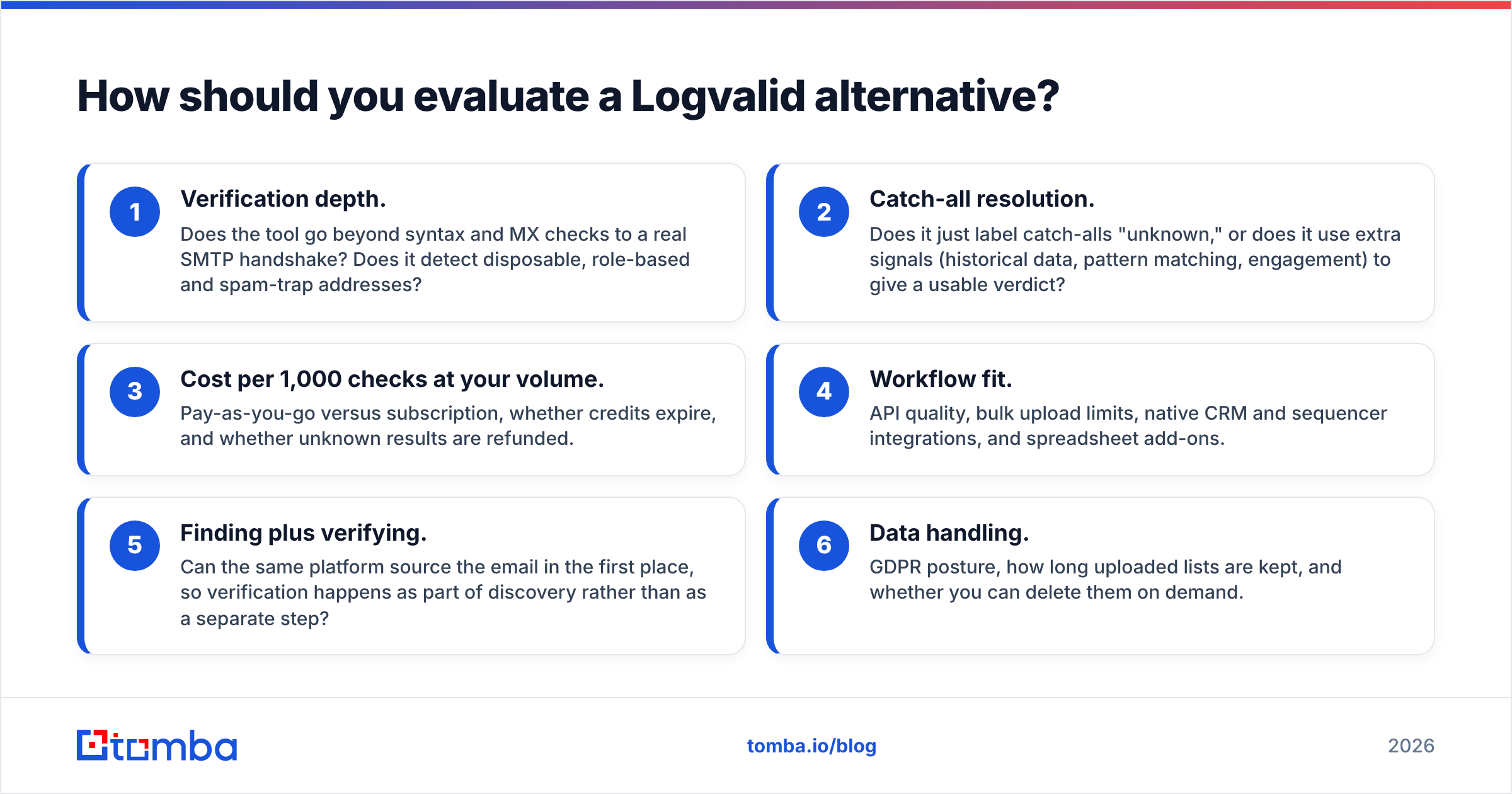
How should you evaluate a Logvalid alternative?#
Before you look at vendors, score each option on the criteria that actually change bounce rate and cost. Here's the checklist used for this comparison:
- Verification depth. Does the tool go beyond syntax and MX checks to a real SMTP handshake? Does it detect disposable, role-based and spam-trap addresses?
- Catch-all resolution. Does it just label catch-alls "unknown," or does it use extra signals (historical data, pattern matching, engagement) to give a usable verdict?
- Cost per 1,000 checks at your volume. Pay-as-you-go versus subscription, whether credits expire, and whether unknown results are refunded.
- Workflow fit. API quality, bulk upload limits, native CRM and sequencer integrations, and spreadsheet add-ons.
- Finding plus verifying. Can the same platform source the email in the first place, so verification happens as part of discovery rather than as a separate step?
- Data handling. GDPR posture, how long uploaded lists are kept, and whether you can delete them on demand.
If you only need item 3, the cheapest bulk verifier wins. If you care about items 2, 4 and 5, the shortlist gets much shorter.
Which Logvalid alternatives are worth considering in 2026?#
Here's the shortlist at a glance. Prices change often and depend on volume, so treat the figures below as approximate entry points and check each vendor's pricing page before you buy.
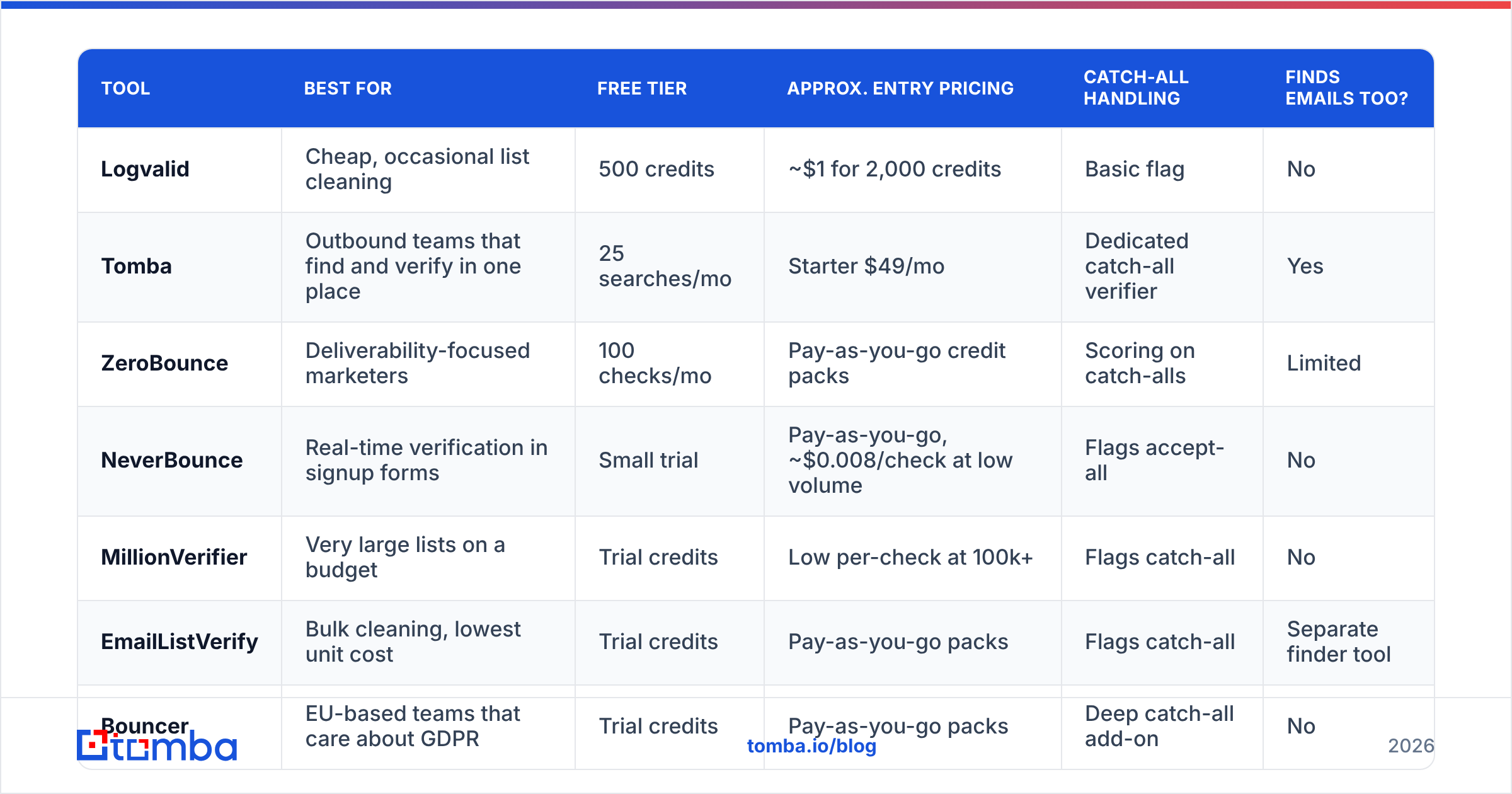
| Tool | Best for | Free tier | Approx. entry pricing | Catch-all handling | Finds emails too? |
|---|---|---|---|---|---|
| Logvalid | Cheap, occasional list cleaning | 500 credits | ~$1 for 2,000 credits | Basic flag | No |
| Tomba | Outbound teams that find and verify in one place | 25 searches/mo | Starter $49/mo | Dedicated catch-all verifier | Yes |
| ZeroBounce | Deliverability-focused marketers | 100 checks/mo | Pay-as-you-go credit packs | Scoring on catch-alls | Limited |
| NeverBounce | Real-time verification in signup forms | Small trial | Pay-as-you-go, ~$0.008/check at low volume | Flags accept-all | No |
| MillionVerifier | Very large lists on a budget | Trial credits | Low per-check at 100k+ | Flags catch-all | No |
| EmailListVerify | Bulk cleaning, lowest unit cost | Trial credits | Pay-as-you-go packs | Flags catch-all | Separate finder tool |
| Bouncer | EU-based teams that care about GDPR | Trial credits | Pay-as-you-go packs | Deep catch-all add-on | No |
| Kickbox | Enterprise senders that need scoring | Trial credits | Pay-as-you-go packs | "Sendex" quality score | No |
1. Tomba: best if you also need to find emails#
Tomba started as an email finder, and verification is part of the same workflow. You can look up a prospect by name and domain, run a domain search to pull every public address at a company, and then check each result with the email verifier without exporting anything.
Where it differs most from Logvalid is catch-all domains. Tomba has a separate catch-all verifier that tries to turn "accept-all" results into a clearer verdict. That matters in B2B, where catch-all domains are common among mid-market and enterprise companies.
- Pricing: Free tier (25 searches/month), Starter $49/mo, Growth $99/mo, Pro $249/mo, Enterprise custom. Full breakdown on the Tomba pricing page.
- Workflow: REST API, Chrome extension, Google Sheets and Excel add-ons, plus HubSpot, Salesforce, Pipedrive and Zapier integrations.
- Trade-off: If you only need to clean a 500k-row newsletter list once, a pure bulk verifier will cost less per check. Tomba pays off when you're prospecting and verifying on a regular basis.
2. ZeroBounce: best for deliverability-first marketers#
ZeroBounce is one of the most recognizable names in verification. It adds extras around the core check: activity data showing whether an address has recently engaged, spam-trap and abuse detection, an inbox placement tester, and blacklist monitoring. There's a recurring free tier of around 100 checks per month.
- Strength: More context per address than Logvalid, which helps when you're re-engaging old lists.
- Trade-off: Per-check cost is higher than budget verifiers, and the add-ons can push the total cost up. If you're weighing it up, our ZeroBounce alternative page lays out the differences.
3. NeverBounce: best for real-time form verification#
NeverBounce (part of ZoomInfo) is well known for its real-time JavaScript widget and API, which catch typos and fake addresses at signup. It also offers bulk cleaning and native integrations with most major ESPs.
- Strength: Very fast real-time API and a mature integration catalog.
- Trade-off: It returns catch-alls as "accept-all" and doesn't resolve them further, so B2B lists can still carry a lot of unknowns.
4. MillionVerifier: best for huge lists on a budget#
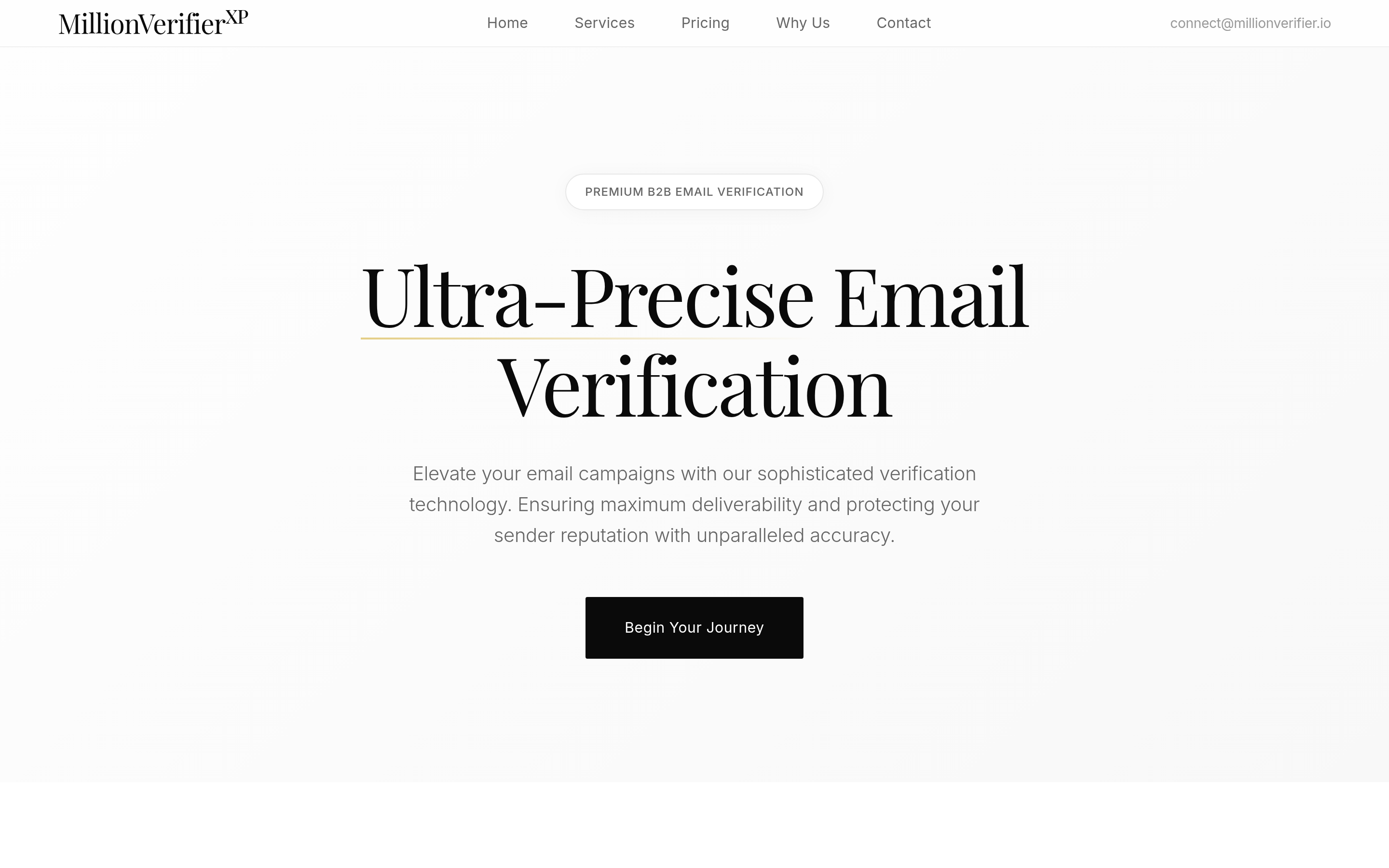
If your main complaint about Logvalid is volume rather than features, MillionVerifier is the usual answer. Its pricing is built for six- and seven-figure lists, credits don't expire, and it refunds credits for unknown results.
- Strength: Among the lowest per-check costs at scale.
- Trade-off: It's a bare-bones interface with few integrations, and catch-all results are flagged rather than resolved.
5. EmailListVerify: best unit economics for bulk cleaning#
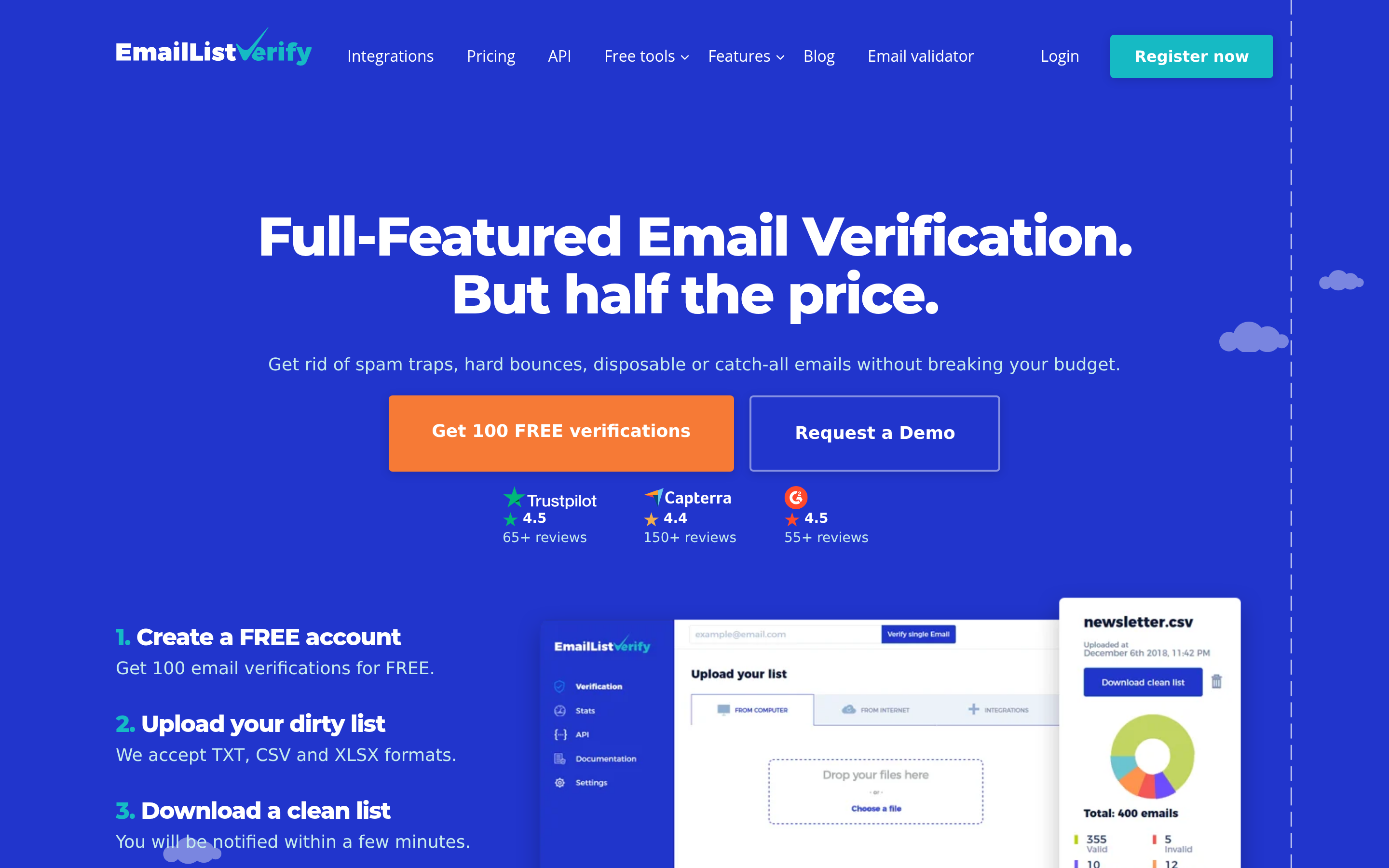
EmailListVerify competes on price too. It offers pay-as-you-go packs and daily-volume subscriptions, and its bulk upload handles large CSVs well.
- Strength: Predictable, low cost per check and a simple bulk workflow.
- Trade-off: It's less polished for real-time or CRM-embedded use.
6. Bouncer: best for GDPR-sensitive EU teams#
Bouncer is based in Poland and leans on its EU data-processing posture. It offers a "deliverability kit" and a paid add-on for deeper catch-all checks.
- Strength: Clear compliance story and solid catch-all tooling.
- Trade-off: The deeper catch-all checks cost extra, so budget for them if your list is B2B-heavy.
7. Kickbox: best for enterprise scoring#
Kickbox gives every address a "Sendex" quality score instead of a plain pass/fail. That's useful when you want to segment by risk rather than delete aggressively. It's popular with larger ESPs and platforms that verify on behalf of their own customers.
- Strength: Granular scoring and strong uptime.
- Trade-off: It's priced above budget tools and is overkill for a small team cleaning a few thousand contacts.
Is Logvalid better than Tomba for email verification?#
It depends on what you're verifying and why.
Logvalid is the better pick if you run occasional, small-to-mid list cleans, your contacts are mostly B2C (Gmail, Outlook, Yahoo), and cost per check is your only real criterion. Its free 500 credits and very low paid entry point are hard to argue with.
Tomba is the better pick if you're doing B2B outbound. In that setting, the harder job is finding the right address at a company whose mail server accepts everything, and knowing whether it will land. Finding and verifying in one step removes the export-upload-reconcile loop, and the catch-all verifier deals with the biggest source of "unknown" results in B2B data.
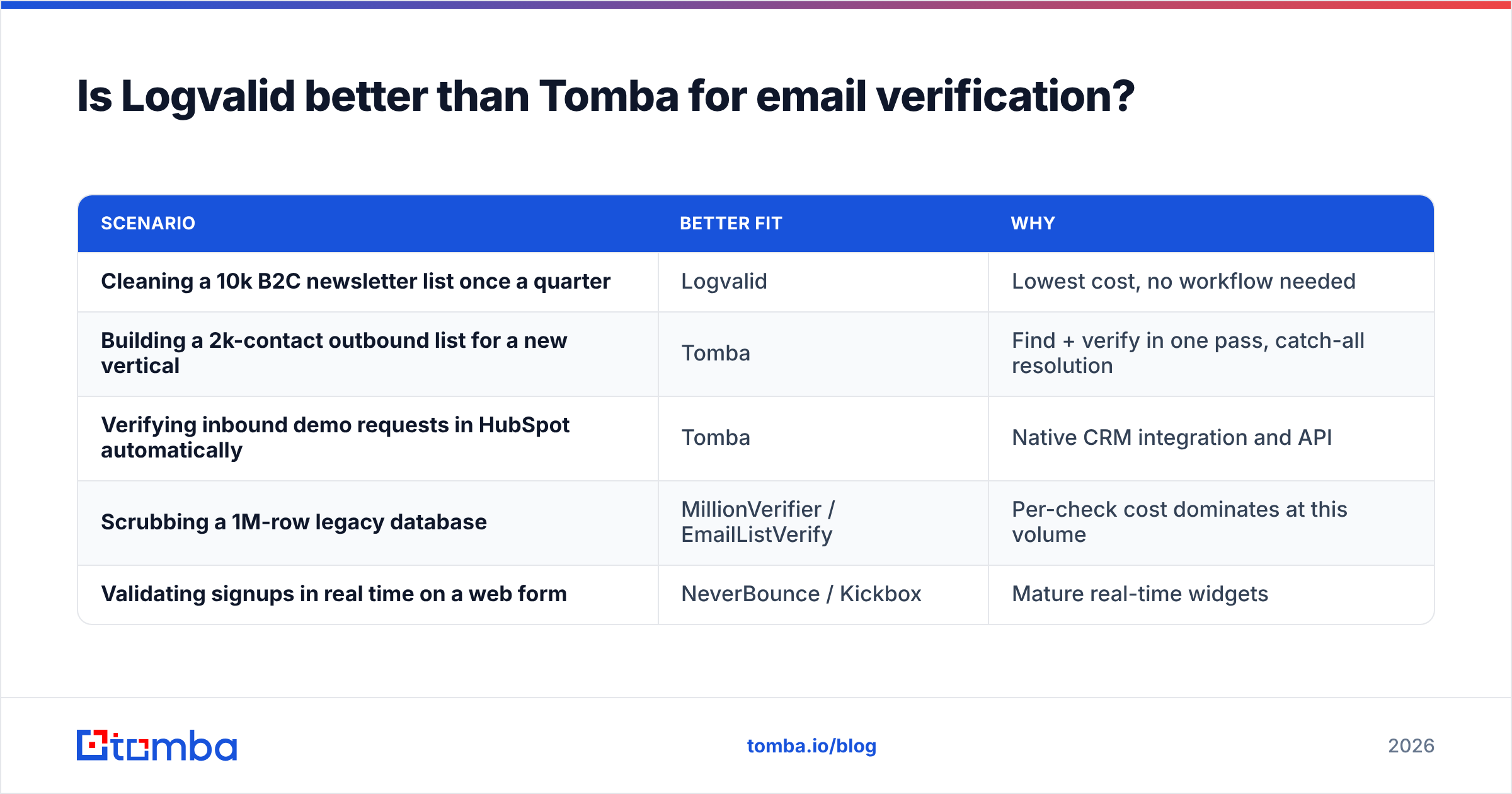
| Scenario | Better fit | Why |
|---|---|---|
| Cleaning a 10k B2C newsletter list once a quarter | Logvalid | Lowest cost, no workflow needed |
| Building a 2k-contact outbound list for a new vertical | Tomba | Find + verify in one pass, catch-all resolution |
| Verifying inbound demo requests in HubSpot automatically | Tomba | Native CRM integration and API |
| Scrubbing a 1M-row legacy database | MillionVerifier / EmailListVerify | Per-check cost dominates at this volume |
| Validating signups in real time on a web form | NeverBounce / Kickbox | Mature real-time widgets |
What goes wrong if you pick the wrong verifier?#
The most common mistake is optimizing for cost per check and ignoring what happens to the "unknown" bucket. Here's the typical sequence:
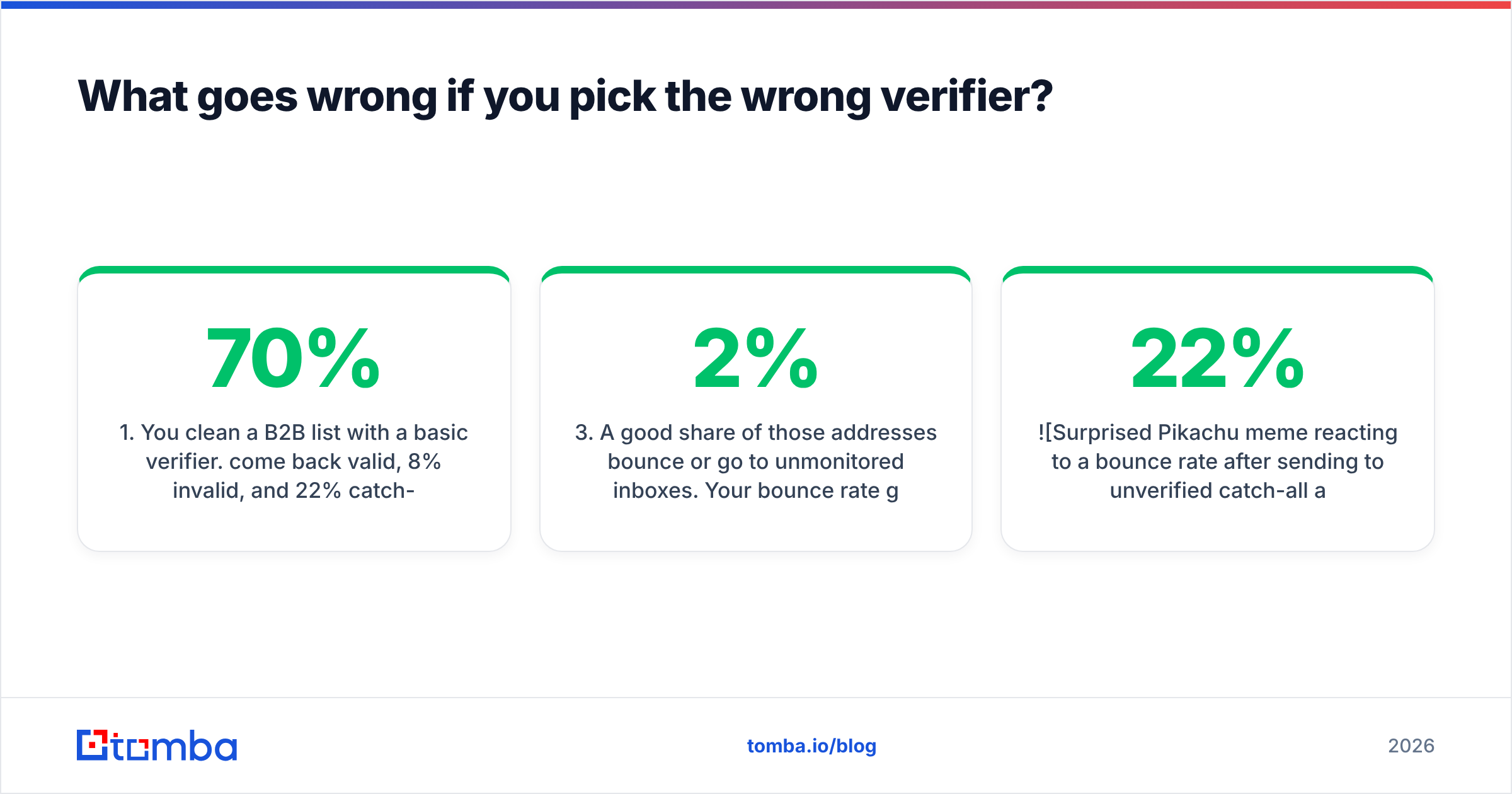
- You clean a B2B list with a basic verifier. 70% come back valid, 8% invalid, and 22% catch-all/unknown.
- To hit volume targets, you send to the unknowns anyway.
- A good share of those addresses bounce or go to unmonitored inboxes. Your bounce rate goes above the roughly 2% threshold mailbox providers watch, and your sender reputation drops.
- Now even your valid emails start landing in spam.

There's no mystery here. Cheap verification that leaves a fifth of your list unresolved isn't actually cheap once you count burned domains and lost pipeline. Google's and Yahoo's bulk-sender requirements, introduced in 2024, made list hygiene non-negotiable for anyone sending at volume.
The fix is one of two things. Either use a verifier that actually resolves catch-alls, or segment unknowns into a separate low-volume sending track with its own warmed-up domain. Either way, you need to know how many unknowns you have before you hit send.
How do Logvalid alternatives compare on pricing?#
Pricing models fall into three buckets, and the right one depends on how regularly you verify:
- Pay-as-you-go credit packs (Logvalid, MillionVerifier, EmailListVerify, NeverBounce, Bouncer, Kickbox). Best for irregular, batch cleaning. Check whether credits expire and whether unknowns are refunded.
- Monthly subscriptions with bundled credits (Tomba, ZeroBounce's subscription option). Best when verification happens every week as part of prospecting or inbound routing.
- Enterprise contracts (Kickbox, ZeroBounce, Tomba Enterprise). Best for platforms verifying on behalf of their own customers, or teams that need SLAs and a DPA.
One rule of thumb: if you're verifying fewer than about 5,000 addresses a month and only cleaning, stay on pay-as-you-go. If you're finding and verifying new contacts every week, a subscription that bundles both usually costs less than two separate tools.
Which Logvalid alternative should you choose?#
Match the tool to the job:
- You prospect B2B contacts every week: Tomba. Finding, verifying and resolving catch-alls in one platform removes the biggest source of wasted sends.
- You run marketing lists and care about engagement signals: ZeroBounce.
- You need to validate form signups in real time: NeverBounce or Kickbox.
- You have a huge legacy list and a small budget: MillionVerifier or EmailListVerify.
- You're EU-based and compliance comes first: Bouncer.
- You clean small B2C lists occasionally: stick with Logvalid. It does that job well.
Whatever you choose, run a head-to-head test before you commit. Take a 1,000-row sample you already know the outcome for (past bounces and replies), run it through two or three tools, and compare how many unknowns each returns and how accurate the valid/invalid verdicts are. An hour of testing tells you more than any vendor's accuracy claim.
Ready to find and verify in one step?#
If you're leaving Logvalid because verification alone isn't enough, and what you really need is the right address at a B2B company plus confidence it won't bounce, try the Tomba Email Finder. Search by name and domain, pull every public contact with domain search, and verify each result, catch-alls included, without leaving the platform. The free tier gives you 25 searches a month to test it against your current stack before you commit.
Related guides#
// get started
Find, verify and enrich your first contacts today
Start on the free plan with 25 searches a month, then scale when your team is ready.
Free plan · No credit card required · GDPR & CCPA
// about the author