Logvalid vs RocketReach: Email Verifier or Contact Finder in 2026?
Logvalid and RocketReach both show up when you shop for email data, but they do different jobs. One cleans lists you already have, the other finds contacts you don't have yet. Here's how to choose.
TL;DR
- Logvalid and RocketReach do different jobs. Logvalid is an email verification tool: it checks addresses you already have. RocketReach is a contact database and email finder: it gets you names, emails, and phone numbers you don't have yet.
- Logvalid costs much less. Public listings show a free plan with 500 verification credits and paid credits from about $1 for 2,000. RocketReach costs about $27–$142/mo on annual billing, or $69–$209/mo if you pay monthly.
- Pick Logvalid if your job is list hygiene: signup forms, old CRM exports, newsletter lists.
- Pick RocketReach if your job is prospecting: finding decision-makers by title, company, and location, and getting their direct dials.
- Most outbound teams need both jobs done. Either stack two tools or use one platform that finds and verifies in the same step.
What is the real difference between Logvalid and RocketReach?#
People search "Logvalid vs RocketReach" because both tools sell email data. The difference is which way the data flows.
Logvalid works on emails you give it. You upload a list or call its API, and it tells you which addresses are valid, invalid, disposable, or risky. It doesn't create new contacts. Directory listings such as Logvalid's Capterra profile describe real-time validation, disposable and spam-trap detection, bulk uploads, API access, and reports that split free-mail addresses from business ones.
RocketReach gives you emails. You search its database of professional profiles by name, company, title, industry, or domain, and it returns contact details. That usually means a work email, sometimes a personal email, and on higher plans a phone number. RocketReach is built for prospecting and recruiting, not list cleaning.
Think of it this way: Logvalid is the bouncer checking IDs at the door, and RocketReach is the promoter bringing people to the club. Both are useful, but they aren't interchangeable.
How do Logvalid and RocketReach compare side by side?#
The pricing below comes from public directory listings and third-party pricing breakdowns at the time of writing. Both vendors change plans often, so check their sites before you buy.
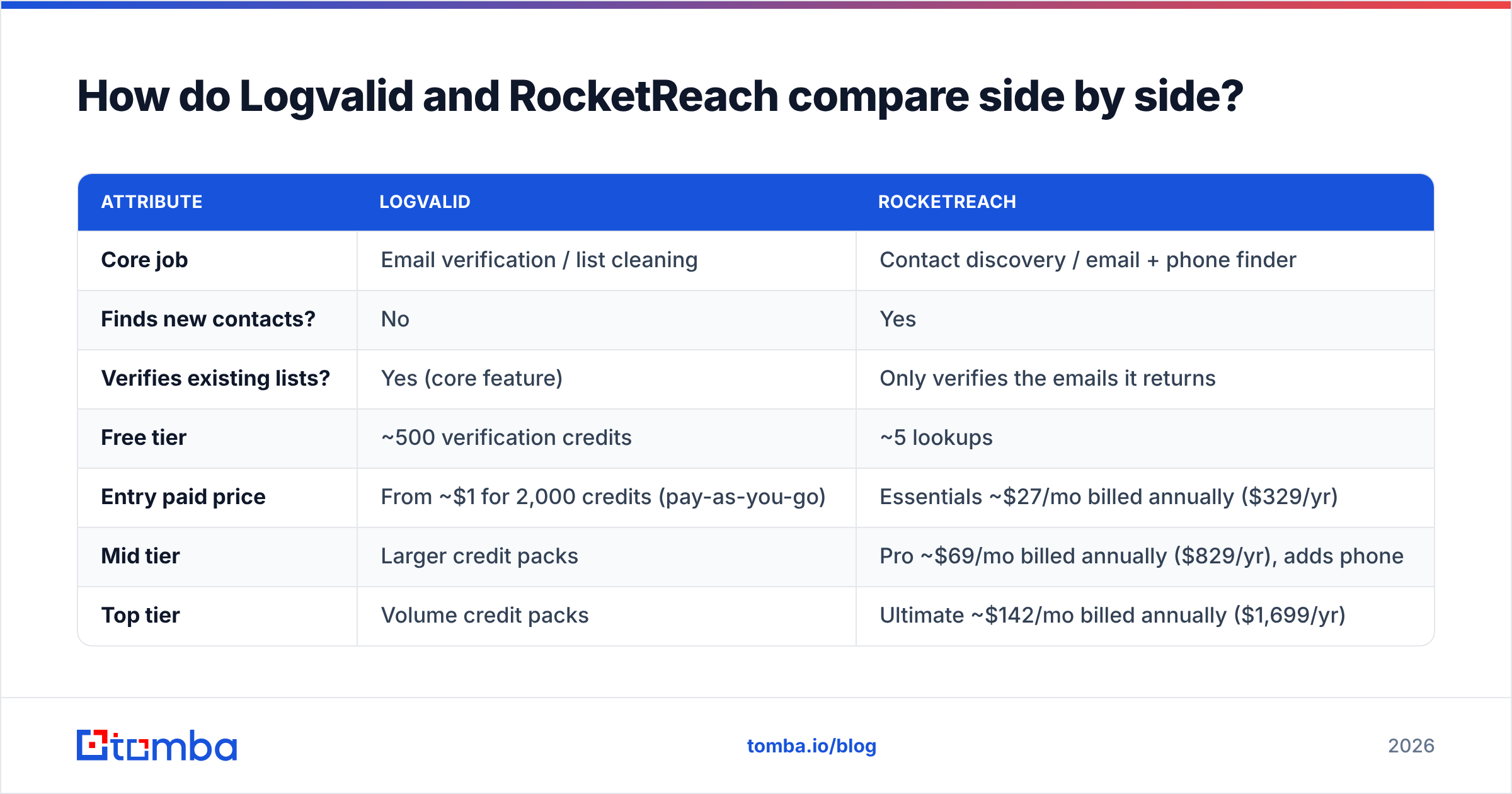
| Attribute | Logvalid | RocketReach |
|---|---|---|
| Core job | Email verification / list cleaning | Contact discovery / email + phone finder |
| Finds new contacts? | No | Yes |
| Verifies existing lists? | Yes (core feature) | Only verifies the emails it returns |
| Free tier | ~500 verification credits | ~5 lookups |
| Entry paid price | From ~$1 for 2,000 credits (pay-as-you-go) | Essentials ~$27/mo billed annually ($329/yr) |
| Mid tier | Larger credit packs | Pro ~$69/mo billed annually ($829/yr), adds phone |
| Top tier | Volume credit packs | Ultimate ~$142/mo billed annually ($1,699/yr) |
| Monthly billing | Credits, no subscription required | ~$69 / $119 / $209 per month |
| Phone numbers | No | Pro and above |
| API | Yes | Yes (higher tiers) |
| Best for | Marketers, SaaS signup flows, list hygiene | SDRs, recruiters, account-based prospecting |
The table shows why "which one is better" is the wrong question. The useful question is which problem you're solving this quarter.
When should you choose Logvalid?#
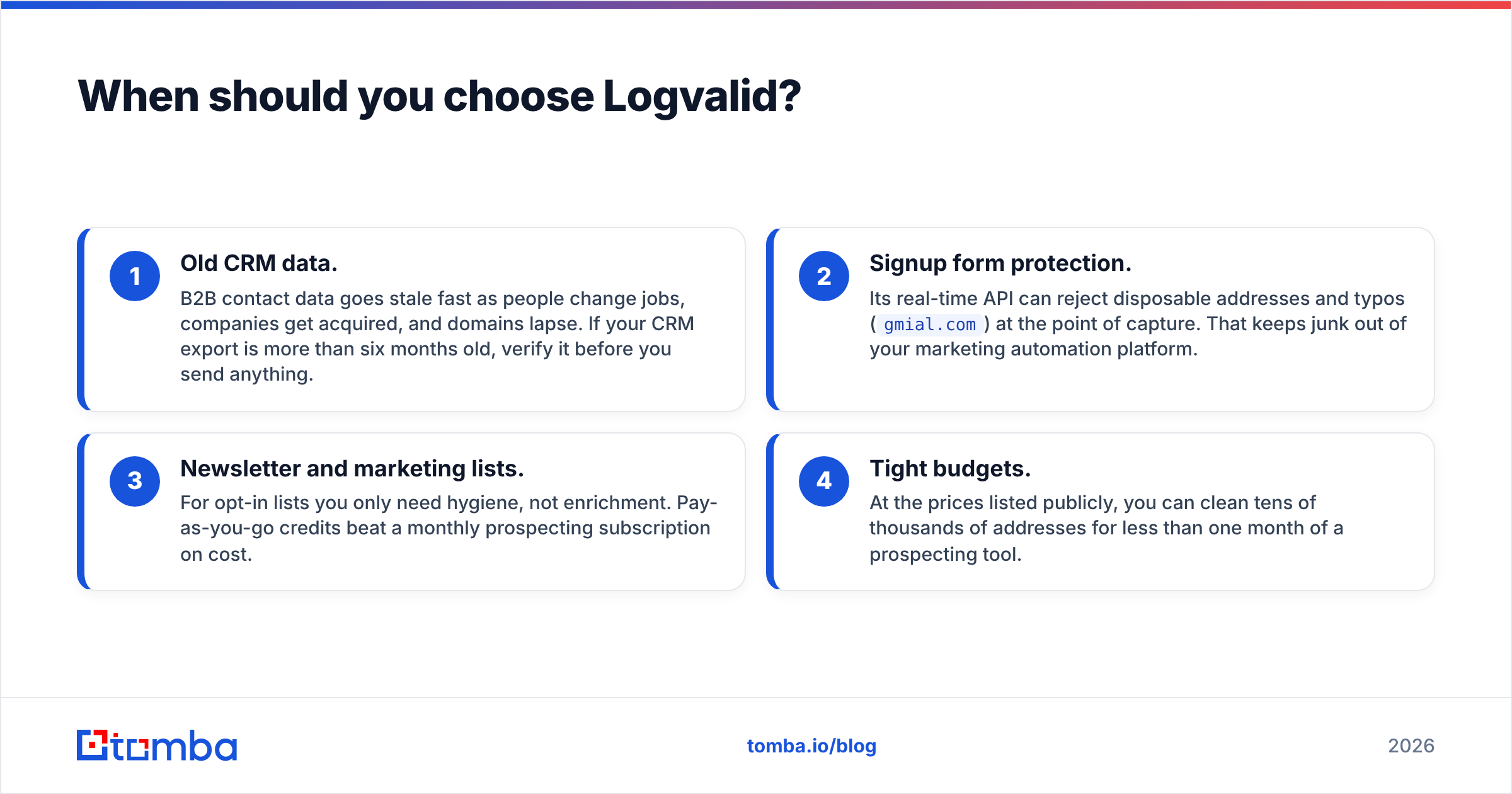
Choose Logvalid if you already have the emails and the risk you're facing is bounces, not missing contacts. Four situations fit:
- Old CRM data. B2B contact data goes stale fast as people change jobs, companies get acquired, and domains lapse. If your CRM export is more than six months old, verify it before you send anything.
- Signup form protection. Its real-time API can reject disposable addresses and typos (
gmial.com) at the point of capture. That keeps junk out of your marketing automation platform. - Newsletter and marketing lists. For opt-in lists you only need hygiene, not enrichment. Pay-as-you-go credits beat a monthly prospecting subscription on cost.
- Tight budgets. At the prices listed publicly, you can clean tens of thousands of addresses for less than one month of a prospecting tool.
Where Logvalid stops: it can't tell you who the VP of Operations at a 200-person logistics company is. It has no search, no filters, and no contact profiles. If your pipeline problem is "we don't know who to email," a verifier won't fix it.
One more caveat. Every verifier has trouble with catch-all domains, meaning mail servers that accept every address. A standard SMTP check returns "accept-all" or "unknown" for these, and many B2B domains are set up this way. Before you buy any verifier, ask how it handles catch-all results. Tools that include a dedicated catch-all verifier can tell you more than "risky."
When should you choose RocketReach?#
Choose RocketReach if your bottleneck is getting contacts, not cleaning them.
Prospecting by persona. RocketReach lets you filter by job title, seniority, company size, industry, and geography, then pull contact details for the people who match. That's the main thing Logvalid can't do.
Phone numbers. From the Pro tier up you get direct dials and mobile numbers. If your motion includes cold calling, email-only tools won't cover you.
Recruiting. A large share of RocketReach's users are recruiters and talent teams. They use it to reach passive candidates whose personal emails aren't public.
CRM workflow. RocketReach has a browser extension and CRM integrations (Salesforce, HubSpot, and others on higher tiers), so reps can look up contacts without leaving their workflow.
Where RocketReach costs you:
- Credits run out. Essentials gives about 1,200 exports a year, roughly 100 a month. An active SDR can use that up in a week. Heavy users end up on Ultimate or buying add-ons.
- Annual commitment. The advertised low prices require annual billing. Paying monthly roughly doubles the entry price.
- Returned data still needs checking. RocketReach grades its emails, but no database is 100% current. Many teams still run RocketReach exports through a separate verifier before sending, which means paying for two tools.
Check user reviews on G2's RocketReach pricing page for details on credit usage and renewals before you commit to a year.
Is RocketReach worth the price compared with Logvalid?#
The cost comparison is lopsided because the products are.
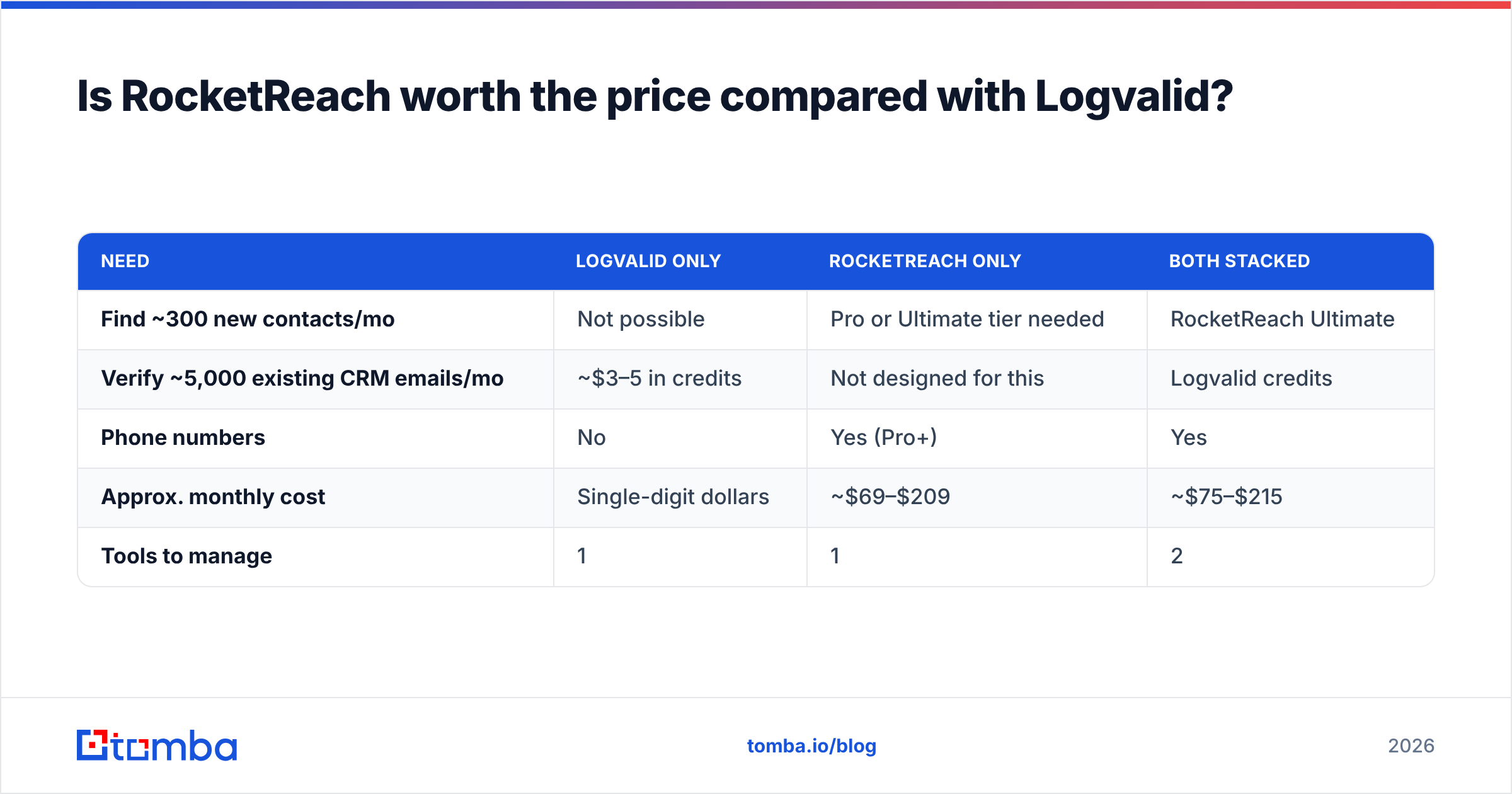
Here's a rough monthly scenario for a two-person outbound team:
| Need | Logvalid only | RocketReach only | Both stacked |
|---|---|---|---|
| Find ~300 new contacts/mo | Not possible | Pro or Ultimate tier needed | RocketReach Ultimate |
| Verify ~5,000 existing CRM emails/mo | ~$3–5 in credits | Not designed for this | Logvalid credits |
| Phone numbers | No | Yes (Pro+) | Yes |
| Approx. monthly cost | Single-digit dollars | ~$69–$209 | ~$75–$215 |
| Tools to manage | 1 | 1 | 2 |
The "Both stacked" column is where most outbound teams end up. It works, but it means two logins, two sets of credits, and a CSV passed from one tool to the other before every campaign. The friction adds up, and it's often why reps skip verification and send unverified emails anyway.
What happens to deliverability if you skip verification?#
This is the practical reason the comparison matters. Mailbox providers watch your bounce rate closely. Google's sender guidelines and most cold email platforms treat a hard-bounce rate above about 2% as a warning sign. Persistent bounces hurt your sender reputation, and a damaged reputation sends even your good emails to spam.
A prospecting database gives you reach, and a verifier protects the domain you send from. If you only have RocketReach, you have reach without protection. If you only have Logvalid, you have protection without anyone new to contact.
A workable rule for any stack:
- Verify anything older than 90 days, whatever its source.
- Verify every export from a prospecting database before it goes into a sequence, unless the finder already verifies at lookup time.
- Segment catch-all results into a smaller, slower-send bucket instead of mixing them with verified addresses.
- Suppress hard bounces right away in your CRM so they never get re-imported.
Are there tools that replace both Logvalid and RocketReach?#
Yes. A group of platforms combines finding and verifying, so every email you get has already been checked. This category includes Tomba, Hunter, Snov.io, and Findymail. They differ in database depth, pricing, and extras such as phone data.
What you gain by combining:
- One credit pool instead of two subscriptions.
- Verification at lookup time, so reps can't skip it.
- Domain search: enter a company website and see every public work email with its pattern, which RocketReach's persona search doesn't directly do.
- A standalone verifier for your existing lists, which covers the Logvalid use case.
What you give up compared with RocketReach specifically: some combined tools have thinner phone coverage or fewer persona-level filters. If direct dials for senior executives are central to your motion, compare phone hit rates on a sample of your real target accounts before switching. Our RocketReach alternative breakdown covers that trade-off in more detail.
For reference, Tomba pricing starts with a free tier of 25 searches a month, then Starter at $49/mo, Growth at $99/mo, Pro at $249/mo, and custom Enterprise plans. That's more than Logvalid credits alone, and in the same range as RocketReach, but it covers both jobs in one account.
How do you decide in five minutes?#
Answer these four questions in order:
- Do you already have the contacts you need? If yes, you need a verifier. Logvalid is a cheap, reasonable choice, and so is any dedicated email verifier.
- Do you need phone numbers for cold calling? If yes, RocketReach Pro or above, or another tool with strong phone coverage, should be on your shortlist.
- Will reps actually verify exports before sending? Be honest. If the answer is "sometimes," pick a tool that verifies at lookup time so the step can't be skipped.
- How many tools can your team realistically manage? A two-tool stack is fine for a RevOps-led team with clean processes. A small team is usually better off with one platform.
Fast verdicts:
- Solo marketer cleaning a newsletter list: Logvalid.
- Recruiter reaching passive candidates: RocketReach.
- SDR team running email and phone sequences: RocketReach plus a verifier, or a combined finder-verifier with decent phone data.
- Founder-led outbound on a budget: a combined email finder with a free tier, so you aren't paying for two subscriptions before you've booked a meeting.
Frequently asked questions#
Is Logvalid an alternative to RocketReach? Not directly. Logvalid verifies emails you already have. RocketReach finds new contacts. They solve different problems and are often used together.
Does RocketReach verify its emails? RocketReach grades and validates the emails it returns, but it isn't built to clean external lists you upload in bulk. Many teams still run exports through a separate verifier.
Which is cheaper, Logvalid or RocketReach? Logvalid, by a wide margin. Its pay-as-you-go credits start at about $1 per 2,000 verifications. RocketReach starts at about $27/mo on annual billing.
Can Logvalid find email addresses? No. It validates addresses. To discover emails by name or domain, you need an email finder.
Which tool should you pick?#
If you've read this far, you've probably found the real problem: you need contacts and you need them clean. Tomba Email Finder does both in one step. Search by name and company, or enter a domain to see a company's email pattern, and every result is checked before it reaches your sequence. It also has a built-in verifier and catch-all checks for the lists you already own. Start on the free plan with 25 searches a month, run it against a sample of your target accounts, and compare the results with what you'd get from a two-tool stack.
Related guides#
// get started
Find, verify and enrich your first contacts today
Start on the free plan with 25 searches a month, then scale when your team is ready.
Free plan · No credit card required · GDPR & CCPA
// about the author