LoneScale Pricing 2026: Plans, Credit Costs and Cheaper Picks
LoneScale starts around $1,000/mo for 20K credits. Here is what each credit buys, where the costs pile up, and when a lighter email-finder stack does the job for a fraction of the price.
- LoneScale pricing starts at about $1,000/month (Core, roughly 20,000 credits). Team runs about $2,500/month for roughly 60,000 credits. Enterprise is custom.
- You pay a flat platform fee, not per seat. Every plan includes unlimited users, so the price depends on credit volume and features, not headcount.
- A credit buys different things. One verified email costs about 1 credit. A mobile number costs about 9 credits. On Core, that works out to about $0.05 per email and $0.45 per mobile.
- The math only works if you use the signals. LoneScale earns its price with job-change and hiring signals inside your CRM. If you mostly need emails, you're overpaying.
- Cheaper route for email-only teams: a dedicated email finder with paid plans from $49/month covers finding and verifying contacts at a small fraction of LoneScale's cost.
What is LoneScale, and what are you actually paying for?#
LoneScale is a buying-signal and enrichment platform built to live inside your CRM. It tracks events that suggest an account may be ready to buy: past customers or champions moving to new companies, executive hires, and hiring patterns. It pushes those events as alerts and records into Salesforce or HubSpot. On top of that it offers waterfall enrichment (it checks several data providers in turn until one returns a match), list building, reverse email lookup, and a Chrome extension.
That matters for pricing because most of LoneScale's price pays for signal monitoring, not contact data. A standalone email finder sells data by the lookup. LoneScale sells a system that watches your CRM and your market and tells reps when to act, and it includes contact data as part of that.
You can see the product and its integrations on the official LoneScale site and its HubSpot marketplace listing.
One caveat before the numbers: LoneScale is sold through sales conversations and has no fully self-serve price list. The figures below come from third-party reviews and buyer reports published in 2026. Treat them as reliable starting points and confirm them on a demo call.
How much does LoneScale cost in 2026?#
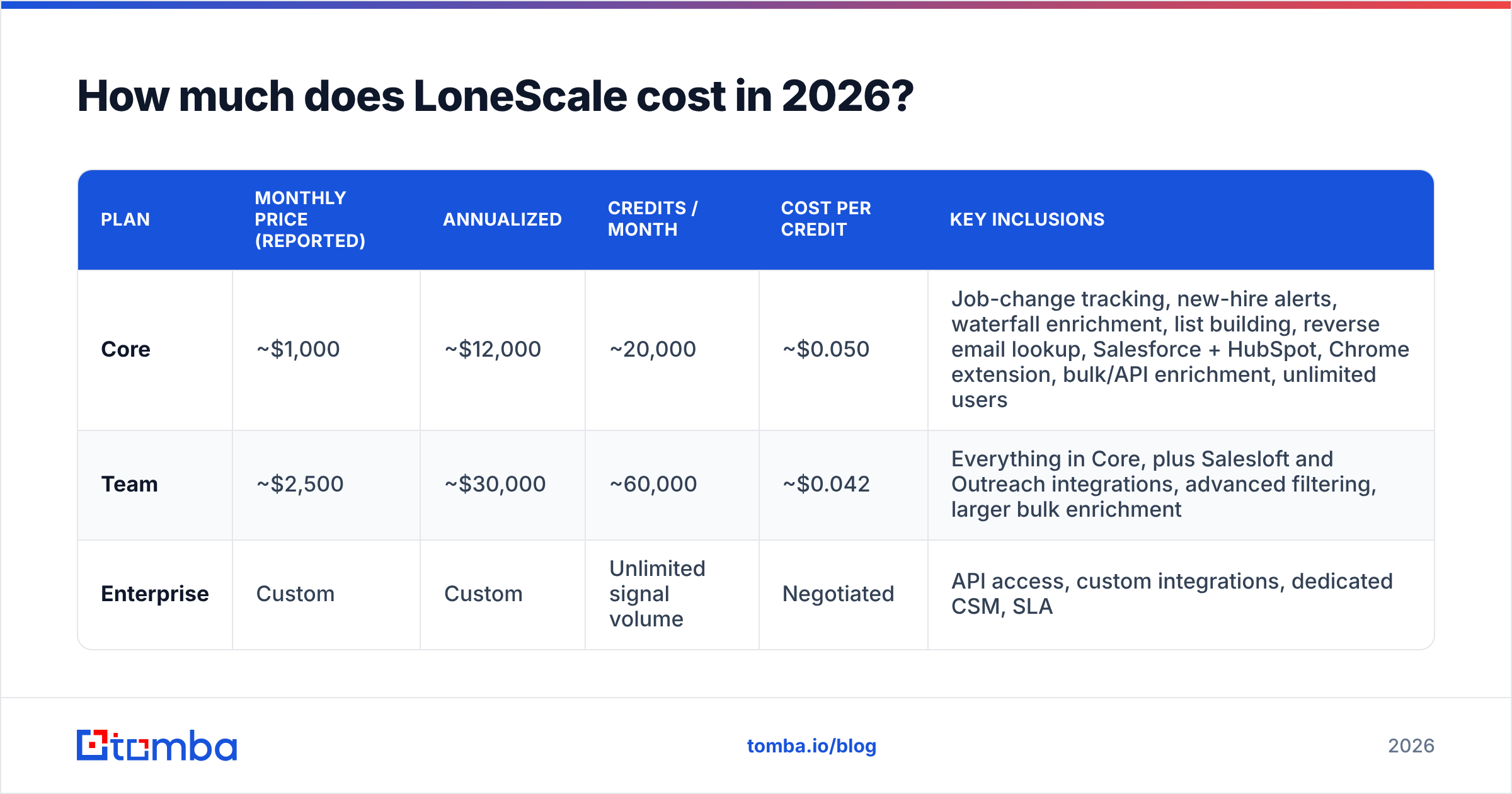
Here is how the plans compare, based on published third-party data.
| Plan | Monthly price (reported) | Annualized | Credits / month | Cost per credit | Key inclusions |
|---|---|---|---|---|---|
| Core | ~$1,000 | ~$12,000 | ~20,000 | ~$0.050 | Job-change tracking, new-hire alerts, waterfall enrichment, list building, reverse email lookup, Salesforce + HubSpot, Chrome extension, bulk/API enrichment, unlimited users |
| Team | ~$2,500 | ~$30,000 | ~60,000 | ~$0.042 | Everything in Core, plus Salesloft and Outreach integrations, advanced filtering, larger bulk enrichment |
| Enterprise | Custom | Custom | Unlimited signal volume | Negotiated | API access, custom integrations, dedicated CSM, SLA |
Team costs 2.5x as much as Core but gives you 3x the credits, so the price per credit drops by about 17%. For most buyers, though, the Salesloft and Outreach integrations will decide the move to Team more than the volume discount. If your reps work sequences in one of those tools, Core's integration list won't cover you.

What does one LoneScale credit actually buy?#
Credits are where the list price and your real cost start to split. Different data types use credits at different rates:
- Verified email: about 1 credit. Roughly 20,000 emails per month on Core, or about $0.05 each at full usage.
- Waterfall enrichment: about 2 credits. Roughly 10,000 records per month on Core, or about $0.10 per record.
- Mobile phone number: about 9.1 credits. Roughly 2,200 mobiles per month on Core, or about $0.45 each.
- Signal alerts (job changes, new hires): included in the plan. You don't pay per alert. The platform fee covers this monitoring.
- Unused credits: ask the rep. Whether unused credits roll over changes your real per-contact cost a lot. Get the answer in writing before you sign.
Phone data takes most of the credit budget. A team that enriches 1,000 mobiles a month uses about 9,100 credits, close to half of Core, before it verifies a single email. If your outbound motion leans on the phone, model your credit burn on mobiles, not emails.
What are the hidden costs in LoneScale pricing?#
The list price is only part of the cost. These are the gaps that usually show up after the contract is signed.
Low usage raises your cost per contact. The $0.05-per-email figure assumes you use all 20,000 credits. Say three SDRs need 1,500 verified emails a month. You'd pay $1,000 to use 7.5% of your credits, which is about $0.67 per email. That's more than 13x the advertised unit cost.
Annual commitments. Sales-led platforms at this price usually expect annual contracts. At Core, that's about $12,000 committed before you know whether reps will act on the signals. Ask for a pilot or a quarterly option.
Integration tier-gating. Salesloft and Outreach sit on Team. If your stack depends on either, the real entry price is about $2,500/month, not $1,000.
CRM hygiene work. Signal platforms only work as well as the CRM they watch. Job-change tracking needs clean contact records and accurate account ownership, and someone has to route alerts to the right rep. Many teams need RevOps hours to set this up. Nobody invoices you for that time, but it costs you all the same.
Mobile-heavy credit burn. As shown above, phone numbers use about 9x the credits of an email. A phone-first team can run out of Core credits months ahead of plan.
Is LoneScale worth the price?#
It depends on one question: will your team act on job-change and hiring signals every week?
LoneScale is a strong fit when:
- You have a large installed base of customers and champions. When one of them moves to a new company, you get a warm, high-converting opportunity.
- Your pipeline strategy already includes signal-based plays, such as reaching new VPs in their first 90 days or re-engaging churned champions at their new employers.
- You run Salesforce or HubSpot as the single source of truth and have someone who owns data quality.
- You have several reps who'd each otherwise need their own seat on a data tool. The unlimited-user model makes the flat fee efficient at scale.
LoneScale is a weak fit when:
- You mostly need email addresses for outbound campaigns. You'd be paying for signal features you don't use.
- Your team is under five reps and books meetings mainly from cold lists, not account signals.
- Your CRM is messy and nobody has time to fix it. The signals will land in bad records and get ignored.
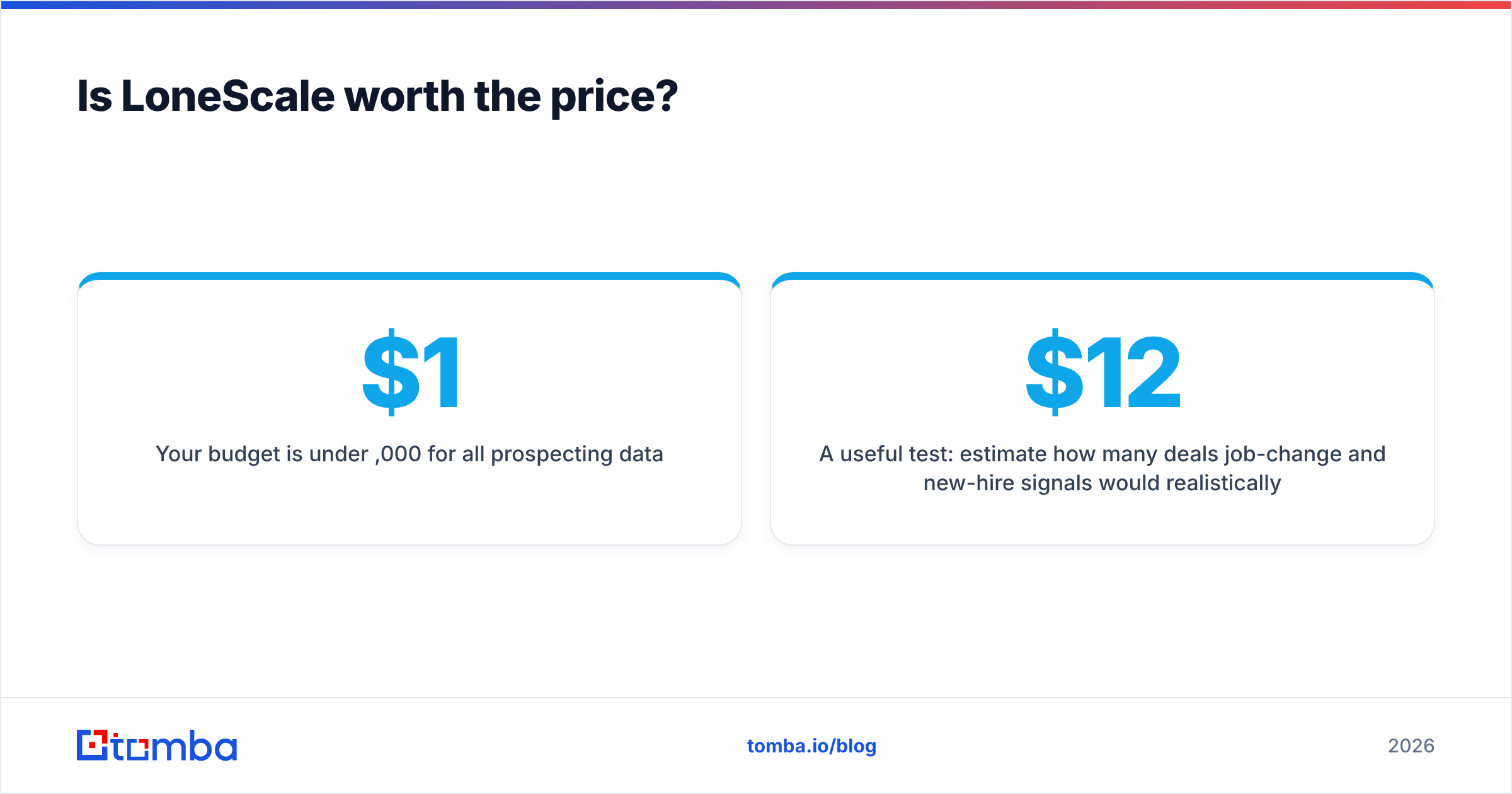
- Your budget is under $1,000/month for all prospecting data.
A useful test: estimate how many deals per year job-change and new-hire signals would realistically source. If one extra closed-won deal covers the $12,000 a year, the math works easily for mid-market and enterprise ACVs. If your average deal is $3,000, you'd need four or more signal-sourced wins a year just to break even on Core.
How does LoneScale pricing compare with alternatives?#
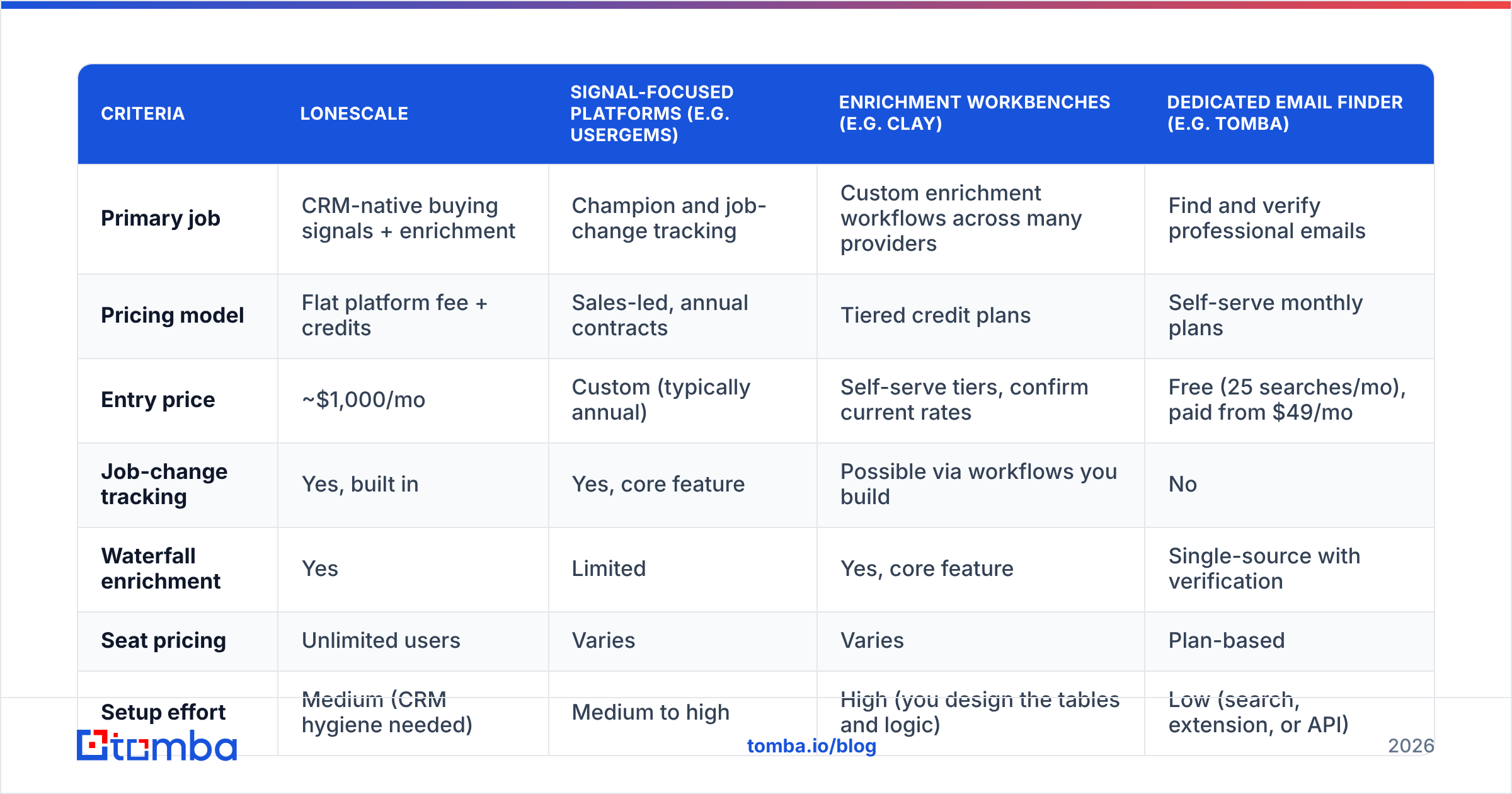
LoneScale competes in two overlapping categories: signal platforms and contact-data or email-finder tools. Comparing it only with email finders is unfair, because email finders don't track job changes. Comparing it only with signal tools misses the fact that many buyers just need contacts.
| Criteria | LoneScale | Signal-focused platforms (e.g. UserGems) | Enrichment workbenches (e.g. Clay) | Dedicated email finder (e.g. Tomba) |
|---|---|---|---|---|
| Primary job | CRM-native buying signals + enrichment | Champion and job-change tracking | Custom enrichment workflows across many providers | Find and verify professional emails |
| Pricing model | Flat platform fee + credits | Sales-led, annual contracts | Tiered credit plans | Self-serve monthly plans |
| Entry price | ~$1,000/mo | Custom (typically annual) | Self-serve tiers, confirm current rates | Free (25 searches/mo), paid from $49/mo |
| Job-change tracking | Yes, built in | Yes, core feature | Possible via workflows you build | No |
| Waterfall enrichment | Yes | Limited | Yes, core feature | Single-source with verification |
| Seat pricing | Unlimited users | Varies | Varies | Plan-based |
| Setup effort | Medium (CRM hygiene needed) | Medium to high | High (you design the tables and logic) | Low (search, extension, or API) |
| Best for | Mid-market and enterprise teams running signal plays | Teams focused on customer expansion | RevOps-heavy teams that build custom data flows | SDRs, founders, and agencies that need verified emails fast |
Most teams that look at LoneScale end up in one of these three setups:
- Signals plus contacts in one platform. Buy LoneScale Core or Team and use its enrichment for everything.
- Signals from the CRM, contacts from a specialist. Use CRM-native features or a lighter signal source, and pair them with a dedicated email finder for contact data.
- Contacts only. Skip signal platforms for now. Build lists from firmographics, and add signals once pipeline volume justifies a five-figure contract.
What's the cheaper option if you mainly need emails?#
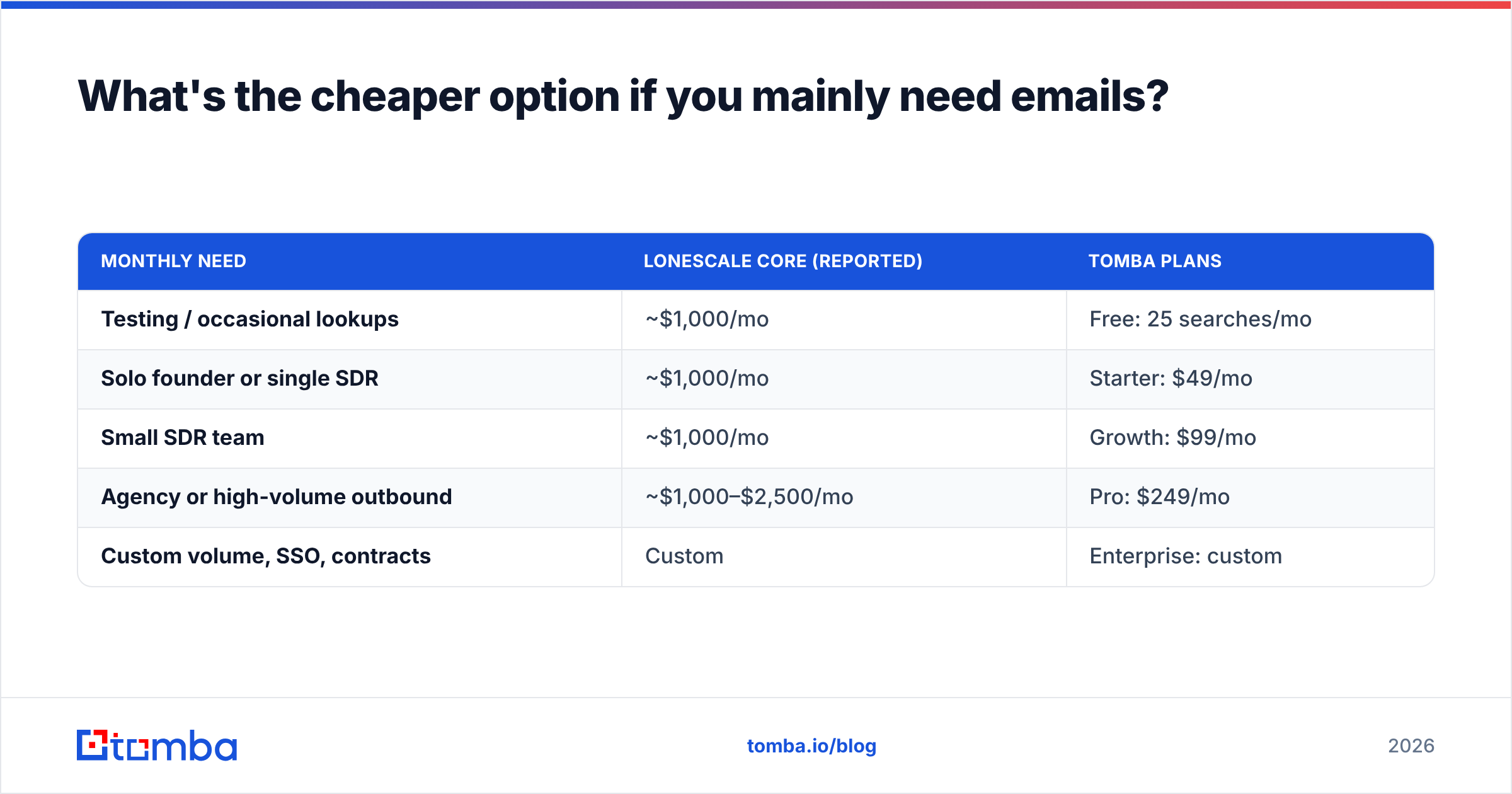
If your main need is "give me a verified work email for this person," a flat $1,000/month signal platform is more than you need. Here's the price gap at typical small-team volumes:
| Monthly need | LoneScale Core (reported) | Tomba plans |
|---|---|---|
| Testing / occasional lookups | ~$1,000/mo | Free: 25 searches/mo |
| Solo founder or single SDR | ~$1,000/mo | Starter: $49/mo |
| Small SDR team | ~$1,000/mo | Growth: $99/mo |
| Agency or high-volume outbound | ~$1,000–$2,500/mo | Pro: $249/mo |
| Custom volume, SSO, contracts | Custom | Enterprise: custom |
To be fair to LoneScale, the Tomba column doesn't include job-change alerts or CRM signal monitoring, and it isn't meant to. What it covers is the contact layer: finding emails by name and domain, verifying them before you send, and enriching leads with company and role data. You can check the credit allowances for each tier on the Tomba pricing page.
For a team of three SDRs who need 1,500 verified contacts a month, that's the difference between about $12,000 a year and a few hundred dollars a year. If signals become a priority later, you can add a signal platform then, with real reply-rate data to justify the spend.

How should you negotiate LoneScale pricing?#
If LoneScale is the right fit, don't accept the first quote. Sales-led pricing usually has room to move. Five levers to use:
- Ask for a paid pilot. A 60–90 day pilot at a reduced credit volume lets you measure how reps act on signals before you commit to $12,000+.
- Negotiate credit rollover. Unused credits carried into the next month lower your effective per-contact cost, especially early on while adoption ramps.
- Unbundle the integrations. If you only need Outreach or Salesloft, ask whether you can add that integration to Core instead of moving to Team.
- Trade term length for price. A 24-month commitment should come with a lower monthly rate. Only offer it after the pilot proves value.
- Benchmark against your current tools. Bring your existing per-contact cost from your current email verifier and data tools. A concrete comparison gives you a stronger case than a vague "it's too expensive."
It also helps to review how your CRM stores contact history before the demo. LoneScale's job-change value depends on how many past champions you have on record. A clean, well-maintained customer relationship management system gives the platform more to work with and gives you a better ROI story at renewal.
What's the verdict on LoneScale pricing?#
LoneScale is not an email-finder price point. It's a signal-platform price point, and it should be judged that way. At about $1,000/month for Core and about $2,500/month for Team, it pays off for mid-market and enterprise teams with large customer bases, clean CRMs, and reps who will act on job-change and hiring alerts every week. For those teams, one extra signal-sourced deal can cover the annual contract.
For everyone else, especially small SDR teams, founders, and agencies whose bottleneck is just getting accurate contact data, the flat fee and credit model mean paying for a lot of capacity you won't use. Start with a lean contact-data stack, prove your outbound motion, and revisit signal platforms when your pipeline volume justifies them.
If what you need right now is verified contacts rather than buying signals, try Tomba Email Finder. Search by name, domain, or company, verify each address before you send, and start on the free tier with 25 searches a month. Paid plans start at $49/month, so you can build a working prospecting motion for less than a single month of a signal platform, and add signals later once your numbers show they'll pay off.
Related guides#
// get started
Find, verify and enrich your first contacts today
Start on the free plan with 25 searches a month, then scale when your team is ready.
Free plan · No credit card required · GDPR & CCPA
// about the author