Lookalike Audience B2B Prospecting: A 2026 Playbook That Works
Ad platforms retired or rebuilt their B2B lookalike tools. This playbook shows how to model your best customers and turn the lookalike list into verified contacts your reps can actually reach.
TL;DR
- Lookalike audience B2B prospecting starts from your best customers, finds the traits they share, and then looks for accounts and people that have the same traits. It works best when you use it to decide who to contact, not only who to show ads to.
- Ad-platform lookalikes got weaker for B2B. Google retired Similar Audiences in 2023, and LinkedIn replaced Lookalike Audiences with Predictive Audiences in 2024. Your own account-level model is now the more dependable asset.
- Build the seed from 30 to 100 customers with high lifetime value, not from every closed-won deal. If the seed is noisy, the lookalike list will be noisy too.
- A lookalike list is a set of companies. It turns into pipeline only when you add named buyers, verified emails, and a sequence.
- Measure it against your current outbound: reply rate, meetings per 100 accounts, and win rate. Don't judge it by audience size.
What is a lookalike audience in B2B prospecting?#
A lookalike audience is a group of prospects chosen because they resemble a "seed" group you already know converts. In B2C the seed is usually a pixel audience or a customer email list, and Meta's algorithm does the matching. Meta's own lookalike audience documentation describes it as reaching new people who are likely to be interested because they're similar to your best existing customers.
B2B needs an extra layer, because the buying unit is a company plus a committee, not a single consumer. Lookalike audience B2B prospecting therefore runs at two levels:
- Account lookalikes. Companies that look like your best customers on firmographics (industry, headcount, revenue band, geography), technographics (the tools they run), and behaviour (hiring, funding, growth).
- Persona lookalikes. The people inside those accounts who hold the same roles as the champions and economic buyers who signed your best deals.
If you skip the second level, you end up with a nice list of 2,000 companies and no idea who to email at any of them.
Why did ad-platform lookalikes stop working for B2B?#
The platforms changed the rules. Google Ads retired Similar Audiences in 2023 and moved advertisers to optimized targeting. LinkedIn dropped its Lookalike Audiences feature in early 2024 and pointed advertisers toward Predictive Audiences and Matched Audiences. Meta still offers lookalikes, but its signal comes mostly from consumer behaviour. That's fine for selling a SaaS tool to freelancers and much less useful for selling a $60k platform to a VP of Finance.
That leaves three structural problems:
- Tiny seeds. A B2B company with 80 great customers is well below the thousands of matched records the ad algorithms prefer.
- Match rates. Upload a list of work emails and a large share won't match to a personal social profile.
- Black-box output. You can't export the audience. You can show it ads, but your SDRs can't call it.
So the playbook moved. Teams now build the lookalike model themselves from firmographic and technographic data, then use ad platforms only as a retargeting and warming layer on top.
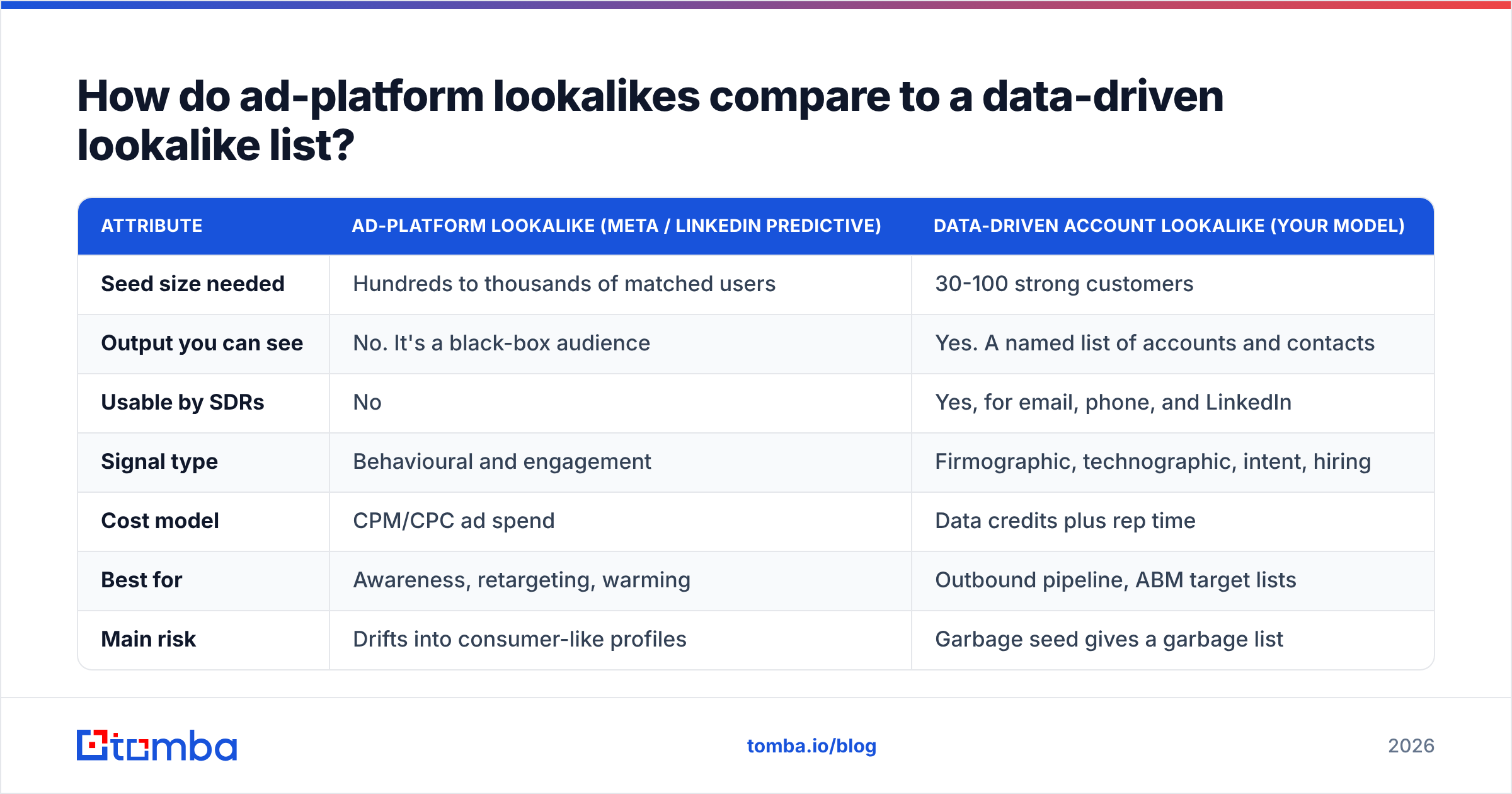
How do ad-platform lookalikes compare to a data-driven lookalike list?#
The two approaches solve different problems. The table below shows where each one fits.
| Attribute | Ad-platform lookalike (Meta / LinkedIn Predictive) | Data-driven account lookalike (your model) |
|---|---|---|
| Seed size needed | Hundreds to thousands of matched users | 30-100 strong customers |
| Output you can see | No. It's a black-box audience | Yes. A named list of accounts and contacts |
| Usable by SDRs | No | Yes, for email, phone, and LinkedIn |
| Signal type | Behavioural and engagement | Firmographic, technographic, intent, hiring |
| Cost model | CPM/CPC ad spend | Data credits plus rep time |
| Best for | Awareness, retargeting, warming | Outbound pipeline, ABM target lists |
| Main risk | Drifts into consumer-like profiles | Garbage seed gives a garbage list |
| Time to first signal | Days (ad delivery) | 1-2 weeks (sequence replies) |
The best programs run both at once. The data-driven list decides which accounts are in play. That same list gets uploaded as a LinkedIn Matched Audience so the accounts see your brand before the first cold email lands.
How do you build a B2B lookalike audience step by step?#
This process is usable in a mid-market team with a CRM, a data provider, and a sequencing tool.
- Pick the seed by value. Export closed-won accounts from the last 18-24 months. Rank them by net revenue retention, contract value, and sales cycle length. Keep the top 30-100. Leave out logo customers you discounted heavily and anyone who churned.
- Profile the seed. For each account, record industry, headcount band, HQ region, funding stage, and three to five technologies they run. The website tech stack checker is enough to spot-check the technographics by hand before you pay for bulk data.
- Find the shared traits. Look for traits that show up in 60% or more of the seed but are rare in your total addressable market. "B2B SaaS" isn't a trait. "B2B SaaS, 50-200 employees, runs HubSpot and Intercom, hired a RevOps lead in the last 12 months" is.
- Search for matches. Run those filters in your B2B database, then score each result by how many seed traits it matches. Tier 1 matches 5 of 5, tier 2 matches 4 of 5. Leave everything below that out of outbound.
- Map the personas. Go back to the seed deals and note who championed them and who signed. Then use domain search on each lookalike account to pull the people in those same roles.
- Verify, then sequence. Run every address through an email verifier before it reaches your sending tool. Lookalike lists are often pulled from several sources, so bounce risk is higher than on a hand-researched list.
Most programs fail at step 1, not step 4. If you pick the seed by "logos we're proud of" instead of by revenue quality, the model will copy your vanity customers.
What data signals make the best lookalike model?#
Not every attribute predicts a good fit equally well. Ordered by typical predictive value for B2B:
- Technographics. If your product integrates with Salesforce, accounts on Salesforce are simply more likely to buy. This is usually the strongest single filter.
- Hiring signals. A company hiring three SDRs is building an outbound motion right now. Job postings show intent that a firmographic record won't.
- Growth stage and funding. A Series B company that closed its round in the last 6 months has budget and pressure to grow.
- Headcount band. Useful as a guardrail more than a predictor. It stops you pitching an enterprise product to a 12-person shop.
- Industry. Often weaker than people expect. Two "fintech" companies can have completely different buying needs.
- Geography. Matters for compliance (GDPR, data residency) and time zones, but rarely predicts fit by itself.
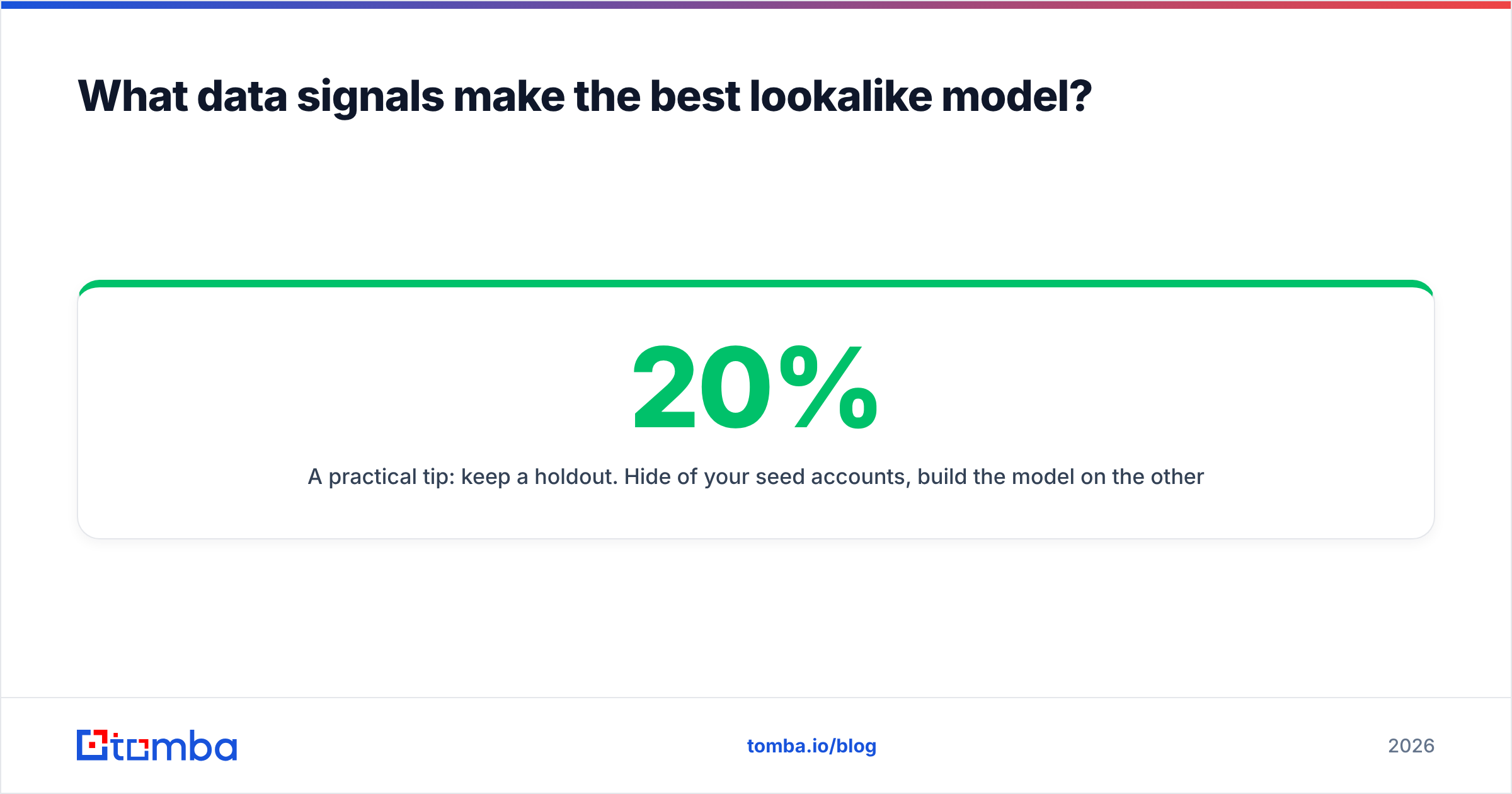
A practical tip: keep a holdout. Hide 20% of your seed accounts, build the model on the other 80%, and check whether the model would have found the hidden 20%. If it misses most of them, your traits are too generic.
How do you turn a lookalike account list into contacts you can reach?#
This is where most lookalike projects stall. Marketing hands over a spreadsheet of 1,500 domains and sales has nothing to do with it.
Working from the list to pipeline:
- Contacts per account. For mid-market deals, target 2-3 people per account: the likely champion, their manager, and one adjacent stakeholder. Use an email finder when you already know the person's name, and domain search when you need to discover who's there.
- Handle catch-all domains separately. Many mid-market and enterprise domains accept every address at the SMTP level, so a normal check can't confirm them. Put catch-all results in a separate, lower-volume sequence instead of mixing them with verified addresses.
- Enrich before you write. Pull title, seniority, LinkedIn URL, and company context through data enrichment so your first line can refer to the actual trait that put them on the list ("You just moved to HubSpot, and so did the three teams we onboarded last quarter").
- Reuse the seed story. Lookalike prospects resemble your customers, so the most persuasive thing you can say is which similar company you helped and what changed for them. Get approval before naming a customer.
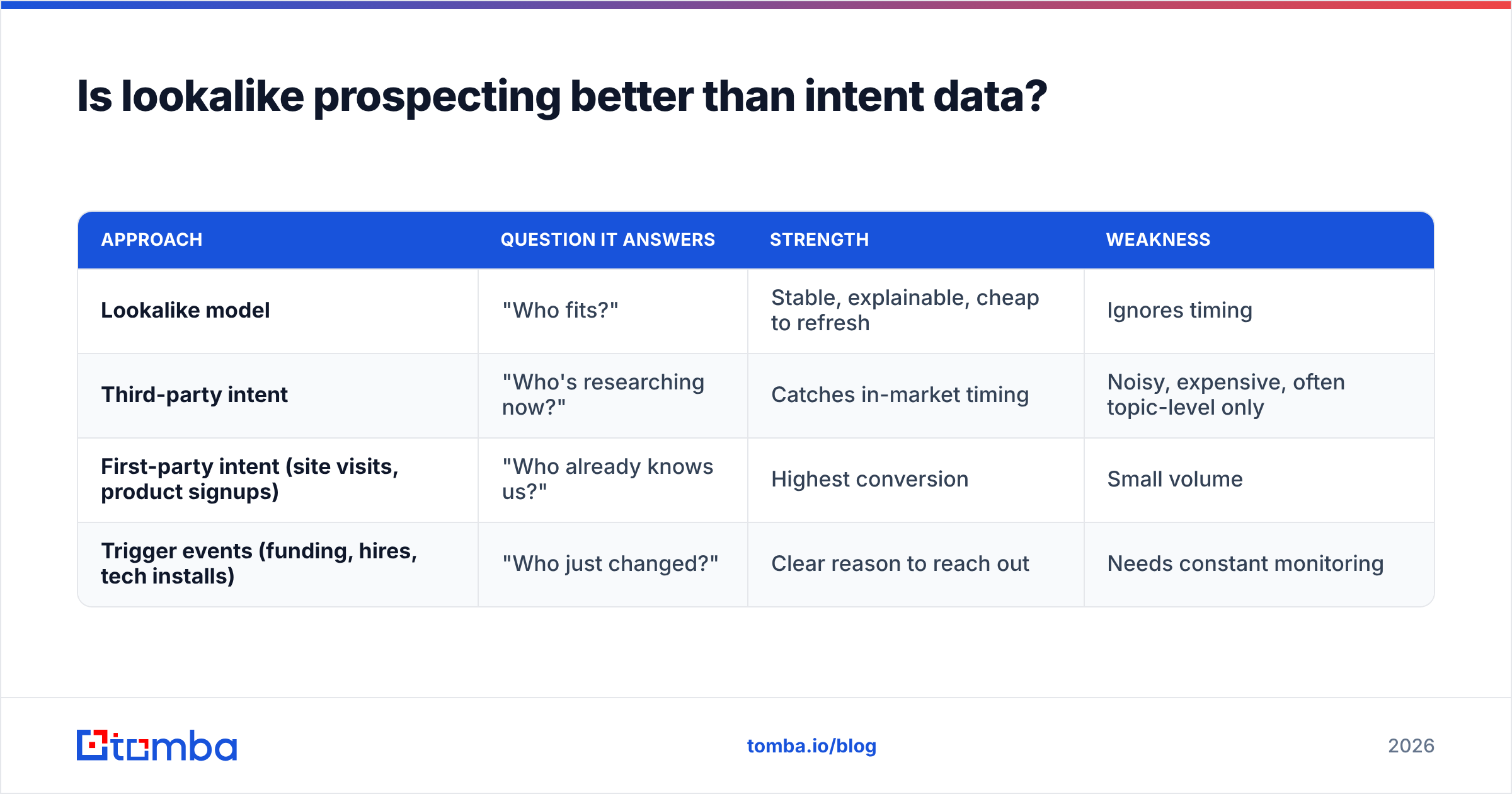
Is lookalike prospecting better than intent data?#
They answer different questions, so "better" depends on which question matters to you right now.
| Approach | Question it answers | Strength | Weakness |
|---|---|---|---|
| Lookalike model | "Who fits?" | Stable, explainable, cheap to refresh | Ignores timing |
| Third-party intent | "Who's researching now?" | Catches in-market timing | Noisy, expensive, often topic-level only |
| First-party intent (site visits, product signups) | "Who already knows us?" | Highest conversion | Small volume |
| Trigger events (funding, hires, tech installs) | "Who just changed?" | Clear reason to reach out | Needs constant monitoring |
The strongest stack puts them in layers: the lookalike model sets the universe of accounts, and intent and trigger events decide the order you work them in. A tier 1 lookalike that also hired a RevOps lead last month goes to the top of Monday's list. A tier 2 lookalike with no signals goes into a slower nurture track.
What results should you expect from lookalike audience B2B prospecting?#
Be careful with any vendor that promises a specific uplift. Results depend on seed quality, deal size, and the quality of your copy. The metrics that matter:
- Reply rate versus your control list. Run the lookalike list and your current outbound list side by side, with the same copy and the same reps, for four weeks.
- Meetings per 100 accounts. Better than per-contact metrics, because lookalikes are an account-level bet.
- Opportunity-to-close win rate. The real test. A lookalike model that gets meetings but not wins is matching on surface traits.
- Bounce rate. Keep it under 2%. If it's higher, your contact data is hurting your sender reputation more than the targeting is helping.
If the lookalike cohort doesn't beat your control on meetings per 100 accounts after a fair test, go back to the seed. The fix is almost always a tighter seed or sharper traits, not more volume.
What are the most common lookalike prospecting mistakes?#
- Seeding with every customer. Your churned, heavily discounted, and one-off deals pull the model toward the wrong profile.
- Too many filters. Stack eight traits and you get 40 accounts. Stack two and you get 40,000. Aim for a first-pass list of 500 to 3,000 accounts.
- Never refreshing. Your ICP moves as the product moves upmarket. Rebuild the seed every two quarters.
- Treating the list as a campaign. A lookalike list is a territory. Work it with multi-touch sequences, ads, and calls over weeks, not with one blast.
- Skipping verification. A fresh lookalike list sent without verification is a quick way to land on a blocklist.
- Relying on a single data source. Coverage varies by region and industry. Check the rows that matter most against a second source before you scale.
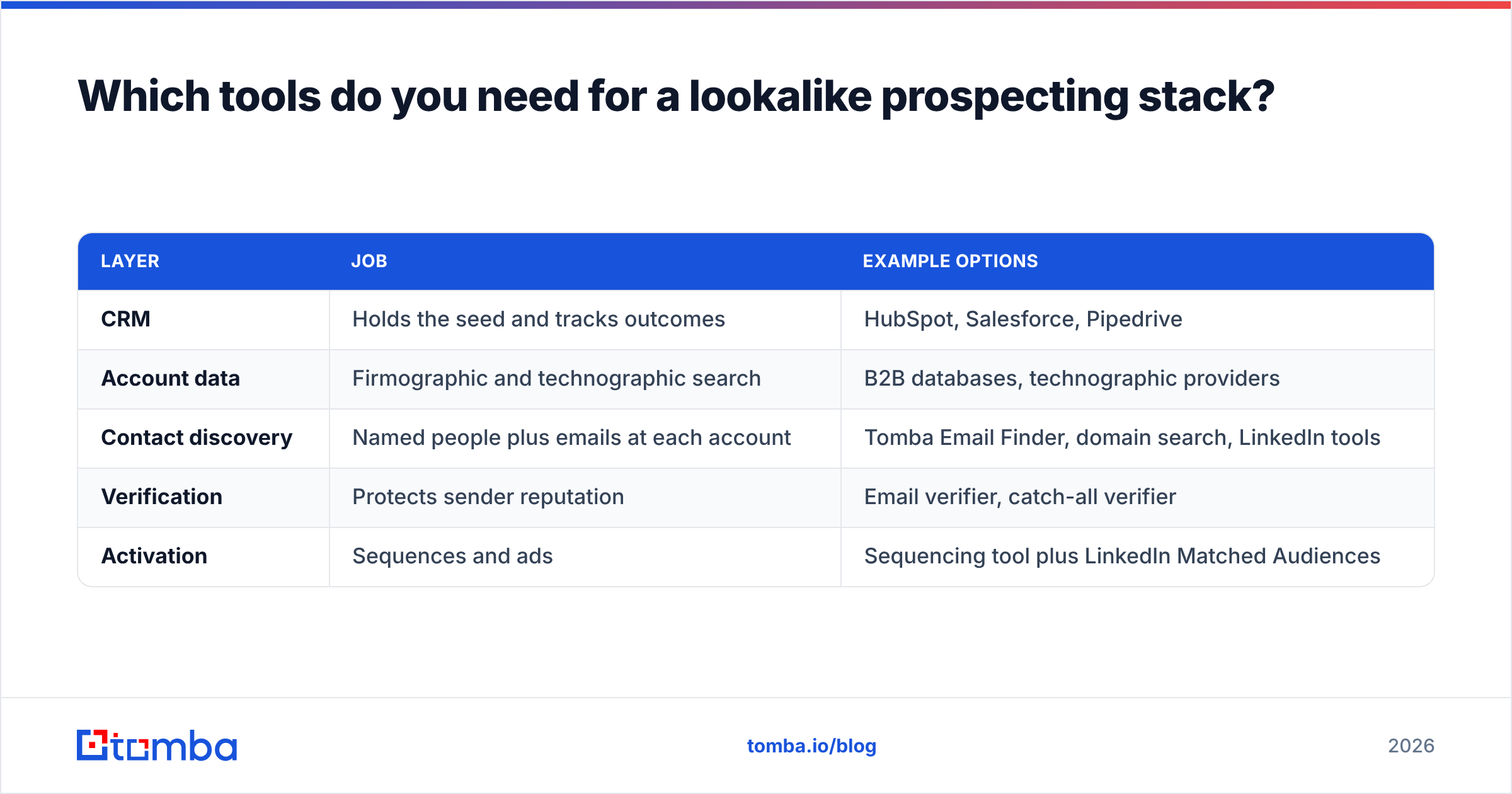
Which tools do you need for a lookalike prospecting stack?#
You don't need an enterprise ABM suite to start. A lean stack looks like this:
| Layer | Job | Example options |
|---|---|---|
| CRM | Holds the seed and tracks outcomes | HubSpot, Salesforce, Pipedrive |
| Account data | Firmographic and technographic search | B2B databases, technographic providers |
| Contact discovery | Named people plus emails at each account | Tomba Email Finder, domain search, LinkedIn tools |
| Verification | Protects sender reputation | Email verifier, catch-all verifier |
| Activation | Sequences and ads | Sequencing tool plus LinkedIn Matched Audiences |
For a first test, check that your contact-discovery layer charges per credit rather than requiring an annual seat contract. Lookalike lists are experimental by nature, so you want to be able to pay for 1,000 lookups, measure, and then scale. Tomba pricing runs from a free tier with 25 searches a month to Starter at $49/mo, Growth at $99/mo, and Pro at $249/mo. That's enough for most teams to run a four-week lookalike pilot without a procurement cycle.
How should you get started this week?#
Keep the first pilot small and easy to measure:
- Monday: Export your top 50 customers by revenue quality. Write down the 4-5 traits most of them share.
- Tuesday: Build a 300-account lookalike list from those traits and tier it.
- Wednesday: Pull 2-3 contacts per tier 1 account and verify every address.
- Thursday: Write one sequence that refers to the shared trait and names a similar customer outcome.
- Friday: Launch alongside a control list, and upload the same accounts as a LinkedIn Matched Audience for air cover.
Four weeks later you'll have data to decide whether to scale, tighten the seed, or drop the approach, instead of an opinion.
A lookalike model only tells you which companies resemble your best customers. You still need the right people at those companies and addresses that won't bounce. Tomba Email Finder takes your lookalike domain list and returns named decision-makers with verified professional emails, so the list your RevOps team builds on Tuesday can be in a live sequence by Friday. Start on the free tier, run your pilot on 25 accounts, and scale up once the replies show the model works.
Related guides#
// get started
Find, verify and enrich your first contacts today
Start on the free plan with 25 searches a month, then scale when your team is ready.
Free plan · No credit card required · GDPR & CCPA
// about the author