Looking Forward to Hearing From You Alternatives: 35 Better Lines
"Looking forward to hearing from you" is polite, but readers skim past it. Here are 35 alternatives sorted by context, whether that's cold outreach, follow-ups, job applications or client work, plus the rule that decides which one to use.
TL;DR
- "Looking forward to hearing from you" is fine, but it's passive. It tells the reader you're waiting without telling them what to do.
- Your best replacement depends on the context: cold outreach, follow-ups, job applications, client work, and internal email each need a different closing line.
- Lines with a specific ask, like a date, a yes/no question or a single next step, tend to get more replies than general "hope to hear back" wording.
- Below you'll find 35 alternatives grouped by situation, a comparison table by tone and reply intent, and a simple rule for picking one.
- The closing line only matters if the email reaches a real inbox, so verify the address before you worry about the wording.
What does "looking forward to hearing from you" actually signal?#
It says three things: you're polite, you expect a reply, and you haven't decided what that reply should be. The third one is the problem.
Think of it like a waiter who says "let me know if you need anything" and then walks off. Nothing is wrong with it, but nobody reacts to it. A waiter who asks "Can I bring you the dessert menu?" gets an answer, because the question needs one.
In business email, the closing line is the last thing your reader sees before they decide to reply, archive, or snooze. Marketers call this spot the call to action, and a vague one wastes it. The phrase isn't rude, and in some settings it's the right choice. It just isn't doing much.
There's a second problem: everyone uses it. When a phrase shows up at the bottom of a large share of the email your prospect gets, they stop reading it. Their eyes slide over it the same way they slide over "Best regards."
When is "looking forward to hearing from you" still the right choice?#
It still works in a few narrow cases. Before replacing it everywhere, know where it belongs:
- Formal applications, such as job applications, grant submissions and RFP responses, where the next step belongs to the other side and pushing would look presumptuous.
- After you've already handed off, for example "I've sent the signed contract, looking forward to hearing from you." The action is already clear from the email itself.
- Very senior or cross-cultural recipients, where a direct ask could come across as pushy and a conventional close shows respect.
Outside those cases, and especially in outbound sales, you're better off with something more specific.
Which alternatives work best for cold outreach?#
Cold email is where the default phrase costs you the most. The reader owes you nothing, so the close has to make replying easy. The lines below go from low-friction (a yes/no reply) to higher commitment (a calendar slot).
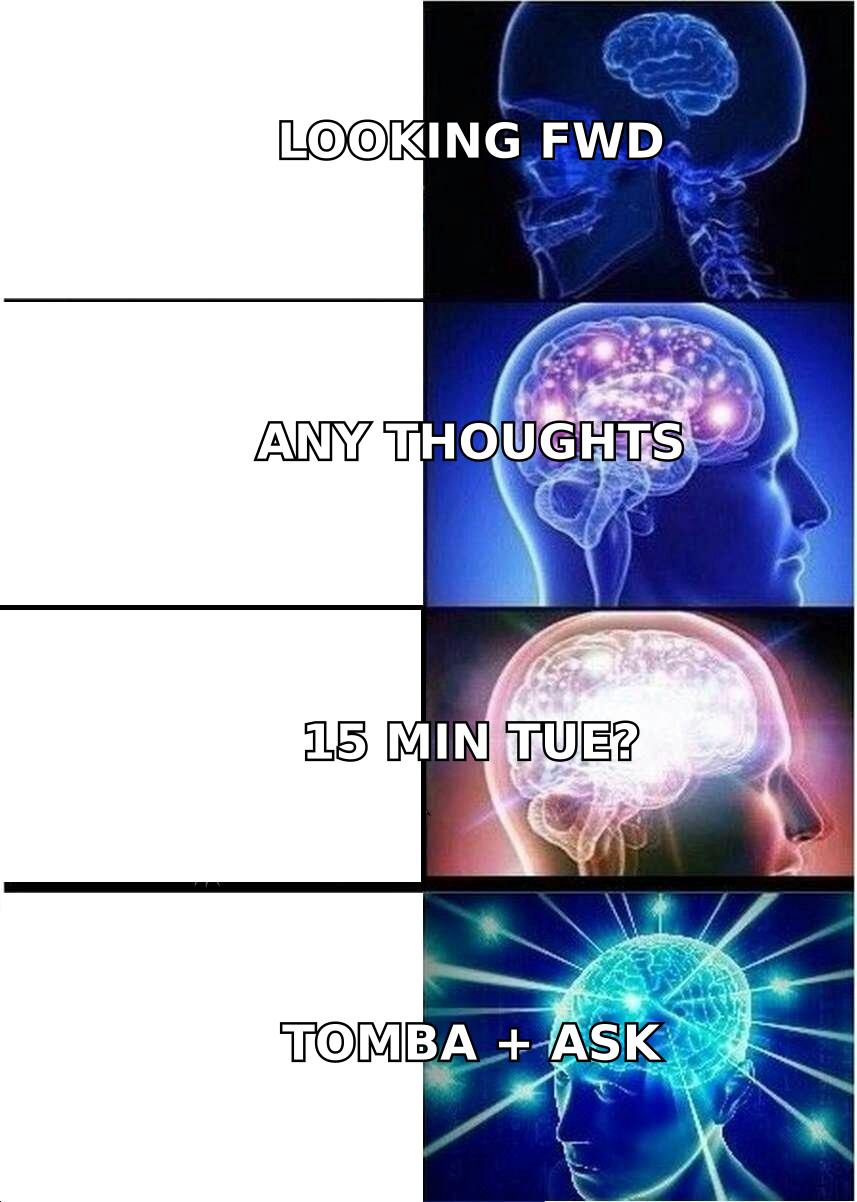
Low-friction, easy to answer:
- "Worth a quick chat?"
- "Is this on your radar for Q1?"
- "Should I send over the two-page overview?"
- "Am I reaching the right person for this?"
- "Open to a 15-minute call next week?"
Specific-time asks:
- "Does Tuesday at 2pm or Thursday at 10am work better?"
- "Could we find 15 minutes before the 20th?"
- "Happy to work around your calendar. What does next week look like?"
Soft, curiosity-based:
- "Curious whether this matches what you're seeing on your end."
- "Would love your take, even if the answer is 'not now.'"
- "If this isn't a priority, a one-word 'no' helps me too."
Line 4 is worth highlighting. It's one of the best-performing closes in cold outreach, because even a "no, talk to Sarah" gives you a referral. It only works if you actually reached a real person, though. If you're guessing addresses, a free email checker tells you whether the mailbox exists before you spend a good line on a bounce.
If you want complete sequences built around these closes, the cold email templates library pairs each opener with a matching CTA.
What should you say instead in a follow-up email?#
Follow-ups need a close that acknowledges the silence without sounding resentful. "Just following up, looking forward to hearing from you" is the classic mistake: you're asking twice without giving the reader any new reason to reply.
- "Did my last note get buried?"
- "Should I close the loop on this for now?"
- "Is there someone else on your team I should speak with?"
- "Any update on your side? Even a 'still deciding' is helpful."
- "I'll check back on the 15th unless you tell me otherwise."
- "Would a different time of year make more sense to revisit?"
Line 13 is known as the "breakup" close. It works because it gives the reader permission to say no, and many people find that easier than saying nothing. Line 16 takes the pressure off the reader by setting your own next step, which helps with busy executives.
To see which of these moves your numbers, track your email response rate per close line rather than per campaign. Once each line has a couple hundred sends, the gaps between them are usually obvious.
What are the best alternatives for job applications and formal emails?#
In formal contexts you want warmth and confidence, but not pressure. The goal is to sound like a peer, not a supplicant.
- "I'd welcome the chance to discuss how I can contribute."
- "Thank you for your time and consideration."
- "I'm available for an interview at your convenience."
- "Please let me know if you need anything further from me."
- "I look forward to the next steps."
- "I appreciate you considering my application."
Line 22 is a small but meaningful upgrade over the original. It assumes the process moves forward, which reads as more confident without being pushy.
Gratitude closes also have some data behind them. Boomerang's widely cited analysis of about 350,000 email threads found that closings with some form of "thanks," and "thanks in advance" in particular, got noticeably higher reply rates than closings without gratitude. That's a correlation, not proof of cause, but it's a cheap test to run.
How should you close emails to existing clients and partners?#
With clients the relationship is already there, so the close can be shorter and more collaborative. Keep the momentum going and make approvals easy.
- "Let me know if this works and I'll get it moving."
- "Happy to jump on a call if it's easier to talk it through."
- "Any edits before I send this to the team?"
- "If this looks good, a quick thumbs-up is all I need."
- "Talk soon."
- "Excited to keep this rolling."
Line 27 is useful because it tells the client exactly how little effort a reply takes. The less work you ask for, the faster the answer comes back.
What works for internal and casual emails?#
Inside your own company, formality slows things down. Match the tone of Slack, not a cover letter.
- "Thoughts?"
- "Let me know what you think."
- "Can you confirm by EOD Thursday?"
- "Shout if anything looks off."
- "Keep me posted."
- "No rush, whenever you get a sec."
Line 32 is the only one here with a deadline, and it's the one most likely to get a timely answer. Use deadlines sparingly, though. If every internal email has one, none of them feels urgent.
How do these alternatives compare by tone and reply intent?#
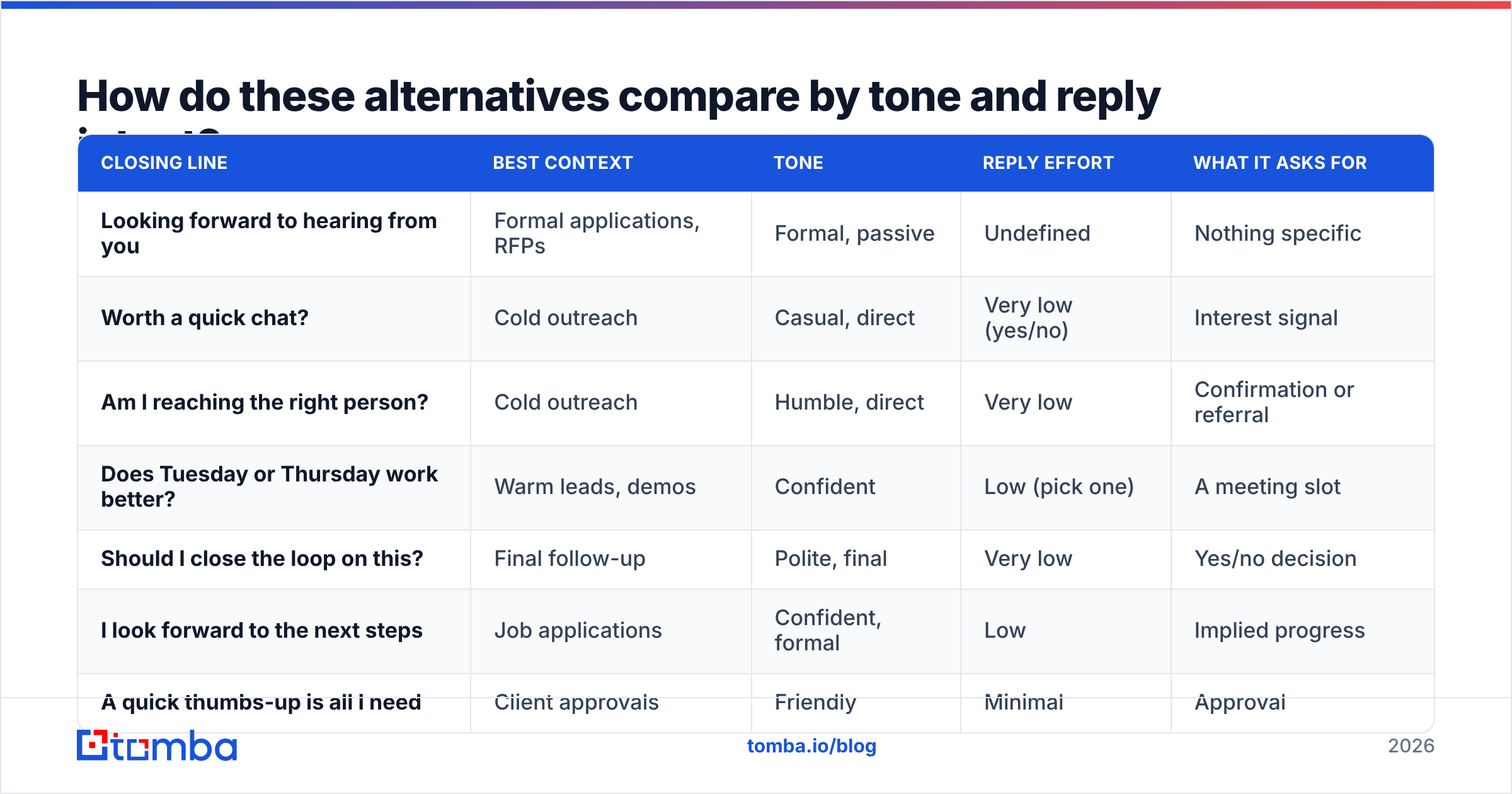
The table below groups the most useful alternatives by what they ask the reader to do. Pick based on the action you want, not the tone you'd like to project.
| Closing line | Best context | Tone | Reply effort | What it asks for |
|---|---|---|---|---|
| Looking forward to hearing from you | Formal applications, RFPs | Formal, passive | Undefined | Nothing specific |
| Worth a quick chat? | Cold outreach | Casual, direct | Very low (yes/no) | Interest signal |
| Am I reaching the right person? | Cold outreach | Humble, direct | Very low | Confirmation or referral |
| Does Tuesday or Thursday work better? | Warm leads, demos | Confident | Low (pick one) | A meeting slot |
| Should I close the loop on this? | Final follow-up | Polite, final | Very low | Yes/no decision |
| I look forward to the next steps | Job applications | Confident, formal | Low | Implied progress |
| A quick thumbs-up is all I need | Client approvals | Friendly | Minimal | Approval |
| Can you confirm by EOD Thursday? | Internal | Direct | Low | Confirmation with deadline |
The pattern is clear: the lower the reply effort, the more replies you get. Every row that beats the original asks for a specific, small action.
How do you pick the right closing line every time?#
Use this four-step check before you hit send. It takes about ten seconds per email.
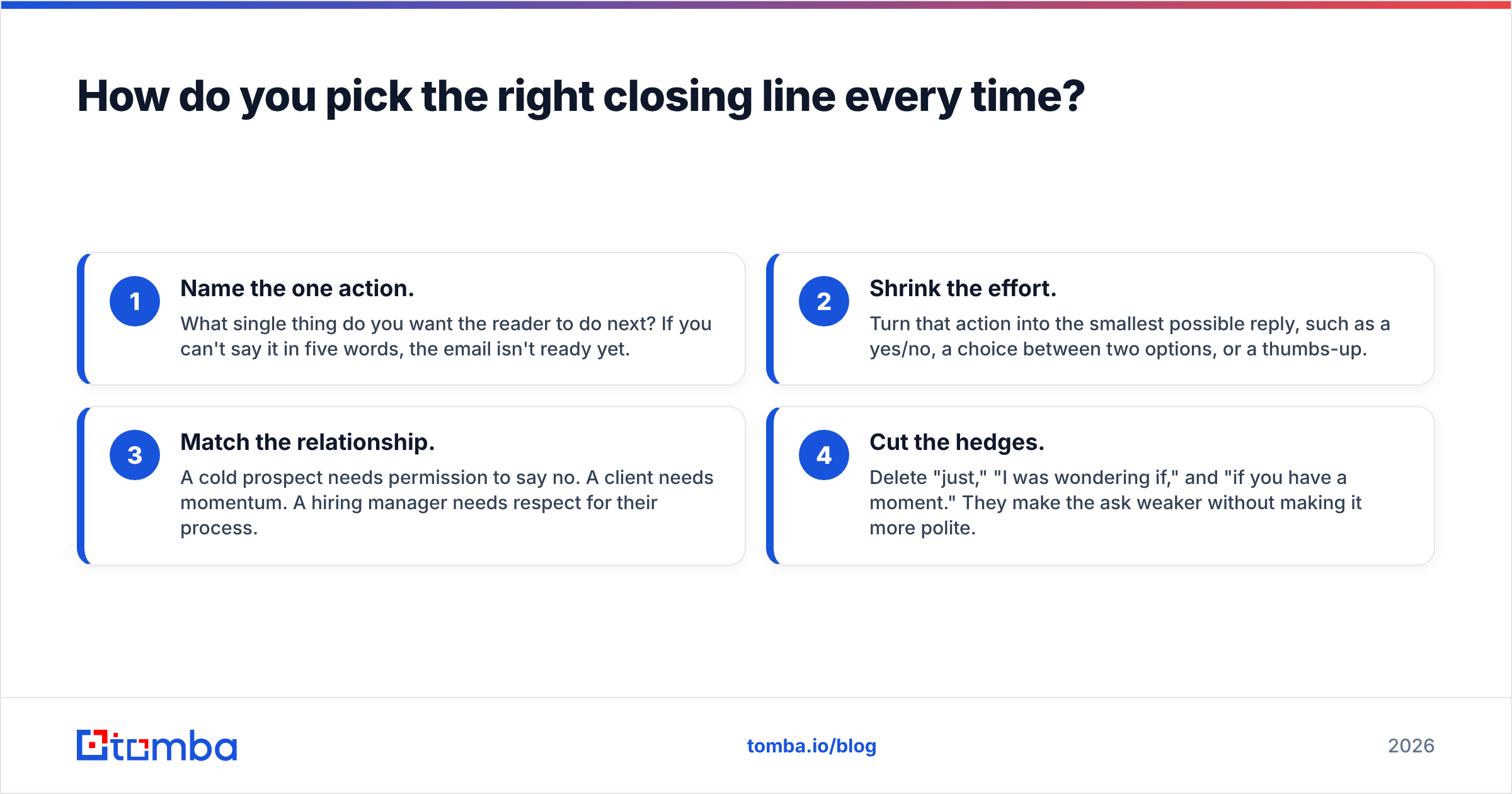
- Name the one action. What single thing do you want the reader to do next? If you can't say it in five words, the email isn't ready yet.
- Shrink the effort. Turn that action into the smallest possible reply, such as a yes/no, a choice between two options, or a thumbs-up.
- Match the relationship. A cold prospect needs permission to say no. A client needs momentum. A hiring manager needs respect for their process.
- Cut the hedges. Delete "just," "I was wondering if," and "if you have a moment." They make the ask weaker without making it more polite.
A common failure is stacking asks: "Let me know your thoughts, and if you're interested we could hop on a call, or I can send the deck." Three options usually get you no reply at all, because the reader has to decide which one to answer. Pick one.
If you're writing at volume, an AI cold email writer can draft variations of the same close for A/B testing, so you're comparing lines on data instead of gut feel. Most sequencing tools, including HubSpot Sequences, can split-test the final line in a template if you keep everything else identical.
Does the sign-off matter if the email never reaches the inbox?#
No. This is the step people skip. You can spend an afternoon polishing the perfect close, but if the address is wrong or the domain is catch-all and the mailbox doesn't exist, nobody reads it. Worse, a high bounce rate damages your sender reputation, which means even your well-written emails to valid addresses start landing in spam.
So the order is:
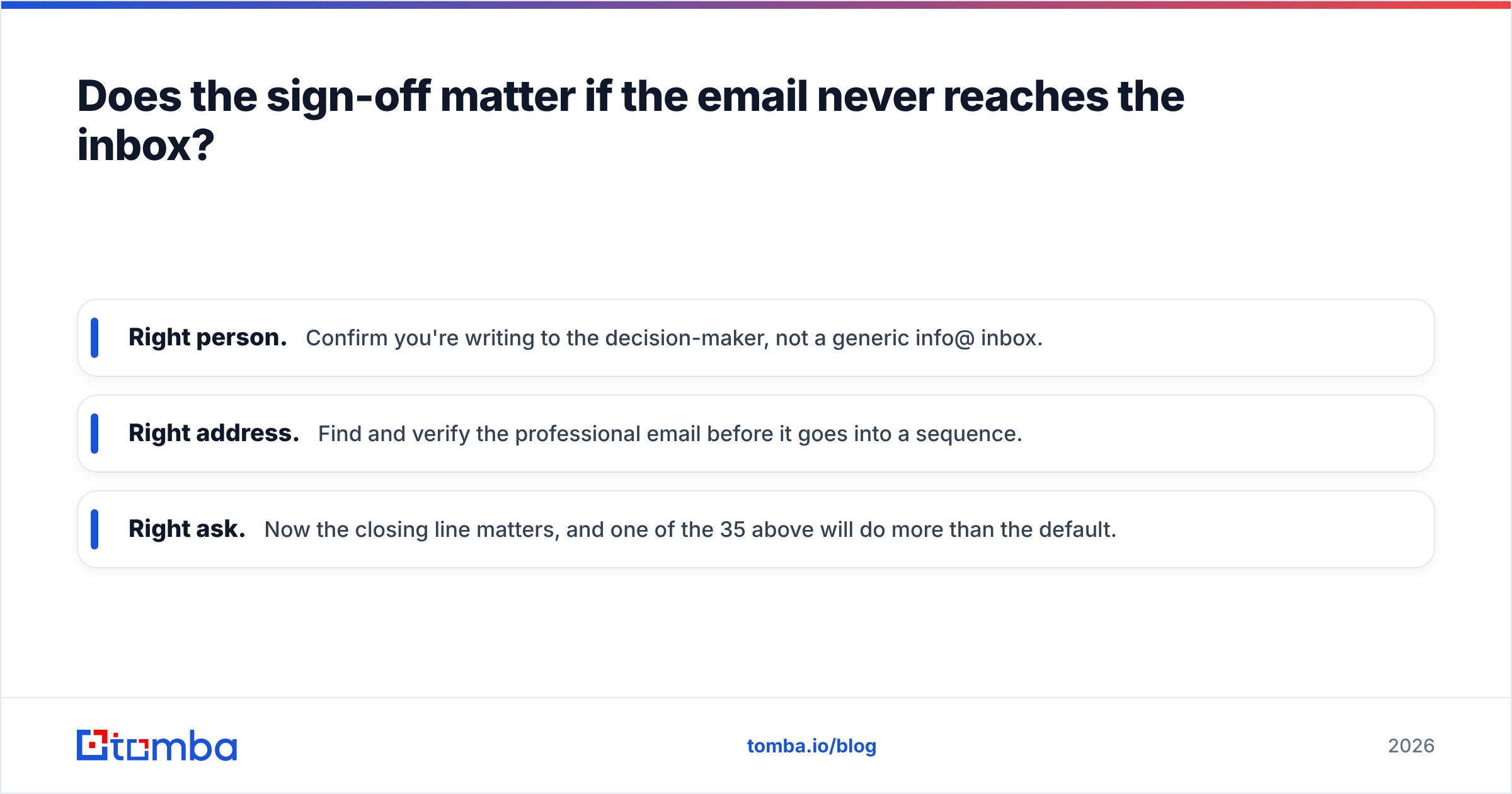
- Right person. Confirm you're writing to the decision-maker, not a generic info@ inbox.
- Right address. Find and verify the professional email before it goes into a sequence.
- Right ask. Now the closing line matters, and one of the 35 above will do more than the default.
A line like "Am I reaching the right person?" is only clever when the address works. Sent to a bounced mailbox, nobody sees it.
What are the most common mistakes to avoid?#
A few patterns come up again and again in outbound email reviews:
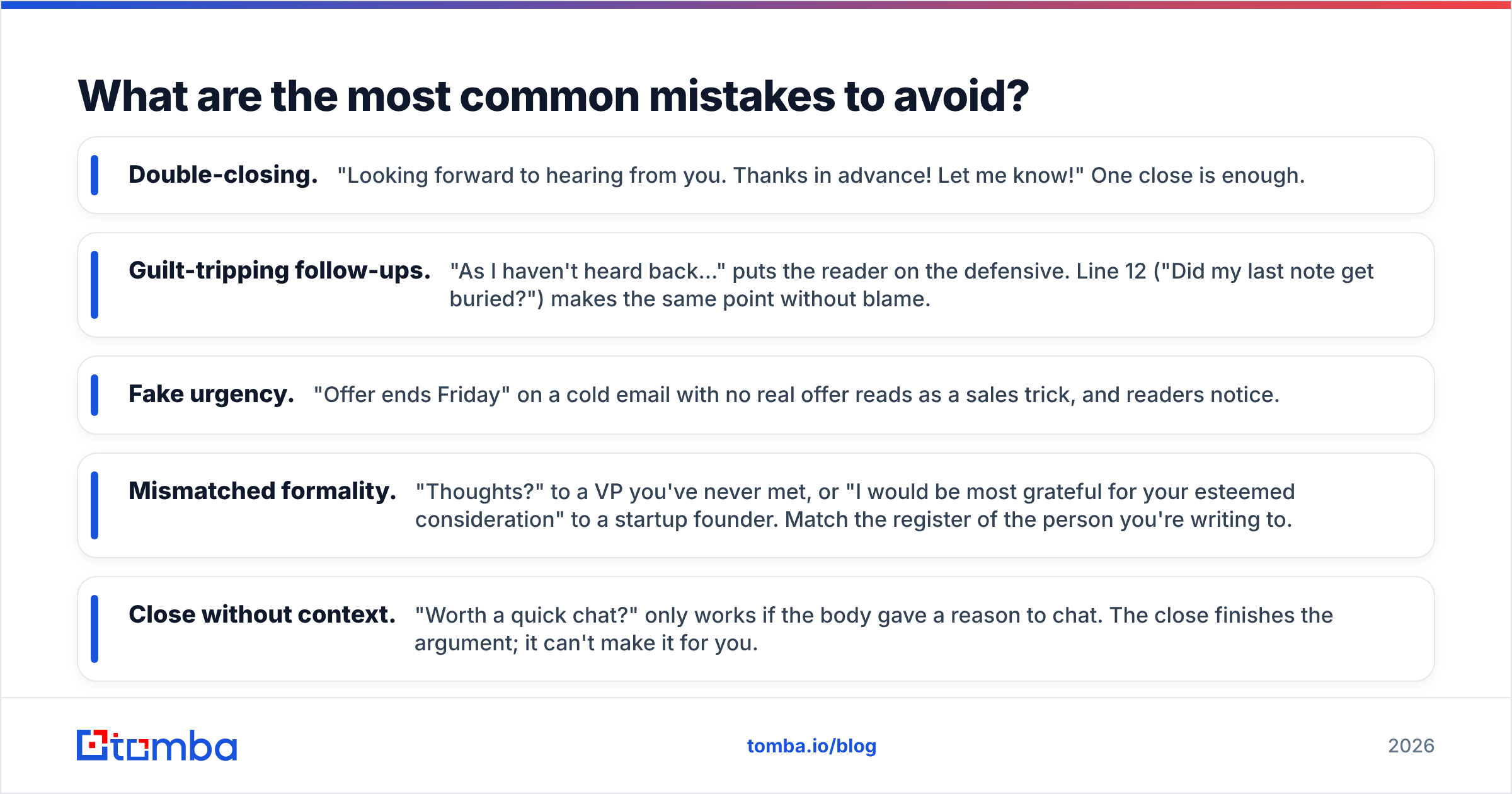
- Double-closing. "Looking forward to hearing from you. Thanks in advance! Let me know!" One close is enough.
- Guilt-tripping follow-ups. "As I haven't heard back..." puts the reader on the defensive. Line 12 ("Did my last note get buried?") makes the same point without blame.
- Fake urgency. "Offer ends Friday" on a cold email with no real offer reads as a sales trick, and readers notice.
- Mismatched formality. "Thoughts?" to a VP you've never met, or "I would be most grateful for your esteemed consideration" to a startup founder. Match the register of the person you're writing to.
- Close without context. "Worth a quick chat?" only works if the body gave a reason to chat. The close finishes the argument; it can't make it for you.
Final take: which alternative should you use?#
If you only remember one thing, remember this: replace "looking forward to hearing from you" with a specific, small, single ask. For cold outreach, "Worth a quick chat?" or "Am I reaching the right person?" are hard to beat. For follow-ups, the breakup close ("Should I close the loop?") often gets a reply when nothing else has. For formal emails, "I look forward to the next steps" keeps the politeness and adds confidence.
Then test it. Rotate two or three closes across a few hundred sends, measure reply rate, and keep the winner.
None of it matters if your email bounces. Before your new closing line goes into a sequence, make sure it reaches a real person. Tomba Email Finder finds professional email addresses by name, domain, or company, with built-in verification so your best copy lands in a real inbox. The free tier includes 25 searches a month, and paid plans start at $49/mo. See Tomba pricing to pick a plan that fits your outreach volume.
Related guides#
// get started
Find, verify and enrich your first contacts today
Start on the free plan with 25 searches a month, then scale when your team is ready.
Free plan · No credit card required · GDPR & CCPA
// about the author