Low Cost Lead Generation: 10 Tactics That Work on a Budget
You don't need a five-figure ad budget to fill your pipeline. Here are 10 low cost lead generation tactics, what each one really costs, and a lean stack for under $500 a month.
TL;DR
- Low cost lead generation is about cost per qualified lead, not the tool price. A $0 channel that eats 20 hours a week can cost more than a $99 tool.
- The cheapest channels are the ones you control: targeted outbound, content aimed at a specific buyer, partnerships, referrals, and turning your existing traffic into leads.
- Paid ads and bought lists feel fast, but for most small B2B teams they are the most expensive way to get a qualified conversation.
- A lean stack (data + verification + sending + CRM) can run for under $500/month and cover most of what a two-person sales team needs.
- Measure every channel on three numbers: cost, hours, and meetings booked. Drop anything that can't show meetings within 60 days.
What is low cost lead generation, really?#
Low cost lead generation means getting qualified prospects into your pipeline at the lowest total cost per lead: software, ad spend, and the hours your team puts in. The last part is the one teams forget.
Think of it like cooking at home versus eating out. The groceries are cheap, but if the recipe takes three hours every night, you haven't saved much. Lead generation works the same way. A "free" LinkedIn scraping routine that burns a rep's afternoon costs you that rep's pipeline time too.
Here's the formula to use:
True cost per lead = (tool spend + ad spend + hours × loaded hourly rate) ÷ qualified leads
If you're new to the discipline, the Wikipedia overview of lead generation covers the basic definitions. This guide is about the economics: where the money leaks and which channels give you the most qualified leads per dollar and per hour.
Which lead generation channels actually cost the least?#
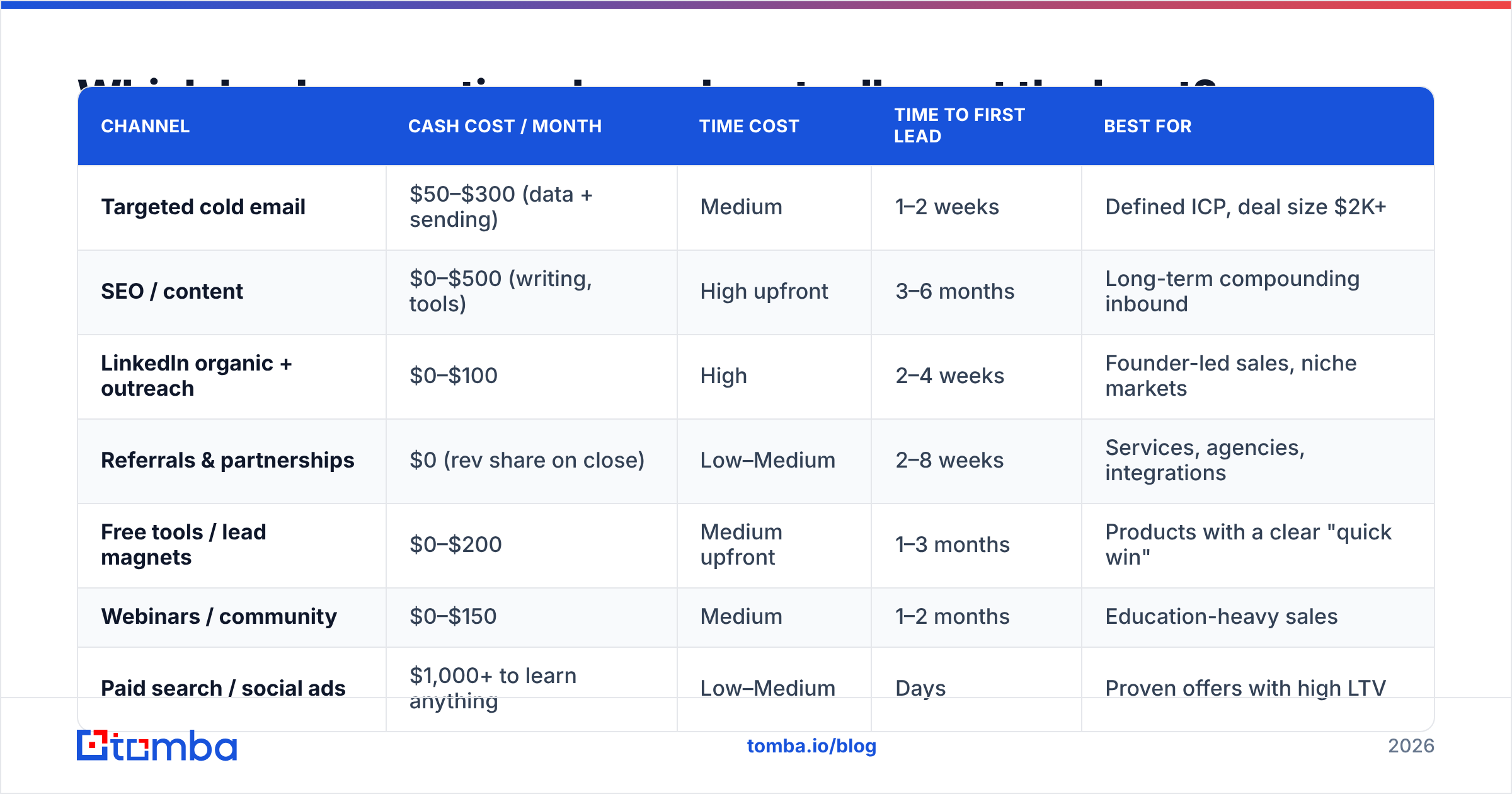
Each channel sits somewhere on a trade-off between cash cost and time cost. The table below uses typical ranges for small B2B teams. Treat them as directional; your numbers depend on your market and deal size.
| Channel | Cash cost / month | Time cost | Time to first lead | Best for |
|---|---|---|---|---|
| Targeted cold email | $50–$300 (data + sending) | Medium | 1–2 weeks | Defined ICP, deal size $2K+ |
| SEO / content | $0–$500 (writing, tools) | High upfront | 3–6 months | Long-term compounding inbound |
| LinkedIn organic + outreach | $0–$100 | High | 2–4 weeks | Founder-led sales, niche markets |
| Referrals & partnerships | $0 (rev share on close) | Low–Medium | 2–8 weeks | Services, agencies, integrations |
| Free tools / lead magnets | $0–$200 | Medium upfront | 1–3 months | Products with a clear "quick win" |
| Webinars / community | $0–$150 | Medium | 1–2 months | Education-heavy sales |
| Paid search / social ads | $1,000+ to learn anything | Low–Medium | Days | Proven offers with high LTV |
| Bought contact lists | $200–$2,000 one-off | Low upfront, high cleanup | Days | Rarely worth it without verification |
Two things stand out. First, the channels with the lowest cash cost usually carry the highest time cost, so your job is to cut that time with automation and good data. Second, paid ads can't really be "low cost" until you already know your offer converts. Otherwise you're paying Google or LinkedIn to run your market research.
How do you build a low cost lead generation system?#
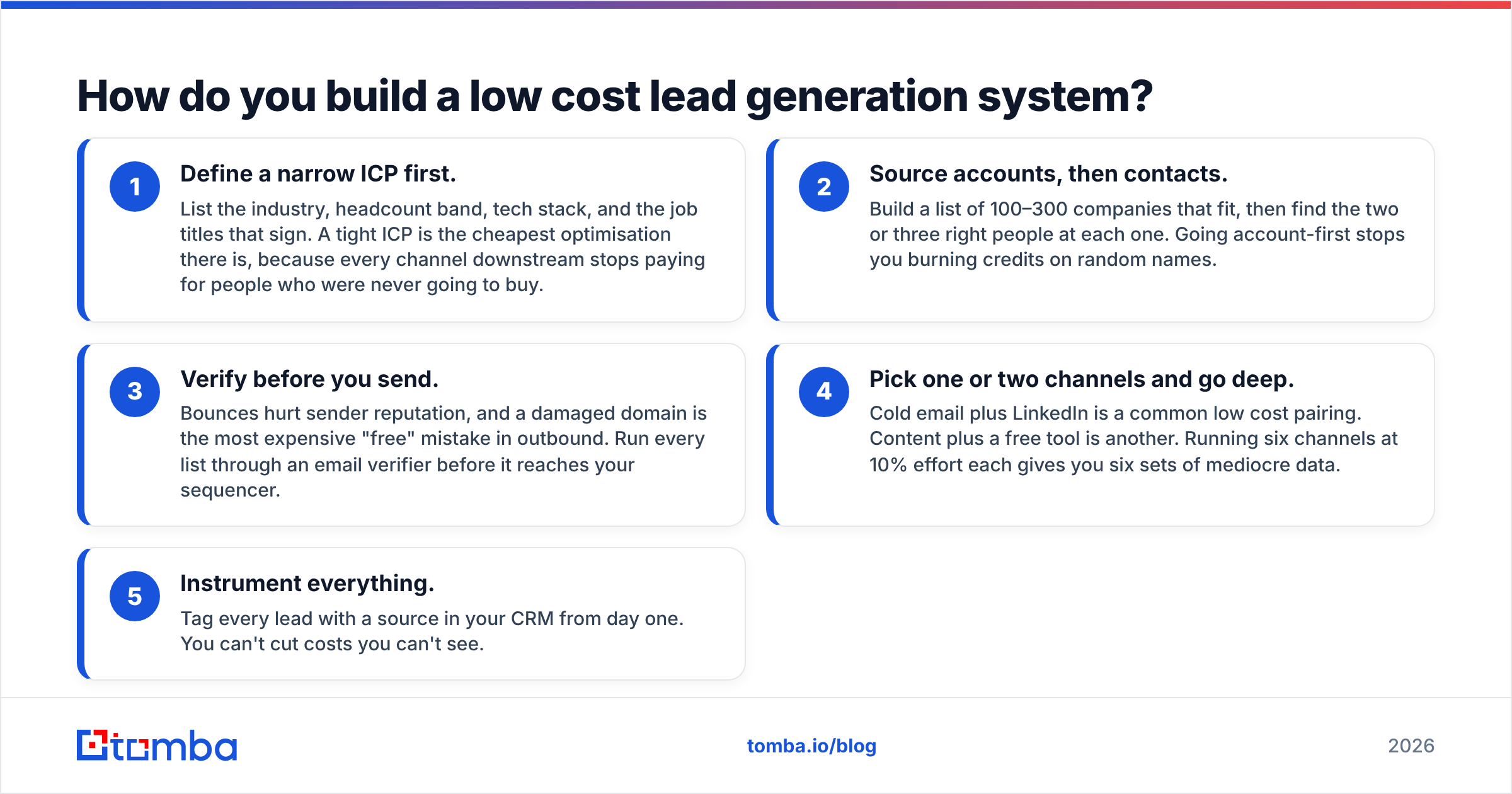
Stringing tactics together doesn't make a system. The teams that keep cost per lead low tend to follow the same five-part structure:
- Define a narrow ICP first. List the industry, headcount band, tech stack, and the job titles that sign. A tight ICP is the cheapest optimisation there is, because every channel downstream stops paying for people who were never going to buy.
- Source accounts, then contacts. Build a list of 100–300 companies that fit, then find the two or three right people at each one. Going account-first stops you burning credits on random names.
- Verify before you send. Bounces hurt sender reputation, and a damaged domain is the most expensive "free" mistake in outbound. Run every list through an email verifier before it reaches your sequencer.
- Pick one or two channels and go deep. Cold email plus LinkedIn is a common low cost pairing. Content plus a free tool is another. Running six channels at 10% effort each gives you six sets of mediocre data.
- Instrument everything. Tag every lead with a source in your CRM from day one. You can't cut costs you can't see.
What are the 10 best low cost lead generation tactics?#
These are ordered roughly by how fast they pay back for a small B2B team.
1. Account-based cold email to a verified list#
Cold email is still one of the cheapest ways to start conversations with people who don't know you yet. Your costs are data, a sending tool, and a couple of warmed secondary domains. The quality of the list decides everything. Use domain search to pull the decision-makers at each target company, and keep each sequence to 50–100 highly relevant accounts so you can personalise the first line.
2. Mining your own website traffic#
You're already paying for traffic through content, brand, or ads. Most of it leaves without a trace. Visitor identification tools, a well-placed demo CTA on high-intent pages (pricing, integrations, comparisons), and exit-intent offers turn traffic you've already paid for into leads with no new spend.
3. Free tools and calculators#
A small, useful tool (an ROI calculator, a grader, a template generator) keeps generating leads long after launch. It works because it gives value before asking for an email. Build it once, link it from relevant blog posts, and gate only the advanced output.
4. Bottom-of-funnel content#
Skip "what is marketing" posts. Write the pages buyers read right before they choose: "X vs Y," "X alternatives," "X pricing," integration guides. These pages get less traffic but convert far better. Keyword data from a tool like HubSpot's free SEO resources or your Search Console tells you which of these queries already bring in impressions.
5. Referral asks built into your process#
Most teams ask for referrals once, awkwardly, and never again. Build the ask into two moments instead: right after a successful onboarding and right after a renewal. A simple double-sided incentive (a credit for both sides) costs nothing until a deal closes.
6. Partner co-marketing#
Find three non-competing companies that sell to the same buyer. Swap newsletter mentions, co-host a webinar, or build an integration together. You borrow a warm audience at zero ad cost.
7. LinkedIn: comments first, DMs second#
Posting helps, but commenting thoughtfully on your buyers' posts is the lower-effort way in. After two or three meaningful exchanges, a connection request converts far better than a cold pitch. Pair this with a way to find the email of the people you engage, so the conversation can move off-platform.
8. Small, focused webinars or roundtables#
Twenty of the right people on a call beat 500 random registrants. Invite prospects from your target list personally, record the session, and turn the recording into three pieces of content.
9. Community participation#
Slack groups, subreddits, and industry forums where your buyers ask questions are free distribution. The rule: be useful for weeks before you mention your product, and never drop links unprompted.
10. Re-engaging closed-lost and old leads#
Your CRM is probably full of leads that went cold for reasons that no longer apply: budget timing, a champion who left, a missing feature you've since shipped. A short re-engagement sequence to this list is often the cheapest pipeline you'll find all quarter, because they already know who you are. Check the contacts are still valid first, since people change jobs constantly.
Is paid advertising ever a low cost lead generation option?#
Sometimes, but only after you've proven an offer through cheaper channels. Paid ads amplify a message that already converts. They're a poor way to find out whether it converts.
A practical rule: if you can't point to at least 10 closed deals from a specific offer and audience, keep the ad budget at zero or close to it. Once you can, retargeting your own site visitors is usually the cheapest paid tactic, because you're only paying to reach people who have already shown interest.
Also watch out for the costs of lead-gen ad forms. They make submitting easy, so volume looks great, but qualification rates often fall. Report on cost per qualified lead, never cost per form fill.
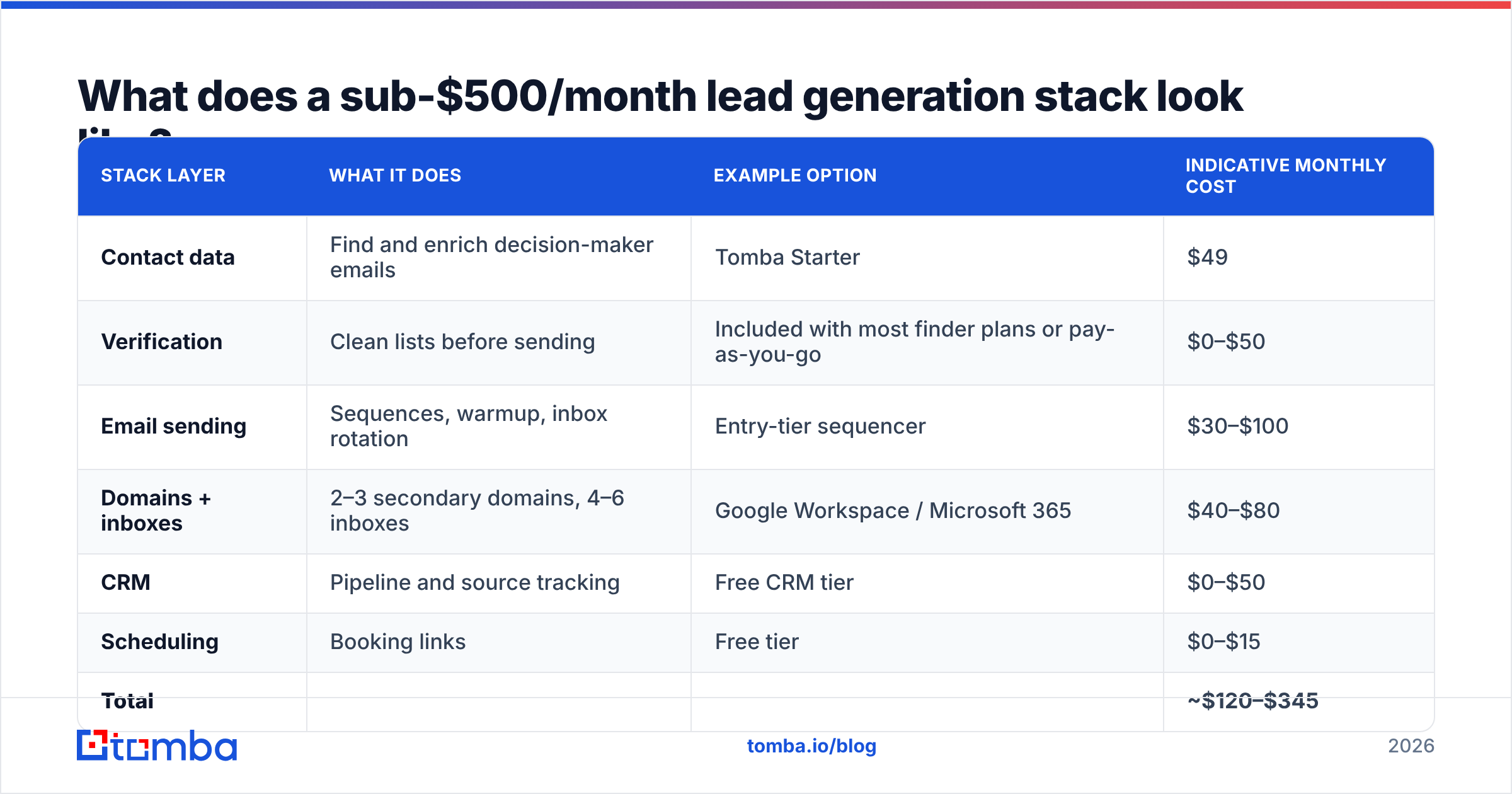
What does a sub-$500/month lead generation stack look like?#
Here's a lean, realistic stack for a team of one to three reps doing outbound plus light inbound. Prices are indicative starting tiers; always check the vendor's current pricing page.
| Stack layer | What it does | Example option | Indicative monthly cost |
|---|---|---|---|
| Contact data | Find and enrich decision-maker emails | Tomba Starter | $49 |
| Verification | Clean lists before sending | Included with most finder plans or pay-as-you-go | $0–$50 |
| Email sending | Sequences, warmup, inbox rotation | Entry-tier sequencer | $30–$100 |
| Domains + inboxes | 2–3 secondary domains, 4–6 inboxes | Google Workspace / Microsoft 365 | $40–$80 |
| CRM | Pipeline and source tracking | Free CRM tier | $0–$50 |
| Scheduling | Booking links | Free tier | $0–$15 |
| Total | ~$120–$345 |
That leaves room in a $500 budget for occasional content help or a design tool for your lead magnet. If volume grows, the data layer is usually the first to scale. Tomba pricing goes from a free tier (25 searches/month) to Starter at $49/month, Growth at $99/month, and Pro at $249/month, so you can move up as reply rates justify it instead of committing to an annual enterprise contract upfront.
Independent review sites like G2 are useful for checking how each layer's vendors hold up in real use before you commit.

How do you lower cost per lead without killing quality?#
Cheap and bad is easy. Cheap and qualified takes discipline. These levers do the most:
- Tighten targeting before you touch copy. A mediocre email to the perfect prospect beats a great email to the wrong one. Narrow by headcount, tech stack, and recent trigger events (funding, hiring, new leadership).
- Protect deliverability. Every bounce and spam complaint makes the next email more expensive to land. Keep bounce rates low by verifying, warming up new inboxes, and capping daily sends per inbox. Our glossary entry on email deliverability covers the fundamentals.
- Reuse every asset three times. One customer interview can become a case study, a LinkedIn post, and a cold email proof point.
- Automate the research, not the relationship. Use tools to find contacts, enrich firmographics, and log activity. Keep the first line of each email, and every reply, human.
- Kill channels quickly. Give each new channel a fixed test window (30–60 days) and a target number of meetings. If it misses, cut it and put the time somewhere else.
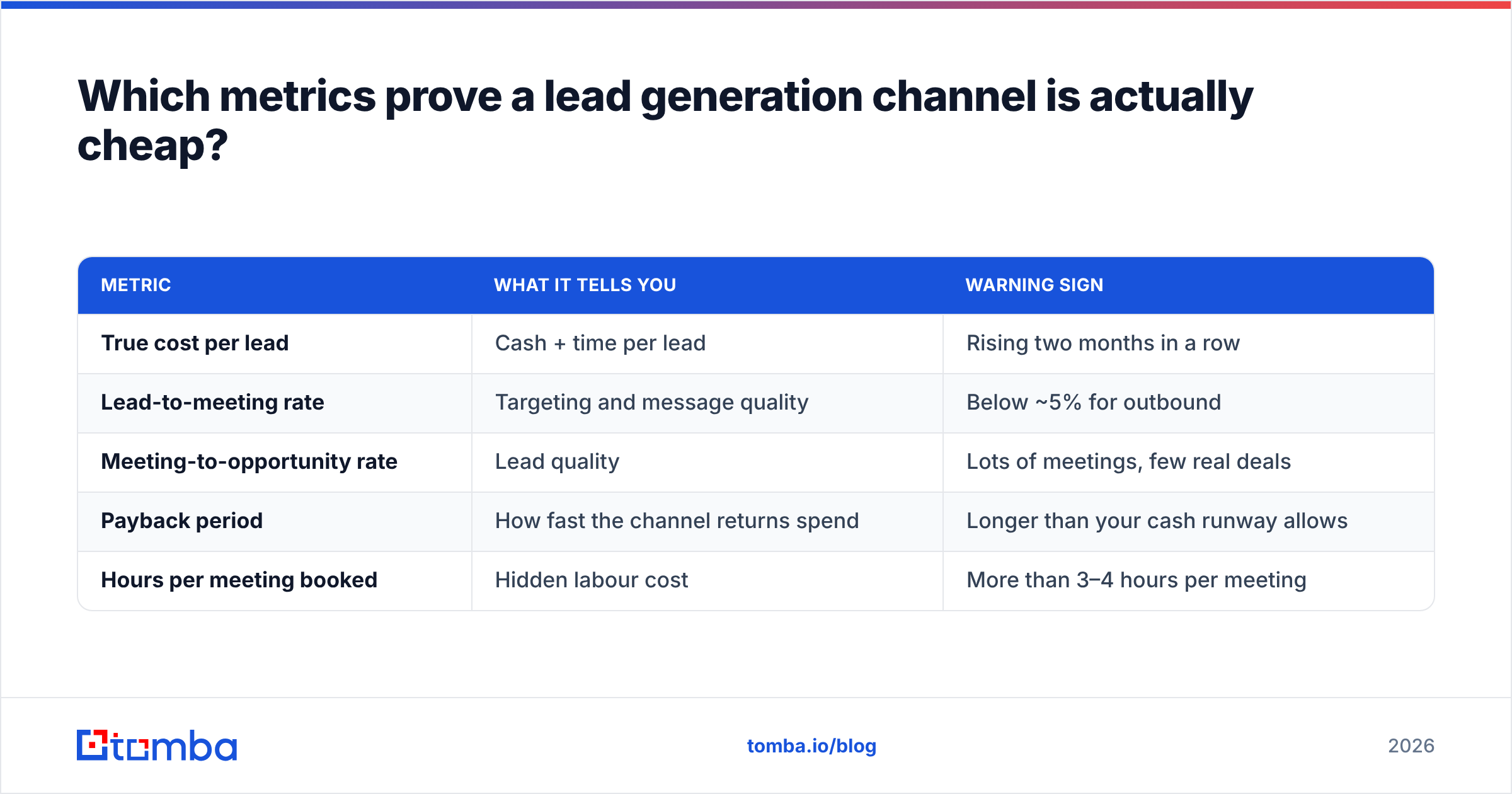
Which metrics prove a lead generation channel is actually cheap?#
Track these per channel, monthly:
| Metric | What it tells you | Warning sign |
|---|---|---|
| True cost per lead | Cash + time per lead | Rising two months in a row |
| Lead-to-meeting rate | Targeting and message quality | Below ~5% for outbound |
| Meeting-to-opportunity rate | Lead quality | Lots of meetings, few real deals |
| Payback period | How fast the channel returns spend | Longer than your cash runway allows |
| Hours per meeting booked | Hidden labour cost | More than 3–4 hours per meeting |
Research firms like Gartner have long pointed out that B2B buyers now do most of their research before talking to sales. In practice, your cheapest leads often come from channels that meet buyers during that self-directed research phase (content, tools, comparisons), while targeted outbound fills the gap with accounts that haven't started looking yet.
What mistakes make "low cost" lead generation expensive?#
- Buying unverified lists. The upfront price looks cheap, but bounce rates can damage your sending domains for weeks.
- Spreading across too many channels. Six half-run channels give you no usable data and no pipeline.
- Ignoring rep time. If your AE spends mornings copying names from LinkedIn into spreadsheets, you're paying AE salary for data-entry work.
- No source tracking. Without it you'll keep funding the channel that feels busy instead of the one that closes.
- Chasing volume metrics. Form fills, opens, and connection accepts are not pipeline.
Where should you start this week?#
If you only do three things in the next seven days:
- Write a one-paragraph ICP and pull a list of 100 target accounts.
- Find and verify two to three decision-makers per account.
- Launch one short, personalised sequence and tag every reply with its source in your CRM.
That's a working low cost lead generation engine in a week, for under $100 in software. Everything else in this guide layers on top.
The data layer is where most budget teams lose either money (bloated platform contracts) or time (manual research). Tomba Email Finder covers that layer without either problem: search by domain, name, or company, get verified professional emails, and start on the free plan before moving to Starter at $49/month once your outbound shows results. Try it on your first 25 target accounts and see what your true cost per lead looks like.
Related guides#
Ready to find emails that actually work?
Join 150,000+ professionals who stopped guessing and started sending. Free credits on signup — no credit card required.
Get the Tomba newsletter
Practical outbound tactics and product updates — once every two weeks.
About the author