Lusha vs Apollo.io (2026): Pricing, Data Quality, and Our Pick
Lusha is the fast contact-reveal tool. Apollo.io is a full prospecting and sequencing suite. We compare data quality, pricing, credits, and workflow fit so you buy the right one.
TL;DR
- Lusha is the faster, simpler tool. You open a LinkedIn profile or CRM record, click, and get a verified email or direct dial. Data on European and mid-market contacts is solid, and the learning curve is close to zero.
- Apollo.io is a full prospecting suite: a large B2B database, filters, sequences, a dialer, and intent signals in one tab. Each seat costs more, but it can replace two or three other tools.
- Pricing models differ. Lusha bills per user with a fixed monthly credit pool, and phone numbers cost several times more credits than emails. Apollo bills per user with large upfront credit grants on annual plans.
- Pick Lusha if reps already have a sequencer and just need accurate contact data inside LinkedIn, Salesforce, or HubSpot. Pick Apollo if you're building outbound from scratch and want one platform.
- Consider a third option if you mainly need email addresses at volume without paying per seat. A domain-based email finder like Tomba is often cheaper per verified email.
What are Lusha and Apollo.io, really?#
Both tools are usually filed under "sales intelligence," but they were built for different jobs.
Lusha started as a browser extension that shows contact details on LinkedIn profiles. Its core value is still the reveal: you're looking at a person, you want their email and mobile number, and Lusha gives you both in one click. It has since added prospecting lists, intent signals, and basic enrichment, but the product is still about reveal accuracy and speed.
Apollo.io started as a database plus a sequencer, and it has grown into a broad go-to-market platform. You can search hundreds of millions of contacts with detailed filters, push them into multi-step email and call sequences, record calls, and track deals. Apollo wants to be the only prospecting tab your reps keep open.
Think of it this way. Lusha is a very good phone book that opens wherever you're already working. Apollo is a phone book with a call center attached. If you already have the call center (Outreach, Salesloft, Instantly, HubSpot sequences), Apollo's extra features overlap with what you pay for elsewhere.
How do Lusha and Apollo.io compare feature by feature?#
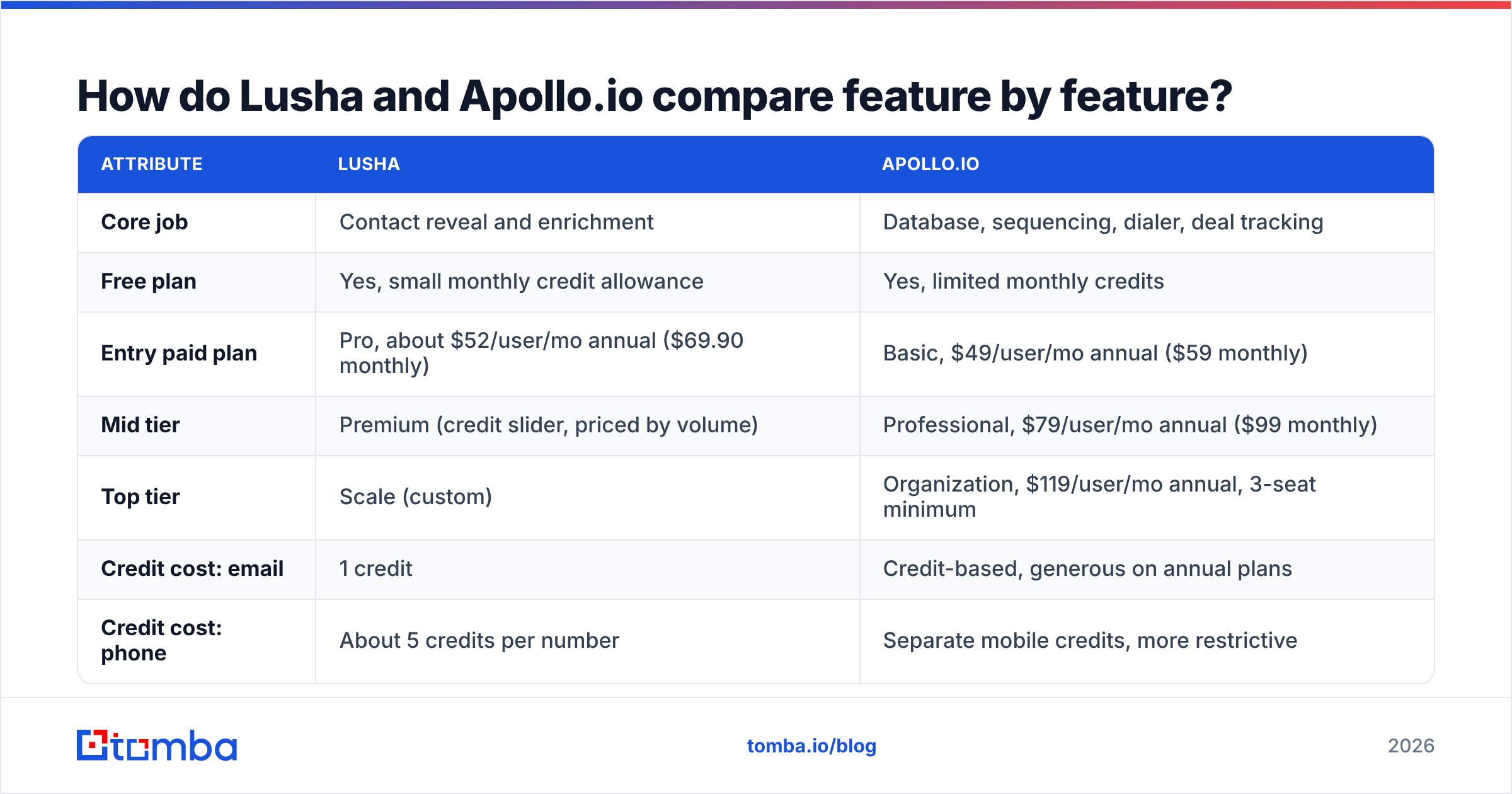
Here's the side-by-side on the attributes that usually decide a purchase. Prices are list prices at the time of writing. Both vendors change plans often, so confirm on the Lusha pricing page and the Apollo pricing page before you sign.
| Attribute | Lusha | Apollo.io |
|---|---|---|
| Core job | Contact reveal and enrichment | Database, sequencing, dialer, deal tracking |
| Free plan | Yes, small monthly credit allowance | Yes, limited monthly credits |
| Entry paid plan | Pro, about $52/user/mo annual ($69.90 monthly) | Basic, $49/user/mo annual ($59 monthly) |
| Mid tier | Premium (credit slider, priced by volume) | Professional, $79/user/mo annual ($99 monthly) |
| Top tier | Scale (custom) | Organization, $119/user/mo annual, 3-seat minimum |
| Credit cost: email | 1 credit | Credit-based, generous on annual plans |
| Credit cost: phone | About 5 credits per number | Separate mobile credits, more restrictive |
| Built-in sequencer | Basic | Yes, multi-channel |
| Built-in dialer | No | Yes |
| Chrome extension | Yes, best in class for LinkedIn | Yes, works on LinkedIn and Gmail |
| CRM sync | Salesforce, HubSpot, Pipedrive, Zoho, more | Salesforce, HubSpot, plus a native CRM |
| Learning curve | Very low | Moderate to high |
| Best fit | Teams with an existing outbound stack | Teams that want one consolidated platform |
The numbers point to the same conclusion as the rest of this post. Apollo gives you more software per dollar. Lusha gives you a narrower product that is easier to adopt.

Which has more accurate contact data?#
This is the question most buyers care about, and the honest answer is that it depends on region, seniority, and data type.

Email accuracy. Both tools verify emails before they show them, and on mainstream North American B2B contacts both land in the same range. User reviews on G2 often credit Lusha with fewer bounces on the contacts it does return. Apollo returns a result for more contacts overall, but a larger share are marked "guessed" or "unverified." That trade-off matters: a tool that returns an email 90% of the time with more bounces can hurt your sender reputation more than a tool that returns one 70% of the time with fewer.
Phone accuracy. Lusha is generally stronger here, especially for direct dials and mobile numbers in Europe and Israel, where the company has its roots. Apollo's mobile coverage has improved, but reps who live on the phone usually rate Lusha higher on connect rates.
Coverage breadth. Apollo wins on raw volume. Its searchable database is larger, and its filters (technographics, headcount growth, job changes, funding) are deeper. If your workflow starts with "build me a list of 2,000 VPs of Ops at Series B SaaS companies," Apollo gets you there faster.
Freshness. Both rely on a mix of contributor networks, public sources, and verification pings. Neither is immune to decay. Expect a few percent of any list to go stale every month as people change jobs, whichever vendor you use.
A practical way to test this: export 200 contacts from your real ICP out of each tool, run both lists through the same independent email verifier, and compare valid, catch-all, and invalid rates. That takes about an hour and tells you more than any vendor accuracy claim.
How do Lusha and Apollo.io price their credits?#
Sticker price per seat is only half the story. The real cost is what you pay per usable contact.
Lusha's model. Each seat comes with a monthly credit pool. An email reveal costs 1 credit and a phone reveal costs about 5. On the Pro tier, a rep who pulls both email and mobile for every contact uses about 6 credits per person, so the monthly pool runs out after roughly 100 fully enriched contacts. Premium and Scale raise the pool, but the price rises with it.
Apollo's model. Annual plans grant a large block of credits upfront, which makes email-heavy prospecting cheap per contact. Mobile numbers and exports are capped more tightly, and some advanced features (intent data, extra seats in sequences, AI features) sit behind higher tiers. The Organization plan requires at least three seats, so a solo founder can't buy into Apollo's top tier.
Cost per verified email, rough math:
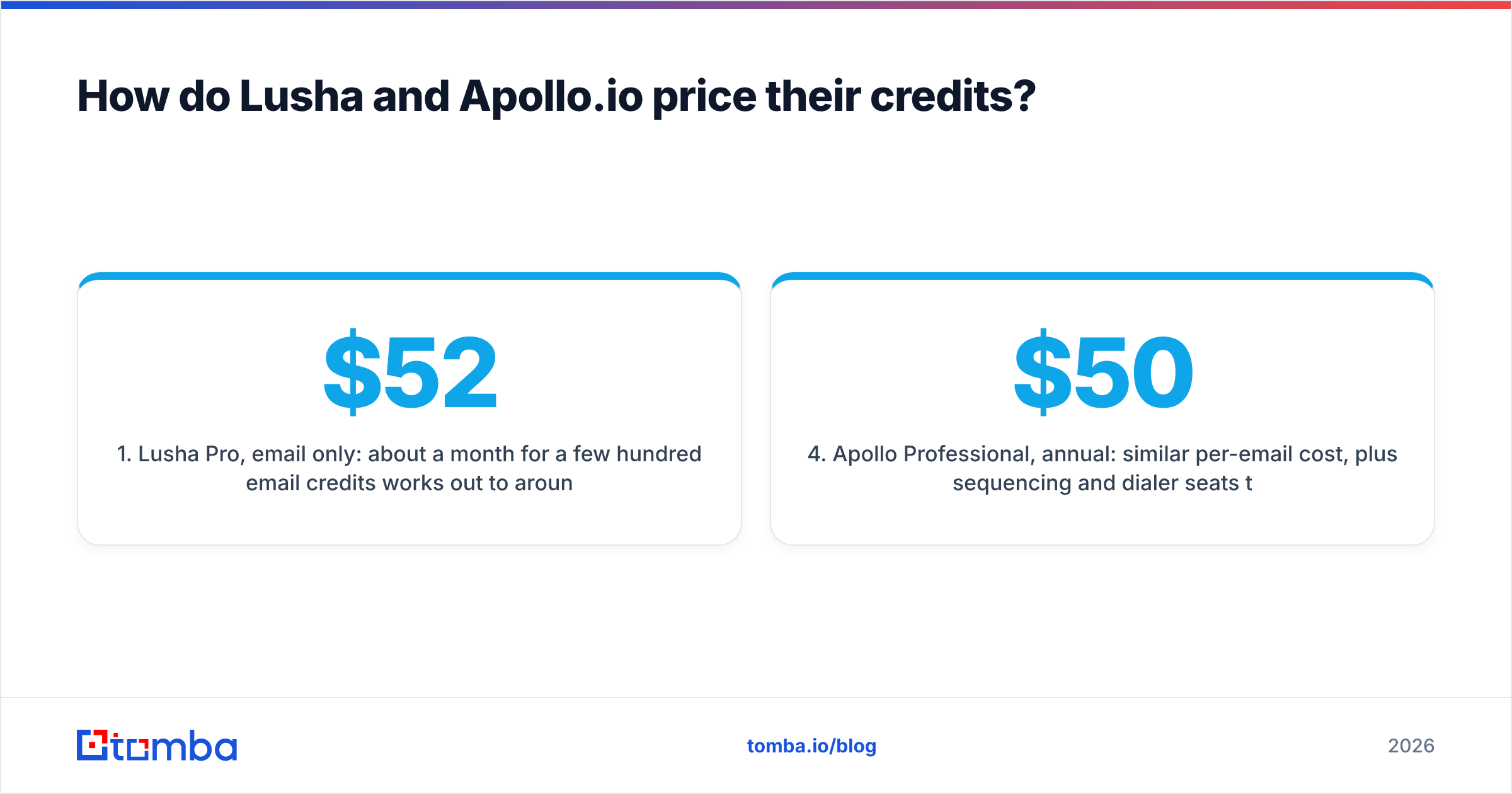
- Lusha Pro, email only: about $52 a month for a few hundred email credits works out to around 10–15 cents per email if you use the whole pool.
- Lusha Pro, email plus phone: effective cost per fully enriched contact rises to around 50 cents or more.
- Apollo Basic, annual: a large upfront credit grant pushes the cost per email to a few cents if you actually use the volume.
- Apollo Professional, annual: similar per-email cost, plus sequencing and dialer seats that would otherwise cost $50–$100 per user elsewhere.
Takeaway: Apollo is cheaper per email at volume, and Lusha is easier to justify per phone number if your team actually dials.

Is Lusha better than Apollo.io for small teams?#
For a team of one to five reps, the answer usually comes down to what you already own.
Choose Lusha if:
- You already run sequences elsewhere. If HubSpot, Instantly, Lemlist, or Outreach handles sending, Apollo's sequencer is just a duplicate.
- Your reps live on LinkedIn. Lusha's extension is the fastest way to grab contact data while browsing Sales Navigator.
- Phone outreach matters. Lusha's mobile coverage tends to give better connect rates.
- You want zero onboarding. Most reps are productive with Lusha in under an hour.
Choose Apollo if:
- You're starting outbound from scratch. One platform for list building, sending, and calling is cheaper than three separate tools.
- You build lists from filters, not profiles. Apollo's search is built for account-based list building at scale.
- Your budget is per company, not per rep. The upfront credit grant on annual plans stretches further than Lusha's monthly pools.
- You'll actually configure it. Apollo rewards teams that set up sequences, deliverability settings, and enrichment rules. Teams that don't end up paying for features they never use.
Is Apollo.io better than Lusha for scaling teams?#
Once you pass about 15 reps, the comparison shifts from features to governance.
Apollo's breadth becomes a liability if you already have a mature stack. RevOps teams often find reps running "shadow sequences" in Apollo that bypass the official sending infrastructure, which makes domain health and attribution harder to manage. If you go with Apollo at scale, decide early whether it's your system of record for outreach or just a data source, and lock down permissions to match.
Lusha's narrower scope fits better in larger orgs that standardize on Salesforce plus a dedicated engagement platform. It enriches records inside the CRM without competing with other tools. The Scale tier adds admin controls, credit allocation by team, and API access, which matter once procurement and security reviews get involved.
If you're comparing Apollo against several data vendors at this stage, our Apollo.io alternatives breakdown covers the wider field.
What do users complain about most?#
No tool is perfect, and the recurring complaints are useful for setting expectations.
Common Lusha complaints:
- Credits run out quickly when phone numbers are included.
- Monthly credits don't roll over on most plans.
- Coverage drops for very small companies and some APAC regions.
- Prospecting filters are thinner than Apollo's.
Common Apollo complaints:
- Mixed email accuracy, with more "guessed" results that need extra verification.
- A busy interface and a steeper learning curve.
- Feature gating that pushes teams toward higher tiers.
- Deliverability risk when teams send straight from Apollo without warming domains.

The pattern behind both lists: the hidden cost is always in credits and data quality, never in the headline seat price. Model your real usage (emails per rep per month, phones per rep per month) before you compare plans.
When should you consider neither?#
There's a large group of buyers for whom both Lusha and Apollo are overkill: agencies, founders, recruiters, and growth marketers who mostly need verified work emails at volume and don't want to pay per seat.
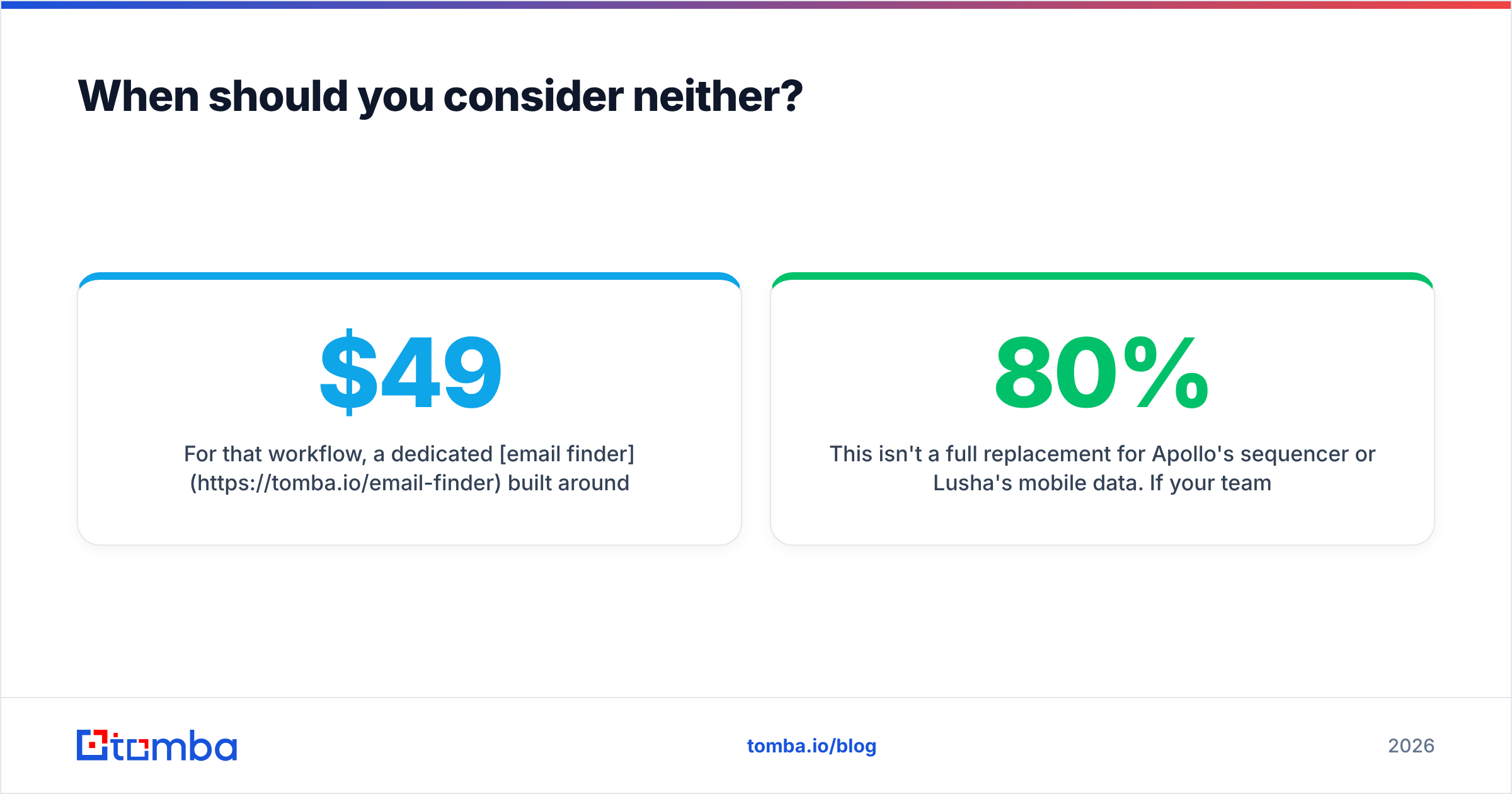
For that workflow, a dedicated email finder built around domain search and pattern verification often wins on cost. You enter a company domain or a name plus company, get the address with a confidence score and the public sources it was found on, and verify it before sending. There's no seat licensing, and pricing scales with searches rather than headcount. Tomba's plans, for example, start with a free tier of 25 searches a month, then Starter at $49/mo, Growth at $99/mo, and Pro at $249/mo. Full pricing details are public.
This isn't a full replacement for Apollo's sequencer or Lusha's mobile data. If your team dials all day, you still need a phone-first source. But if 80% of your use is "find this person's work email and confirm it won't bounce," a per-search tool usually costs less per verified contact than a per-seat sales intelligence platform.
Lusha vs Apollo.io: which should you choose?#
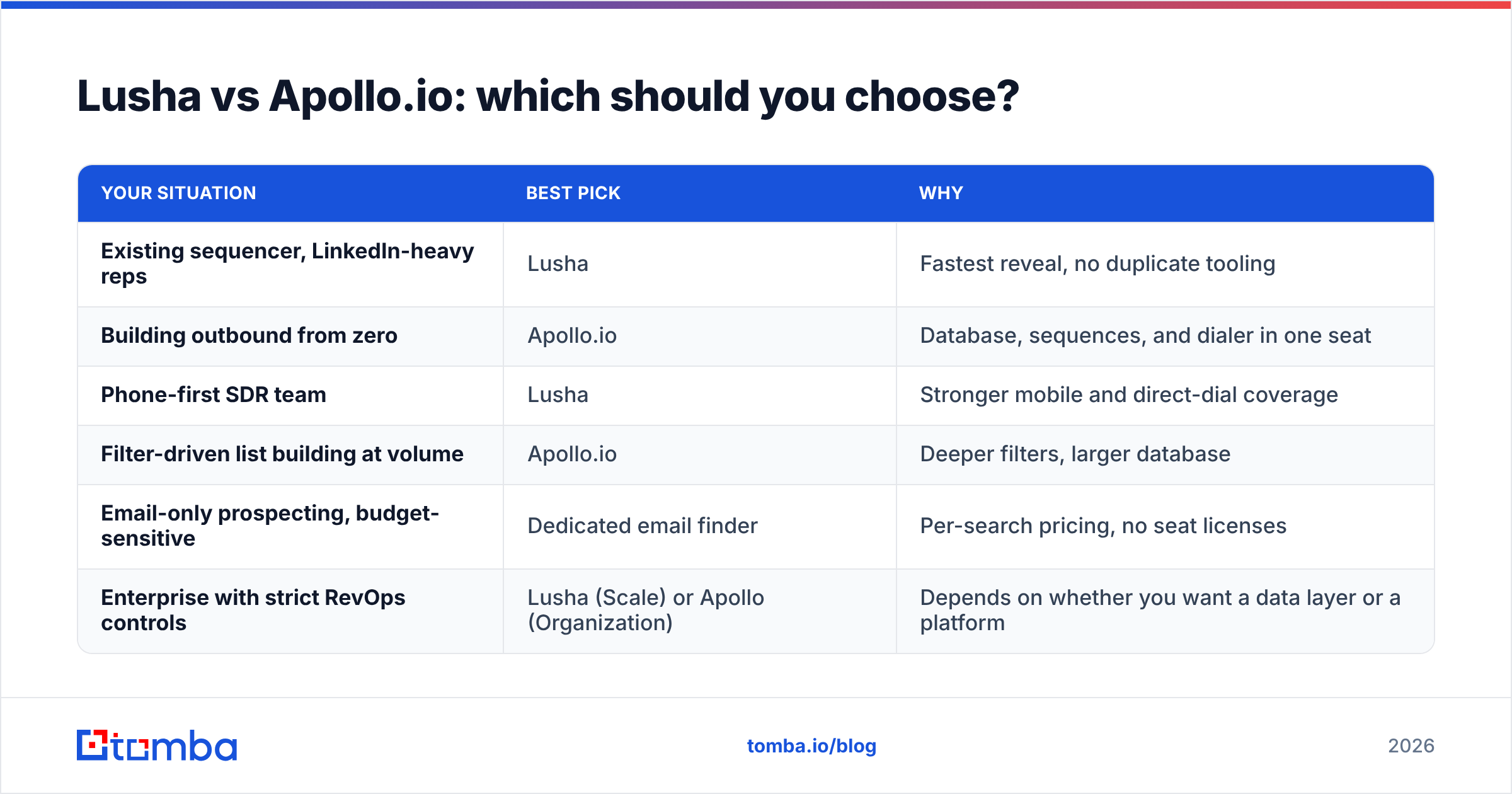
Here's the decision in one place:
| Your situation | Best pick | Why |
|---|---|---|
| Existing sequencer, LinkedIn-heavy reps | Lusha | Fastest reveal, no duplicate tooling |
| Building outbound from zero | Apollo.io | Database, sequences, and dialer in one seat |
| Phone-first SDR team | Lusha | Stronger mobile and direct-dial coverage |
| Filter-driven list building at volume | Apollo.io | Deeper filters, larger database |
| Email-only prospecting, budget-sensitive | Dedicated email finder | Per-search pricing, no seat licenses |
| Enterprise with strict RevOps controls | Lusha (Scale) or Apollo (Organization) | Depends on whether you want a data layer or a platform |
Neither tool is objectively better. Lusha is the better data-reveal tool, Apollo is the better all-in-one platform, and the right choice depends on which of those you're actually missing. Run a 200-contact test from your own ICP through both, verify the results independently, and let your bounce and connect rates decide.
Ready to find verified emails without per-seat pricing?#
If your shortlist was really about getting accurate work emails, try Tomba Email Finder before you commit to a per-seat contract. Search by domain, by name and company, or straight from LinkedIn with the Chrome extension, and get a confidence score and source URLs for every address. The free plan includes 25 searches a month, so you can run the same 200-contact test against Lusha and Apollo and compare the results yourself.
Related guides#
// get started
Find, verify and enrich your first contacts today
Start on the free plan with 25 searches a month, then scale when your team is ready.
Free plan · No credit card required · GDPR & CCPA
// about the author