Lusha vs Mattermark: Contact Data vs Startup Intel in 2026
Lusha vs Mattermark looks like a fair fight until you check the dates. One is a live contact-data tool. The other was folded into FullContact in 2017. Here's what each was built for and what to use in 2026.
TL;DR
- Lusha is an active B2B contact-data platform. Its strength is direct dials and emails for named people, and it lives in a Chrome extension and your CRM.
- Mattermark was a startup and private-company intelligence platform built for VCs and growth teams. FullContact bought its assets in late 2017, and you can't buy it as a standalone product today.
- So "Lusha vs Mattermark" isn't really a head-to-head in 2026. You're comparing a working contact tool with a discontinued company-signals database.
- If you need contacts, buy Lusha or a cheaper email-first tool. If you need what Mattermark did (funding, growth scores, deal flow), look at Crunchbase or PitchBook.
- On email-first prospecting with a tight budget, Tomba's free tier (25 searches/mo) and $49/mo Starter plan cost less to get started than most contact-data suites.
Why do people still compare Lusha vs Mattermark?#
Old listicles, G2-style category pages, and some procurement spreadsheets still put both tools under "B2B data." From the outside they look like substitutes, since both sell information about companies and the people who work there.
They answered different questions, though.
- Lusha answers: "How do I reach this person?" You get an email, a mobile number, a job title, and a CRM record.
- Mattermark answered: "Which companies are growing fast enough to matter?" You got funding rounds, headcount growth, web traffic trends, and a proprietary "growth score."
One tool helps an SDR book a meeting today. The other helps an investor or strategist decide which accounts deserve attention this quarter. If you go in expecting a feature-for-feature fight, you'll pick wrong.
The bigger issue is timing. In December 2017, FullContact acquired Mattermark's assets, which added roughly 4 million companies and 20+ million contacts to FullContact's identity graph. Mattermark stopped operating as an independent product after that. If a vendor comparison page still lists Mattermark pricing, that page is stale.
What is Lusha, and who is it built for?#
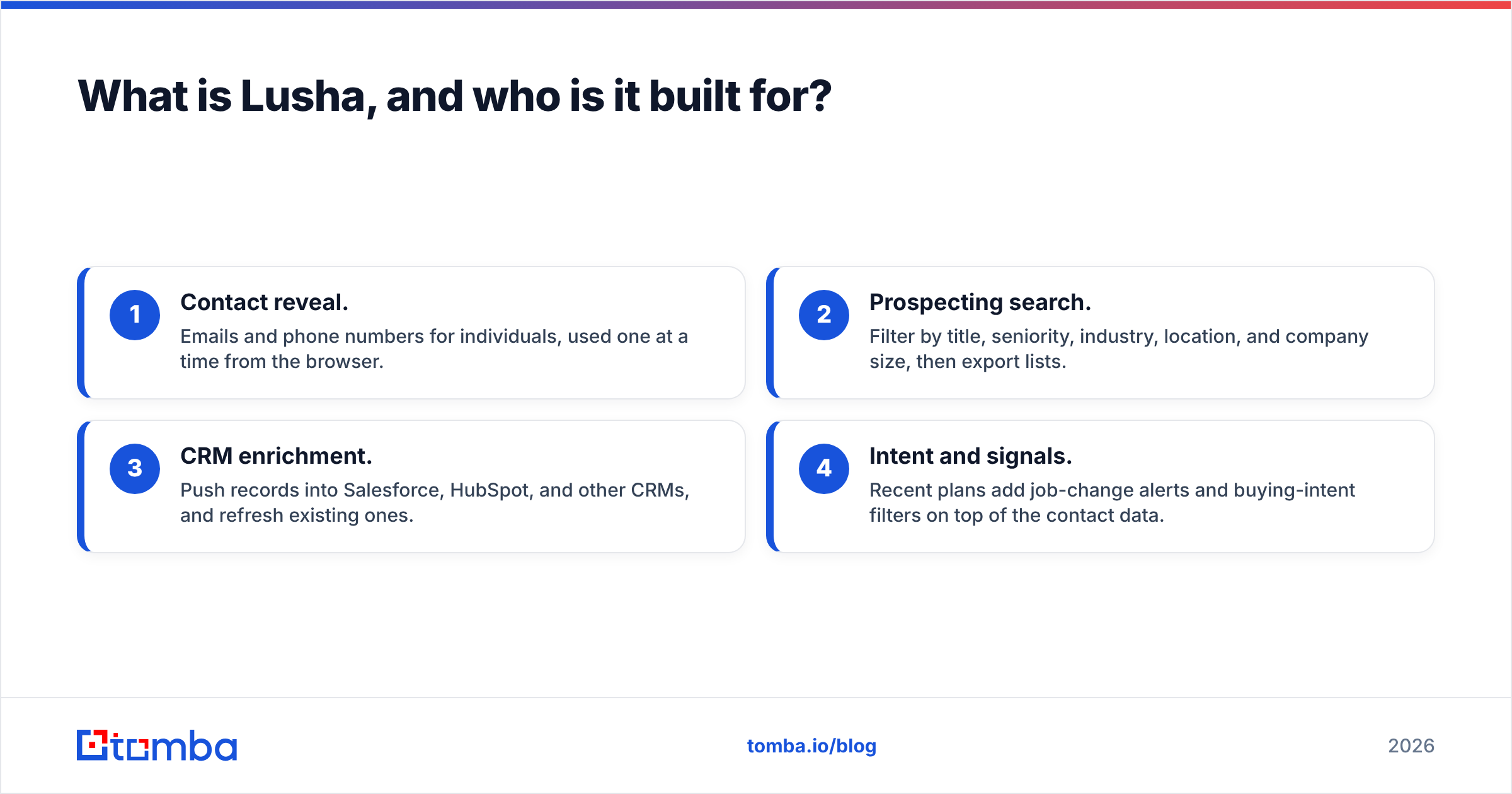
Lusha is a B2B contact and company data platform founded in 2016. Most users meet it through the Chrome extension: you open a LinkedIn profile or a company website, click the extension, and Lusha reveals the person's work email and, when it has one, a direct or mobile number.
Its core jobs:
- Contact reveal. Emails and phone numbers for individuals, used one at a time from the browser.
- Prospecting search. Filter by title, seniority, industry, location, and company size, then export lists.
- CRM enrichment. Push records into Salesforce, HubSpot, and other CRMs, and refresh existing ones.
- Intent and signals. Recent plans add job-change alerts and buying-intent filters on top of the contact data.
Lusha prices on credits, and the details matter. A phone reveal typically costs far more credits than an email reveal (third-party pricing breakdowns in 2026 put it at about 10 credits per phone vs 1 per email). Lusha also changes list prices and runs promotions often, so check the official Lusha pricing page before you trust any number in a blog post, this one included.
Lusha suits SDR and AE teams that cold call, where mobile numbers drive connect rates, and teams that want one Chrome extension wired directly into the CRM.
What was Mattermark, and why did it disappear?#
Mattermark launched in 2013 as a data product for venture capital firms. Its pitch was a quantified way to spot breakout startups before everyone else did. It tracked:
- Funding rounds and investors
- Employee headcount growth over time
- Website traffic and mobile app rankings
- Social follower growth
- A composite "Growth Score" and "Mindshare Score" ranking companies by momentum
Later it pushed into sales use cases ("find fast-growing accounts to sell into"), but its DNA was company-level signals, not person-level contact data. You could find out that a Series B fintech had grown headcount 40% in six months. Getting the VP of Engineering's mobile number was a different matter.
Mattermark struggled to grow revenue fast enough to match its funding, and the market it targeted filled up with better-funded rivals, mainly Crunchbase on the open-data side and PitchBook on the institutional side. The FullContact acquisition followed. FullContact itself has since moved toward identity resolution, so the Mattermark you remember isn't something you can evaluate, trial, or build a workflow on in 2026.

How do Lusha and Mattermark compare side by side?#
Here's a direct comparison. The Mattermark column shows the product as it existed before the 2017 acquisition, because that's the only version anyone can honestly describe.
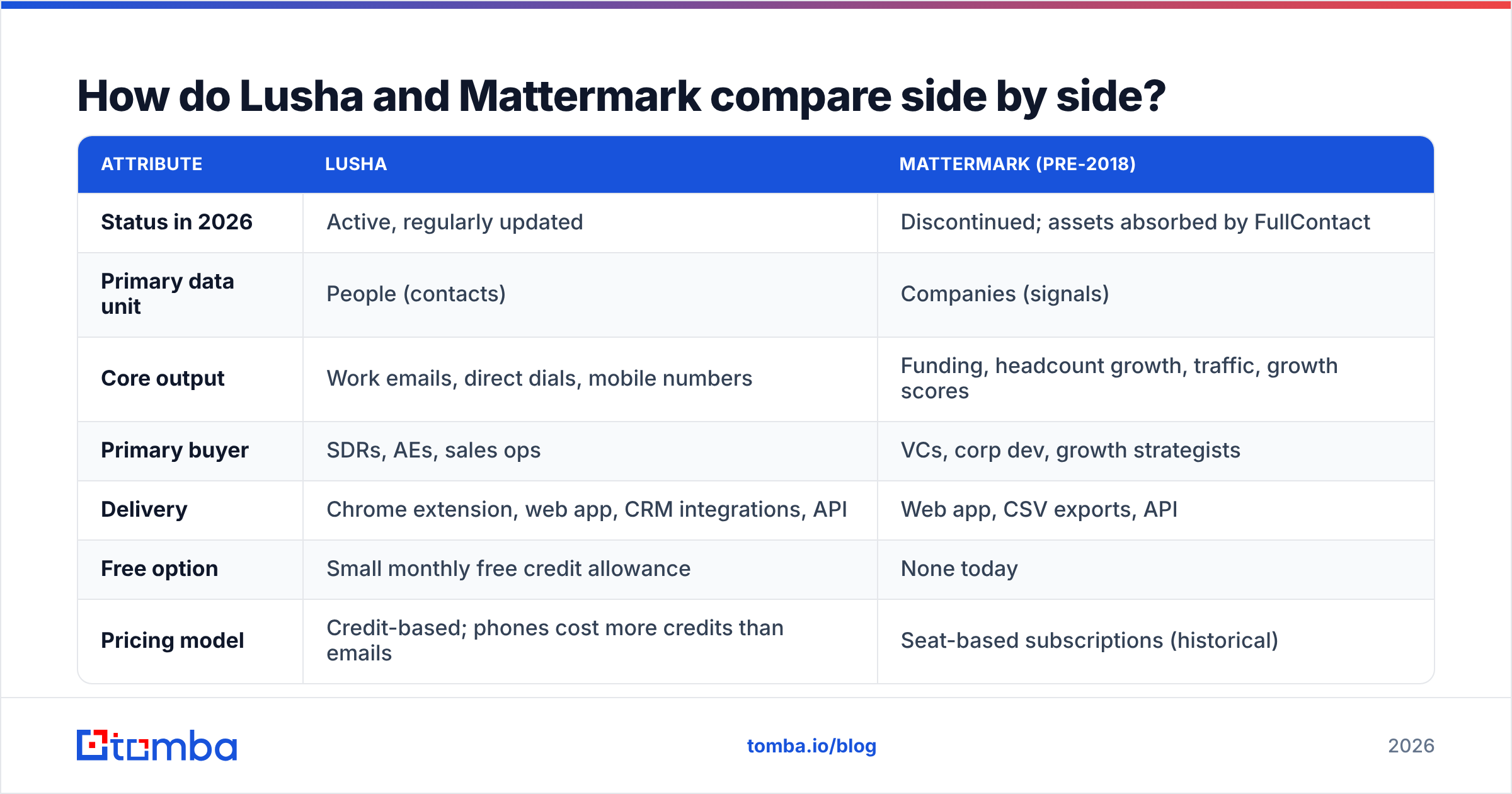
| Attribute | Lusha | Mattermark (pre-2018) |
|---|---|---|
| Status in 2026 | Active, regularly updated | Discontinued; assets absorbed by FullContact |
| Primary data unit | People (contacts) | Companies (signals) |
| Core output | Work emails, direct dials, mobile numbers | Funding, headcount growth, traffic, growth scores |
| Primary buyer | SDRs, AEs, sales ops | VCs, corp dev, growth strategists |
| Delivery | Chrome extension, web app, CRM integrations, API | Web app, CSV exports, API |
| Free option | Small monthly free credit allowance | None today |
| Pricing model | Credit-based; phones cost more credits than emails | Seat-based subscriptions (historical) |
| Best for | Getting a specific person on the phone or in the inbox | Deciding which startups or accounts are worth watching |
| Can you buy it today? | Yes | No |
The table makes the asymmetry obvious. Lusha wins every row that involves using the tool, because it's the only one you can use.
Which tool fits which job in 2026?#
If you landed here, you probably have one of four jobs to do. Here's what I'd recommend for each.
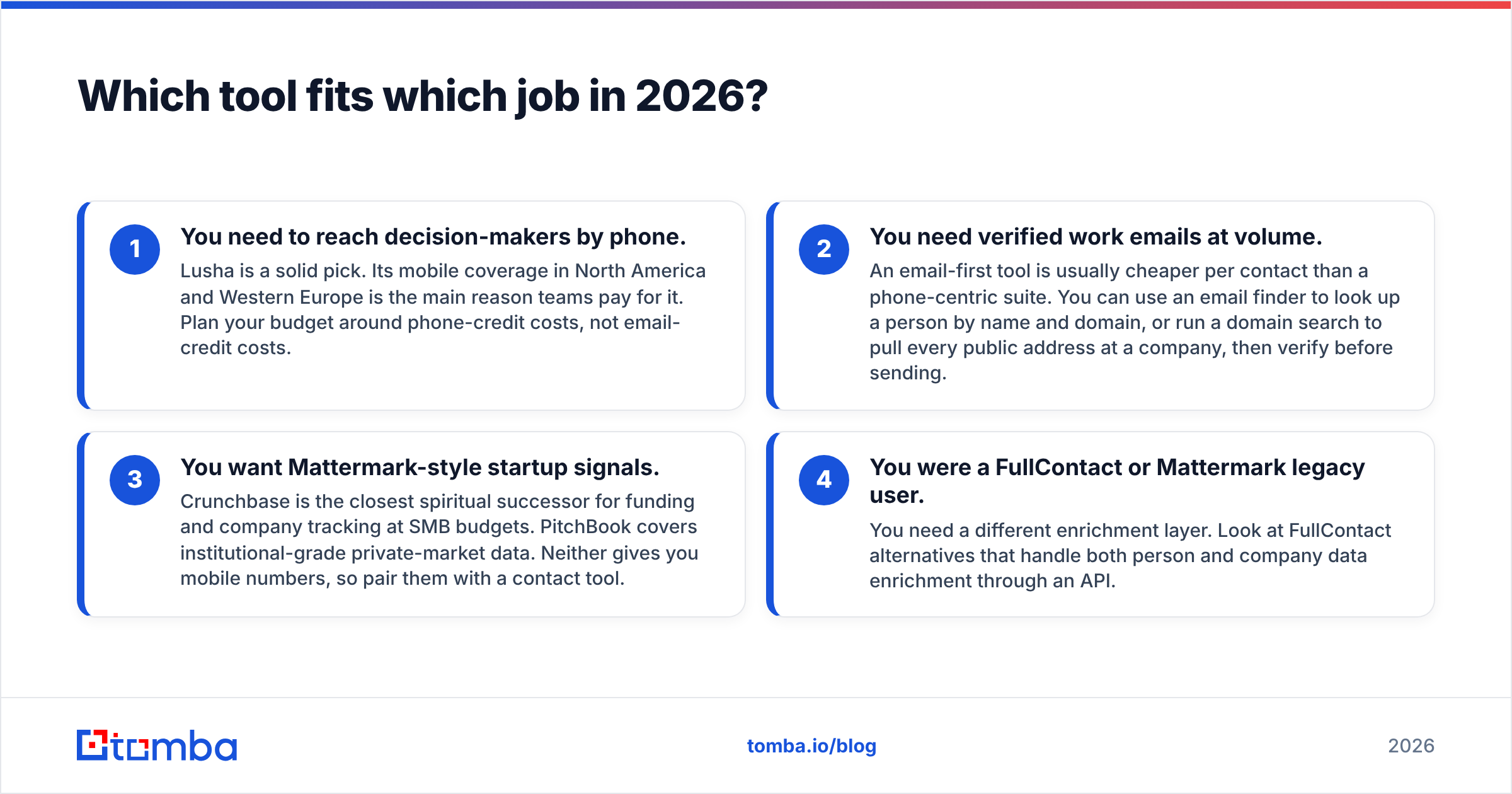
- You need to reach decision-makers by phone. Lusha is a solid pick. Its mobile coverage in North America and Western Europe is the main reason teams pay for it. Plan your budget around phone-credit costs, not email-credit costs.
- You need verified work emails at volume. An email-first tool is usually cheaper per contact than a phone-centric suite. You can use an email finder to look up a person by name and domain, or run a domain search to pull every public address at a company, then verify before sending.
- You want Mattermark-style startup signals. Crunchbase is the closest spiritual successor for funding and company tracking at SMB budgets. PitchBook covers institutional-grade private-market data. Neither gives you mobile numbers, so pair them with a contact tool.
- You were a FullContact or Mattermark legacy user. You need a different enrichment layer. Look at FullContact alternatives that handle both person and company data enrichment through an API.
The pattern most teams settle on is two layers. One source answers "which accounts" (signals, funding, intent), and a second source answers "which humans, and how do I reach them" (emails, phones). Mattermark tried to grow from the first layer into the second, and Lusha is moving from the second into the first. Neither covers both perfectly.
Is Lusha worth it compared to cheaper email-first tools?#
That depends on how much of your outreach happens by phone.
Lusha makes sense when:
- Your team makes a lot of cold calls and mobile numbers measurably lift connect rates.
- You want one browser extension that every rep already knows.
- You need native CRM sync with minimal setup.
Lusha is harder to justify when:
- Your outbound is mostly email and you rarely dial.
- You run high-volume campaigns, where per-credit costs add up fast.
- You need bulk domain-level discovery (every email at 500 target companies), which a credit-per-reveal model isn't designed for.
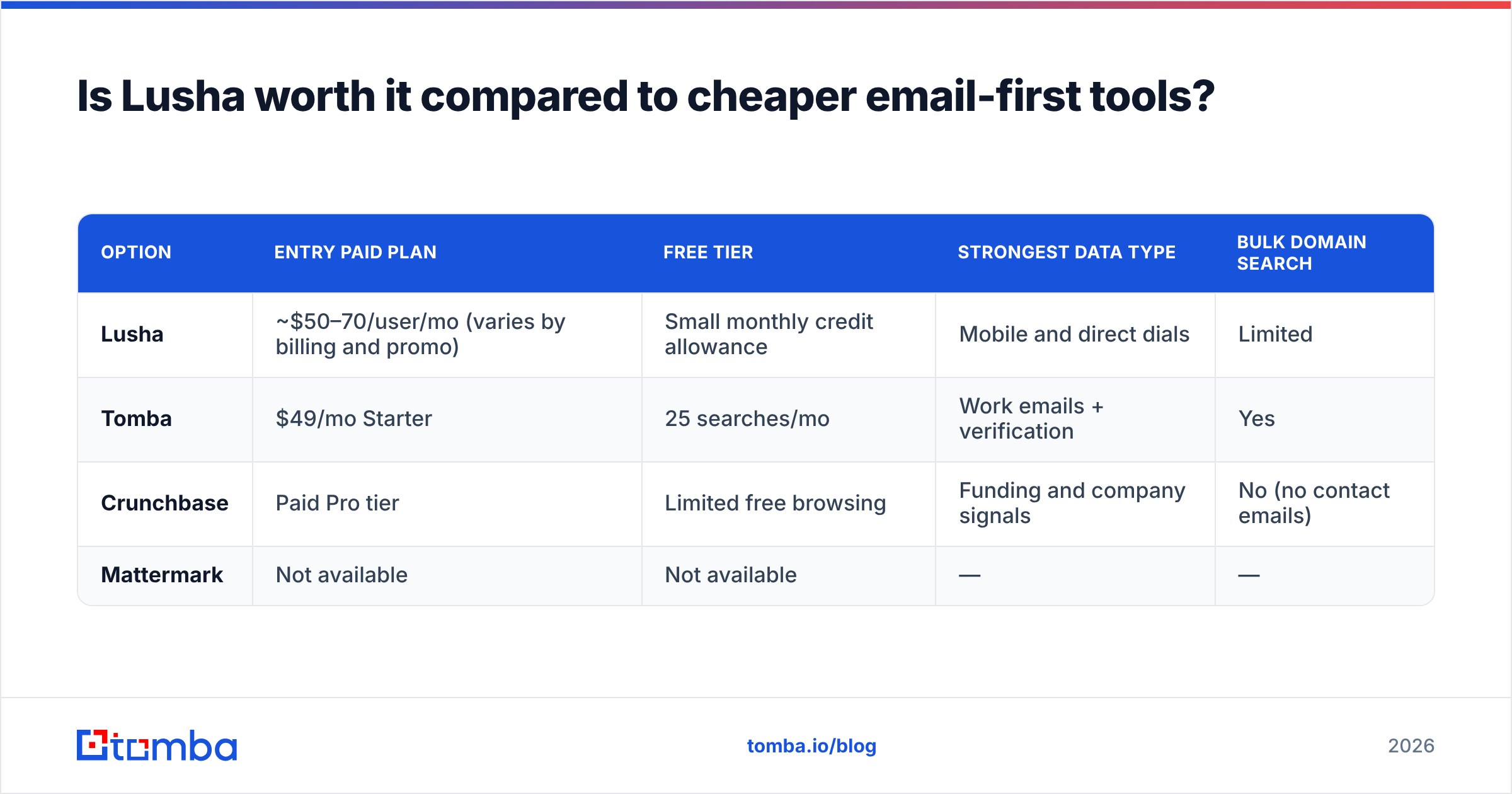
To give a rough sense of entry-level pricing, here's how the cheapest paid paths compare at the time of writing. Treat Lusha's figures as a snapshot, because they change often.
| Option | Entry paid plan | Free tier | Strongest data type | Bulk domain search |
|---|---|---|---|---|
| Lusha | ~$50–70/user/mo (varies by billing and promo) | Small monthly credit allowance | Mobile and direct dials | Limited |
| Tomba | $49/mo Starter | 25 searches/mo | Work emails + verification | Yes |
| Crunchbase | Paid Pro tier | Limited free browsing | Funding and company signals | No (no contact emails) |
| Mattermark | Not available | Not available | — | — |
If you want to look at how other teams stack these up in reviews, Lusha's G2 profile is worth skimming. Filter by company size, because SMB and enterprise reviewers usually complain about different things (credit costs vs data coverage).
What should you check before buying any B2B data tool?#
Mattermark's story is a good reminder that vendors disappear and get acquired. Before you commit annual budget to any data provider, check these five things.
- Data freshness. Ask how often records are re-verified. B2B contact data goes stale fast as people change jobs, and a database refreshed yearly will burn your sender reputation.
- Verification built in. Every email you export should carry a deliverability status. If it doesn't, budget for a separate email verifier pass before every campaign.
- Export and portability. Make sure you can get your enriched records out in CSV or through an API. If the vendor gets acquired the way Mattermark did, your data shouldn't go with it.
- Credit math on your actual mix. Model a month of real usage (for example 800 emails and 150 phones) against each vendor's credit rules. The sticker price rarely matches the invoice.
- Compliance posture. Look for GDPR and CCPA handling, a clear opt-out process, and published data-sourcing practices. Your legal team will ask, so have the answer ready.

So who wins: Lusha or Mattermark?#
Lusha wins by default, because Mattermark hasn't been a buyable product since 2017. That isn't a knock on what Mattermark built. Its growth scores influenced a lot of how VCs and RevOps teams still think about account prioritization. But you can't put a defunct platform in your stack.
The more useful question is what to buy in Mattermark's place, and whether Lusha is the right replacement. My take:
- For phone-heavy outbound: Lusha.
- For startup and funding signals: Crunchbase or PitchBook.
- For email-first outbound on a budget: an email-first finder with built-in verification, paired with a signals source if you need account prioritization.
Most teams that came looking for "Lusha vs Mattermark" really want a working contact layer plus a signals layer. Price those two layers separately and you'll usually spend less than you would on one all-in suite.
Where does Tomba fit if email is your main channel?#
If your outbound runs mostly through the inbox, start with Tomba Email Finder. You can look up a contact by name and company, or pull every public address on a domain, and each result comes with a verification status, so you aren't sending to dead mailboxes. The free tier gives you 25 searches a month to test coverage on your real target list before you pay, and paid plans start at $49/mo. Full tiers are on the Tomba pricing page. Run your top 50 accounts through it, compare the hit rate with what you'd get from a credit-based phone tool, and decide based on your own numbers rather than any vendor's pitch.
Related guides#
// get started
Find, verify and enrich your first contacts today
Start on the free plan with 25 searches a month, then scale when your team is ready.
Free plan · No credit card required · GDPR & CCPA
// about the author