Lusha vs ProsperFleet (Valgen): Which B2B Data Tool Fits You?
Lusha is a general-purpose B2B contact database. ProsperFleet by Valgen is a specialist dataset for anyone selling to trucking and commercial fleets. Here is how to tell which one your team needs, and when you need both.
TL;DR
- Lusha is a horizontal B2B contact database. It gives you emails and direct dials for almost any industry, and you work in it through a Chrome extension, a web prospector, and CRM integrations. It's self-serve, and a free tier gets you started.
- ProsperFleet by Valgen is a vertical dataset built for companies that sell to U.S. fleets and trucking operators. It covers vehicle counts, fleet locations, and vehicle types, and it's priced through a sales conversation.
- If your ICP is "any B2B company," Lusha (or a similar contact tool) is the better fit. If your ICP is "companies running 5+ commercial vehicles," ProsperFleet's fleet attributes are hard to get anywhere else.
- Many fleet-focused teams use both kinds of tool: a fleet dataset to choose the accounts, and an email finder plus verifier to reach the right people at them.
- Before you sign anything, verify a sample of each vendor's contacts. Fleet operators turn over staff fast, and stale data shows up quickly in your bounce rate.
What is the real difference between Lusha and ProsperFleet Valgen?#
Comparing these two isn't quite apples to apples. They answer different questions.
Lusha answers "Who is this person, and how do I reach them?" It's a contact-level tool. You find a prospect on LinkedIn or a company website, click the extension, and get an email address and often a phone number. The database spans every industry, so it isn't tuned to any one of them.
ProsperFleet answers "Which companies run fleets, how big are those fleets, and where are they?" Valgen, a Chicago-area data company founded in 2009, built ProsperFleet for sellers of telematics, fuel cards, fleet insurance, safety software, EV charging, equipment financing, and similar products. According to Valgen's ProsperFleet product page, the dataset covers roughly 1.2 million U.S. companies with 5+ vehicles, about 1.6 million fleet locations, more than 30 million commercial vehicles, and around 2.2 million contacts.
So when people search "Lusha vs ProsperFleet Valgen," they're usually weighing one of two things:
- Do they need fleet-specific firmographics, or just contact data?
- Can a generalist tool cover the trucking vertical well enough?
The rest of this post works through both.
How do Lusha and ProsperFleet compare feature by feature?#
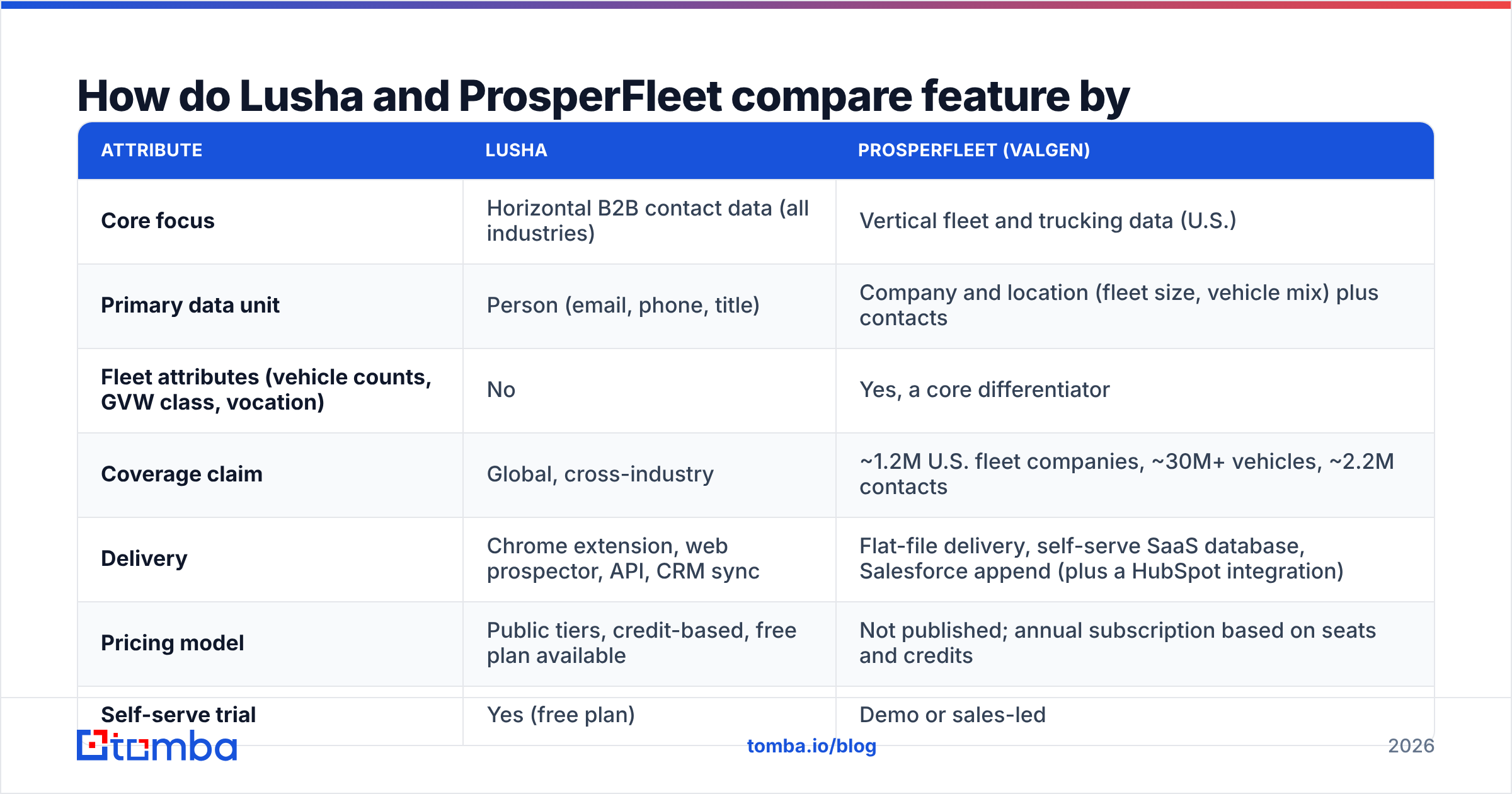
| Attribute | Lusha | ProsperFleet (Valgen) |
|---|---|---|
| Core focus | Horizontal B2B contact data (all industries) | Vertical fleet and trucking data (U.S.) |
| Primary data unit | Person (email, phone, title) | Company and location (fleet size, vehicle mix) plus contacts |
| Fleet attributes (vehicle counts, GVW class, vocation) | No | Yes, a core differentiator |
| Coverage claim | Global, cross-industry | ~1.2M U.S. fleet companies, ~30M+ vehicles, ~2.2M contacts |
| Delivery | Chrome extension, web prospector, API, CRM sync | Flat-file delivery, self-serve SaaS database, Salesforce append (plus a HubSpot integration) |
| Pricing model | Public tiers, credit-based, free plan available | Not published; annual subscription based on seats and credits |
| Self-serve trial | Yes (free plan) | Demo or sales-led |
| Best for | SDRs prospecting across many verticals | Teams whose entire TAM is commercial fleets |
The biggest gap is in the third row. Lusha can tell you a company's headcount, industry, and revenue band. It can't tell you that a regional HVAC contractor runs 38 light-duty vans across three yards. If you're selling GPS tracking priced per vehicle, that number is what you qualify on.
Where does fleet data like ProsperFleet's come from?#
A lot of trucking data starts with the U.S. Department of Transportation. Interstate carriers register with the Federal Motor Carrier Safety Administration (FMCSA), so public records exist for medium- and heavy-duty carriers.
The weakness of FMCSA-only data is that it misses most light-duty and vocational fleets: plumbers, landscapers, pest-control companies, utilities, and field-service businesses that never haul freight across state lines. Valgen says ProsperFleet combines several sources beyond FMCSA filings to fill that gap. That's the main reason fleet-focused sellers pay for a specialist instead of scraping the public registry themselves.
Here's how a typical fleet-sales data stack is layered:
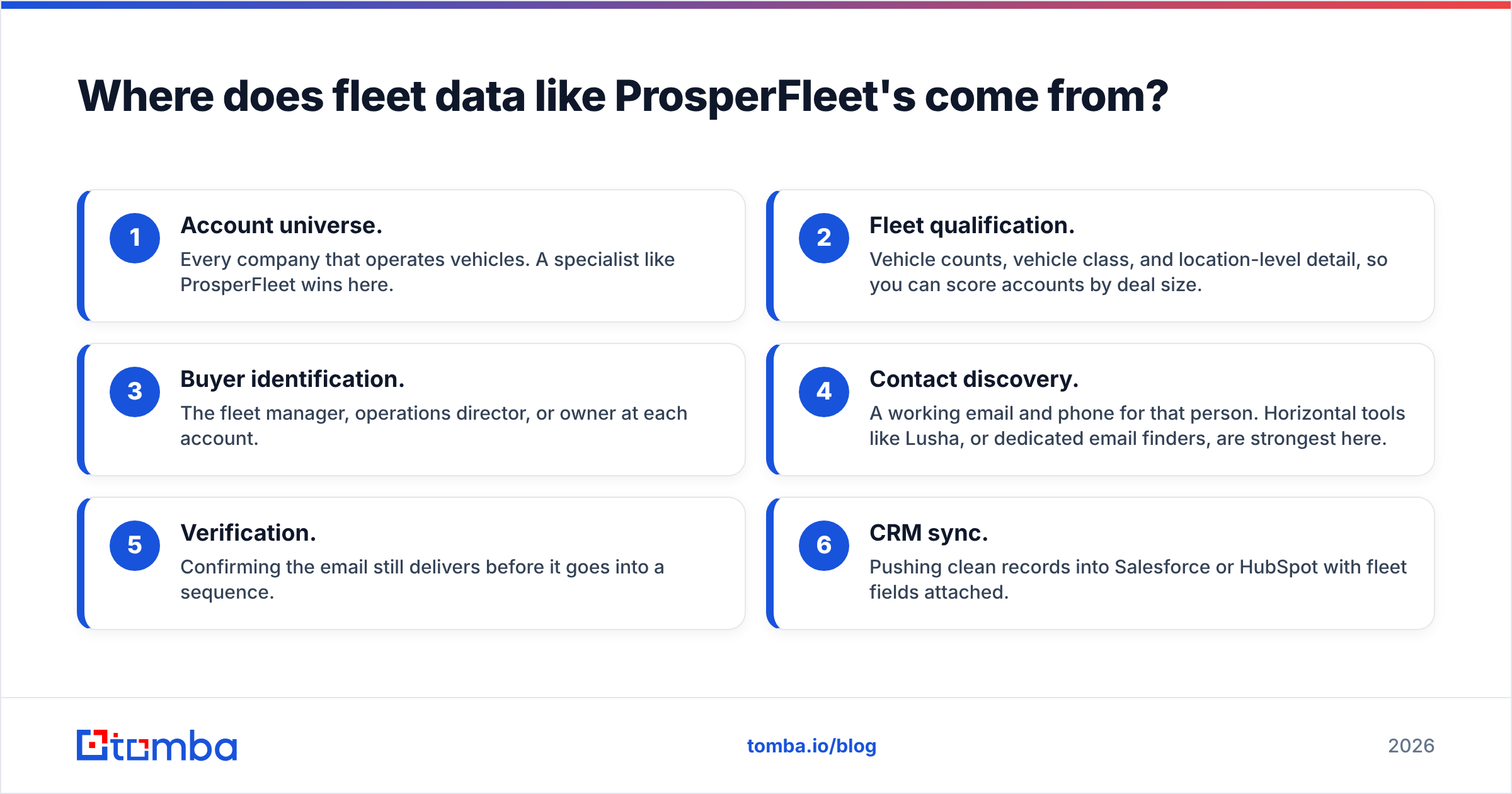
- Account universe. Every company that operates vehicles. A specialist like ProsperFleet wins here.
- Fleet qualification. Vehicle counts, vehicle class, and location-level detail, so you can score accounts by deal size.
- Buyer identification. The fleet manager, operations director, or owner at each account.
- Contact discovery. A working email and phone for that person. Horizontal tools like Lusha, or dedicated email finders, are strongest here.
- Verification. Confirming the email still delivers before it goes into a sequence.
- CRM sync. Pushing clean records into Salesforce or HubSpot with fleet fields attached.
ProsperFleet covers layers 1–3 well and includes some contacts. Lusha covers layers 3, 4, and 6 across all industries. Neither one replaces a dedicated verification step at layer 5.

How much do Lusha and ProsperFleet cost?#
Lusha publishes its pricing. At the time of writing, the tiers are Free (about 40 credits/month), Starter, Pro, Premium, and a custom Scale plan. List prices run from roughly $49.90/month (Starter) to $399.90/month (Premium), and annual billing and promotions frequently bring those down. One email reveal typically costs 1 credit, and one phone reveal costs about 5. Lusha changes its packaging often, so check Lusha's pricing page for current numbers before you budget.
ProsperFleet doesn't publish pricing. Third-party reviews describe an annual subscription priced on two axes: user seats and download credits. Each company or contact record you export consumes credits. Custom flat-file pulls are scoped separately. Expect a sales call and a quote. Because it's niche data with a small competitive set, it typically costs more per record than a horizontal contact database, but you're paying for attributes you can't easily get elsewhere.
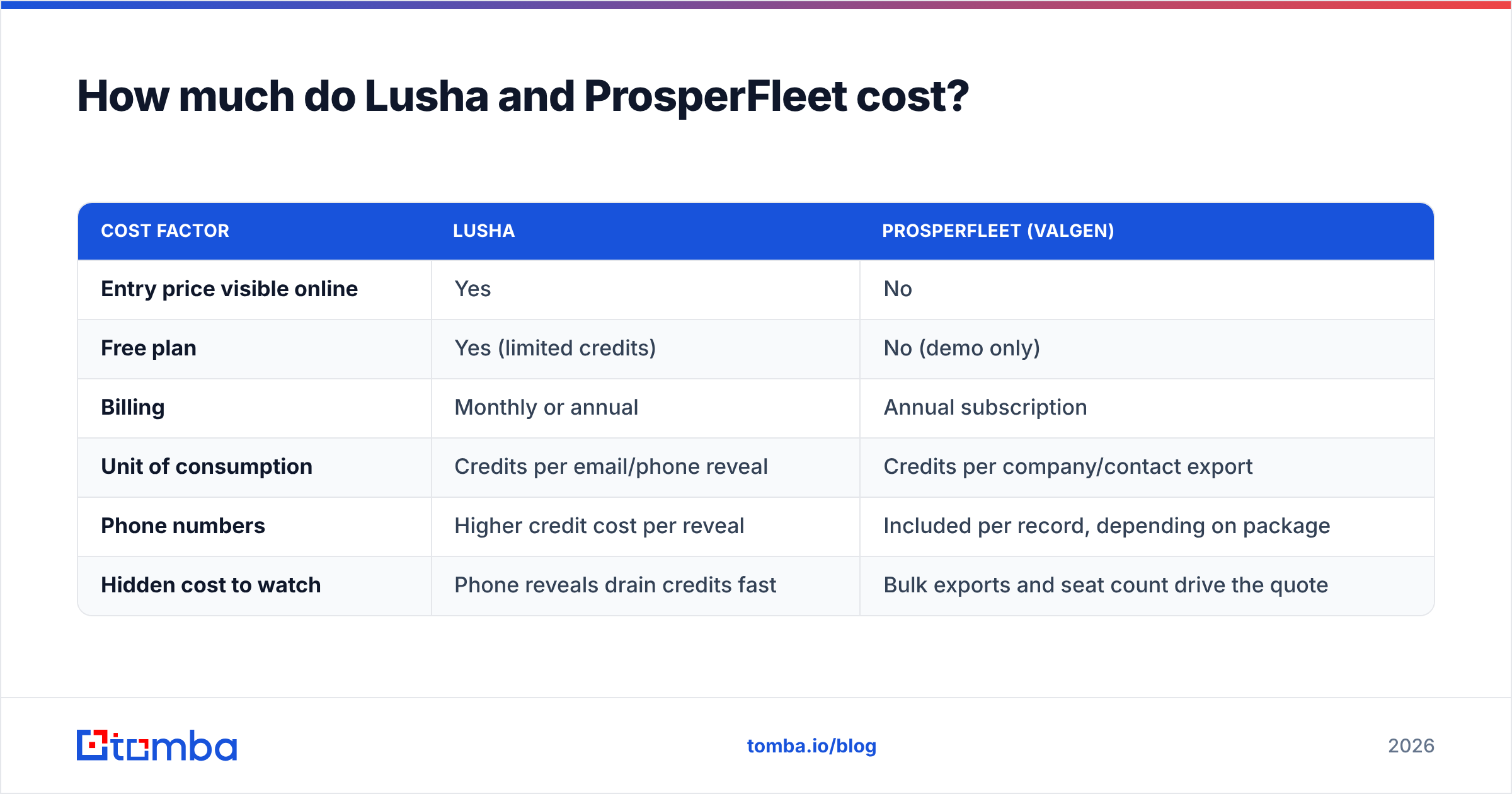
| Cost factor | Lusha | ProsperFleet (Valgen) |
|---|---|---|
| Entry price visible online | Yes | No |
| Free plan | Yes (limited credits) | No (demo only) |
| Billing | Monthly or annual | Annual subscription |
| Unit of consumption | Credits per email/phone reveal | Credits per company/contact export |
| Phone numbers | Higher credit cost per reveal | Included per record, depending on package |
| Hidden cost to watch | Phone reveals drain credits fast | Bulk exports and seat count drive the quote |
Ask both vendors one practical question: what happens to unused credits? Lusha's monthly plans have historically allowed some rollover, while annual plans reset. Get ProsperFleet's terms in writing during procurement.
Which tool has better data quality for fleet prospects?#
For the fleet vertical, ProsperFleet has a structural advantage on firmographics. It was built around vehicle data, and Valgen has been collecting it since 2009. Lusha has no equivalent for vehicle counts or vehicle class.
For contact-level accuracy, the answer is less clear. Trucking and field-service companies are hard targets for every contact vendor:
- Many small fleets are owner-operated businesses with a generic
info@ordispatch@mailbox, or a Gmail address. - Fleet managers change jobs often, so contact data decays quickly.
- A lot of decision-makers aren't active on LinkedIn, which weakens any tool that relies on LinkedIn-sourced contacts.
That last point matters for Lusha. Its extension works best when your prospect has a LinkedIn profile. A 15-truck excavation company in rural Ohio may not have one.
Whichever vendor you pick, run a pilot. Pull 200 records from your real ICP, push the emails through an email verifier, and measure three things: the valid rate, the catch-all rate, and the hard-bounce rate on a small test send. Vendor accuracy claims are averages across every industry. Your number for fleets is the only one that counts.
Is Lusha better than ProsperFleet for SDR prospecting?#
For day-to-day SDR work across mixed verticals, yes. Lusha has the smoother workflow:
- Browser extension. Reveal contacts while you browse LinkedIn, Sales Navigator, or company sites.
- Self-serve onboarding. A rep can be productive the same day.
- Sequencing and CRM hooks. Native connections into Salesforce, HubSpot, and outreach tools.
- Breadth. If your team sells to fleets and to other segments, one tool covers everything.
User reviews on G2 and similar sites describe ProsperFleet as more of a list-building and territory-planning tool. Ops or marketing teams use it to define the addressable market, build target account lists, and append fleet fields inside Salesforce. Reps then work those accounts, often with a separate contact tool.
So a common answer to "Lusha or ProsperFleet?" is "ProsperFleet to pick the accounts, something else to reach the people."
When should you pick ProsperFleet over Lusha?#
Pick ProsperFleet if:
- Your product is priced per vehicle, per driver, or per location, so fleet size is how you qualify deals.
- Your TAM is mostly U.S. companies running 5+ commercial vehicles.
- You need territory or account planning based on fleet density by geography.
- You want fleet attributes written directly onto Salesforce account records.
- You sell into light-duty and vocational fleets that FMCSA data misses.
Pick Lusha if:
- You sell horizontally and fleets are just one segment among many.
- You mainly need direct dials and emails for named people, not vehicle intelligence.
- You want transparent, self-serve pricing and a free tier to test with.
- Your prospects are reachable through LinkedIn.
Pick both, or a specialist plus a lightweight email tool, if fleets are your core market and you also need high-volume, verified contact discovery for the accounts ProsperFleet surfaces.
What are the alternatives if neither fits?#
If ProsperFleet's account intelligence fits but you need more emails per account, add a dedicated email finder and verifier rather than a second full contact database. You can run domain search on each fleet company's website to see every public address and the company's email pattern, then verify before you send.
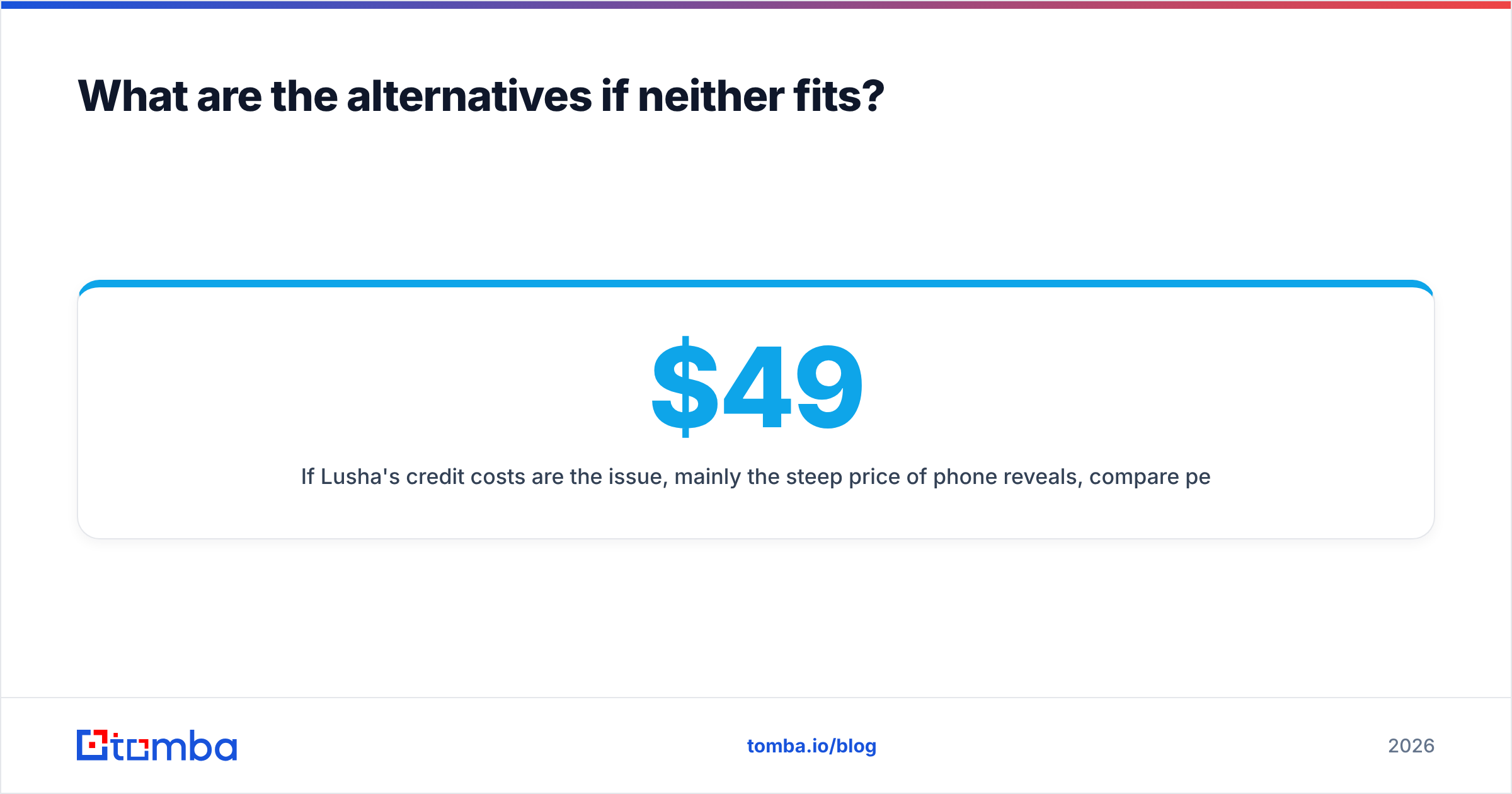
If Lusha's credit costs are the issue, mainly the steep price of phone reveals, compare per-contact costs across horizontal tools. Tomba's tiers are Free (25 searches/month), Starter at $49/month, Growth at $99/month, and Pro at $249/month, with Enterprise on custom terms. Full pricing details are public, which makes it easy to model cost per verified email against your Lusha quote.
If you sell globally, keep in mind that ProsperFleet is U.S.-focused. You'll need separate sources for fleets in Europe, Canada, or elsewhere.
How should a fleet-sales team set up its data workflow?#
Here's a practical stack for a team selling telematics or fleet services in 2026:
- Define the account universe. Pull U.S. companies with 10–250 vehicles in your target vocations from your fleet dataset.
- Score accounts. Rank by vehicle count × your price per vehicle, then filter by region to match rep territories.
- Find the buyer. For each account, identify the fleet manager, operations VP, or owner.
- Discover and verify emails. Use a finder for the named contact, fall back to the company's email pattern, and verify every address. Watch catch-all domains, which are common with small businesses on shared hosting.
- Enrich and sync. Push verified contacts with fleet fields into your CRM so marketing can segment by fleet size.
- Re-verify quarterly. Fleet contacts go stale faster than most B2B data, so re-check before each big campaign.
This setup keeps the specialist dataset doing what it's best at (which accounts matter and how big they are), while a cheaper, high-throughput email workflow handles reachability.
So which should you buy: Lusha or ProsperFleet Valgen?#
It depends on your market, not on which tool has more features.
- Your whole business is selling to fleets? ProsperFleet's vehicle-level intelligence is the hard part to replace. Start there, then add a contact and verification layer for the accounts it surfaces.
- Fleets are one segment of a broad B2B motion? Lusha's self-serve, cross-industry contact data will serve your reps better day to day. Accept that you won't get vehicle counts.
- Budget is tight and you already know your target accounts? You may not need either full platform. A list of target domains plus an email finder and verifier can cover a lot of the work.
Whatever you choose, run a 200-record pilot on your real ICP and verify the results before you commit to an annual contract.
If you already know which fleet accounts you want and just need to reach the right people at them, Tomba Email Finder finds professional email addresses by name, domain, or company, and the data enrichment and verification tools sit right next to it. Start on the free plan with 25 searches a month, test it against the fleet accounts from your ProsperFleet or Lusha pilot, and compare cost per verified contact before you renew either contract.
Related guides#
// get started
Find, verify and enrich your first contacts today
Start on the free plan with 25 searches a month, then scale when your team is ready.
Free plan · No credit card required · GDPR & CCPA
// about the author