Lusha vs RampedUp (2026): Pricing, Data Quality and Best Fit
Lusha sells self-serve seats for reps. RampedUp sells annual contracts for bulk data and CRM cleanup. We compare pricing, data sourcing, workflow fit and the hidden costs, so you buy the right one.
TL;DR
- Lusha is a self-serve prospecting tool built for individual reps and small teams. It has a free plan, monthly billing, a strong Chrome extension, and per-seat pricing that starts at about $50/month.
- RampedUp works more like a data vendor than a rep tool. Its published plans start at about $4,500/year for 12,000 credits, and it sells bulk records, CRM enrichment, and data hygiene to marketing and RevOps teams.
- Pick Lusha if your reps need to reveal a few hundred contacts a month straight from LinkedIn. Pick RampedUp if you need to clean or enrich tens of thousands of CRM records at once.
- Lusha's phone reveals use several credits each, and RampedUp asks you to commit for a year upfront. Run a pilot on your own ICP before you sign with either one.
- If you mostly need verified work emails without an annual contract, a pay-monthly email finder can cover it for less.
What is the real difference between Lusha and RampedUp?#
The two tools solve different problems even though both sell "contact data."
Lusha is built for the person sending the outreach. A rep opens a LinkedIn profile or a company website, clicks the Lusha extension, and gets an email and often a direct dial. The product is designed around that one moment: one rep, one prospect, one reveal. Prospecting lists, intent signals, and CRM sync are layered on top, but the extension is still the main product.
RampedUp is built for whoever owns the database. It describes itself as a contact data provider with hundreds of millions of web-sourced contacts and tens of millions of company records. It also sells data health checks, CRM enrichment, identity-graph data, and bulk list builds. The buyer is usually a marketing ops lead, a RevOps team, or an agency, and their question is less "who is this person" and more "why are 30% of our 80,000 CRM records stale?"
Here is the short version:
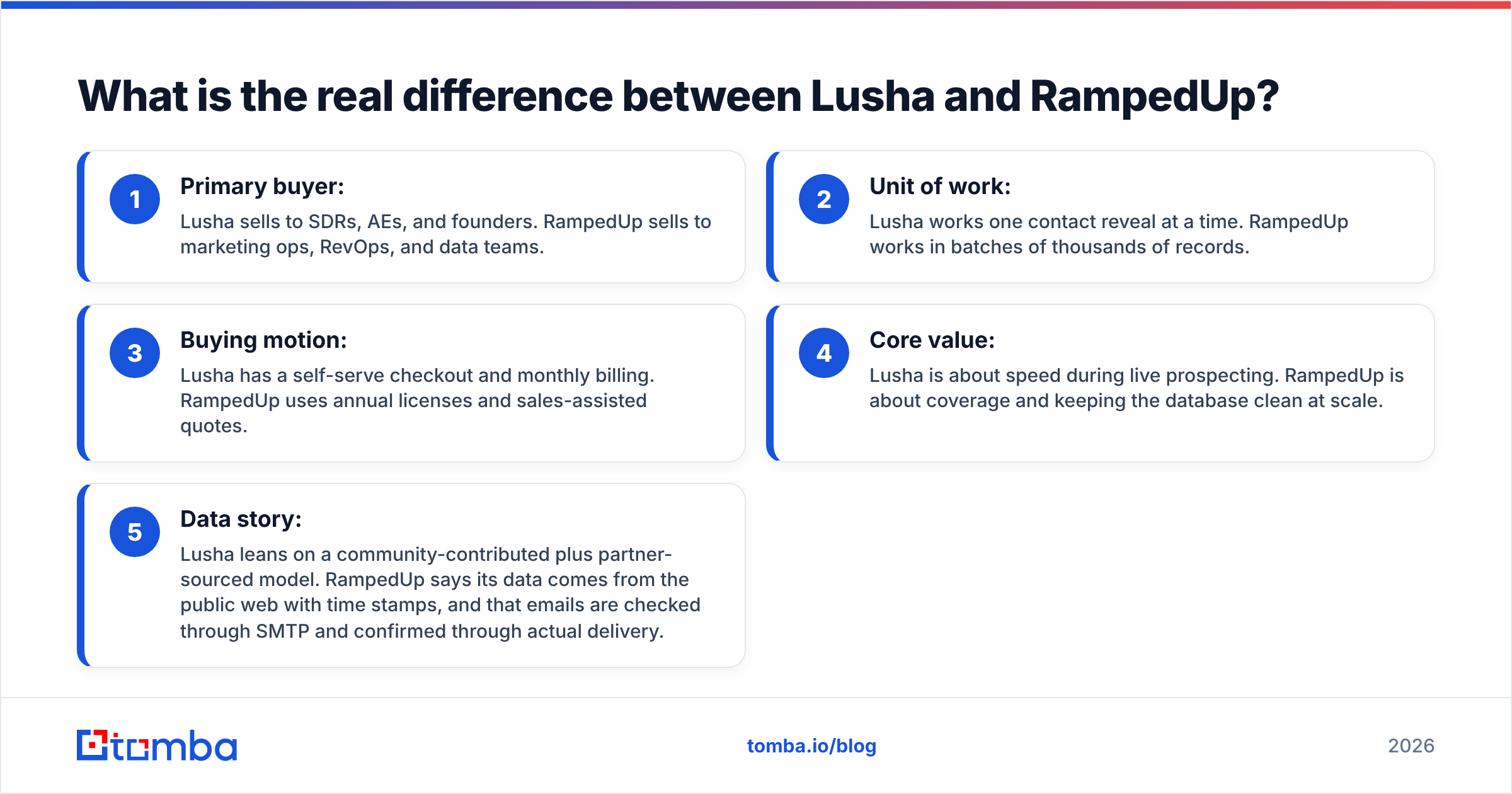
- Primary buyer: Lusha sells to SDRs, AEs, and founders. RampedUp sells to marketing ops, RevOps, and data teams.
- Unit of work: Lusha works one contact reveal at a time. RampedUp works in batches of thousands of records.
- Buying motion: Lusha has a self-serve checkout and monthly billing. RampedUp uses annual licenses and sales-assisted quotes.
- Core value: Lusha is about speed during live prospecting. RampedUp is about coverage and keeping the database clean at scale.
- Data story: Lusha leans on a community-contributed plus partner-sourced model. RampedUp says its data comes from the public web with time stamps, and that emails are checked through SMTP and confirmed through actual delivery.
If you go in thinking these are interchangeable, you will probably overpay. A five-person SDR team on a RampedUp Entry license is paying for bulk capacity it won't use, and a RevOps team trying to clean a 100k-record Salesforce instance one Lusha reveal at a time will run out of credits within a week.
How do Lusha and RampedUp compare feature by feature?#
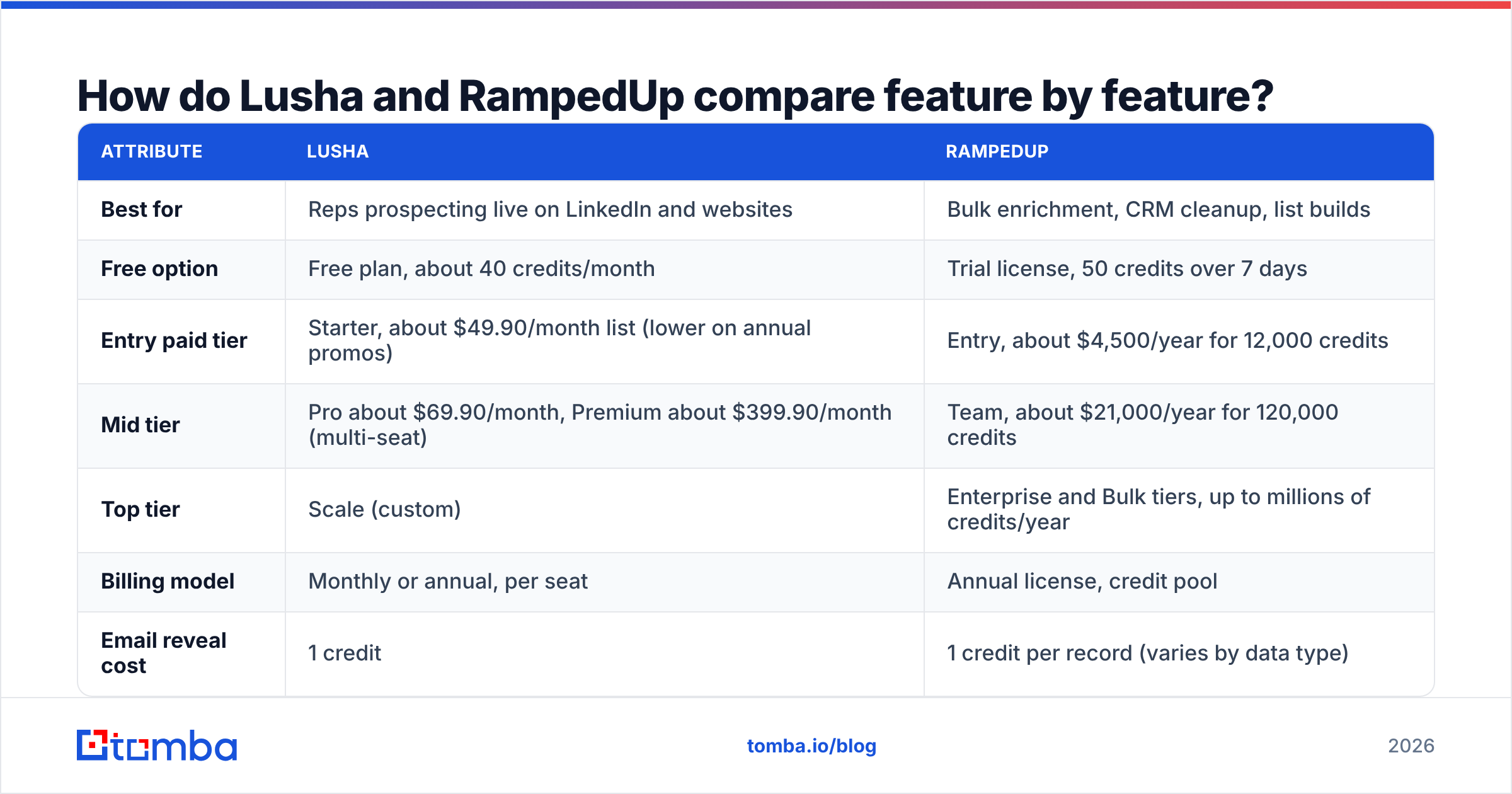
The table below sums up the parts that actually affect a buying decision. Prices come from public listings at the time of writing. Both vendors run promotions and negotiate custom deals, so check current numbers on Lusha's pricing page and RampedUp's G2 pricing listing before you budget.
| Attribute | Lusha | RampedUp |
|---|---|---|
| Best for | Reps prospecting live on LinkedIn and websites | Bulk enrichment, CRM cleanup, list builds |
| Free option | Free plan, about 40 credits/month | Trial license, 50 credits over 7 days |
| Entry paid tier | Starter, about $49.90/month list (lower on annual promos) | Entry, about $4,500/year for 12,000 credits |
| Mid tier | Pro about $69.90/month, Premium about $399.90/month (multi-seat) | Team, about $21,000/year for 120,000 credits |
| Top tier | Scale (custom) | Enterprise and Bulk tiers, up to millions of credits/year |
| Billing model | Monthly or annual, per seat | Annual license, credit pool |
| Email reveal cost | 1 credit | 1 credit per record (varies by data type) |
| Phone reveal cost | About 5 credits per number | Bundled by data product and contract |
| Chrome extension | Yes, the core of the product | Available, but secondary to bulk workflows |
| CRM integrations | Salesforce, HubSpot, Pipedrive, and others | CRM enrichment and data health check services |
| B2C data | No, B2B only | Yes, B2C and identity-graph products available |
| Effective cost per contact | Higher per record, low commitment | Lower per record at volume, high commitment |
There are two things the table doesn't show well.
First, cost per usable contact is the number that counts, not cost per credit. Lusha's Starter tier works out to about a dollar or more per email credit, and a phone reveal can cost several times that. RampedUp's Entry tier comes to about $0.37 per credit, and it falls fast on higher tiers. But if 25% of a bulk file bounces, or half the records are outside your ICP, your real cost per usable contact rises sharply. Ask both vendors for a sample file, run it against your own verification, and calculate cost per deliverable contact.
Second, commitment risk. With Lusha, a bad month costs you one month. With RampedUp, a bad fit costs you a year. That isn't a criticism of RampedUp. Data vendors that sell in bulk need annual contracts to make the economics work. It does mean the pilot matters more before you sign.

Is Lusha better than RampedUp for SDR prospecting?#
Yes, for most SDR teams, mainly because of workflow.
An SDR's day looks like this: open Sales Navigator, scan a dozen profiles, pick the three that matter, get their contact info, write a personalized first line, push it to the sequencer. Lusha's extension fits that loop with very little friction. You click on the profile, the email and phone show up, and you push the contact to HubSpot or Salesforce in one action. It also has prospecting filters, so a rep can build a short list by title, seniority, and company size without leaving the app.
Where Lusha falls short:
- Phone credits drain fast. If your motion depends on cold calling, a 4,800-credit annual allocation at about 5 credits per phone number gives you fewer than 1,000 dials' worth of numbers a year per seat. Budget for that up front.
- Regional coverage is uneven. North American and Western European contacts tend to fill reliably. Coverage gets thinner in APAC, LATAM, and in the SMB long tail.
- Seat-based pricing scales linearly. Ten reps cost about ten times as much as one rep. There isn't a big efficiency gain from growing the team.
RampedUp can technically support SDR prospecting, but the economics and the interface aren't designed for it. A rep doesn't want to pull a 12,000-record file. They want the three right people at one account, right now.
Is RampedUp better than Lusha for CRM enrichment and data hygiene?#
Yes. This is where RampedUp makes the most sense.
B2B data decays constantly. People change jobs, companies rebrand, and email domains get retired. A CRM that was clean two years ago has a meaningful share of dead records now, and HubSpot's research on database decay has long put the annual figure in the double digits. Dead records hurt more than your reports. They raise bounce rates, damage sender reputation, and distort attribution.
RampedUp's Data Health Check and enrichment services are built for this problem. You send in your existing database, and RampedUp matches it against its records, flags stale contacts, appends missing fields (titles, phones, firmographics), and returns a refreshed file. For a marketing team about to run a large nurture campaign, or a RevOps team preparing for a CRM migration, that is a one-time or quarterly project that fits an annual license well.
Lusha also offers enrichment, including CRM auto-enrichment on higher tiers. But it charges per credit at seat-level pricing, so enriching 50,000 records through Lusha usually costs more than doing it through a bulk vendor. Lusha is a better fit for keeping new records clean as reps add them than for repairing a large backlog.
A practical split many teams use:
- Backlog cleanup: a bulk vendor like RampedUp, run once or twice a year.
- Ongoing capture: a rep-level tool (Lusha, or a lighter email finder) for new contacts.
- Gatekeeping: a separate email verifier before anything enters a sequence, whatever the source.
How accurate is the data from each tool?#
Neither vendor publishes an independent, reproducible accuracy benchmark, and you should be skeptical of any vendor's self-reported match rate. Here is what's known about how each one builds its data:
- Lusha combines data from partners with a contributor network. Users of some Lusha products share contact details from their address books. That gives it good coverage of active professionals in well-covered markets. It has also drawn privacy questions over the years, and Lusha has responded by emphasizing GDPR and CCPA compliance and ISO certifications.
- RampedUp says its data is collected from the public web, time-stamped, and validated through SMTP checks, web cross-referencing, and confirmed delivery. The time stamp helps, because it lets you judge how fresh a record is instead of trusting a single "verified" badge.
User reviews on G2 and similar sites describe both tools as solid for mainstream North American B2B contacts. Both get complaints about outdated phones and gaps in niche industries. That pattern is common across the whole category, not specific to either vendor.
The only accuracy number you should trust is your own. Here is a simple pilot protocol:
- Pull 200 contacts that match your actual ICP: your industries, regions, and seniority levels.
- Request the same 200 from each vendor during the trial.
- Run every returned email through the same independent verifier.
- Send a small, warmed-up test campaign and log hard bounces.
- Compare deliverable contacts per dollar, not fill rate.
Twenty minutes of setup can save you from a year-long mistake.
What about compliance and data privacy?#
Both vendors say they comply with GDPR and CCPA, and both offer opt-out mechanisms. That covers the vendor side. It doesn't cover yours. If you email EU contacts, you still need a documented legitimate-interest basis, a clear opt-out in every message, and a process for handling data subject requests.
Two practical points:
- B2C data raises the stakes. RampedUp sells B2C and identity-graph products alongside B2B. If your use case is strictly B2B, make sure your contract and export filters keep personal consumer data out of your CRM.
- Contributor-network data needs to be documented. If your legal team asks where a contact came from, you need an answer. Ask Lusha for its source documentation as part of procurement, not after an audit.
What are the hidden costs in Lusha vs RampedUp?#
Pricing pages show list prices, but the real total cost of ownership depends on a few things that are easy to miss.
Lusha hidden costs
- Phone reveals at roughly 5 credits each mean a calling-heavy team runs through its allocation in weeks.
- Promotional annual prices can renew at standard list prices. Check the renewal clause.
- Advanced features such as intent signals, larger exports, and deeper CRM automation sit on higher tiers. The Starter plan you trial isn't always the plan you end up needing.
RampedUp hidden costs
- The annual commitment is the big one. If your team shrinks or your ICP changes mid-year, unused credits can go to waste.
- Credits used on records that turn out to be off-ICP still count against your pool. Filter carefully before you pull.
- Custom data products (B2C, identity graph, technographics) are usually quoted separately.

Which one should you choose?#
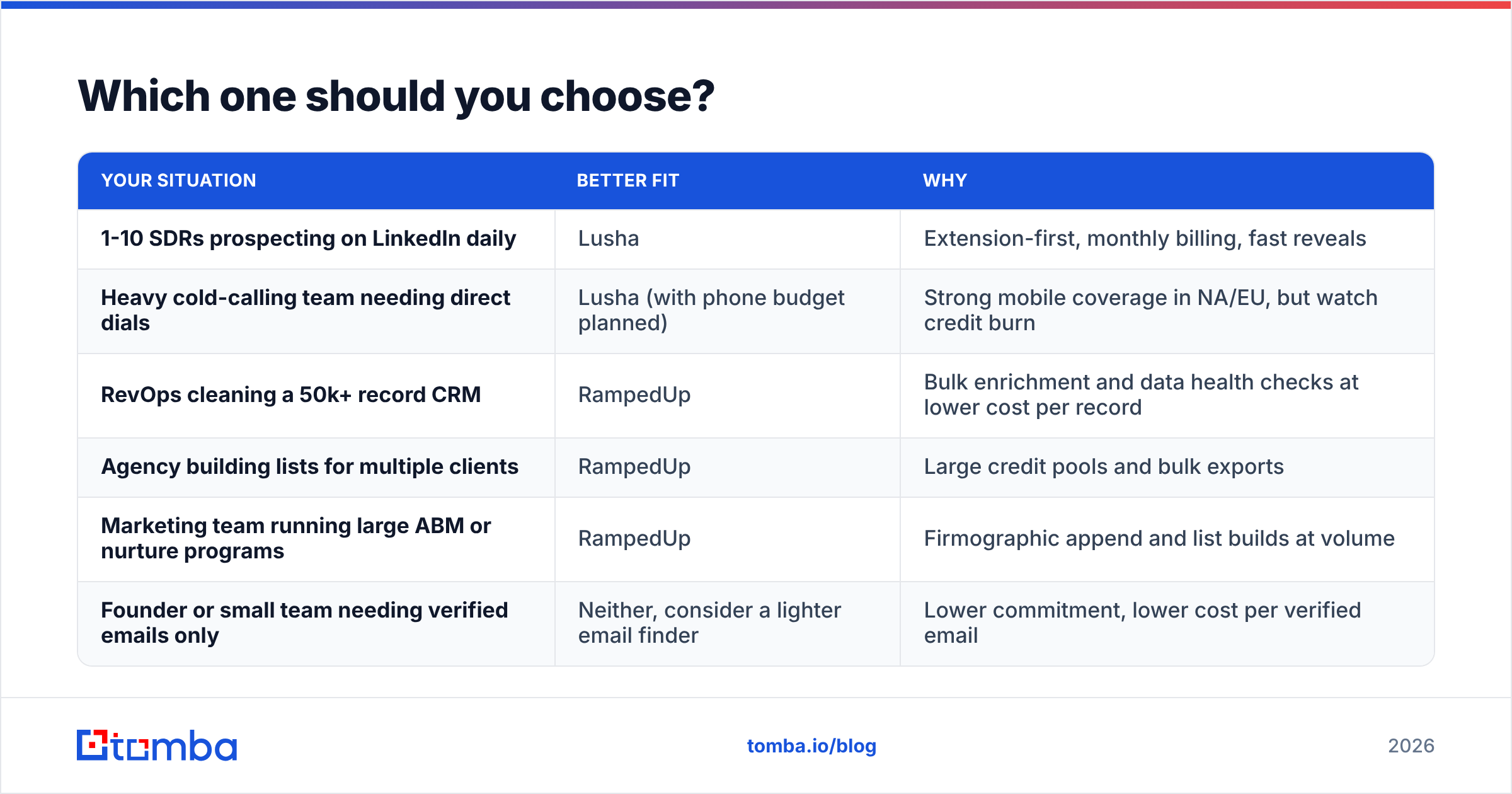
Base the decision on who uses the tool and how many records they handle each month.
| Your situation | Better fit | Why |
|---|---|---|
| 1-10 SDRs prospecting on LinkedIn daily | Lusha | Extension-first, monthly billing, fast reveals |
| Heavy cold-calling team needing direct dials | Lusha (with phone budget planned) | Strong mobile coverage in NA/EU, but watch credit burn |
| RevOps cleaning a 50k+ record CRM | RampedUp | Bulk enrichment and data health checks at lower cost per record |
| Agency building lists for multiple clients | RampedUp | Large credit pools and bulk exports |
| Marketing team running large ABM or nurture programs | RampedUp | Firmographic append and list builds at volume |
| Founder or small team needing verified emails only | Neither, consider a lighter email finder | Lower commitment, lower cost per verified email |
The last row matters more than it looks. A lot of teams evaluating Lusha vs RampedUp don't need direct dials, B2C data, or a 12,000-credit annual pool. They need a reliable way to find and verify work emails for a few hundred prospects a month. If that's you, an email finder with domain search, built-in verification, and monthly billing will cover the job for a fraction of either option's cost.
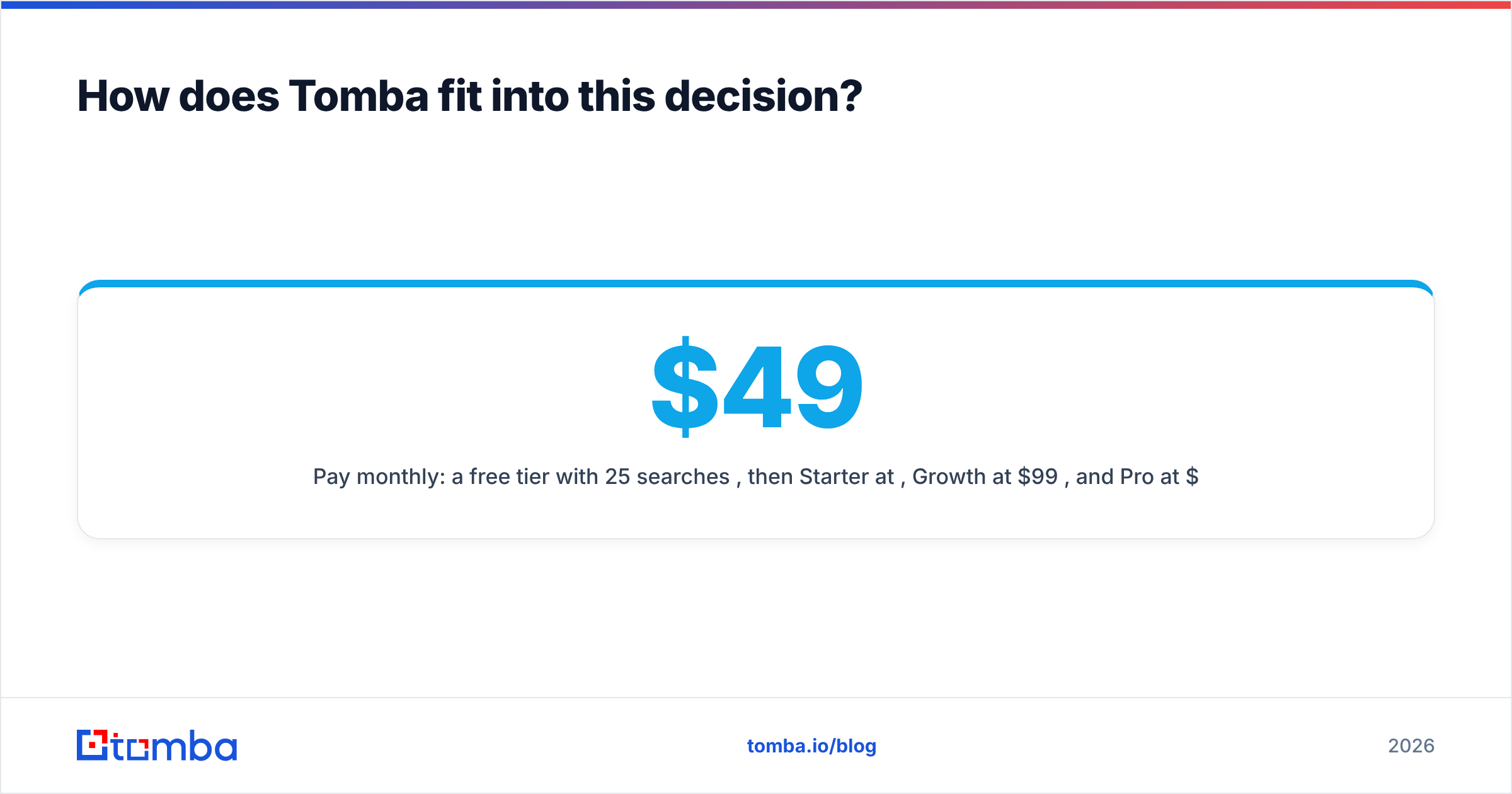
How does Tomba fit into this decision?#
Tomba isn't trying to replace RampedUp's bulk data services or Lusha's phone-heavy prospecting. It covers the large middle ground in between: teams that need accurate professional emails, verification, and light enrichment without per-seat bloat or a five-figure annual contract.
What that looks like in practice:
- Find emails by name and company, or pull every public address at a domain.
- Verify emails before they enter a sequence, including catch-all handling.
- Enrich contacts with company and role data, and push them to HubSpot, Salesforce, or Pipedrive.
- Pay monthly: a free tier with 25 searches/month, then Starter at $49/month, Growth at $99/month, and Pro at $249/month. See full Tomba pricing for current limits.
Many teams use Tomba as their everyday email layer and bring in a bulk vendor once or twice a year for big cleanup projects. That combination usually costs less than putting every rep on a premium seat.
Final verdict: Lusha vs RampedUp#
Lusha suits the individual rep: quick, self-serve, extension-first, and priced so you can start small and cancel. RampedUp suits the database owner: bulk, annual, and cheaper per record at volume, with real strength in enrichment and hygiene. Neither is better across the board. Each one is a poor fit for the other's job.
Before you commit, run the 200-contact pilot, measure deliverable contacts per dollar, and read the renewal terms. If the pilot shows that you mostly need verified work emails, not direct dials or bulk files, you can skip both contracts entirely.
Ready to find verified work emails without an annual commitment? Try Tomba Email Finder. Search by name, company, or domain, verify every result automatically, and start with 25 free searches a month before upgrading to Starter at $49/month.
Related guides#
// get started
Find, verify and enrich your first contacts today
Start on the free plan with 25 searches a month, then scale when your team is ready.
Free plan · No credit card required · GDPR & CCPA
Get the Tomba newsletter
Product and data updates
// about the author