Lusha vs Salutary Data: Pricing, Coverage, and Which to Pick
Lusha is a self-serve prospecting tool for reps. Salutary Data is a US data provider you license in bulk. Here is how to tell which one your team needs before you sign anything.
TL;DR
- Lusha is a self-serve prospecting tool. Reps reveal contacts one at a time from a Chrome extension or web app, pay per credit, and can be running the same afternoon.
- Salutary Data is a boutique, US-only B2B data provider. You license records in bulk through files, feeds, or an API, on custom annual or pay-per-match pricing.
- If you want individual reps prospecting on LinkedIn and in the CRM, Lusha fits better. If you're enriching a data warehouse, training a model, or loading a whole US market into a CRM, Salutary Data fits better.
- Neither one is cheap for high-volume email discovery. If you mostly need verified work emails, a dedicated email finder usually costs less per contact.
- Before you buy, run a 200-record pilot against your own ICP. Database size claims tell you very little about how well a vendor covers your segment.
The "Lusha vs Salutary Data" question gets confusing because the two products barely overlap. Both sell B2B contact data, but one is software you log into and the other is mostly data you take delivery of. Once you see that difference, choosing is easy. This guide compares delivery model, coverage, pricing, compliance, and workflow fit, and covers the cases where neither tool is the right buy.
What is Lusha?#
Lusha is a sales intelligence platform founded in 2016. It's best known for its Chrome extension, which shows a contact's email and phone number while you browse LinkedIn, Salesforce, HubSpot, or a company website. Around that extension it has built a web prospecting app with search filters, intent signals, list building, light sequencing, and CRM enrichment.
The model is credit-based and self-serve. According to Lusha's official pricing page and 2026 third-party breakdowns, the plans are:
- Free: about 40 credits per month, one seat
- Starter, Pro, Premium: paid tiers that add credits, seats, CRM integrations, and bulk features. Annual-billing promotions have pushed entry pricing into the high-$30s per month during 2026.
- Scale: custom credits, seats, and contract
Credits are the cost to watch. A verified email costs 1 credit. A phone number costs 5 credits. Revealing both on one contact can use up to 6 credits. Exports, API calls, and enrichment can also draw from the same balance. On monthly plans unused credits roll over up to a cap. On annual plans they generally reset at the end of the cycle.
Lusha works well for speed and ease of use. A new SDR can install the extension and be pulling phone numbers in five minutes. Coverage is strongest in North America and reasonably good in Western Europe.
What is Salutary Data?#
Salutary Data is a boutique B2B contact and company data provider founded in 2016 by Jeff Clewley and Scott Gordon. Both spent six years at NetProspex, which Dun & Bradstreet acquired in 2015. That background shows in the product. Salutary Data is built as a curated data asset, not as a prospecting app.
Its database is US-only. Published figures vary by listing and date: Salutary's own materials have cited anywhere from ~46 million fully verified records to 148M+ curated contacts across 4M+ companies. Its marketing emphasizes:
- Verified email coverage on its core record set
- Large counts of direct-dial and mobile numbers (tens of millions of direct dials, millions of mobiles)
- A job-title fill rate of around 99%
- A multi-source, aggregator approach with human-led ("white-glove") service
Pricing is custom, sold as an annual subscription or pay-per-match. Delivery is usually flat files, recurring data feeds, or an API for enrichment and identity resolution. Typical buyers are RevOps teams, marketing ops, data science groups building ML/AI features, recruiting platforms, and companies that embed B2B data in their own products. Reviewers on G2's Salutary Data listing mostly praise reliability and curation.

How do Lusha and Salutary Data differ at a glance?#
The simplest comparison: Lusha is a vending machine and Salutary Data is a wholesaler. With a vending machine you walk up, pay per item, and leave with exactly what you picked. With a wholesaler you negotiate a contract, take delivery by the pallet, and stock your own shelves. Both sell the same kind of goods, but you buy and use them in completely different ways.
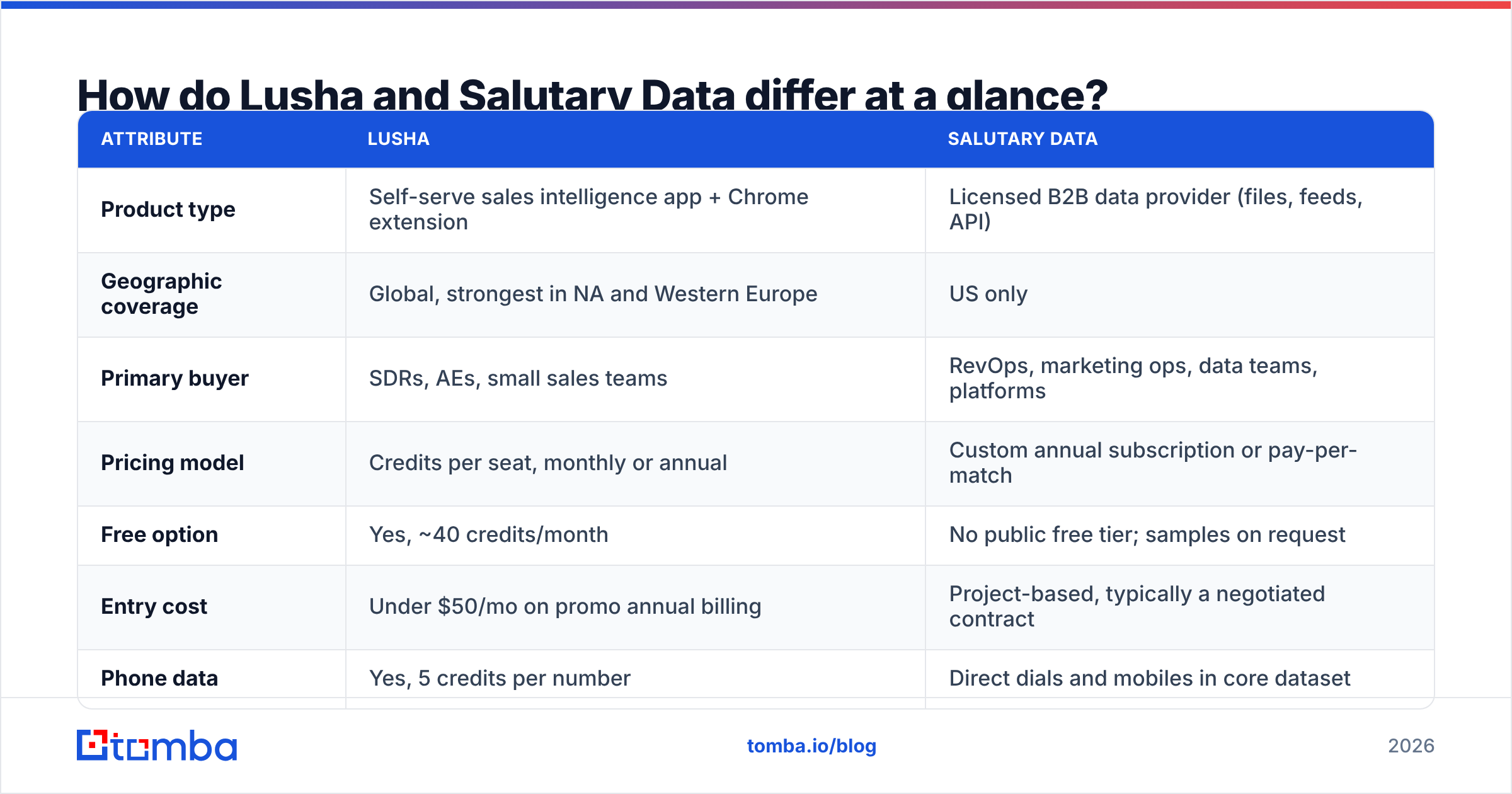
| Attribute | Lusha | Salutary Data |
|---|---|---|
| Product type | Self-serve sales intelligence app + Chrome extension | Licensed B2B data provider (files, feeds, API) |
| Geographic coverage | Global, strongest in NA and Western Europe | US only |
| Primary buyer | SDRs, AEs, small sales teams | RevOps, marketing ops, data teams, platforms |
| Pricing model | Credits per seat, monthly or annual | Custom annual subscription or pay-per-match |
| Free option | Yes, ~40 credits/month | No public free tier; samples on request |
| Entry cost | Under $50/mo on promo annual billing | Project-based, typically a negotiated contract |
| Phone data | Yes, 5 credits per number | Direct dials and mobiles in core dataset |
| Time to first contact | Minutes | Days to weeks (scoping, sample, contract) |
| CRM workflow | Native HubSpot, Salesforce, Pipedrive and more | Delivered into your stack via file or API |
| Best for | One-by-one prospecting at the rep level | Bulk enrichment, TAM builds, data products |
The fact that matters most here is US only. If even 20% of your pipeline sits in EMEA or APAC, Salutary Data cannot be your only source.
Which has better data coverage and accuracy?#
You can't answer that from a vendor's homepage, and anyone who says you can is guessing. Database size is a vanity metric. What matters is match rate and accuracy within your ICP.
Here's how they tend to differ in practice:
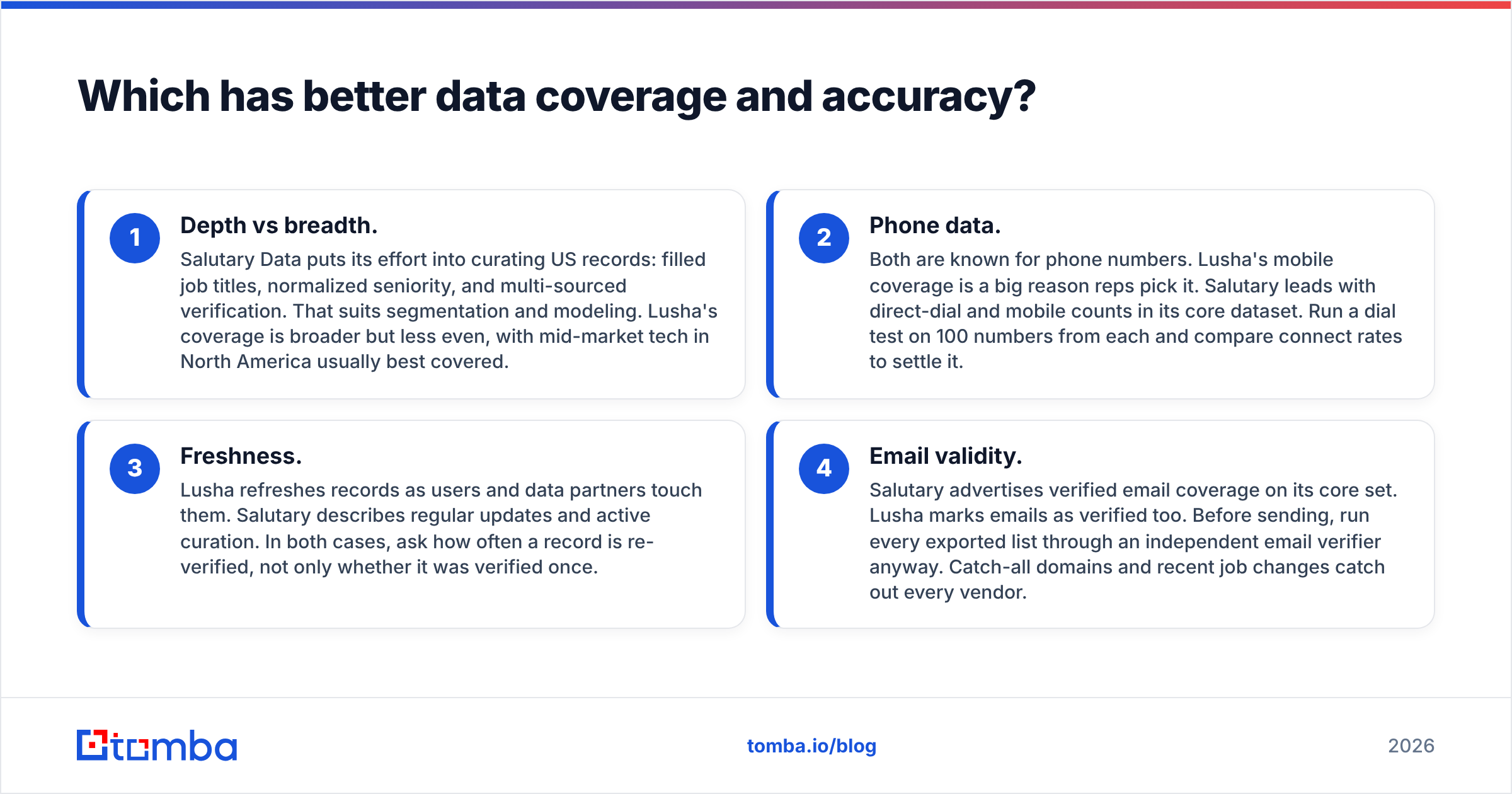
- Depth vs breadth. Salutary Data puts its effort into curating US records: filled job titles, normalized seniority, and multi-sourced verification. That suits segmentation and modeling. Lusha's coverage is broader but less even, with mid-market tech in North America usually best covered.
- Phone data. Both are known for phone numbers. Lusha's mobile coverage is a big reason reps pick it. Salutary leads with direct-dial and mobile counts in its core dataset. Run a dial test on 100 numbers from each and compare connect rates to settle it.
- Freshness. Lusha refreshes records as users and data partners touch them. Salutary describes regular updates and active curation. In both cases, ask how often a record is re-verified, not only whether it was verified once.
- Email validity. Salutary advertises verified email coverage on its core set. Lusha marks emails as verified too. Before sending, run every exported list through an independent email verifier anyway. Catch-all domains and recent job changes catch out every vendor.
How to run a fair pilot:
- Pull 200 contacts that look like your best closed-won accounts.
- Ask each vendor to enrich the same list. Salutary will usually run a sample match. Use Lusha's free or trial credits.
- Measure match rate, email bounce rate after verification, phone connect rate, and title accuracy.
- Compare cost per usable contact, not cost per record.
How does pricing compare in real terms?#
Their pricing models are hard to compare directly, so convert both into a cost per usable contact.
Lusha math. Take a Pro-level seat at roughly 7,200 credits a year. If every reveal is email-only, that's up to 7,200 emails. If every reveal is email plus phone, it drops to about 1,200 contacts. Most sales teams want phones, which is why Lusha's effective cost per contact rises faster than the sticker price suggests. Add seats for each rep and the annual bill grows quickly.
Salutary math. There's no public price list. Pay-per-match means you pay for records that actually match your input, so you aren't charged for failed lookups. Annual subscriptions make sense when you need hundreds of thousands of records or a continuous feed. For large volumes the unit cost can fall well below what self-serve credit tools charge. The catch is a higher minimum commitment and a longer buying cycle.
Rule of thumb:
- Under ~5,000 contacts a year, mostly rep-driven: Lusha (or a cheaper finder) wins on total cost and convenience.
- Over ~100,000 US records a year, or a recurring enrichment feed: Salutary-style licensing usually wins on unit economics.
- In between: get quotes from both and calculate cost per verified, matched contact.
Which fits your sales workflow better?#
Pick based on who touches the data and where they touch it.
Choose Lusha if:
- Your reps prospect on LinkedIn and want contact details next to the profile
- You need CRM enrichment out of the box with no engineering work
- You sell globally, or at least beyond the US
- You want month-to-month flexibility and a free tier to test with
Choose Salutary Data if:
- You're building a full US total addressable market in your CRM or warehouse
- You need consistently structured fields (title, seniority, function, firmographics) for scoring and routing
- You're feeding a product, model, or identity-resolution pipeline
- You'd rather have a vendor relationship with human support than a self-serve dashboard
A clean CRM depends on how data comes in. Lusha adds contacts one by one as reps work. Salutary loads them in bulk, governed by whoever owns the import. Neither is wrong, but each needs different hygiene rules.

What about compliance and data privacy?#
Both vendors take compliance seriously, but their exposure differs.
- Lusha markets heavily on privacy. It publicizes GDPR and CCPA alignment and security certifications, and it has to, because it processes global data, including EU contacts.
- Salutary Data, being US-only, mainly deals with US state privacy laws such as CCPA/CPRA and with sourcing transparency. Licensing agreements usually set out permitted use, so read them closely if you plan to resell or embed the data.
Whichever vendor you pick, your own outbound program carries the legal risk. Keep opt-outs honored across tools, document where each record came from, and keep suppression lists synced.
Are there cases where neither is the right choice?#
Yes, and they're more common than most comparison posts admit.
If your main need is finding and verifying work emails for outbound, both tools may be more than you need. Lusha bundles phone and intent features you pay for through credits. Salutary sells complete curated records with minimums. A dedicated email finder covers this more cheaply:
- Pull every public address at a target company with domain search, then filter by department.
- Look up a specific person from name plus company with an email finder.
- Verify before sending, including on catch-all domains.
- Plug the results into your sequencer or CRM through the API or integrations.
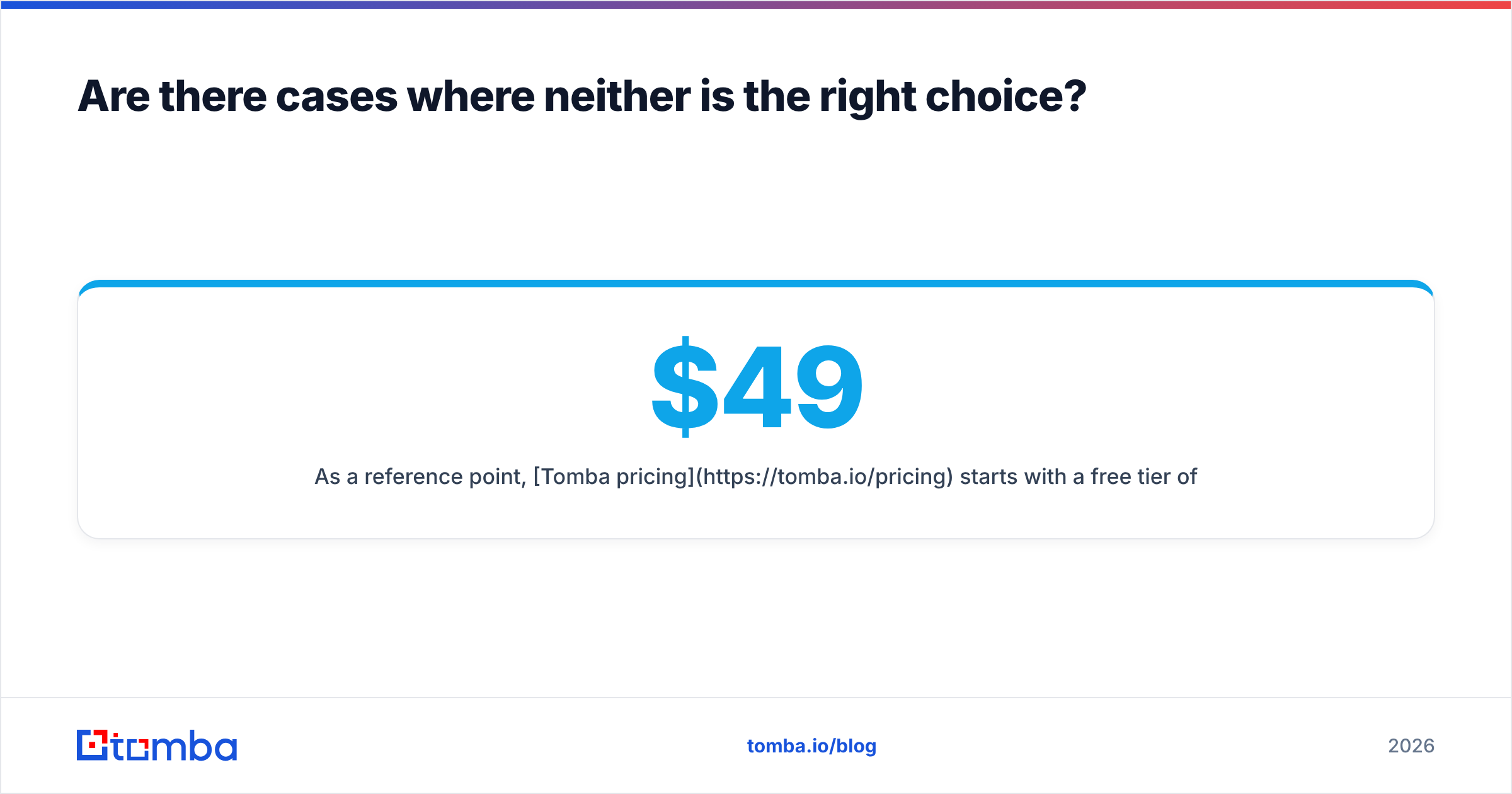
As a reference point, Tomba pricing starts with a free tier of 25 searches per month, then Starter at $49/mo, Growth at $99/mo, Pro at $249/mo, and custom Enterprise plans. Teams whose motion is email-first and not phone-heavy often find that cheaper per usable contact than credit-based all-in-one tools. Teams that need US mobile numbers at scale may still want Lusha or Salutary alongside it.
A stack many teams settle on: a licensed dataset (such as Salutary) for TAM and scoring, a self-serve tool for rep-level prospecting, and an email finder plus verifier to fill gaps and clean everything before it reaches a sequence.
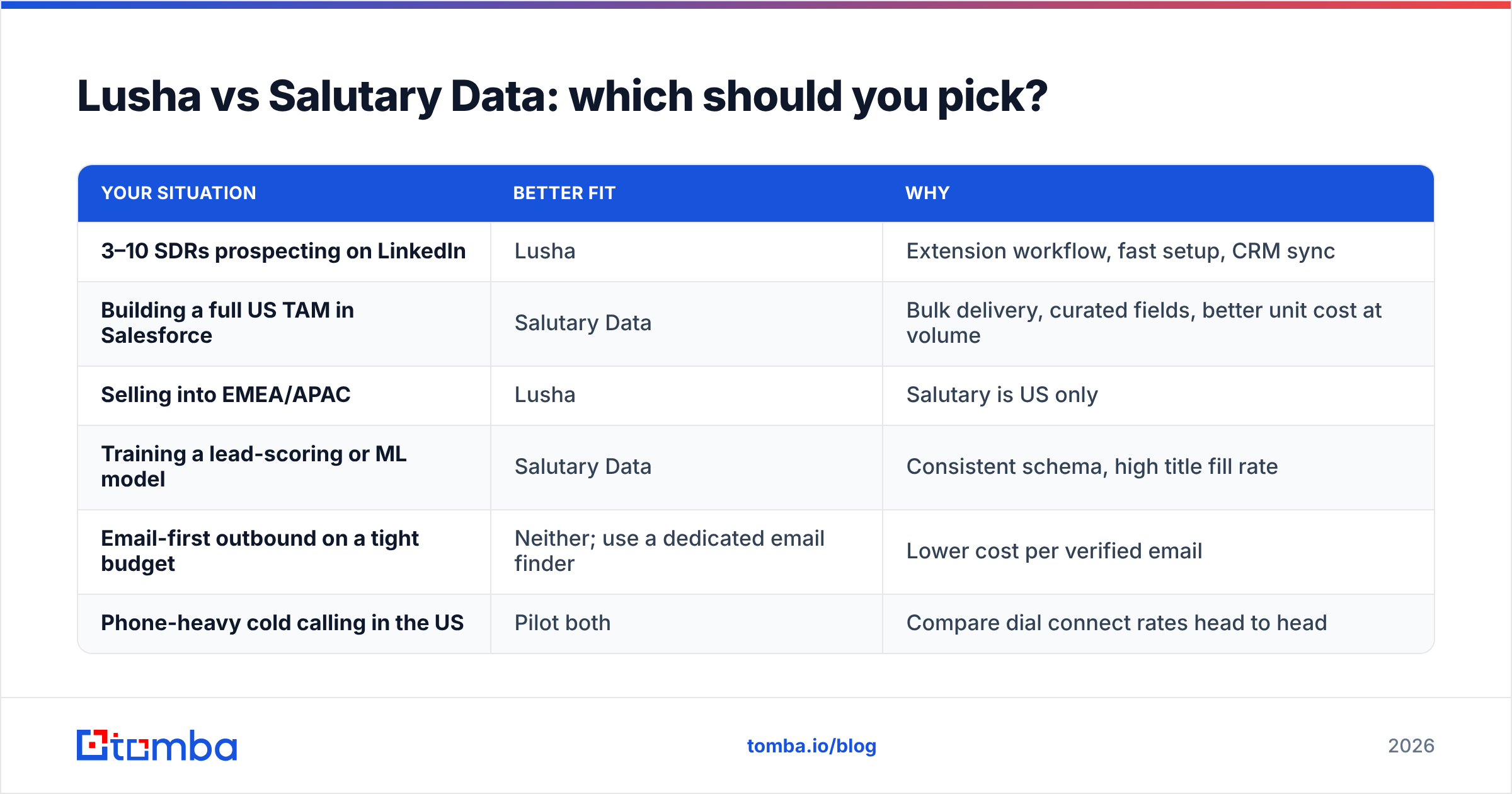
Lusha vs Salutary Data: which should you pick?#
It comes down to what you're buying.
| Your situation | Better fit | Why |
|---|---|---|
| 3–10 SDRs prospecting on LinkedIn | Lusha | Extension workflow, fast setup, CRM sync |
| Building a full US TAM in Salesforce | Salutary Data | Bulk delivery, curated fields, better unit cost at volume |
| Selling into EMEA/APAC | Lusha | Salutary is US only |
| Training a lead-scoring or ML model | Salutary Data | Consistent schema, high title fill rate |
| Email-first outbound on a tight budget | Neither; use a dedicated email finder | Lower cost per verified email |
| Phone-heavy cold calling in the US | Pilot both | Compare dial connect rates head to head |
Lusha is the better product for people who prospect. Salutary Data is the better asset for systems that need data. If you're unsure which you are, look at who will be using it on Monday morning.
If your real bottleneck is getting accurate work emails for the accounts you already target, start with the Tomba Email Finder. Enter a name and company or a domain, get verified addresses back, and send them to your CRM or sequencer. There are no phone credits to burn and no annual minimum. You can test it free on 25 searches this month against the same 200-contact pilot list you'd use for Lusha or Salutary, and compare cost per usable contact on your own data.
Related guides#
// get started
Find, verify and enrich your first contacts today
Start on the free plan with 25 searches a month, then scale when your team is ready.
Free plan · No credit card required · GDPR & CCPA
Get the Tomba newsletter
Product and data updates
// about the author