Lusha vs Sparklane (2026): Which Prospecting Tool Wins?
Lusha sells fast contact reveals. Sparklane sells AI buying signals with a European focus. We compare data coverage, pricing, credits and GDPR fit to help you pick the right one for your territory.
TL;DR
- Lusha is a self-serve contact data tool. Its Chrome extension shows direct dials and work emails on LinkedIn and company websites. It suits SDR teams that sell into North America and want to start the same day.
- Sparklane is a French sales intelligence platform with two products. Discover is for contact lookup and Predict finds accounts using AI and buying signals. It suits teams that sell into France and the rest of Europe and care more about when to call an account than about a large contact count.
- On cost, Lusha publishes its prices and has a free plan. Sparklane Discover starts at about €44/user/month (billed annually) for 100 credits. Predict is quote-only.
- Pick Lusha if you need volume and phone numbers. Pick Sparklane if you need account timing and EU data. If all you need is verified emails at a lower cost per contact, an email finder like Tomba does that job without a per-seat intelligence contract.
Lusha and Sparklane show up on the same shortlists, but they answer different questions. Lusha tells you who to contact and how to reach them. Sparklane tells you which accounts to work this week and why. If you buy the wrong one, you either have plenty of phone numbers and no sense of priority, or good signals and no one to contact.
This guide compares both tools on data, workflow, pricing, compliance and fit, then gives a verdict for each type of team.
What is Lusha?#
Lusha is a B2B contact and company data platform based in New York and Tel Aviv. Most people know it for its browser extension. You open a LinkedIn profile or a company website, click the Lusha icon and reveal a work email, a direct dial or a mobile number for one credit per reveal.
Lusha has grown well beyond the extension. The current product includes:
- A prospecting database with filters for job title, seniority, headcount, industry, technology and location
- Intent and job-change signals, which are thinner than Sparklane's signals but useful for timing
- CRM enrichment for HubSpot, Salesforce and Pipedrive
- Basic sequencing for emails, so smaller teams can prospect and send from one tool
- An API for enrichment inside your own stack
Lusha's main strength is mobile and direct-dial coverage, mostly in the US and the UK. That is why outbound teams that rely on calling tend to keep it even after adding other data vendors.
What is Sparklane?#
Sparklane is a sales intelligence company based in Rennes, France. Its users are mostly French and European B2B sales teams. It sells two products:
- Sparklane Discover is a self-serve contact finder with a browser extension. It is priced per user with a monthly credit allowance.
- Sparklane Predict is an AI-driven targeting platform. It tracks business events such as fundraising, executive hires, relocations, new sites, tenders and expansion news. It scores accounts on how closely they match your ideal customer profile and on how likely they are to buy right now.
Sparklane is built around timing. It does not try to have the most contacts. It tries to show you the 40 accounts out of 4,000 where something just changed. Its French company data, including SIREN-linked firmographics and local news sources, goes deeper than most US-built tools do for that market.

How do Lusha and Sparklane actually differ?#
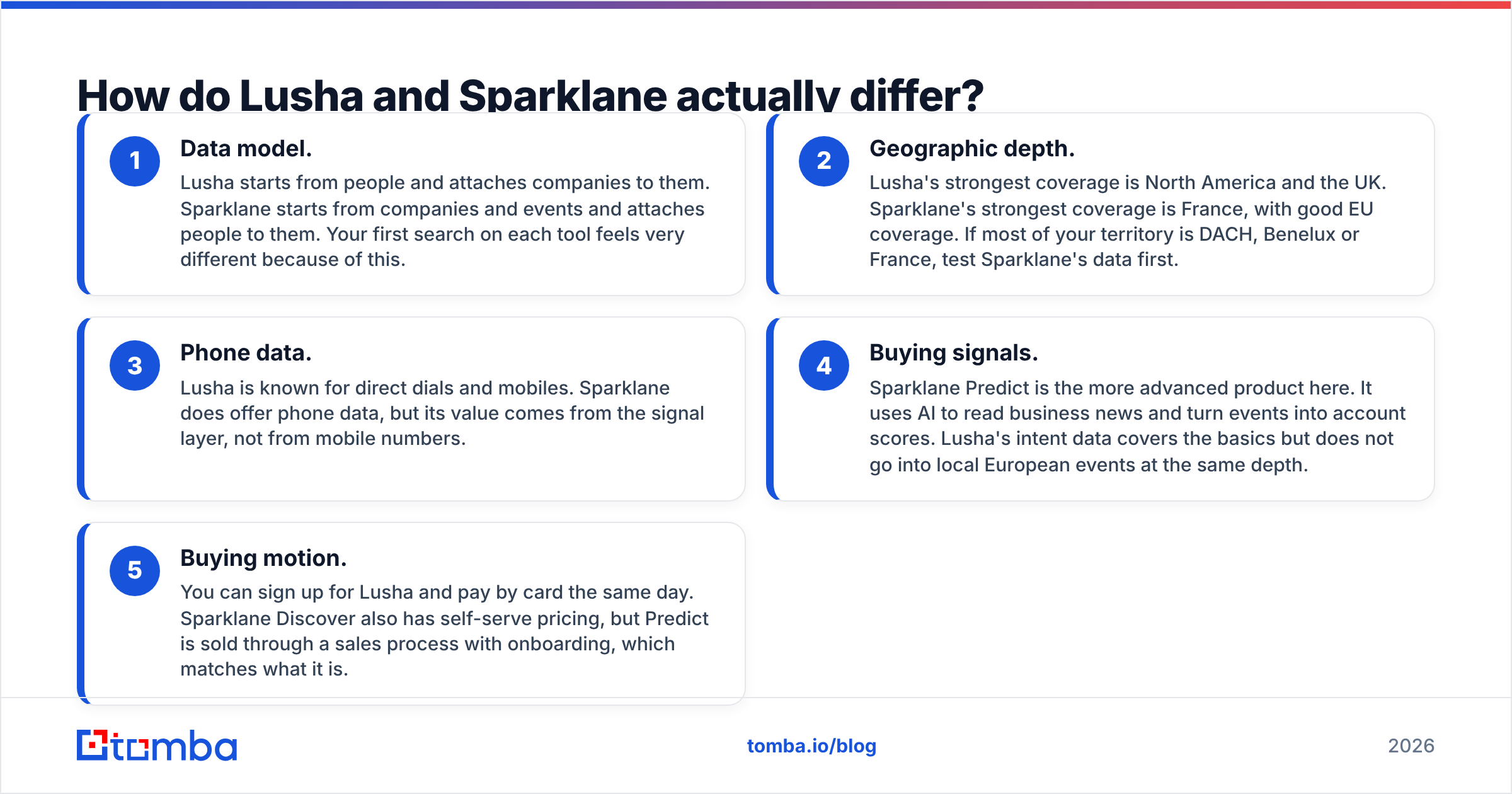
In short, Lusha is a contact-first tool and Sparklane is a signal-first tool. Everything else in this comparison follows from that. Here are the five places where the difference matters most:
- Data model. Lusha starts from people and attaches companies to them. Sparklane starts from companies and events and attaches people to them. Your first search on each tool feels very different because of this.
- Geographic depth. Lusha's strongest coverage is North America and the UK. Sparklane's strongest coverage is France, with good EU coverage. If most of your territory is DACH, Benelux or France, test Sparklane's data first.
- Phone data. Lusha is known for direct dials and mobiles. Sparklane does offer phone data, but its value comes from the signal layer, not from mobile numbers.
- Buying signals. Sparklane Predict is the more advanced product here. It uses AI to read business news and turn events into account scores. Lusha's intent data covers the basics but does not go into local European events at the same depth.
- Buying motion. You can sign up for Lusha and pay by card the same day. Sparklane Discover also has self-serve pricing, but Predict is sold through a sales process with onboarding, which matches what it is.
How do Lusha and Sparklane compare feature by feature?#
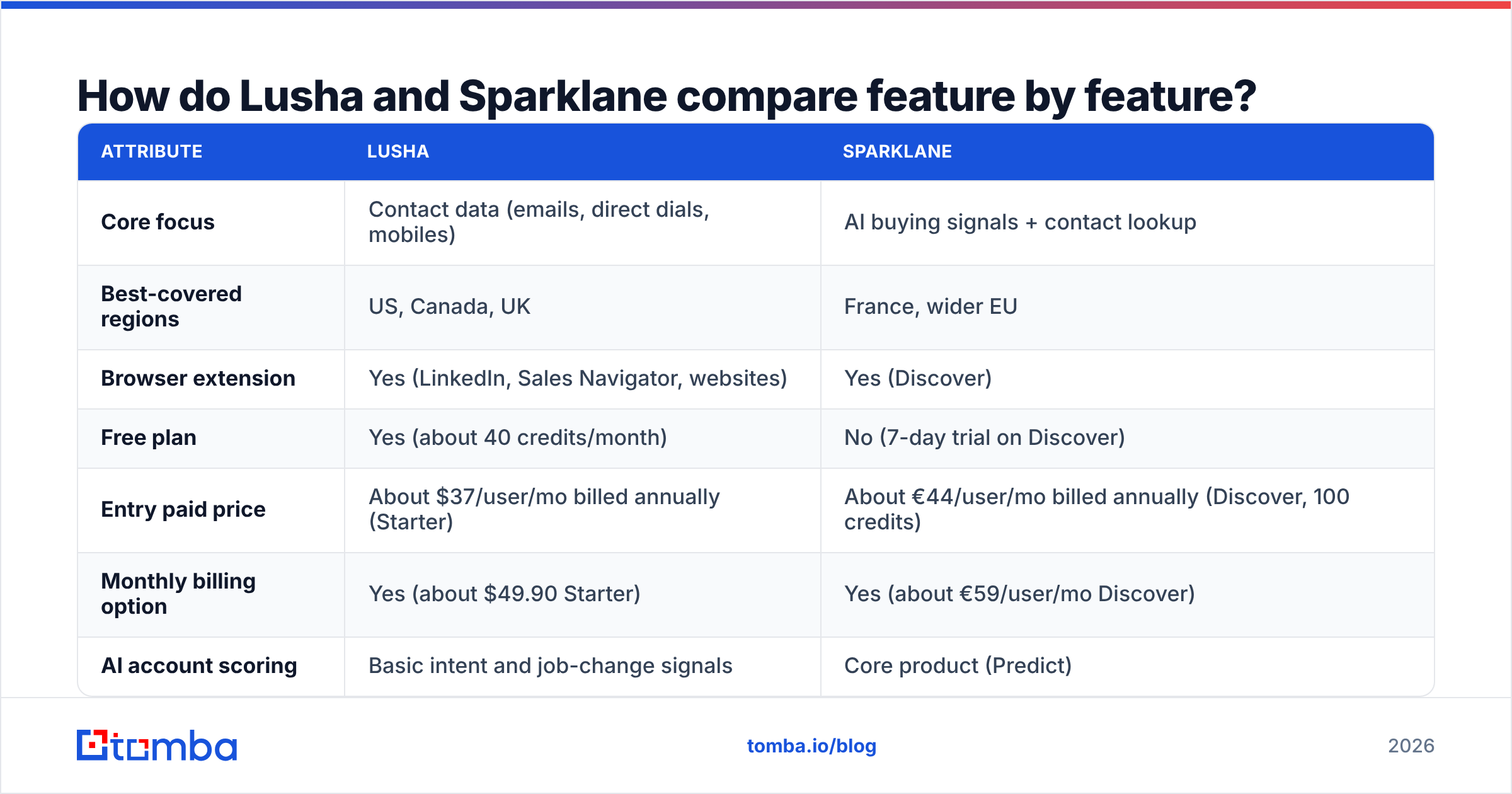
| Attribute | Lusha | Sparklane |
|---|---|---|
| Core focus | Contact data (emails, direct dials, mobiles) | AI buying signals + contact lookup |
| Best-covered regions | US, Canada, UK | France, wider EU |
| Browser extension | Yes (LinkedIn, Sales Navigator, websites) | Yes (Discover) |
| Free plan | Yes (about 40 credits/month) | No (7-day trial on Discover) |
| Entry paid price | About $37/user/mo billed annually (Starter) | About €44/user/mo billed annually (Discover, 100 credits) |
| Monthly billing option | Yes (about $49.90 Starter) | Yes (about €59/user/mo Discover) |
| AI account scoring | Basic intent and job-change signals | Core product (Predict) |
| Business event tracking | Limited | Fundraising, hires, relocations, tenders, expansions |
| CRM integrations | HubSpot, Salesforce, Pipedrive, more | Salesforce, HubSpot, Microsoft Dynamics, more |
| Built-in sequencing | Basic email sequences | No (it sends signals to your CRM/engagement tool) |
| Phone credit cost | Several times an email credit (5-10 credits, depending on plan) | Credit-based, varies by plan |
| GDPR posture | GDPR/CCPA compliant, ISO-certified | EU-headquartered, GDPR-native |
| Ideal buyer | SDR teams that call heavily into North America | European AE/ABM teams that care about timing |
Prices are taken from public pricing pages and third-party pricing breakdowns as of 2026. Both vendors change credit bundles often, so check the live pricing page before you sign anything.
Is Lusha cheaper than Sparklane?#
At the entry level, the two cost about the same per seat. They stop being comparable once you look at what a credit buys and what you will actually end up on.
Lusha's credit math. The Starter plan has about 400 credits per month and the Pro plan about 600. An email reveal costs 1 credit, but a phone reveal costs several times that. A Pro seat that seems to cover 600 contacts may only cover 60 to 120 phone numbers if your team mostly calls. Also note that on annual plans, unused credits usually reset at the end of each cycle instead of rolling over.
Sparklane's credit math. Discover includes 100 credits per user per month. That works out to about €0.44 per credit on annual billing and €0.59 on monthly billing. That is expensive per contact if you only want volume. Discover is not where Sparklane's value is, though. Predict is, and it is quote-only. Expect an annual contract priced on seats, data scope and signal modules. On review sites like G2, buyers in mid-market regularly report Predict deals in the low-to-mid five figures per year.
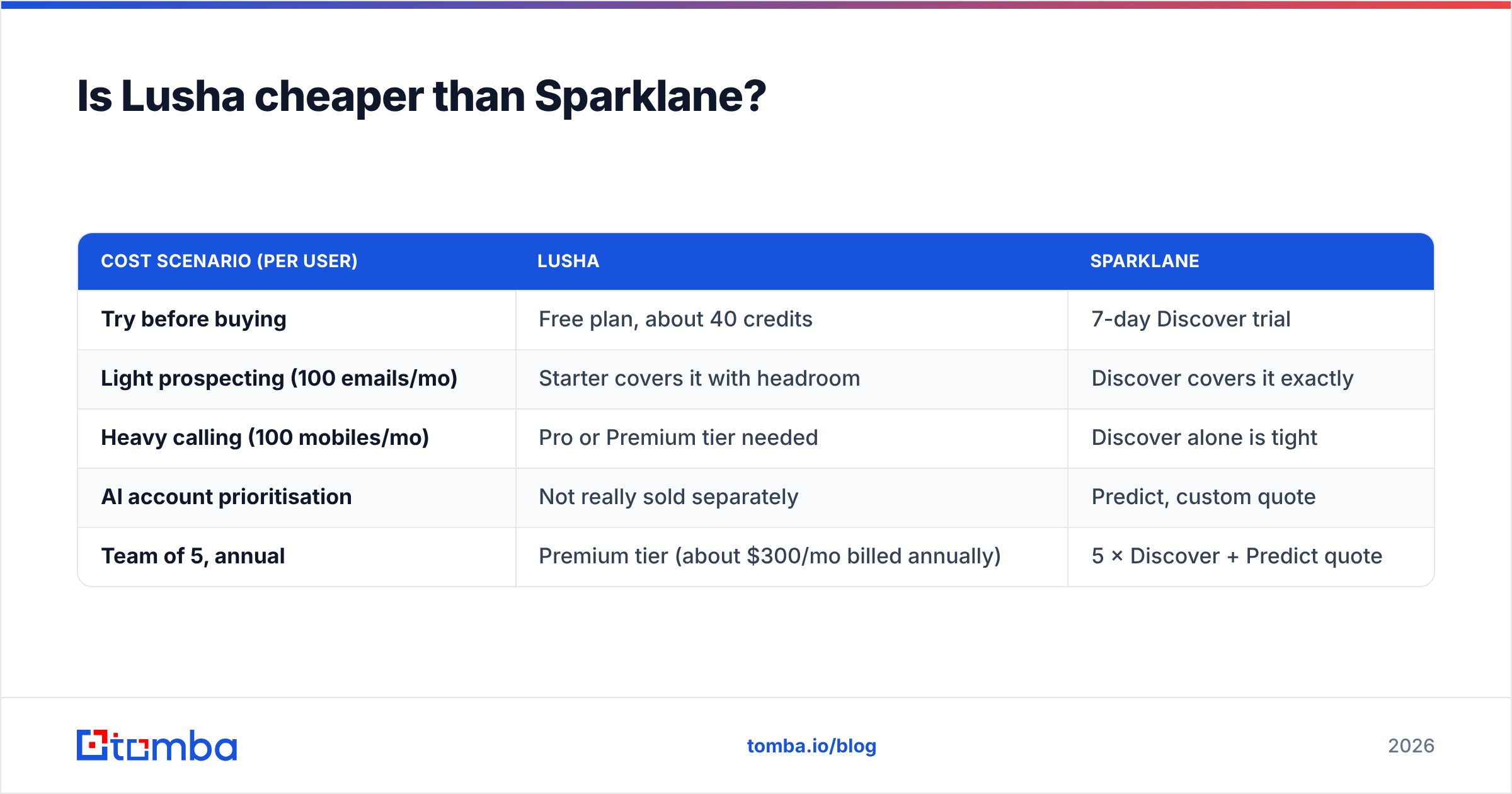
| Cost scenario (per user) | Lusha | Sparklane |
|---|---|---|
| Try before buying | Free plan, about 40 credits | 7-day Discover trial |
| Light prospecting (100 emails/mo) | Starter covers it with headroom | Discover covers it exactly |
| Heavy calling (100 mobiles/mo) | Pro or Premium tier needed | Discover alone is tight |
| AI account prioritisation | Not really sold separately | Predict, custom quote |
| Team of 5, annual | Premium tier (about $300/mo billed annually) | 5 × Discover + Predict quote |
Bottom line on price: Lusha is cheaper and more predictable if you are buying contacts. Sparklane costs more, but you are paying for prioritisation, which Lusha does not really offer. Comparing them only on cost per credit leads to the wrong choice.
Which tool has better data accuracy?#
Neither vendor publishes an independent accuracy audit. Treat any single "95% accurate" claim with caution, including claims from other tools.
Here is what you can expect in practice:
- Lusha's emails are usually reliable for US and UK companies with standard email formats. Accuracy drops for smaller EU companies and for catch-all domains. Its mobile numbers are the main reason teams buy it.
- Sparklane's firmographic and event data for French companies is very good, because it draws on official registries and local news. Its contact-level coverage outside France is thinner than Lusha's.
Whichever you choose, run every exported list through an email verifier before it reaches your sequencer. If 3-5% of a 2,000-contact list bounces, your domain reputation takes real damage. The few cents per contact that verification costs is cheap protection.
A useful test before signing a contract: take 200 contacts you have already confirmed (closed-won customers are ideal). Look them up in both tools and count how many emails and phone numbers each one gets right. This takes an afternoon and tells you more than any vendor demo.
How do they handle GDPR and European prospecting?#
If you sell into Europe, this section may decide the purchase for you.
GDPR allows B2B prospecting on a legitimate-interest basis, but you need clear data sourcing, opt-out handling and a documented balancing test. Both vendors state that they comply:
- Lusha says it complies with GDPR and CCPA, holds ISO 27001 certification and has gone through privacy reviews after early scrutiny. It runs a public opt-out process.
- Sparklane is headquartered in the EU and works under French data-protection oversight (CNIL). For legal and procurement teams at European companies, that often makes the approval process shorter.
Neither tool takes compliance off your hands. You still need opt-out links, a suppression list and records of your legitimate-interest assessment. For a cautious EU legal team, though, an EU-based vendor usually means fewer emails back and forth before approval.

Which tool fits which team?#
Use the scenarios below to match your situation to a tool.
Choose Lusha if:
- Your reps make cold calls and need mobile and direct-dial numbers
- Your territory is mostly the US, Canada or the UK
- You want to sign up by card today, with no sales cycle
- You are a small team that needs prospecting and basic sequencing in one product
Choose Sparklane if:
- You sell into France or the wider EU and find US-built databases thin there
- Your deals are account-based and timing matters (new funding, new site, new executive)
- You already have a contact source and need help deciding which accounts to work
- Your procurement team prefers an EU-headquartered data vendor
Consider neither (or something cheaper) if:
- Your main need is finding and verifying professional email addresses at volume
- You already pay for a CRM with intent data and only need contact details
- You are a founder or a one-person sales team and both per-seat models feel heavy
In that last case, a dedicated email finder plus a verifier covers most outbound email needs at a lower cost per contact. You can keep Lusha or Sparklane in reserve for calling or signals once your pipeline volume justifies it.
Can you use Lusha and Sparklane together?#
Yes. Some European teams that also sell into the US do this on purpose:
- Sparklane Predict produces the weekly list of priority accounts based on signals.
- Lusha (or another contact tool) adds mobile numbers for the decision-makers at those accounts.
- A verification step checks emails before they go into the sequencer.
- Everything syncs to the CRM, so reps work from one queue.
It works, but you are paying two vendors with overlapping contact features. Before you buy both, check whether one tool plus a cheaper email finder would cover the gap. Often only one of the two products is really needed.
What do users say about Lusha and Sparklane?#
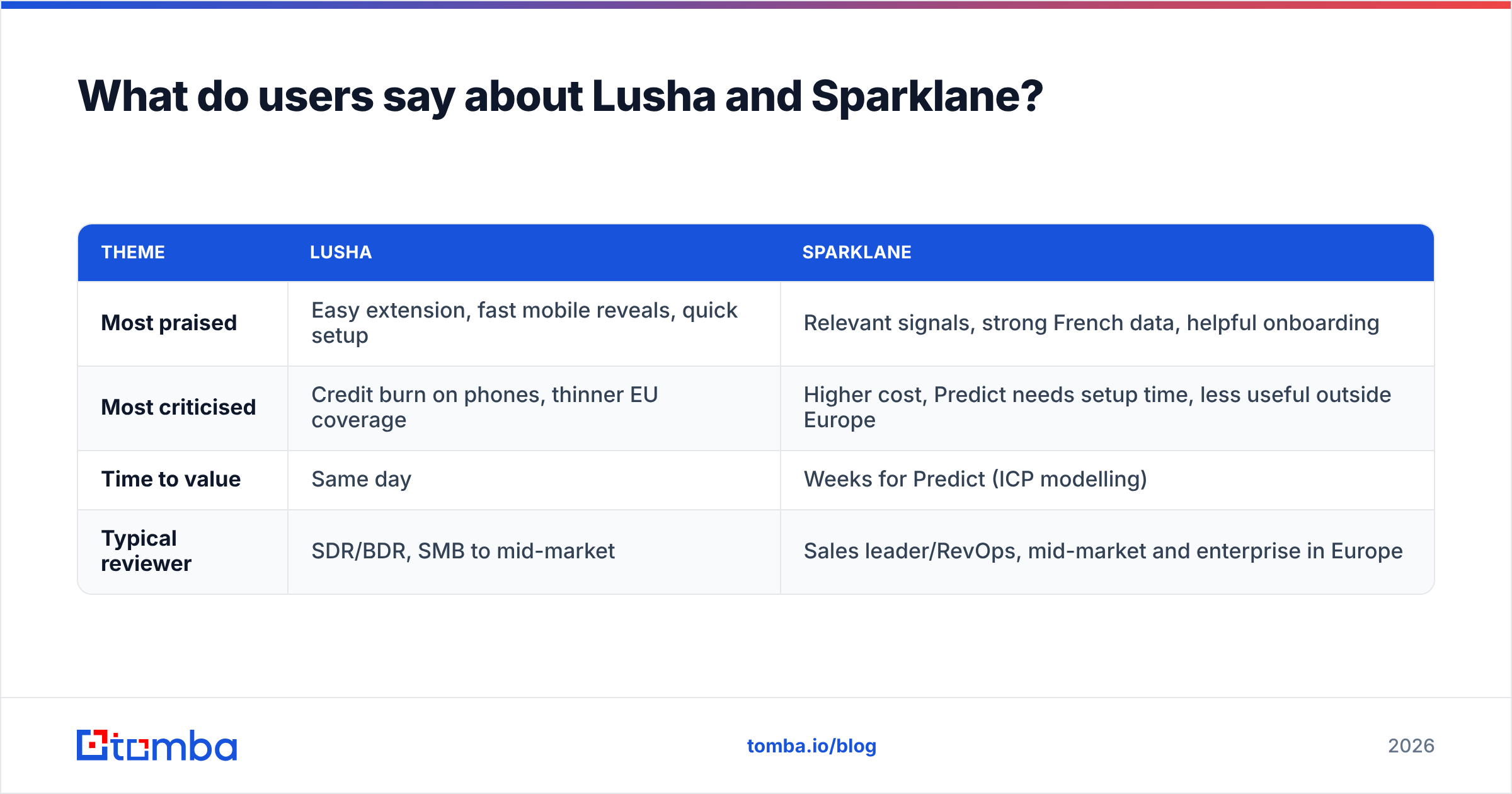
On review platforms such as G2 and Capterra, the feedback is fairly consistent:
| Theme | Lusha | Sparklane |
|---|---|---|
| Most praised | Easy extension, fast mobile reveals, quick setup | Relevant signals, strong French data, helpful onboarding |
| Most criticised | Credit burn on phones, thinner EU coverage | Higher cost, Predict needs setup time, less useful outside Europe |
| Time to value | Same day | Weeks for Predict (ICP modelling) |
| Typical reviewer | SDR/BDR, SMB to mid-market | Sales leader/RevOps, mid-market and enterprise in Europe |
The pattern matches the positioning. Lusha users like that it is fast. Sparklane users like that it shows them where to focus. The complaints are the other side of each strength.
Lusha vs Sparklane: what's the final verdict?#
There is no single winner because the two tools solve different problems.
- Lusha is the better choice for teams that need contact data quickly, especially phone numbers, in North American markets, with prices published openly.
- Sparklane is the better choice for European teams selling account-based deals, where knowing when an account is ready to buy matters more than adding more contacts.
If you are still undecided, look at what is limiting your pipeline right now. If reps cannot reach the people they want to reach, buy Lusha. If reps are reaching people but at the wrong accounts or at the wrong time, buy Sparklane.
If the limit is simply getting accurate work emails at a sensible cost, both tools may be more than you need.
Need verified emails without a per-seat intelligence contract?#
The Tomba Email Finder finds professional email addresses from a name and a company, or lists every public email on a domain. Every result can be checked with the built-in verifier before it reaches your sequencer. It works in the browser, in Google Sheets and through the API, and it connects to the CRMs you already use. The free tier gives you 25 searches a month to test it against your own list, and paid plans start at $49/month (see Tomba pricing). Use it on its own for email outreach, or pair it with Lusha or Sparklane to keep your cost per contact down while those tools handle phones and signals.
Related guides#
Ready to find emails that actually work?
Join 150,000+ professionals who stopped guessing and started sending. Free credits on signup — no credit card required.
Get the Tomba newsletter
Practical outbound tactics and product updates — once every two weeks.
About the author