Lusha vs The Data City: Contact Data or UK Market Intelligence?
Lusha tells you who to email. The Data City tells you which UK companies are worth targeting at all. Here is how the two compare on data, pricing and use cases, and when to run them together.
TL;DR
- Lusha is a contact-data tool for sales. It gives reps verified emails and direct dials for named people, mostly through a Chrome extension and CRM integrations.
- The Data City is a UK company-intelligence platform. It sorts 5M+ UK companies into 400+ emerging-sector classifications (RTICs) and is used by policymakers, investors, researchers and market-sizing teams.
- They answer different questions. Lusha answers "how do I reach this person?" The Data City answers "which companies are in this market?"
- If you sell into a niche UK sector such as hydrogen, cyber security or agritech, the strongest setup uses both: build the account list in The Data City, then find contacts with a contact-data tool.
- If you just need contacts, Lusha or a lower-cost email finder will do the job without a market-intelligence licence.
Searches for "Lusha vs The Data City" usually come from someone who has been told to "get better data" and has found two tools that both say B2B data. They are not substitutes. Choosing between them works like choosing between a map and a phone book: one shows you where things are, the other tells you how to call them. This guide covers what each one does, where they overlap, what they cost, and which one fits your team.
What is Lusha?#
Lusha is a B2B contact and company data platform built for salespeople. You look up a prospect on LinkedIn, a company website or inside your CRM, and Lusha shows a work email, a direct or mobile number, and basic firmographics such as company size, industry and location.
Its main workflows are:
- Chrome extension that reveals contact details on LinkedIn and Sales Navigator profiles
- Prospecting search that filters people by title, seniority, department, location and company attributes
- CRM enrichment for Salesforce, HubSpot and other systems, which fills in missing emails and phones on existing records
- Intent and job-change signals on higher tiers, so reps can see when a buyer moves companies or a target account starts researching a topic
Lusha bills in credits. In 2026 a verified email usually costs 1 credit and a phone number costs more, often 5 credits, so phone-heavy teams burn through allowances quickly. There is a free plan with a small monthly credit allowance. Paid tiers run from a low-cost single-seat Starter plan up to team plans and custom Scale contracts. Lusha changes its prices and promotions often, so check the official pricing page before you budget.
Lusha is strongest at the level of the individual person. Coverage is broad across North America and Europe, and the extension is fast enough that reps actually use it.
What is The Data City?#
The Data City is a UK data company. Instead of relying on government SIC codes, it classifies companies by reading their websites and other public signals with machine learning. Its core product is a set of Real-Time Industrial Classifications (RTICs): more than 400 emerging-sector definitions such as Net Zero, Space, Cyber Security, Games, Life Sciences and Photonics, applied across a database of more than 5 million UK companies.
According to The Data City's own documentation, the platform is aimed at emerging sectors, high-growth companies, innovation clusters and investment. Typical users include:
- Government and local authorities mapping regional economies and innovation clusters
- Universities and research bodies studying sector growth
- Investors and corporate development teams sizing markets and building target lists
- Trade bodies and agencies that need to know how many UK firms work in a sector, and where they are
SIC codes are notoriously poor at describing modern businesses. A drone-delivery startup might be filed under "other business support activities". The Data City's classifier reads what the company actually does and tags it accordingly. You get a defensible, regularly refreshed list of companies in a market, with turnover, headcount, growth, location and related data where it is available.
What it does not do is the job Lusha does. It is not designed to give an SDR a verified direct email for a named head of procurement.
How do Lusha and The Data City compare side by side?#
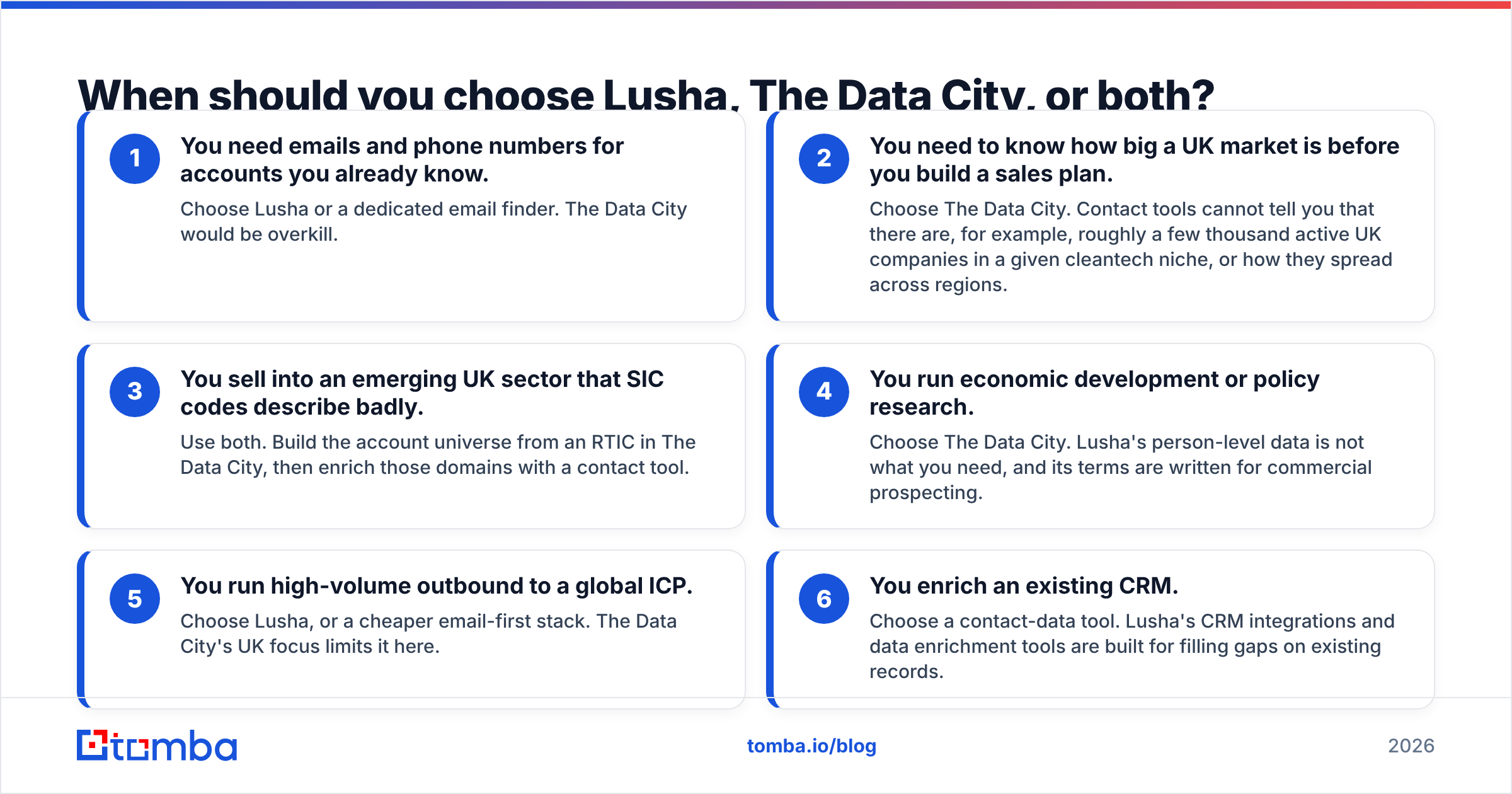
| Attribute | Lusha | The Data City |
|---|---|---|
| Core question answered | Who do I contact, and how? | Which companies are in this market? |
| Primary unit of data | People (contacts) | Companies (organisations) |
| Geographic focus | Global, strongest in NA and Europe | UK-focused (5M+ UK companies) |
| Classification method | Standard industry filters | 400+ machine-learning RTICs, beyond SIC codes |
| Verified emails and direct dials | Yes, the core product | Not the core product |
| Main users | SDRs, AEs, recruiters, RevOps | Policymakers, analysts, investors, market researchers |
| Typical workflow | Chrome extension, CRM enrichment, prospect search | List builder, sector maps, exports, reports |
| Free access | Free plan with limited monthly credits | Free trial for new users |
| Pricing model | Per-seat plans plus credits | Platform licences and projects; RTIC sponsorship around £20k–£25k/yr |
| Best for | Booking meetings with named buyers | Market sizing, cluster mapping, TAM building |
The rows show where each tool's strength lies. Lusha is deep on people and shallow on market structure. The Data City is deep on market structure and is not a contact-reveal tool.
When should you choose Lusha, The Data City, or both?#
Base the decision on the job you need done, not on the vendor category. These are the scenarios we see most often:
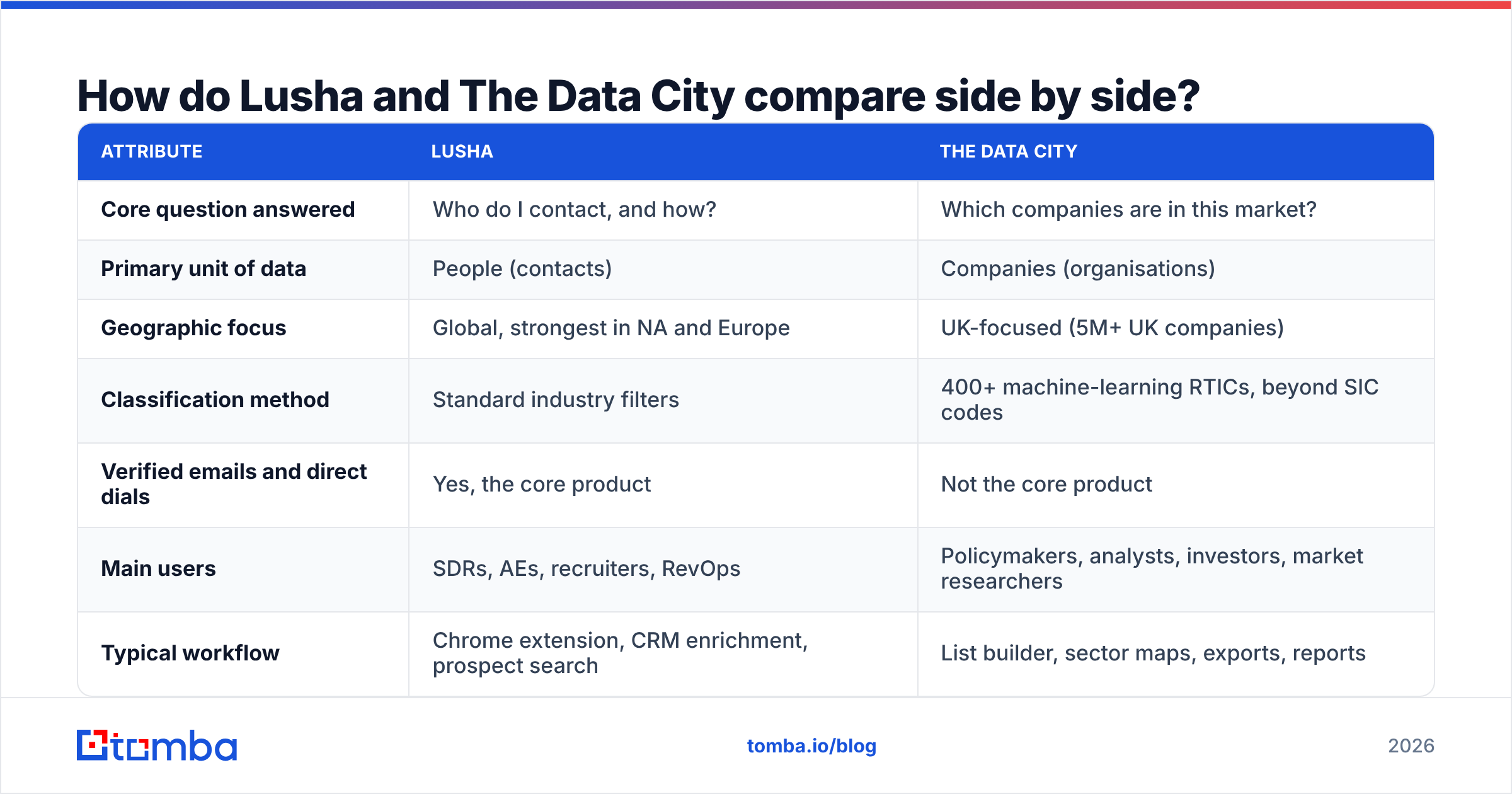
- You need emails and phone numbers for accounts you already know. Choose Lusha or a dedicated email finder. The Data City would be overkill.
- You need to know how big a UK market is before you build a sales plan. Choose The Data City. Contact tools cannot tell you that there are, for example, roughly a few thousand active UK companies in a given cleantech niche, or how they spread across regions.
- You sell into an emerging UK sector that SIC codes describe badly. Use both. Build the account universe from an RTIC in The Data City, then enrich those domains with a contact tool.
- You run economic development or policy research. Choose The Data City. Lusha's person-level data is not what you need, and its terms are written for commercial prospecting.
- You run high-volume outbound to a global ICP. Choose Lusha, or a cheaper email-first stack. The Data City's UK focus limits it here.
- You enrich an existing CRM. Choose a contact-data tool. Lusha's CRM integrations and data enrichment tools are built for filling gaps on existing records.

Is Lusha's data accurate enough for outbound?#
For most teams, yes, with caveats. Lusha performs well on reviews sites such as G2, where users mostly praise ease of use and the extension's speed. The common complaints are:
- Phone credit cost. Direct dials cost several times as much as an email, so a phone-led team can run through its allowance mid-month.
- Coverage drops outside core markets. Smaller companies, non-English-speaking regions and very niche sectors come back with fewer hits.
- Credit rollover rules differ by billing cycle. Depending on the plan, unused credits may roll over on monthly billing and reset on annual billing. Read the terms before you commit to a year.
However accurate a vendor is, verify before sending. Data decays. People change jobs, domains change, and catch-all servers accept anything. Running a list through an email verifier before a campaign is cheap insurance for your sender reputation.
Is The Data City's data accurate enough for market sizing?#
For UK sector analysis it is one of the more credible sources available, because the classification is transparent and is refreshed continuously rather than frozen in Companies House filings. A few points to keep in mind:
- The RTICs are probabilistic. A machine-learning classifier reading websites will sometimes tag a company that only mentions a sector in passing. The Data City publishes its methodology and lets users review lists, but you should still sanity-check the edges of any RTIC before quoting a number in a board deck.
- It depends on companies having a web presence. Dormant or holding companies with no website are harder to classify, which is usually what you want for commercial targeting.
- It is UK-centric. If your market is the UK plus the US, you will need a second source for the US side.
Lusha is not built for this kind of analysis. Its industry filters are useful for narrowing a prospect search, but they are not meant to produce a census of a sector.
How does pricing compare between Lusha and The Data City?#
The two pricing models are as different as the products.
Lusha is self-serve SaaS. You can start free, upgrade on a card, and scale by seats and credits. A solo rep can be live in ten minutes. The total cost depends on how many phone numbers you reveal, how many seats you need, and whether you use API or enrichment features that consume extra credits.
The Data City is a licensed data platform. New users get a free trial, and the company publishes standard licence and project costs on its website. Its best-known premium option is RTIC sponsorship: an organisation funds the creation and maintenance of a new sector classification, at roughly £20,000–£25,000 a year according to The Data City's own announcements. Most buyers are institutions with research or policy budgets, not individual sales reps.
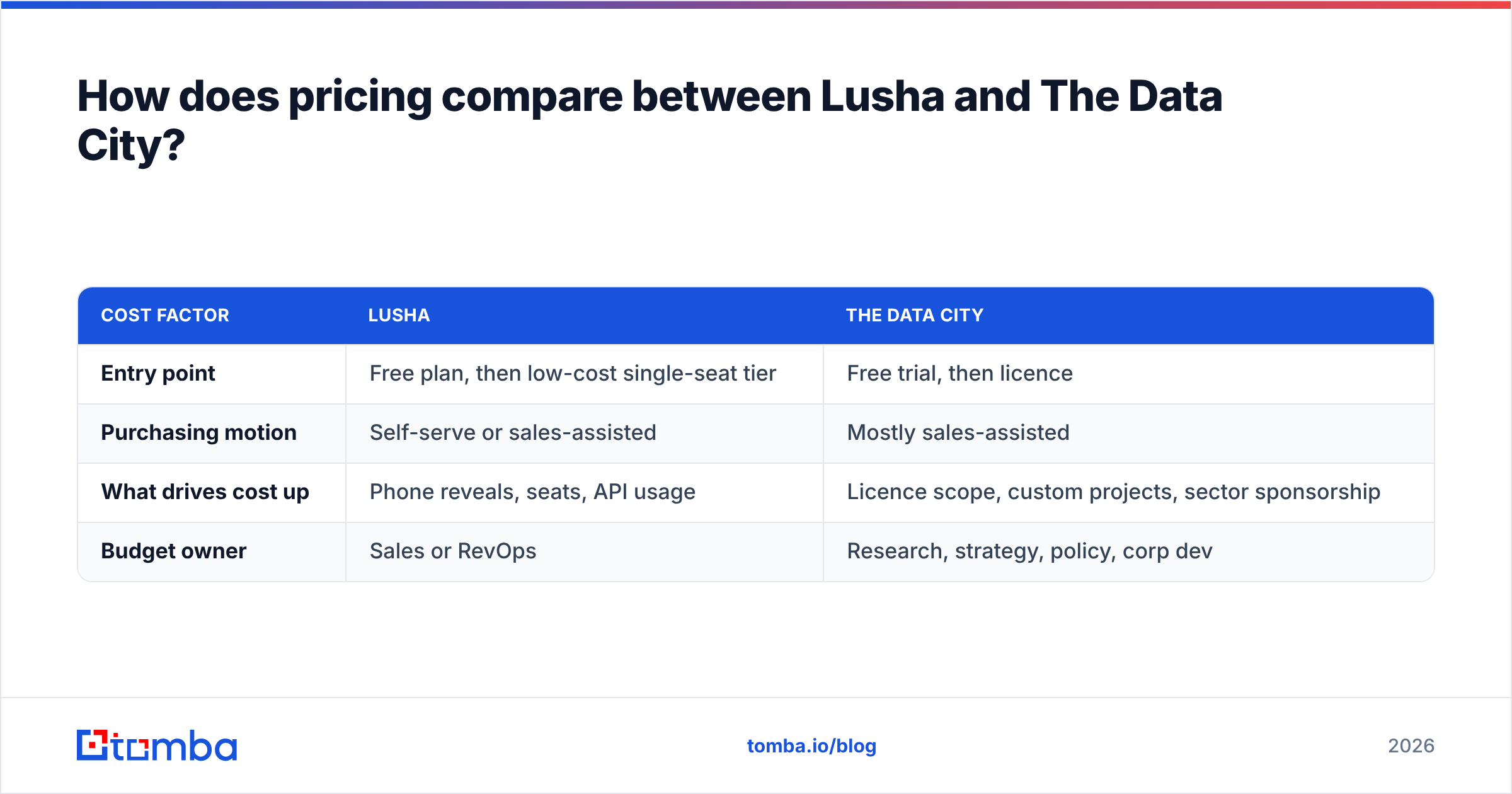
| Cost factor | Lusha | The Data City |
|---|---|---|
| Entry point | Free plan, then low-cost single-seat tier | Free trial, then licence |
| Purchasing motion | Self-serve or sales-assisted | Mostly sales-assisted |
| What drives cost up | Phone reveals, seats, API usage | Licence scope, custom projects, sector sponsorship |
| Budget owner | Sales or RevOps | Research, strategy, policy, corp dev |
If your budget sits in the sales team, Lusha is the easier purchase. If it sits in strategy or research, The Data City fits more naturally.
Can you use Lusha and The Data City together?#
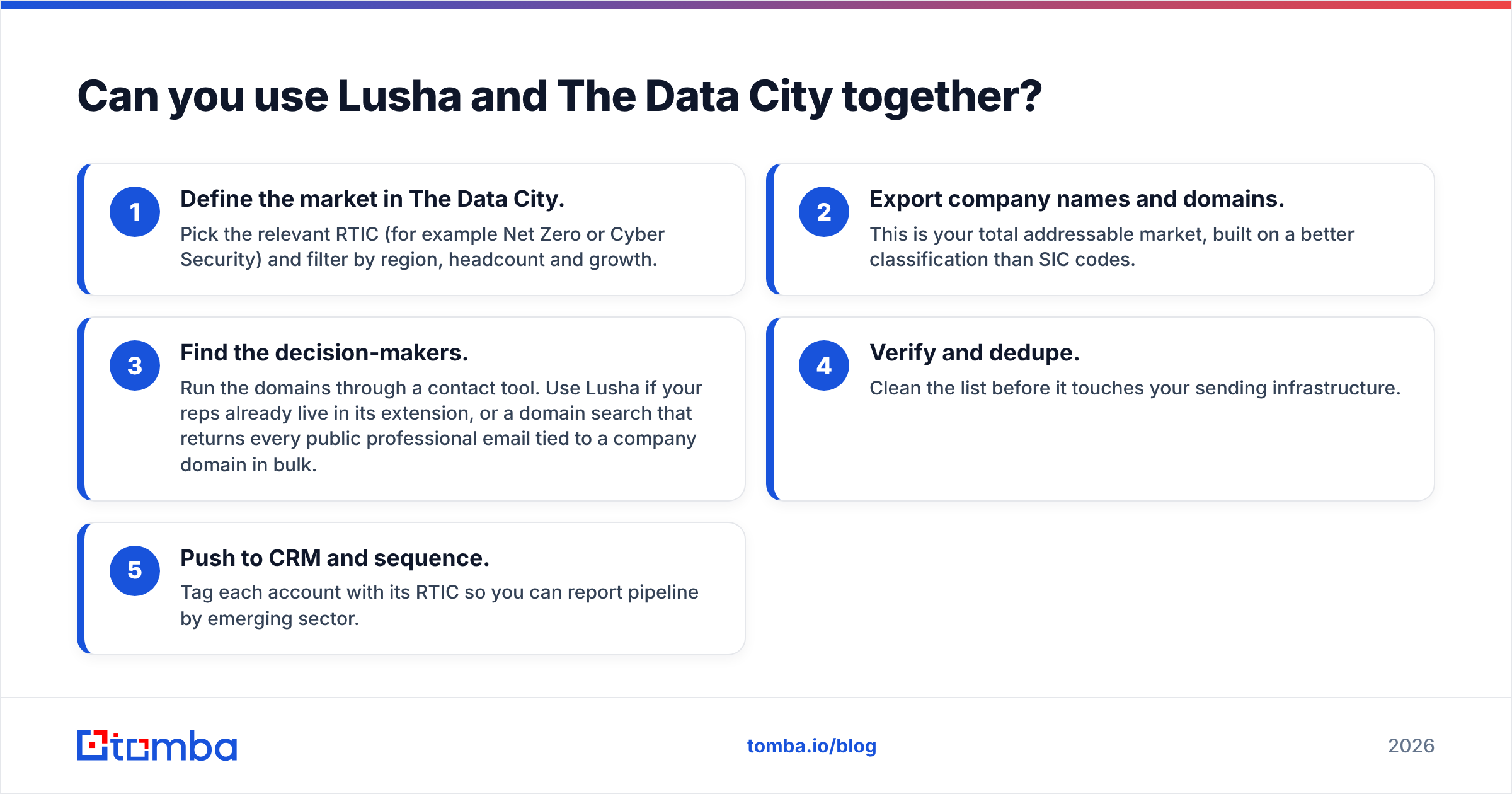
Yes. For UK-focused B2B companies selling into a specialist sector, this is often the best setup. A practical workflow:
- Define the market in The Data City. Pick the relevant RTIC (for example Net Zero or Cyber Security) and filter by region, headcount and growth.
- Export company names and domains. This is your total addressable market, built on a better classification than SIC codes.
- Find the decision-makers. Run the domains through a contact tool. Use Lusha if your reps already live in its extension, or a domain search that returns every public professional email tied to a company domain in bulk.
- Verify and dedupe. Clean the list before it touches your sending infrastructure.
- Push to CRM and sequence. Tag each account with its RTIC so you can report pipeline by emerging sector.
This combination gives you something neither tool provides on its own: a defensible answer to "why these accounts?" plus a reachable contact at each one.

What are the pros and cons of each tool?#
Lusha: pros
- Fast, well-liked Chrome extension for LinkedIn prospecting
- Emails and direct dials in one place
- Self-serve, with a free plan to test
- Solid CRM integrations for enrichment
Lusha: cons
- Phone reveals are expensive in credits
- Coverage thins out in niche markets and smaller companies
- Credit and rollover rules take some reading to understand
- No sector intelligence beyond standard industry filters
The Data City: pros
- 400+ emerging-sector RTICs that go well beyond SIC codes
- Real-time, machine-learning classification of 5M+ UK companies
- Strong for market sizing, cluster mapping and policy research
- Transparent methodology and published pricing
The Data City: cons
- UK-focused, so not a global prospecting database
- Not a contact-reveal tool for SDR workflows
- Licences are priced for institutions rather than solo reps
- Classification edges need human review before you treat counts as definitive
Which should you pick in 2026?#
Pick Lusha if your problem is reaching people. You already know your target accounts, or your ICP is broad and global, and your reps need emails and phone numbers inside LinkedIn and the CRM.
Pick The Data City if your problem is understanding a market. You need to size, map or monitor UK companies in an emerging sector, and you need the list to hold up in front of a board, a funder or a government department.
Pick both if you sell into a specialist UK sector. Use The Data City to decide which accounts matter and a contact tool to reach them.
One cost point applies to everyone: if all you need is the "reach people" half, you do not have to pay premium prices for phone-first credits. Many teams pair a sector or account source with an email-first finder and only buy direct dials for the top tier of accounts. Compare Tomba pricing against your current per-contact cost before you renew anything.
Where does Tomba fit in this stack?#
If The Data City, your CRM or a spreadsheet already gives you a list of UK companies, the next step is finding the right people at those domains. Tomba Email Finder does that step. Enter a name and company, or a full domain, and it returns professional email addresses with source and confidence data. Built-in verification keeps bounces down. There is a free tier with 25 searches a month, and paid plans start at $49/mo, so you can turn a sector list into a contactable pipeline without committing to a phone-credit contract. Paste your first ten domains in and see what comes back.
Related guides#
// get started
Find, verify and enrich your first contacts today
Start on the free plan with 25 searches a month, then scale when your team is ready.
Free plan · No credit card required · GDPR & CCPA
Get the Tomba newsletter
Product and data updates
// about the author