Machine Learning Sales Forecasting: A Practical 2026 Guide
Machine learning can make your sales forecast much more accurate, but only if your pipeline data is clean. This guide covers the models, the data you need, the tools, and a 90-day rollout plan.
TL;DR
- Machine learning sales forecasting predicts revenue from patterns in past deals, activity data, and pipeline movement, not from what reps say they expect to close.
- Gradient-boosted trees, run on deal-level data, are the practical default for most B2B teams. Use time-series models for top-line run-rate revenue, and save deep learning for very large datasets.
- Data quality limits accuracy more than model choice does. Missing close dates, stale stages, and bounced contacts quietly ruin a forecast.
- Most teams should start with the forecasting built into their CRM, check it against rep calls for one or two quarters, and only then decide whether a dedicated platform is worth paying for.
- If your contact and account data is clean and enriched, every model works better. That is the cheapest accuracy gain you can get.
What is machine learning sales forecasting?#
Machine learning sales forecasting means training a statistical model on your past sales data so it can estimate future revenue, the chance each deal closes, and when it will close. The model doesn't ask a rep how confident they feel. It looks at thousands of closed-won and closed-lost deals and learns which signals actually came before a signature.
Those signals are usually things a human can't weigh consistently across a whole pipeline:
- How long a deal has sat in its current stage compared with the historical median
- How many stakeholders are engaged, and how senior they are
- Whether email and meeting activity in the last 14 days is rising or falling
- Whether the close date has slipped, and how many times
- Deal size compared with the account's firmographic profile
- Seasonality, quarter-end timing, and product mix
The output is usually a probability for each deal (for example, "Acme expansion: 34% likely to close this quarter") plus a summed forecast with a confidence range. Ideally you also get an explanation of which factors moved each score up or down.
Underneath, this is a supervised learning problem. The label is "won or lost" (or "closed by date X"), and the features are everything you know about the deal at a given point in time. Gradient boosting, which Wikipedia describes as building an ensemble of weak decision trees one after another, does most of the work in production sales tools today.
How does ML forecasting compare to traditional methods?#
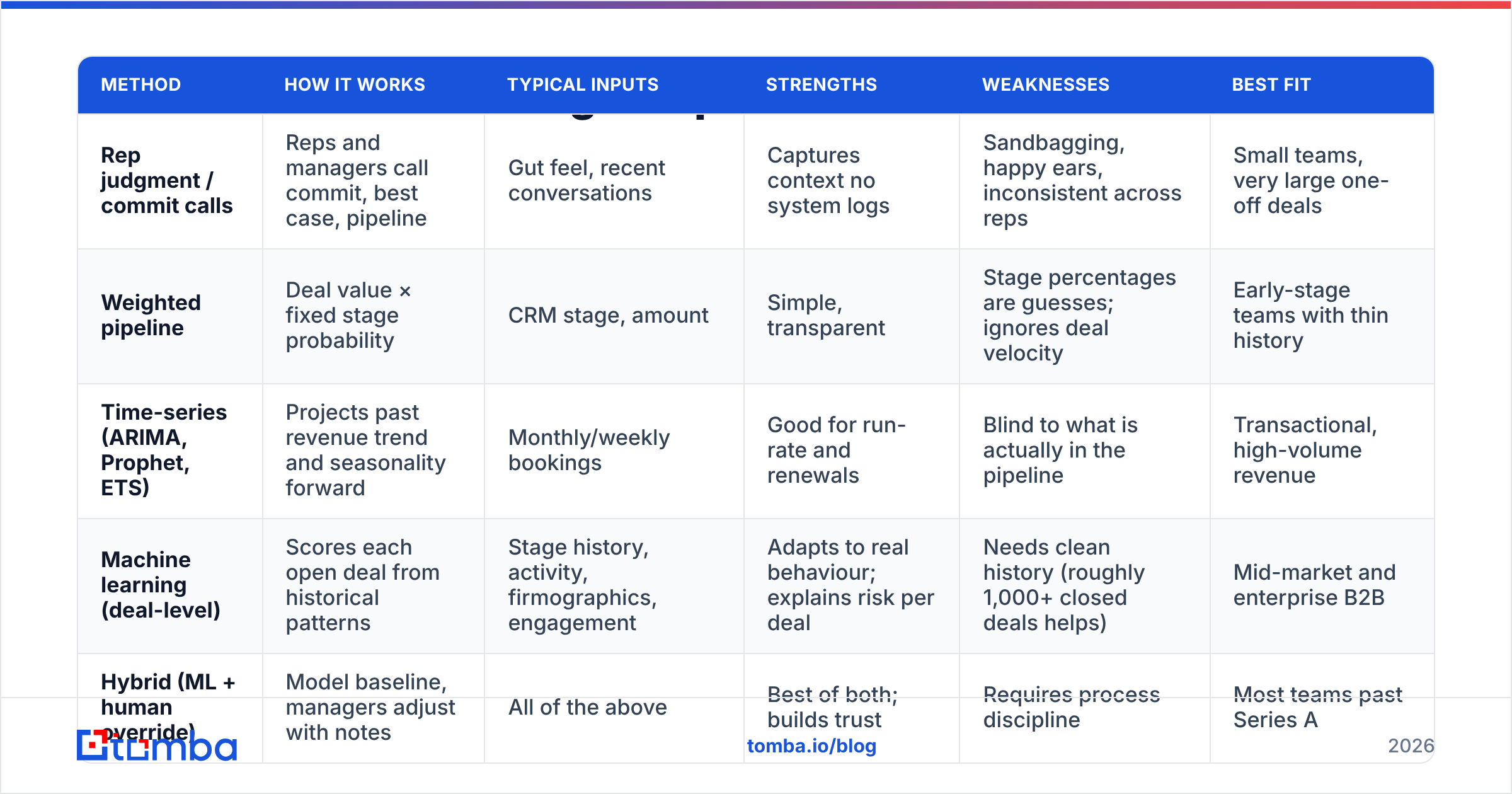
You probably already run some version of the first two rows below. Machine learning doesn't replace them overnight. It gives you an independent second opinion you can check them against.
| Method | How it works | Typical inputs | Strengths | Weaknesses | Best fit |
|---|---|---|---|---|---|
| Rep judgment / commit calls | Reps and managers call commit, best case, pipeline | Gut feel, recent conversations | Captures context no system logs | Sandbagging, happy ears, inconsistent across reps | Small teams, very large one-off deals |
| Weighted pipeline | Deal value × fixed stage probability | CRM stage, amount | Simple, transparent | Stage percentages are guesses; ignores deal velocity | Early-stage teams with thin history |
| Time-series (ARIMA, Prophet, ETS) | Projects past revenue trend and seasonality forward | Monthly/weekly bookings | Good for run-rate and renewals | Blind to what is actually in the pipeline | Transactional, high-volume revenue |
| Machine learning (deal-level) | Scores each open deal from historical patterns | Stage history, activity, firmographics, engagement | Adapts to real behaviour; explains risk per deal | Needs clean history (roughly 1,000+ closed deals helps) | Mid-market and enterprise B2B |
| Hybrid (ML + human override) | Model baseline, managers adjust with notes | All of the above | Best of both; builds trust | Requires process discipline | Most teams past Series A |
The comparison that matters is between the bottom two rows. In practice, the teams with the most reliable forecasts treat the model as the baseline and make managers justify any override in writing. That one habit removes a lot of the politics from forecast calls.
Which machine learning models actually work for sales forecasting?#
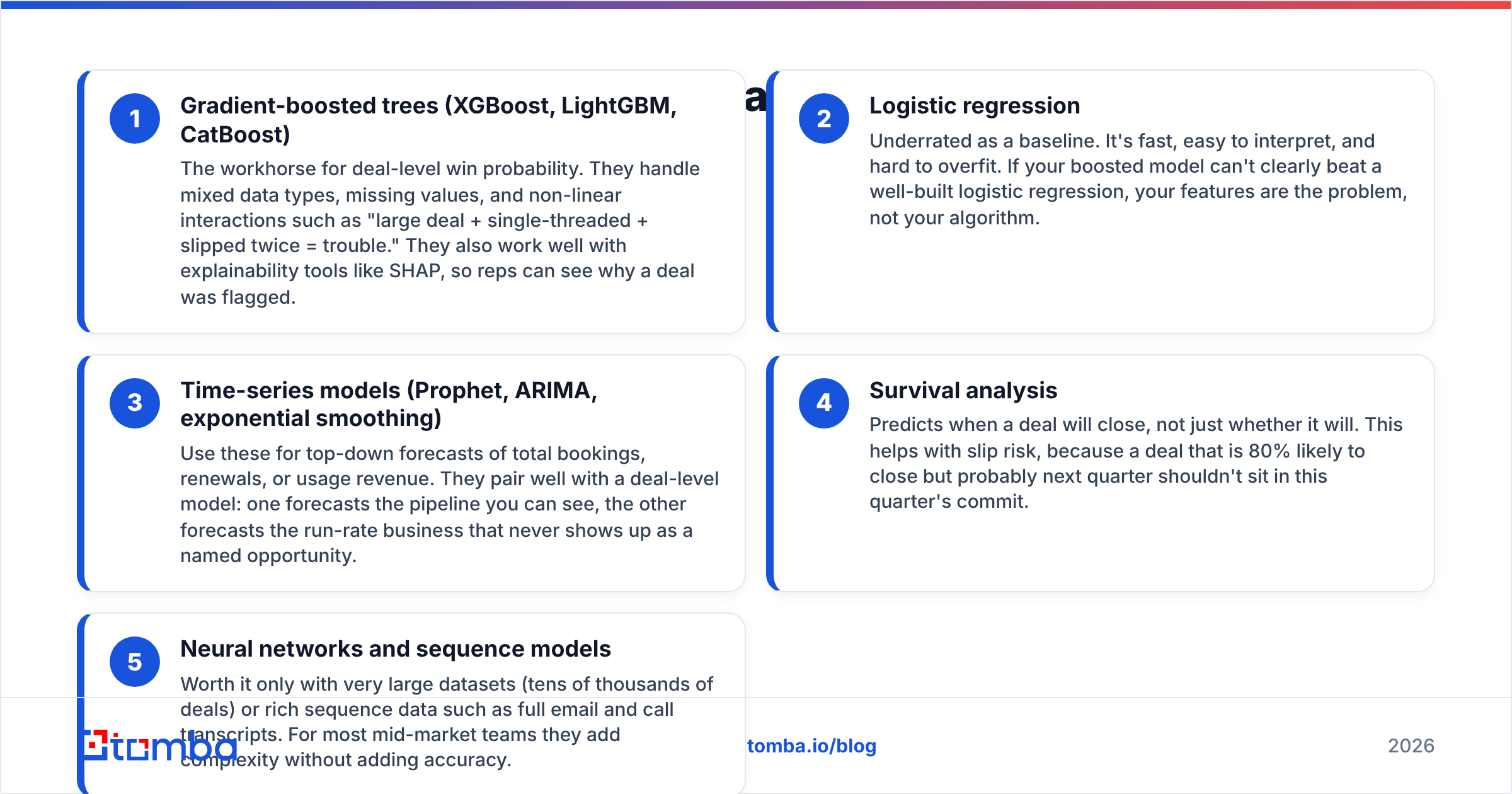
You don't need a research lab. Five model families cover almost every real-world B2B forecasting setup:
- Gradient-boosted trees (XGBoost, LightGBM, CatBoost) — The workhorse for deal-level win probability. They handle mixed data types, missing values, and non-linear interactions such as "large deal + single-threaded + slipped twice = trouble." They also work well with explainability tools like SHAP, so reps can see why a deal was flagged.
- Logistic regression — Underrated as a baseline. It's fast, easy to interpret, and hard to overfit. If your boosted model can't clearly beat a well-built logistic regression, your features are the problem, not your algorithm.
- Time-series models (Prophet, ARIMA, exponential smoothing) — Use these for top-down forecasts of total bookings, renewals, or usage revenue. They pair well with a deal-level model: one forecasts the pipeline you can see, the other forecasts the run-rate business that never shows up as a named opportunity.
- Survival analysis — Predicts when a deal will close, not just whether it will. This helps with slip risk, because a deal that is 80% likely to close but probably next quarter shouldn't sit in this quarter's commit.
- Neural networks and sequence models — Worth it only with very large datasets (tens of thousands of deals) or rich sequence data such as full email and call transcripts. For most mid-market teams they add complexity without adding accuracy.
A sensible stack for a team with a few thousand historical opportunities is a LightGBM win-probability model, a survival model for timing, and Prophet for the run-rate layer. Then reconcile the three every week.
What data do you need before ML forecasting works?#
This is where most projects quietly fail. The model can only learn from what your CRM recorded, and most CRMs record a cleaned-up version of what reps remembered to log.
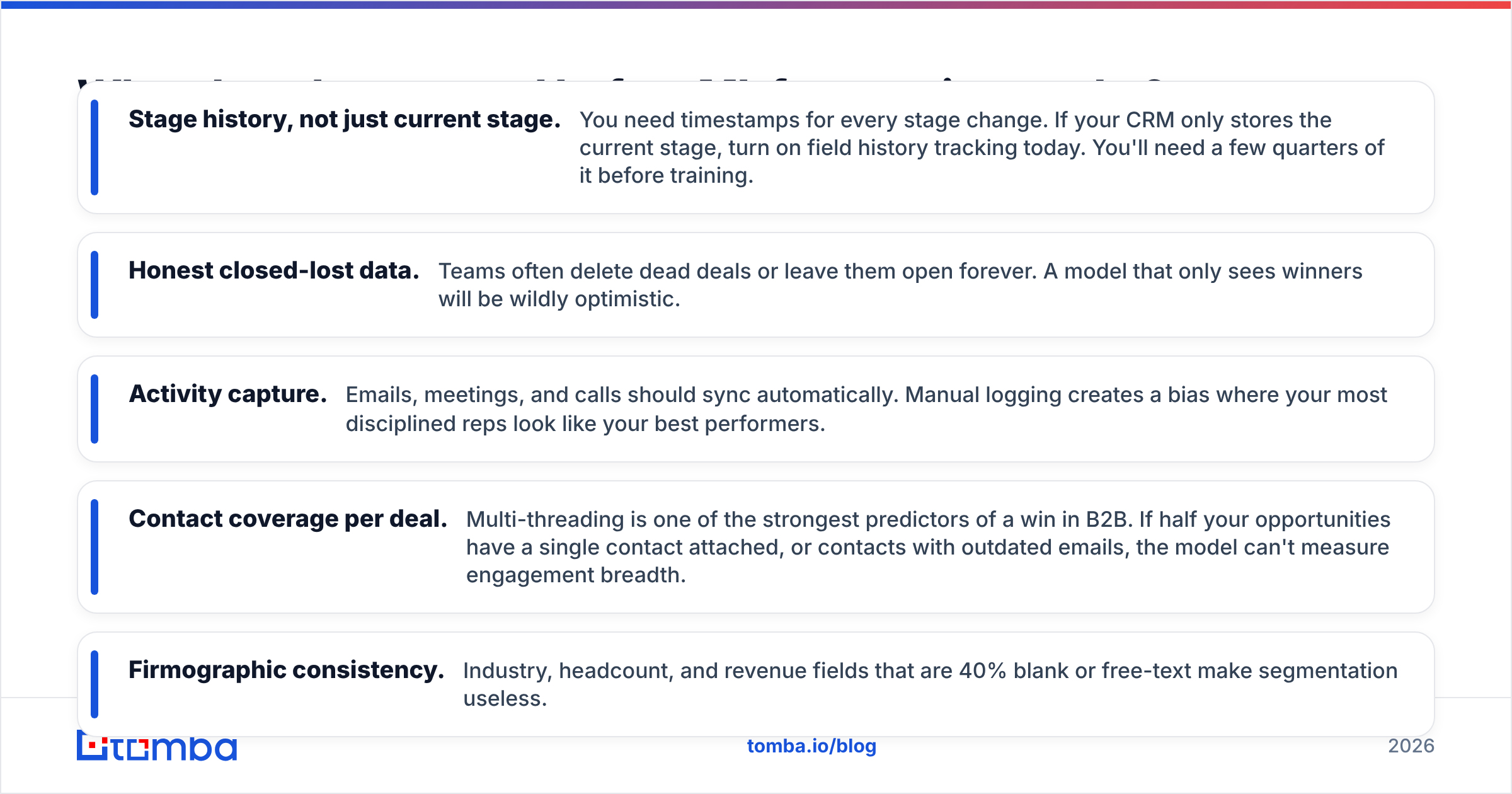
Before you spend money on a platform, audit these five areas:
- Stage history, not just current stage. You need timestamps for every stage change. If your CRM only stores the current stage, turn on field history tracking today. You'll need a few quarters of it before training.
- Honest closed-lost data. Teams often delete dead deals or leave them open forever. A model that only sees winners will be wildly optimistic.
- Activity capture. Emails, meetings, and calls should sync automatically. Manual logging creates a bias where your most disciplined reps look like your best performers.
- Contact coverage per deal. Multi-threading is one of the strongest predictors of a win in B2B. If half your opportunities have a single contact attached, or contacts with outdated emails, the model can't measure engagement breadth.
- Firmographic consistency. Industry, headcount, and revenue fields that are 40% blank or free-text make segmentation useless.
The last two points are where data enrichment pays for itself. Filling in missing titles, seniority, company size, and verified emails gives the model features it would otherwise have to guess at. Running your contact base through an email verifier also tells you whether "no reply in 30 days" means the buyer went cold or the email bounced. Those are very different signals, and they affect deal scores very differently.
A rough rule of thumb: if you have fewer than about 500 closed opportunities with reliable stage history, start with weighted pipeline plus a simple logistic regression. Once you're past 1,000 to 2,000, boosted models start to clearly earn their keep.
Which sales forecasting tools use machine learning?#
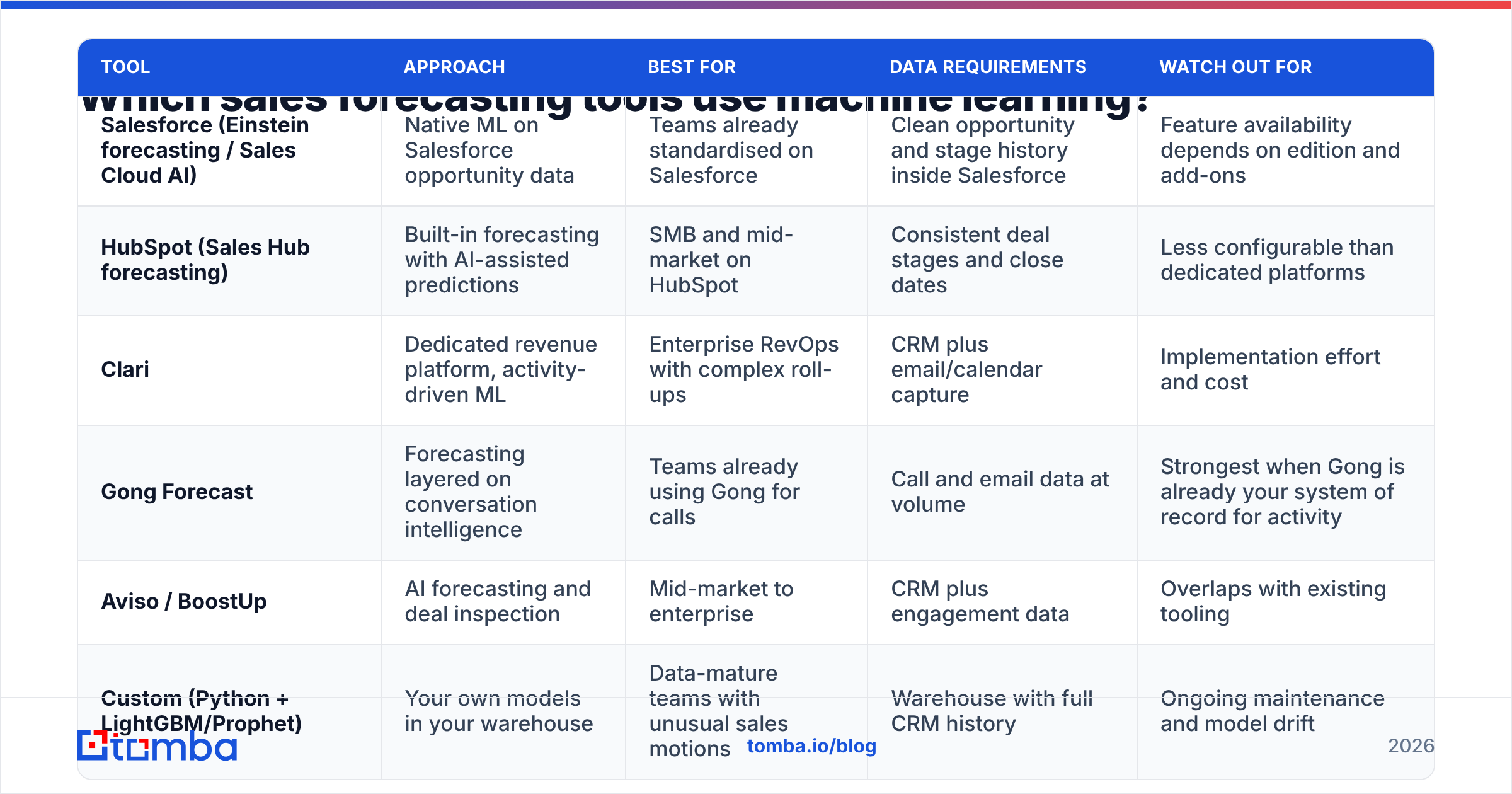
You can build your own model in Python, or you can buy one. Most teams should buy first, learn what matters, and build later only if they have to. Here's how the main options compare by approach. Check vendor sites for current pricing, because packaging changes often.
| Tool | Approach | Best for | Data requirements | Watch out for |
|---|---|---|---|---|
| Salesforce (Einstein forecasting / Sales Cloud AI) | Native ML on Salesforce opportunity data | Teams already standardised on Salesforce | Clean opportunity and stage history inside Salesforce | Feature availability depends on edition and add-ons |
| HubSpot (Sales Hub forecasting) | Built-in forecasting with AI-assisted predictions | SMB and mid-market on HubSpot | Consistent deal stages and close dates | Less configurable than dedicated platforms |
| Clari | Dedicated revenue platform, activity-driven ML | Enterprise RevOps with complex roll-ups | CRM plus email/calendar capture | Implementation effort and cost |
| Gong Forecast | Forecasting layered on conversation intelligence | Teams already using Gong for calls | Call and email data at volume | Strongest when Gong is already your system of record for activity |
| Aviso / BoostUp | AI forecasting and deal inspection | Mid-market to enterprise | CRM plus engagement data | Overlaps with existing tooling |
| Custom (Python + LightGBM/Prophet) | Your own models in your warehouse | Data-mature teams with unusual sales motions | Warehouse with full CRM history | Ongoing maintenance and model drift |
Gartner's sales research has argued for years that forecast accuracy is an organisational problem as much as a technical one, and the tool landscape reflects that. The platforms that succeed tend to win on workflow (inspection, roll-ups, override tracking) as much as on raw model quality.
If you're on Salesforce or HubSpot, turn on the native AI forecasting first and run it in shadow mode next to your current process for a quarter. That costs you almost nothing and tells you whether your data is good enough to justify a bigger platform.
How accurate is machine learning sales forecasting?#
The honest answer: it depends almost entirely on your data and your sales motion. Vendors publish impressive numbers, but those come from their best customers. Expect less at first.
What you can reasonably expect:
- Deal-level win prediction improves meaningfully on fixed stage percentages once you have enough history, mostly because the model catches stalled and single-threaded deals earlier than managers do.
- Quarter-level forecast error usually narrows after two to three quarters of tuning. Most of the gain comes from fixing data problems the model exposed, not from the model itself.
- Timing (slip) prediction is harder than win/loss prediction and is often where the biggest practical value sits.
Measure it properly. Track mean absolute percentage error (MAPE) for the quarter-level number. For deal-level scores, use calibration (do deals scored at 30% actually close about 30% of the time?) and the Brier score. Compare the model against your rep commits on the same snapshot dates. If you only compare against the final number, the comparison is meaningless.
One trap to avoid is data leakage. If your training features include fields that only get filled in after a deal closes, like "contract signed date" or a stage that is effectively "closed-won pending", your backtest accuracy will look incredible and your live accuracy will collapse. Always build features from point-in-time snapshots.
How do you roll out ML forecasting without losing the team's trust?#
Reps and managers will ignore a forecast they don't understand, and they'll actively undermine one that makes them look bad. Plan the rollout around adoption, not around the model.
Days 1–30: Fix the foundations. Turn on stage history tracking, require close-date reasons when dates move, clean up stale open deals, and enrich missing contact and account fields. Agree on definitions with your RevOps team: what counts as "commit", what counts as a slipped deal.
Days 31–60: Shadow mode. Run the model (native CRM or vendor trial) alongside your existing forecast without showing scores to reps. Snapshot both forecasts every Monday. At the end of the window, compare them on calibration and error.
Days 61–90: Show the why, not just the number. Release deal scores to managers first, with the top three factors behind each score. Use them in pipeline reviews as questions ("the model flags single-threading here; who else is involved?") rather than verdicts. Track override rate and override accuracy.
After 90 days you'll know three things: whether the model beats your reps, where your data is still weak, and whether a dedicated platform would add enough to justify its cost. Tie the outcome back to metrics leadership already watches, such as win rate and forecast error at week 4 of the quarter.
Is machine learning sales forecasting worth it for smaller teams?#
Sometimes. If you close fewer than about 100 deals a quarter and each one involves the founder or a senior AE, rep judgment plus a disciplined weighted pipeline is probably enough. The model won't have enough examples to learn from, and the cost of a dedicated platform won't pay back.
It becomes worth it when any of these is true:
- You have several managers rolling up forecasts and you're seeing inconsistent calls between teams
- Your quarter-end misses are coming from slipped deals rather than lost deals
- Your board or finance team needs a forecast with a confidence range, not a single number
- You have a high-velocity motion where no human can inspect every deal
Even for small teams, the groundwork is never wasted. Clean stage history, real closed-lost reasons, multi-threaded opportunities, and verified contact data all improve your current forecast before any model gets involved.
What should you do next?#
Start with the data, not the algorithm. Pull a report of open opportunities with fewer than two contacts attached, deals with a close date in the past, and contacts whose emails have never been verified. That report is your accuracy backlog, and fixing it improves whatever forecasting method you use today.
The cheapest way to strengthen deal-level signals is to make sure every opportunity is properly multi-threaded with reachable buyers. Tomba Email Finder lets you find verified professional emails by name, domain, or company, so you can add the missing economic buyer or technical evaluator to a deal before your model, or your manager, flags it as single-threaded. Start on the free plan with 25 searches a month, or move to Starter at $49/mo when you're ready to enrich the whole pipeline.
Related guides#
// start free
See who Tomba finds at any company
Type a company's domain to see its people, their roles and verified work emails, each with the pages it was found on. Free account, no card.
Free plan · No credit card required · GDPR & CCPA
// about the author