Madison Logic Alternatives: 9 ABM and Intent Platforms for 2026
Madison Logic bundles intent data, ABM ads, and content syndication into one contract. Here are 9 alternatives grouped by the job you actually need done, plus how to choose without overbuying.
TL;DR
- Madison Logic is an account-based marketing (ABM) platform. It combines intent data, multi-channel ABM ads, and content syndication. It's a good fit for enterprise demand-gen teams and usually too much for lean outbound teams.
- The best Madison Logic alternatives depend on which part you're replacing: 6sense and Demandbase for a full ABM suite, Bombora for raw intent data, Informa TechTarget Priority Engine and Integrate for content-driven demand, and RollWorks for mid-market ABM ads.
- Most teams switch over pricing or over missing contact-level data. Account intent tells you which company is in market. It doesn't tell you who to email.
- If you mainly need verified contact data to act on intent signals, pair a lighter intent source with an email finder like Tomba instead of signing a six-figure ABM contract.
- Every platform below except Tomba quotes custom pricing, so budget for a sales cycle and push for a pilot.
What is Madison Logic, and why do teams look for alternatives?#
Madison Logic is a B2B ABM platform for marketing teams that want to find accounts showing purchase intent and reach them across channels. Its product combines three things:
- Intent data. Account-level signals that show which companies are researching topics related to your solution.
- ABM advertising. Display, social, and connected TV campaigns aimed at those accounts.
- Content syndication. Distributing your gated assets through a publisher network and delivering leads that match your account list.
The bundle makes sense when one team owns pipeline from awareness to MQL. You can see the current product lineup on the Madison Logic website.
People who search for "Madison Logic alternatives" usually fall into one of four groups:
- Pricing pressure. Contracts are quote-based and usually annual, often with lead-volume commitments. That's hard to justify for teams under roughly 50 sellers.
- Intent without contacts. Account-level intent tells you Acme Corp is researching "data warehouse migration". It doesn't tell you which of Acme's 4,000 employees to email.
- Lead quality concerns. Syndicated leads differ in how much the person actually engaged with the content. Some teams want first-party engagement data instead.
- Overlap with existing tools. If you already pay for a CRM with intent add-ons or a sales intelligence suite, part of Madison Logic's value is duplicated.
Knowing which of these applies to you narrows the shortlist quickly.
Which category of Madison Logic alternative do you actually need?#
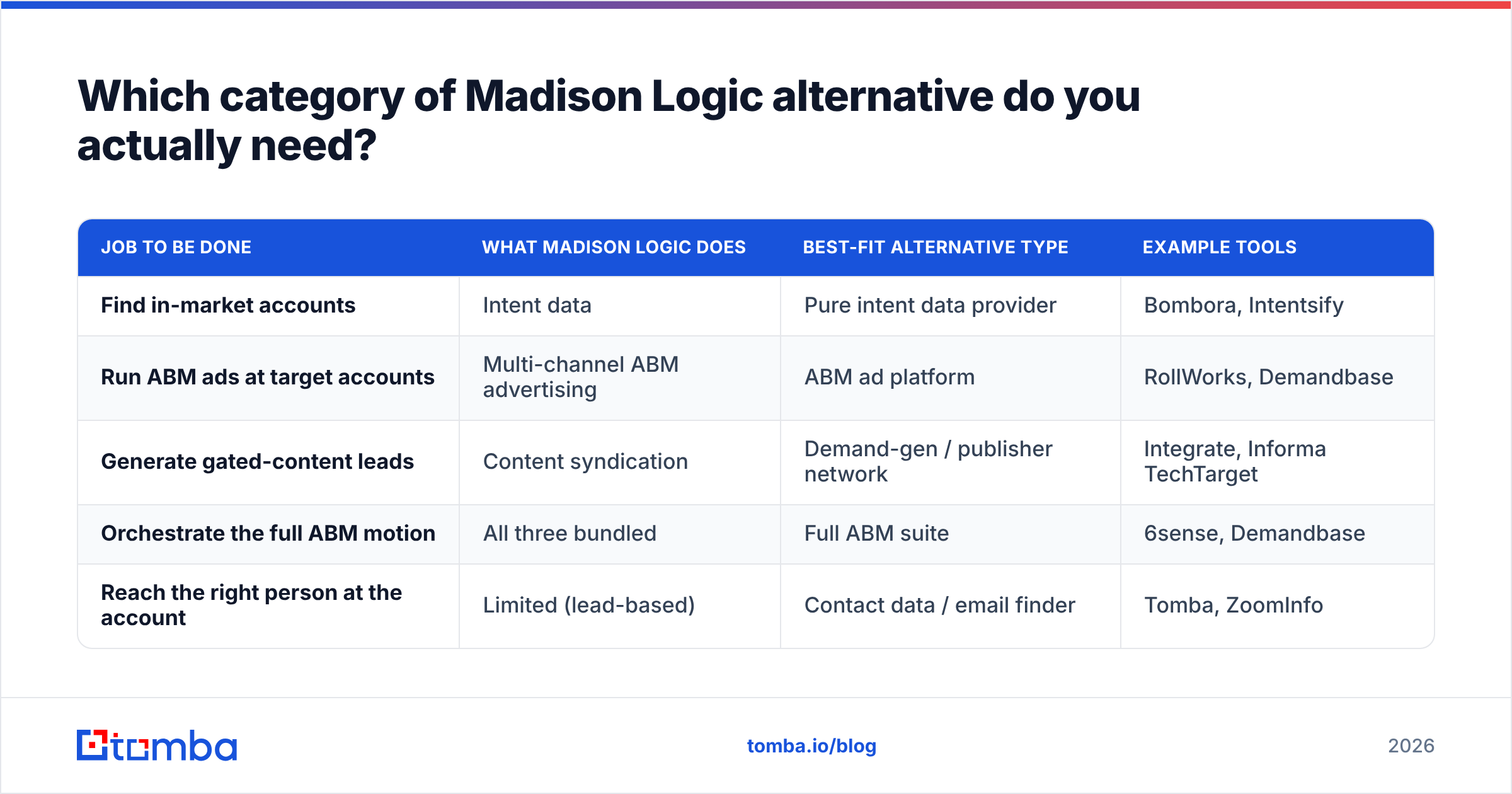
Before comparing vendors, decide which job you're hiring the tool for. Madison Logic does several jobs, and most alternatives do one or two of them well.
| Job to be done | What Madison Logic does | Best-fit alternative type | Example tools |
|---|---|---|---|
| Find in-market accounts | Intent data | Pure intent data provider | Bombora, Intentsify |
| Run ABM ads at target accounts | Multi-channel ABM advertising | ABM ad platform | RollWorks, Demandbase |
| Generate gated-content leads | Content syndication | Demand-gen / publisher network | Integrate, Informa TechTarget |
| Orchestrate the full ABM motion | All three bundled | Full ABM suite | 6sense, Demandbase |
| Reach the right person at the account | Limited (lead-based) | Contact data / email finder | Tomba, ZoomInfo |
The last row is the one most teams overlook. Intent and ads warm up an account, but a seller still needs a verified email address to start the conversation. That's a different tool category, and it costs much less.
What are the 9 best Madison Logic alternatives in 2026?#
Each tool below is grouped by its strongest use case. None of them is a drop-in clone of Madison Logic, so read the "best for" line carefully.
1. 6sense — best full ABM suite replacement#
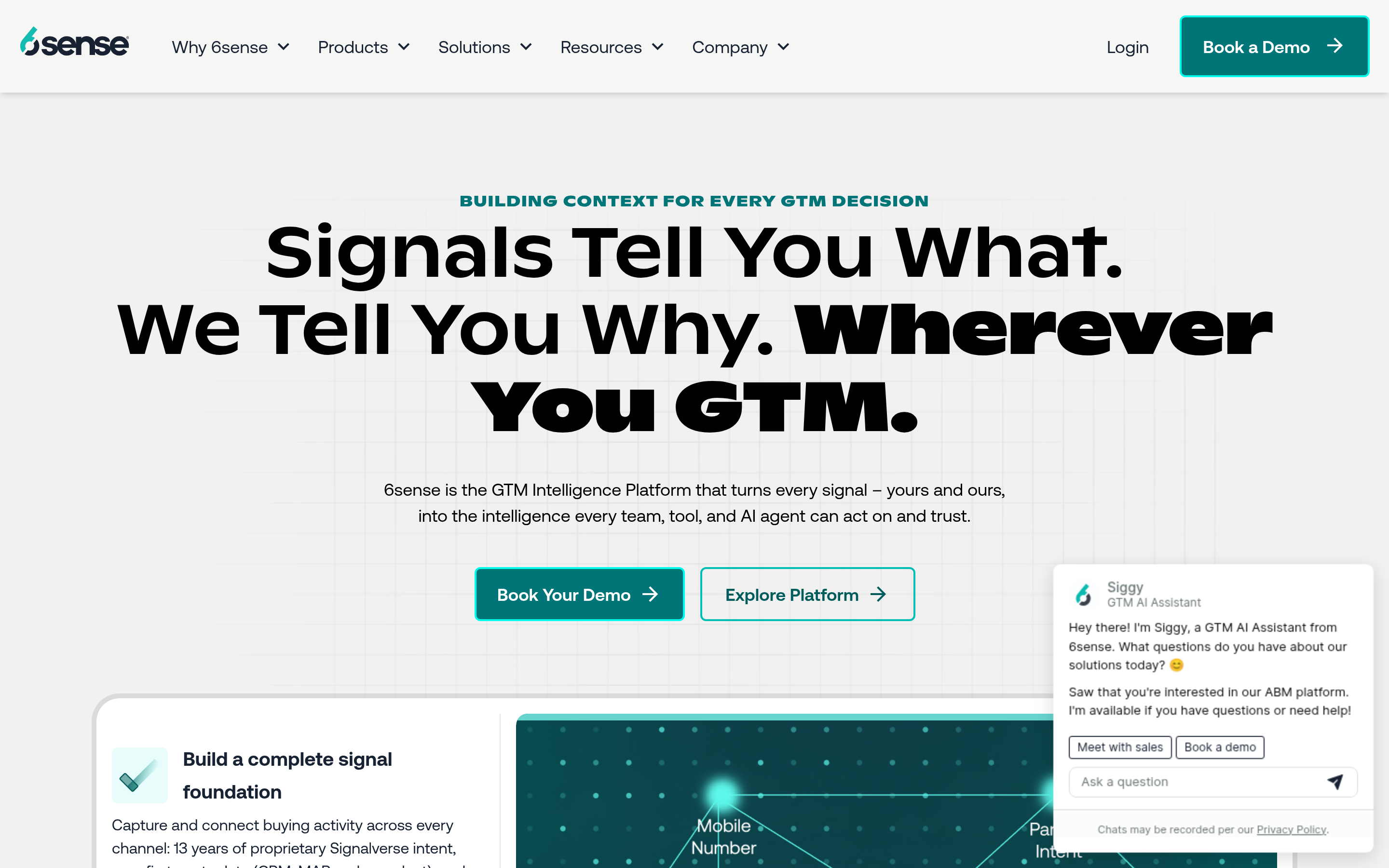
6sense is the platform most often compared head-to-head with Madison Logic. Its Revenue AI platform combines account identification, predictive intent ("buying stage" modeling), ABM advertising, and sales-facing account insights. The biggest difference is orientation: 6sense is built to hand prioritized accounts to SDRs and AEs, while Madison Logic leans toward marketing programs and lead delivery.
- Strengths: predictive buying-stage models, strong sales-team adoption, deep CRM integration, a free tier for basic contact credits.
- Watch-outs: enterprise pricing and a long implementation. Accuracy depends on clean CRM data.
- Best for: companies with dedicated RevOps that want one system of record for account prioritization.
If you're already evaluating 6sense and want lighter options, see our 6sense alternative breakdown.
2. Demandbase — best for ABM advertising plus account intelligence#
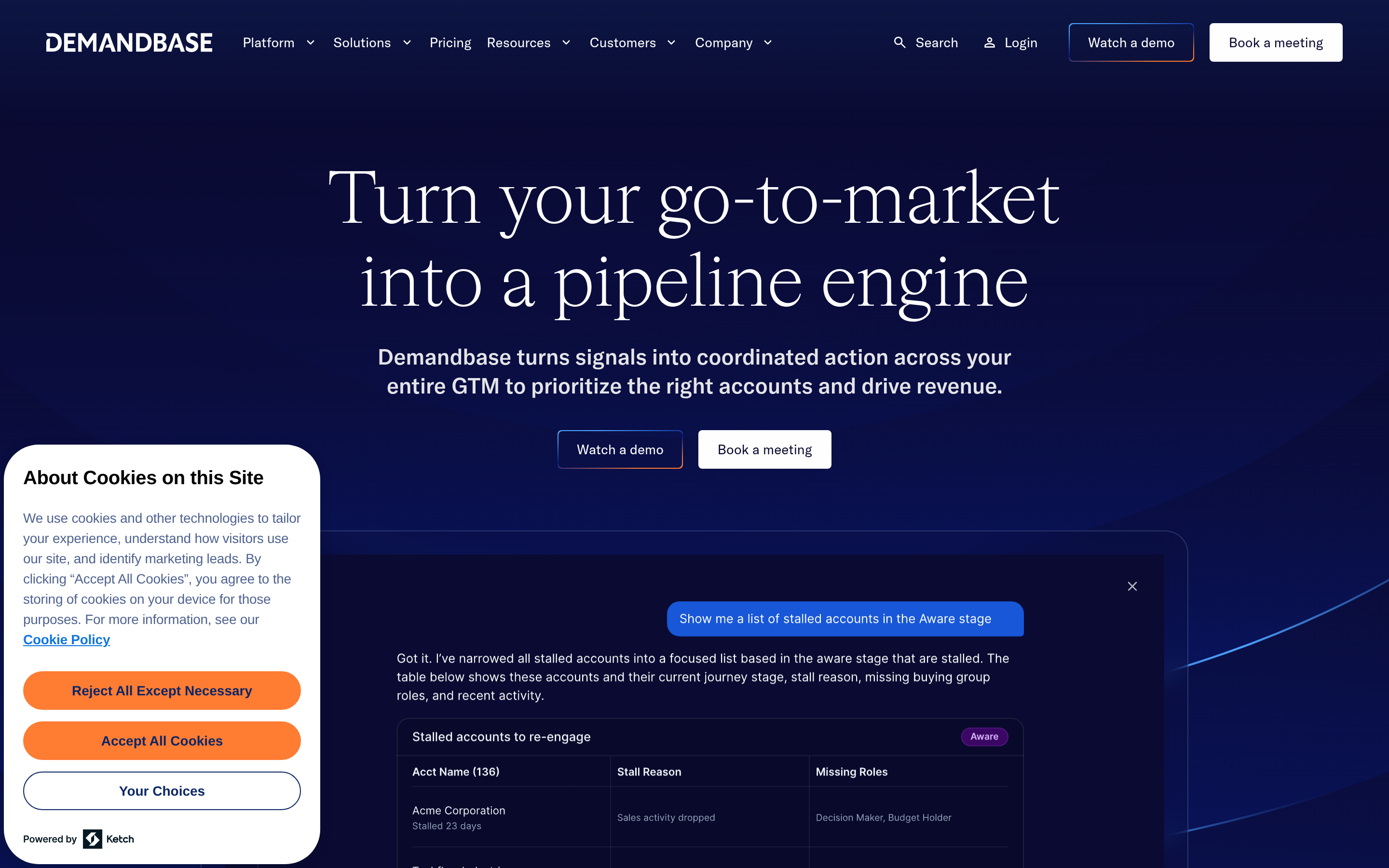
Demandbase One covers advertising, intent, account identification, and sales intelligence. It has a long ABM track record and its own B2B DSP, which gives it more control over ad targeting than tools that resell inventory.
- Strengths: a mature ad platform, solid account-level reporting, and a broad data layer since its acquisitions in the sales intelligence space.
- Watch-outs: a complex UI and premium pricing. Adoption outside marketing takes effort.
- Best for: marketing-led ABM teams running large paid budgets.
Compare lighter options in our Demandbase alternative guide.
3. Bombora — best raw intent data source#
Bombora runs the Company Surge data co-op, a network of B2B publishers sharing anonymized content-consumption data. Many ABM platforms license or partner with Bombora rather than building their own intent data, so buying direct often gets you the same signal without the bundled media.
- Strengths: a large co-op data footprint, thousands of intent topics, and integrations into most CRMs and ad platforms.
- Watch-outs: account-level data only. You still need tools to act on it (ads, sequences, contact data).
- Best for: teams that already have ad and outbound tooling and only want the intent layer.
4. Informa TechTarget Priority Engine — best for tech-buyer intent with named contacts#
TechTarget's Priority Engine is built on first-party engagement across its own network of technology publications. TechTarget combined with Informa Tech in 2024. The key difference from co-op intent is that Priority Engine can surface prospect-level activity, meaning specific people researching relevant topics, not just accounts.
- Strengths: first-party, prospect-level signals and strong coverage of IT and technology buyers.
- Watch-outs: coverage is strongest in tech, and thinner if you sell to manufacturing, healthcare, or other verticals.
- Best for: B2B tech vendors selling to IT, security, data, and infrastructure buyers.
5. Integrate — best for content syndication governance#
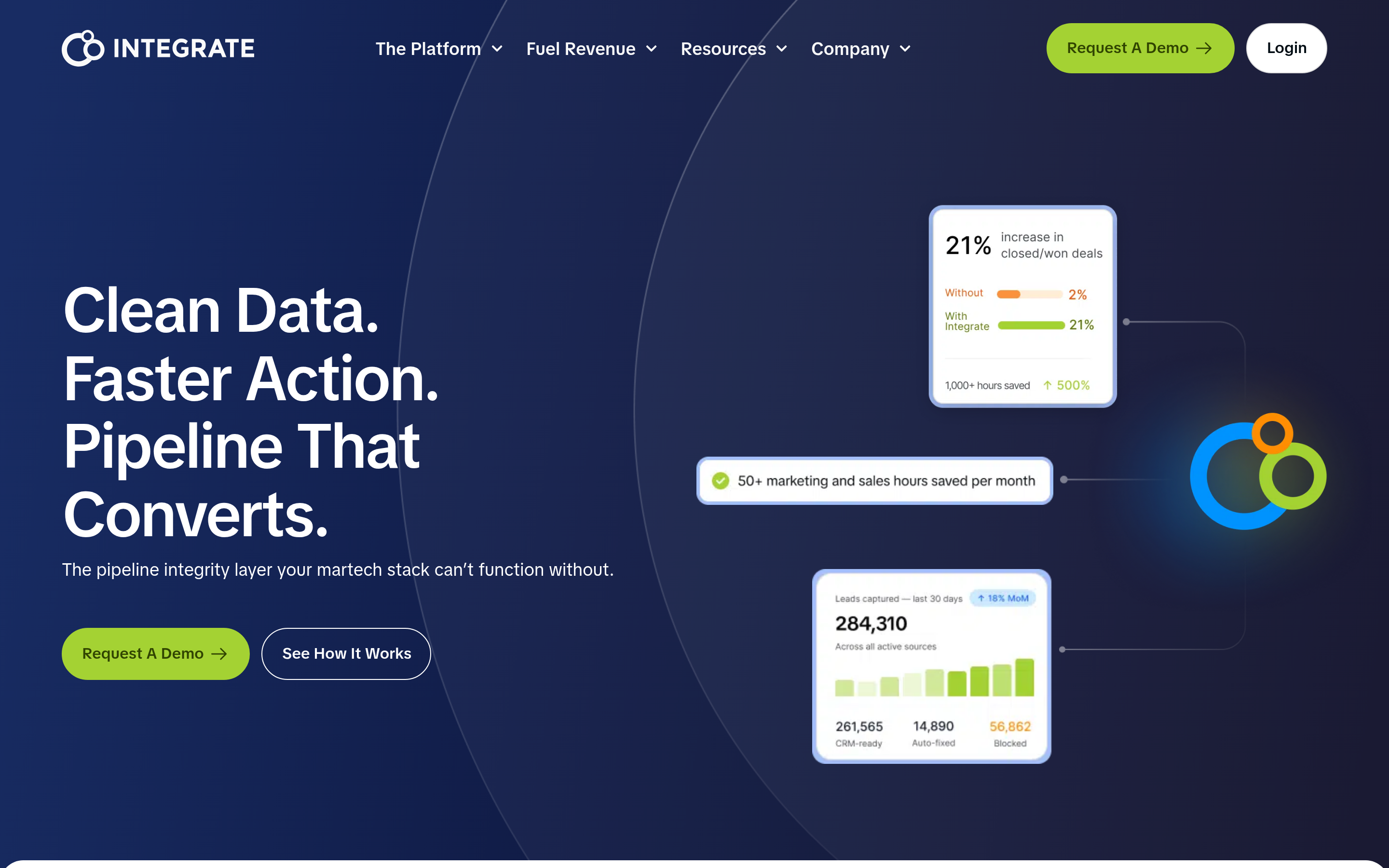
If the part of Madison Logic you actually use is content syndication, Integrate is the closest specialist. It doesn't run its own publisher network. Instead, it sits between you and multiple lead vendors to validate, de-duplicate, and route leads before they reach your CRM.
- Strengths: lead validation, multi-vendor management, and compliance controls.
- Watch-outs: you still pay publishers separately, so it's a governance layer, not a lead source.
- Best for: demand-gen teams buying leads from three or more syndication vendors.
6. Intentsify — best for multi-source intent#
Intentsify combines several intent sources (co-op, bidstream, and its own) and adds activation services such as content syndication and display. It positions itself as a more transparent, analyst-supported intent provider.
- Strengths: layered intent sources, service-heavy onboarding, and topic-level research reports.
- Watch-outs: smaller ecosystem than 6sense or Demandbase, and pricing is quote-based.
- Best for: mid-market and enterprise teams that want intent plus hands-on help to use it.
7. RollWorks — best mid-market ABM ads platform#
RollWorks, from NextRoll, is the most approachable ABM platform for teams that aren't ready for a six-figure suite. It covers account identification, ABM display and social ads, and basic intent, with a self-serve feel.
- Strengths: faster setup, an easier UI, and a strong HubSpot and Salesforce connection.
- Watch-outs: lighter intent data and less sophisticated orchestration than the enterprise suites.
- Best for: marketing teams of 2 to 10 people running their first ABM program.
8. ZoomInfo — best for contact data plus intent in one contract#

ZoomInfo started as a contact database and has added intent signals (Streaming Intent), website visitor identification, and engagement tools. It's not an ABM ad platform, but it fills the "who to contact" gap that Madison Logic leaves open.
- Strengths: a large contact and company database, intent add-ons, and broad integrations.
- Watch-outs: annual contracts, auto-renewal terms, and per-seat costs that climb quickly.
- Best for: sales-led organizations that care more about direct outreach than ads.
9. Tomba — best low-cost contact layer to pair with any intent source#
Tomba isn't an ABM platform and doesn't try to be. It's an email finder and enrichment tool. It belongs on this list because the most common reason teams outgrow Madison Logic is that they need contacts at intent-surging accounts, not more account-level signal.
The workflow is simple. Export surging accounts from Bombora, 6sense Free, or your CRM's intent feed. Run the domains through domain search to see who works there. Then use the Tomba Email Finder to get verified addresses for the specific personas you sell to.
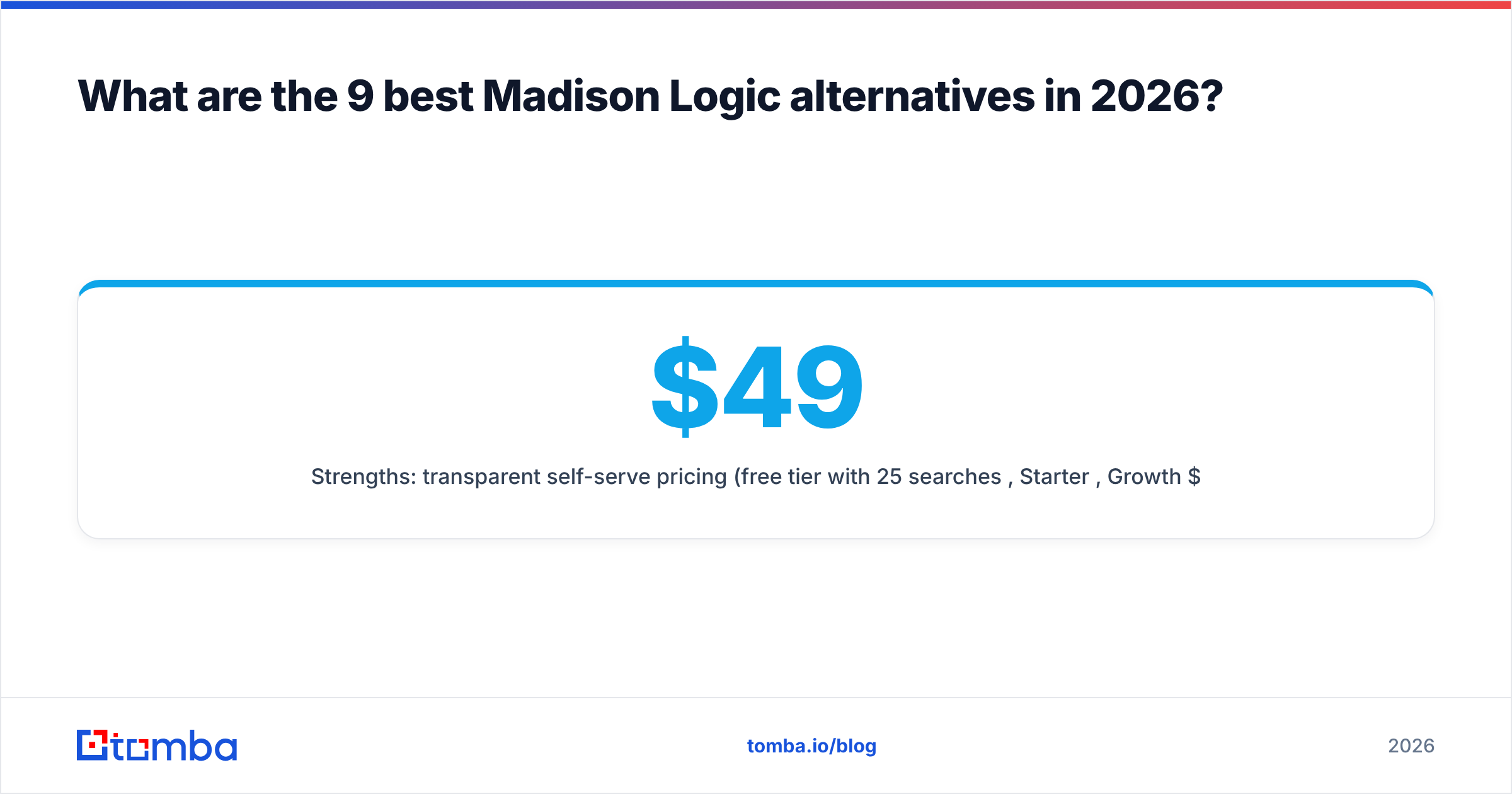
- Strengths: transparent self-serve pricing (free tier with 25 searches/month, Starter $49/mo, Growth $99/mo, Pro $249/mo), built-in verification, plus API, Sheets, and CRM integrations.
- Watch-outs: no intent data, ad platform, or syndication. You pair it with those tools rather than replacing them.
- Best for: outbound teams that want to act on intent signals without a heavy ABM contract.
How do Madison Logic alternatives compare on pricing and features?#
ABM vendors rarely publish prices. The table below reflects publicly stated packaging and common buyer-reported deal structures. Always get a written quote.
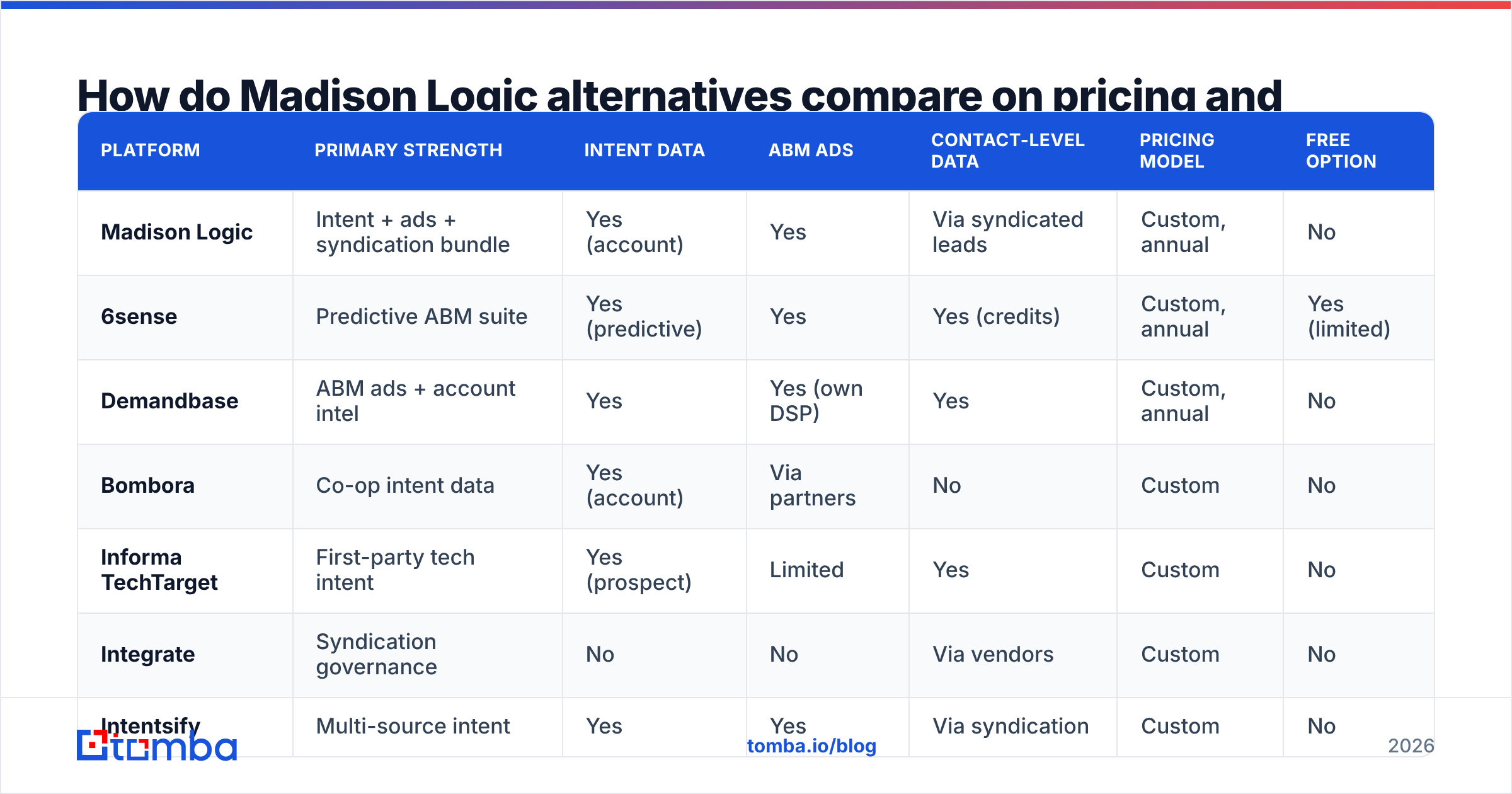
| Platform | Primary strength | Intent data | ABM ads | Contact-level data | Pricing model | Free option |
|---|---|---|---|---|---|---|
| Madison Logic | Intent + ads + syndication bundle | Yes (account) | Yes | Via syndicated leads | Custom, annual | No |
| 6sense | Predictive ABM suite | Yes (predictive) | Yes | Yes (credits) | Custom, annual | Yes (limited) |
| Demandbase | ABM ads + account intel | Yes | Yes (own DSP) | Yes | Custom, annual | No |
| Bombora | Co-op intent data | Yes (account) | Via partners | No | Custom | No |
| Informa TechTarget | First-party tech intent | Yes (prospect) | Limited | Yes | Custom | No |
| Integrate | Syndication governance | No | No | Via vendors | Custom | No |
| Intentsify | Multi-source intent | Yes | Yes | Via syndication | Custom | No |
| RollWorks | Mid-market ABM ads | Basic | Yes | No | Tiered / quote | No |
| ZoomInfo | Contact database + intent | Yes (add-on) | No | Yes | Custom, annual | No |
| Tomba | Email finding + verification | No | No | Yes | $49–$249/mo, Enterprise custom | Yes (25/mo) |
Two patterns stand out. First, only a few tools combine account intent and verified contact data, and the ones that do are priced for enterprise. Second, the gap between "custom, annual" and "$49/month self-serve" is where most mid-market teams find savings.
Is Madison Logic better than 6sense or Demandbase?#
Neither is better overall. Each is better for a particular motion.
Choose Madison Logic if your primary KPI is marketing-sourced leads and you value content syndication bundled with intent-driven ads. Lead delivery is built in, which suits demand-gen teams measured on MQL volume. (If your org still argues about what counts as a marketing qualified lead, settle that before you buy any of these.)
Choose 6sense if sales adoption matters most. Its buying-stage predictions and account prioritization are designed to change what SDRs do each morning.
Choose Demandbase if paid ABM advertising is the center of your program and you want tight control over targeting and attribution.
Independent reviews help here. The G2 account-based marketing category shows user ratings broken down by company size. Filter to your segment, because enterprise praise often doesn't carry over to a 30-person team.
What hidden costs should you watch for when switching?#
Sticker price is only part of the cost. Teams moving off Madison Logic, or onto any of these platforms, regularly hit these costs:
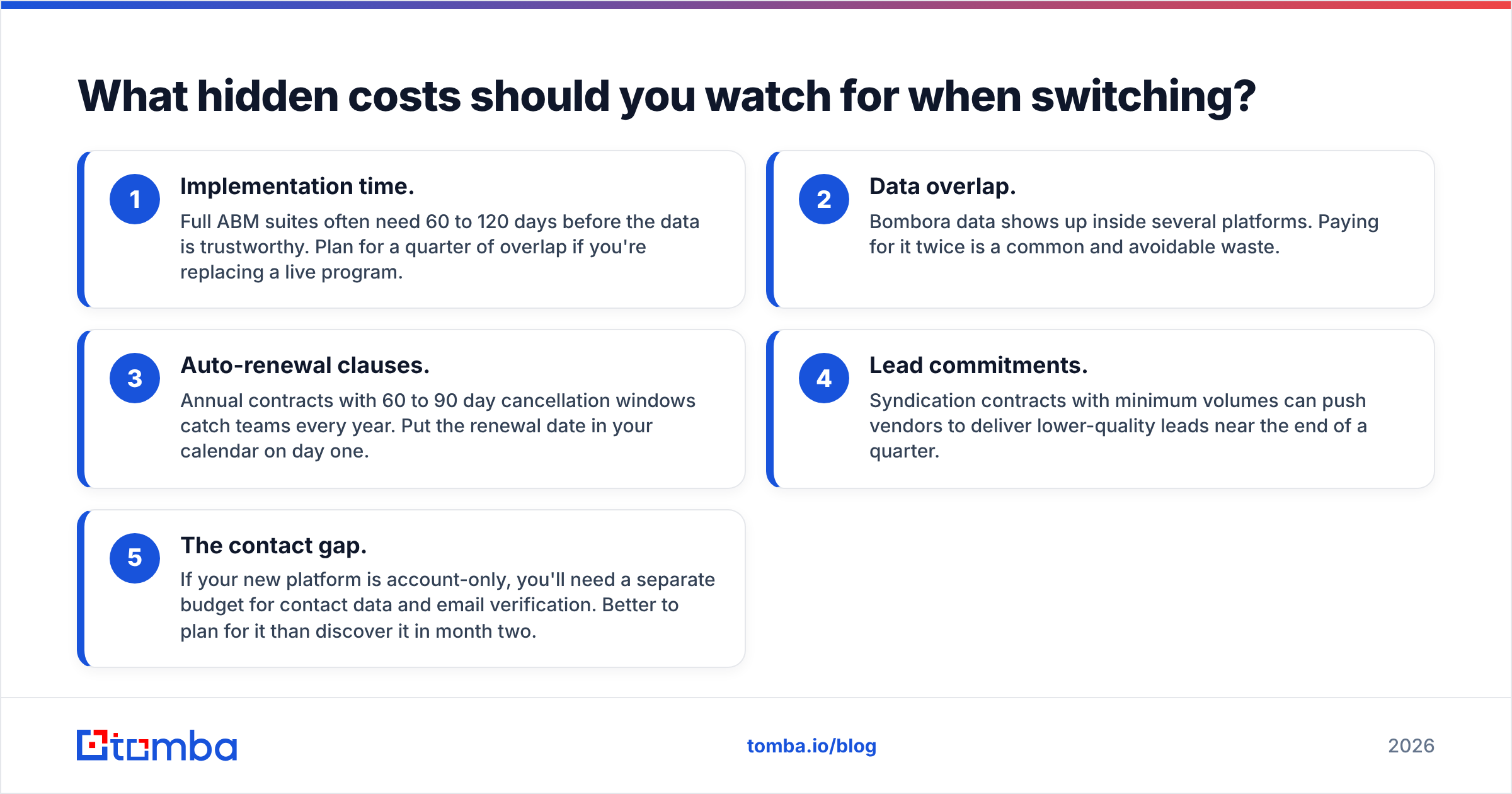
- Implementation time. Full ABM suites often need 60 to 120 days before the data is trustworthy. Plan for a quarter of overlap if you're replacing a live program.
- Data overlap. Bombora data shows up inside several platforms. Paying for it twice is a common and avoidable waste.
- Auto-renewal clauses. Annual contracts with 60 to 90 day cancellation windows catch teams every year. Put the renewal date in your calendar on day one.
- Lead commitments. Syndication contracts with minimum volumes can push vendors to deliver lower-quality leads near the end of a quarter.
- The contact gap. If your new platform is account-only, you'll need a separate budget for contact data and email verification. Better to plan for it than discover it in month two.

How do you build a lean Madison Logic alternative stack?#
If an all-in-one ABM suite is overkill, you can assemble most of the value from modular parts. The common lean stack looks like this:
- Intent signal. Bombora direct, 6sense's free tier, or the intent feed included in HubSpot or Salesforce add-ons. Start with 5 to 10 high-relevance topics, not 200.
- Account identification. Website visitor identification to see which target accounts are already on your site.
- Contact layer. An email finder to turn surging accounts into named people with verified addresses. Use data enrichment to add title, seniority, and LinkedIn URL so reps can personalize.
- Activation. Your existing sequencer for email and LinkedIn, and LinkedIn Matched Audiences for ads if you need paid reach.
- Measurement. Track meetings booked and pipeline created per surging account, not just leads delivered.
This setup usually costs a fraction of a bundled ABM contract. You can also swap any single part without renegotiating everything. The trade-off is integration work. Someone has to own the flow from intent signal to verified contact to sequence, and that person is usually in RevOps.
Which Madison Logic alternative should you choose?#
Use this as a quick decision path:
- Replacing the whole ABM program and have RevOps support: 6sense or Demandbase.
- Only need the intent signal: Bombora or Intentsify.
- Sell to IT buyers and want named prospects: Informa TechTarget Priority Engine.
- Content syndication is the main motion: Integrate, plus your publishers of choice.
- First ABM program on a mid-market budget: RollWorks.
- Sales-led and want one big contact-plus-intent contract: ZoomInfo.
- Already have intent data and need people to email: Tomba.
Whichever direction you take, ask every vendor for a pilot on your own target account list. Ask them to show match rates against your CRM, not their demo data. That single request filters out more weak fits than any feature checklist.
Ready to act on intent signals without the enterprise price tag?#
Intent data only produces pipeline when a rep can reach the right person at the right account. If you already know which companies are in market and need the contacts behind them, the Tomba Email Finder finds and verifies professional email addresses by domain, name, or company. It plugs into the CRM and sequencer you already use. Start on the free plan with 25 searches a month, or compare Tomba pricing to scale from $49/month with no annual lock-in.
Related guides#
// start free
See who Tomba finds at any company
Type a company's domain to see its people, their roles and verified work emails, each with the pages it was found on. Free account, no card.
Free plan · No credit card required · GDPR & CCPA
// about the author