Madison Logic Pricing Reviews Pros and Cons: 2026 Buyer's Guide
Madison Logic doesn't publish prices, and its reviews are mixed. Here is what the ABM platform is likely to cost in 2026, what G2 reviewers praise and complain about, and when a cheaper stack makes more sense.
This guide puts Madison Logic pricing reviews pros and cons in one place. You'll see what it costs, what users say, and who should skip it.
TL;DR
- Madison Logic has no public pricing. Third-party estimates start at about $3,000/month plus media spend. Programs big enough to show results often run $40K–$80K+ per year.
- Reviews are mostly positive. The platform holds roughly 4.3/5 on G2 from 260+ reviews. People praise lead volume, global reach, and support. They complain about a steep learning curve and leads that sit high in the funnel.
- It fits mid-market and enterprise demand-gen teams that run content syndication and ABM display across many regions. It's overkill if you mainly need contact data for outbound.
- The hidden cost is follow-up. Syndicated leads and intent-scored accounts only turn into pipeline once your reps reach the right people. That usually means paying for contact data and verification too.
- If outbound is where your pipeline comes from, an email finder plus enrichment costs a fraction of an ABM contract. You can always add ABM later.
What is Madison Logic?#
Madison Logic is an account-based marketing (ABM) platform based in New York. It's been around since the mid-2000s and started as a B2B content syndication network. Today it sells a bundle it calls the ML Platform. The idea is simple. Find accounts that show buying intent. Reach them with ads and gated content. Then pass the engaged contacts to sales.
If the idea is new to you, the Wikipedia overview of account-based marketing covers the basics. In short, you pick target accounts first. Then you run campaigns at that list instead of casting a wide net.
Here's an analogy. A traditional lead-gen vendor is a fishing trawler: you pay per fish, whatever gets caught. Madison Logic sells itself as a spear fisher with sonar. It finds the schools you care about (intent data), lures them in (ads and content), and hands you the ones that bite (syndicated leads). Whether the sonar is accurate is the question most reviews end up debating.
What does the Madison Logic platform actually include?#
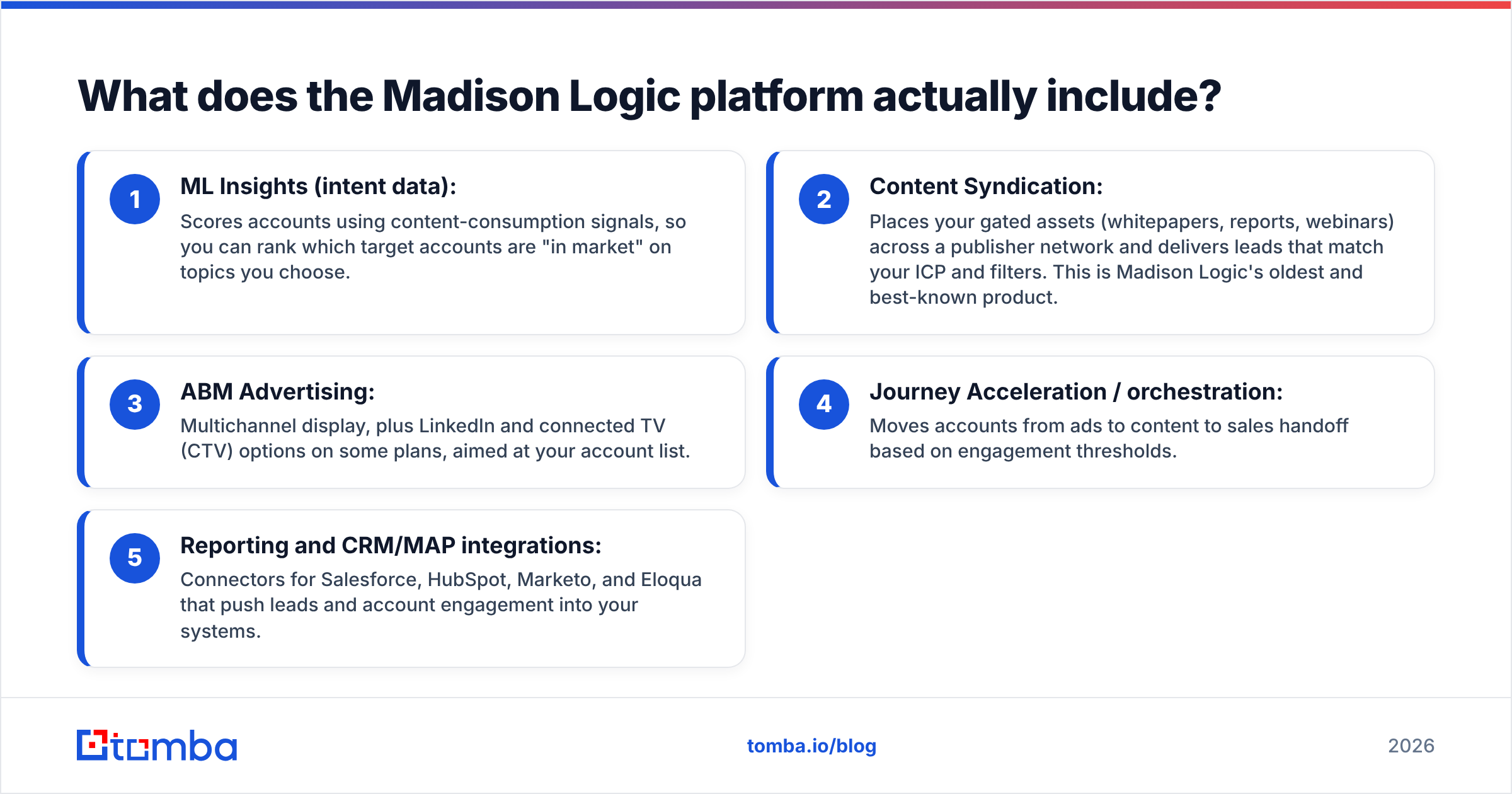
The modules change names over time, but the platform breaks down into five parts. These are the line items your quote will be built from:
- ML Insights (intent data): Scores accounts using content-consumption signals, so you can rank which target accounts are "in market" on topics you choose.
- Content Syndication: Places your gated assets (whitepapers, reports, webinars) across a publisher network and delivers leads that match your ICP and filters. This is Madison Logic's oldest and best-known product.
- ABM Advertising: Multichannel display, plus LinkedIn and connected TV (CTV) options on some plans, aimed at your account list.
- Journey Acceleration / orchestration: Moves accounts from ads to content to sales handoff based on engagement thresholds.
- Reporting and CRM/MAP integrations: Connectors for Salesforce, HubSpot, Marketo, and Eloqua that push leads and account engagement into your systems.
You don't have to buy everything. Many customers start with content syndication alone and add advertising later. That choice drives most of the variation in pricing.
How much does Madison Logic cost in 2026?#
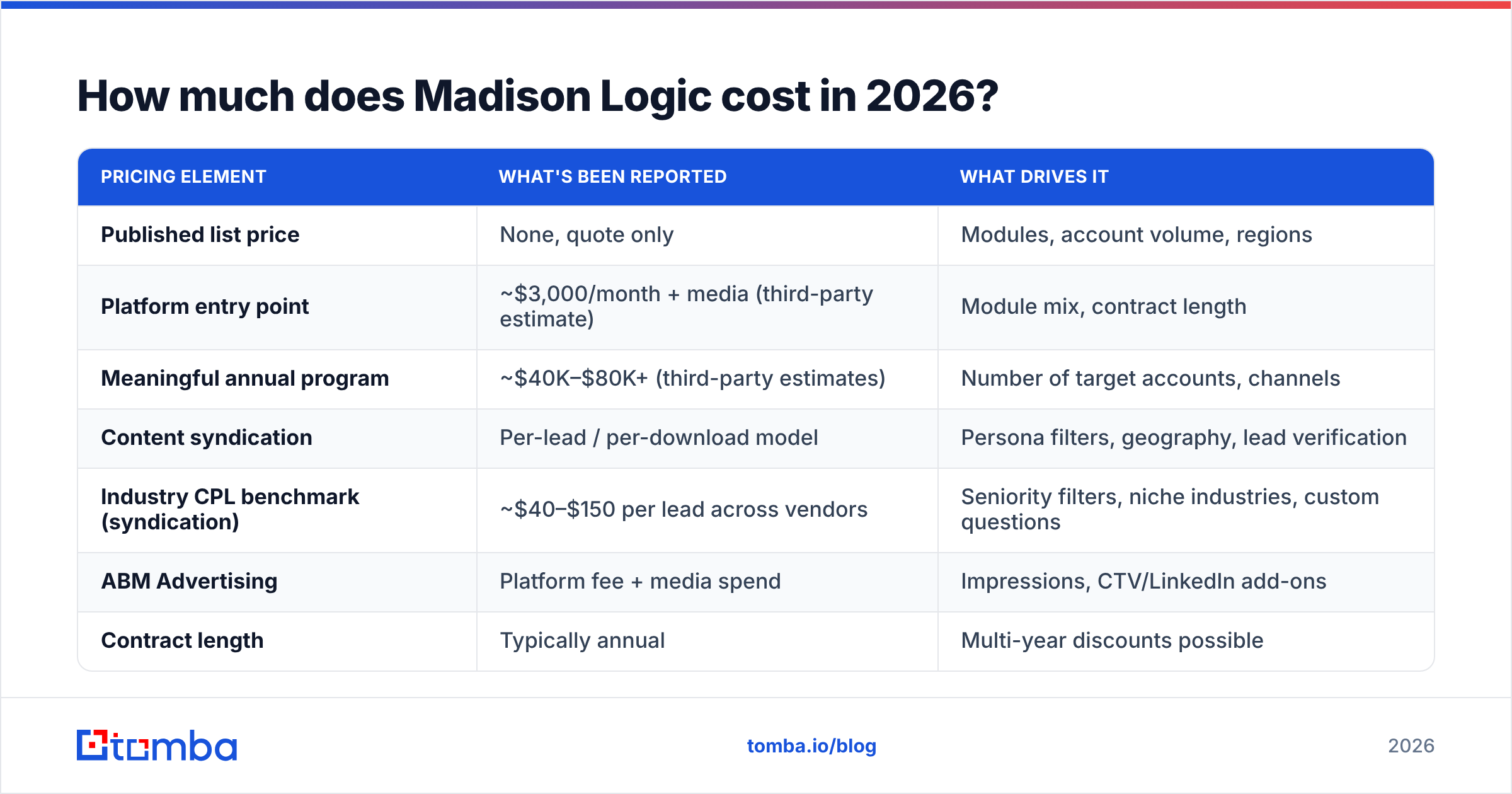
There is no public price list. Every deal is custom-quoted after a sales call. Here's what independent and competitor sources have reported, and what pushes the number up or down.
| Pricing element | What's been reported | What drives it |
|---|---|---|
| Published list price | None, quote only | Modules, account volume, regions |
| Platform entry point | ~$3,000/month + media (third-party estimate) | Module mix, contract length |
| Meaningful annual program | ~$40K–$80K+ (third-party estimates) | Number of target accounts, channels |
| Content syndication | Per-lead / per-download model | Persona filters, geography, lead verification |
| Industry CPL benchmark (syndication) | ~$40–$150 per lead across vendors | Seniority filters, niche industries, custom questions |
| ABM Advertising | Platform fee + media spend | Impressions, CTV/LinkedIn add-ons |
| Contract length | Typically annual | Multi-year discounts possible |
| Free trial / free tier | No | — |
Treat these as rough guides. The figures come from competitor and analyst blogs, and they don't agree with each other. Ask your Madison Logic rep for a written breakdown of platform fees versus media versus per-lead costs.
What raises your Madison Logic bill?#
- Tight persona filters. Asking for "VP+ in IT security at companies with 1,000+ employees in DACH" costs far more per lead than "director+ in North America."
- Custom qualification questions. Each extra question on a syndication form usually adds to CPL.
- Multiple regions and languages. Global reach is one of Madison Logic's strengths, and you pay for it.
- CTV and LinkedIn add-ons. Media for these channels costs more than standard programmatic display.
- Larger account lists. More target accounts means more data and more impressions.
What lowers it?#
- Starting with syndication only and proving cost per opportunity before adding ads.
- Committing to annual or multi-year terms.
- Broader filters on top-of-funnel assets, with tight filters saved for bottom-funnel content.

What do Madison Logic reviews say?#
On Madison Logic's G2 reviews page, the platform has roughly 4.3 out of 5 stars from about 265 reviews as of mid-2026. That's a solid score for an enterprise ABM tool. The written reviews are more mixed than the star rating suggests.
What reviewers like#
- Lead volume and reach. Teams running global campaigns say Madison Logic delivers consistent lead flow across regions where other vendors struggle.
- Account managers and support. Responsive customer success teams come up again and again, often by name.
- Filtering on syndication. The ability to filter by title, seniority, industry, and company size gets regular praise.
- CRM/MAP integrations. Leads land in Salesforce or Marketo without manual CSV uploads.
What reviewers complain about#
- Learning curve and UI. Several reviewers call the interface unintuitive and say full use needs training or hand-holding from a CSM.
- Top-of-funnel lead quality. A recurring complaint is that syndicated leads downloaded a whitepaper but aren't close to buying. Sales teams then struggle to convert them.
- Attribution to pipeline. Some marketers find it hard to prove that ABM ad spend caused closed-won deals, not just engagement.
- Opaque intent scoring. Users want more clarity on why an account is flagged as surging.
None of these complaints is unique to Madison Logic. They apply to the whole syndication-plus-intent category, including competitors like Demandbase and 6sense. They matter, though, because they hit your ROI directly.
Madison Logic pricing reviews pros and cons: the summary table#
| Pros | Cons |
|---|---|
| Large global publisher network for content syndication | No public pricing, so budgeting needs a sales cycle |
| Combines intent, ads, and syndication in one contract | Steep learning curve, UI criticized in reviews |
| Strong account management reputation | Syndicated leads often early-stage, slow to convert |
| Good fit for multi-region, multi-language programs | ROI attribution can be hard to prove |
| Native connectors for Salesforce, HubSpot, Marketo, Eloqua | No free tier or self-serve trial |
| Per-lead syndication pricing keeps spend tied to output | Total cost climbs quickly with media and add-ons |
Is Madison Logic better than 6sense or Demandbase?#
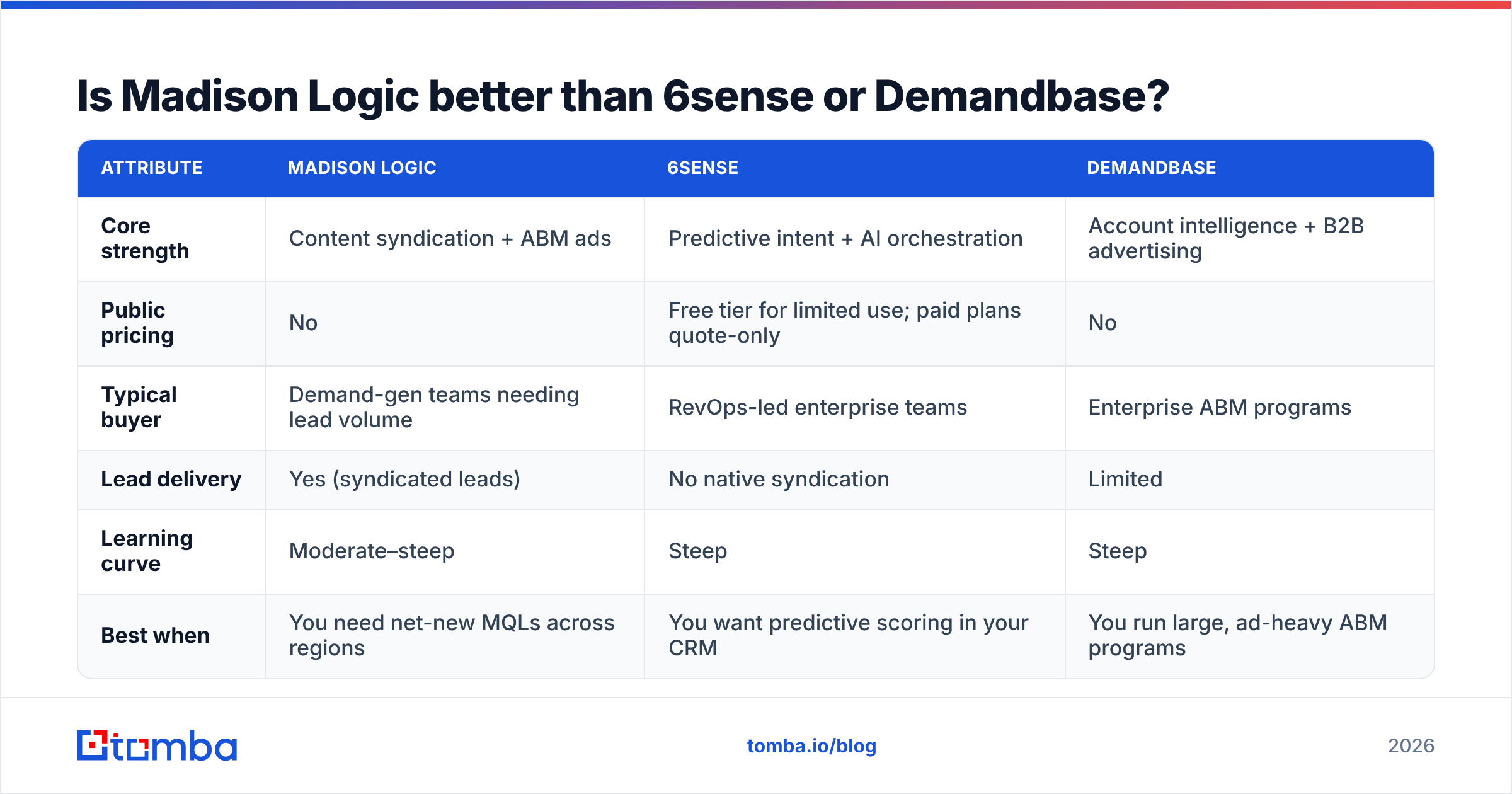
They overlap, but they're built around different centers. Madison Logic began as a syndication network, while 6sense and Demandbase began as intent and account-intelligence platforms. That history still shows in what each one does best.
| Attribute | Madison Logic | 6sense | Demandbase |
|---|---|---|---|
| Core strength | Content syndication + ABM ads | Predictive intent + AI orchestration | Account intelligence + B2B advertising |
| Public pricing | No | Free tier for limited use; paid plans quote-only | No |
| Typical buyer | Demand-gen teams needing lead volume | RevOps-led enterprise teams | Enterprise ABM programs |
| Lead delivery | Yes (syndicated leads) | No native syndication | Limited |
| Learning curve | Moderate–steep | Steep | Steep |
| Best when | You need net-new MQLs across regions | You want predictive scoring in your CRM | You run large, ad-heavy ABM programs |
If you're comparing these platforms and none fits your budget, Tomba keeps breakdowns of a 6sense alternative and a Demandbase alternative for teams that care more about outbound contact data than ad orchestration.
What are the hidden costs of Madison Logic?#
The contract price isn't the full cost. Plan for these too:
- Contact data for follow-up. Intent data tells you which account is surging, not who to email. Most teams still buy an email finder or contact database. That lets SDRs reach the whole buying committee, not just the one person who downloaded the asset.
- Lead verification. Syndicated leads and form fills include bad addresses. Sending sequences to them without checking hurts your sender reputation. Budget for an email verifier.
- Content production. Syndication needs a steady supply of gated assets. Without them you'll be re-syndicating the same ebook and watching CPL climb.
- Ops time. Someone has to set up routing, lead scoring, and SLAs so syndicated leads don't rot in a MAP nurture. That time is often a fractional RevOps hire.
- Media you can't fully attribute. ABM display and CTV budgets are real cash. Some of it will build awareness you can't trace back to specific deals.
Add these up and the effective first-year cost can run well past the quoted platform fee.
Who should buy Madison Logic and who shouldn't?#
Madison Logic is a good fit if you:
- Run a demand-gen function with a content engine and a budget of roughly $50K+ per year for paid programs.
- Need lead flow in several regions (EMEA, APAC, LATAM) with local-language assets.
- Have marketing ops in place to score, route, and nurture syndicated leads.
- Measure success as pipeline influenced by accounts over quarters, not just meetings booked this month.
You should probably skip it if you:
- Are a seed-to-Series A team where outbound SDRs drive most pipeline.
- Need direct contact details (verified emails, phone numbers) more than awareness.
- Can't produce fresh gated content every quarter.
- Want month-to-month, self-serve tools you can turn off any time.

Is there a cheaper alternative to Madison Logic?#
Yes, if your goal is pipeline from outbound rather than paid reach. A lean stack many teams use instead of, or before, an ABM platform:
- Target account list: Build it from your CRM's closed-won data and firmographic filters.
- Contacts at those accounts: Use an email finder or domain search to pull the buying committee at each account. Then enrich records with title, seniority, and company data through data enrichment.
- Verification: Clean every list before it goes into a sequence.
- Sequencing: Use any outbound tool you already pay for.
- Light intent: Website visitor identification and job-change signals cover much of what small teams need from intent data.
At Tomba pricing, this runs from a free tier (25 searches per month) to $49/mo Starter, $99/mo Growth, and $249/mo Pro. A full year on Growth costs about what one month of a mid-sized ABM program might.
The trade-off is plain: you give up syndicated lead volume and programmatic reach, and you gain direct access to the people you want to talk to. Plenty of teams run both. Madison Logic feeds top-of-funnel demand, and a contact-data tool lets SDRs work the whole buying committee.
How do you negotiate a better Madison Logic deal?#
If you decide Madison Logic fits, these steps protect your budget:
- Pilot syndication first. Run a 90-day program on one or two assets with a fixed lead cap. Measure cost per opportunity, not cost per lead.
- Get replacement terms in writing. Agree up front on what counts as a bad lead (wrong title, bounced email, outside ICP) and how fast it gets replaced.
- Split platform fees from media. Ask for a line-item quote so you can tell what's software and what's spend you could move to other channels.
- Tie renewals to pipeline metrics. Use your CRM data to anchor the renewal talk in opportunities created, not impressions.
- Compare at least two quotes. Get a competing proposal from another ABM or syndication vendor. Pricing in this category moves a lot when there's competition.
Final verdict: is Madison Logic worth it?#
Madison Logic is worth it for well-resourced demand-gen teams that need global syndication and ABM ads in one contract. They also need the ops setup to convert early-stage leads. The roughly 4.3/5 G2 rating reflects real strengths: reach, filtering, and support. The complaints about learning curve and top-of-funnel lead quality are just as real.
It's not worth it for lean, outbound-first teams. If your SDRs mainly need to know who to contact and how to reach them, a five- or six-figure ABM contract solves the wrong problem.
That's the short version of Madison Logic pricing reviews pros and cons. Whichever way you go, intent and syndication only pay off once your team can reach the right decision-makers. Tomba Email Finder finds verified work emails by domain, name, or company. That turns every surging account and syndicated lead into a buying committee your reps can contact. You can start on the free tier and check the data quality yourself before spending a dollar on media.
Related guides#
// start free
See who Tomba finds at any company
Type a company's domain to see its people, their roles and verified work emails, each with the pages it was found on. Free account, no card.
Free plan · No credit card required · GDPR & CCPA
// about the author