MadKudu Alternatives: 8 Lead Scoring Tools Compared for 2026
HG Insights bought MadKudu in 2025, and buyers now pay enterprise-contract prices. Here are 8 MadKudu alternatives for predictive lead scoring, ranked by team size, budget and data needs.
TL;DR
- MadKudu is still a strong predictive lead-scoring engine. HG Insights acquired it in August 2025, though, and pricing is now an enterprise quote. Third-party estimates put the median contract at around $32K a year.
- If you already pay for HubSpot Enterprise or Salesforce, try their native predictive scoring first. It costs little or nothing extra and covers most mid-market needs.
- For account-level intent and ABM, 6sense and Demandbase are the main replacements. For product-led growth (PLG) signals, look at Pocus and Common Room.
- No scoring model is better than the data it reads. Missing or bounced emails break scoring before the model even runs, so budget for an enrichment and verification layer whichever tool you pick.
- Smaller teams can get about 80% of the value from a rules-based fit score plus clean, enriched contact data, for a fraction of the cost.
What is MadKudu, and why are teams looking for alternatives?#
MadKudu built its name on predictive lead scoring for B2B SaaS, especially product-led companies. The model combines firmographic fit (company size, industry, tech stack) with behavioral signals (product usage, page views, email engagement). The output is a score that tells sales which signups and inbound leads to work first.
The product itself is fine. What changed is the business around it:
- Ownership changed. MadKudu bought Breadcrumbs in October 2024, and HG Insights then acquired MadKudu in August 2025. The docs and API now carry HG Platform branding, and API access goes through sales.
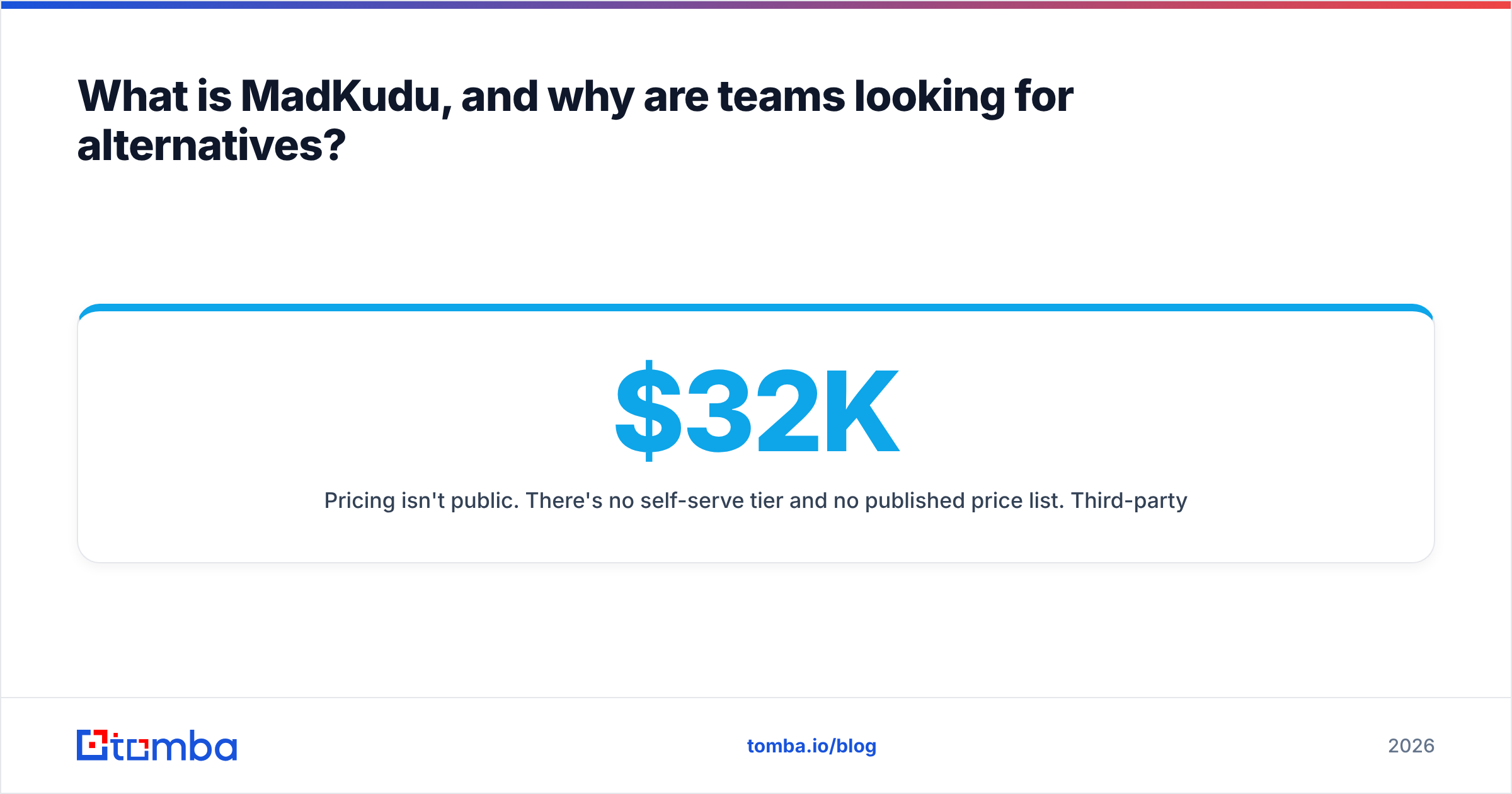
- Pricing isn't public. There's no self-serve tier and no published price list. Third-party trackers that cite Vendr purchase data report a median annual spend of about $32K. Other reviewers estimate $24K–$55K a year depending on tier.
- It takes time to stand up. Predictive models need clean historical conversion data, a working CRM sync and usually some RevOps time before the scores are worth trusting.
If you're a 10-person sales team with a few hundred inbound leads a month, that's a lot of contract for one score. If you're an enterprise already on HG's data platform, the acquisition may suit you well. Most of this post is for the first group.
How should you evaluate MadKudu alternatives?#
Before you compare vendors, decide which problem you're solving. "Lead scoring" covers at least four different jobs:
- Fit scoring. Does this company and person match your ideal customer profile (ICP)? This only needs firmographic and contact data.
- Behavioral scoring. Is this lead engaging with your site, emails or content? This needs marketing automation tracking.
- Product usage scoring. Is this free user hitting the activation moments that predict a paid conversion? This needs a product analytics pipeline.
- Intent scoring. Is this account researching your category somewhere else on the web? This needs third-party intent data.
MadKudu did 1, 2 and 3 well. Most alternatives are strong in one or two of these. Picking the right one is mostly about matching the tool to your main job.
What are the 8 best MadKudu alternatives in 2026?#
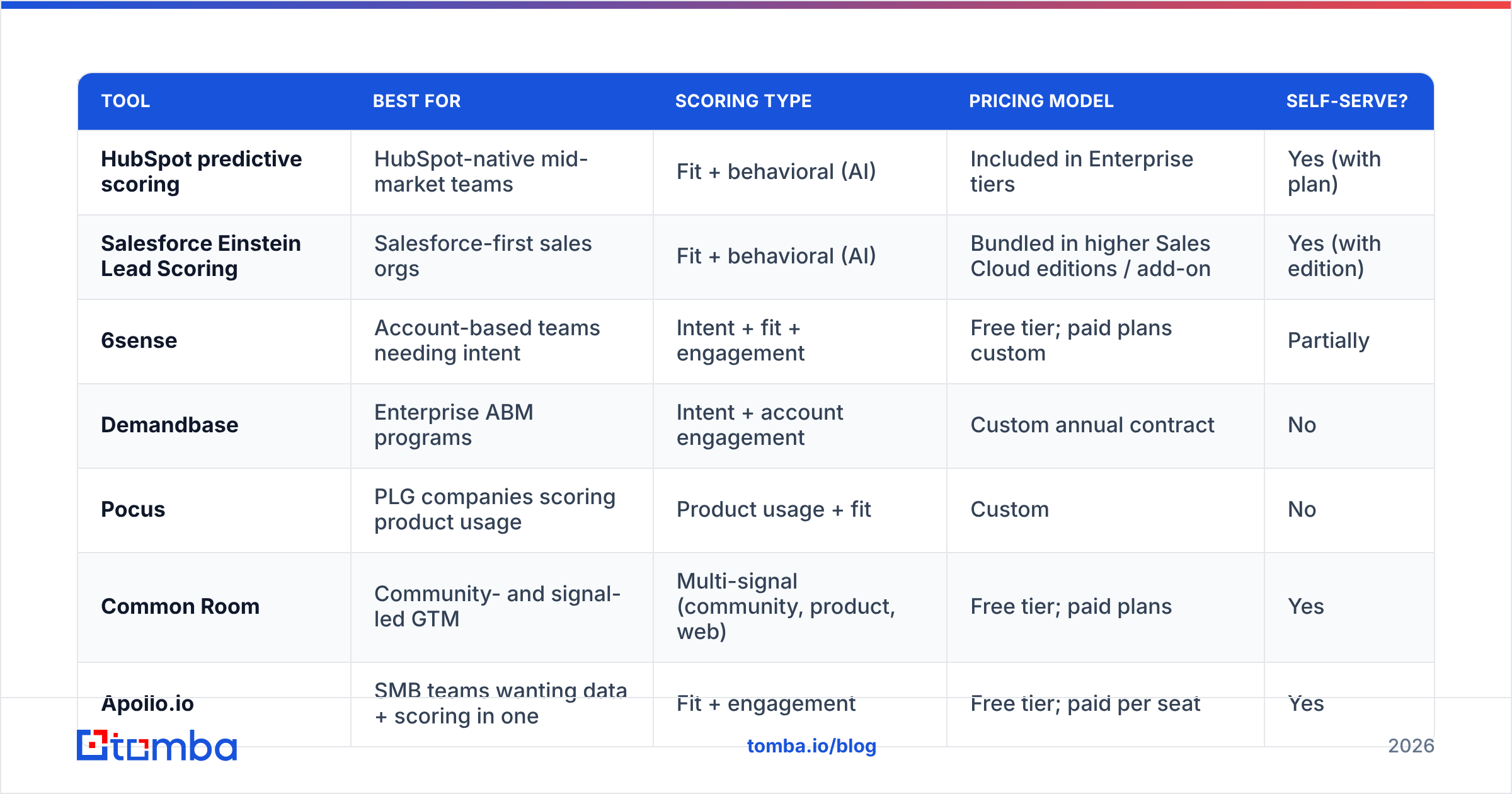
| Tool | Best for | Scoring type | Pricing model | Self-serve? |
|---|---|---|---|---|
| HubSpot predictive scoring | HubSpot-native mid-market teams | Fit + behavioral (AI) | Included in Enterprise tiers | Yes (with plan) |
| Salesforce Einstein Lead Scoring | Salesforce-first sales orgs | Fit + behavioral (AI) | Bundled in higher Sales Cloud editions / add-on | Yes (with edition) |
| 6sense | Account-based teams needing intent | Intent + fit + engagement | Free tier; paid plans custom | Partially |
| Demandbase | Enterprise ABM programs | Intent + account engagement | Custom annual contract | No |
| Pocus | PLG companies scoring product usage | Product usage + fit | Custom | No |
| Common Room | Community- and signal-led GTM | Multi-signal (community, product, web) | Free tier; paid plans | Yes |
| Apollo.io | SMB teams wanting data + scoring in one | Fit + engagement | Free tier; paid per seat | Yes |
| DIY: rules model + enrichment | Lean teams under ~1,000 leads/month | Fit (rules-based) | Cost of your data tools | Yes |
1. HubSpot predictive lead scoring#
If your marketing and sales already run on HubSpot, check here first. The predictive scoring in HubSpot's Enterprise tiers trains on your own closed-won history and assigns a likelihood-to-close score with no extra integration work. HubSpot also absorbed Clearbit in 2023 (now sold as Breeze Intelligence), so enrichment can feed the same model natively.
- Pros: Zero integration work, scores sit next to the contact record, transparent enough for reps to trust.
- Cons: It only sees HubSpot data. Product usage signals require custom events, and the model is less tunable than MadKudu's.
- Choose it if: HubSpot is your system of record and you mostly score inbound marketing leads.
2. Salesforce Einstein Lead Scoring#
Einstein Lead Scoring is the Salesforce equivalent. It analyzes your converted leads, finds the fields that predict conversion, and shows the top contributing factors on each record. That explainability matters, because reps ignore scores they can't understand.
- Pros: Native to the CRM, explains each score, no extra vendor to procure.
- Cons: It needs a decent volume of historical conversions to train, and it's tied to higher Sales Cloud editions or an add-on.
- Choose it if: You're a Salesforce shop with at least a year of clean lead conversion history.
3. 6sense#
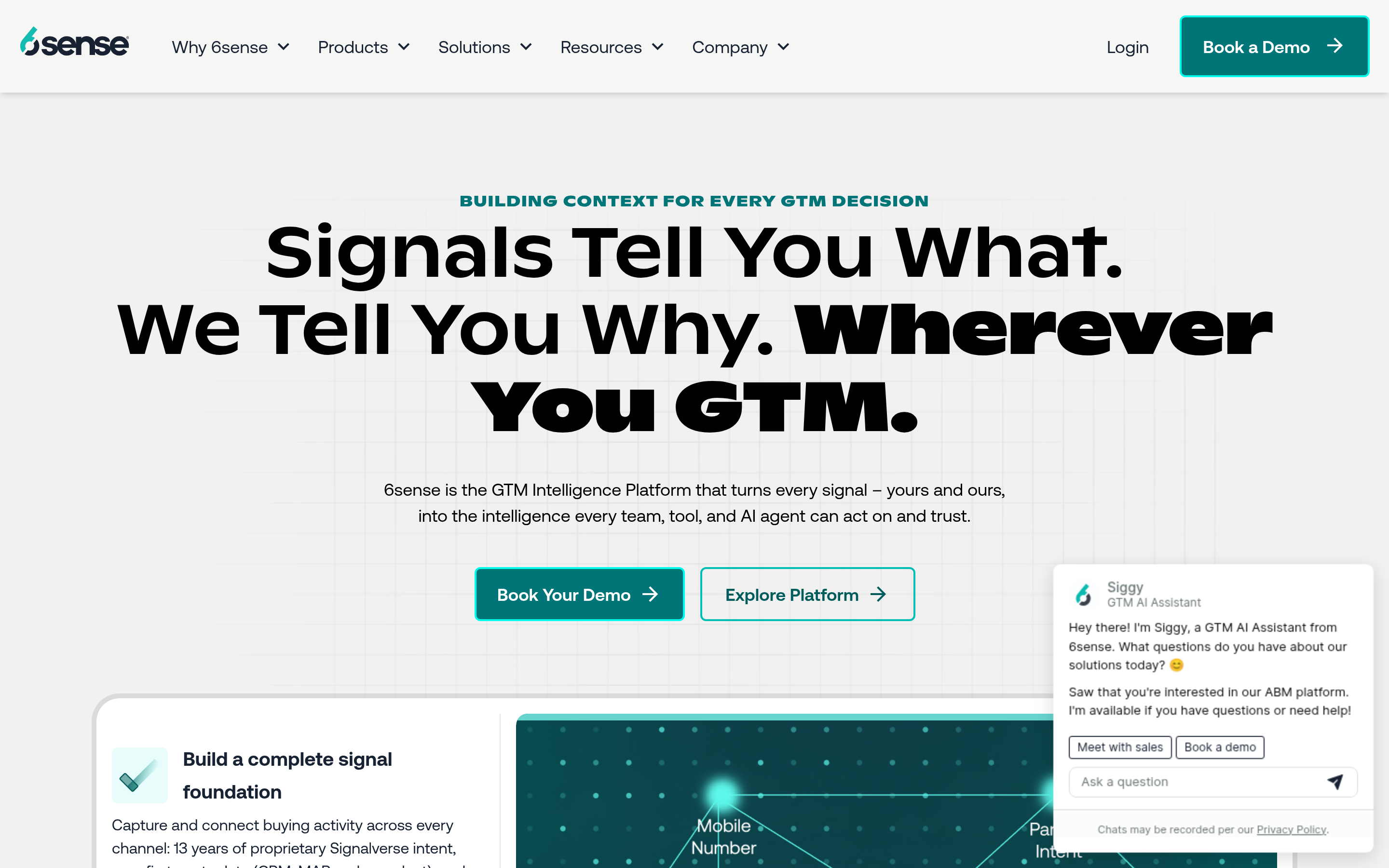
6sense moves the score from the lead to the account. It combines third-party intent data, firmographic fit and engagement to estimate where each account is in its buying journey. If you've drifted toward account-based selling since you bought MadKudu, this is the closest step up. See our 6sense alternative breakdown for the other side of that decision.
- Pros: Strong intent coverage, buying-stage predictions, a usable free tier to test with.
- Cons: Enterprise pricing for the full platform, and implementation is heavy.
- Choose it if: You sell to defined account lists and intent signals matter more to you than individual lead behavior.
4. Demandbase#
Demandbase is the other enterprise ABM platform. It scores account engagement and intent, then connects those scores to advertising and sales plays. It's a better fit for marketing-led ABM programs than for teams that just want an MQL score in the CRM. We compare it in more depth in our Demandbase alternative guide.
- Pros: Mature ABM orchestration, account-level scoring, built-in advertising.
- Cons: Custom contracts that often cost more than MadKudu did. Too much tool for lead-level scoring.
- Choose it if: You run a full ABM motion with a dedicated marketing ops function.

5. Pocus#
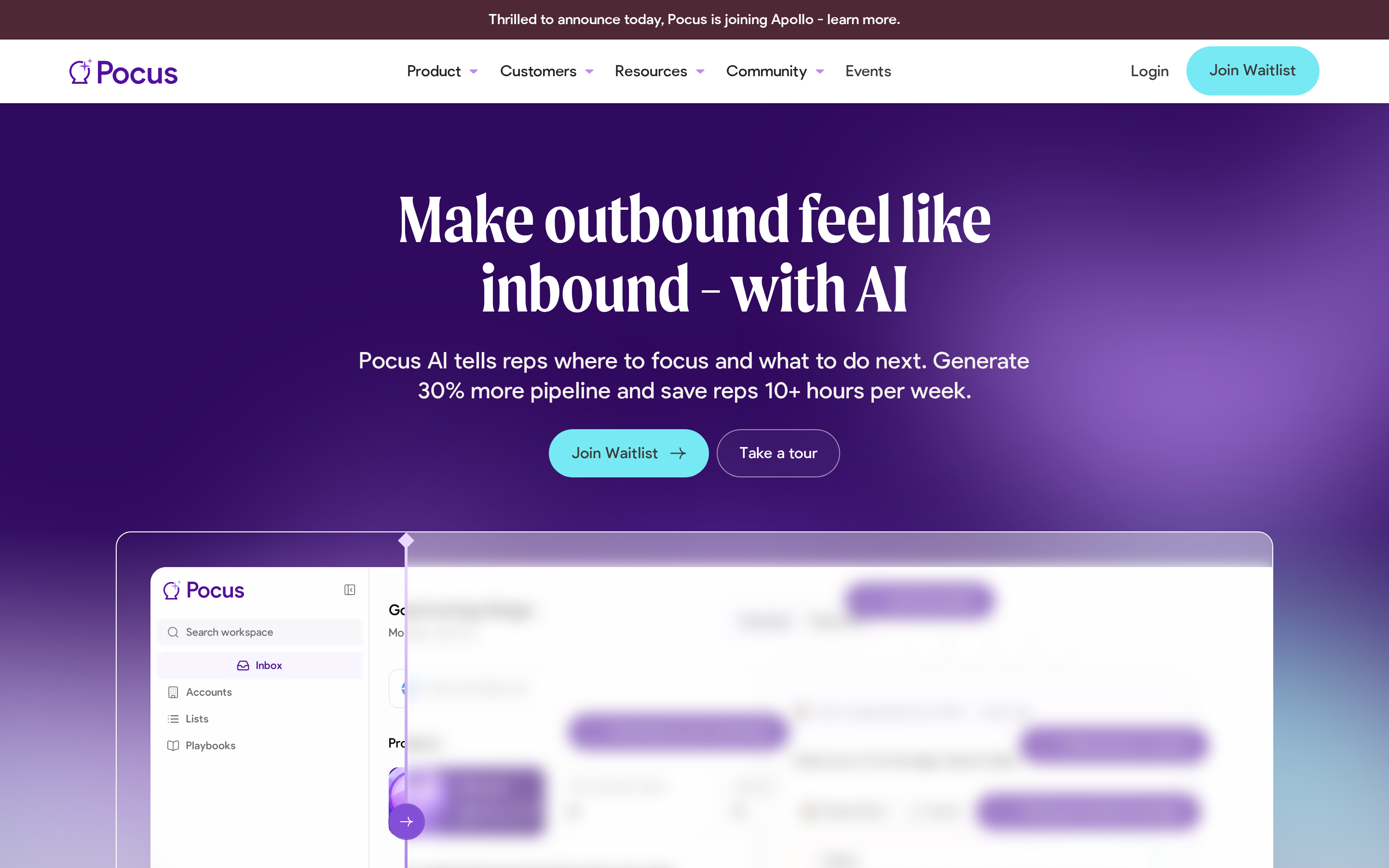
Pocus is built for product-led sales, the same audience MadKudu originally served. It brings in product usage data from your warehouse, combines it with fit data, and flags product-qualified leads (PQLs) and expansion opportunities for reps.
- Pros: Built around product usage, warehouse-native, good playbooks for converting free users to paid.
- Cons: Assumes a working data warehouse and event tracking. Less useful if you're sales-led.
- Choose it if: Your best leads are self-serve signups, and usage tells you more than form fills do.
6. Common Room#
Common Room collects signals from many sources: community activity (Slack, Discord, GitHub), product usage, website visits and social engagement. It resolves them to people and accounts, then lets you build scoring and routing on top.
- Pros: Broad signal coverage, a free tier for testing, strong identity resolution.
- Cons: Scoring logic is more rules and filters than a trained predictive model.
- Choose it if: Your buyers show up in developer communities or social channels before they ever fill out a form.
7. Apollo.io#
Apollo isn't a dedicated scoring platform. It's a database plus sequencing tool, and it now ships with AI-assisted lead scoring on top. For SMB teams, having data, scoring and outreach in one place is often enough to drop a separate scoring vendor altogether. If you outgrow its data quality, see our Apollo alternative comparison.
- Pros: Cheap entry point, free tier, scoring runs on data you already have in the tool.
- Cons: Scoring is less sophisticated than MadKudu, and contact accuracy varies by region and segment.
- Choose it if: You're a small outbound team and "good enough" scoring is fine.
8. DIY: a rules-based fit model plus enrichment#
This is the option vendors rarely mention: build it yourself. With a few hundred leads a month, a weighted fit score in your CRM will cover most of what a predictive model gives you. Use five to eight attributes, such as employee count, industry, job seniority, tech stack and region.
- Pros: Close to free, fully transparent, easy for sales to adopt.
- Cons: It doesn't learn on its own. You review the weights quarterly.
- Choose it if: Your lead volume is under roughly 1,000 a month and you can't justify a five-figure contract.
Why does data quality matter more than the scoring model?#
Every tool above shares one dependency. They all score whatever data reaches them, and inbound lead data is messy. People sign up with Gmail addresses, fill in fake job titles or skip the company field. Your bought lists decay at the usual B2B rate of roughly 20–30% a year.
A predictive model that gets an incomplete record can't place it. A lead with no company domain gets no firmographic fit. A lead with a bounced email can't be nurtured, so it never produces the behavioral signal the model is waiting for. These are the usual ways bad data breaks scoring:
- Personal email signups. A
jane.doe@gmail.comsignup has no domain, so the model can't attach company size or industry. The lead scores low even when Jane is a VP at a 2,000-person target account. - Missing contacts on hot accounts. Intent tools like 6sense flag an account as in-market, but the CRM has no buyer on it. A high score with nobody to email does nothing for pipeline.
- Invalid or catch-all addresses. Nurture emails bounce, engagement scores never rise, and repeated bounces hurt your sender reputation for the rest of your outreach.
- Stale job data. A champion who changed jobs six months ago still scores as decision-maker, so reps work a dead record.
The fix happens upstream of the model. Before a lead reaches your scoring tool, run data enrichment to resolve personal emails to work identities and fill in firmographics. Then verify emails so nurture and sequences actually land. Teams that do this usually find their existing scoring model was fine all along. It was just reading half-empty records.
Is MadKudu still worth it compared with these alternatives?#
For some teams, yes. MadKudu is still a capable predictive engine, and the HG Insights acquisition gives it access to HG's technographic and spend data. That may make its fit scoring better than before. If you're an enterprise SaaS company with high lead volume, a data team and an HG relationship, renewing can be the rational choice.
It's harder to justify in these cases:
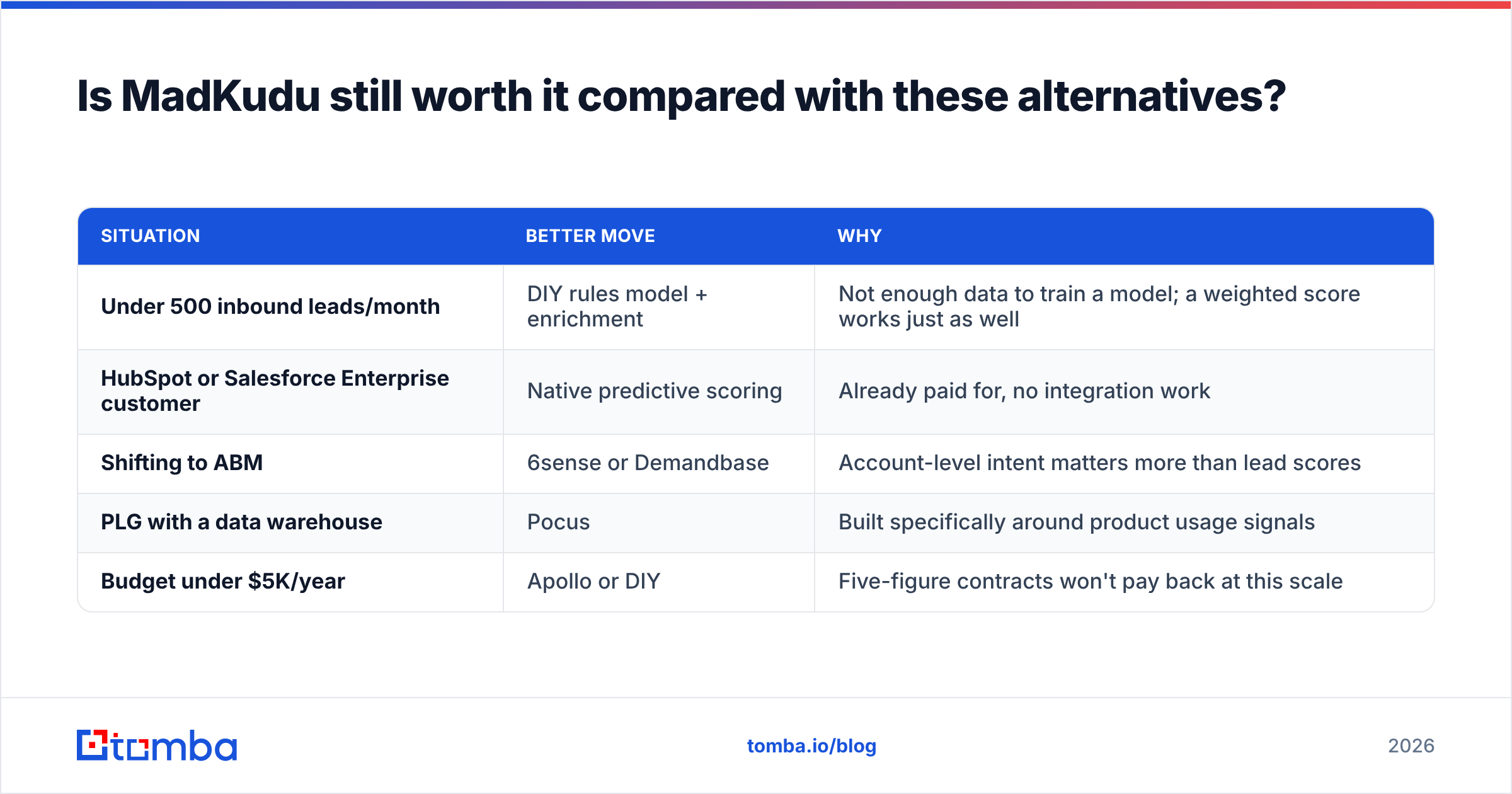
| Situation | Better move | Why |
|---|---|---|
| Under 500 inbound leads/month | DIY rules model + enrichment | Not enough data to train a model; a weighted score works just as well |
| HubSpot or Salesforce Enterprise customer | Native predictive scoring | Already paid for, no integration work |
| Shifting to ABM | 6sense or Demandbase | Account-level intent matters more than lead scores |
| PLG with a data warehouse | Pocus | Built specifically around product usage signals |
| Budget under $5K/year | Apollo or DIY | Five-figure contracts won't pay back at this scale |
Ask one question before you sign any renewal or new contract: how many extra closed-won deals does the score need to produce each year to cover its cost? At a $32K contract and a $15K average contract value, that's three deals a year that would otherwise have been missed. Some teams clear that easily, and many don't. Peer reviews on G2 are a useful check on how quickly similar companies saw payback.
How do you migrate off MadKudu without losing scoring history?#
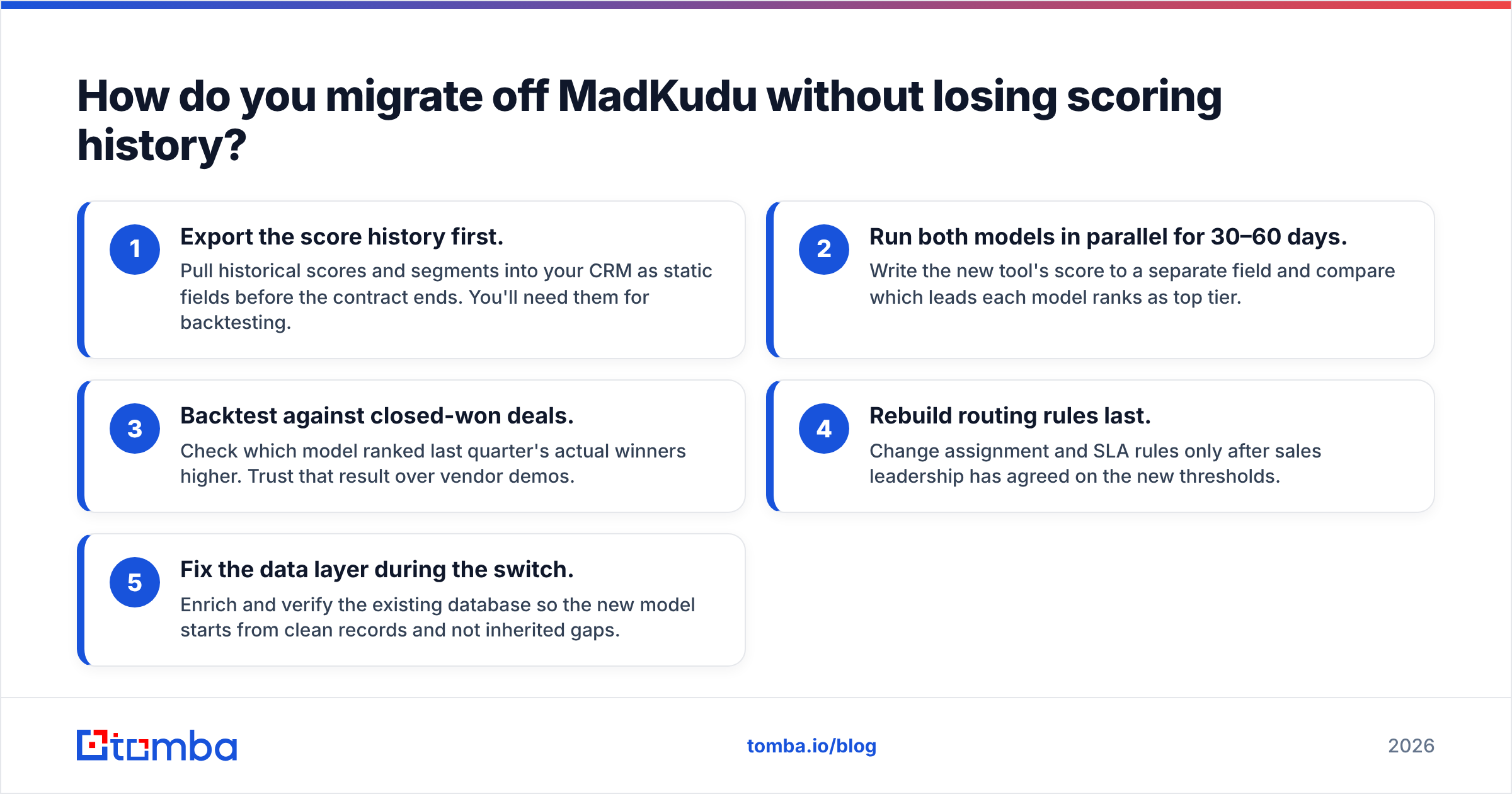
Switching scoring tools mid-quarter can confuse reps and break routing. Here's a lower-risk sequence:
- Export the score history first. Pull historical scores and segments into your CRM as static fields before the contract ends. You'll need them for backtesting.
- Run both models in parallel for 30–60 days. Write the new tool's score to a separate field and compare which leads each model ranks as top tier.
- Backtest against closed-won deals. Check which model ranked last quarter's actual winners higher. Trust that result over vendor demos.
- Rebuild routing rules last. Change assignment and SLA rules only after sales leadership has agreed on the new thresholds.
- Fix the data layer during the switch. Enrich and verify the existing database so the new model starts from clean records and not inherited gaps.
Which MadKudu alternative should you choose?#
Start with your situation, not the feature lists:
- Already on HubSpot or Salesforce Enterprise: use the native predictive scoring and spend the savings on data quality.
- Moving to account-based selling: 6sense for intent-led prioritization, Demandbase for full ABM orchestration.
- PLG with real product data: Pocus, or Common Room if community signals matter too.
- Small team, tight budget: Apollo, or a rules-based model on top of enriched, verified contacts.
All of these options have the same weak point. A score only matters if your reps can reach the person behind it. When a model flags a hot account, you need the right decision-maker's verified work email that same day, not after a week of research.
That's what Tomba Email Finder is for. You can find professional email addresses by domain, name or company, verify them before they go into a sequence, and give your scoring model complete records to work with. You can start on the free tier with 25 searches a month, and paid plans start at $49/mo, which costs far less than any five-figure scoring contract.
Related guides#
// start free
See who Tomba finds at any company
Type a company's domain to see its people, their roles and verified work emails, each with the pages it was found on. Free account, no card.
Free plan · No credit card required · GDPR & CCPA
// about the author