MadKudu Pricing Pros and Cons: 2026 Reviews & Buyer's Guide
MadKudu's list prices run from about $999 to $2,499 a month, but buyers report paying around $30K a year. Here's what you get, what reviewers complain about, and when a lighter stack makes more sense.
This guide to MadKudu pricing pros and cons covers what the plans cost, what reviewers say, and when a cheaper setup makes more sense.
TL;DR
- MadKudu is a predictive lead-scoring tool for B2B SaaS. It tells your reps which leads are likely to buy. It does not find emails or contact data.
- 2026 listings put Growth at about $999–$2,000/month and Pro at about $2,499/month. Enterprise is custom. Sources disagree, and you often need a demo to get a quote.
- Reviews are strong: about 4.5/5 on G2. Users like the support and the scores inside Salesforce. They dislike the limited control over scoring and the clunky interface.
- It pays off with heavy inbound or PLG volume and clean CRM data. Under a few hundred new leads a month, a simple rules-based score usually does the job.
- Scores need real data. Budget for enrichment and verified emails too.
What is MadKudu, and who is it built for?#
MadKudu is a predictive scoring and lead-prioritization platform. It pulls firmographic, technographic and behavioral data (product usage, website visits, marketing engagement) into a model that outputs a fit score and a likelihood-to-buy score for every lead and account. Those scores land inside Salesforce, HubSpot or Marketo, where your reps actually work.
A useful way to think about it: a CRM is your filing cabinet, and MadKudu is the assistant who goes through the cabinet every morning and puts the ten folders you should open today on top.
The company has always aimed at B2B SaaS, especially product-led growth (PLG) companies. Those teams have thousands of free signups and need to know which handful are worth a sales touch. Recent products like MadKudu Copilot push the scores further into rep workflows with account briefs and suggested outreach.
If you're new to the concept, the Wikipedia entry on lead scoring explains the difference between manual and predictive approaches. MadKudu sits on the predictive end.
How much does MadKudu cost in 2026?#
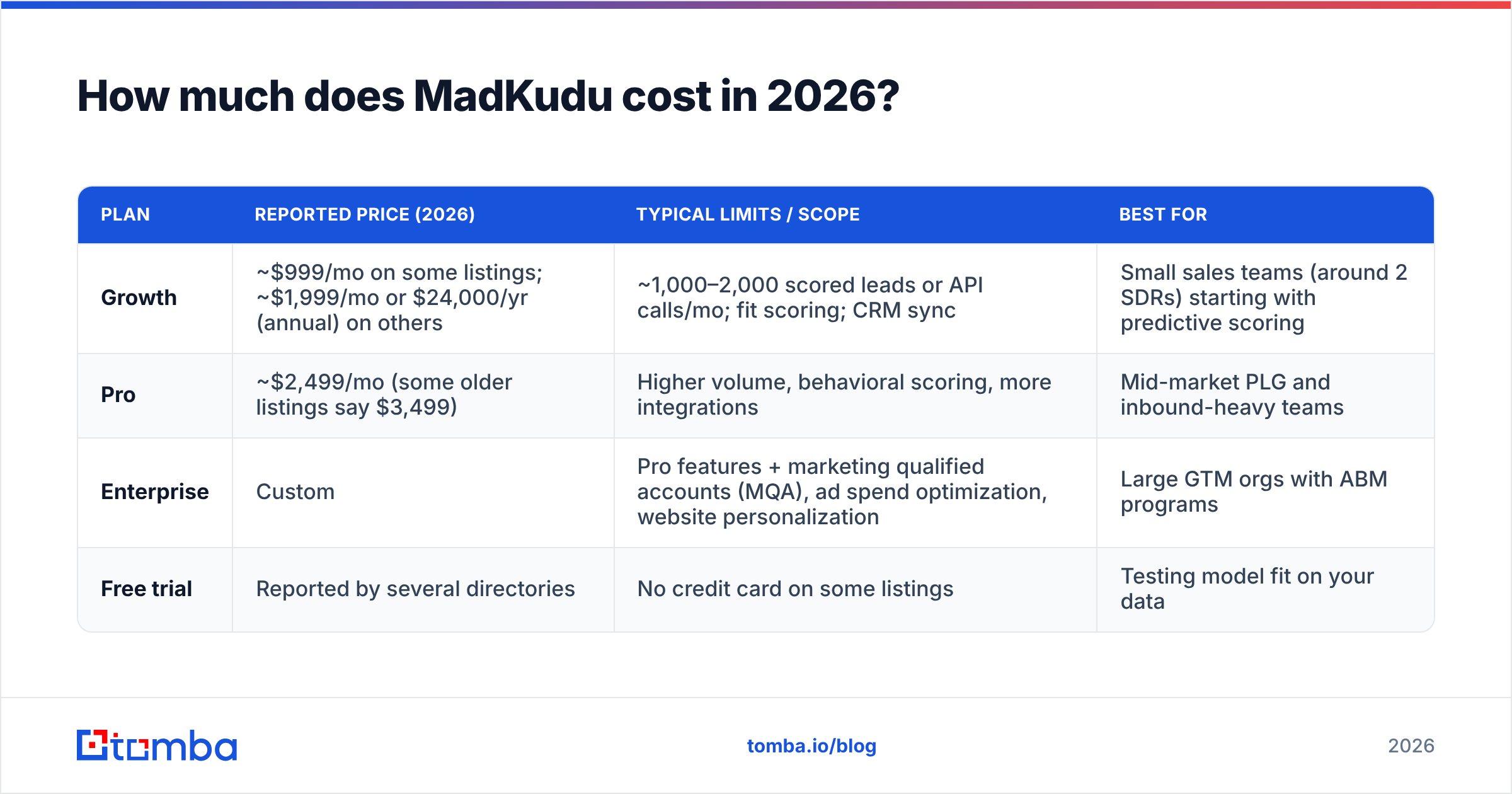
The short answer is "it depends on who you ask." MadKudu has changed between published list prices and demo-gated quotes over the years, and third-party directories don't agree. Here is what the most recent listings report:
| Plan | Reported price (2026) | Typical limits / scope | Best for |
|---|---|---|---|
| Growth | ~$999/mo on some listings; ~$1,999/mo or $24,000/yr (annual) on others | ~1,000–2,000 scored leads or API calls/mo; fit scoring; CRM sync | Small sales teams (around 2 SDRs) starting with predictive scoring |
| Pro | ~$2,499/mo (some older listings say $3,499) | Higher volume, behavioral scoring, more integrations | Mid-market PLG and inbound-heavy teams |
| Enterprise | Custom | Pro features + marketing qualified accounts (MQA), ad spend optimization, website personalization | Large GTM orgs with ABM programs |
| Free trial | Reported by several directories | No credit card on some listings | Testing model fit on your data |
Two caveats matter more than the list prices:
- Annual commitments are standard. Several reviewers and directories say Growth is sold on an annual contract. That makes the monthly figure misleading if you only want to try it for a quarter.
- What buyers actually pay is higher than the entry tier. Procurement-data aggregators that track real purchases report a median contract in the low-$30K-per-year range. That's an unofficial figure, but it lines up with where most mid-market teams end up once volume and integrations are added.
Confirm current numbers on the official MadKudu website before you put anything in a budget. Treat the table above as a starting point for negotiation.

What's actually included at each tier?#
The main split in what you get is fit scoring versus behavioral scoring.
- Fit scoring answers "does this company and person look like our past customers?" It uses firmographics (industry, size, revenue), technographics (what software they run) and role data. This is the core of the entry tier.
- Behavioral scoring answers "is this lead acting like a buyer right now?" It uses product usage events, pricing-page visits, email engagement and so on. This is where MadKudu stands out for PLG companies, and it's usually gated to higher tiers.
- Account-level scoring (MQA) rolls individual signals up to the account. That makes it the tool for ABM teams that care about buying committees rather than single leads. It's typically an Enterprise feature.
- Copilot and AI features turn scores into rep-facing context: why an account is hot, who to contact, and draft messaging. Packaging for these has moved around, so ask specifically what's included in your quote.
If your team only needs fit scoring, you're paying for capability you won't use on the higher tiers. If you need behavioral scoring on product data, the entry tier probably won't be enough.
What do MadKudu reviews say?#
On MadKudu's G2 profile, the product averages about 4.5 out of 5 across a few dozen reviews. The sample is small compared with mass-market sales tools, which makes sense for an expensive, specialized product. The themes are consistent, though.
What reviewers praise:
- Support and onboarding. This comes up more than anything else. Reviewers describe the customer success team as responsive and hands-on in building the initial model, which matters a lot with a tool that's only as good as its configuration.
- Scores inside Salesforce. Reps don't have to open another tab. The score, plus the signals behind it, appears on the lead or account record.
- Explainability. Several reviewers point out that MadKudu shows why a lead scored high, not just the number. Reps trust a score they can understand.
- Faster triage. Teams report spending less SDR time on low-fit signups.
What reviewers criticize:
- Limited control over scoring weights. Ops teams want to adjust how individual signals are weighted and get finer score granularity. Some end up relying on MadKudu's team to make changes.
- Interface. The UI is described as functional but not intuitive, especially for non-technical marketers.
- Behavioral data depth. Some users want more behavioral signals out of the box.
- Custom fields and search. A few reviewers ask for better support for custom fields and filtering by them.
None of these is a dealbreaker. They're the normal trade-offs of a managed predictive model: you get a strong model faster, but you have less direct control over how it works.
What are the MadKudu pricing pros and cons?#
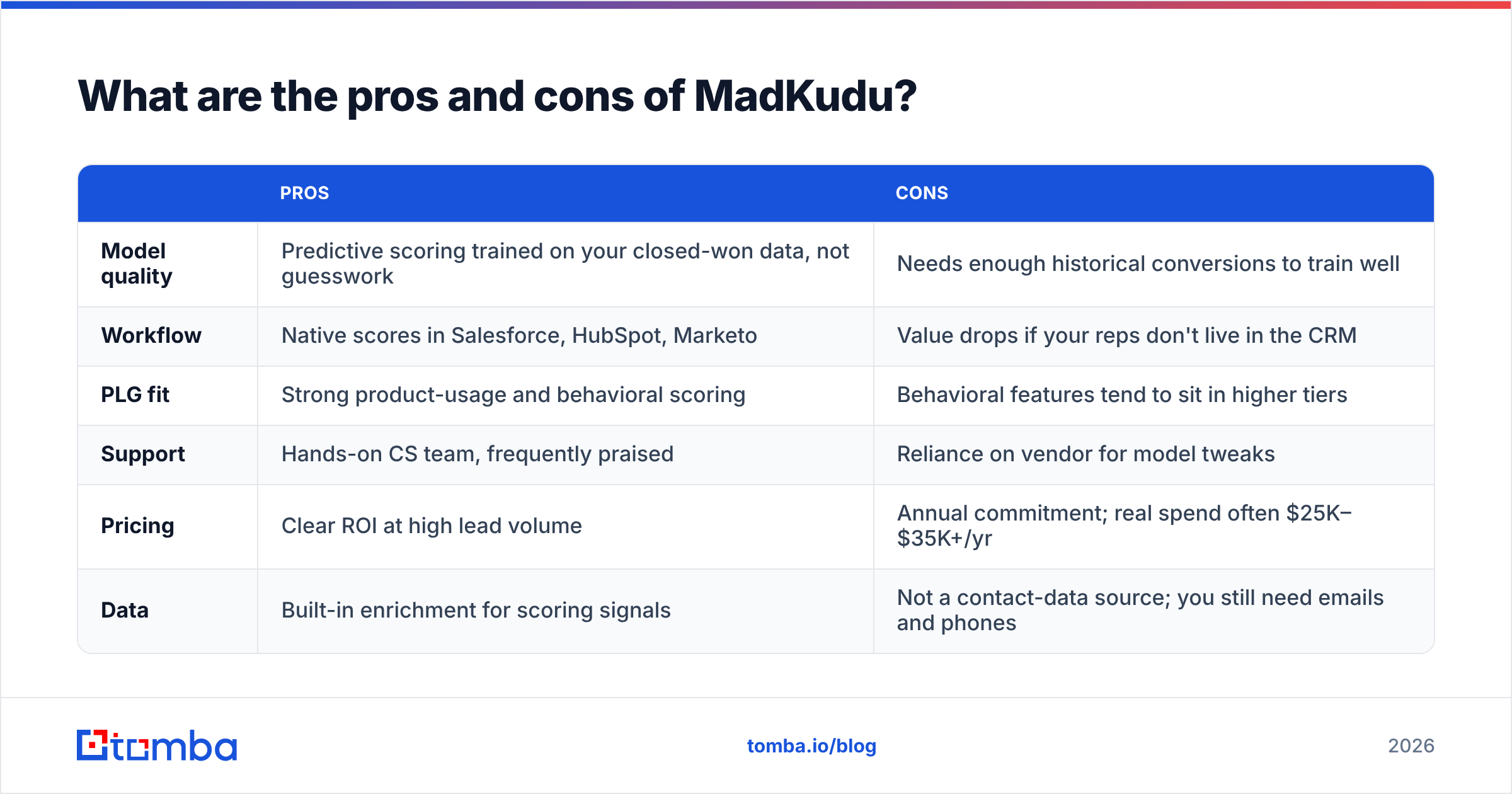
Here are the MadKudu pricing pros and cons side by side, along with the product trade-offs that affect your return.
| Pros | Cons | |
|---|---|---|
| Model quality | Predictive scoring trained on your closed-won data, not guesswork | Needs enough historical conversions to train well |
| Workflow | Native scores in Salesforce, HubSpot, Marketo | Value drops if your reps don't live in the CRM |
| PLG fit | Strong product-usage and behavioral scoring | Behavioral features tend to sit in higher tiers |
| Support | Hands-on CS team, frequently praised | Reliance on vendor for model tweaks |
| Pricing | Clear ROI at high lead volume | Annual commitment; real spend often $25K–$35K+/yr |
| Data | Built-in enrichment for scoring signals | Not a contact-data source; you still need emails and phones |
The last row is the one teams most often miss. A score tells you who to prioritize. It doesn't give you a verified email address for the VP of Engineering at the account that just jumped to "very good." That gap is where a lot of the promised ROI disappears.
Is MadKudu worth it for your team?#
Use these four checks. If you can't say yes to at least three, wait.
- Volume. Are you getting several hundred or more net-new leads or signups each month? Below that, a sharp SDR plus a simple rules-based score can review everything by hand.
- History. Do you have at least a year of clean closed-won and closed-lost data in your CRM? Predictive models need examples to learn from.
- CRM hygiene. Are lead records complete, with company domain, title and a valid email? A model scoring half-empty records will produce confident but useless output.
- Sales capacity mismatch. Do your reps have more leads than time, so prioritization changes revenue rather than just reordering a short list?
If you're a seed-stage team with 80 demo requests a month, MadKudu is a sports car in a parking lot. If you're a Series B PLG company with 10,000 monthly signups and four AEs, it can pay for itself within a quarter.
Before you commit, it helps to agree internally on what a qualified lead means. Tomba's glossary entry on the marketing qualified lead (MQL) is a good shared definition to start the conversation with sales.
How does MadKudu compare with alternatives?#
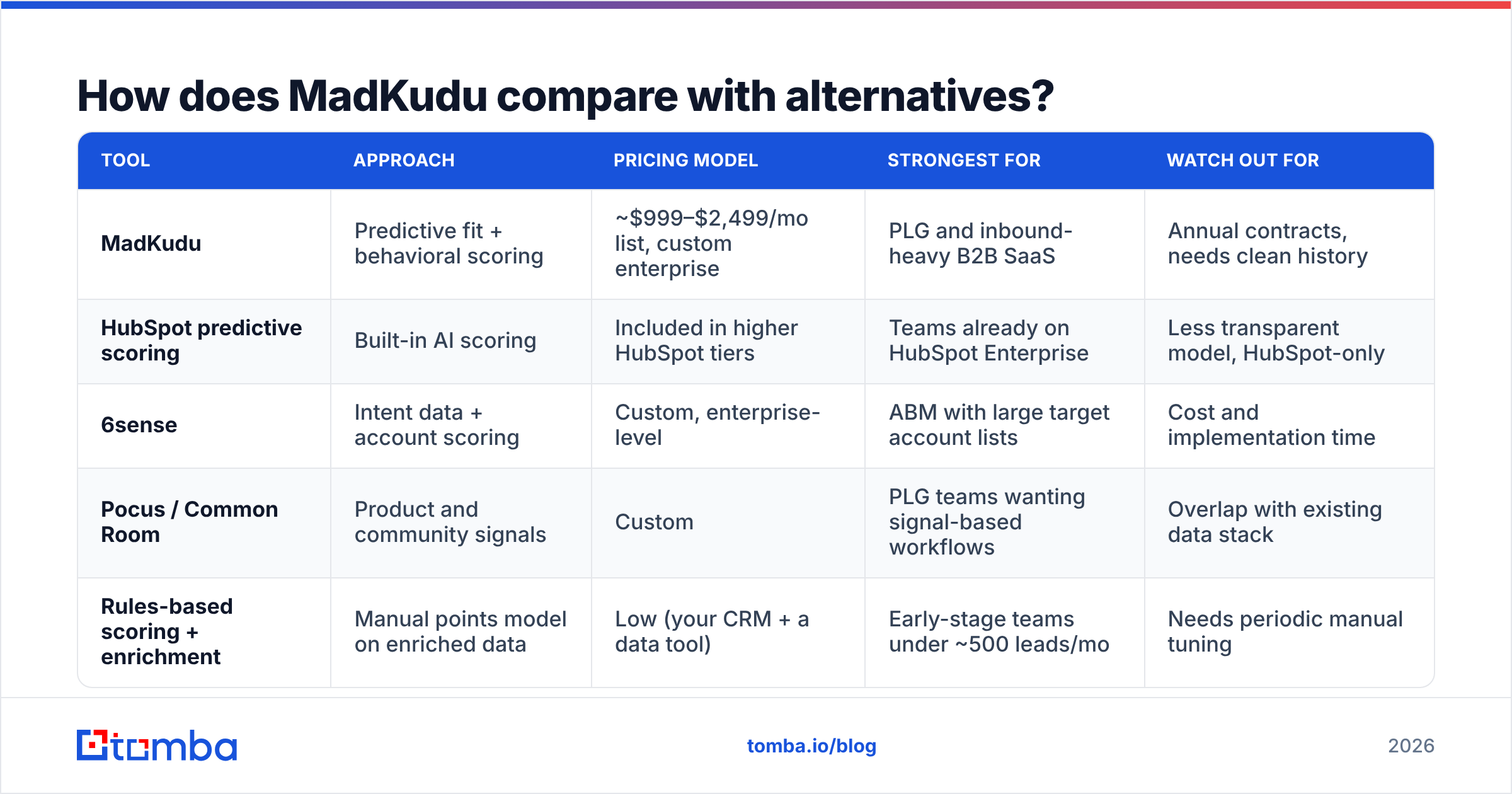
Predictive scoring is a crowded category, and the right alternative depends on what you're actually missing.
| Tool | Approach | Pricing model | Strongest for | Watch out for |
|---|---|---|---|---|
| MadKudu | Predictive fit + behavioral scoring | ~$999–$2,499/mo list, custom enterprise | PLG and inbound-heavy B2B SaaS | Annual contracts, needs clean history |
| HubSpot predictive scoring | Built-in AI scoring | Included in higher HubSpot tiers | Teams already on HubSpot Enterprise | Less transparent model, HubSpot-only |
| 6sense | Intent data + account scoring | Custom, enterprise-level | ABM with large target account lists | Cost and implementation time |
| Pocus / Common Room | Product and community signals | Custom | PLG teams wanting signal-based workflows | Overlap with existing data stack |
| Rules-based scoring + enrichment | Manual points model on enriched data | Low (your CRM + a data tool) | Early-stage teams under ~500 leads/mo | Needs periodic manual tuning |
If you're already on HubSpot's top tiers, try its native predictive scoring before you buy a separate tool. HubSpot documents how it works in its lead scoring guide. If account-level intent across thousands of target accounts is the main need, 6sense competes more directly, and our 6sense alternative breakdown covers the trade-offs.

What's the cheaper stack if MadKudu is overkill?#
For most teams under the volume threshold, the useful parts of predictive scoring come from two things: complete data on each lead and a simple, honest points model. You can build that for a fraction of a MadKudu contract.
- Enrich every inbound record. Add company size, industry, location and role with a data enrichment tool. Now your score has inputs.
- Write a 10-rule fit score. Add points for ICP industry, company size, target titles and key tools. Take points away for personal emails, students and competitors.
- Add three behavior triggers. Pricing-page visit, second product login, teammate invite. These catch most buying intent.
- Find and verify the contact first. When an account scores high, use an email finder to reach the real decision-maker. Verify the address before it enters a sequence.
- Review monthly against closed-won. See what your won deals share and adjust the points. MadKudu automates this step. You can do it by hand with a calendar reminder.
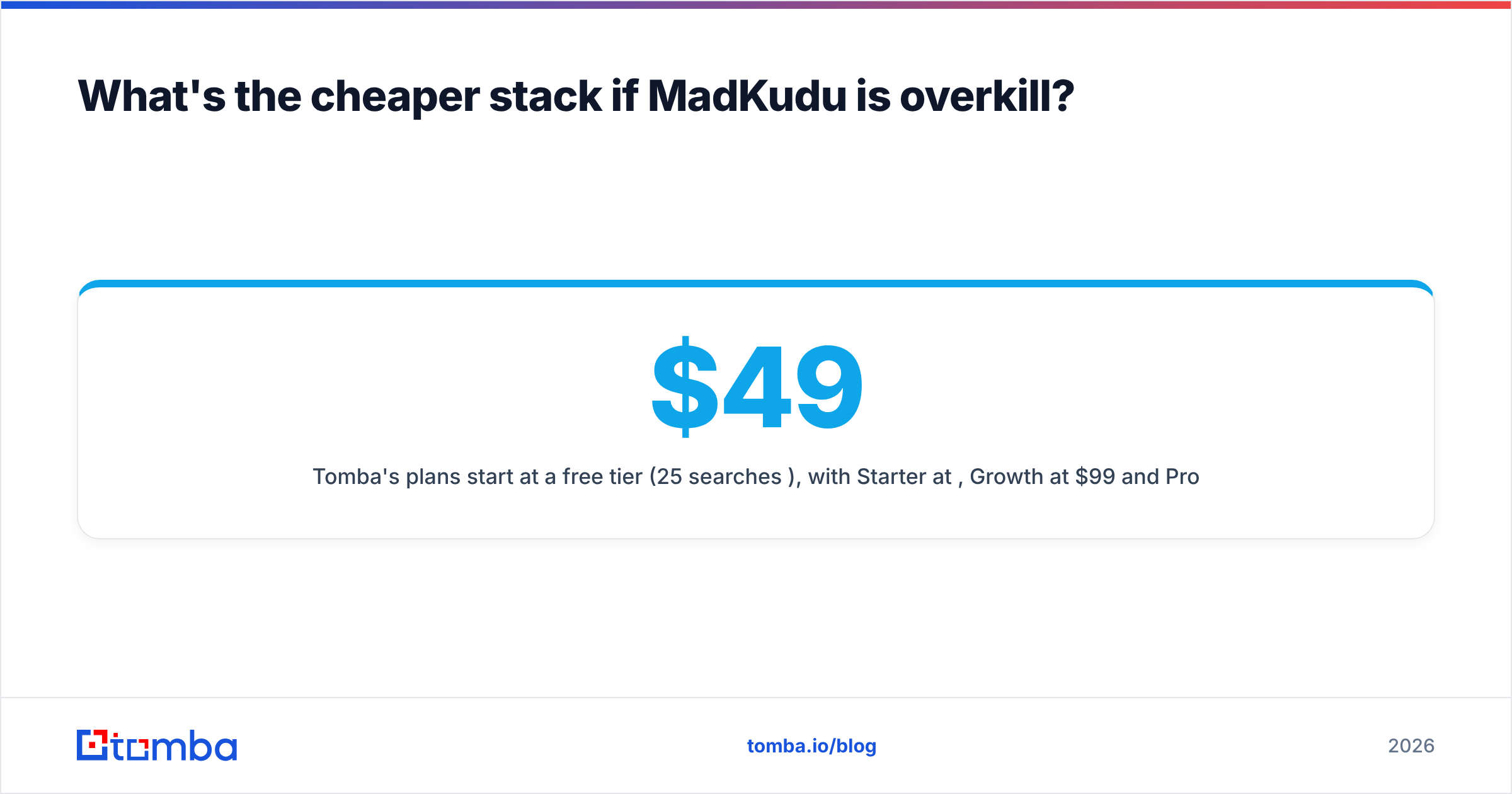
Tomba's plans start at a free tier (25 searches/month), with Starter at $49/mo, Growth at $99/mo and Pro at $249/mo. See the Tomba pricing page for details. Even on Pro, you're spending a small slice of a typical MadKudu contract, so you can use this approach to prove the scoring concept before buying a predictive platform.
This isn't an either/or. Many teams that do buy MadKudu still run enrichment and email finding next to it, because the model can only prioritize records, it can't create them.
How should you negotiate a MadKudu contract?#
If you decide MadKudu fits, these moves usually help:
- Ask for a model-fit proof first. Ask MadKudu to train on your historical data and show lift (conversion rate of top-decile leads vs. average) before you sign.
- Scope volume honestly. Overestimating lead volume pushes you into a higher tier. Start with current volume and negotiate an expansion clause.
- Pin down what's included. Copilot, MQA and ad-spend features have moved between tiers. Get them named in the order form.
- Push on term length. Annual is standard, but a shorter pilot or an opt-out after six months is sometimes available, especially near quarter-end.
- Check integration costs. Confirm that your CRM, marketing automation and product analytics connectors are included and don't need extra services fees.
Final verdict: should you buy MadKudu in 2026?#
MadKudu is a mature, well-reviewed product that does one job well. It tells high-volume B2B SaaS teams which leads deserve attention now. The support team is a real plus, and reps trust scores they can see explained inside Salesforce.
Price is the hurdle. Once you add volume and features, real contracts land well above the entry price, usually on annual terms. Weigh the MadKudu pricing pros and cons against your volume, history and data quality. If you pass, MadKudu is a good investment. If not, put the money into clean data and a simple score first. Revisit predictive scoring when your lead flow outgrows your reps.
Whichever way you go, a score is only useful when your reps can reach the person behind it. The Tomba Email Finder finds professional email addresses by domain, name or company, so every account your scoring flags comes with a verified contact for the decision-maker. Start on the free plan, run it on your top-scored accounts this week, and see how many more of your best leads you can actually contact.
Related guides#
// start free
See who Tomba finds at any company
Type a company's domain to see its people, their roles and verified work emails, each with the pages it was found on. Free account, no card.
Free plan · No credit card required · GDPR & CCPA
// about the author