8 Best MailerCheck Alternatives in 2026 for Email Verification
MailerCheck is a solid verifier from the MailerLite team, but it isn't the best fit for every list. Here are 8 alternatives ranked by catch-all handling, deliverability testing, integrations and cost per 1,000 checks.

TL;DR
- MailerCheck is a credit-based email verifier from the MailerLite team. It also sells inbox placement tests, email insights and DMARC monitoring. It's a good fit if you already use MailerLite and want simple pay-as-you-go verification.
- Most teams look for MailerCheck alternatives for one of four reasons: weak catch-all handling, no way to find emails, few native integrations, or the need for heavier deliverability testing.
- For B2B prospecting, a combined finder and verifier like Tomba removes a step. You find and verify the address in the same workflow, not in two tools.
- For pure list hygiene at volume, ZeroBounce, NeverBounce, Bouncer and Kickbox are the established options. For inbox placement testing, GlockApps goes deeper than MailerCheck.
- Credit prices change often. Check each vendor's live pricing page before you commit, and test any tool on a sample of 500 to 1,000 of your own contacts.
What is MailerCheck, and why do people look for alternatives?#
MailerCheck is an email verification and deliverability tool built by MailerLite. You upload a list or connect an ESP, and it sorts addresses into valid, invalid, catch-all, disposable, role-based and similar buckets. Beyond list cleaning, it offers inbox placement tests, email content insights, blocklist monitoring and DMARC monitoring.
Pricing runs on credits. New accounts get a small batch of free credits. Paid orders start at 1,000 credits, which you can buy one time, on autopay, or as a monthly subscription. Each verified address uses one credit. Third-party listings such as G2's MailerCheck pricing page put pay-as-you-go verification at roughly a cent per email at the low end, with lower per-credit rates at volume. Inbox placement and insights tests use credits too.
That's a fair deal for a MailerLite customer cleaning a newsletter list. The friction appears in other situations:
- You do outbound, not newsletters. MailerCheck verifies addresses you already have. It doesn't help you find them.
- Your list is mostly B2B domains. Corporate domains often accept all mail (catch-all), and a verifier that only labels them "unknown" leaves a large share of your list unresolved.
- You need native CRM or sequencer integrations beyond the ESP connectors MailerCheck focuses on.
- You want deeper deliverability diagnostics, such as seed testing across many mailbox providers or detailed spam filter reports.

What should you compare when evaluating MailerCheck alternatives?#
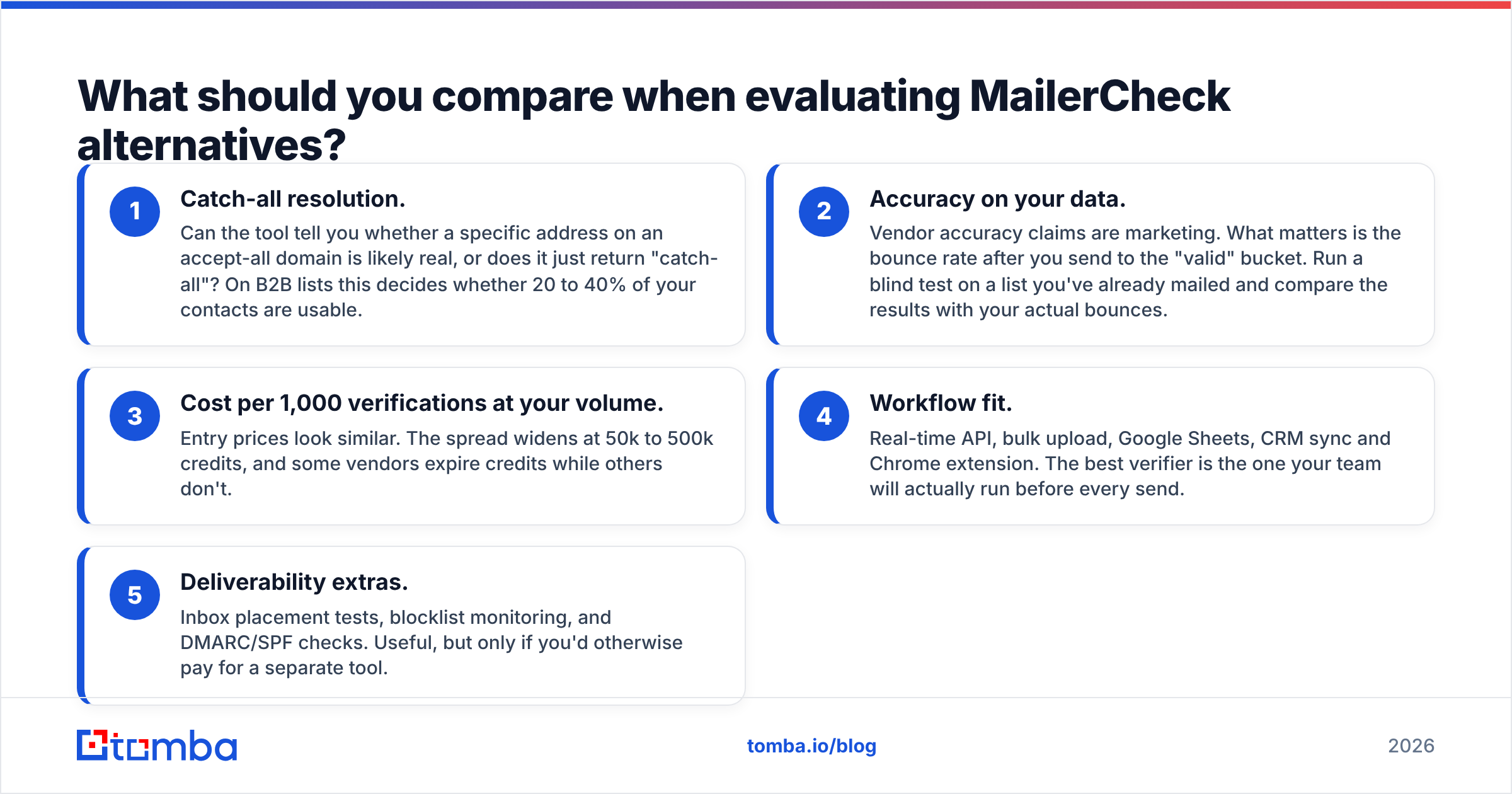
Before the tool-by-tool breakdown, here are the five attributes that actually separate verifiers in practice:
- Catch-all resolution. Can the tool tell you whether a specific address on an accept-all domain is likely real, or does it just return "catch-all"? On B2B lists this decides whether 20 to 40% of your contacts are usable.
- Accuracy on your data. Vendor accuracy claims are marketing. What matters is the bounce rate after you send to the "valid" bucket. Run a blind test on a list you've already mailed and compare the results with your actual bounces.
- Cost per 1,000 verifications at your volume. Entry prices look similar. The spread widens at 50k to 500k credits, and some vendors expire credits while others don't.
- Workflow fit. Real-time API, bulk upload, Google Sheets, CRM sync and Chrome extension. The best verifier is the one your team will actually run before every send.
- Deliverability extras. Inbox placement tests, blocklist monitoring, and DMARC/SPF checks. Useful, but only if you'd otherwise pay for a separate tool.
Which MailerCheck alternatives are worth considering in 2026?#
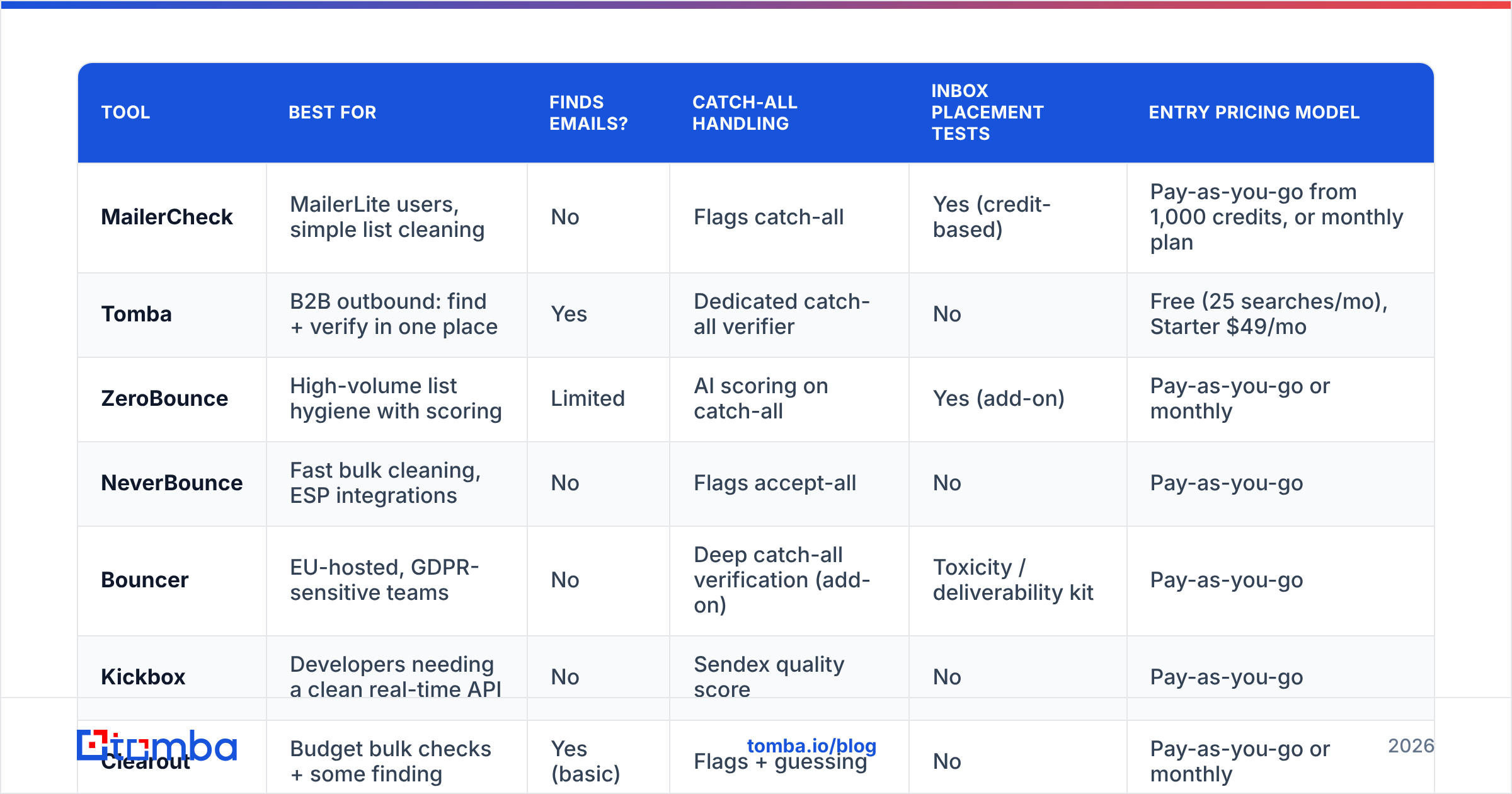
Here's the shortlist at a glance. Prices are approximate entry points at the time of writing and change frequently, so treat them as directional.
| Tool | Best for | Finds emails? | Catch-all handling | Inbox placement tests | Entry pricing model |
|---|---|---|---|---|---|
| MailerCheck | MailerLite users, simple list cleaning | No | Flags catch-all | Yes (credit-based) | Pay-as-you-go from 1,000 credits, or monthly plan |
| Tomba | B2B outbound: find + verify in one place | Yes | Dedicated catch-all verifier | No | Free (25 searches/mo), Starter $49/mo |
| ZeroBounce | High-volume list hygiene with scoring | Limited | AI scoring on catch-all | Yes (add-on) | Pay-as-you-go or monthly |
| NeverBounce | Fast bulk cleaning, ESP integrations | No | Flags accept-all | No | Pay-as-you-go |
| Bouncer | EU-hosted, GDPR-sensitive teams | No | Deep catch-all verification (add-on) | Toxicity / deliverability kit | Pay-as-you-go |
| Kickbox | Developers needing a clean real-time API | No | Sendex quality score | No | Pay-as-you-go |
| Clearout | Budget bulk checks + some finding | Yes (basic) | Flags + guessing | No | Pay-as-you-go or monthly |
| GlockApps | Inbox placement and spam testing | No | N/A (not a verifier) | Yes, core product | Monthly subscription |
The sections below explain where each one wins and where it falls short.
Is Tomba a good MailerCheck alternative for B2B teams?#
If your list comes from prospecting rather than signups, yes. Tomba is an email finder first: you look up a person by name and domain, search a whole company with domain search, or pull contacts from LinkedIn via the browser extension. Every result comes with a verification status, so you aren't exporting from one tool and importing into another.
For lists you already own, the Tomba email verifier runs SMTP, MX, syntax, disposable and role-based checks. The part that matters most against MailerCheck is catch-all handling. Tomba's catch-all verifier tries to resolve whether a specific address on an accept-all domain is likely deliverable, instead of leaving it in limbo.
Strengths
- Finding and verification in one credit pool
- Bulk upload, API, Google Sheets, Chrome extension, CRM integrations (HubSpot, Salesforce, Pipedrive)
- Free tier for testing on real data before paying
Limitations
- No inbox placement testing or seed-list reports. Pair it with a deliverability tool if you need that.
- If you only clean a newsletter list and never prospect, a pure verifier may be cheaper per check.
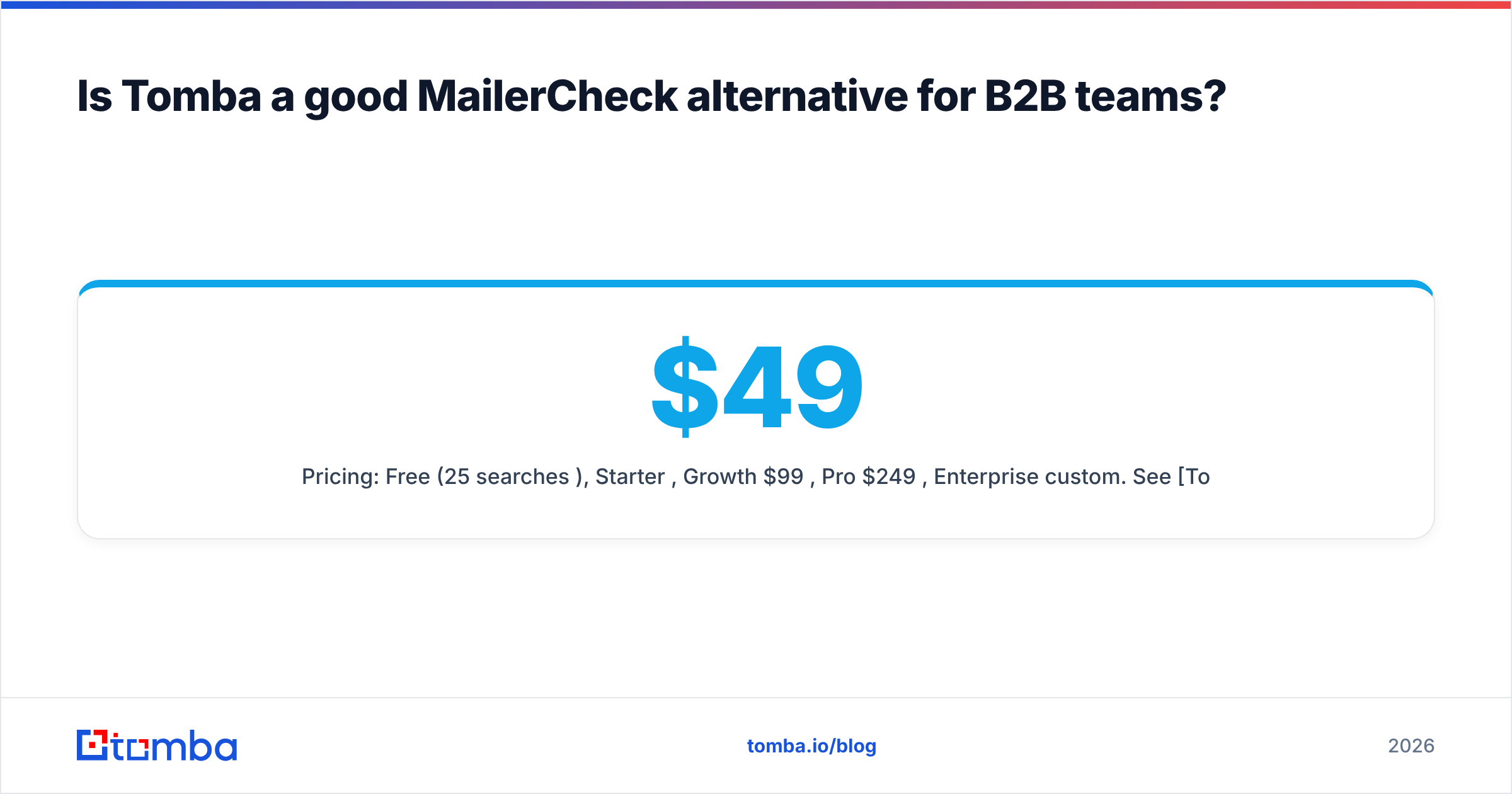
Pricing: Free (25 searches/month), Starter $49/mo, Growth $99/mo, Pro $249/mo, Enterprise custom. See Tomba pricing for credit allocations per plan.
Is ZeroBounce better than MailerCheck?#
ZeroBounce is the closest like-for-like replacement, and it goes further on several fronts. Alongside standard verification, it offers an AI scoring model that ranks catch-all and unknown addresses by likelihood of engagement, plus activity data showing whether an address has been active recently. It also sells inbox placement testing, blocklist monitoring and DMARC tools, so a MailerCheck user won't lose deliverability features by switching.
Choose it if you clean large lists regularly and want more than a binary valid/invalid verdict on risky addresses.
Watch out for total cost once you stack scoring and deliverability add-ons. For a deeper breakdown, see our ZeroBounce alternative comparison.
Is NeverBounce a cheaper MailerCheck alternative?#
NeverBounce (owned by ZoomInfo) is built for speed and integrations. It connects to a long list of ESPs and CRMs, cleans big files quickly, and offers a real-time API for signup forms. Per-1,000 pricing is competitive at volume.
Choose it if you want fast, no-frills bulk cleaning with a broad ESP integration catalog.
Watch out for catch-all results. NeverBounce labels accept-all addresses but doesn't attempt deep resolution, so B2B-heavy lists can end up with a large "unknown" bucket. It also has no inbox placement testing.
Should EU teams consider Bouncer instead of MailerCheck?#
Bouncer is a Poland-based verifier that leans on GDPR compliance and EU data handling, which matters if your legal team asks where uploaded lists are processed. It offers bulk and API verification, a toxicity check that flags addresses linked to spam traps or litigators, and a deep catch-all verification option.
Choose it if data residency and compliance documentation are part of your buying criteria, or your lists have a lot of accept-all domains.
Watch out for the add-on structure. Some advanced checks are billed separately from base verification.
Is Kickbox a good MailerCheck alternative for developers?#
Kickbox is a favourite of engineering teams because its API is clean, well documented and fast. Its Sendex score gives each address a quality rating rather than a flat status, which is handy when you want to set your own risk threshold in code.
Choose it if you're adding verification to signup forms or internal tools and want a dependable real-time API.
Watch out for the lack of prospecting and inbox placement features. It's a verifier and only a verifier.
Is Clearout worth it as a budget option?#
Clearout combines bulk verification with basic email finding and a form guard for signup pages. Per-credit pricing is usually on the affordable end, and it integrates with common CRMs and ESPs.
Choose it if you want low-cost bulk cleaning and occasional email lookups without paying for a full prospecting platform.
Watch out for finder coverage. Its lookup tools are secondary features, so hit rates on mid-market and enterprise contacts tend to trail dedicated finders.
Which tool replaces MailerCheck's inbox placement tests?#
If what you actually use in MailerCheck is the deliverability side (seeing whether a campaign lands in the inbox, promotions or spam), a verifier won't replace it. GlockApps is the specialist here. You send a campaign to its seed list and get placement results across major mailbox providers, plus spam filter checks, authentication diagnostics and DMARC analytics.
Choose it if your bounce rate is fine but open rates dropped and you suspect spam-folder placement.
Watch out for the scope. GlockApps won't clean your list, so most teams pair it with a verifier.
Before paying for any placement tool, rule out the basics with free checks: your SPF record, a blocklist lookup, and a spam score on your copy.

How do you pick the right MailerCheck alternative for your use case?#
Match the tool to the job, not to the feature list. A practical decision path:
- You prospect B2B contacts and send cold outreach. Use a combined finder and verifier (Tomba) so every contact is verified the moment you source it. Add catch-all verification, because corporate domains are where plain verifiers struggle.
- You run a large marketing list and clean it quarterly. ZeroBounce or NeverBounce. Compare per-1,000 cost at your real volume, not the entry tier.
- You collect signups and want to block bad addresses at the form. Kickbox or another real-time API with low latency.
- Compliance drives the purchase. Bouncer, for its EU positioning and documentation.
- Your problem is spam-folder placement, not bounces. GlockApps, paired with whichever verifier you already have.
- You're happy in MailerLite and send under 10k emails a month. Honestly, MailerCheck may still be the simplest choice. Don't switch for the sake of it.
How should you test a verifier before switching?#
Vendor accuracy numbers come from vendor-chosen test sets. Run your own blind test instead:
- Pull 1,000 addresses you've already emailed, with known bounce outcomes from your ESP logs.
- Run the same file through two or three tools on free trials or minimum credit packs.
- Score each tool on three numbers: how many known bounces it marked valid (false positives), how many delivered addresses it marked invalid (false negatives), and how many it left as unknown or catch-all.
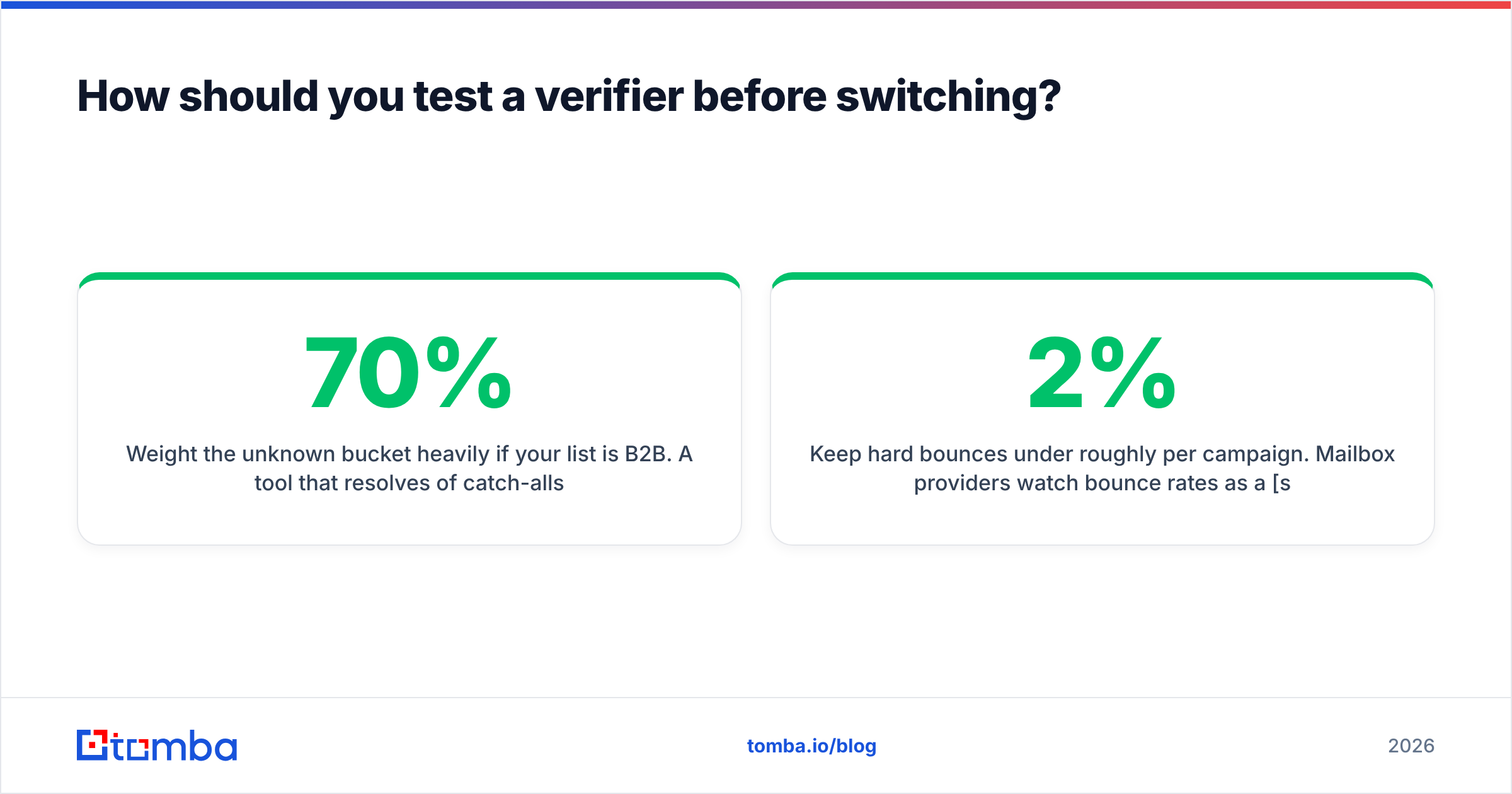
- Weight the unknown bucket heavily if your list is B2B. A tool that resolves 70% of catch-alls with acceptable accuracy is worth more than one that's 1% more accurate on easy domains.
- Time the bulk job and check the export format. A tool your SDRs find annoying won't get used before every send.
Keep hard bounces under roughly 2% per campaign. Mailbox providers watch bounce rates as a sender reputation signal, and recovering a burned domain takes far longer than cleaning a list.
What are the most common mistakes when switching verifiers?#
- Verifying once and never again. B2B data decays as people change jobs. Re-verify any segment older than about 90 days before a sequence.
- Sending to the whole catch-all bucket. Either resolve catch-alls with a dedicated check or send to them in small, monitored batches.
- Ignoring role-based addresses. info@ and sales@ inboxes rarely reply to cold email and often have stricter filtering.
- Comparing entry prices only. A tool that's cheaper at 1,000 credits can cost more at 100,000. Model your annual volume.
- Assuming verification fixes deliverability. Clean lists prevent bounces. Inbox placement also depends on authentication, warmup, sending volume and copy.
Final verdict: which MailerCheck alternative should you choose?#
MailerCheck is a credible, fairly priced verifier, especially inside the MailerLite ecosystem. You outgrow it when your lists come from prospecting rather than signups, when catch-all domains make up a big share of your contacts, or when you need integrations and deliverability depth it doesn't offer.
For pure list hygiene at scale, ZeroBounce and NeverBounce are the established picks, Bouncer suits compliance-led teams, and Kickbox suits API-first teams. GlockApps is the one to add if inbox placement is your real problem.
If you're building B2B contact lists, verification shouldn't be a separate step at all. The Tomba Email Finder finds professional addresses by name, domain or company and returns each one with a verification status, with catch-all checks available when you need them. Start on the free plan with 25 searches a month, run your own sample through it, and compare the bounce rate with your current setup before you pay for anything.
Related guides#
// start free
See who Tomba finds at any company
Type a company's domain to see its people, their roles and verified work emails, each with the pages it was found on. Free account, no card.
Free plan · No credit card required · GDPR & CCPA
// about the author