Cloduraai vs Market Location: B2B Data Platforms Compared
Clodura.ai vs Market Location: an honest, side-by-side look at data coverage, accuracy, pricing, and workflow fit — plus where a leaner email-finder beats both.
Cloduraai vs Market Location comes down to one question: do you pay for a bigger database, or a more accurate one? These two B2B data tools sit on opposite ends of that trade-off. Pick the wrong one and you waste budget. You also burn your sender reputation with bounced emails.
This is a neutral, side-by-side breakdown. No vendor is perfect. By the end, you'll know which platform fits your team — and where a focused email finder beats both on cost per verified contact.
TL;DR#
- Clodura.ai is a broad sales-intelligence suite: a large North America-weighted contact database, buyer intent, org charts, and built-in email cadences. Best for outbound teams that want an all-in-one.
- Market Location is a UK/Europe-focused B2B marketing database, strong on firmographics, telemarketing lists, and direct-mail data. Best for region-specific list buying and multi-channel campaigns.
- Accuracy, not size, is the real cost driver. Both platforms carry stale records; you pay for it in bounces unless you verify before sending.
- Pricing models differ sharply: Clodura sells annual SaaS seats; Market Location leans toward list licensing and managed data services.
- A pay-as-you-go email finder like Tomba often delivers a lower cost per verified contact when you only need reachable emails, not a full intelligence stack.
What is Clodura.ai?#
Clodura.ai is a sales-prospecting and sales-intelligence platform built around a self-service contact database (the vendor cites hundreds of millions of B2B contacts, heavily weighted toward North America). Beyond raw records, it bundles direct-dial numbers, technographic and buyer-intent signals, organizational charts, and a lightweight email-sequencing tool so reps can prospect and send from one place.
The pitch is consolidation: instead of stitching together a database, a verifier, and a cadence tool, you get one login. That's genuinely useful for a small SDR team. The trade-off is depth — each module is "good enough" rather than best-in-class, and data freshness varies widely by region and seniority. You can read real user impressions on Clodura.ai's G2 profile and the vendor's own clodura.ai site.
What is Market Location?#
Market Location is a UK-based B2B data and marketing services provider with a long history in direct marketing. Its core strength is firmographic breadth across British and European businesses: company records, decision-maker contacts, telephone-marketing data, postal/direct-mail lists, and email marketing data, often sold as licensed lists or delivered through managed data services.
Where Clodura targets self-service reps, Market Location historically serves marketers running multi-channel campaigns — direct mail, telemarketing, and email — who need clean, segmented lists for a specific territory or industry. The model is closer to traditional list licensing than to a modern SaaS seat, which matters a lot for how (and how often) you can use the data.

Cloduraai vs Market Location: the core comparison#
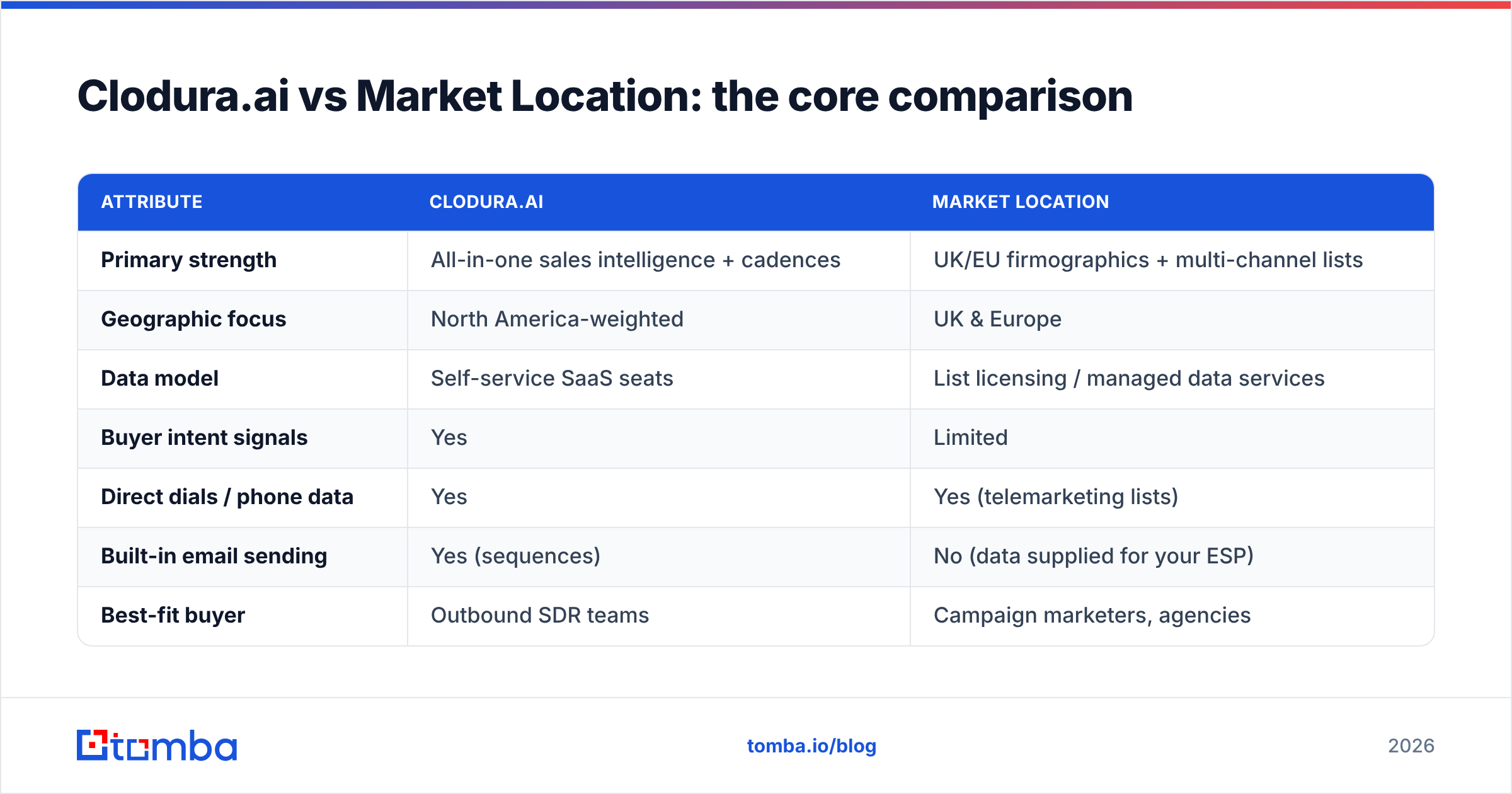
Here's the Cloduraai vs Market Location head-to-head on the attributes that change your results.
| Attribute | Clodura.ai | Market Location |
|---|---|---|
| Primary strength | All-in-one sales intelligence + cadences | UK/EU firmographics + multi-channel lists |
| Geographic focus | North America-weighted | UK & Europe |
| Data model | Self-service SaaS seats | List licensing / managed data services |
| Buyer intent signals | Yes | Limited |
| Direct dials / phone data | Yes | Yes (telemarketing lists) |
| Built-in email sending | Yes (sequences) | No (data supplied for your ESP) |
| Best-fit buyer | Outbound SDR teams | Campaign marketers, agencies |
| Pricing transparency | Published tiers, annual bias | Quote-based, list-dependent |
The pattern is clear: Clodura is a workflow tool, Market Location is a data source. If your bottleneck is "I need software to run outbound," Clodura leans your way. If your bottleneck is "I need a clean, licensed list for a UK direct-mail and telemarketing push," Market Location fits better.
Which one is more accurate?#
Neither wins accuracy by default — and that's the point. Large databases drift over time. People change jobs at roughly 20–30% per year, so any static list decays fast. Clodura's North America focus means its US data is usually fresher than its overseas coverage. Market Location keeps its UK firmographics clean. But the email fields in licensed lists are the most likely to go stale between refreshes.
The takeaway for both: verify before you send. A bounce rate above 3–5% tells inbox providers you're not keeping your list clean. That drags down email deliverability for your whole domain. So run any purchased or exported list through an email verifier before your first send. It's the highest-ROI step most teams skip. If a provider's data can't survive verification, its headline database size is just a vanity metric.
How does pricing compare?#
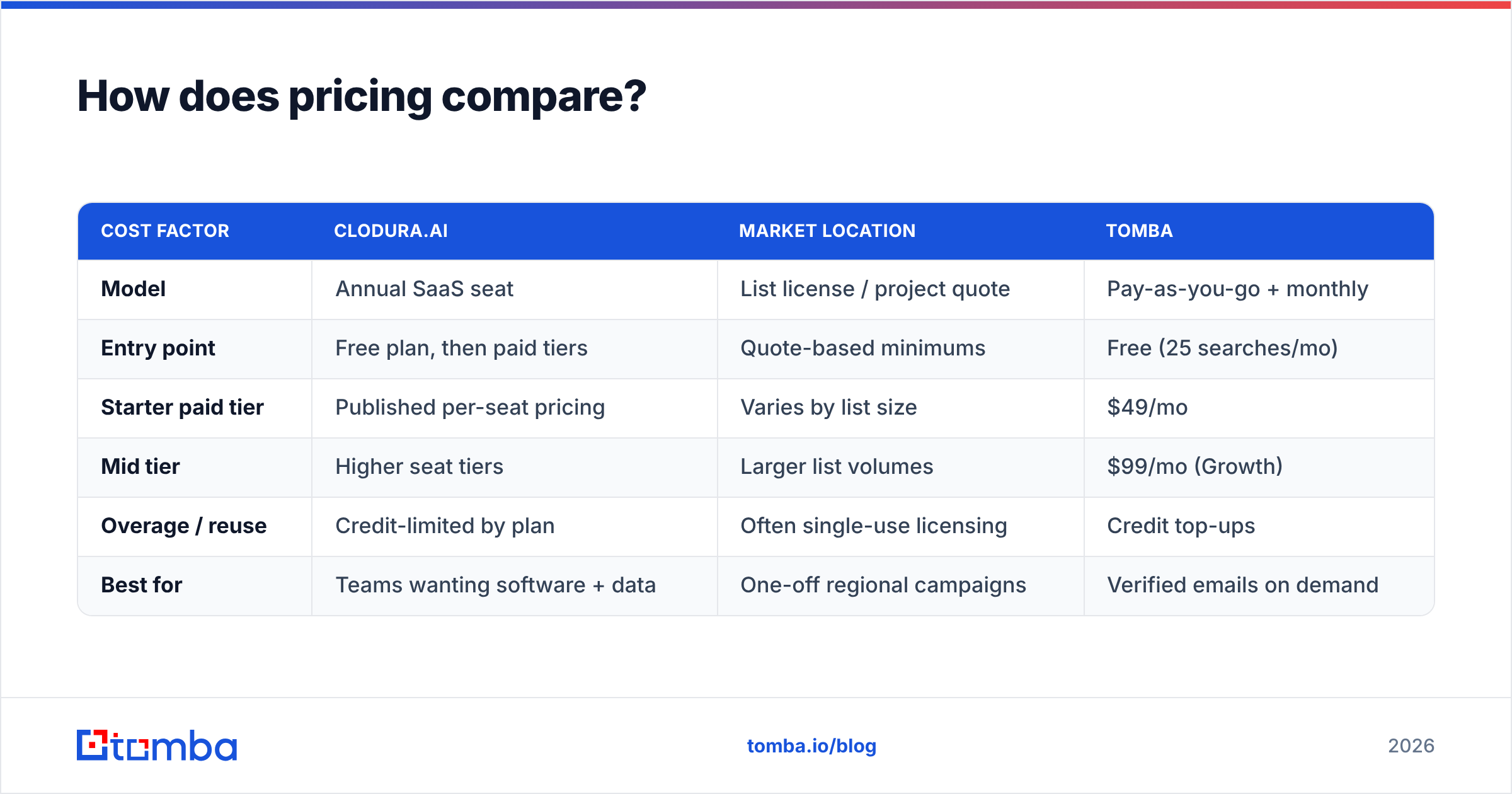
This is where the two platforms diverge most, and where total cost of ownership can surprise you.
| Cost factor | Clodura.ai | Market Location | Tomba |
|---|---|---|---|
| Model | Annual SaaS seat | List license / project quote | Pay-as-you-go + monthly |
| Entry point | Free plan, then paid tiers | Quote-based minimums | Free (25 searches/mo) |
| Starter paid tier | Published per-seat pricing | Varies by list size | $49/mo |
| Mid tier | Higher seat tiers | Larger list volumes | $99/mo (Growth) |
| Overage / reuse | Credit-limited by plan | Often single-use licensing | Credit top-ups |
| Best for | Teams wanting software + data | One-off regional campaigns | Verified emails on demand |
Two things to watch. First, Clodura's better rates usually require annual commitment, so "monthly" pricing you see may not reflect what you actually pay. Second, list-licensing models like Market Location's can restrict reuse — a list bought for one campaign may not be licensed for indefinite CRM enrichment, so read the terms. Compare both against transparent Tomba pricing if predictable per-contact cost matters to you.
Where does a focused email finder beat both?#
When your real need is "get me verified, reachable email addresses for these companies," a full intelligence suite is overkill and a licensed list is overpriced. That's the gap a dedicated finder fills.
Consider the practical workflow differences:
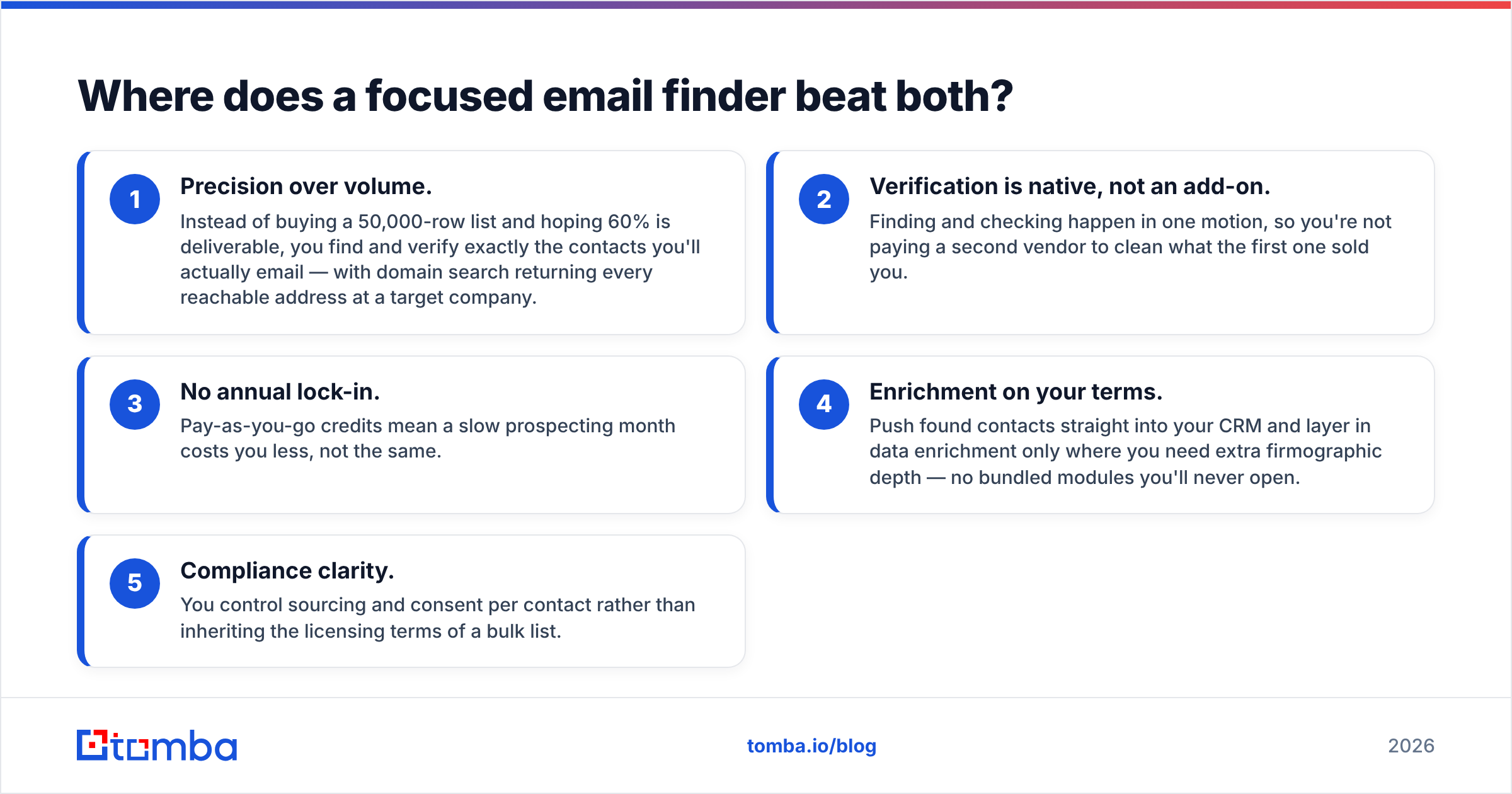
- Precision over volume. Instead of buying a 50,000-row list and hoping 60% is deliverable, you find and verify exactly the contacts you'll actually email — with domain search returning every reachable address at a target company.
- Verification is native, not an add-on. Finding and checking happen in one motion, so you're not paying a second vendor to clean what the first one sold you.
- No annual lock-in. Pay-as-you-go credits mean a slow prospecting month costs you less, not the same.
- Enrichment on your terms. Push found contacts straight into your CRM and layer in data enrichment only where you need extra firmographic depth — no bundled modules you'll never open.
- Compliance clarity. You control sourcing and consent per contact rather than inheriting the licensing terms of a bulk list.
This isn't an argument that Clodura.ai or Market Location are bad tools — both are respected in their lanes. It's that "biggest database" and "cheapest list" are the wrong targets. Cost per verified, emailable contact is the number that maps to pipeline, and a lean finder usually wins it.
Which should you choose?#
Match the tool to the job:
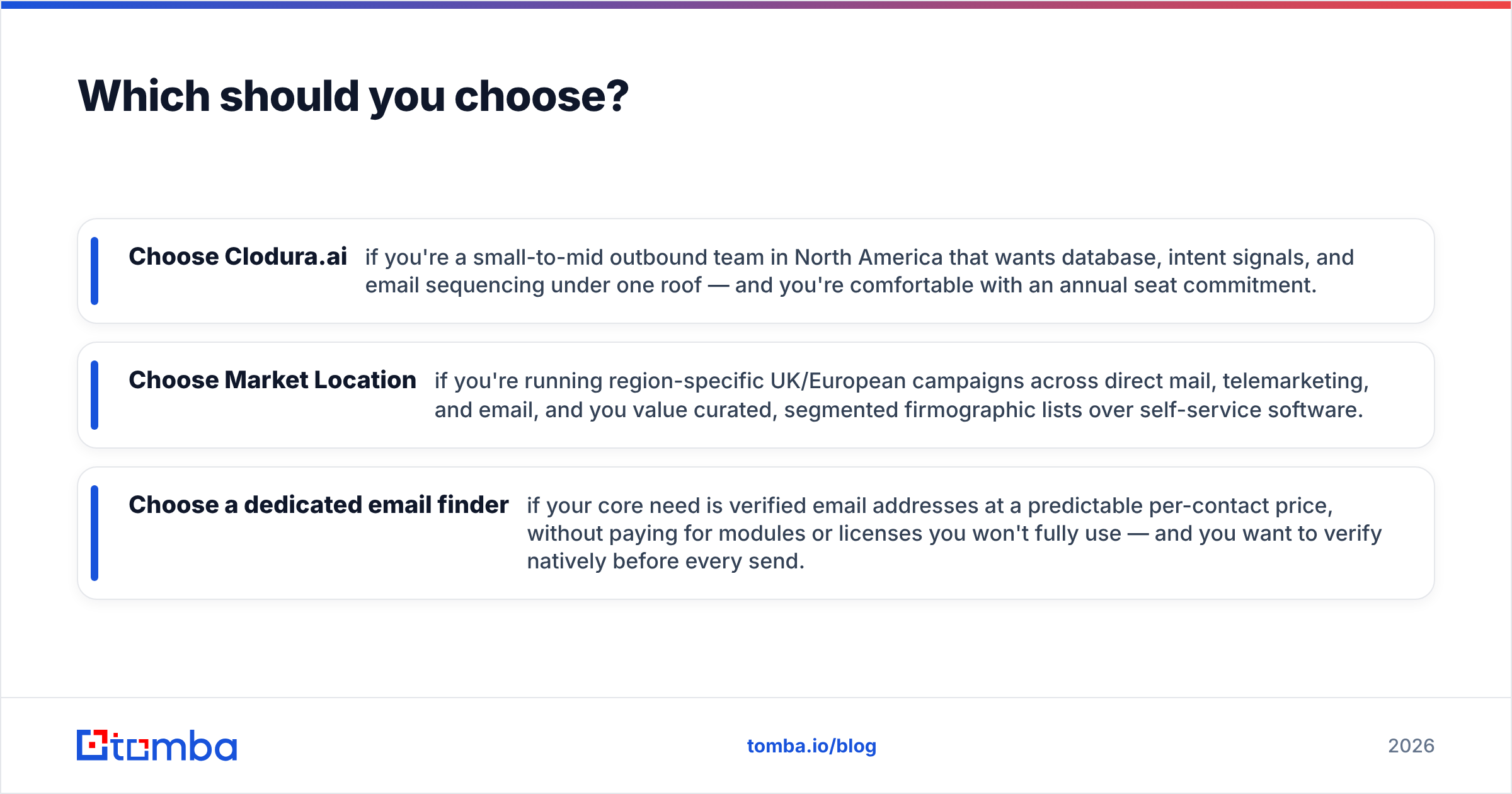
- Choose Clodura.ai if you're a small-to-mid outbound team in North America that wants database, intent signals, and email sequencing under one roof — and you're comfortable with an annual seat commitment.
- Choose Market Location if you're running region-specific UK/European campaigns across direct mail, telemarketing, and email, and you value curated, segmented firmographic lists over self-service software.
- Choose a dedicated email finder if your core need is verified email addresses at a predictable per-contact price, without paying for modules or licenses you won't fully use — and you want to verify natively before every send.
Many teams end up running a hybrid: an intelligence platform for accounts and signals, plus a finder-and-verifier for the actual contact data that has to be deliverable. If you're evaluating the broader field, our roundups of an Apollo alternative and a Clearbit alternative cover adjacent trade-offs, and Capterra's B2B data category is a useful neutral shortlist.
The bottom line#
The Cloduraai vs Market Location choice really solves two different problems wearing similar labels. Clodura is software-first and North America-weighted, built for reps running sequences. Market Location is data-first and UK/EU-focused, built for marketers running lists. Neither is more accurate by default. Both decay, and both demand verification before you trust them.
If what you actually need is reachable emails at a fair, transparent price, skip the debate over whose database is bigger. Start free with the Tomba Email Finder — 25 searches a month, no annual lock-in. Find the exact contacts you'll email, verify them in the same flow, and pay only for what you use. That's the metric that turns into replies.
Related guides#
// get started
Find, verify and enrich your first contacts today
Start on the free plan with 25 searches a month, then scale when your team is ready.
Free plan · No credit card required · GDPR & CCPA
// about the author