Clodura.ai vs ReachStream (2026): B2B Data Platforms Compared
Clodura.ai and ReachStream both promise clean B2B contact data at a fair price — but they solve different problems. Here's an honest, feature-by-feature breakdown to help you pick.
Choosing between Clodura.ai and ReachStream comes down to one question: do you want an all-in-one sales prospecting engine, or a low-cost contact database you can export and own? Both platforms sell B2B data, both undercut the enterprise giants on price, and both get pitched as "the affordable ZoomInfo alternative." But they are built for different buyers, and picking the wrong one wastes budget and burns your sender reputation with bad data.
This is a neutral, feature-by-feature breakdown — pricing, data accuracy, workflow, and the gaps neither vendor advertises — so you can decide which fits your motion.
TL;DR — Clodura.ai vs ReachStream at a glance#
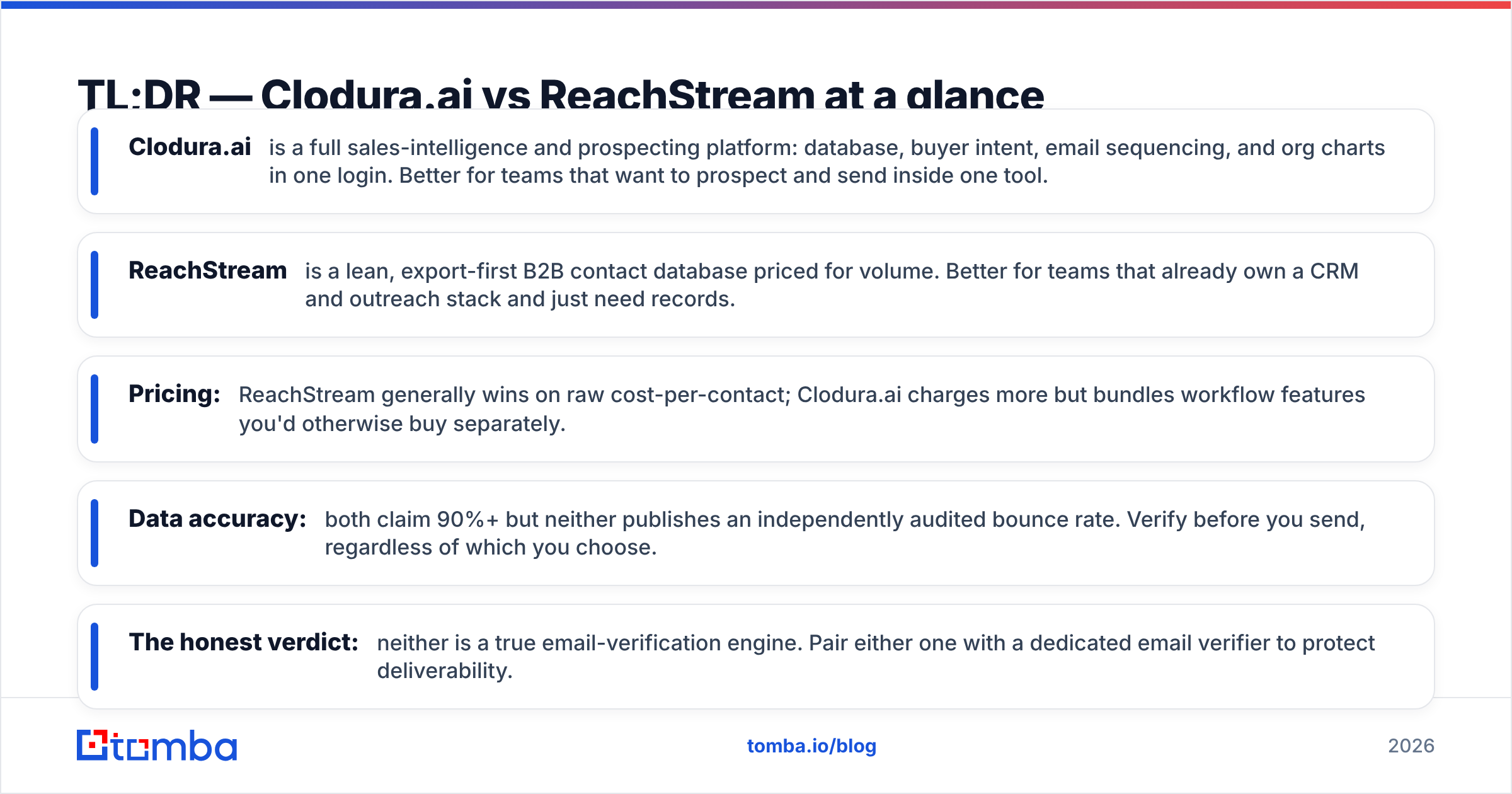
- Clodura.ai is a full sales-intelligence and prospecting platform: database, buyer intent, email sequencing, and org charts in one login. Better for teams that want to prospect and send inside one tool.
- ReachStream is a lean, export-first B2B contact database priced for volume. Better for teams that already own a CRM and outreach stack and just need records.
- Pricing: ReachStream generally wins on raw cost-per-contact; Clodura.ai charges more but bundles workflow features you'd otherwise buy separately.
- Data accuracy: both claim 90%+ but neither publishes an independently audited bounce rate. Verify before you send, regardless of which you choose.
- The honest verdict: neither is a true email-verification engine. Pair either one with a dedicated email verifier to protect deliverability.
What is Clodura.ai?#
Clodura.ai is an AI-driven sales prospecting platform built around a proprietary B2B database of roughly 600M+ contacts and 18M+ companies. Its pitch is "everything in one place": you search for accounts, pull direct-dial numbers and verified emails, see org charts and buyer-intent signals, and then run email sequences without leaving the app.
Think of it like a Swiss Army knife for outbound. The database is the blade you reach for most, but the sequencing, intent data, and technographic filters are the extra tools folded into the same handle. That bundling is the whole value proposition — and also the reason it costs more per seat than a plain data vendor.
Clodura leans heavily on its automated email-sequencing and cadence features, which puts it in closer competition with tools like Apollo than with a pure list provider. If you want to read how bundled prospecting suites stack up against focused tools, our Apollo alternative breakdown covers the same trade-off.
What is ReachStream?#
ReachStream is a B2B contact and company database designed for one job: give you exportable records at a predictable, low price. It markets a database of 120M+ contacts across industries, with filters for title, industry, location, company size, and revenue. You build a list, you export it, you own it.
The mental model here is a wholesale warehouse. You are not paying for a fancy storefront or a barista — you are paying for pallets of data at a low unit cost, and you bring your own truck (your CRM, your sequencer, your verification step). For teams that already have a mature outreach stack, that's exactly what they want. For teams that want guidance and workflow, it can feel bare.
ReachStream's subscription and pay-as-you-go options make it attractive to smaller teams and agencies that need periodic list pulls rather than a always-on prospecting cockpit.
Clodura.ai vs ReachStream: the full comparison table#
Here's the head-to-head on the attributes that actually change your buying decision. Prices reflect publicly listed tiers at the time of writing and shift often — confirm on each vendor's page before committing.
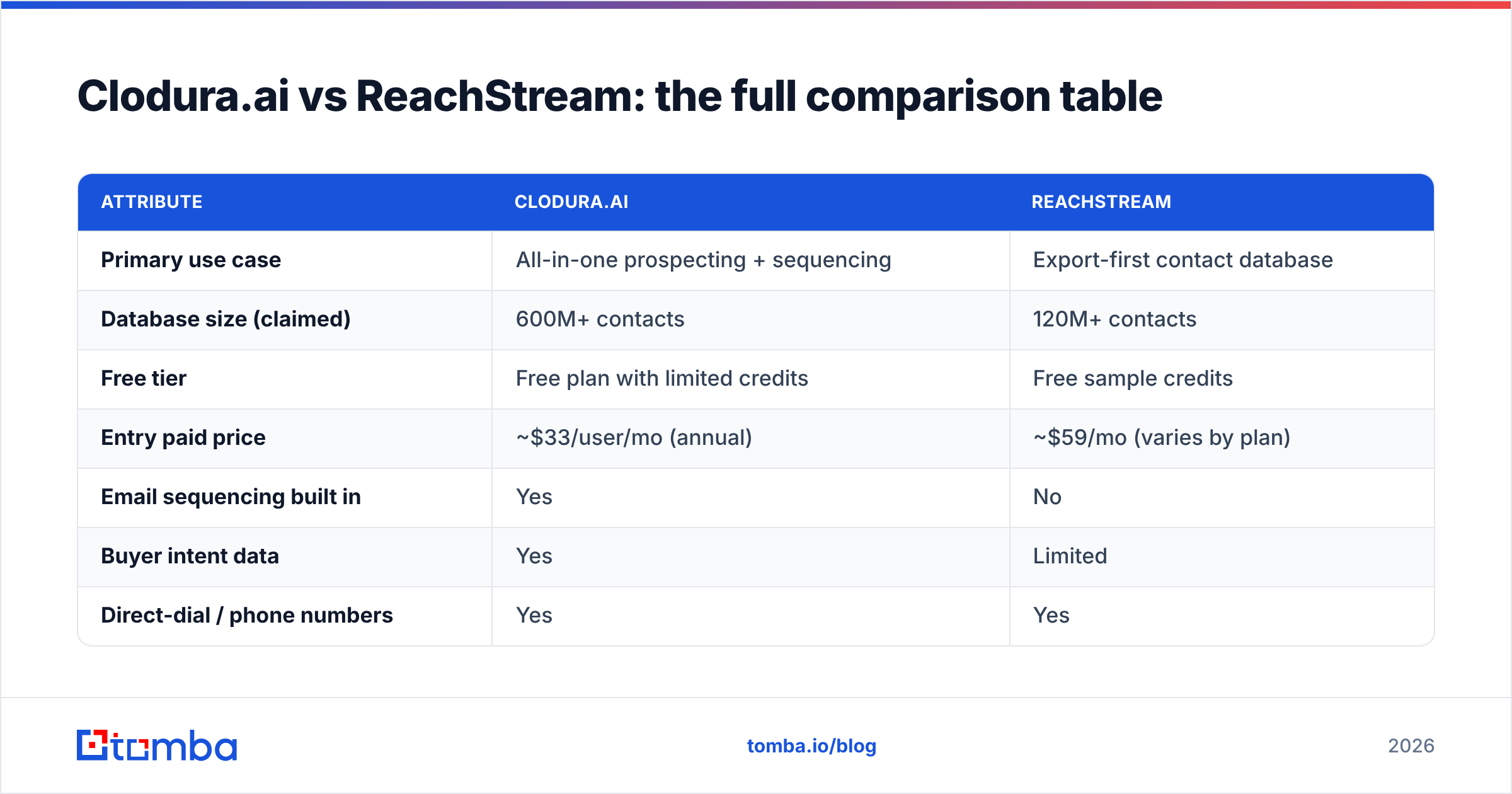
| Attribute | Clodura.ai | ReachStream |
|---|---|---|
| Primary use case | All-in-one prospecting + sequencing | Export-first contact database |
| Database size (claimed) | 600M+ contacts | 120M+ contacts |
| Free tier | Free plan with limited credits | Free sample credits |
| Entry paid price | ~$33/user/mo (annual) | ~$59/mo (varies by plan) |
| Email sequencing built in | Yes | No |
| Buyer intent data | Yes | Limited |
| Direct-dial / phone numbers | Yes | Yes |
| Data export (CSV) | Yes | Yes (core feature) |
| Best for | SDR teams wanting one tool | Teams with existing stack |
| Independent bounce audit published | No | No |
The pattern is clear: Clodura.ai charges for workflow, ReachStream charges for records. If you strip sequencing and intent out of Clodura, you're paying a premium for data you could source cheaper elsewhere. If you add a sequencer and verifier on top of ReachStream, your true all-in cost creeps toward Clodura's bundled price. Model your real total cost, not the sticker.
Is Clodura.ai better than ReachStream?#
It depends entirely on your team's maturity and stack — there is no universal winner.
Choose Clodura.ai if:
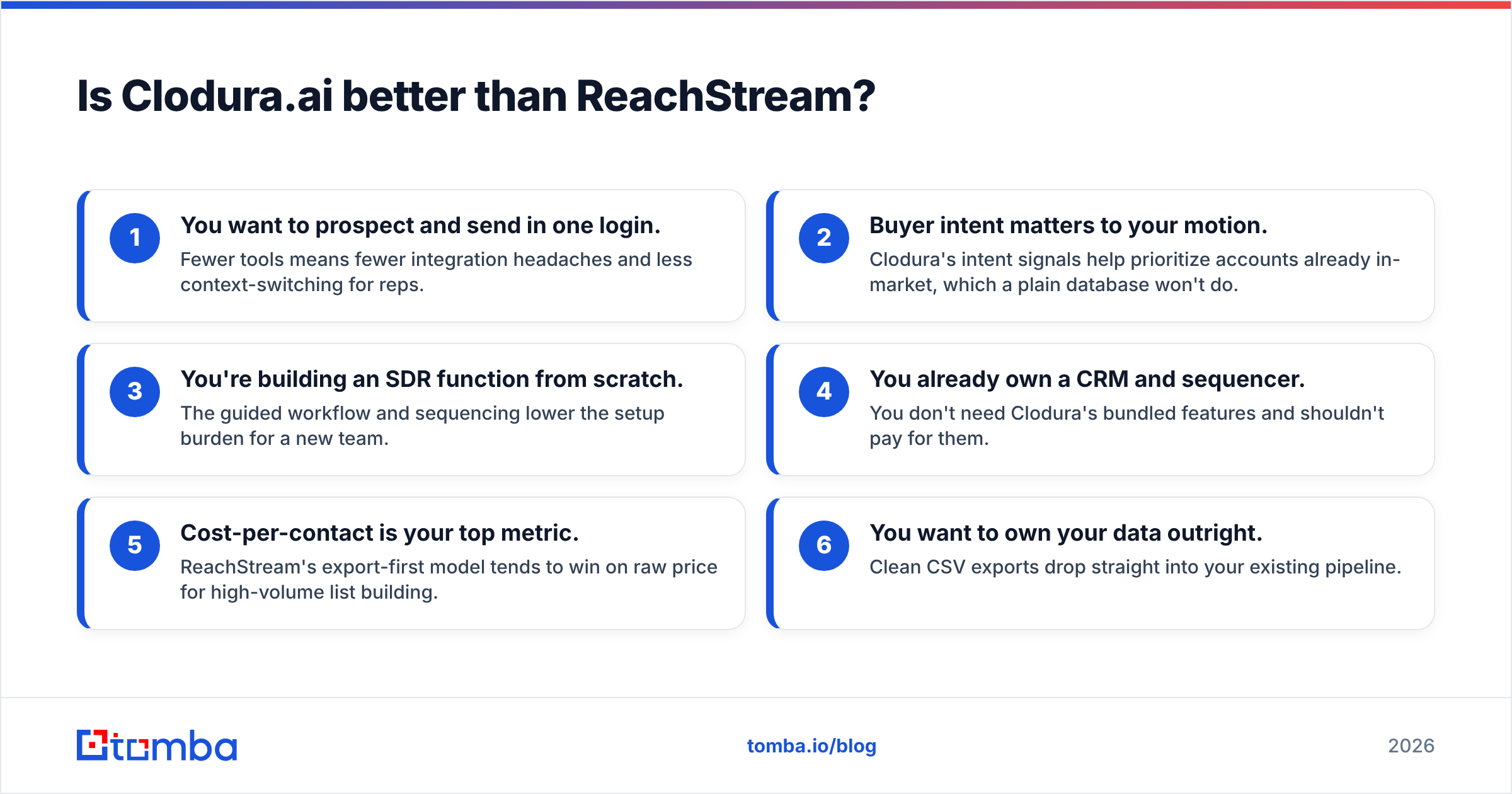
- You want to prospect and send in one login. Fewer tools means fewer integration headaches and less context-switching for reps.
- Buyer intent matters to your motion. Clodura's intent signals help prioritize accounts already in-market, which a plain database won't do.
- You're building an SDR function from scratch. The guided workflow and sequencing lower the setup burden for a new team.
Choose ReachStream if:
- You already own a CRM and sequencer. You don't need Clodura's bundled features and shouldn't pay for them.
- Cost-per-contact is your top metric. ReachStream's export-first model tends to win on raw price for high-volume list building.
- You want to own your data outright. Clean CSV exports drop straight into your existing pipeline.
One caution that applies to both: bundled "verified" flags are not the same as a real-time verification pass. A database can mark an address as valid based on when it was last checked, which may be months ago. That's how a "90% accurate" list still produces a 12% bounce rate on send day.
How accurate is the data — really?#
Both vendors advertise accuracy figures north of 90%, and neither publishes an independent, third-party bounce audit you can inspect. That's not unique to them — it's the norm across the industry, which is exactly why you should treat any accuracy claim as a starting point, not a guarantee.
Data decays fast. Studies from vendors like HubSpot have long pegged B2B database decay at roughly 22–30% per year as people change jobs, companies get acquired, and email formats change. A record that was accurate when it entered the database can be dead six months later. No provider — Clodura, ReachStream, or anyone else — beats that decay curve permanently.
The practical takeaway: verify at the moment of send, not at the moment of purchase. Run your exported list through a dedicated verification step to catch the records that have gone stale since the database last touched them. Tomba's catch-all verifier also handles the domains that generic checkers mark "unknown," which is where a surprising share of B2B bounces hide. If you want the mechanics, our email deliverability glossary entry explains how bounce rate feeds sender reputation.
You can validate any provider's quality cheaply: export a 200-contact sample, run it through a verifier, and measure the real deliverable rate before you buy the annual plan. Do this for both Clodura and ReachStream and let the numbers, not the marketing, decide.
Which is cheaper — and what's the true cost?#
ReachStream usually wins the sticker-price comparison, but the sticker price is not your real cost.
Your true cost per usable contact is:
- The subscription (per seat or per credit)
- Plus the verification pass you must run to hit inbox
- Plus the wasted sends on records that bounce anyway
- Plus the tool time to stitch data into your CRM and sequencer
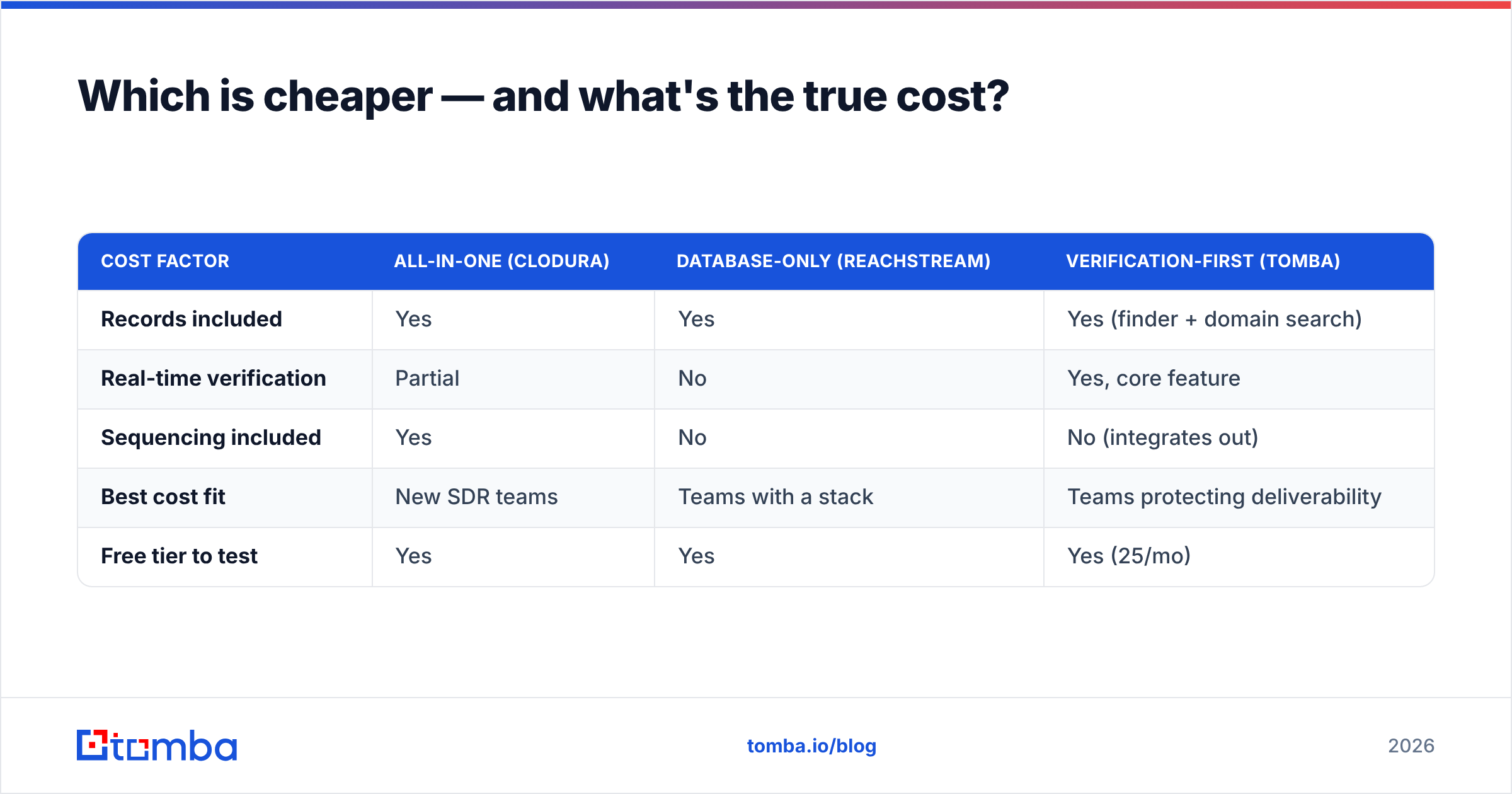
Clodura folds sequencing into its price, so a team without an existing outreach tool may find its bundled cost competitive once you'd otherwise buy a separate sequencer. ReachStream's low per-contact cost shines when you already own that infrastructure and only need records. Neither includes independent verification, so budget for that line item in both cases.
For reference, here's how a focused, verification-first tool prices against these bundled models. Tomba runs a free tier (25 searches/mo), then Starter at $49/mo, Growth at $99/mo, and Pro at $249/mo — full Tomba pricing is public. The point isn't that one number is lowest; it's that you should compare cost per verified, deliverable contact, not cost per raw record.
| Cost factor | All-in-one (Clodura) | Database-only (ReachStream) | Verification-first (Tomba) |
|---|---|---|---|
| Records included | Yes | Yes | Yes (finder + domain search) |
| Real-time verification | Partial | No | Yes, core feature |
| Sequencing included | Yes | No | No (integrates out) |
| Best cost fit | New SDR teams | Teams with a stack | Teams protecting deliverability |
| Free tier to test | Yes | Yes | Yes (25/mo) |
Where does a dedicated email finder fit in?#
Both Clodura and ReachStream are databases first. If your core problem is "I have a list of target companies and named prospects, and I need their correct, deliverable email addresses right now," a purpose-built finder is often faster and cleaner than filtering a giant database.
That's the gap a tool like Tomba fills. You can run a domain search to pull every known address pattern at a target company, use the email finder to resolve a specific first-name/last-name/domain combination, and pipe it through verification in the same flow. For teams working from a defined account list rather than casting a wide net, that finder-plus-verifier loop wastes less budget than paying for millions of records you'll never touch.
It's also worth noting where these platforms overlap with other data vendors. If you're cross-shopping, peers like BookYourData take a pay-as-you-go, verified-on-purchase approach that sits between Clodura's bundle and ReachStream's volume model — worth a look if neither extreme fits. Comparison directories like G2 are a good neutral place to read unfiltered user reviews of all three before you commit.
Clodura.ai vs ReachStream: the verdict#
Here's the honest bottom line.
- Pick Clodura.ai if you're standing up outbound from scratch and want database, intent, and sequencing under one roof — and you're willing to pay a premium for that convenience.
- Pick ReachStream if you already have a CRM and sequencer, care most about cost-per-contact, and want to own clean exports.
- Pick neither as your verification layer. Both are data sources, not deliverability tools. Whichever you choose, verify at send time.
The teams that get burned are the ones that treat a database subscription as a complete outbound stack. Data is the raw material; deliverability is the finished product. The gap between them is verification — and that's a line item you should never skip, no matter which vendor's name is on the invoice.
Get deliverable contacts without the guesswork#
If your real need is finding correct, verified email addresses for a defined list of target accounts — not renting millions of records you'll never use — start with a finder built for exactly that. The Tomba Email Finder resolves professional emails by name, domain, or company, and every result runs through verification so you protect your sender reputation from the first send. Try it on the free tier (25 searches a month, no card), test the deliverable rate against your current provider, and let the numbers pick your winner. Pair it with the Tomba API when you're ready to automate the whole flow.
Related guides#
Ready to find emails that actually work?
Join 150,000+ professionals who stopped guessing and started sending. Free credits on signup — no credit card required.
Get the Tomba newsletter
Practical outbound tactics and product updates — once every two weeks.
About the author