Cloduraai vs Woodpecker (2026): Which Sales Tool Wins?
Clodura.ai bundles a B2B database with sequences; Woodpecker is a focused cold email engine. Here's an honest, side-by-side breakdown to help you pick the right fit for your outbound stack in 2026.
You're comparing Cloduraai vs Woodpecker because both promise to fuel your outbound. But they solve different halves of the problem. One hands you a database and sequences under one login. The other is a sending engine built for deliverability, and it assumes you already have contacts. Pick wrong and you waste money. You either overpay for features you won't touch, or you bolt three tools together to do one job.
This guide is for revenue teams who care about pipeline, not logos. No fluff. No "both are great." Just a clear read on where each tool earns its price — and where it doesn't.
TL;DR — Cloduraai vs Woodpecker at a glance#
- Clodura.ai is an all-in-one sales intelligence platform. It gives you a ~600M-contact B2B database, intent signals, org charts, and built-in email sequences. It's best when you need data and outreach in one place.
- Woodpecker is a specialist cold email and deliverability tool. It doesn't sell you contacts. It just makes sure the emails you send actually land in the inbox.
- Data quality is Clodura's pitch. Inbox placement is Woodpecker's. They compete only at the sequence step, where their edges overlap.
- Pricing: Woodpecker is cheaper to start for pure sending. Clodura costs more, but it replaces a separate data vendor.
- The honest verdict: Buy Woodpecker if you already have a data source you trust. Buy Clodura if you want to skip a separate prospecting tool. Many teams pair a dedicated email finder with Woodpecker for a leaner, more accurate stack.
What is Clodura.ai?#
Clodura.ai is a sales prospecting platform built around a proprietary B2B contact database. You don't export a list from one tool and send from another. Instead, you work from a single dashboard. You search accounts, pull verified emails and direct dials, view org charts, watch buying-intent signals, and launch email sequences.
Think of it like a grocery store with a kitchen attached. You shop for ingredients (contacts) and cook the meal (outreach) without leaving the building. That convenience is the whole value proposition.
Core capabilities:
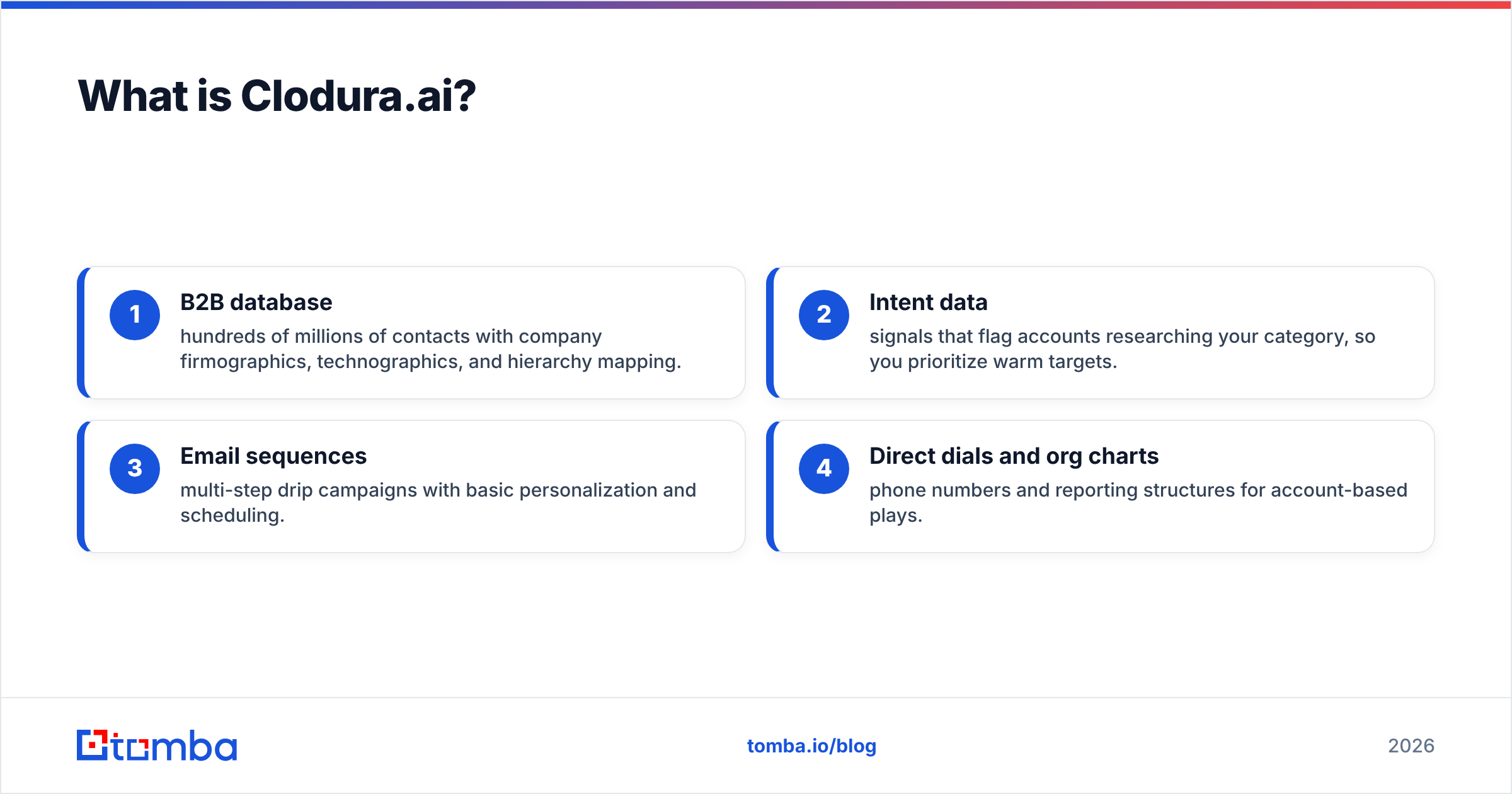
- B2B database — hundreds of millions of contacts with company firmographics, technographics, and hierarchy mapping.
- Intent data — signals that flag accounts researching your category, so you prioritize warm targets.
- Email sequences — multi-step drip campaigns with basic personalization and scheduling.
- Direct dials and org charts — phone numbers and reporting structures for account-based plays.
Where it wins: teams starting from zero who need contacts fast. They don't want to stitch together a database vendor plus a sending tool. Where it strains: its sequencing and deliverability tooling is competent, but not the deepest on the market. That's exactly where Woodpecker specializes.
What is Woodpecker?#
Woodpecker is a cold email automation tool with a near-religious focus on deliverability. It assumes you bring your own contacts — from a data provider, a scrape, or a tool like Tomba's domain search. Its job is simple. It sends those emails so they reach the primary inbox, not spam or promotions.
If Clodura is the grocery-store-with-kitchen, Woodpecker is a high-end espresso machine. It does one thing, and it does it better than the all-in-one box in the break room.
Core capabilities:
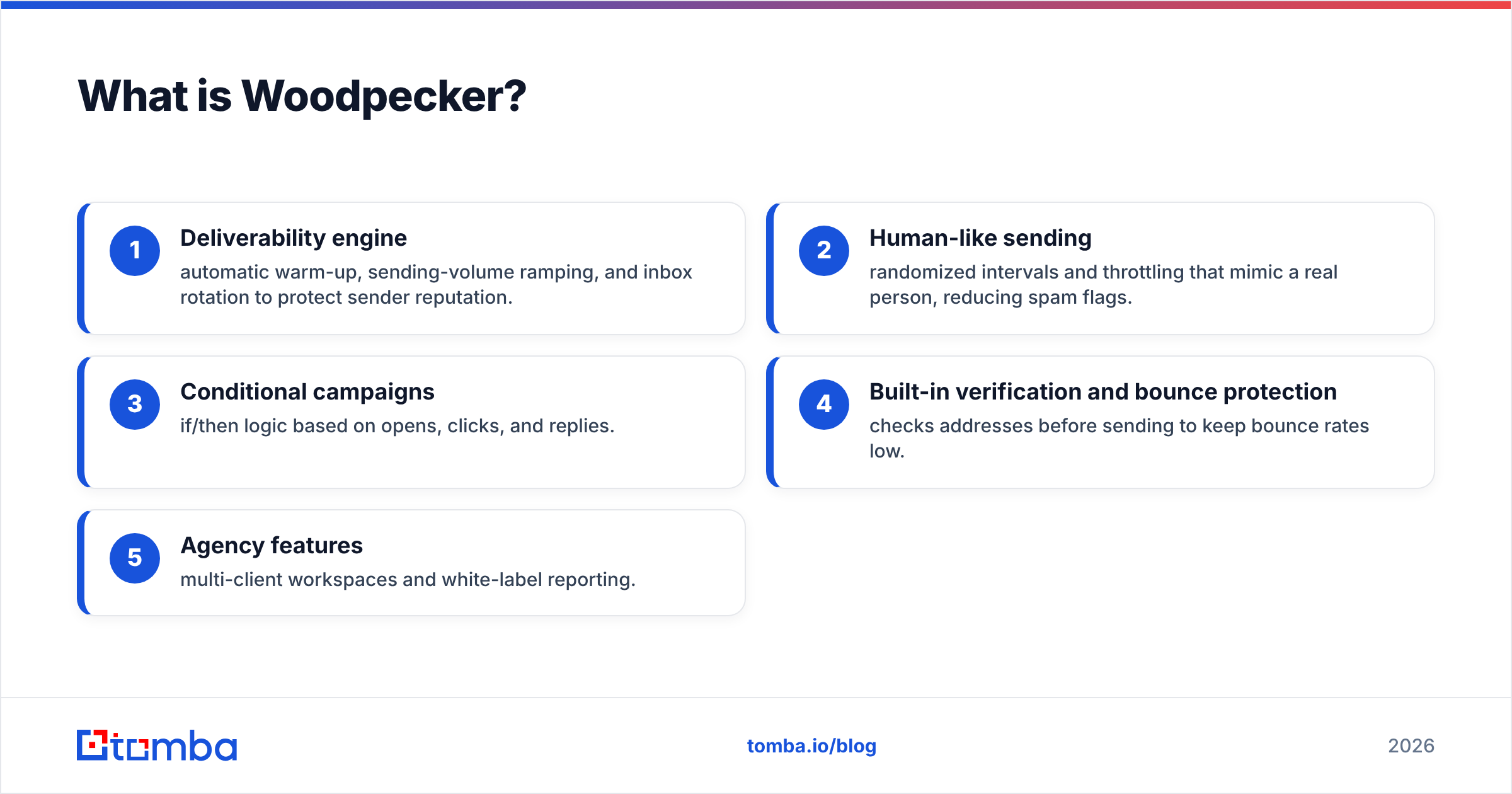
- Deliverability engine — automatic warm-up, sending-volume ramping, and inbox rotation to protect sender reputation.
- Human-like sending — randomized intervals and throttling that mimic a real person, reducing spam flags.
- Conditional campaigns — if/then logic based on opens, clicks, and replies.
- Built-in verification and bounce protection — checks addresses before sending to keep bounce rates low.
- Agency features — multi-client workspaces and white-label reporting.
Where it wins: reply rates and inbox placement for teams who already have a list. Where it strains: it gives you zero contacts. You always need a data source alongside it.
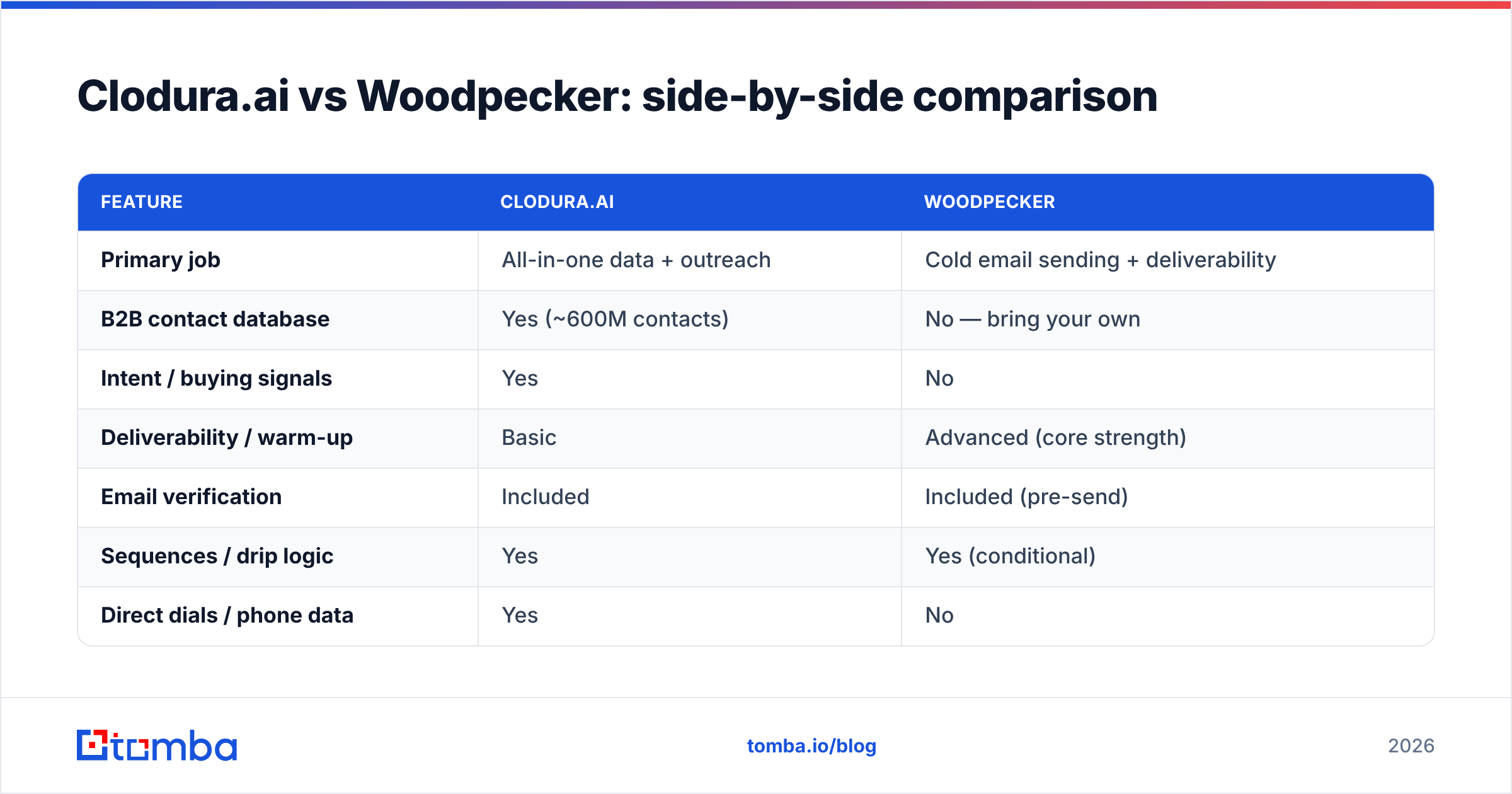
Cloduraai vs Woodpecker: side-by-side comparison#
Here's the head-to-head on the dimensions that change your buying decision.
| Feature | Clodura.ai | Woodpecker |
|---|---|---|
| Primary job | All-in-one data + outreach | Cold email sending + deliverability |
| B2B contact database | Yes (~600M contacts) | No — bring your own |
| Intent / buying signals | Yes | No |
| Deliverability / warm-up | Basic | Advanced (core strength) |
| Email verification | Included | Included (pre-send) |
| Sequences / drip logic | Yes | Yes (conditional) |
| Direct dials / phone data | Yes | No |
| Agency / white-label | Limited | Strong |
| Best for | Teams needing data + sending | Teams with data needing inbox placement |
| Learning curve | Higher (more surface area) | Lower (focused) |
The pattern is clear. Clodura is broad; Woodpecker is deep. Neither is "better" in the abstract. The winner depends on your bottleneck: finding people or reaching them.
Is Clodura.ai better than Woodpecker for cold outreach?#
Only if data is your bottleneck. Clodura is better when you don't have a reliable contact source and want to avoid buying one separately. You get lists, intent, and a sequencer in one subscription. That simplifies procurement and onboarding.
But "all-in-one" has a cost. Bundled databases are convenient. Yet their email accuracy varies by region and seniority. If a chunk of your Clodura contacts bounce, your email deliverability suffers — no matter how good your copy is. That's why many teams verify Clodura exports through a dedicated email verifier before loading them into a sequence.
Woodpecker wins the moment your list is solid. Its warm-up and inbox-rotation features keep you out of spam at scale. That's the single hardest part of cold email in 2026, as Google and Microsoft tighten sender rules. If you send high volume and live or die by reply rate, Woodpecker's deliverability edge beats Clodura's convenience.

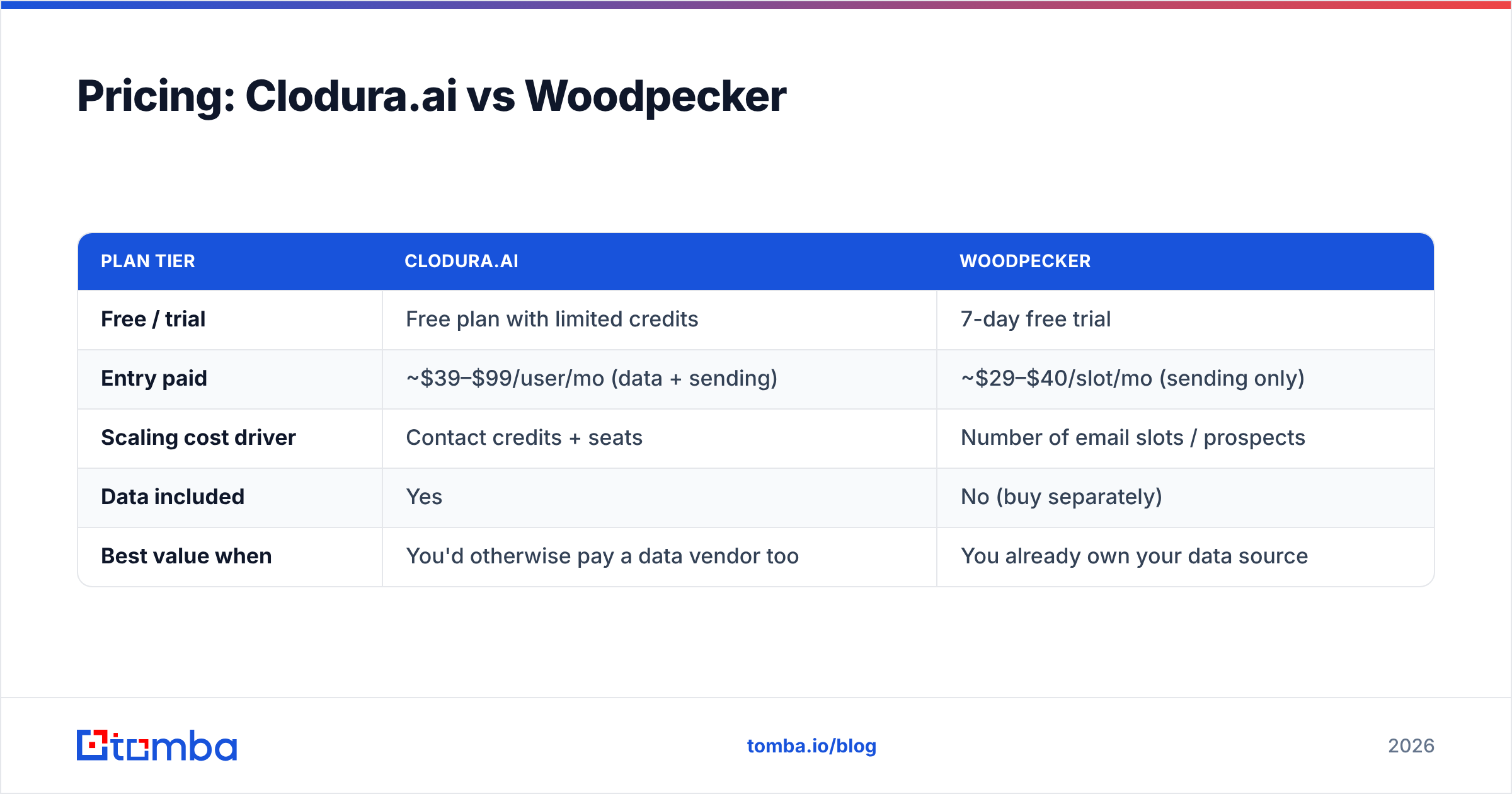
Pricing: Cloduraai vs Woodpecker#
Pricing shapes the decision more than any feature list. So here's the honest shape of it. Both vendors change plans often. Confirm current numbers on their sites before you commit.
| Plan tier | Clodura.ai | Woodpecker |
|---|---|---|
| Free / trial | Free plan with limited credits | 7-day free trial |
| Entry paid | ~$39–$99/user/mo (data + sending) | ~$29–$40/slot/mo (sending only) |
| Scaling cost driver | Contact credits + seats | Number of email slots / prospects |
| Data included | Yes | No (buy separately) |
| Best value when | You'd otherwise pay a data vendor too | You already own your data source |
Watch the trap in raw price. Woodpecker looks cheaper. But if you add a separate data provider, your total stack cost can match or beat Clodura. The reverse is also true. If you already have a data workflow — say, a bulk email finder that fills your CRM — Woodpecker's lower sticker price is the real number. Clodura's bundled data is spend you don't need.
Run the math on total cost of ownership, not the headline plan. For reference on how a standalone finder-plus-verifier stack prices out, compare against Tomba pricing. It starts free (25 searches/mo) and scales from $49/mo.
Which one has better deliverability?#
Woodpecker, clearly. It's the entire product thesis. Warm-up automation, human-like send patterns, bounce protection, and inbox rotation are first-class citizens, not add-ons. If your emails land in spam today, Woodpecker is the more direct fix.
Clodura includes deliverability basics. But they're a supporting feature of a data platform, not its core. That's fine for moderate volume. It's a liability at aggressive scale.
That said, no sending tool can fix a dirty list. Deliverability starts before the send, with clean, verified addresses. Two practices matter, whichever tool you choose:
- Verify every address pre-send. Even great data decays 2–3% per month as people change jobs. A quick pass through an email verification step cuts bounces that would wreck your reputation.
- Handle catch-all domains carefully. Many corporate domains accept all mail. That hides invalid addresses. A catch-all verifier tells you which risky addresses are worth the send.
Do those two things, and Woodpecker's engine has clean fuel to work with. Skip them, and even the best sender rotation won't save your inbox placement. For the fundamentals, HubSpot's guide to email deliverability is a solid primer.
Pros and cons#
Clodura.ai — pros: one login for data and outreach; built-in intent signals; org charts and direct dials for ABM; removes the need for a separate database vendor.
Clodura.ai — cons: deliverability is basic; data accuracy varies by segment; broader surface area means a steeper learning curve; you pay for data even if you already have a source.
Woodpecker — pros: best-in-class deliverability and warm-up; lower entry price for pure sending; strong agency/white-label features; focused, easy to learn.
Woodpecker — cons: no contact data at all; requires a separate prospecting tool; less useful for account-based plays needing phone and org data.
You can cross-check both on independent review sites like G2 and Capterra. See how real users rate support, uptime, and data freshness before you commit.
Which should you choose in 2026?#
Match the tool to your actual bottleneck:
- Choose Clodura.ai if you're starting from scratch. You need contacts and intent data, and you want the simplicity of one platform. It fits smaller teams that don't already run a data vendor.
- Choose Woodpecker if you already have a trusted data source. Your real problem is inbox placement, reply rate, or managing many client accounts. It's the deliverability specialist.
- Choose a best-of-breed stack if you want maximum accuracy and control. Pair a dedicated email finder and verifier with Woodpecker's sending. You get pinpoint data plus elite deliverability, often at a lower blended cost than an all-in-one. And you're not locked into one vendor's database.
That third path is where a lot of high-performing outbound teams land. A focused finder resolves emails by name and domain. It verifies them before they ever hit a sequence, so your list stays clean. A specialist like Woodpecker then keeps it landing. It's the difference between renting a bundle and building a stack you trust. Want to see how Clodura stacks up against other data platforms? The Apollo alternative breakdown covers the wider prospecting-tool landscape.
The bottom line#
Clodura.ai and Woodpecker aren't really the same product. One sells you people to email. The other makes sure those emails arrive. So the right question isn't "which is better." It's "which half of the outbound problem is costing me pipeline right now?" Fix that half first.
If your data is the weak link, start there. Tomba's Email Finder resolves professional email addresses by name, company, or domain. It verifies them in the same workflow. Then it drops clean contacts straight into whatever sender you choose — Woodpecker included. Start free with 25 searches a month. Scale from $49/mo when your outbound is ready to grow. Clean data in, replies out. That's the part no sending tool can do for you.
Related guides#
// get started
Find, verify and enrich your first contacts today
Start on the free plan with 25 searches a month, then scale when your team is ready.
Free plan · No credit card required · GDPR & CCPA
// about the author