9 Best Close CRM Alternatives in 2026 (Free & Paid Options)
Close is a strong calling-first CRM, but the per-seat price climbs fast. Here are 9 Close alternatives for 2026 — compared on price, calling, automation, and data.
Close is one of the better calling-first CRMs on the market — but "better" and "right for you" are not the same thing. As your team grows, the per-seat pricing climbs, the built-in power dialer becomes overkill for reps who live in email, and you may want deeper native data or a lighter interface. If any of that sounds familiar, this guide walks through the strongest Close alternatives in 2026, what each one is actually good at, and where the hidden costs hide.
TL;DR#
- Close is best for high-velocity inside sales teams that want calling, SMS, and email in one CRM — but it gets expensive per seat and is heavier than solo founders or small teams need.
- Best cheaper CRM alternative: Pipedrive for pipeline simplicity, Freshsales for built-in phone at a lower price.
- Best for scale: HubSpot (free tier, huge ecosystem) and Salesforce (enterprise depth).
- Best data layer to pair with any CRM: Tomba for accurate contact data — most CRMs are only as good as the emails and phone numbers you feed them.
- A CRM organizes deals; it does not find the prospects. Budget separately for a data/enrichment tool.
Why look for a Close alternative?#
Close markets itself to inside sales teams that make a lot of calls and send a lot of email, and it does that job well. The reasons teams still shop around usually come down to four things:
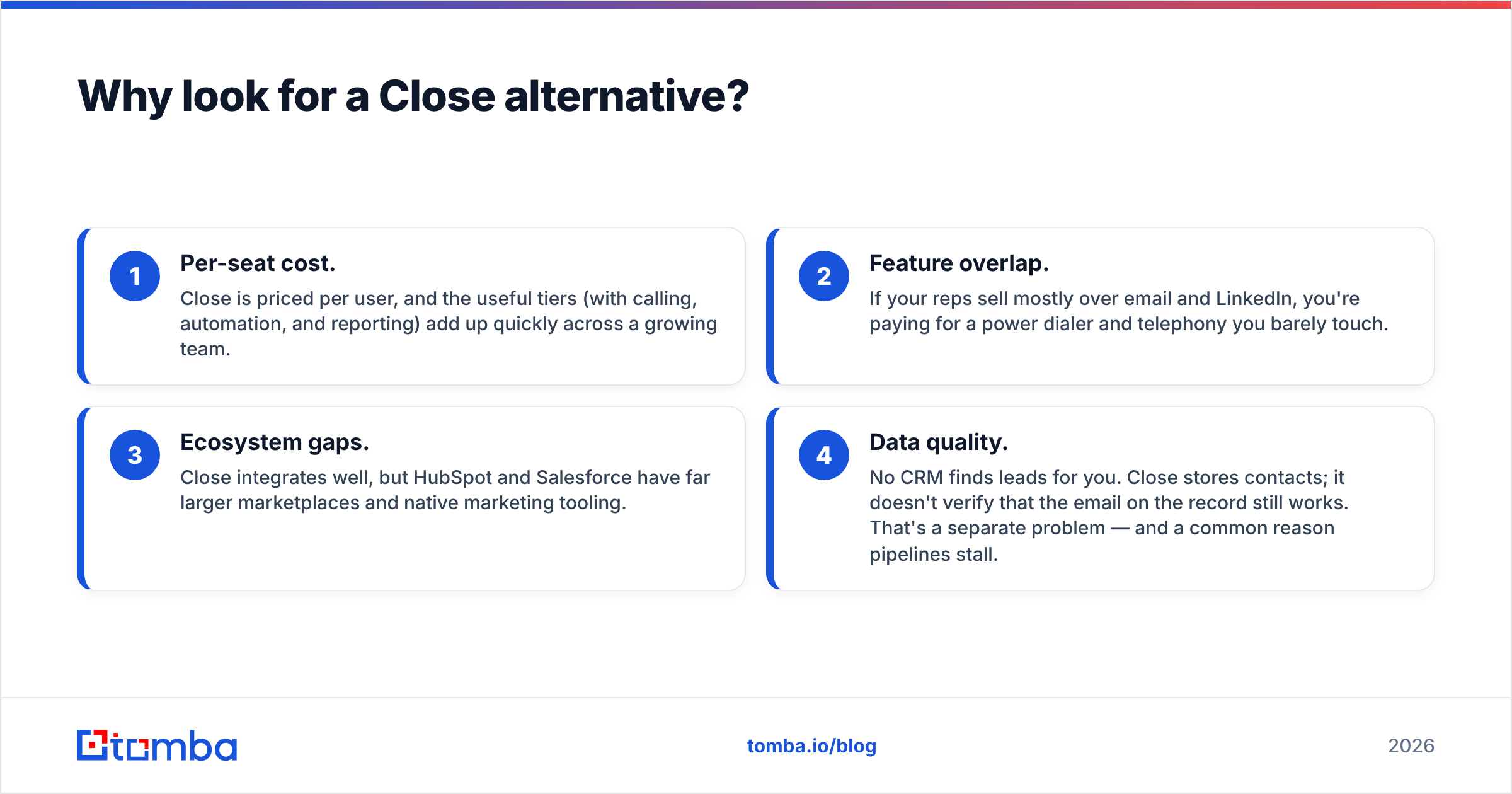
- Per-seat cost. Close is priced per user, and the useful tiers (with calling, automation, and reporting) add up quickly across a growing team.
- Feature overlap. If your reps sell mostly over email and LinkedIn, you're paying for a power dialer and telephony you barely touch.
- Ecosystem gaps. Close integrates well, but HubSpot and Salesforce have far larger marketplaces and native marketing tooling.
- Data quality. No CRM finds leads for you. Close stores contacts; it doesn't verify that the email on the record still works. That's a separate problem — and a common reason pipelines stall.
That last point matters more than most buyers expect. Switching CRMs won't fix a list full of bounced addresses. Before you migrate, it's worth pairing whatever CRM you choose with a proper email finder and email verifier so your reps work clean records from day one.
What is Close, and who is it actually for?#
Close is a CRM built around outbound activity. Its signature features are the built-in power and predictive dialers, native SMS, email sequencing, and a "do everything from one screen" workflow designed to cut down on tab-switching. It's genuinely good for SDR and inside-sales teams grinding through call lists.
Where it fits less well:
- Solo founders and micro-teams who want a simple deal board without paying for telephony.
- Field sales or relationship-led teams where calls are scheduled, not blasted.
- Marketing-heavy orgs that want CRM plus email marketing, forms, and landing pages in one bill.
If you're in one of those buckets, one of the alternatives below will likely fit better and cost less.
Close alternatives at a glance (2026)#
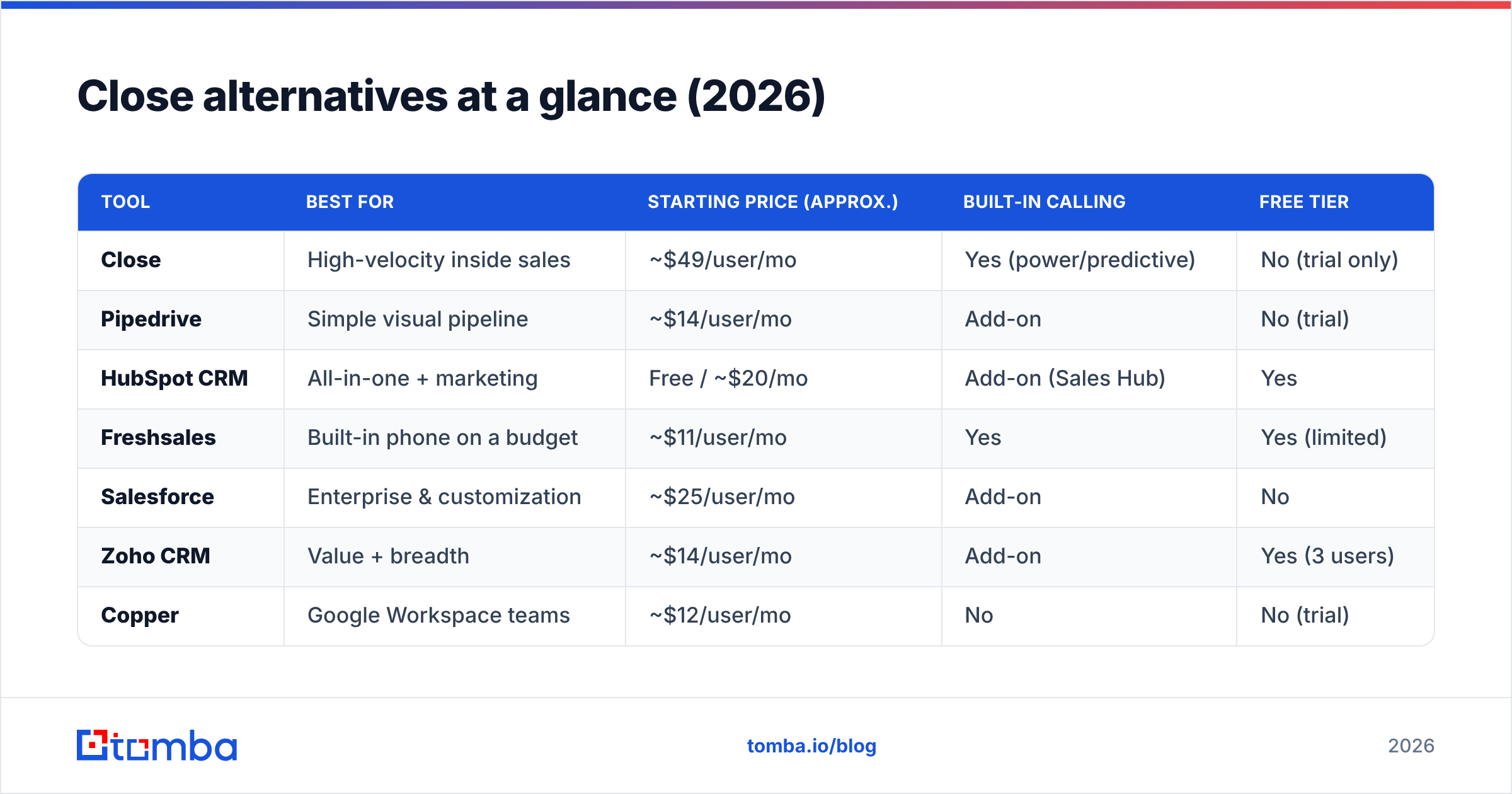
Here's the quick comparison. Prices are the entry paid tier with meaningful CRM features and are approximate per-seat figures — always confirm current pricing on each vendor's site, since tiers change.
| Tool | Best for | Starting price (approx.) | Built-in calling | Free tier |
|---|---|---|---|---|
| Close | High-velocity inside sales | ~$49/user/mo | Yes (power/predictive) | No (trial only) |
| Pipedrive | Simple visual pipeline | ~$14/user/mo | Add-on | No (trial) |
| HubSpot CRM | All-in-one + marketing | Free / ~$20/mo | Add-on (Sales Hub) | Yes |
| Freshsales | Built-in phone on a budget | ~$11/user/mo | Yes | Yes (limited) |
| Salesforce | Enterprise & customization | ~$25/user/mo | Add-on | No |
| Zoho CRM | Value + breadth | ~$14/user/mo | Add-on | Yes (3 users) |
| Copper | Google Workspace teams | ~$12/user/mo | No | No (trial) |
| Apollo | Prospecting + CRM combo | Free / ~$49/mo | Yes | Yes |
| Nutshell | SMB simplicity + support | ~$19/user/mo | Add-on | No (trial) |
What are the best Close alternatives in 2026?#
1. Pipedrive — best for a clean, visual pipeline#
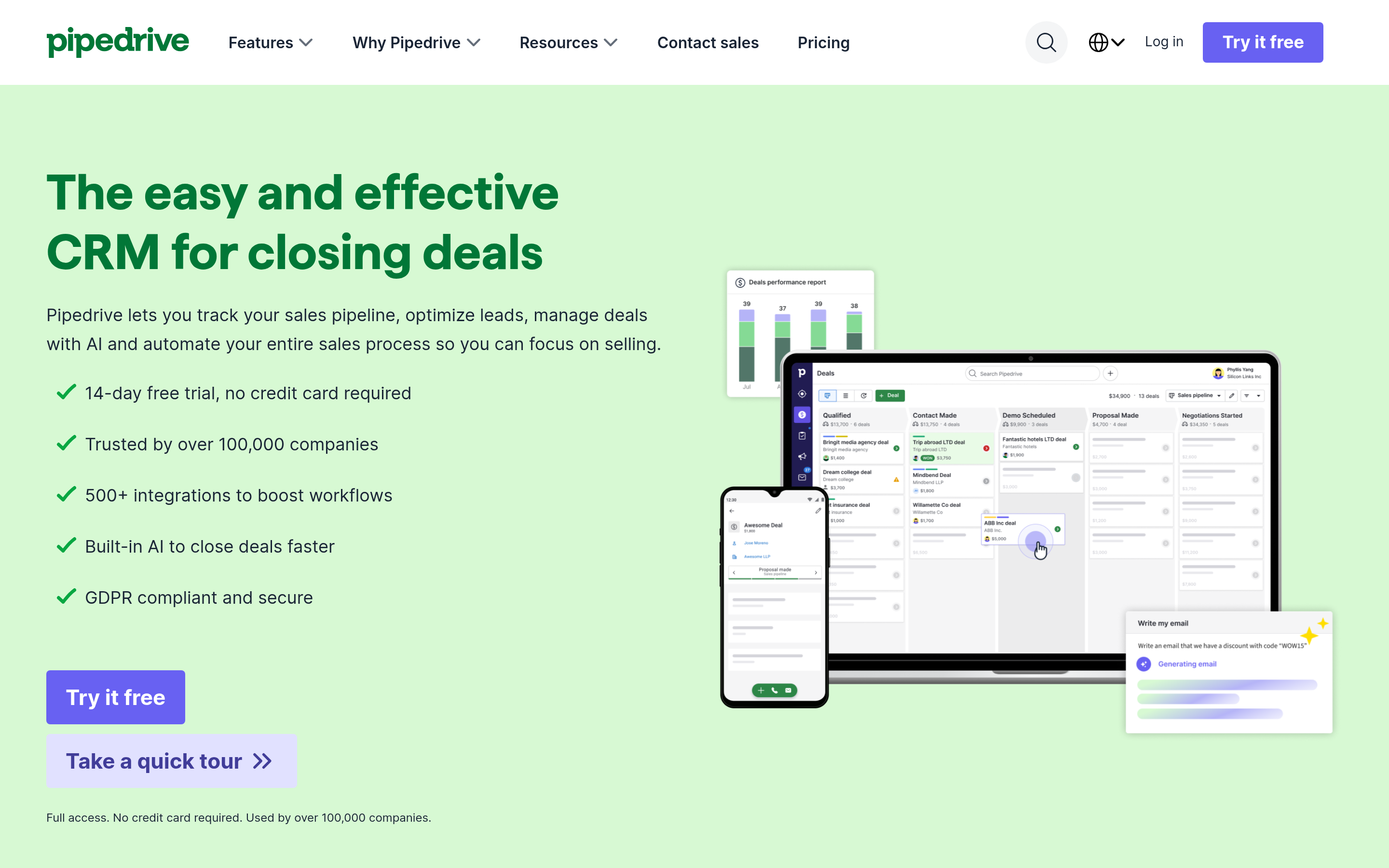
Pipedrive is the go-to when you want deal stages you can drag across a board without a heavy setup. It's cheaper than Close at the entry tier, the learning curve is short, and automation is solid on mid tiers. Calling is an add-on rather than a core strength, so it suits email- and meeting-led teams more than dialer-heavy ones.
- Pros: Intuitive UI, affordable start, strong pipeline analytics.
- Cons: Calling and some automation live behind add-ons; reporting is lighter than Salesforce.
2. HubSpot CRM — best free tier and ecosystem#
HubSpot's free CRM is genuinely usable, and it scales into marketing, service, and sales "Hubs" as you grow. If you want CRM plus email marketing, forms, and landing pages under one roof, it's hard to beat. The catch is that costs jump sharply once you need the paid Sales Hub seats and marketing contacts. See the HubSpot integration if you want to push verified contacts straight into it.
- Pros: Free to start, massive app marketplace, best-in-class marketing tools.
- Cons: Paid tiers get expensive fast; power features gated to higher plans.
3. Freshsales — best built-in phone for the price#
If the main reason you liked Close was native calling, Freshsales (from Freshworks) gives you a built-in phone, email, and AI-based lead scoring at a lower entry price. It's a strong value pick for SMB inside-sales teams that want the dialer without Close's per-seat bill.
- Pros: Built-in phone, AI scoring, generous entry pricing.
- Cons: Ecosystem smaller than HubSpot/Salesforce; some UI rough edges.
4. Salesforce — best for enterprise depth#
Salesforce is the default when you need deep customization, complex territory and forecasting rules, and an app for every edge case. It's overkill (and overpriced) for a five-person team, but unmatched once you have RevOps, admins, and multi-team workflows. Connect it via the Salesforce integration to keep records enriched.
- Pros: Endless customization, enterprise-grade reporting, huge ecosystem.
- Cons: Steep learning curve, admin overhead, real cost of ownership is high.
5. Zoho CRM — best all-round value#

Zoho CRM packs a remarkable amount — pipeline, automation, analytics, and a whole suite of adjacent business apps — into low per-seat pricing. If budget is tight but you don't want to feel boxed in, it's the value champion.
- Pros: Cheap, broad feature set, part of a larger Zoho suite.
- Cons: UI can feel busy; best value only if you adopt the wider Zoho ecosystem.
6. Copper — best for Google Workspace teams#
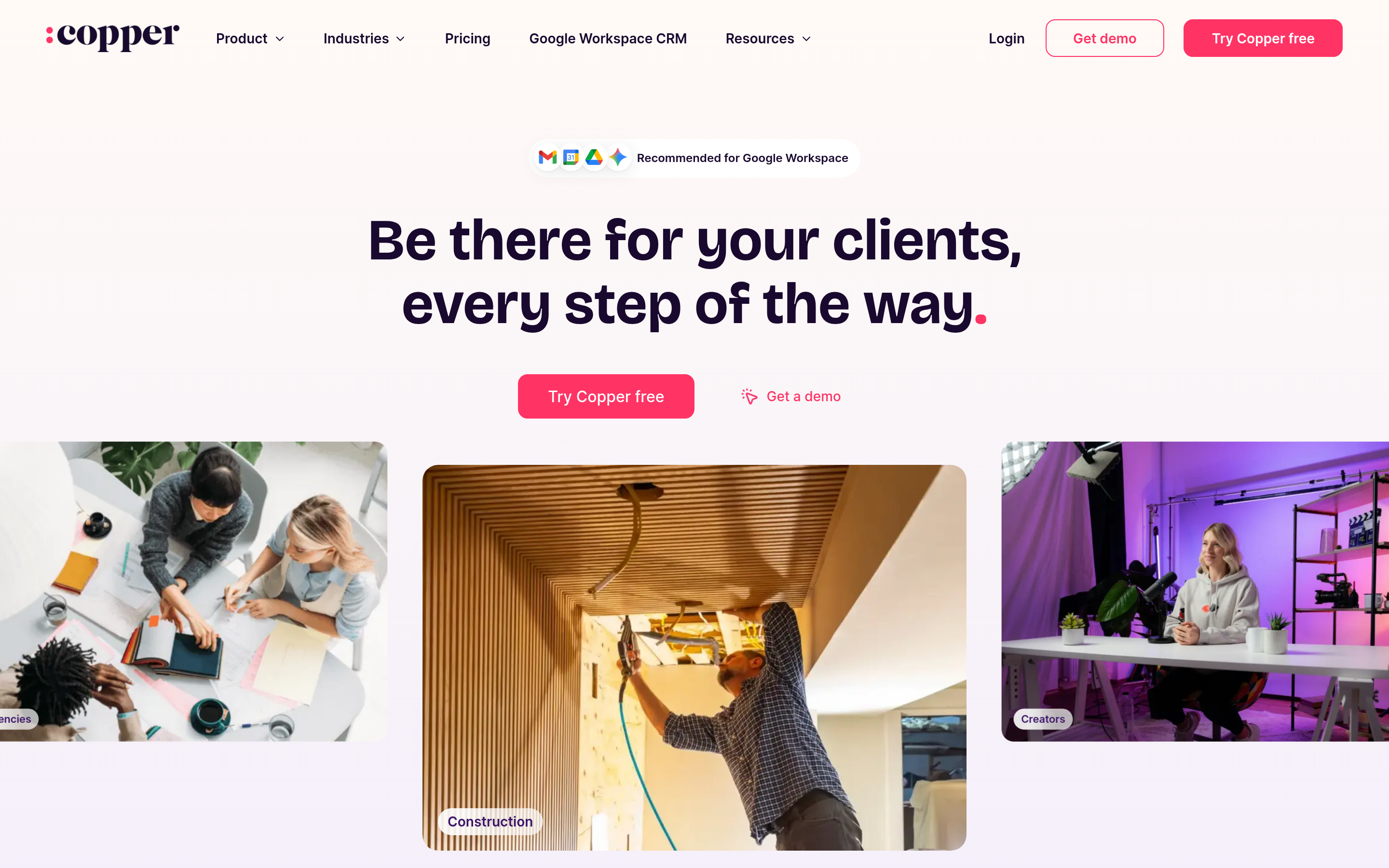
Copper lives inside Gmail and Google Workspace, auto-logging emails and contacts so reps barely leave their inbox. If your company runs on Google, it removes a lot of manual data entry.
- Pros: Deep Gmail/Workspace integration, low-friction adoption.
- Cons: No native calling; less suited to phone-heavy outbound.
7. Apollo — best prospecting-plus-CRM combo#
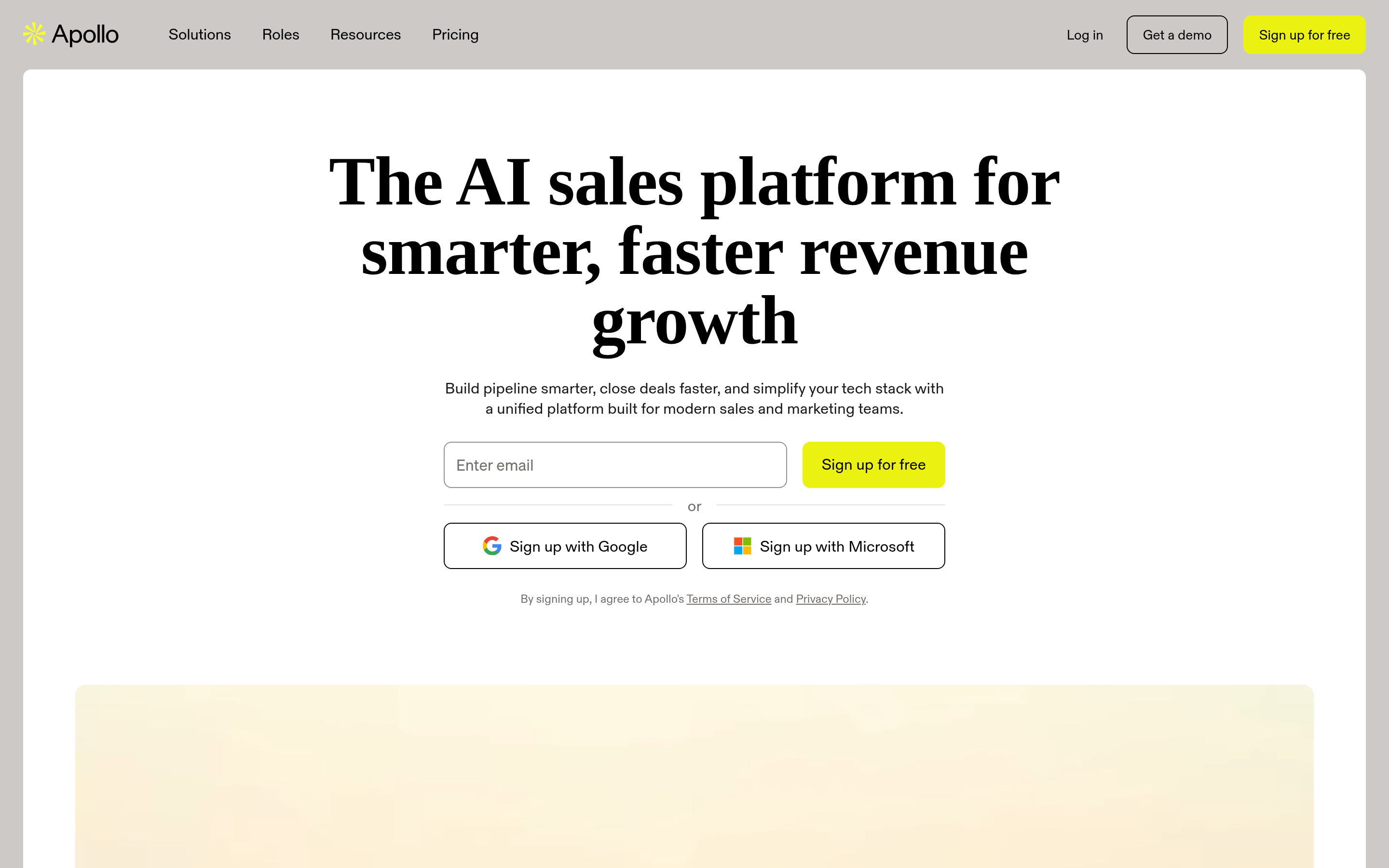
Apollo blurs the line between a data provider and a CRM: it offers a B2B contact database, sequences, a dialer, and lightweight CRM features. For early-stage teams it can replace two tools. Just weigh its data accuracy and export limits — if that's your concern, compare it as an Apollo alternative on the data side.
- Pros: Built-in prospecting database, sequences, and dialer in one.
- Cons: CRM features are lighter than dedicated CRMs; data accuracy varies.
8. Nutshell — best simple CRM with human support#
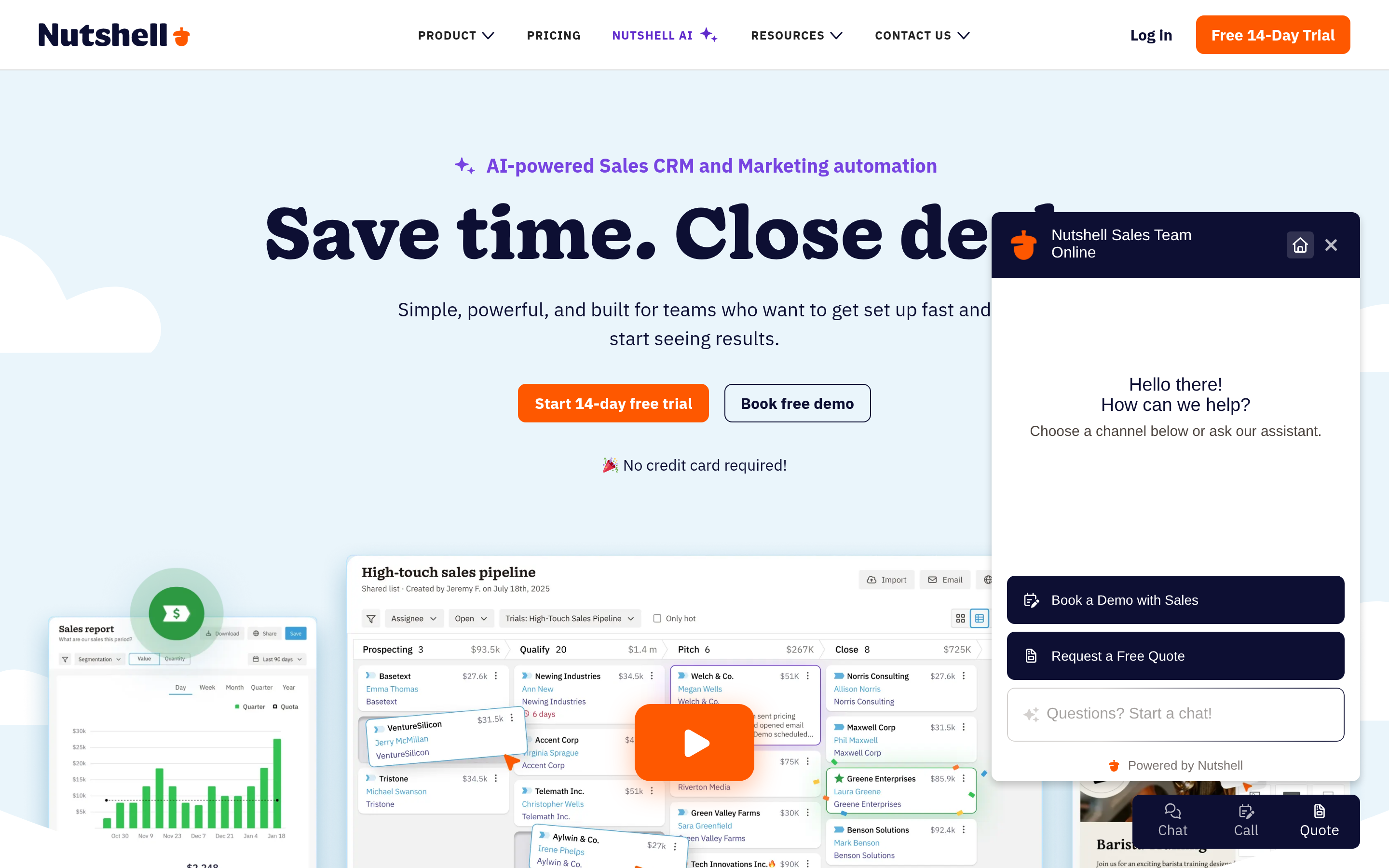
Nutshell targets SMBs that want a straightforward CRM, pipeline automation, and responsive human support without enterprise complexity. It's a comfortable middle ground between Pipedrive's simplicity and HubSpot's breadth.
- Pros: Easy setup, good support, fair SMB pricing.
- Cons: Fewer advanced features; calling is an add-on.
9. Tomba — the data layer every CRM on this list needs#
Here's the honest framing: Tomba is not a CRM, and it won't replace Close. But it fixes the problem a new CRM never will — bad contact data. Whichever CRM you pick, Tomba's email finder, domain search, phone finder, and data enrichment keep your records accurate before they ever hit your pipeline. Feed clean, verified contacts into Pipedrive, HubSpot, or Salesforce and your reps stop wasting hours on bounces and wrong numbers.

How do I choose the right Close alternative?#
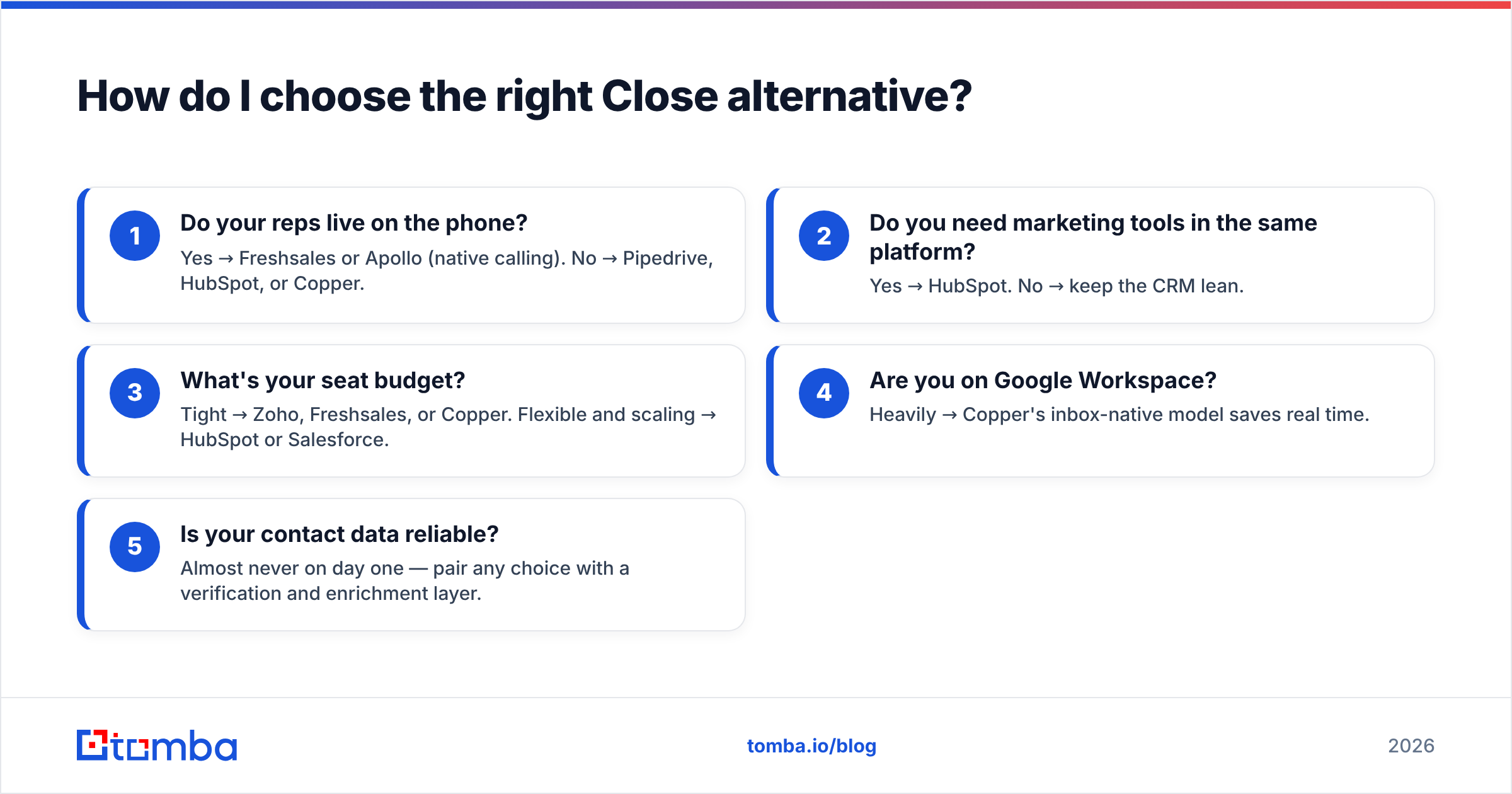
Work through these in order — the answer usually falls out by step three.
- Do your reps live on the phone? Yes → Freshsales or Apollo (native calling). No → Pipedrive, HubSpot, or Copper.
- Do you need marketing tools in the same platform? Yes → HubSpot. No → keep the CRM lean.
- What's your seat budget? Tight → Zoho, Freshsales, or Copper. Flexible and scaling → HubSpot or Salesforce.
- Are you on Google Workspace? Heavily → Copper's inbox-native model saves real time.
- Is your contact data reliable? Almost never on day one — pair any choice with a verification and enrichment layer.
A useful rule: pick the CRM for workflow fit, and solve data quality separately. Teams that bundle both decisions into one tool usually overpay for a database that decays anyway.
Is a cheaper Close alternative worth switching to?#
Usually yes — if you're paying for features you don't use. If half your reps never touch the predictive dialer, moving them to Pipedrive or Zoho can cut the CRM bill meaningfully while keeping the parts you actually use. But factor in migration effort: exporting deals, remapping fields, and retraining reps has a real cost. Switch when the annual savings clearly beat that one-time friction — not for a marginal price difference.
And whatever you migrate, migrate clean. Running a bulk verify on your export before import means you don't carry dead contacts into the new system. Check Tomba pricing to size the data layer alongside your CRM budget.
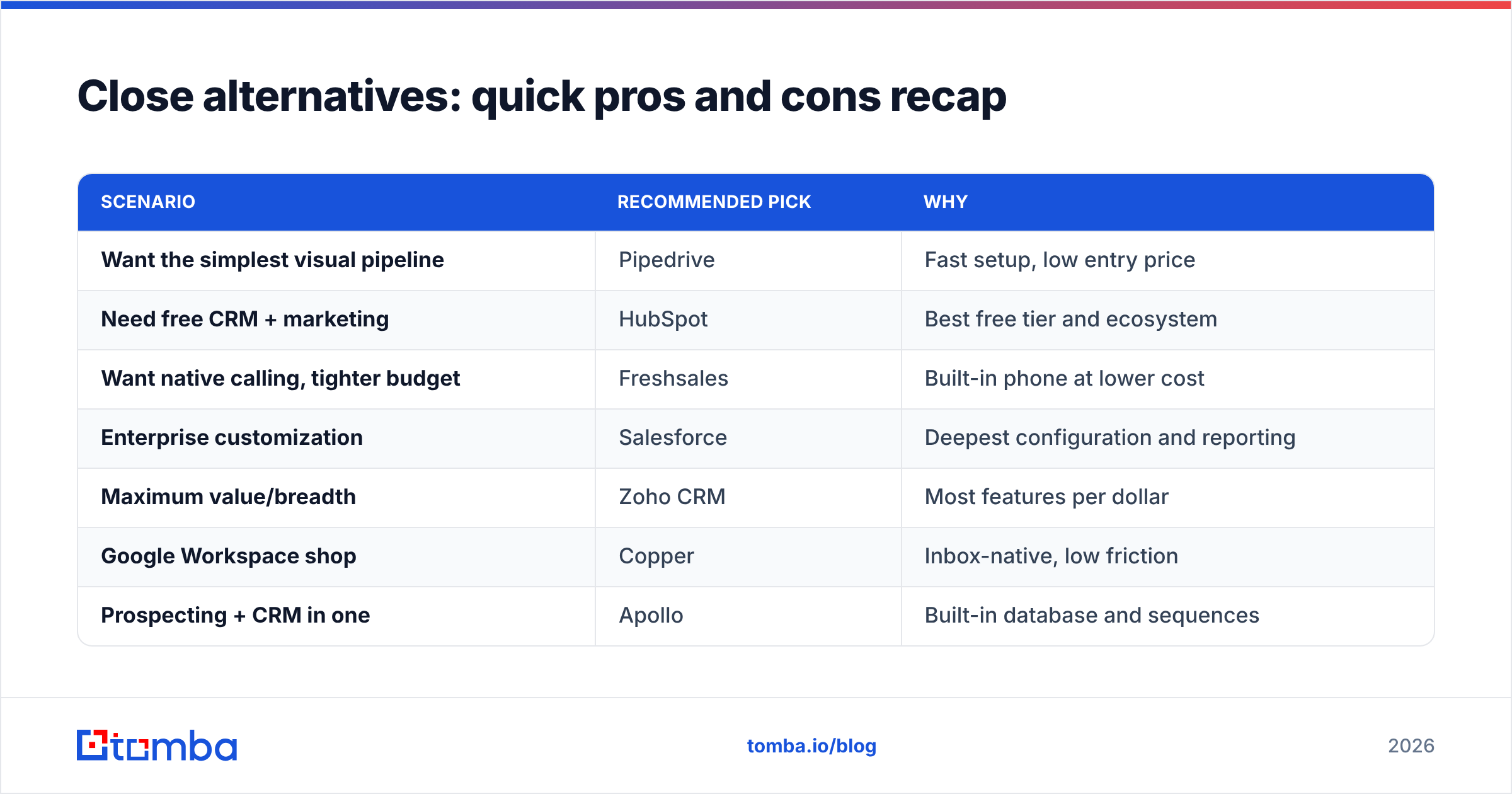
Close alternatives: quick pros and cons recap#
| Scenario | Recommended pick | Why |
|---|---|---|
| Want the simplest visual pipeline | Pipedrive | Fast setup, low entry price |
| Need free CRM + marketing | HubSpot | Best free tier and ecosystem |
| Want native calling, tighter budget | Freshsales | Built-in phone at lower cost |
| Enterprise customization | Salesforce | Deepest configuration and reporting |
| Maximum value/breadth | Zoho CRM | Most features per dollar |
| Google Workspace shop | Copper | Inbox-native, low friction |
| Prospecting + CRM in one | Apollo | Built-in database and sequences |
| Fixing contact data (any CRM) | Tomba | Accurate emails, phones, enrichment |
You can cross-check user sentiment on any of these on a neutral review site like G2 before committing — pricing pages tell you the list price, not the real-world experience.
The bottom line#
There's no single "best" Close alternative — there's the one that matches how your team sells and what you're willing to pay per seat. Pipedrive and Zoho win on simplicity and price, HubSpot and Salesforce win on scale, and Freshsales wins on built-in calling for less. But every one of them shares the same blind spot: they store contacts, they don't find or verify them.
That's the gap to close first. Start with the Tomba Email Finder to build accurate, verified contact lists — then pour them into whichever CRM you choose. Clean data in means fewer bounces, more connects, and a pipeline your reps can actually trust. Tomba's free tier gives you 25 searches a month to test it, with paid plans from $49/mo when you're ready to scale.
Related guides#
Ready to find emails that actually work?
Join 150,000+ professionals who stopped guessing and started sending. Free credits on signup — no credit card required.
Get the Tomba newsletter
Practical outbound tactics and product updates — once every two weeks.
About the author