Close Deal Meaning: What It Takes to Close a Sale in 2026
"Close deal" sounds simple, but the meaning behind it decides whether your pipeline turns into revenue. Here's what closing really involves, step by step.
TL;DR
- Close deal meaning: to "close a deal" is to move a prospect from interest to a signed, committed agreement — the moment a sales opportunity officially becomes revenue.
- Closing is not a single event; it's the payoff of a repeatable process: prospecting, qualifying, presenting, handling objections, and asking for the commitment.
- The best closers don't "convince" — they remove friction, confirm fit, and make saying yes the obvious next step.
- Data quality decides your close rate before the pitch ever happens: you can't close a deal with a contact you never reached.
- Modern closing is measured (win rate, sales cycle length, deal value), coached, and increasingly assisted by clean data and automation.
What is the close deal meaning?#
To close a deal means to finalize a sale — the point where a prospect formally agrees to buy and commits, usually with a signature, payment, or purchase order. It's the transition from "we're talking" to "we have a customer."
Think of closing like landing a plane. The flight (your sales process) can be smooth for hours, but the landing is where everything is decided. A rough approach — unclear pricing, unresolved objections, the wrong decision-maker — and you skid off the runway. A clean approach, and the passengers barely notice they've arrived. The close is that landing: brief, decisive, and dependent on everything that came before.
In practice, "close a deal" is used two ways:
- The moment — the specific action of securing agreement ("I closed the deal on Friday").
- The skill — the broader ability to guide buyers to a decision ("she's great at closing").
Both meanings share a root idea: closing turns potential into committed revenue. Everything upstream — a great domain search that surfaced the right contact, a sharp discovery call, a tailored demo — exists to make the close possible.
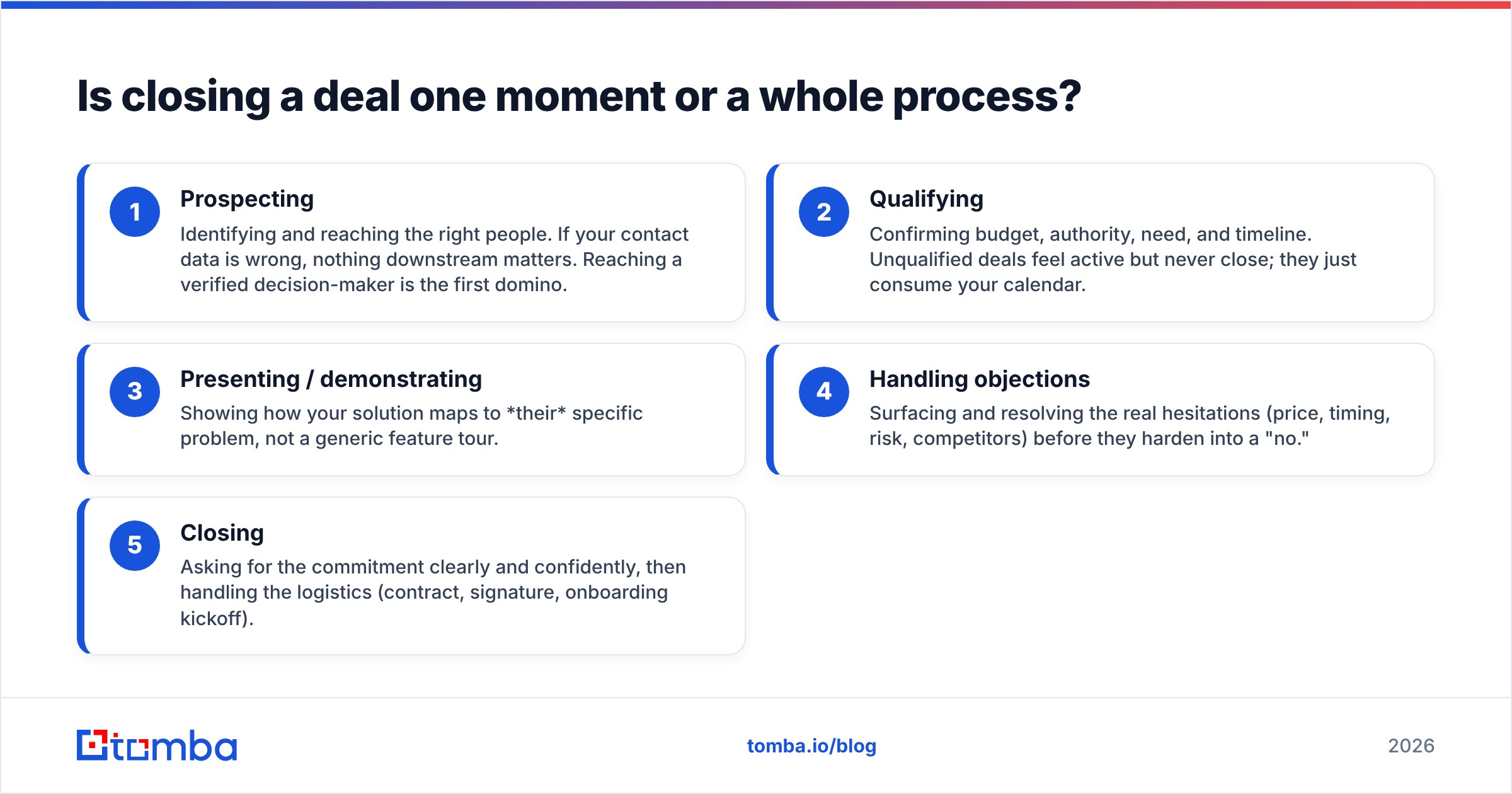
Is closing a deal one moment or a whole process?#
It's both, and confusing the two is why so many reps struggle. The moment of closing is real, but it's the visible tip of a much larger process. Deals close because of what happened in the weeks before, not because of a clever line at the end.
Here's the anatomy of a close, broken into the stages that actually move a deal forward:
- Prospecting — Identifying and reaching the right people. If your contact data is wrong, nothing downstream matters. Reaching a verified decision-maker is the first domino.
- Qualifying — Confirming budget, authority, need, and timeline. Unqualified deals feel active but never close; they just consume your calendar.
- Presenting / demonstrating — Showing how your solution maps to their specific problem, not a generic feature tour.
- Handling objections — Surfacing and resolving the real hesitations (price, timing, risk, competitors) before they harden into a "no."
- Closing — Asking for the commitment clearly and confidently, then handling the logistics (contract, signature, onboarding kickoff).
Skip or rush any stage and the close gets harder. A rep who "can't close" usually has a qualification problem or a data problem three steps earlier.
What are the most common closing techniques?#
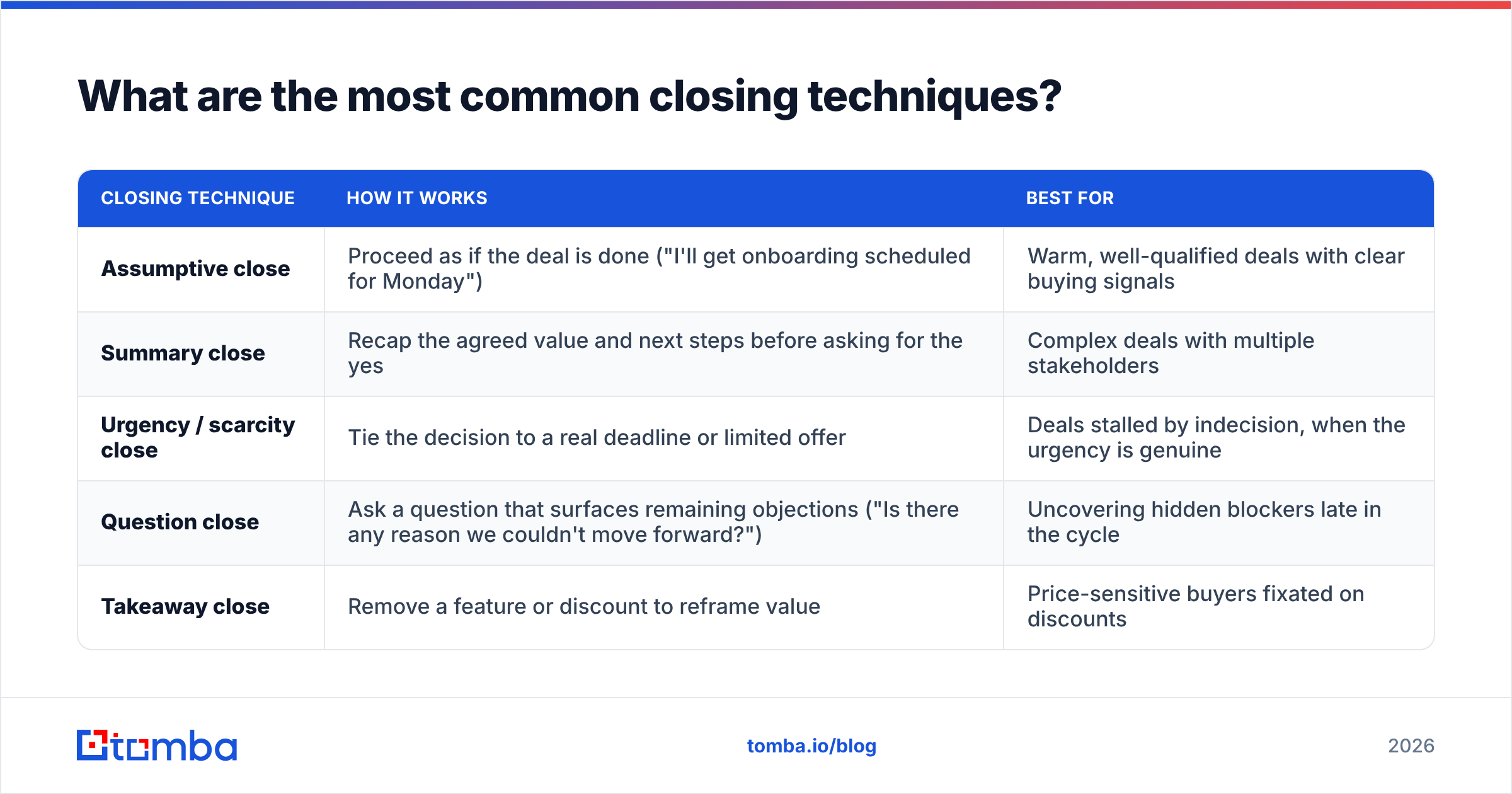
There's no single magic phrase. Effective closing is about reading the buyer and choosing the right approach. Below are the techniques that still work in 2026 — and when to use each.
| Closing technique | How it works | Best for |
|---|---|---|
| Assumptive close | Proceed as if the deal is done ("I'll get onboarding scheduled for Monday") | Warm, well-qualified deals with clear buying signals |
| Summary close | Recap the agreed value and next steps before asking for the yes | Complex deals with multiple stakeholders |
| Urgency / scarcity close | Tie the decision to a real deadline or limited offer | Deals stalled by indecision, when the urgency is genuine |
| Question close | Ask a question that surfaces remaining objections ("Is there any reason we couldn't move forward?") | Uncovering hidden blockers late in the cycle |
| Takeaway close | Remove a feature or discount to reframe value | Price-sensitive buyers fixated on discounts |
The mistake beginners make is treating these as tricks. They're not. A close only lands when the value is already clear and the fit is real. Technique is the delivery, not the substance.
One rule ties them together: always be closing on the next step, not just the final signature. Every touchpoint should end with a committed next action — a follow-up call, a stakeholder intro, a trial start. Small yeses compound into the big one.
Why do most deals fail to close?#
Most deals don't die at the close. They die quietly, earlier, and the rep only notices at the end. Here are the real killers:
- You reached the wrong person. Pitching a champion who can't sign anything is the most common — and most avoidable — failure. Verified contact data for the actual decision-maker changes the outcome before you say a word.
- Weak qualification. The prospect was never a fit, but "maybe" felt better than "no." Chasing unqualified deals inflates your pipeline and crushes your win rate. (For a refresher on how commit-probability works, see the definition of win rate.)
- Unresolved objections. The buyer had a concern they never voiced, and you never asked. Silence isn't agreement.
- No clear next step. The deal drifted because no one owned the momentum. Deals in motion close; deals at rest stall.
- Bad timing and no follow-up. Studies of B2B outreach consistently show most sales require multiple follow-ups, yet many reps quit after one or two. Persistence, not pressure, closes.
Notice how many of these trace back to inputs — who you talked to and whether you qualified them — rather than closing skill. That's the uncomfortable truth: your close rate is largely set before the negotiation. Reliable prospecting data and a disciplined sales process fix more lost deals than any clever script.
How does data quality affect your ability to close?#
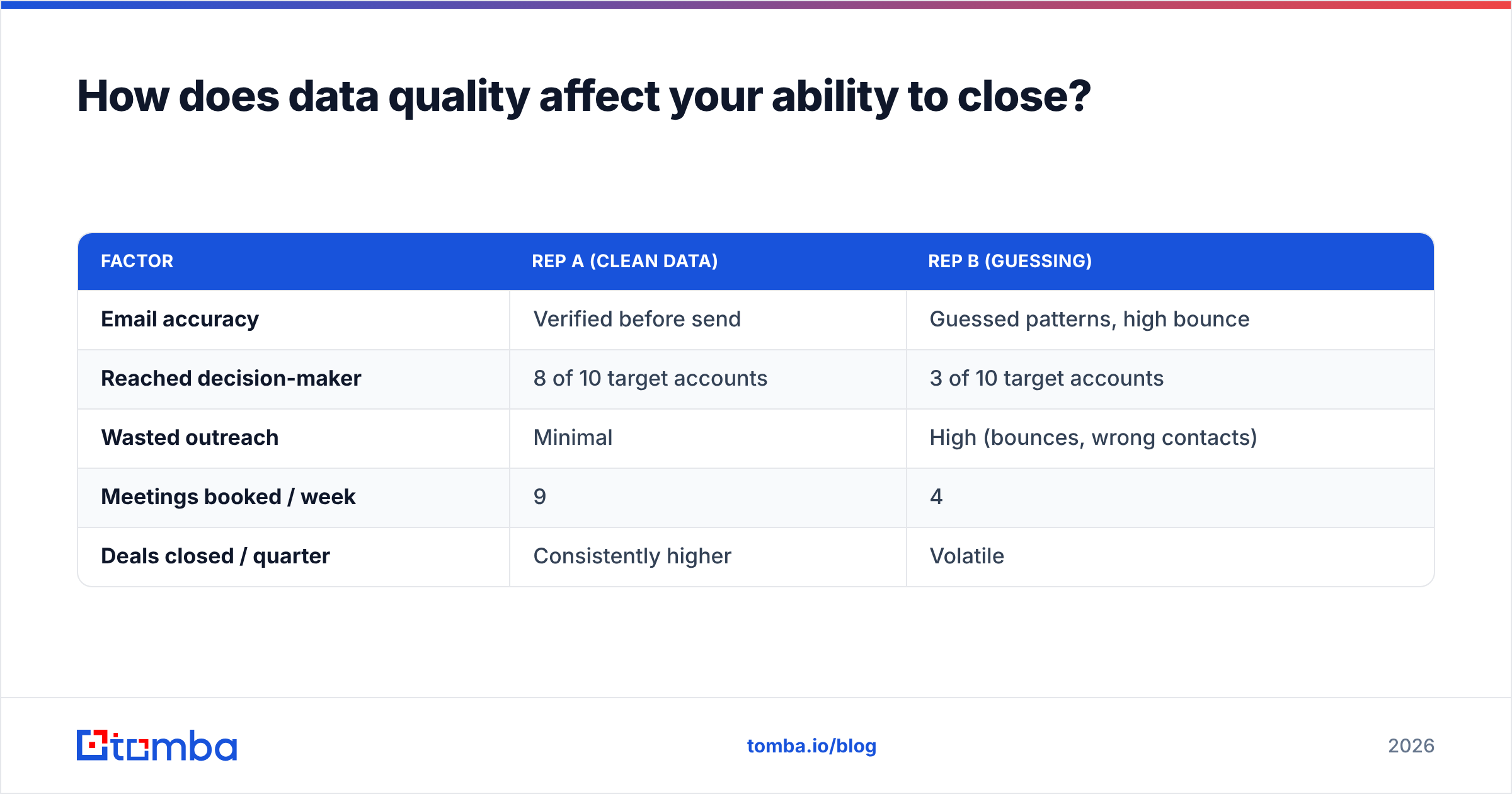
You cannot close a deal with someone you never reached — so contact accuracy is the hidden first step of every close. This is where the "close deal meaning" quietly expands: closing isn't just the last conversation, it's the whole chain of reaching, qualifying, and converting the right person.
Consider two reps working identical territories:
| Factor | Rep A (clean data) | Rep B (guessing) |
|---|---|---|
| Email accuracy | Verified before send | Guessed patterns, high bounce |
| Reached decision-maker | 8 of 10 target accounts | 3 of 10 target accounts |
| Wasted outreach | Minimal | High (bounces, wrong contacts) |
| Meetings booked / week | 9 | 4 |
| Deals closed / quarter | Consistently higher | Volatile |
Rep A didn't close more because of talent. Rep A closed more because more of the pipeline was real — reaching verified people at the right accounts. That's the multiplier most closing advice ignores.
This is exactly the gap a tool like Tomba Email Finder fills: instead of guessing an email format and hoping, you find and verify professional addresses tied to the accounts you're targeting, then push them straight into outreach. Pair the finder with an email verifier to strip out risky addresses before they hurt your sender reputation, and your entire close chain gets shorter and more predictable. For teams running volume, the bulk email finder turns a list of target companies into a list of reachable, verified decision-makers in one pass.
Independent review sites like G2 rank email-finding and verification tools on exactly these dimensions — deliverability and accuracy — because they're what separate a pipeline that closes from one that just looks busy.
How do you measure whether you're closing well?#
"Are you good at closing?" is a feeling. These metrics turn it into evidence:
- Win rate — Closed-won deals divided by total qualified opportunities. The single clearest measure of closing effectiveness.
- Sales cycle length — Days from first contact to signature. Shorter cycles usually mean cleaner qualification and stronger momentum.
- Average deal value — Are you closing bigger, or just closing more small deals that don't move the number?
- Stage conversion rates — Where do deals stall? A leak between "demo" and "proposal" points to a value or objection problem, not a closing-skill problem.
- Follow-up density — How many touches does a closed deal actually take? Reps who track this stop quitting early.
Track these over time and closing stops being mysterious. You'll see, concretely, whether your problem is reach (top of funnel), qualification (middle), or the ask itself (bottom). Most teams assume the last and neglect the first two — where the real leverage is.
CRM platforms like HubSpot and Salesforce make these metrics visible by default, which is why disciplined closers live inside their pipeline reports, not just their inbox.
What does a strong close actually look like?#
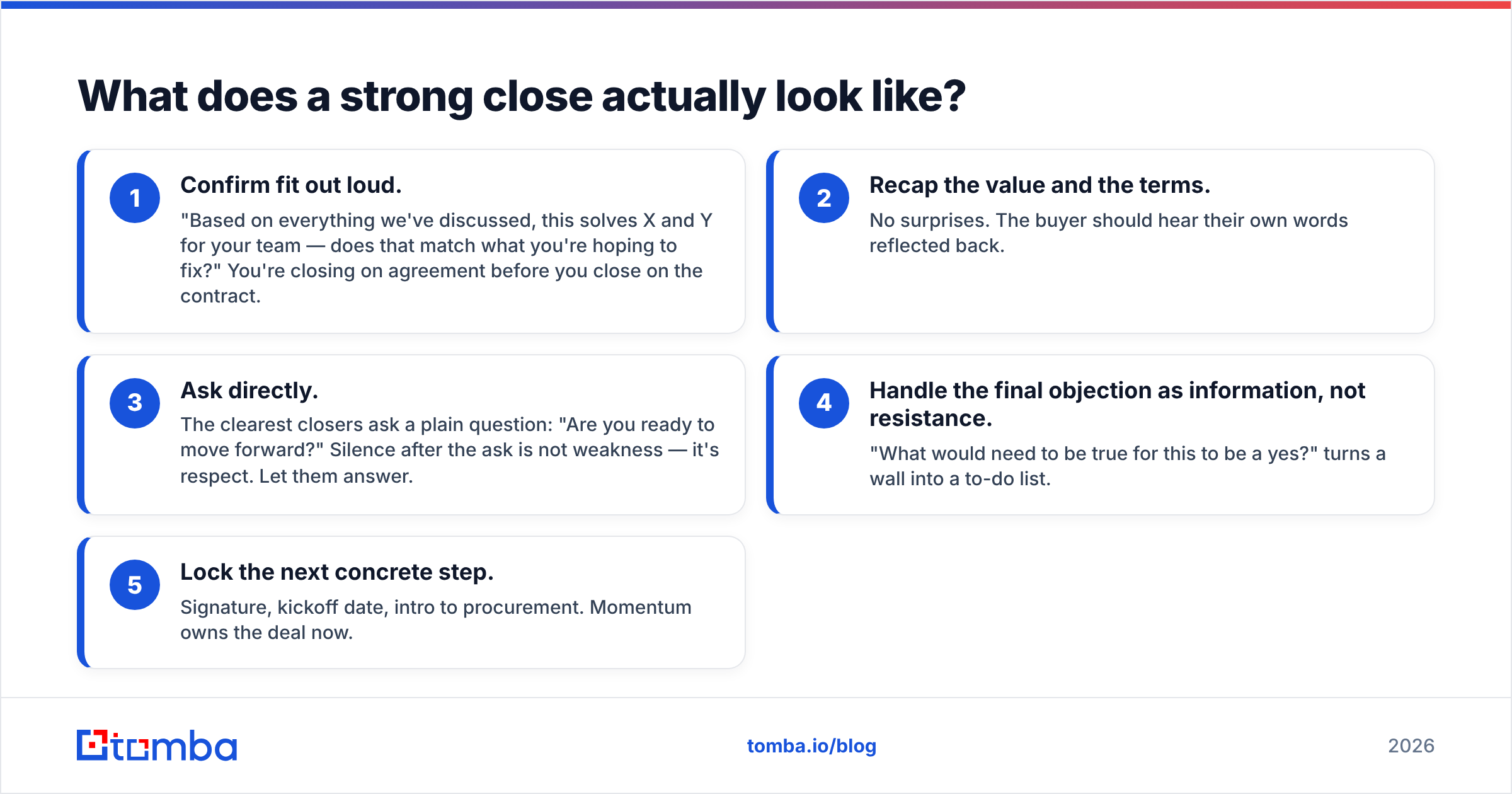
Put it together and a strong close is almost boring — because the drama was handled earlier. Here's the shape of it:
- Confirm fit out loud. "Based on everything we've discussed, this solves X and Y for your team — does that match what you're hoping to fix?" You're closing on agreement before you close on the contract.
- Recap the value and the terms. No surprises. The buyer should hear their own words reflected back.
- Ask directly. The clearest closers ask a plain question: "Are you ready to move forward?" Silence after the ask is not weakness — it's respect. Let them answer.
- Handle the final objection as information, not resistance. "What would need to be true for this to be a yes?" turns a wall into a to-do list.
- Lock the next concrete step. Signature, kickoff date, intro to procurement. Momentum owns the deal now.
That's it. No manipulation, no cornering. A confident close is what happens when the right person, properly qualified, sees clear value and is simply asked to decide.
Frequently asked questions#
What does "close a deal" mean in simple terms? It means finalizing a sale — getting a prospect to formally agree to buy and commit, typically with a signature or payment. It's the moment an opportunity becomes revenue.
Is closing a skill or a process? Both. There's a specific closing moment (asking for and securing commitment), but it only succeeds because of the process before it: reaching the right person, qualifying, presenting value, and resolving objections.
Why do good pitches still fail to close? Usually because of an upstream problem — you reached the wrong contact, the deal was never qualified, an objection went unspoken, or there was no clear next step. Closing skill can't rescue a deal built on bad inputs.
How does contact data affect closing? Directly. You can't close someone you never reached. Verified emails and phone numbers for actual decision-makers mean more of your pipeline is real, which lifts your close rate before any negotiation happens.
How do I know if I'm closing well? Track win rate, sales cycle length, average deal value, and where deals stall by stage. These reveal whether your gap is reach, qualification, or the ask itself.
Close more deals by fixing the first step first#
The close deal meaning is bigger than a signature — it's the payoff of reaching the right person, qualifying honestly, and asking with confidence. And the part most reps overlook is the very first link: actually reaching a verified decision-maker.
That's where your closing rate is quietly won or lost. Start every deal with accurate, verified contact data using Tomba Email Finder — find professional emails by name, company, or domain, verify them before you send, and spend your closing energy on real conversations instead of bounced messages. Check the Tomba pricing plans (a free tier gets you 25 searches a month to start) and put a cleaner pipeline behind every close.
Related guides#
Ready to find emails that actually work?
Join 150,000+ professionals who stopped guessing and started sending. Free credits on signup — no credit card required.
Get the Tomba newsletter
Practical outbound tactics and product updates — once every two weeks.
About the author