How to Close Deals Faster in 2026: A Sales Cycle Playbook
Deals stall for predictable reasons: bad data, slow follow-up, and fuzzy qualification. Here's the 2026 playbook to compress your sales cycle without discounting your way to a signature.
Closing deals faster is rarely about being a smoother talker. It is about removing the friction that quietly adds days and weeks to every opportunity: chasing the wrong contact, waiting on a reply that never comes, or discovering in week three that your champion can't sign. Speed comes from fixing the process, not pushing the prospect.
This guide breaks down where sales cycles actually leak time and gives you a concrete playbook to compress them in 2026 — without resorting to end-of-quarter discounts to force a signature.
TL;DR#
- Deal speed is a data problem first. Reaching the right decision-maker with a verified email on day one removes the single biggest source of delay.
- Slow follow-up kills more deals than bad pitches. Responding within an hour and sequencing touches beats a "perfect" email sent late.
- Qualify hard, early. Cutting a bad-fit deal in week one is a speed win, not a loss.
- Multithread every opportunity. Single-threaded deals stall the moment your one contact goes quiet.
- Tools compound. A clean data layer (like Tomba Email Finder) plus tight CRM hygiene shaves days off every stage.
Why Do Deals Take So Long to Close?#
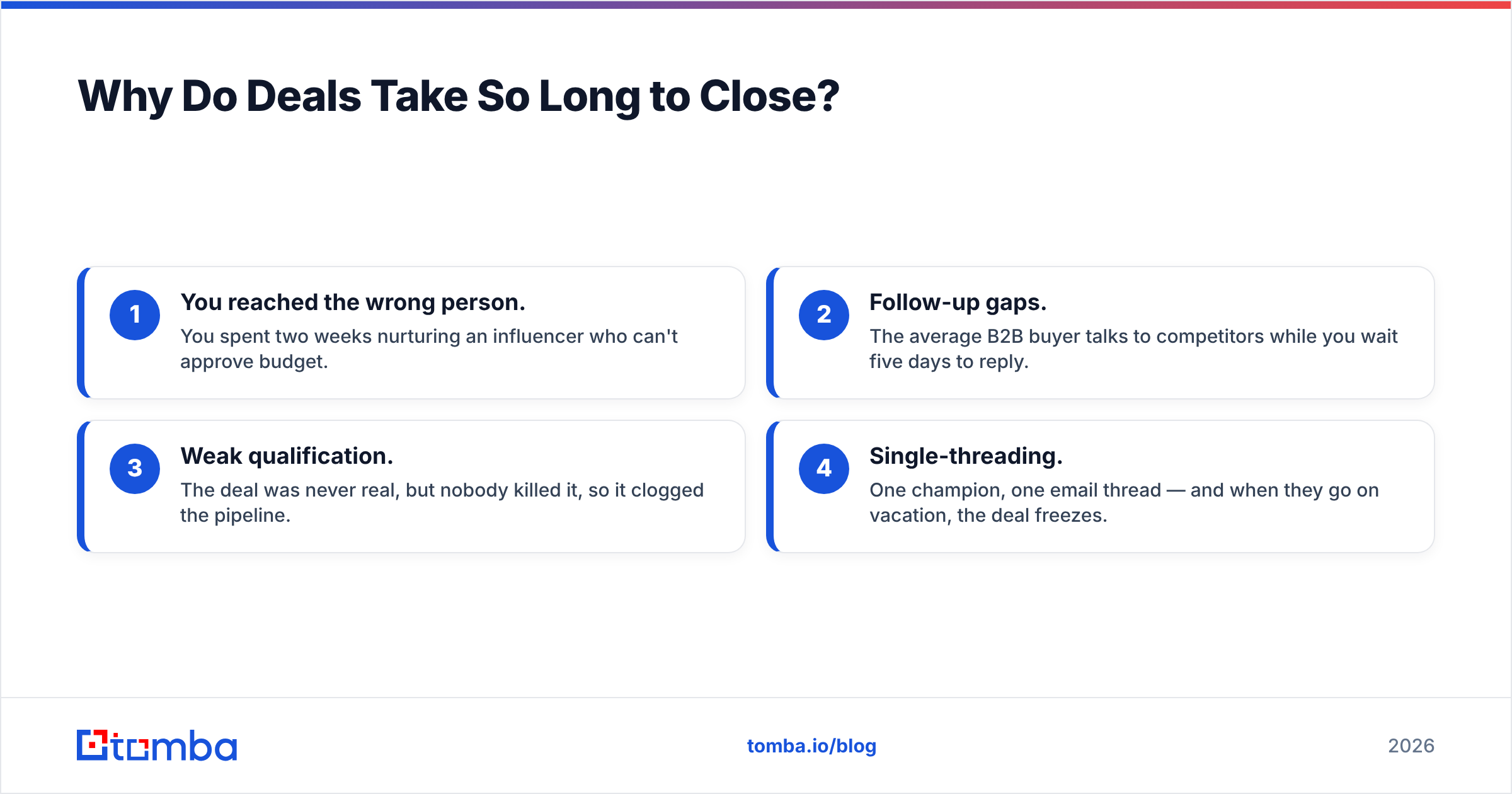
Deals drag for structural reasons, not because buyers enjoy dragging their feet. When you map a stalled opportunity backward, the delay almost always traces to one of four causes:
- You reached the wrong person. You spent two weeks nurturing an influencer who can't approve budget.
- Follow-up gaps. The average B2B buyer talks to competitors while you wait five days to reply.
- Weak qualification. The deal was never real, but nobody killed it, so it clogged the pipeline.
- Single-threading. One champion, one email thread — and when they go on vacation, the deal freezes.
According to Gartner research on B2B buying, a typical purchase now involves six to ten stakeholders, each with their own information. Every extra stakeholder you discover late adds a full cycle of introductions, objections, and approvals. The fastest closers front-load that discovery.
Is Faster Always Better, or Are You Just Discounting?#
Faster is only better when the deal was going to close anyway. There's a difference between compressing the cycle (removing friction) and buying the close (slashing price to beat a deadline). The second one trains buyers to wait for your desperation.
Genuine speed comes from three levers you control:
- Precision at the top of funnel — talking to qualified, reachable decision-makers instead of spraying a list.
- Momentum in the middle — keeping the buyer engaged with fast, relevant follow-up.
- Clarity at the bottom — knowing exactly who signs and what they need before you get there.
Discounting touches none of those. It just moves the number. Keep your list clean with a reliable email verifier and you protect both your speed and your margin.
What Actually Shortens a Sales Cycle?#
Here are the highest-leverage moves, ordered by impact. Most teams can implement the first three this quarter.
1. Reach verified decision-makers on day one. The largest hidden delay is contact discovery. If prospecting takes you three days per account and half your emails bounce, you have added a week before the buyer even hears from you. A domain search that returns every role at a company — with confidence scores — collapses that to minutes.
2. Cut first-response time to under an hour. Speed-to-lead studies consistently show that responding within the first hour dramatically raises the odds of a meaningful conversation. Automate the trigger, personalize the message.
3. Qualify with a hard framework. MEDDIC, BANT, whatever you use — apply it ruthlessly in the first call. A fast "no" is a gift.
4. Multithread from the start. Ask for the economic buyer's name on call one. Use a phone finder to open a second channel so the deal never rests on a single unread inbox.
5. Send a mutual action plan. A shared timeline with dates and owners turns a vague "we'll circle back" into a committed sequence.
6. Remove legal and procurement surprises. Ask early what the buyer's approval process looks like. Procurement is the number-one stall in enterprise deals.
How Does Better Data Speed Up the Close?#
Better data speeds up every stage because bad data taxes every stage. A bounced email doesn't just fail — it costs you the days you waited for a reply that was never going to come, plus the days spent hunting for the "real" address.
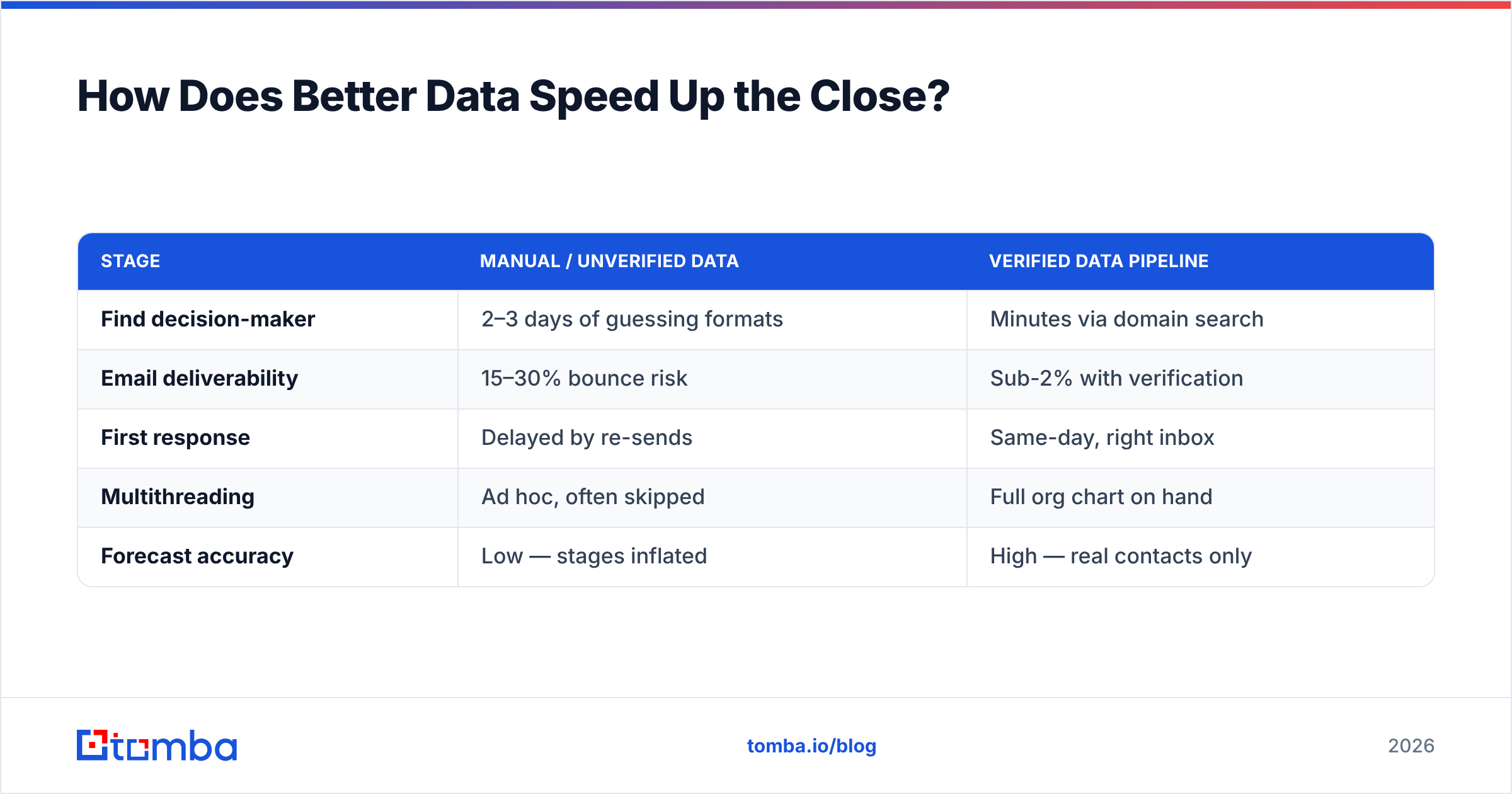
Here is what the two approaches look like side by side across a single deal cycle.
| Stage | Manual / unverified data | Verified data pipeline |
|---|---|---|
| Find decision-maker | 2–3 days of guessing formats | Minutes via domain search |
| Email deliverability | 15–30% bounce risk | Sub-2% with verification |
| First response | Delayed by re-sends | Same-day, right inbox |
| Multithreading | Ad hoc, often skipped | Full org chart on hand |
| Forecast accuracy | Low — stages inflated | High — real contacts only |
The compounding effect matters. Shaving two days off discovery, one day off deliverability, and eliminating a re-send loop can pull a 45-day cycle down to the low 30s — no discount required. That is why teams treat their contact database as infrastructure, not a nice-to-have. If you want to see where the numbers come from, Tomba is transparent about its data sources.
Which Tools Help You Close Deals Faster?#
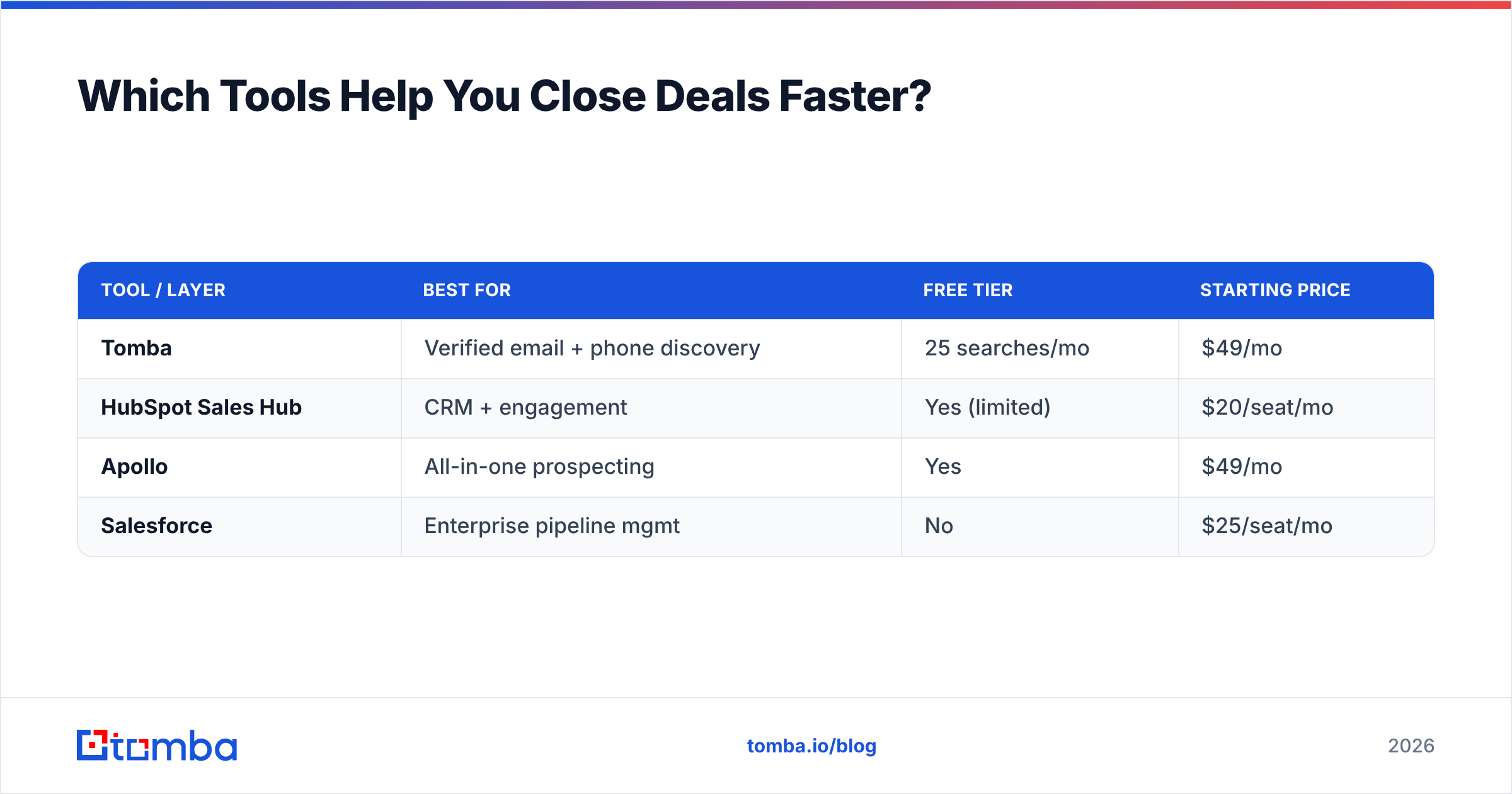
No single tool closes a deal, but the right stack removes the friction that slows one down. You need three layers: a data layer, an engagement layer, and a process layer. Here's how a few common options compare on the dimensions that affect speed.
| Tool / Layer | Best for | Free tier | Starting price |
|---|---|---|---|
| Tomba | Verified email + phone discovery | 25 searches/mo | $49/mo |
| HubSpot Sales Hub | CRM + engagement | Yes (limited) | $20/seat/mo |
| Apollo | All-in-one prospecting | Yes | $49/mo |
| Salesforce | Enterprise pipeline mgmt | No | $25/seat/mo |
A few notes on fit:
- Data layer. This is where speed is won or lost. Tomba's Tomba pricing starts with a free tier of 25 searches per month, then Starter at $49/mo and Growth at $99/mo — competitive for teams that live or die by contact accuracy. Compare feature sets on a neutral marketplace like G2 before committing.
- Engagement layer. A CRM like HubSpot or Salesforce keeps the momentum organized. The point is logged, timely follow-up — not the logo.
- Process layer. Mutual action plans and clear stage exit criteria live here. This is discipline, not software.
The mistake teams make is over-investing in the engagement layer while starving the data layer. A beautiful sequence sent to a bounced address is still a bounce.
How Do You Multithread Without Being Annoying?#
Multithreading feels risky — nobody wants to go over their champion's head. The trick is to frame every new contact as helping your champion, not bypassing them.
- Ask for the intro. "Who else should be in the loop so we don't slow this down for you?" makes speed the shared goal.
- Bring value to each thread. The finance stakeholder cares about ROI; the technical lead cares about integration. Tailor, don't broadcast.
- Find the org quietly. Before the call, map who reports to whom. A LinkedIn finder helps you understand the structure so your ask on the call is precise rather than fishing.
When you multithread early, a champion going dark becomes a speed bump instead of a wall. You already have a second and third relationship keeping the deal alive.
What Does a Fast Deal Cycle Actually Look Like?#
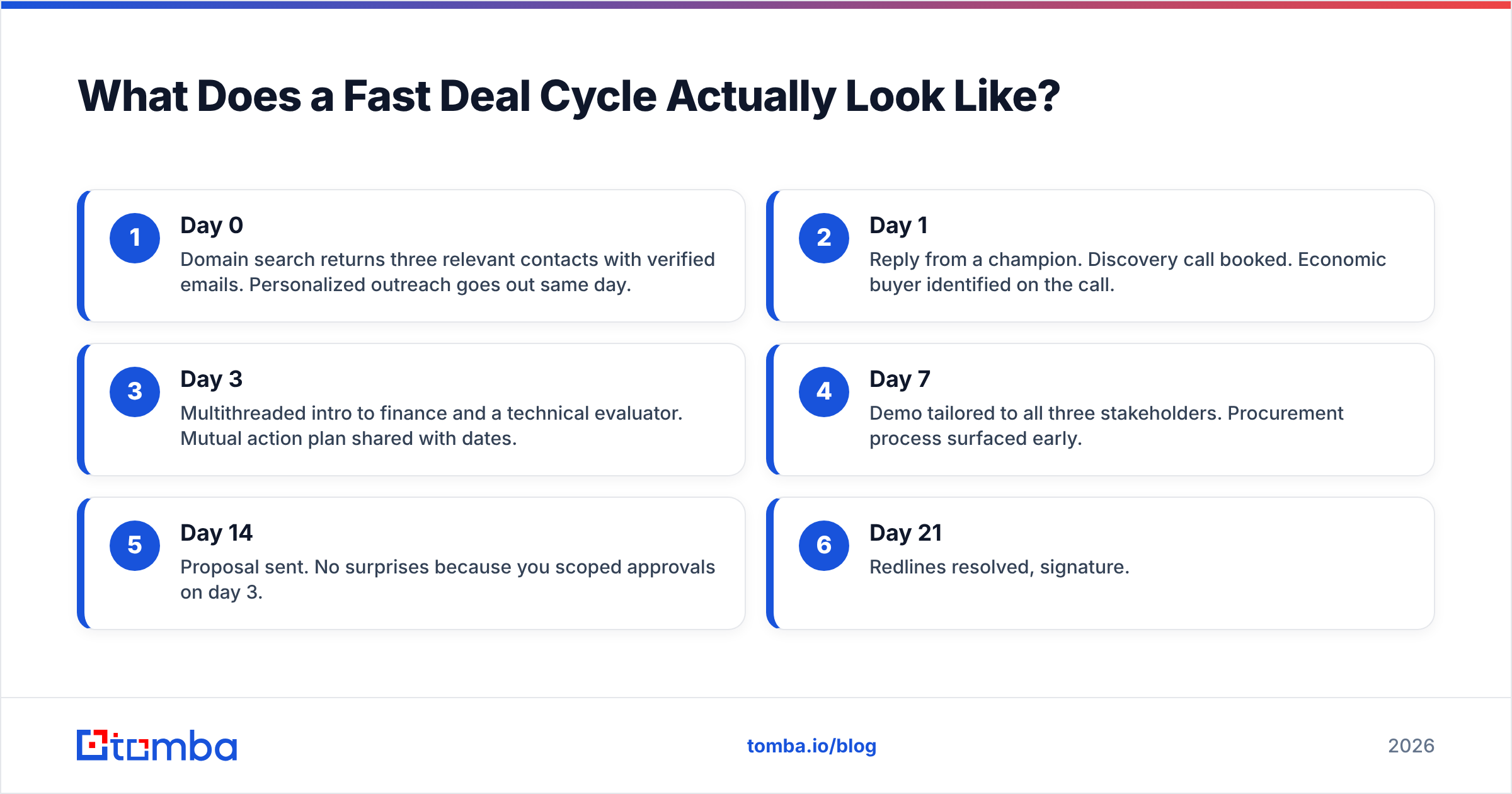
Here is a compressed timeline for a mid-market deal when the data and process are tight:
- Day 0 — Domain search returns three relevant contacts with verified emails. Personalized outreach goes out same day.
- Day 1 — Reply from a champion. Discovery call booked. Economic buyer identified on the call.
- Day 3 — Multithreaded intro to finance and a technical evaluator. Mutual action plan shared with dates.
- Day 7 — Demo tailored to all three stakeholders. Procurement process surfaced early.
- Day 14 — Proposal sent. No surprises because you scoped approvals on day 3.
- Day 21 — Redlines resolved, signature.
Compare that to the default: a week lost finding the right email, a champion who ghosts because you were single-threaded, and a procurement ambush in week five. Same rep, same product — the difference is entirely process and data.
Common Mistakes That Slow Deals Down#
Avoid these and you'll outpace most of your market:
- Chasing quantity over reachability. A list of 5,000 unverified contacts is slower than 500 verified ones, because bounces and dead ends waste real days.
- Confusing activity with progress. Twelve touches to the wrong person is not a fast deal; it's a slow one in disguise.
- Skipping qualification to protect pipeline optics. Inflated stages make forecasts worse and cycles longer.
- Treating follow-up as optional. Most closable deals are lost in the gaps between touches, not in the pitch.
- Relying on one channel. Email-only outreach dies when the inbox goes quiet. Layer in phone and social.
For deeper reading on stage discipline and pipeline hygiene, Tomba's B2B glossary is a useful reference for standardizing terms across your team.
Frequently Asked Questions#
How much can better data realistically speed up a deal? Expect to remove two to five days per cycle just from faster, more accurate contact discovery and near-zero bounce rates. On a 45-day cycle, that is a 10–15% compression before you touch anything else.
Is faster closing bad for deal quality? No — as long as you're compressing friction, not skipping qualification. Killing bad-fit deals early is part of closing good deals faster.
Do I need an enterprise CRM to close faster? No. Discipline beats software. A lightweight CRM plus a clean data source and a consistent follow-up cadence outperforms an expensive stack used sloppily.
What is the single fastest change I can make this week? Cut first-response time to under an hour and verify every contact before outreach. Those two changes alone move the needle immediately.
Close Faster, Starting With Your First Touch#
Every day you shave off the top of the funnel is a day you don't have to claw back later with discounts or pressure. The fastest closers aren't lucky — they reach the right, verified decision-maker on day one, follow up relentlessly, and multithread before the deal needs saving.
Start where the biggest delay hides: contact discovery. Tomba Email Finder returns verified professional emails by name, domain, or company with confidence scores, so your first touch lands in the right inbox instead of a bounce folder. Try the free tier — 25 searches a month — and see how many days you pull out of your next cycle.
Related guides#
Ready to find emails that actually work?
Join 150,000+ professionals who stopped guessing and started sending. Free credits on signup — no credit card required.
Get the Tomba newsletter
Practical outbound tactics and product updates — once every two weeks.
About the author