Closed Deals: How to Consistently Move Pipeline to Won in 2026
Pipeline doesn't pay the bills — closed deals do. Here's the exact framework top reps use to convert more opportunities into won revenue in 2026.
TL;DR
- A closed deal is an opportunity that has reached a final, irreversible state — won (signed and paid) or lost — not a "verbal yes" or a stuck "commit."
- Pipeline volume is a vanity metric. Win rate, sales-cycle length, and average deal size are the levers that actually grow closed-won revenue.
- Most deals die from bad data and weak qualification, not weak closing lines. Reaching the right contact early beats a slick close every time.
- A repeatable close depends on three things: clean contact data, a documented stage exit criteria, and a mutual action plan the buyer co-owns.
- Tools that keep your CRM accurate — verified emails, direct dials, enriched firmographics — shorten cycles and lift win rate more than any "closing script."
What is a closed deal (and what isn't)?#
A closed deal is an opportunity that has reached a terminal outcome: closed-won (contract signed, revenue booked) or closed-lost (the buyer said no or went dark permanently). Everything before that — discovery, demo, proposal, "we're just waiting on legal" — is open pipeline, no matter how confident the rep feels.
This distinction matters because sales teams routinely fool themselves. A deal marked "commit" in the CRM is not a closed deal. A verbal "we love it, send the paperwork" is not a closed deal. Until the signature and the first payment clear, the deal can still slip, shrink, or vanish. Treating optimistic forecasts as closed revenue is the single fastest way to blow a quarter.
Think of it like a restaurant reservation. A table booked for 8 p.m. is a forecast — the guests might cancel, arrive late, or ghost. The revenue only counts when they sit down, order, and pay the check. Closed-won is the paid check.
Why do most deals never close?#
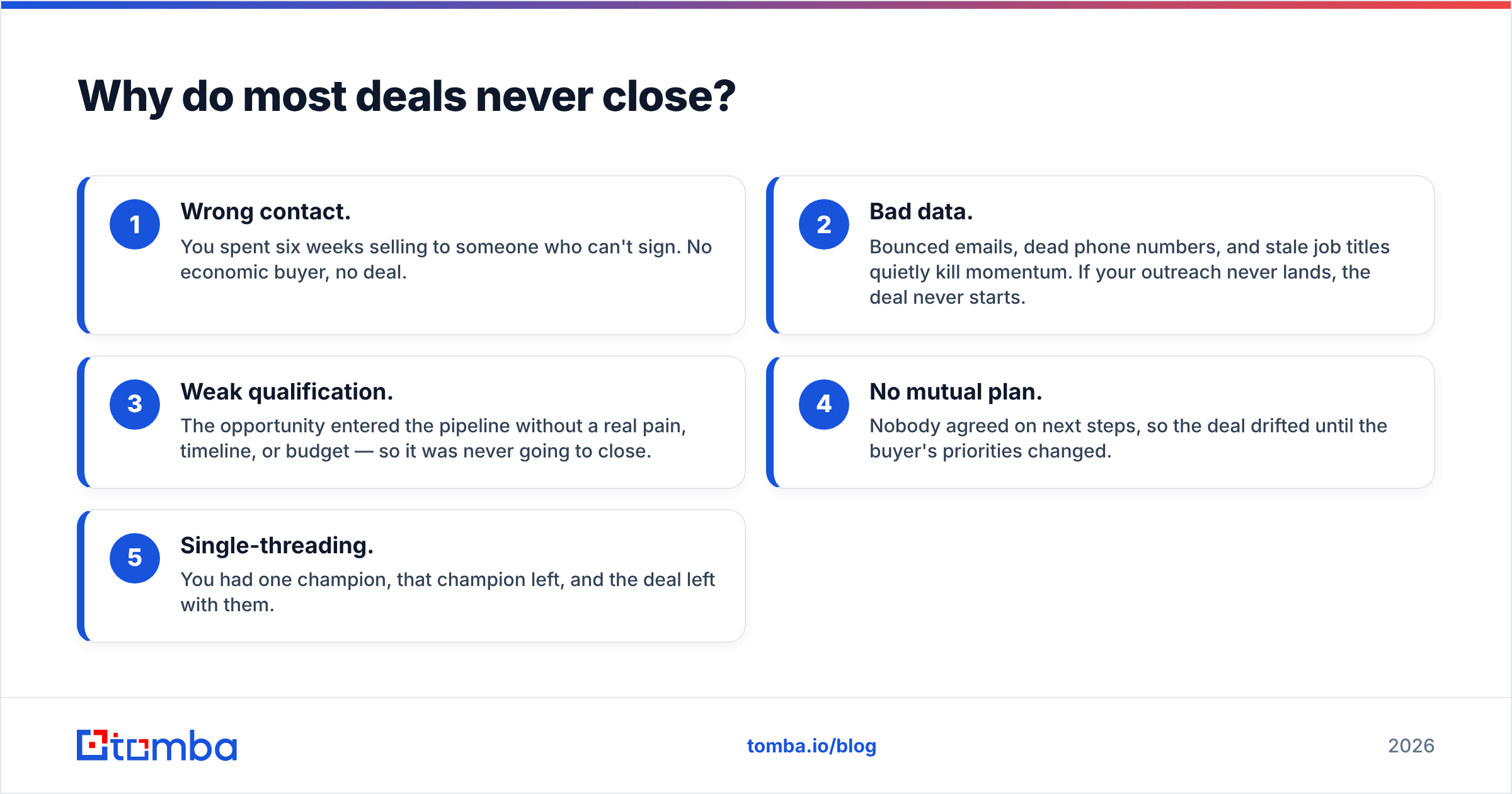
Reps love to blame pricing or "no budget," but post-mortems tell a different story. The majority of stalled deals trace back to problems that happened long before the negotiation:
- Wrong contact. You spent six weeks selling to someone who can't sign. No economic buyer, no deal.
- Bad data. Bounced emails, dead phone numbers, and stale job titles quietly kill momentum. If your outreach never lands, the deal never starts.
- Weak qualification. The opportunity entered the pipeline without a real pain, timeline, or budget — so it was never going to close.
- No mutual plan. Nobody agreed on next steps, so the deal drifted until the buyer's priorities changed.
- Single-threading. You had one champion, that champion left, and the deal left with them.
Notice that only one of these is about "closing skill." According to Gartner's research on B2B buying, buyers spend only about 17% of their purchase journey meeting with sales reps — and that time is split across every vendor they consider. You don't get many at-bats, so the quality of your data and qualification decides the outcome long before you ask for the signature.
How do you measure closed-deal performance?#
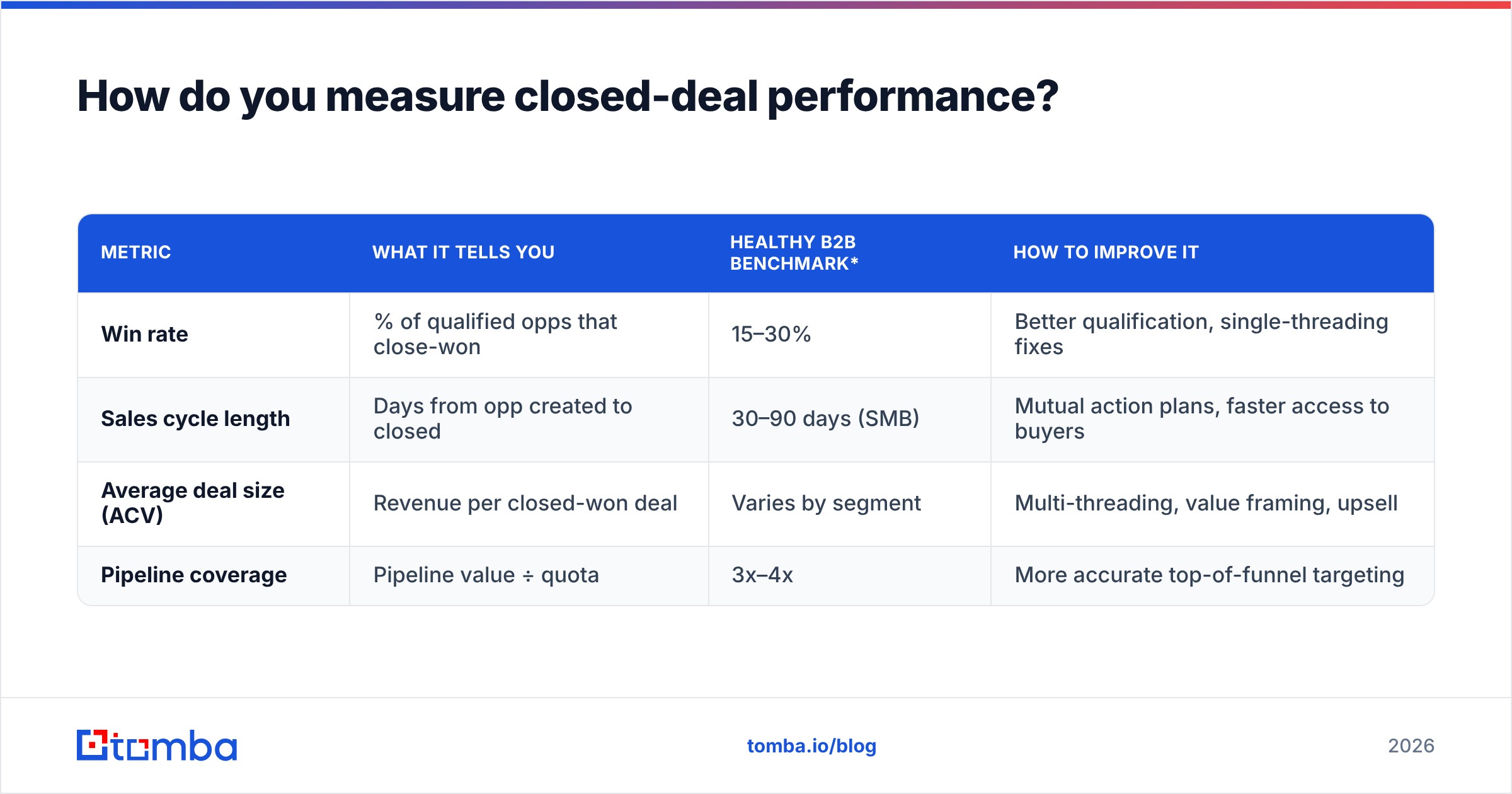
You can't improve what you don't measure. Four metrics tell you almost everything about your ability to convert pipeline into closed deals.
| Metric | What it tells you | Healthy B2B benchmark* | How to improve it |
|---|---|---|---|
| Win rate | % of qualified opps that close-won | 15–30% | Better qualification, single-threading fixes |
| Sales cycle length | Days from opp created to closed | 30–90 days (SMB) | Mutual action plans, faster access to buyers |
| Average deal size (ACV) | Revenue per closed-won deal | Varies by segment | Multi-threading, value framing, upsell |
| Pipeline coverage | Pipeline value ÷ quota | 3x–4x | More accurate top-of-funnel targeting |
*Benchmarks vary widely by industry and deal size; treat them as directional, not gospel. Vendors like HubSpot and Salesforce publish segment-specific data worth checking against your own numbers.
The trap is optimizing pipeline coverage alone. A rep sitting on 6x coverage with a 9% win rate has a qualification problem, not a volume problem — and piling on more low-quality leads makes it worse. The sales win rate is where the money hides.
What are the stages of a deal that actually closes?#
Every closed deal passes through a predictable path. The point of naming the stages isn't bureaucracy — it's defining exit criteria so a deal can't advance on hope alone.
- Prospect → Contacted: You've reached a real, verified decision-maker. Exit criteria: two-way engagement confirmed (a reply, a booked call), not just a sent email.
- Contacted → Qualified: Confirmed pain, budget signal, timeline, and authority. Exit criteria: the buyer has articulated a problem worth solving now.
- Qualified → Demo/Evaluation: The buyer sees your solution against their specific pain. Exit criteria: a defined success metric they agree on.
- Evaluation → Proposal: Pricing and scope delivered. Exit criteria: a named economic buyer and a mutual action plan with dates.
- Proposal → Closed-Won: Signature and payment. Exit criteria: contract executed — nothing softer counts.
The reps who consistently hit quota treat stage one as the highest-leverage step. If you enter the funnel talking to the wrong person with a guessed email address, no amount of downstream polish saves the deal. That's why accurate targeting data — verified emails, direct dials, current titles — is a closing tool, not just a prospecting tool.
How does data quality change your close rate?#
Directly and measurably. Deal velocity is a chain, and the first link is reaching the right human. When that link is weak, everything downstream compounds the damage.
Consider two reps working identical territories:
- Rep A buys a cheap, unverified list. 30% of emails bounce, 20% of phone numbers are dead, and a chunk of titles are two roles out of date. Half their "activity" never reaches a live buyer.
- Rep B works a verified, enriched list where contacts are confirmed and roles are current. Nearly every touch lands with a real decision-maker.
Same effort, wildly different closed-deal outcomes. Rep B isn't a better closer — they're just not wasting cycles on ghosts. This is where an email verifier and solid data enrichment quietly do more for your number than any negotiation training. Clean data shortens the cycle (fewer dead ends), lifts win rate (more time with real buyers), and protects sender reputation (fewer bounces).
If you want to sanity-check your own funnel, pull your last 20 closed-lost deals and tag the failure reason. If more than a quarter died at "never reached the right person" or "no response," your problem is upstream of closing — it's data and targeting.
What's the difference between chasing pipeline and closing deals?#
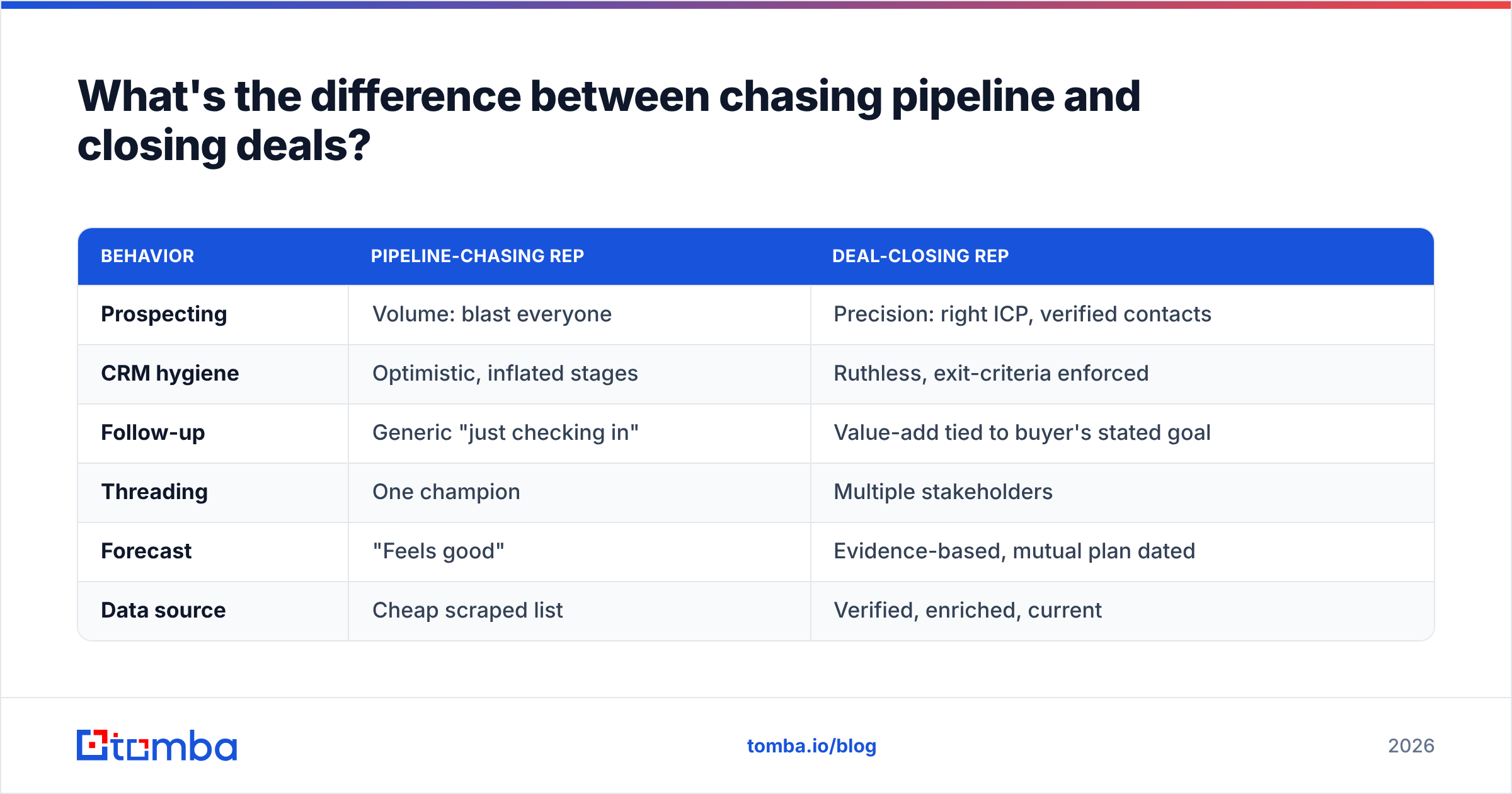
They feel similar but reward opposite behaviors. Chasing pipeline optimizes for activity; closing deals optimizes for outcomes.
| Behavior | Pipeline-chasing rep | Deal-closing rep |
|---|---|---|
| Prospecting | Volume: blast everyone | Precision: right ICP, verified contacts |
| CRM hygiene | Optimistic, inflated stages | Ruthless, exit-criteria enforced |
| Follow-up | Generic "just checking in" | Value-add tied to buyer's stated goal |
| Threading | One champion | Multiple stakeholders |
| Forecast | "Feels good" | Evidence-based, mutual plan dated |
| Data source | Cheap scraped list | Verified, enriched, current |
The deal-closing column costs less in the long run because it wastes far less effort. A tighter, accurate top of funnel means every hour goes toward opportunities that can actually close. That's also why teams increasingly lean on sales automation to remove busywork and reserve human time for the conversations that move deals to won.
A practical framework to close more deals in 2026#
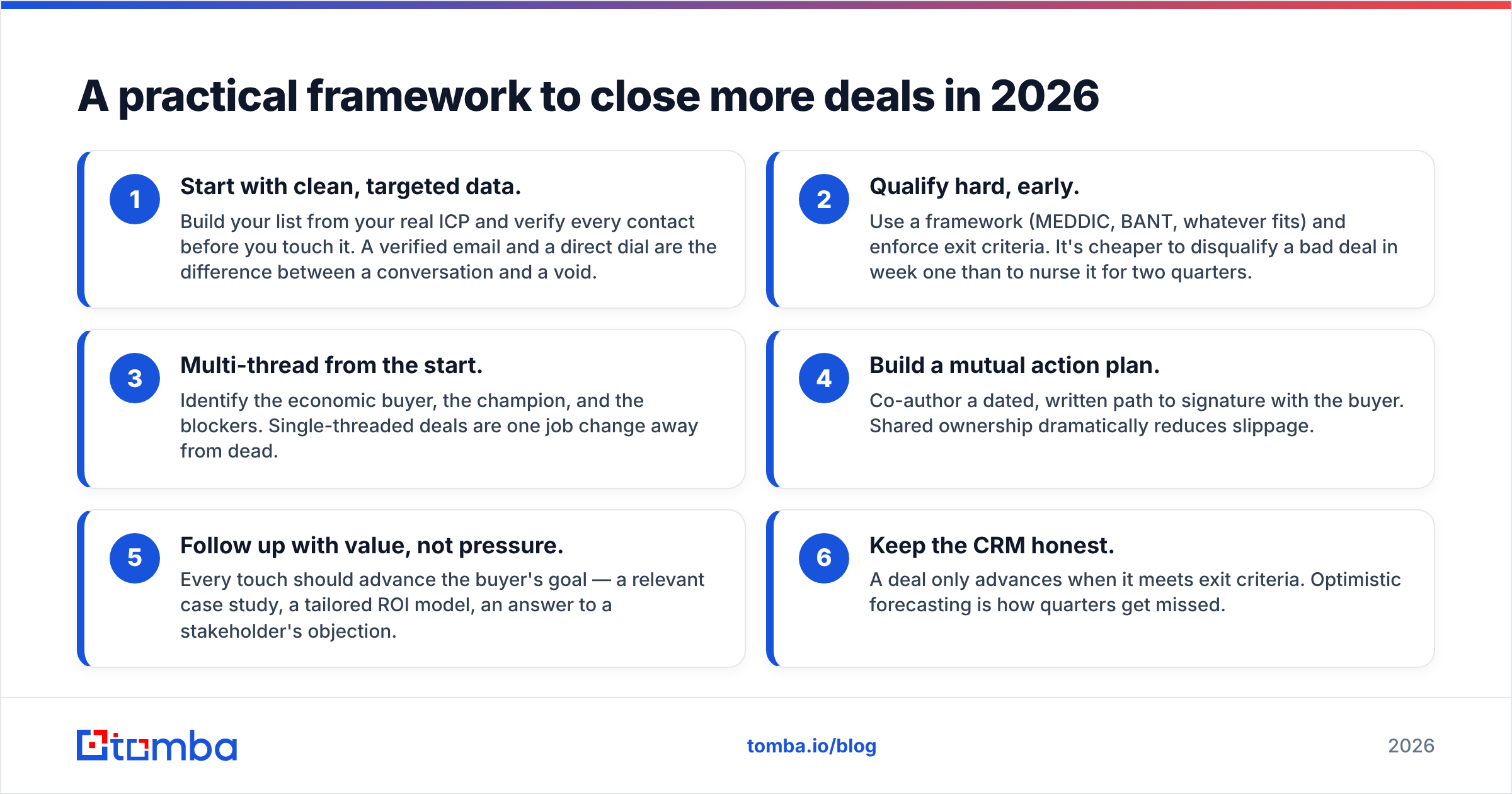
Here's the sequence that consistently converts opportunities into closed deals. None of it is exotic — the edge is in doing all of it, consistently.
- Start with clean, targeted data. Build your list from your real ICP and verify every contact before you touch it. A verified email and a direct dial are the difference between a conversation and a void.
- Qualify hard, early. Use a framework (MEDDIC, BANT, whatever fits) and enforce exit criteria. It's cheaper to disqualify a bad deal in week one than to nurse it for two quarters.
- Multi-thread from the start. Identify the economic buyer, the champion, and the blockers. Single-threaded deals are one job change away from dead.
- Build a mutual action plan. Co-author a dated, written path to signature with the buyer. Shared ownership dramatically reduces slippage.
- Follow up with value, not pressure. Every touch should advance the buyer's goal — a relevant case study, a tailored ROI model, an answer to a stakeholder's objection.
- Keep the CRM honest. A deal only advances when it meets exit criteria. Optimistic forecasting is how quarters get missed.
Run this loop and your win rate climbs, your cycle shortens, and your forecast starts matching reality. The unglamorous truth: most of the leverage lives in steps one and two, before the "selling" even starts.
How do the right tools accelerate closed deals?#
Tooling won't fix a broken process, but the right stack removes the friction that stalls good deals. Three categories earn their keep:
- Accurate contact data. A bulk email finder plus verification keeps your outreach landing and your CRM current. Reaching the right person on the first try compresses the entire cycle.
- Enrichment. Firmographic and contact enrichment tells you who to multi-thread and why the deal matters to them — the raw material for a value-based close.
- CRM integrations. Piping verified data straight into your CRM means reps sell instead of doing data entry, and forecasts reflect reality.
For teams evaluating options, peer-review sites like G2 are a reasonable place to compare data providers on real accuracy and support — not just marketing claims. Pair that research with a free trial and test the data against contacts you can verify yourself.
Turn better data into more closed deals#
Closed deals are the only pipeline metric that pays your team. And the fastest, most durable way to close more of them is to stop wasting cycles on bad contacts and start every opportunity with verified, accurate data.
That's exactly what the Tomba Email Finder is built for: find and verify professional email addresses by name, domain, or company so your reps spend their time with real buyers instead of chasing dead ends. Enrich the record, multi-thread the account, and feed clean data straight into your pipeline. Start on the free tier (25 searches/mo) or scale up on a plan from $49/mo — see the full Tomba pricing — and give every deal the one thing it needs to close: a real conversation with the right person.
Related guides#
Ready to find emails that actually work?
Join 150,000+ professionals who stopped guessing and started sending. Free credits on signup — no credit card required.
Get the Tomba newsletter
Practical outbound tactics and product updates — once every two weeks.
About the author