Closed Lost: What It Means and How to Win Deals Back in 2026
Closed lost isn't a dead end — it's data. Learn what the stage really means, how to code loss reasons, and a proven playbook to reopen and win deals back.
TL;DR
- Closed lost is the CRM stage for a deal that ended without a sale — the buyer chose a competitor, went silent, ran out of budget, or lost internal priority.
- It is not failure data you should bury. Coded correctly, closed-lost reasons are the single cheapest source of pipeline insight you own.
- The biggest mistake is a vague "lost" with no reason code. Without a structured loss taxonomy, you cannot fix win rate, forecast accuracy, or re-engagement timing.
- Between 15% and 30% of closed-lost deals are winnable later — but only if your contact data is still accurate when the timing changes.
- The playbook below covers how to define the stage, code the reasons, run a loss-reason review, and reopen deals with clean, verified contact data.
What does "closed lost" actually mean?#
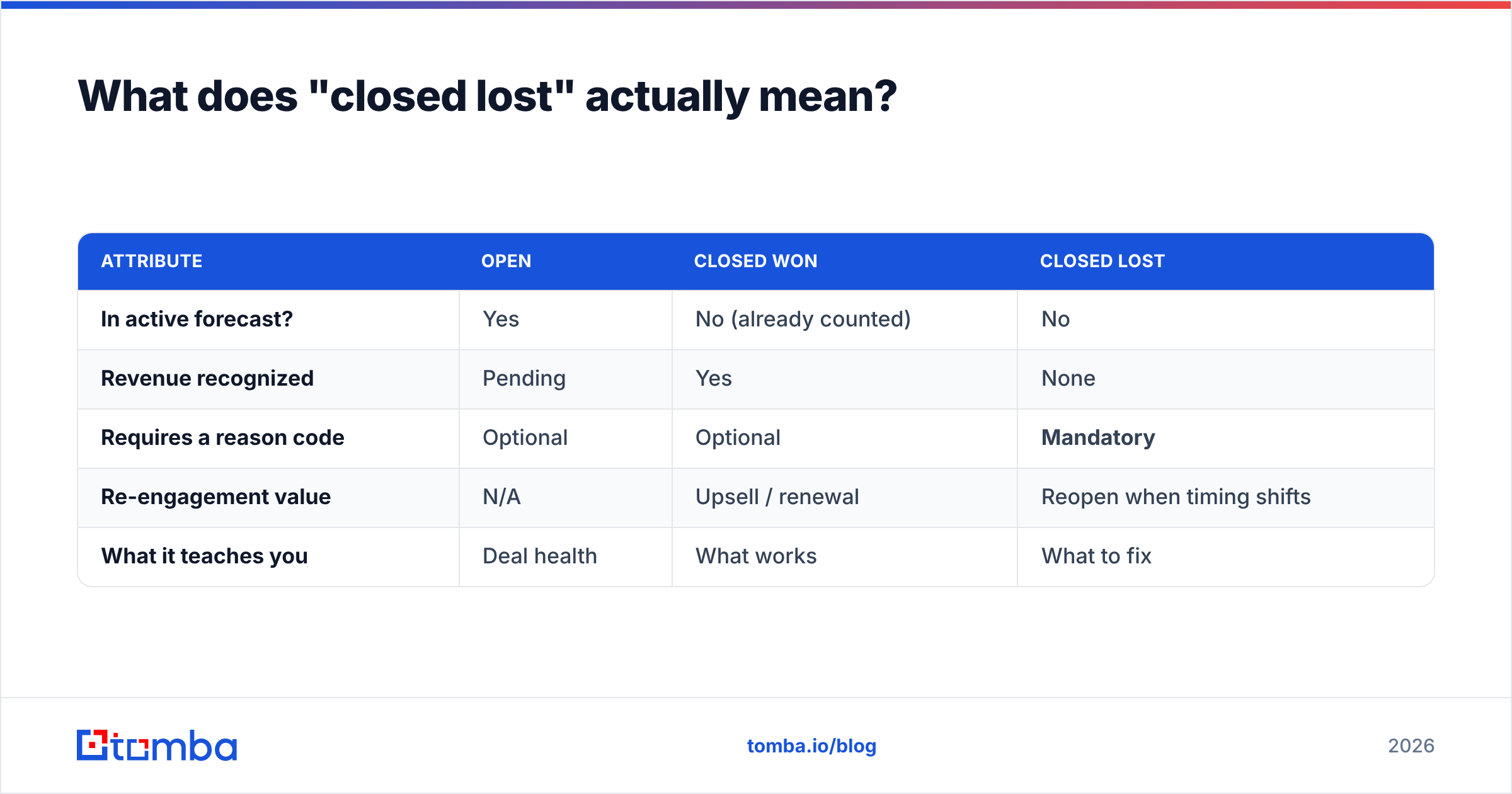
Closed lost is the terminal pipeline stage you apply to an opportunity that will not become revenue in this cycle. The deal is out of your active forecast. The buyer either bought elsewhere, decided to do nothing, or disqualified themselves on budget, authority, or timing.
Think of your pipeline like a restaurant reservation book. "Closed won" is a party that showed up and paid. "Open" is a booking still on the calendar. "Closed lost" is the table that canceled — and the whole point of tracking cancellations is to learn why people cancel so you keep fewer empty tables next month. Most teams write "cancelled" and move on. The good ones write down the reason.
Technically, closed lost sits opposite closed won at the bottom of your funnel. Every opportunity eventually resolves into one of the two. What separates a mediocre revenue org from a sharp one is how much intelligence they extract from the losing half.
| Attribute | Open | Closed Won | Closed Lost |
|---|---|---|---|
| In active forecast? | Yes | No (already counted) | No |
| Revenue recognized | Pending | Yes | None |
| Requires a reason code | Optional | Optional | Mandatory |
| Re-engagement value | N/A | Upsell / renewal | Reopen when timing shifts |
| What it teaches you | Deal health | What works | What to fix |
The mandatory reason code in that last column is the whole game. A closed-won deal confirms your motion works. A closed-lost deal, properly documented, tells you exactly where the motion breaks — and that is far more actionable.
Why do so many teams get closed lost wrong?#
Because "lost" feels like an admission, reps rush past it. The deal died, the commission evaporated, and nobody wants to spend ten minutes documenting a defeat. So the CRM fills up with opportunities marked lost and nothing else.
That habit quietly destroys three things:
- Forecast accuracy — You cannot model win rate by segment if you do not know why segments lose. Your sales win rate becomes a single blurry number instead of a diagnostic.
- Product and pricing feedback — If 40% of your losses are "too expensive" but you never tag it, your pricing committee is flying blind.
- Re-engagement — A deal lost to "no budget this quarter" is a follow-up in 90 days. A deal lost to "chose competitor" may never come back. If both are just "lost," you treat them identically and waste effort on the wrong ones.

The fix is not more discipline through willpower. It is making the right action the easy action: a required, structured loss-reason field that takes one click, plus a short async ritual to review the patterns.
What are the most common closed lost reasons?#
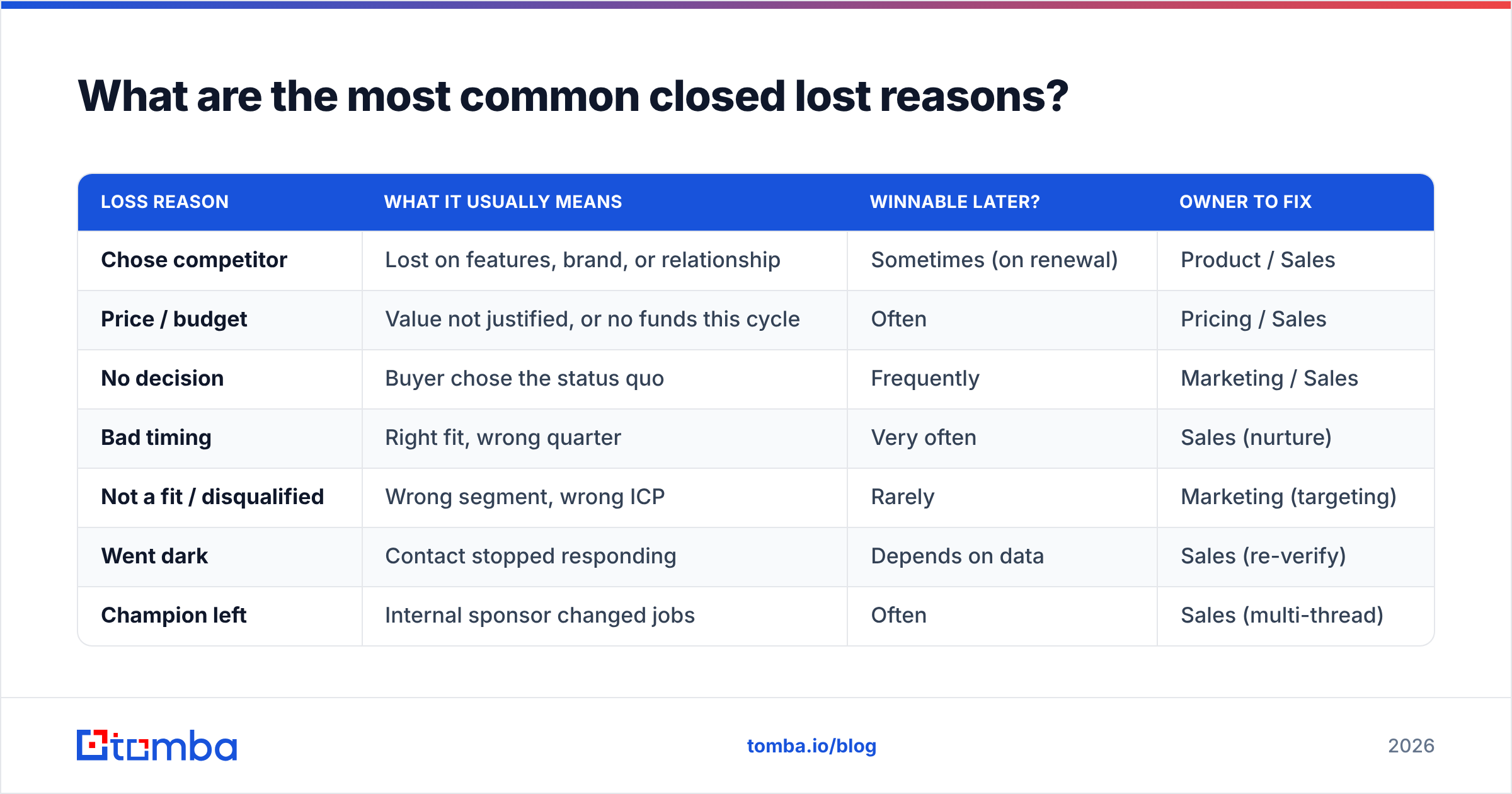
Loss reasons cluster into a handful of buckets. Standardize them so every rep picks from the same list — free-text loss notes are unsearchable and worthless in aggregate.
| Loss reason | What it usually means | Winnable later? | Owner to fix |
|---|---|---|---|
| Chose competitor | Lost on features, brand, or relationship | Sometimes (on renewal) | Product / Sales |
| Price / budget | Value not justified, or no funds this cycle | Often | Pricing / Sales |
| No decision | Buyer chose the status quo | Frequently | Marketing / Sales |
| Bad timing | Right fit, wrong quarter | Very often | Sales (nurture) |
| Not a fit / disqualified | Wrong segment, wrong ICP | Rarely | Marketing (targeting) |
| Went dark | Contact stopped responding | Depends on data | Sales (re-verify) |
| Champion left | Internal sponsor changed jobs | Often | Sales (multi-thread) |
Two patterns matter most for revenue teams:
- "No decision" is often your biggest competitor. Studies from sales researchers consistently show that a large share of forecasted deals end in no decision rather than a competitive loss. You are not losing to a rival tool — you are losing to inertia. That is a messaging and urgency problem, not a feature problem.
- "Went dark" and "champion left" are data problems in disguise. When a buyer goes silent or your sponsor changes companies, the deal is not truly dead — your contact path is dead. Rebuild the path with fresh, verified contacts and the opportunity reopens.
How should you structure a closed lost taxonomy?#
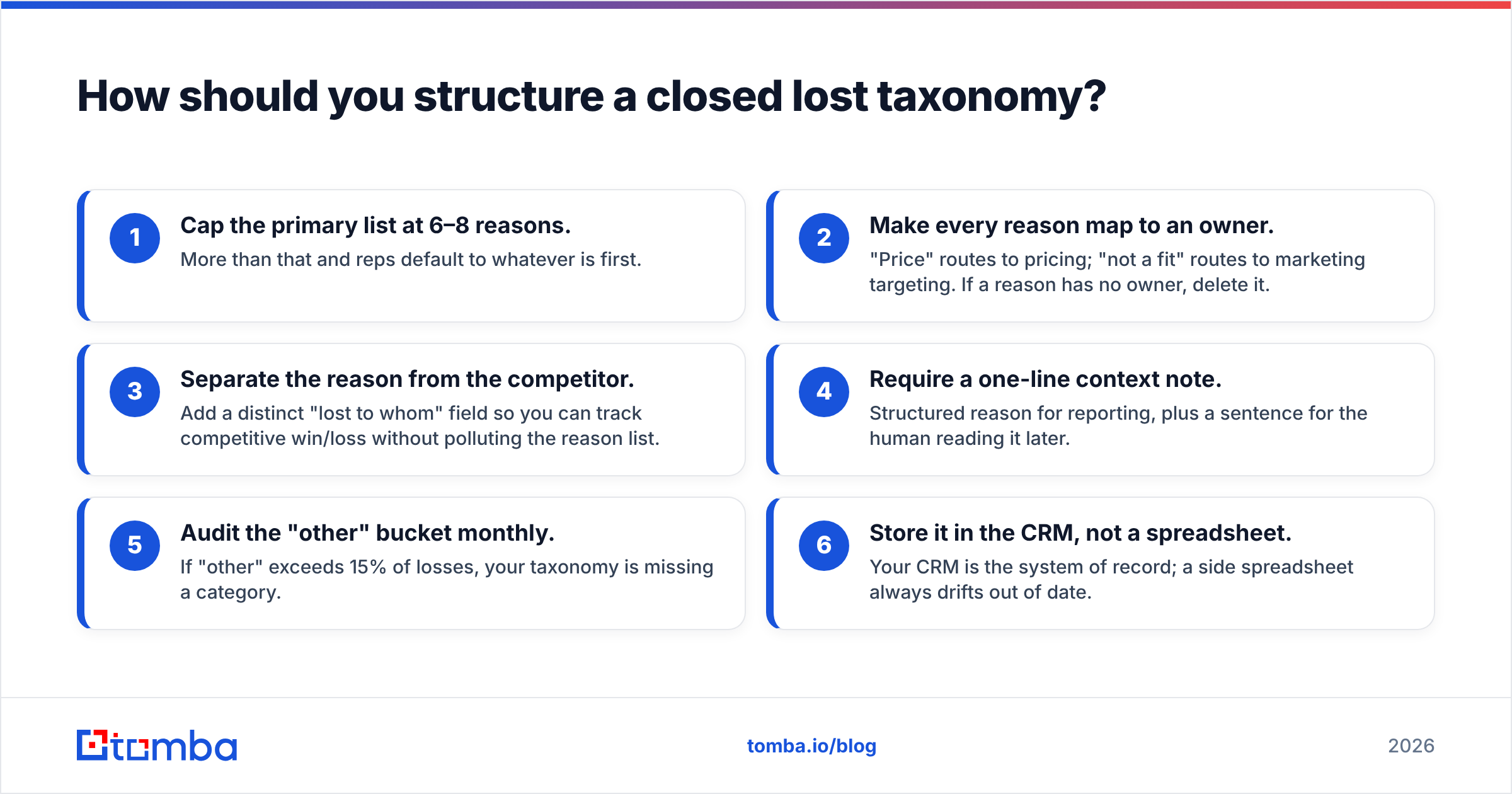
Keep it short enough that reps actually use it and rich enough that it drives decisions. A good taxonomy has a primary reason (required, single-select) and an optional secondary tag for nuance.
Follow these rules when you design it:
- Cap the primary list at 6–8 reasons. More than that and reps default to whatever is first.
- Make every reason map to an owner. "Price" routes to pricing; "not a fit" routes to marketing targeting. If a reason has no owner, delete it.
- Separate the reason from the competitor. Add a distinct "lost to whom" field so you can track competitive win/loss without polluting the reason list.
- Require a one-line context note. Structured reason for reporting, plus a sentence for the human reading it later.
- Audit the "other" bucket monthly. If "other" exceeds 15% of losses, your taxonomy is missing a category.
- Store it in the CRM, not a spreadsheet. Your CRM is the system of record; a side spreadsheet always drifts out of date.
This structure turns a graveyard of dead deals into a queryable dataset. You can now ask: What is our win rate against Competitor X in the mid-market? or Which loss reason has the highest reopen rate? — and get real answers.
Is a closed lost deal really gone?#
No — and treating every loss as permanent is the most expensive assumption in B2B sales. A meaningful slice of losses are timing, budget, or champion issues that resolve on their own within two to four quarters.
The key is triage. Sort your closed-lost pile into three tiers:
- Reopen soon (0–90 days): Lost to "no budget this quarter" or "bad timing." The fit was real; only the calendar was wrong. These are your highest-ROI follow-ups.
- Nurture (3–12 months): "No decision" and "champion left." The organization still fits your ICP, but you need a new trigger event or a new internal sponsor.
- Archive (rarely revisit): "Not a fit" and hard disqualifications. Revisiting these wastes cycles better spent on tiers one and two.
Here is the catch that sinks most re-engagement programs: by the time the timing is right, your contact data is stale. People change jobs every two to three years. The champion who went dark may now be at a company that fits you even better — but only if you can find their new email. This is where a reliable email finder and ongoing data enrichment turn a cold, dead record into a warm, reachable opportunity.
What does a closed lost review process look like?#
You do not need a heavyweight ceremony. You need a repeatable rhythm that converts loss data into changes. Here is a lean monthly cadence any RevOps or sales manager can run.
Weekly (rep-level, async): Every closed-lost deal gets a primary reason, a competitor tag if relevant, and one context sentence. Non-negotiable. No reason, no closing the opportunity.
Monthly (team-level, 45 minutes):
- Pull the loss-reason report for the period. Sort by volume and by dollar value — the two lists rarely match, and the dollar list is where your leaks hide.
- Identify the top three reasons by revenue lost. Assign each to its owner.
- Review the "reopen soon" tier and load those contacts back into sequences with verified data.
- Spot-check five losses for tagging accuracy. Reps under pressure default to "price" — verify it is actually price.
Quarterly (leadership): Roll loss reasons into a win/loss narrative. Feed "chose competitor" into product roadmap and battlecards. Feed "not a fit" into ICP and marketing targeting. Feed "no decision" into messaging and sales enablement.
This loop is how closed-lost data stops being an autopsy and starts being a steering wheel. Teams that run it consistently see measurable win-rate lift within two quarters, because they are fixing root causes instead of re-losing the same deals.
How does data quality change your closed lost outcomes?#
Dramatically. Two closed-lost problems — "went dark" and "champion left" — are not sales-skill problems at all. They are contact-data problems. If you cannot reach the right person, the deal is lost by default, regardless of how good your pitch was.
Consider the reopen workflow for a "champion left" loss:
- Detect that your sponsor changed jobs.
- Find their new company and role.
- Get a verified, deliverable email for them there.
- Re-engage with a warm, relevant message referencing the prior relationship.
- Simultaneously multi-thread into their former company's replacement.
Every step after the first depends on accurate, fresh B2B data. Bounced emails and outdated titles turn a promising reopen into another silent loss. This is why the strongest revenue teams pair their loss taxonomy with a data hygiene routine — verifying and enriching closed-lost contacts before re-engagement, not after the bounce.
Authoritative sales research backs this up: firms like Gartner and platforms such as HubSpot repeatedly find that data decay and poor contact accuracy are among the top silent killers of B2B pipeline. Closed-lost re-engagement is precisely where that decay bites hardest, because time has passed since the last touch.
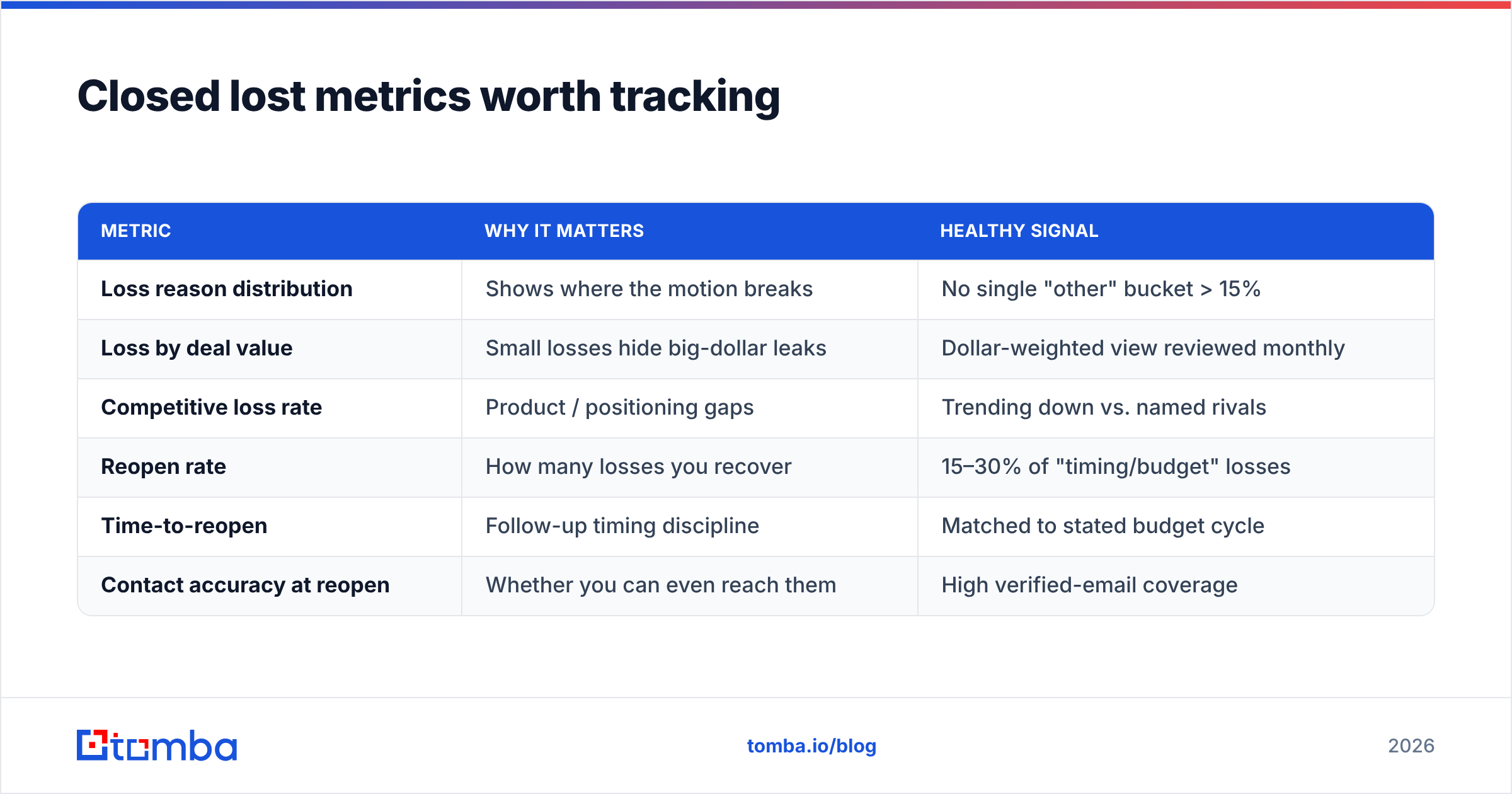
Closed lost metrics worth tracking#
If you only track raw loss volume, you are missing the story. Track these instead:
| Metric | Why it matters | Healthy signal |
|---|---|---|
| Loss reason distribution | Shows where the motion breaks | No single "other" bucket > 15% |
| Loss by deal value | Small losses hide big-dollar leaks | Dollar-weighted view reviewed monthly |
| Competitive loss rate | Product / positioning gaps | Trending down vs. named rivals |
| Reopen rate | How many losses you recover | 15–30% of "timing/budget" losses |
| Time-to-reopen | Follow-up timing discipline | Matched to stated budget cycle |
| Contact accuracy at reopen | Whether you can even reach them | High verified-email coverage |
That last row is the quiet multiplier. You can nail every other metric, but if your contact accuracy at reopen is low, your recovered-revenue number collapses. Clean data is the difference between a re-engagement list and a bounce list.
Turning closed lost into your next pipeline#
Closed lost is not the end of a deal — it is the start of a smarter one. The teams that win consistently do three things: they require a structured loss reason on every dead deal, they triage losses into reopen, nurture, and archive tiers, and they keep contact data fresh so timing-based losses can actually be recovered.
The first two are process. The third is data — and that is where the recovery either happens or dies. When a "no budget this quarter" deal comes back into season, or a departed champion resurfaces at a better-fit company, you need a verified email in seconds, not a bounce two days later.
That is exactly what the Tomba Email Finder is built for: find and verify professional email addresses by name, company, or domain so your closed-lost pile becomes a live, reachable re-engagement list. Pair it with automated enrichment and you convert the gravefyard into a pipeline. Check the Tomba pricing plans — starting free with 25 searches a month, then Starter at $49/mo — and turn your next batch of closed-lost deals into closed won.
Related guides#
// get started
Find, verify and enrich your first contacts today
Start on the free plan with 25 searches a month, then scale when your team is ready.
Free plan · No credit card required · GDPR & CCPA
// about the author