Closed Lost Meaning: What It Signals and How to Win Back Deals
Closed lost isn't a dead end—it's data. Learn what the closed lost stage really means, why deals land there, and how to turn lost opportunities into future revenue.
TL;DR
- Closed lost is the CRM stage for a deal that ended without a sale—the buyer said no, went silent, chose a competitor, or ran out of budget.
- It is not a failure log. It is your single richest source of data on why revenue leaks out of your pipeline.
- Every closed lost record should carry a structured reason (price, timing, competitor, no decision) so you can spot patterns instead of guessing.
- A meaningful share of closed lost deals are not dead forever—timing and budget objections often reverse in 6–12 months.
- Clean contact data is what makes re-engagement possible: if you can't reach the buyer again, "closed lost" really does mean gone.
What does closed lost mean in sales?#
Closed lost means a deal has ended and no purchase happened. The opportunity is closed—no longer active in your working pipeline—and the outcome was a loss rather than a win. In most CRMs, every opportunity eventually reaches one of two terminal stages: closed won (the deal was signed) or closed lost (it wasn't).
Think of your pipeline like a checkout line at a grocery store. Some carts make it through the register (closed won). Some get abandoned in the aisle—the shopper changed their mind, couldn't find what they wanted, or the line was too long (closed lost). Either way, the cart leaves the line. What matters is whether you bother to ask why it was abandoned.
Closed lost is a status, not a judgment. A well-run sales team treats it as the end of one cycle, not the end of the relationship. The deal is closed; the account is not necessarily dead.
Why does the closed lost stage actually matter?#
Because what you record here decides whether you learn anything. A pipeline that only tracks wins is like a doctor who only studies healthy patients—you miss every lesson that could prevent the next loss.
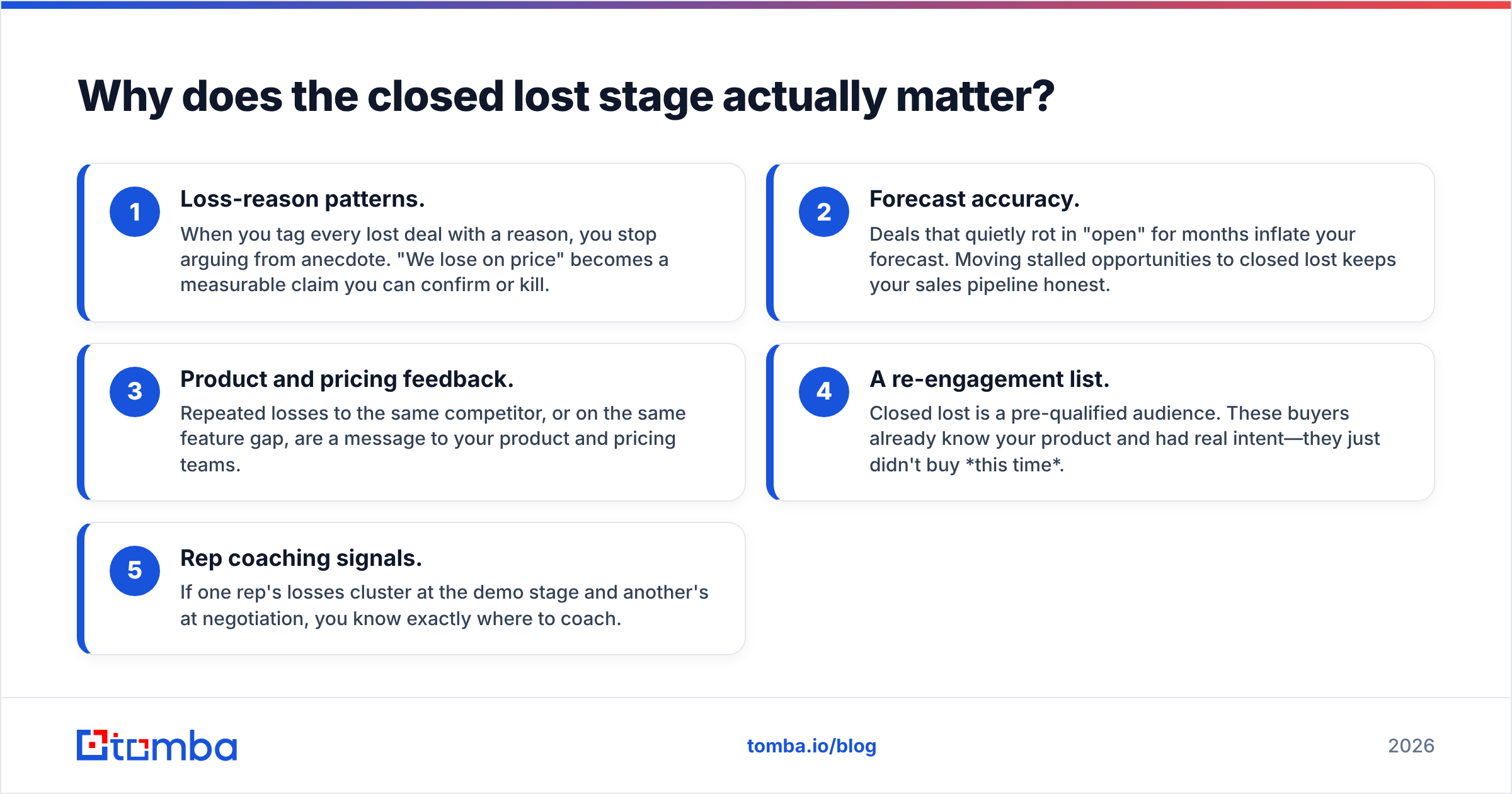
Here is what a disciplined closed lost process gives you:
- Loss-reason patterns. When you tag every lost deal with a reason, you stop arguing from anecdote. "We lose on price" becomes a measurable claim you can confirm or kill.
- Forecast accuracy. Deals that quietly rot in "open" for months inflate your forecast. Moving stalled opportunities to closed lost keeps your sales pipeline honest.
- Product and pricing feedback. Repeated losses to the same competitor, or on the same feature gap, are a message to your product and pricing teams.
- A re-engagement list. Closed lost is a pre-qualified audience. These buyers already know your product and had real intent—they just didn't buy this time.
- Rep coaching signals. If one rep's losses cluster at the demo stage and another's at negotiation, you know exactly where to coach.
Ignore the stage and you throw all of that away. Gartner and other analysts have long noted that most B2B buying journeys involve a large, shifting buying group—which means a single "no" often reflects internal politics, not a permanent verdict. That is precisely why the reason matters more than the label.
Closed lost vs closed won vs open: what's the difference?#
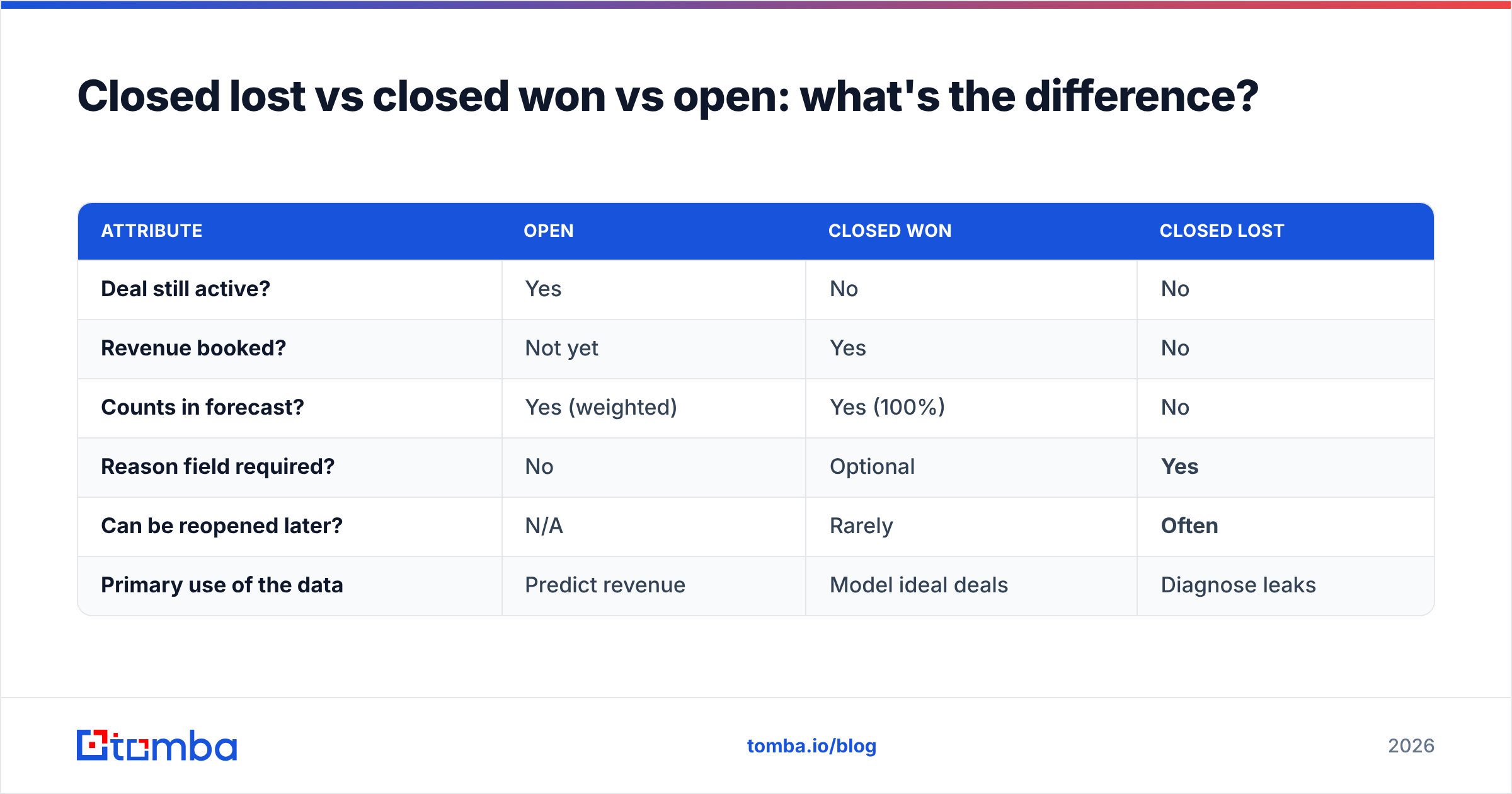
These three states cover the entire lifecycle of an opportunity. Confusing them is the most common reason pipeline reports lie.
| Attribute | Open | Closed Won | Closed Lost |
|---|---|---|---|
| Deal still active? | Yes | No | No |
| Revenue booked? | Not yet | Yes | No |
| Counts in forecast? | Yes (weighted) | Yes (100%) | No |
| Reason field required? | No | Optional | Yes |
| Can be reopened later? | N/A | Rarely | Often |
| Primary use of the data | Predict revenue | Model ideal deals | Diagnose leaks |
The key row is the last two. Closed won teaches you what a good deal looks like. Closed lost teaches you where your process breaks—and, crucially, it can be reopened. A deal marked lost on "budget frozen this quarter" is a completely different asset than one marked lost on "chose competitor, signed 3-year contract."
What are the most common closed lost reasons?#
If you only take one habit from this guide, make it this: standardize your loss reasons. Free-text notes like "went dark" are useless at scale. A short, mandatory dropdown turns closed lost into analytics.
Here are the reasons most B2B teams should track, with what each one actually tells you:
- No decision / status quo. The buyer chose to do nothing. This is often your largest loss category and the most winnable later—nothing changed except timing.
- Lost to competitor. Track which competitor. This feeds your battlecards and your win rate analysis.
- Price / budget. Separate "too expensive" (a value problem) from "no budget this cycle" (a timing problem). They need opposite follow-ups.
- Bad timing. A real need exists, but not now. Set a reminder, not a tombstone.
- No response / went dark. The contact stopped replying. Frequently a data or multithreading problem, not a real rejection.
- Not a fit. Wrong ICP, wrong use case. This one you want to lose—but tag it so marketing stops sending you lookalikes.
- Lost champion. Your internal advocate left the company. The deal died with their departure, not with genuine disinterest.
That last one is a goldmine. When a champion changes jobs, they often rebuild the same stack at their new company. The deal isn't lost—it moved.
Can a closed lost deal be reopened?#
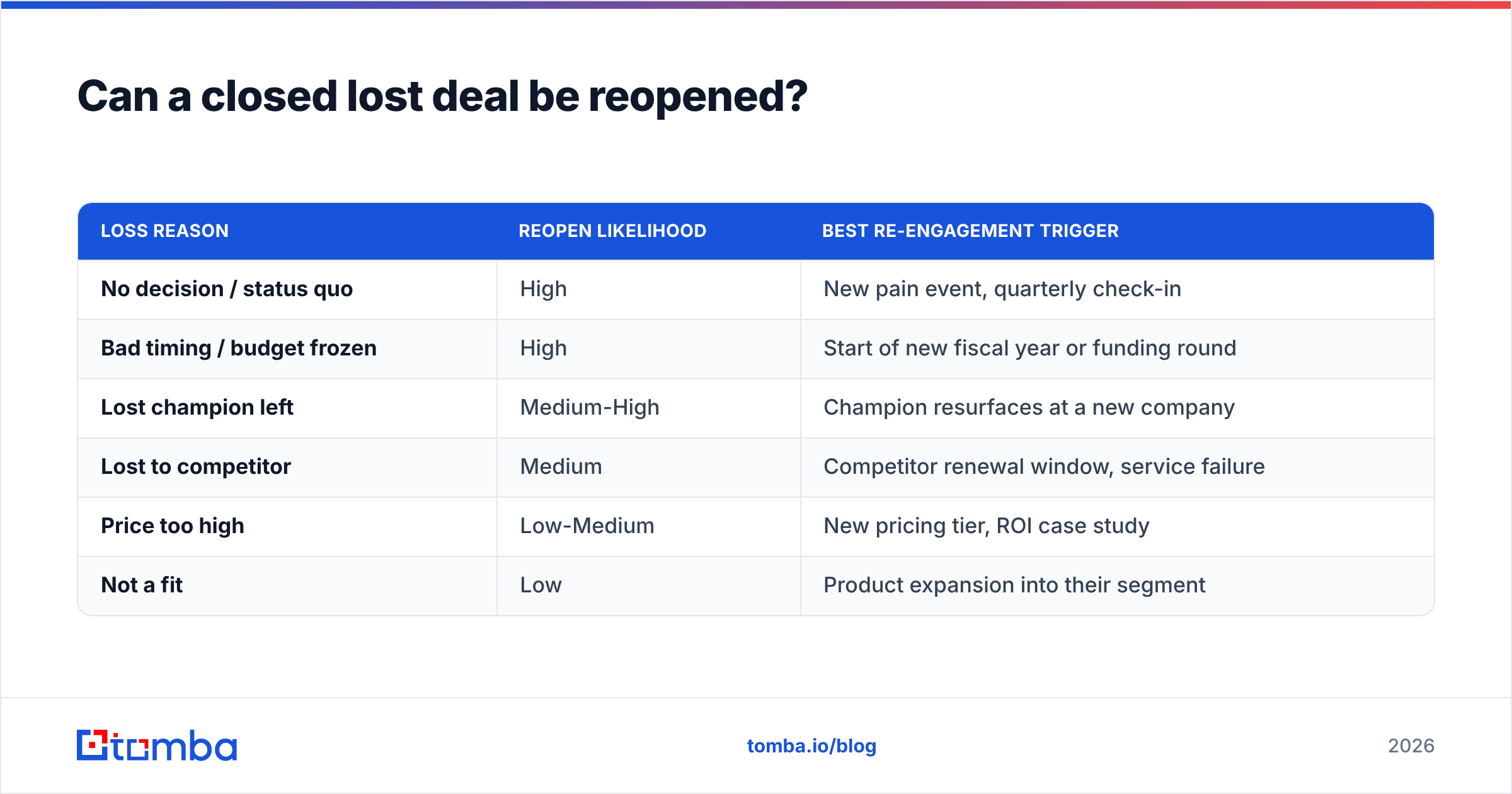
Yes—and a surprising share of them should be. Closed lost is a terminal stage, not a terminal verdict on the account. The right question is not "is this deal dead?" but "what killed it, and does that condition still hold?"
Map your reopen strategy to the reason:
| Loss Reason | Reopen Likelihood | Best Re-engagement Trigger |
|---|---|---|
| No decision / status quo | High | New pain event, quarterly check-in |
| Bad timing / budget frozen | High | Start of new fiscal year or funding round |
| Lost champion left | Medium-High | Champion resurfaces at a new company |
| Lost to competitor | Medium | Competitor renewal window, service failure |
| Price too high | Low-Medium | New pricing tier, ROI case study |
| Not a fit | Low | Product expansion into their segment |
The mechanics matter as much as the timing. To reopen a deal you need to actually reach the buyer—and after 6–12 months, contact records go stale fast. People change roles, companies, and email addresses. This is where re-engagement quietly dies: the intent is there, but the email address on file bounces.
Before you launch any closed lost win-back campaign, refresh the data. Run your old contacts through an email verifier to strip out the addresses that no longer resolve, and use data enrichment to catch the people who moved on—including those departed champions now sitting in a buying seat somewhere new.

How should you set up closed lost tracking in your CRM?#
You don't need a heavyweight system. You need three fields and one rule.
The three fields:
- Loss reason (required dropdown). Use the standardized list above. Required means required—no saving a closed lost deal without it.
- Competitor (conditional). Only appears when reason is "lost to competitor." Keeps your data clean.
- Reopen date (optional). A future date to resurface the deal. This turns "bad timing" from a dead end into a scheduled follow-up.
The one rule: No deal sits open past its expected close date without a decision. Either it's still progressing (update the date), or it's stalled (mark it closed lost with a reason). Zombie deals are the enemy of an accurate forecast.
Both HubSpot and Salesforce let you make the loss-reason field mandatory on the closed lost stage—use that setting. It's the single highest-leverage configuration change for pipeline hygiene. If you want a deeper primer on stage definitions, G2's sales glossary is a solid neutral reference.
Once the data is flowing, review it monthly. Sort closed lost by reason. The category that surprises you is the one worth a team conversation.
How do you turn closed lost data into won deals?#
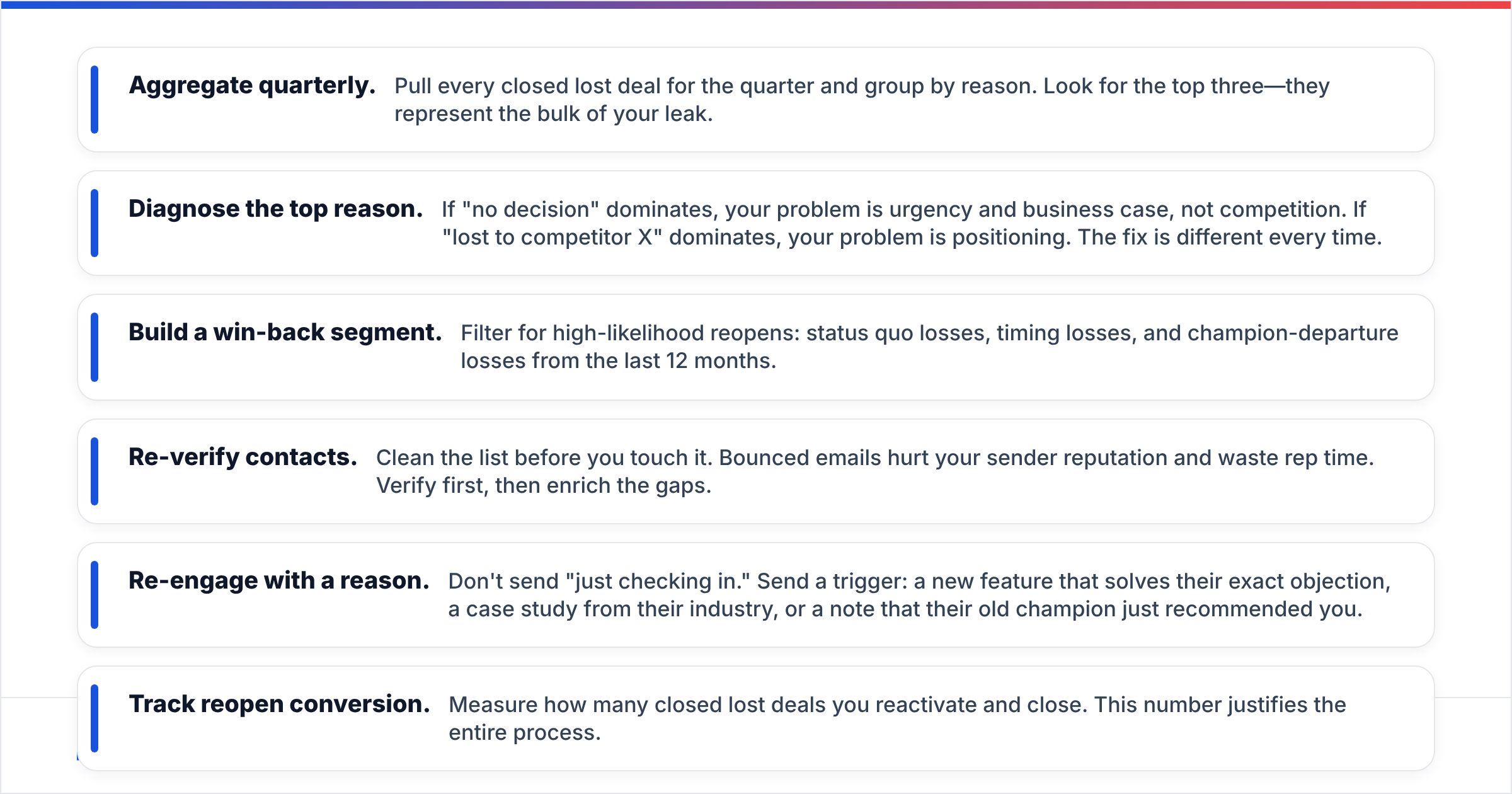
Closed lost analysis only pays off if it changes what you do next. Here's the loop that separates teams who "track losses" from teams who recover revenue:
- Aggregate quarterly. Pull every closed lost deal for the quarter and group by reason. Look for the top three—they represent the bulk of your leak.
- Diagnose the top reason. If "no decision" dominates, your problem is urgency and business case, not competition. If "lost to competitor X" dominates, your problem is positioning. The fix is different every time.
- Build a win-back segment. Filter for high-likelihood reopens: status quo losses, timing losses, and champion-departure losses from the last 12 months.
- Re-verify contacts. Clean the list before you touch it. Bounced emails hurt your sender reputation and waste rep time. Verify first, then enrich the gaps.
- Re-engage with a reason. Don't send "just checking in." Send a trigger: a new feature that solves their exact objection, a case study from their industry, or a note that their old champion just recommended you.
- Track reopen conversion. Measure how many closed lost deals you reactivate and close. This number justifies the entire process.
The teams that do this consistently find that closed lost isn't a graveyard—it's a farm. You planted intent months ago. Some of it is ready to harvest.
What does closed lost mean for your data strategy?#
Here's the uncomfortable truth: closed lost is only recoverable if your contact data survives. A perfectly tagged loss reason is worthless if the buyer's email bounces and their phone number is disconnected. The deal doesn't die when you mark it lost—it dies when you can no longer reach the person.
That reframes the whole exercise. Winning back closed lost deals is downstream of data quality. Before your win-back campaign, you need current emails, current titles, and current employers for a list of contacts that has been aging in your CRM. Manually re-researching each one doesn't scale past a handful.
This is exactly the gap Tomba's Email Finder closes. Feed it your stale closed lost accounts and it returns verified, current professional email addresses—so your re-engagement list is reachable, not a wall of bounces. Pair it with the built-in email verifier to protect your deliverability, and bulk lead generation tools when you're reviving a large segment at once. Plans start free with 25 searches a month, and paid tiers begin at $49/mo—see full Tomba pricing for the tier that fits your win-back volume.
Closed lost meaning, in one line: it's the end of a deal and the start of a decision—do you file it and forget it, or mine it for the revenue that's still there? Refresh your data, work the reopen list, and let the label stop being final.
Ready to reactivate your closed lost pipeline? Start with a clean, reachable list. Use the Tomba Email Finder to turn months-old lost accounts back into contacts you can actually reach—then go win them back.
Related guides#
Ready to find emails that actually work?
Join 150,000+ professionals who stopped guessing and started sending. Free credits on signup — no credit card required.
Get the Tomba newsletter
Practical outbound tactics and product updates — once every two weeks.
About the author