Closed Won Revenue: How to Track, Forecast, and Grow It
Closed won revenue is the cleanest signal you have about what actually sells. Here's how to define it, separate it from bookings and MRR, and use it to forecast and grow pipeline in 2026.
TL;DR
- Closed won revenue is the total value of deals your team has signed and committed to in a given period. It is the one pipeline number that isn't a guess.
- It is not the same as bookings, billings, or MRR. Mixing them up is the fastest way to break a forecast.
- A closed won number is only as trustworthy as the CRM data behind it. Dirty contact data and stale stages quietly inflate or hide it.
- Track it by segment, cohort, and rep, not just as one company-wide total. The aggregate hides where you're actually winning.
- Clean top-of-funnel data — verified contacts, accurate accounts — is what makes closed won revenue predictable instead of surprising.
What is closed won revenue?#
Closed won revenue is the dollar value of every deal your sales team has officially signed in a period. Think of it like the final score of a game: not the shots you took, not the chances you created, but the points that actually landed on the board.
In most CRMs, a deal moves through stages — prospecting, qualification, proposal, negotiation — and ends in one of two terminal states: closed won or closed lost. When a deal hits closed won, its deal amount rolls into your closed won revenue for that month, quarter, or year.
That sounds simple, and the definition is. What trips teams up is everything around it: what "signed" means, when revenue is recognized, and whether the number in the CRM reflects reality. A deal marked closed won in March that doesn't get invoiced until June, or churns in July, is still sitting in your March total unless someone corrects it.
So the working definition most revenue teams use is tighter: closed won revenue is the committed contract value of deals that have been signed and are expected to be fulfilled. It's the cleanest leading indicator you have — but only if the inputs are clean.

How is closed won revenue different from bookings, billings, and MRR?#
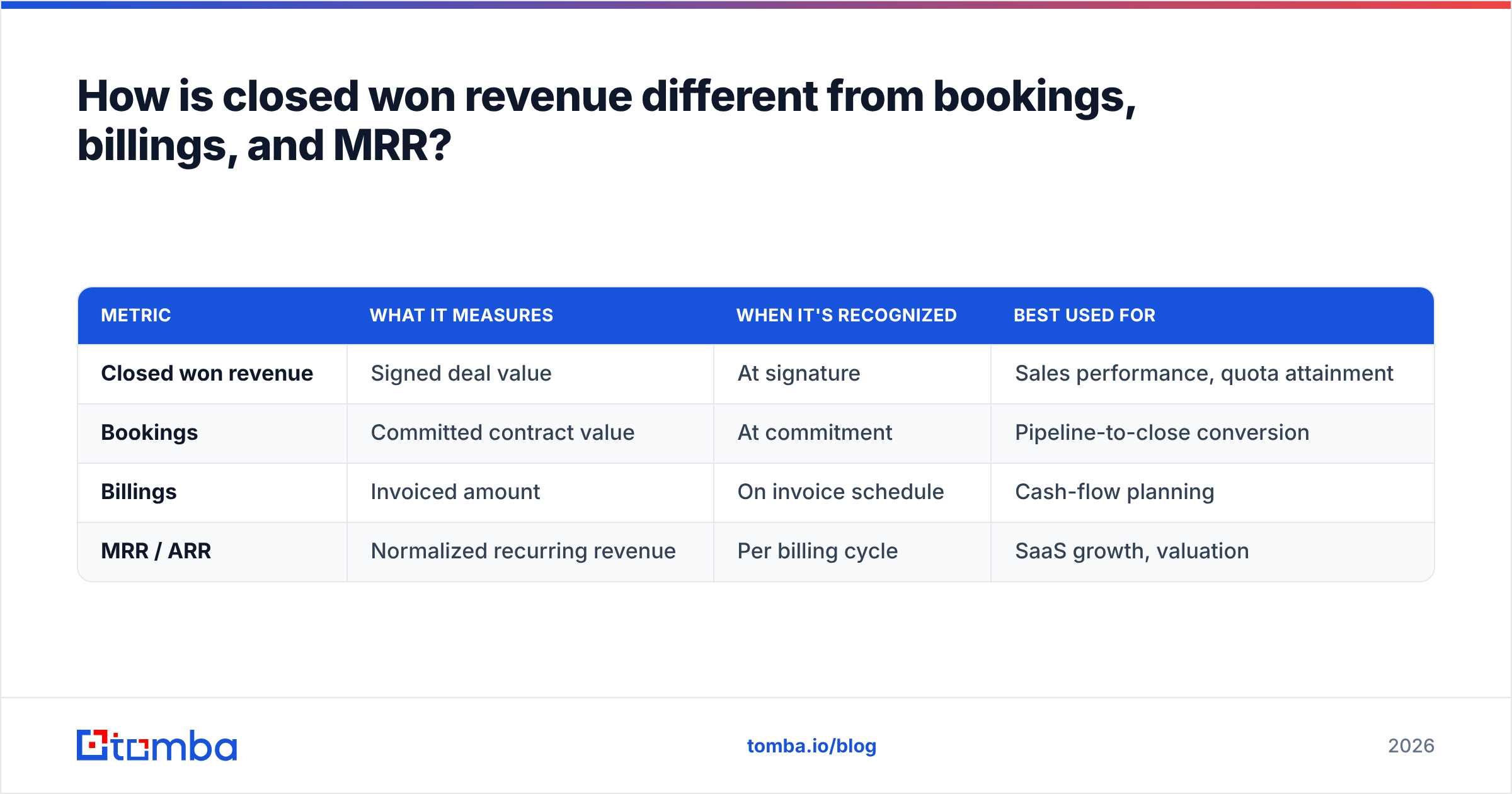
This is where forecasts fall apart. These terms get used interchangeably in stand-ups, and then finance and sales end up reporting different numbers to the same board.
Here's the plain-language separation:
- Closed won revenue — the total contract value of signed deals in the period. A signal of sales performance.
- Bookings — the value of contracts customers have committed to. Often used identically to closed won, but sometimes includes deals not yet countersigned.
- Billings — what you've actually invoiced. This lags closed won because you invoice on a schedule, not on signature.
- MRR / ARR — recurring monthly or annual revenue. This strips out one-time fees and normalizes multi-year deals into a run-rate.
| Metric | What it measures | When it's recognized | Best used for |
|---|---|---|---|
| Closed won revenue | Signed deal value | At signature | Sales performance, quota attainment |
| Bookings | Committed contract value | At commitment | Pipeline-to-close conversion |
| Billings | Invoiced amount | On invoice schedule | Cash-flow planning |
| MRR / ARR | Normalized recurring revenue | Per billing cycle | SaaS growth, valuation |
A concrete example. You sign a $36,000 two-year contract on March 1 with $6,000 in one-time onboarding. Your closed won revenue for March is $42,000 (total contract value plus onboarding). Your billings in March might be only $1,500 plus the $6,000 onboarding if you invoice monthly. Your new MRR is $1,500. Same deal, three very different numbers — and every one of them is correct for its purpose.
If your team reports "we closed $42K" to sales leadership and "$7.5K" to finance, both are right. The trouble only starts when nobody says which metric they mean.
Why does closed won revenue matter more than most pipeline metrics?#
Because it's the only number in the pipeline that isn't a prediction. Everything upstream — pipeline coverage, weighted forecast, expected value — is a probability. Closed won is the settled fact those probabilities are supposed to converge on.
That makes it your ground truth for three things:
- Forecast accuracy. You can only know if your weighted pipeline model works by comparing what it predicted to what actually closed. Closed won is the answer key.
- Win-rate math. Your win rate is closed won deals divided by all closed deals. Get closed won wrong and every downstream conversion metric is wrong too.
- Comp and quota. Reps get paid on closed won. The number has to be defensible down to the deal.
According to Gartner research on sales analytics, the teams that forecast most accurately are the ones that treat their CRM as a source of record, not a status-update chore. Closed won revenue is the metric that exposes whether that discipline exists. A pipeline stuffed with optimistic amounts and deals parked in "negotiation" for 90 days will always disappoint against actual closed won.
How do you calculate and segment closed won revenue?#
The base calculation is trivial: sum the deal amount of every opportunity marked closed won in your period.
Closed won revenue = Σ (deal amount) for all deals where stage = "Closed Won"
                     and close date is within the period
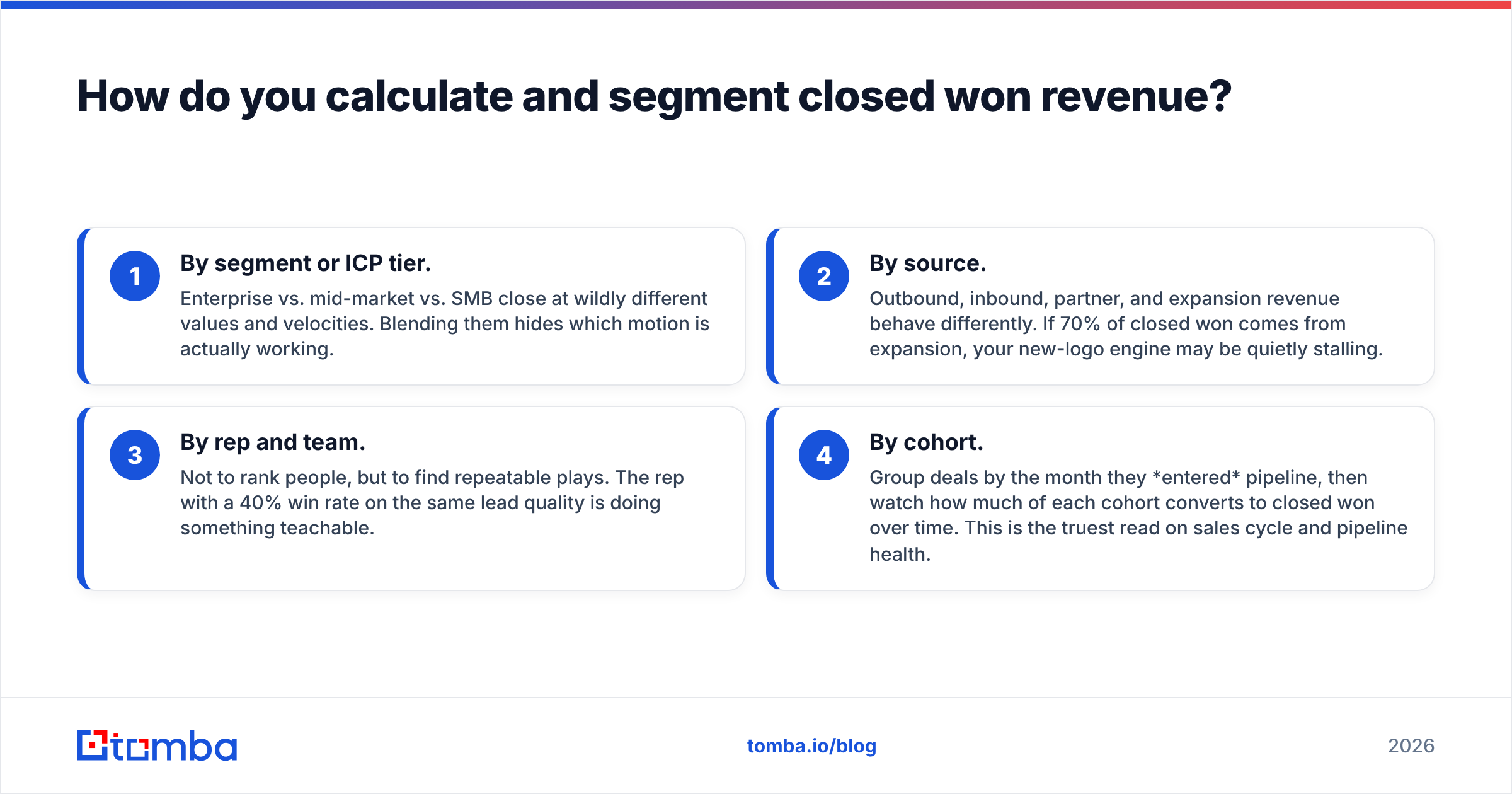
The value comes from how you slice it. A single company-wide total tells you almost nothing about why you won. Segment it instead:
- By segment or ICP tier. Enterprise vs. mid-market vs. SMB close at wildly different values and velocities. Blending them hides which motion is actually working.
- By source. Outbound, inbound, partner, and expansion revenue behave differently. If 70% of closed won comes from expansion, your new-logo engine may be quietly stalling.
- By rep and team. Not to rank people, but to find repeatable plays. The rep with a 40% win rate on the same lead quality is doing something teachable.
- By cohort. Group deals by the month they entered pipeline, then watch how much of each cohort converts to closed won over time. This is the truest read on sales cycle and pipeline health.
Cohort analysis is the one most teams skip and the one that pays off most. It answers "of the pipeline we built in January, how much had we won by April?" — which is the question that actually drives hiring and spend decisions.

What makes closed won revenue unreliable — and how do you fix it?#
Bad data upstream. That's the whole answer, and it's worth sitting with.
Closed won revenue inherits every flaw in the data that fed the pipeline. If your reps prospected into wrong-fit accounts with bad contact info, the deals that survived to closed won are a biased, noisy sample — and the ones that died in stage two burned quota capacity you'll never see in the report.
The common failure modes:
- Duplicate or stale accounts inflate pipeline and double-count revenue when the same deal exists twice.
- Bad contact data kills deals before they start — bounced emails and dead phone numbers mean the rep never reaches the decision-maker, so genuinely winnable deals show up as closed lost.
- Sandbagging and happy-ears — reps parking real deals to smooth quota, or marking shaky deals as high-probability. Both distort the gap between forecast and closed won.
- Inconsistent close-date logic — booking the deal to the wrong period so a quarter looks better than it was.
You can't fix reps' honesty with a tool, but you can fix the data layer, and that's where most of the leverage is. Clean, verified contact and account data means your pipeline is built from real, reachable buyers — so the deals that reach closed won reflect genuine demand, not data noise.
That's the connection between top-of-funnel accuracy and bottom-line predictability. When you start prospecting with an accurate email finder and enrich records with reliable firmographics, fewer deals die from unreachable contacts, your win rate stabilizes, and your closed won number becomes something you can actually forecast against. Feeding a clean, deduplicated list into your CRM does more for forecast accuracy than any weighting model.
Which tools help you track and grow closed won revenue?#
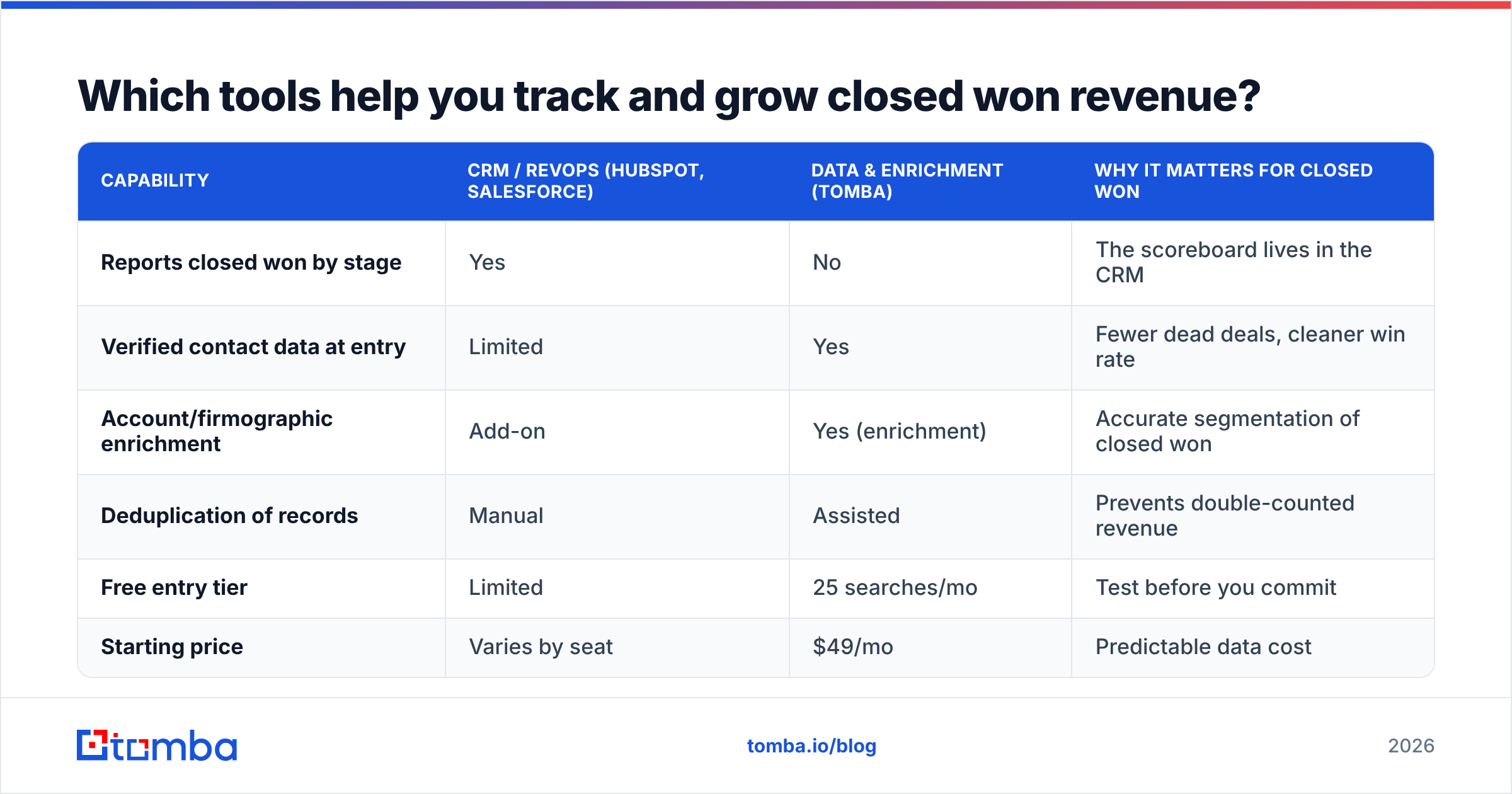
The stack splits into two jobs: the system of record that reports closed won, and the data layer that makes it trustworthy. Most teams over-invest in the first and neglect the second.
| Capability | CRM / RevOps (HubSpot, Salesforce) | Data & enrichment (Tomba) | Why it matters for closed won |
|---|---|---|---|
| Reports closed won by stage | Yes | No | The scoreboard lives in the CRM |
| Verified contact data at entry | Limited | Yes | Fewer dead deals, cleaner win rate |
| Account/firmographic enrichment | Add-on | Yes (enrichment) | Accurate segmentation of closed won |
| Deduplication of records | Manual | Assisted | Prevents double-counted revenue |
| Free entry tier | Limited | 25 searches/mo | Test before you commit |
| Starting price | Varies by seat | $49/mo | Predictable data cost |
Platforms like HubSpot and Salesforce are excellent at recording and visualizing closed won revenue once the data is inside them. What they don't do well out of the box is guarantee that the contacts entering the pipeline are real and reachable. That's the gap a dedicated data tool fills.
Tomba sits at the front of that flow. You find verified professional emails, enrich accounts with accurate firmographics, and deduplicate before records ever hit the CRM. The result isn't a flashier dashboard — it's a closed won number that matches reality, because the pipeline behind it was built from real buyers. If you want to see the tiers, the Tomba pricing starts with a free plan of 25 searches a month, then Starter at $49/mo, Growth at $99/mo, and Pro at $249/mo.
How do you actually grow closed won revenue?#
You grow it by improving one of four inputs, in roughly this priority order:
- Lead quality. More right-fit accounts in pipeline is the highest-leverage change. A clean, verified prospecting list means reps spend time on reachable buyers instead of chasing bounced contacts. This lifts win rate without adding headcount.
- Win rate. Tighten qualification so reps walk away from deals that won't close, freeing capacity for the ones that will. Segment your closed won data to find the plays that already work and coach them across the team.
- Average deal size. Multi-year terms, bundling, and expansion motions raise the value of each closed won deal. Track closed won by product line to see where upsell actually lands.
- Sales velocity. Shorter cycles mean more deals reach closed won per quarter. Removing data friction — no time wasted finding contacts or fixing records — is an underrated velocity lever.
Notice that three of the four depend on data quality. You can't reliably improve win rate if you don't trust your win-rate denominator. You can't segment for deal size if your accounts are duplicated. Clean data isn't a nice-to-have adjacent to revenue — it's the substrate the whole growth model sits on.
Frequently asked questions#
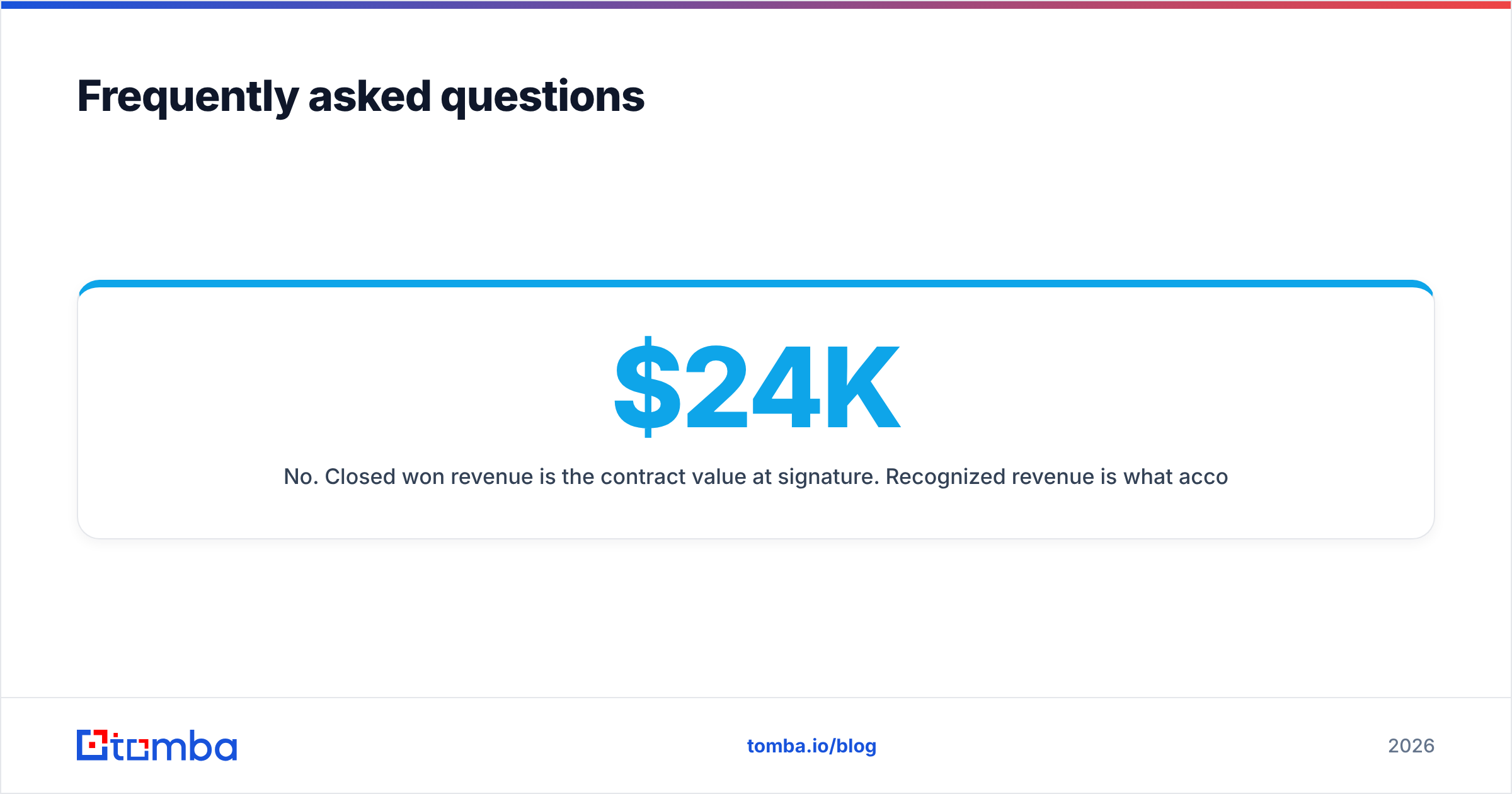
Is closed won revenue the same as recognized revenue? No. Closed won revenue is the contract value at signature. Recognized revenue is what accounting books as earned over the delivery period, governed by rules like ASC 606. A $24K annual deal is $24K closed won on day one but recognized at roughly $2K per month.
Should I count closed won at total contract value or annual value? Both, for different audiences. Sales comp and performance usually run on total contract value. Growth and valuation conversations run on ARR. Report both explicitly and label which is which — the confusion always comes from an unlabeled number.
How often should I review closed won revenue? Weekly for the current period's pace, monthly for segment trends, and quarterly for cohort conversion. Reviewing only at quarter-end means you find out you missed after it's too late to fix.
Can a closed won deal be reversed? Yes — if a signed deal falls through before fulfillment, it should move out of closed won, and your reporting should reflect the correction. Leaving reversed deals in the total is one of the most common ways closed won revenue drifts from reality.
The bottom line#
Closed won revenue is the one pipeline metric that isn't a guess — which is exactly why it deserves clean inputs. Define it precisely, keep it separate from bookings and MRR, and segment it by cohort and source instead of staring at one blended total. Above all, protect the data that feeds it. A forecast is only as honest as the contacts your reps started with.
If unreachable prospects and dirty records are quietly dragging on your win rate, start at the source. The Tomba Email Finder gives you verified, deal-ready contacts so the pipeline you build converts to closed won revenue you can actually count on. Try the free tier — 25 searches, no card — and see how a cleaner top of funnel sharpens the number at the bottom.
Related guides#
Ready to find emails that actually work?
Join 150,000+ professionals who stopped guessing and started sending. Free credits on signup — no credit card required.
Get the Tomba newsletter
Practical outbound tactics and product updates — once every two weeks.
About the author