Closed Won vs Closed Lost: What Your Pipeline Is Telling You
Closed Won and Closed Lost are more than CRM checkboxes. Learn how to define, track, and mine both stages to lift win rate and stop guessing why deals die.
Every deal in your CRM eventually lands in one of two buckets: Closed Won or Closed Lost. The labels sound simple, but how you define them, when you apply them, and what you do with the data afterward is the difference between a pipeline you can forecast and a pipeline you're guessing at.
TL;DR#
- Closed Won = a deal that resulted in a signed contract or paid purchase; Closed Lost = a qualified opportunity that ended without a sale. Both are terminal stages — the deal leaves your active pipeline.
- The gap between them is your win rate, and it's only trustworthy if reps mark stages consistently and record a reason on every loss.
- Closed Lost is not a failure log — it's your richest source of coaching, product, and targeting intel. Most teams throw it away.
- Dirty contact data quietly inflates Closed Lost: you can't win a deal you never reached. Clean, verified data at the top of the funnel changes the ratio.
- This guide covers definitions, a side-by-side comparison, loss-reason taxonomies, and how to turn both stages into a feedback loop.
What does Closed Won vs Closed Lost actually mean?#
Closed Won is the stage you apply when a prospect signs, pays, or otherwise commits to buy. The revenue is booked, the opportunity is removed from your open pipeline, and the account usually hands off to onboarding or customer success.
Closed Lost is the stage for any qualified opportunity that ends without a purchase — the prospect chose a competitor, lost budget, went silent, or decided to do nothing. The key word is qualified. A lead that was never a real fit shouldn't pollute your Closed Lost data; that belongs in a "disqualified" or "not a fit" bucket instead.
Think of your pipeline like a hospital triage board. Closed Won is a patient discharged healthy. Closed Lost is a case that was admitted, treated, and still didn't survive. Lumping in people who walked past the front door but were never patients makes your survival rate meaningless. That distinction is why your CRM stage definitions matter more than the labels themselves.
Both stages share one trait: they are terminal. Once a deal is Closed Won or Closed Lost, it stops aging in your active pipeline and stops skewing your open-deal forecast. That's the whole point of closing a deal out — good or bad, it gets it off the board.
How do Closed Won and Closed Lost compare?#
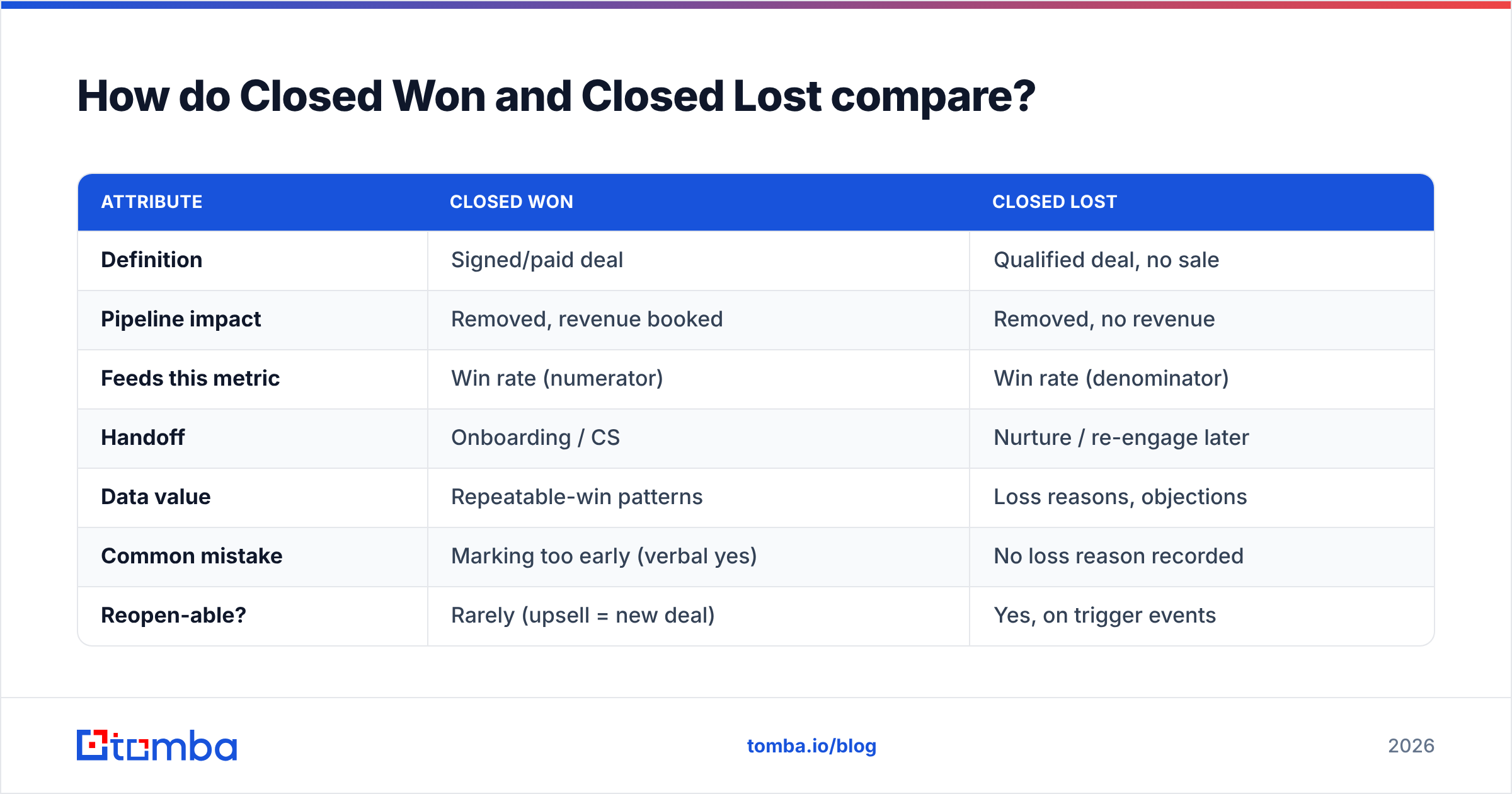
Here's the side-by-side view most reps never see written down:
| Attribute | Closed Won | Closed Lost |
|---|---|---|
| Definition | Signed/paid deal | Qualified deal, no sale |
| Pipeline impact | Removed, revenue booked | Removed, no revenue |
| Feeds this metric | Win rate (numerator) | Win rate (denominator) |
| Handoff | Onboarding / CS | Nurture / re-engage later |
| Data value | Repeatable-win patterns | Loss reasons, objections |
| Common mistake | Marking too early (verbal yes) | No loss reason recorded |
| Reopen-able? | Rarely (upsell = new deal) | Yes, on trigger events |
The row that quietly drives everything is the third one. Win rate is Closed Won ÷ (Closed Won + Closed Lost). If reps stuff dead deals into a vague "on hold" status instead of marking them lost, your denominator shrinks and your win rate looks inflated. If they mark verbal agreements as Won before the contract is signed, your numerator inflates too. Either way, the number you report up the chain is fiction.
Why is Closed Lost more valuable than most teams think?#
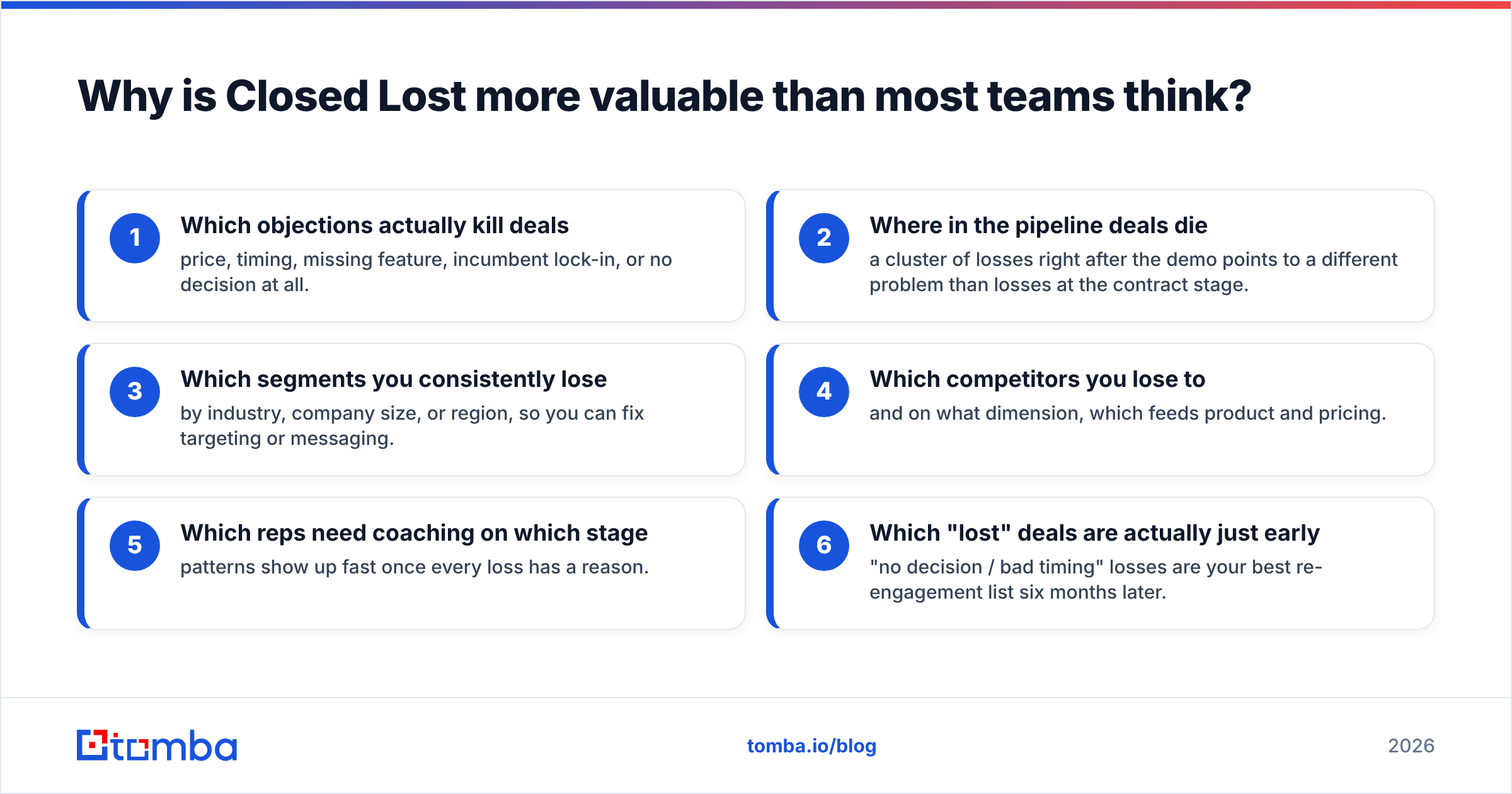
Closed Lost is the most under-mined asset in B2B sales. Teams celebrate wins and bury losses, but the losses are where the coaching lives.
Consider what a well-tagged Closed Lost record tells you:
- Which objections actually kill deals — price, timing, missing feature, incumbent lock-in, or no decision at all.
- Where in the pipeline deals die — a cluster of losses right after the demo points to a different problem than losses at the contract stage.
- Which segments you consistently lose — by industry, company size, or region, so you can fix targeting or messaging.
- Which competitors you lose to — and on what dimension, which feeds product and pricing.
- Which reps need coaching on which stage — patterns show up fast once every loss has a reason.
- Which "lost" deals are actually just early — "no decision / bad timing" losses are your best re-engagement list six months later.
According to HubSpot's sales research, follow-up and timing drive a large share of outcomes — which means a big chunk of your Closed Lost pile is timing, not rejection. Those aren't dead; they're dormant. A "closed lost — no budget this quarter" deal is a warm lead with a calendar reminder attached.
The catch: none of this works if the loss reason field is optional. Make it mandatory. A free-text box no one fills in is worthless; a required dropdown with five to eight clean options is gold.
What loss reasons should you track?#
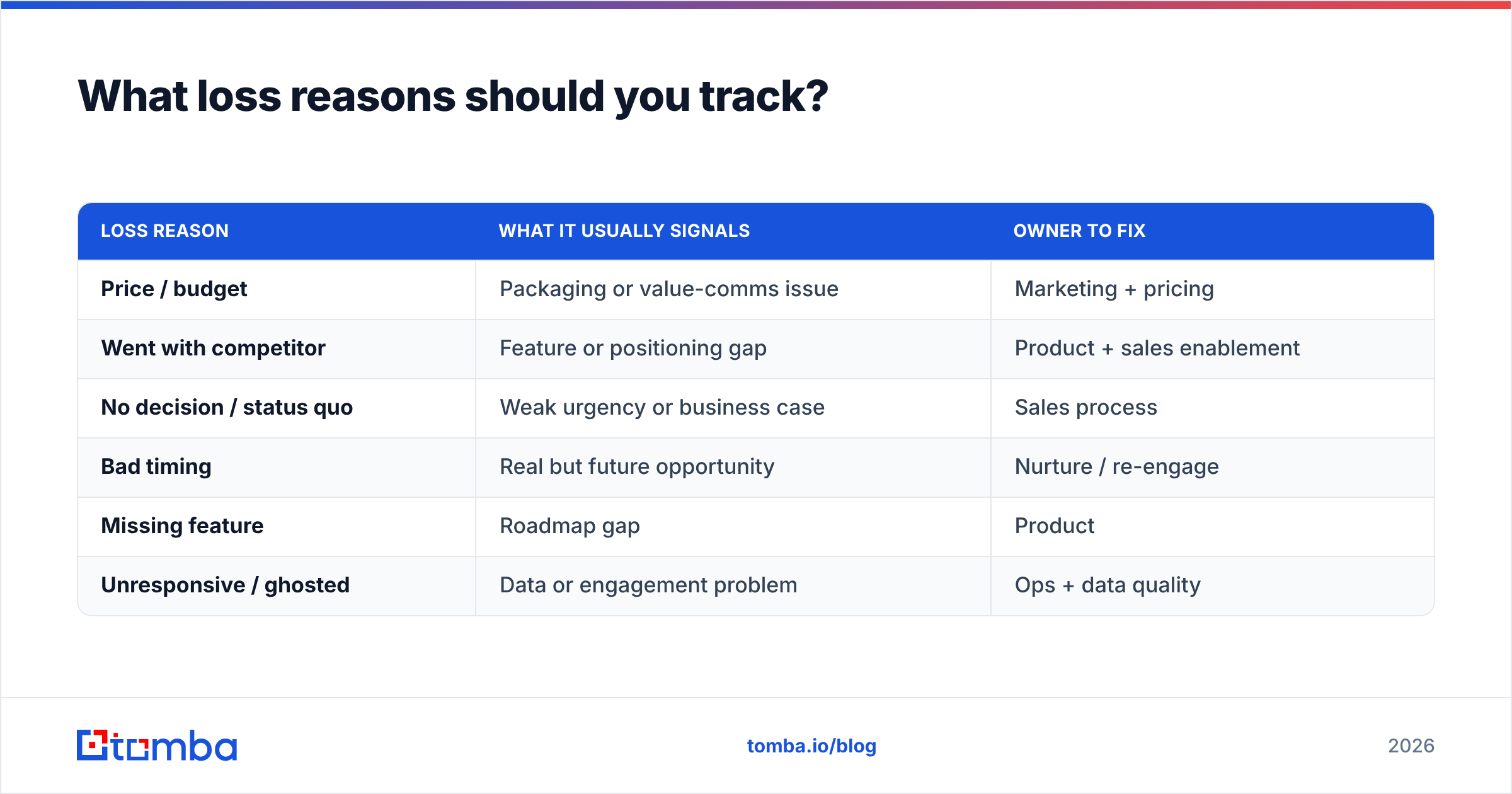
Keep the taxonomy tight. Too many options and reps pick randomly; too few and you lose signal. A workable starter set:
| Loss reason | What it usually signals | Owner to fix |
|---|---|---|
| Price / budget | Packaging or value-comms issue | Marketing + pricing |
| Went with competitor | Feature or positioning gap | Product + sales enablement |
| No decision / status quo | Weak urgency or business case | Sales process |
| Bad timing | Real but future opportunity | Nurture / re-engage |
| Missing feature | Roadmap gap | Product |
| Unresponsive / ghosted | Data or engagement problem | Ops + data quality |
That last row — unresponsive / ghosted — is the one that hides a data problem in plain sight. When a big share of your losses are "never heard back," the issue often isn't your pitch. It's that you were emailing an address that bounced, or calling a number that's three jobs out of date. You can't lose a deal on merits you never got to argue.
How does data quality change your Closed Won vs Closed Lost ratio?#
Your win rate has an invisible ceiling set by how many of your prospects you can actually reach. Every unreachable contact is a silent Closed Lost.
Here's the chain: you can run a flawless discovery call, nail the demo, and send a perfect proposal — but only for the contacts whose email and phone details are correct. If 20% of your outbound list is bad data, that's 20% of your pipeline dying before a rep ever gets a reply, and most of it lands in Closed Lost tagged "unresponsive." Your reps look like they're losing deals; they're actually losing connections.
This is where top-of-funnel data hygiene quietly moves the bottom-of-funnel metric. Using an accurate email finder and running lists through an email verifier before a sequence starts removes the invalid addresses that would otherwise become phantom losses. Enriching thin records with a data enrichment pass adds the direct dials and current titles that turn a cold "no reply" into an actual conversation.
The point isn't that better data wins every deal. It's that better data ensures your Closed Lost pile reflects sales outcomes — objections you can coach against — instead of operational ones you never see. When you scrub the reachability problem out, the losses that remain are honest signal.
When should you mark a deal Closed Won or Closed Lost?#
Timing discipline is where forecasts live or die.
Mark Closed Won only when the commitment is real and irreversible — the contract is signed, the PO is issued, or the payment clears. A verbal "we're in" is not a win. Reps who close deals on enthusiasm inflate the forecast and then spend next quarter explaining slippage. As Salesforce notes in its forecasting guidance, stage integrity is the foundation of any reliable prediction.
Mark Closed Lost decisively when a qualified deal has clearly ended — the prospect signed elsewhere, the project was killed, or the deal has gone cold past your defined threshold (say, 30 days of no response after multiple touches). Don't let dead deals rot in "negotiation" for months; a stale open pipeline is worse than an honest loss because it hides your real conversion math.
A simple rule of thumb: a deal should never sit in an open stage longer than that stage's average cycle time × 2. Past that, it's either Won or Lost. Force the decision. This keeps your pipeline clean and your win rate trustworthy.
How do you build a Closed Won / Closed Lost feedback loop?#
Data you collect but never review is a compliance exercise, not a strategy. Turn both terminal stages into a monthly loop:
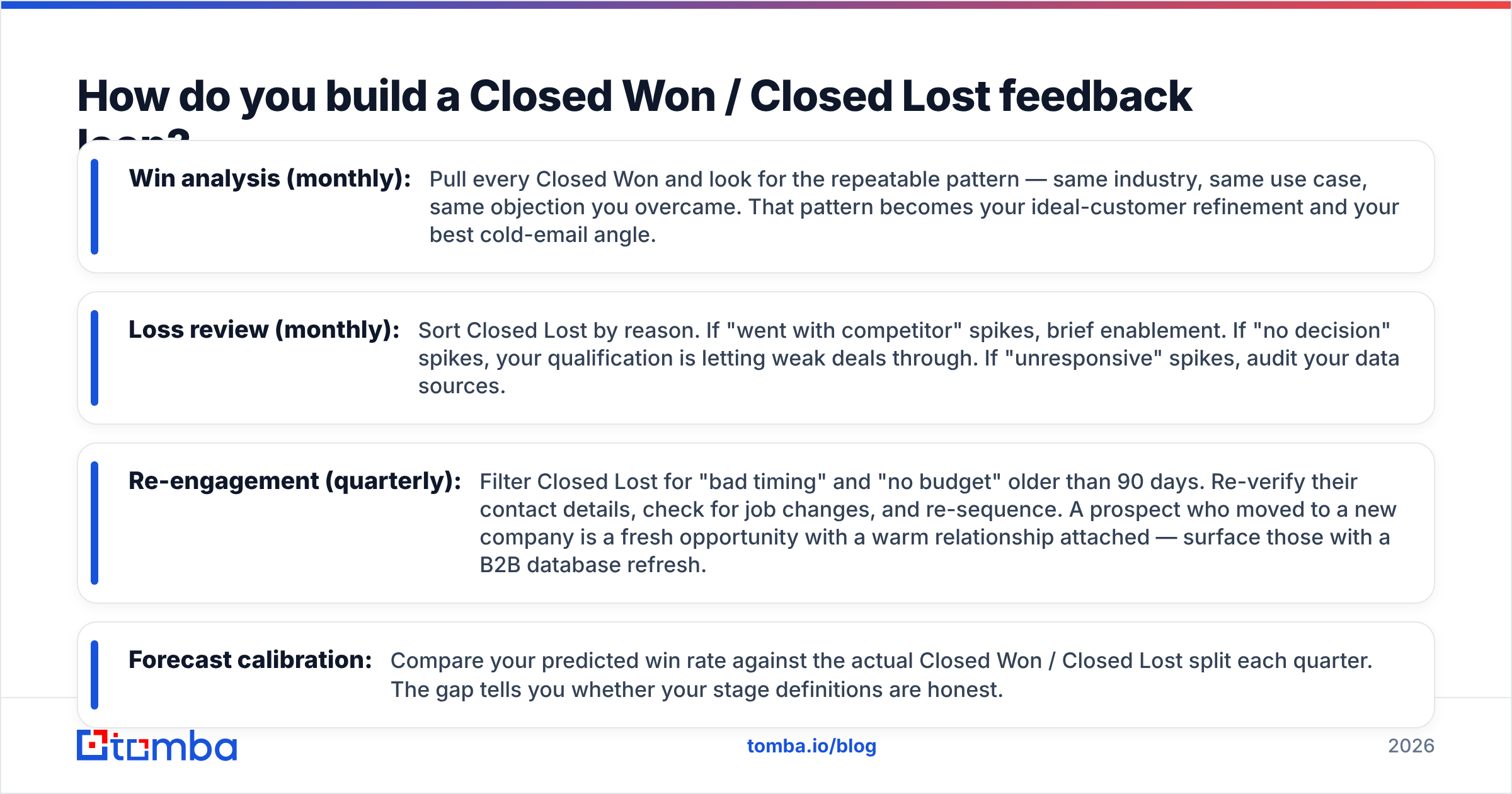
- Win analysis (monthly): Pull every Closed Won and look for the repeatable pattern — same industry, same use case, same objection you overcame. That pattern becomes your ideal-customer refinement and your best cold-email angle.
- Loss review (monthly): Sort Closed Lost by reason. If "went with competitor" spikes, brief enablement. If "no decision" spikes, your qualification is letting weak deals through. If "unresponsive" spikes, audit your data sources.
- Re-engagement (quarterly): Filter Closed Lost for "bad timing" and "no budget" older than 90 days. Re-verify their contact details, check for job changes, and re-sequence. A prospect who moved to a new company is a fresh opportunity with a warm relationship attached — surface those with a B2B database refresh.
- Forecast calibration: Compare your predicted win rate against the actual Closed Won / Closed Lost split each quarter. The gap tells you whether your stage definitions are honest.
Run this loop for two quarters and you'll stop treating Closed Lost as a graveyard and start treating it as a pipeline in waiting.
Closed Won vs Closed Lost: the bottom line#
Closed Won and Closed Lost are the two exits from your pipeline, and the ratio between them is the single clearest scoreboard your sales org has. But that scoreboard only tells the truth when two things are true: reps mark stages with discipline, and the contacts they're working are real, reachable people. Get the definitions tight, make loss reasons mandatory, and mine both stages every month.
And before you blame the pitch for a wall of "unresponsive" losses, check the data underneath it. Start every deal with verified, complete contact details so your reps compete on merit — not on whether the email even landed. The Tomba Email Finder gives you accurate professional emails by domain, name, or company, backed by built-in verification and enrichment, so more of your pipeline reaches a human and fewer deals die in silence. Explore the Tomba plans — the free tier includes 25 searches a month to test the difference on your own list.
Related guides#
Ready to find emails that actually work?
Join 150,000+ professionals who stopped guessing and started sending. Free credits on signup — no credit card required.
Get the Tomba newsletter
Practical outbound tactics and product updates — once every two weeks.
About the author