CloseFactor Pricing, Reviews, Pros and Cons (2026 Guide)
An honest look at CloseFactor pricing, real user reviews, and the pros and cons of its AI account-research platform — plus where a lighter, cheaper stack wins.
CloseFactor promises to turn messy account research into ready-to-use GTM signals. But every buyer asks the same first question: what does it actually cost? That answer is hard to find on its website. This guide fixes that. Below is a straight look at CloseFactor pricing, reviews, pros and cons — the real numbers, what users say, and who the tool fits — before you book a demo.
TL;DR#
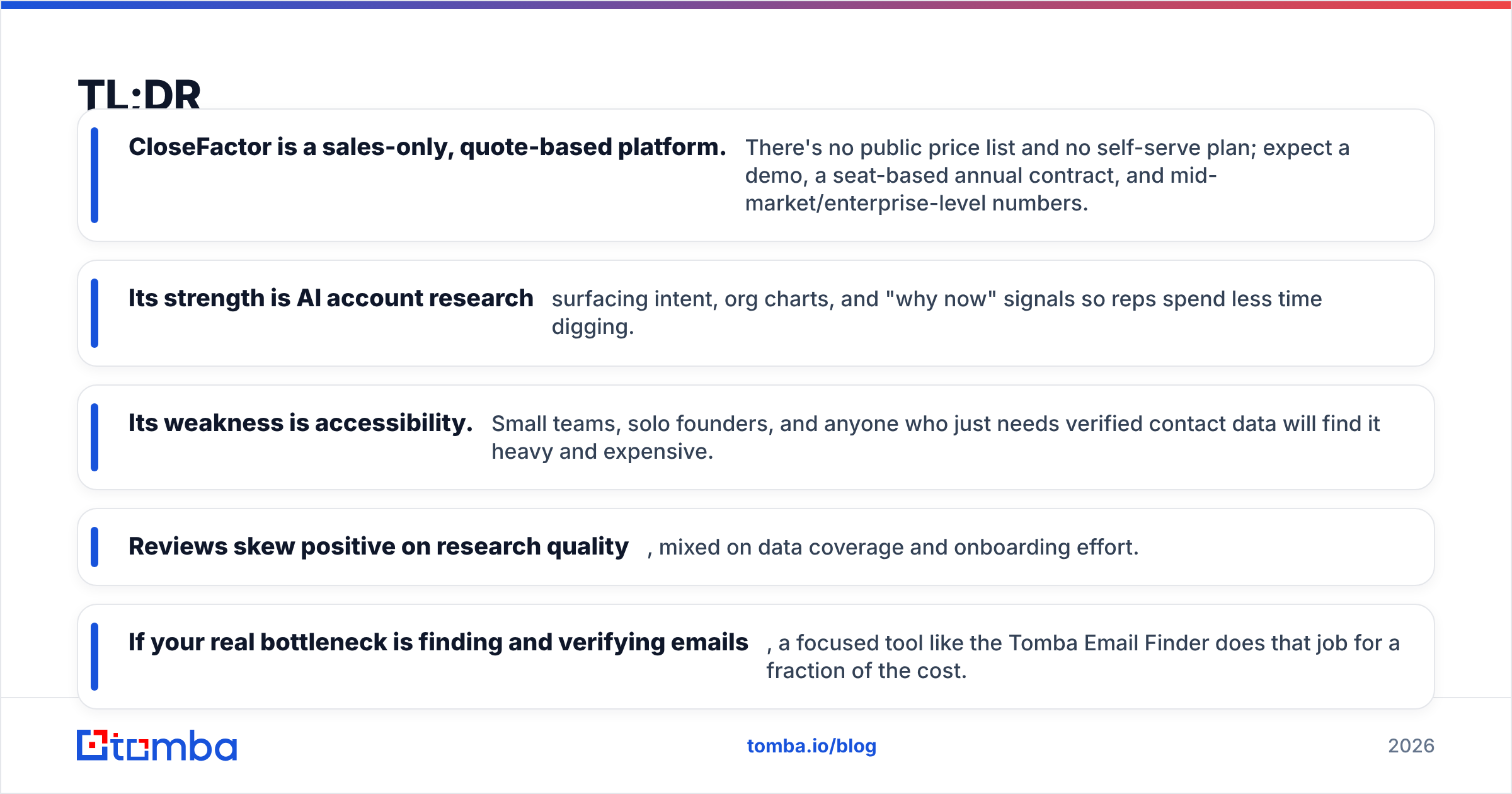
- CloseFactor is a sales-only, quote-based platform. There's no public price list and no self-serve plan. Expect a demo, a seat-based annual contract, and mid-market or enterprise numbers.
- Its strength is AI account research — surfacing intent, org charts, and "why now" signals so reps spend less time digging.
- Its weakness is accessibility. Small teams, solo founders, and anyone who just needs verified contact data will find it heavy and expensive.
- Reviews skew positive on research quality, mixed on data coverage and onboarding effort.
- If your real bottleneck is finding and verifying emails, a focused tool like the Tomba Email Finder does that job for a fraction of the cost.
What is CloseFactor?#
CloseFactor is an AI-powered go-to-market platform. It automates the tedious part of outbound: account research. Instead of a rep opening ten browser tabs to understand a target company, CloseFactor reads across public sources — job postings, tech stacks, news, 10-Ks, and websites. It then assembles a structured view of each account, scores and prioritizes them, maps buying committees, and hands reps talking points tied to real triggers.
Think of it like a research analyst who never sleeps. A junior analyst might spend an hour reading a prospect's earnings call to find one useful hook. CloseFactor's models scan that same material in seconds and flag the sentence a rep can open with. Technically, it blends large-language-model summarization, intent data, and CRM enrichment aimed at RevOps and enterprise SDR teams.
That framing matters for pricing. CloseFactor sells outcomes for teams, not credits for individuals — and the cost structure reflects that.

How much does CloseFactor cost in 2026?#
Short answer: CloseFactor does not publish pricing. It's quote-only, sold as an annual, seat-based contract after a demo. Buyer reports across review sites and analyst notes point to the mid-market-to-enterprise range. It is not the sub-$100/month bracket you'd see on a self-serve tool.
Here's the honest reality of what to expect when you engage sales:
- No free trial by default — you'll get a guided demo, sometimes a limited pilot for qualified teams.
- Seat-based billing — pricing scales with the number of reps who log in, not just the number of accounts you research.
- Annual commitment — month-to-month is rarely on the table.
- Platform + data tiers — deeper intent signals, CRM sync depth, and integrations often sit in higher tiers.
- Implementation and onboarding — enterprise contracts can carry a setup or success component.
- Negotiable at volume — like most sales-tech, list numbers soften with seat count and term length.
The vendor gates the number, so treat any figure you see quoted online as directional, not a rate card. The pattern is clear even without exact dollars. This is a considered purchase for funded sales orgs, not an impulse buy.

CloseFactor pricing vs. the alternatives#
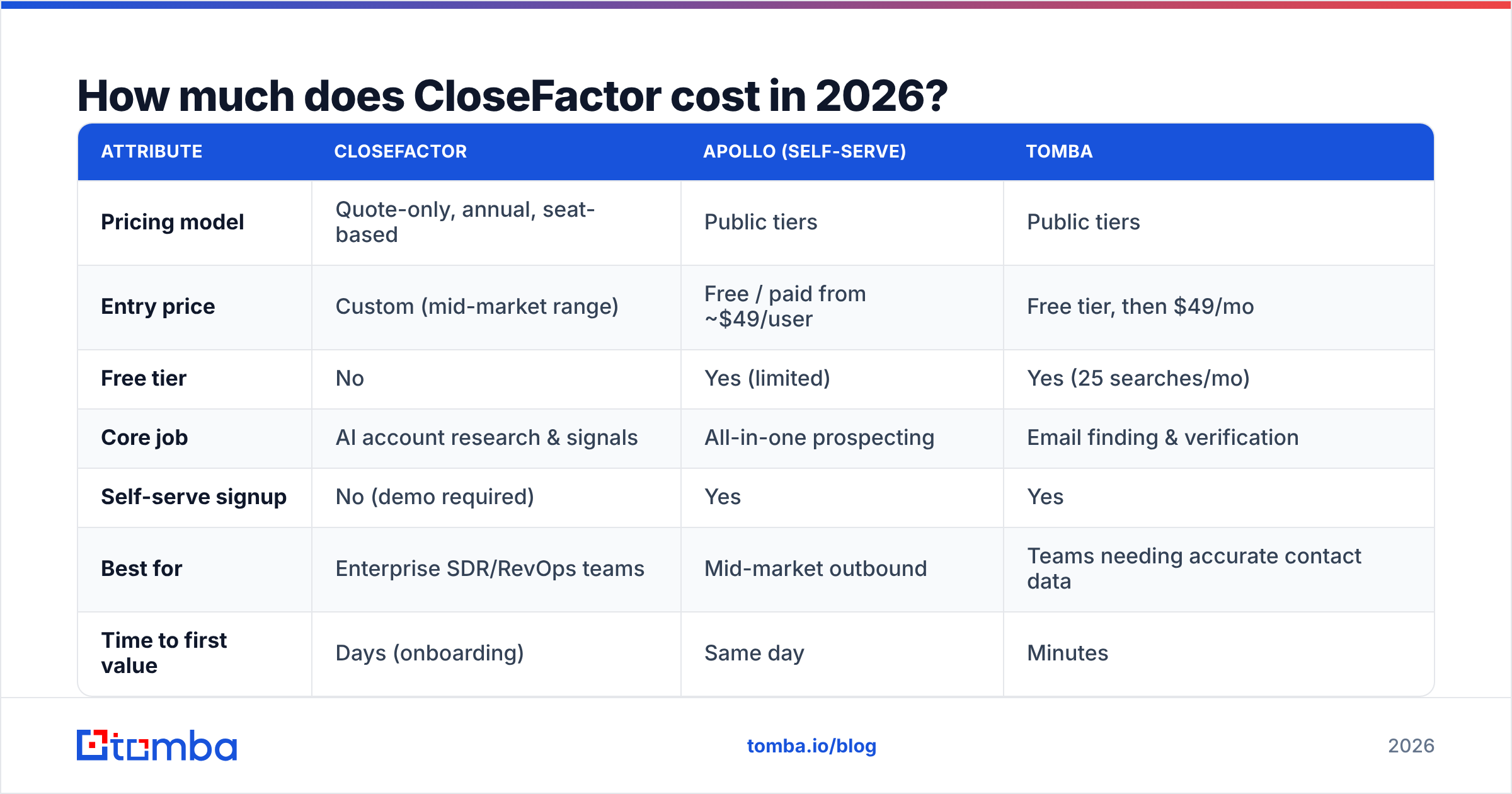
To make the trade-off concrete, here's how a quote-only research platform compares to transparent, self-serve tooling. The numbers below for CloseFactor are ranges reported by buyers, not official list prices.
| Attribute | CloseFactor | Apollo (self-serve) | Tomba |
|---|---|---|---|
| Pricing model | Quote-only, annual, seat-based | Public tiers | Public tiers |
| Entry price | Custom (mid-market range) | Free / paid from ~$49/user | Free tier, then $49/mo |
| Free tier | No | Yes (limited) | Yes (25 searches/mo) |
| Core job | AI account research & signals | All-in-one prospecting | Email finding & verification |
| Self-serve signup | No (demo required) | Yes | Yes |
| Best for | Enterprise SDR/RevOps teams | Mid-market outbound | Teams needing accurate contact data |
| Time to first value | Days (onboarding) | Same day | Minutes |
The takeaway isn't that CloseFactor is overpriced. It's that it's priced for a specific buyer. If you're that buyer — a scaled sales org drowning in manual research — the cost can pay for itself. If you're not, you're renting a research analyst when you needed a contact database. You can see the opposite end of the transparency spectrum on the Tomba pricing page, where every tier and credit count is public.
What do CloseFactor reviews say?#
Across G2 and other review platforms, CloseFactor earns solid marks. But the sentiment splits along predictable lines.
What reviewers praise:
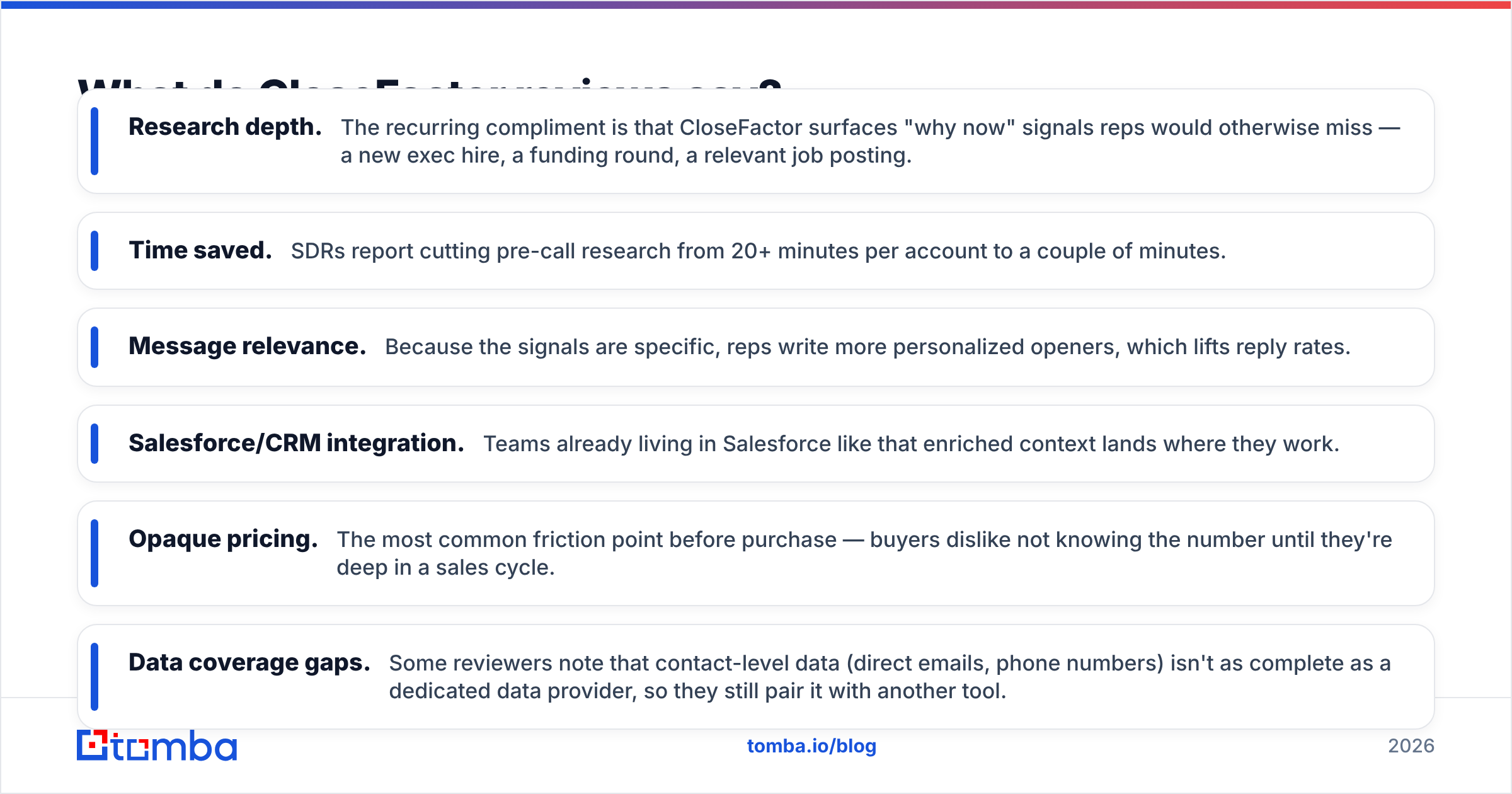
- Research depth. The recurring compliment is that CloseFactor surfaces "why now" signals reps would otherwise miss — a new exec hire, a funding round, a relevant job posting.
- Time saved. SDRs report cutting pre-call research from 20+ minutes per account to a couple of minutes.
- Message relevance. Because the signals are specific, reps write more personalized openers, which lifts reply rates.
- Salesforce/CRM integration. Teams already living in Salesforce like that enriched context lands where they work.
What reviewers criticize:
- Opaque pricing. This is the most common friction point before purchase. Buyers dislike not knowing the number until they're deep in a sales cycle.
- Data coverage gaps. Some reviewers note that contact-level data (direct emails, phone numbers) isn't as complete as a dedicated data provider, so they still pair it with another tool.
- Onboarding lift. Getting full value requires configuration and buy-in. It's not plug-and-play for a one-person team.
- Overkill for small teams. More than one reviewer describes it as powerful but hard to justify below a certain team size.
That last critique is the crux of the pros-and-cons decision, so let's lay it out plainly.
CloseFactor pricing, reviews, pros and cons#
| Pros | Cons |
|---|---|
| Best-in-class AI account research and signal detection | No public pricing; demo-gated sales cycle |
| Strong personalization inputs that lift reply rates | Annual, seat-based contracts — high commitment |
| Deep Salesforce/CRM enrichment | Contact-level data (emails/phones) can be thin |
| Prioritizes accounts so reps focus on "why now" | Onboarding and configuration required |
| Scales research across a whole SDR team | Overkill and over-budget for small teams/solos |
Read the table as a fit test, not a scorecard. Every "con" is really a statement about who should buy. If you have a team of reps, a Salesforce instance, and budget for GTM tooling, the cons are manageable. If you're a founder-led sales motion or a small agency, the same cons become dealbreakers.

Is CloseFactor worth it?#
It's worth it when research is your bottleneck — not when data is. Here's a clean way to decide.
Choose CloseFactor if:
- You run a mid-market or enterprise sales team with multiple SDRs.
- Reps waste hours manually researching accounts before outreach.
- You live in Salesforce and want enriched context inside it.
- You can commit to an annual contract and a proper onboarding.
Look elsewhere if:
- You mainly need accurate emails and phone numbers to start outreach.
- You're a solo founder, small agency, or lean startup team.
- You want transparent, pay-as-you-grow pricing without a demo.
- You need value today, not after a configuration project.
Most teams that hesitate on CloseFactor discover their actual problem is the last mile. They have target accounts. They just can't reliably reach the right person. That's a data problem, not a research problem — and it's far cheaper to solve.
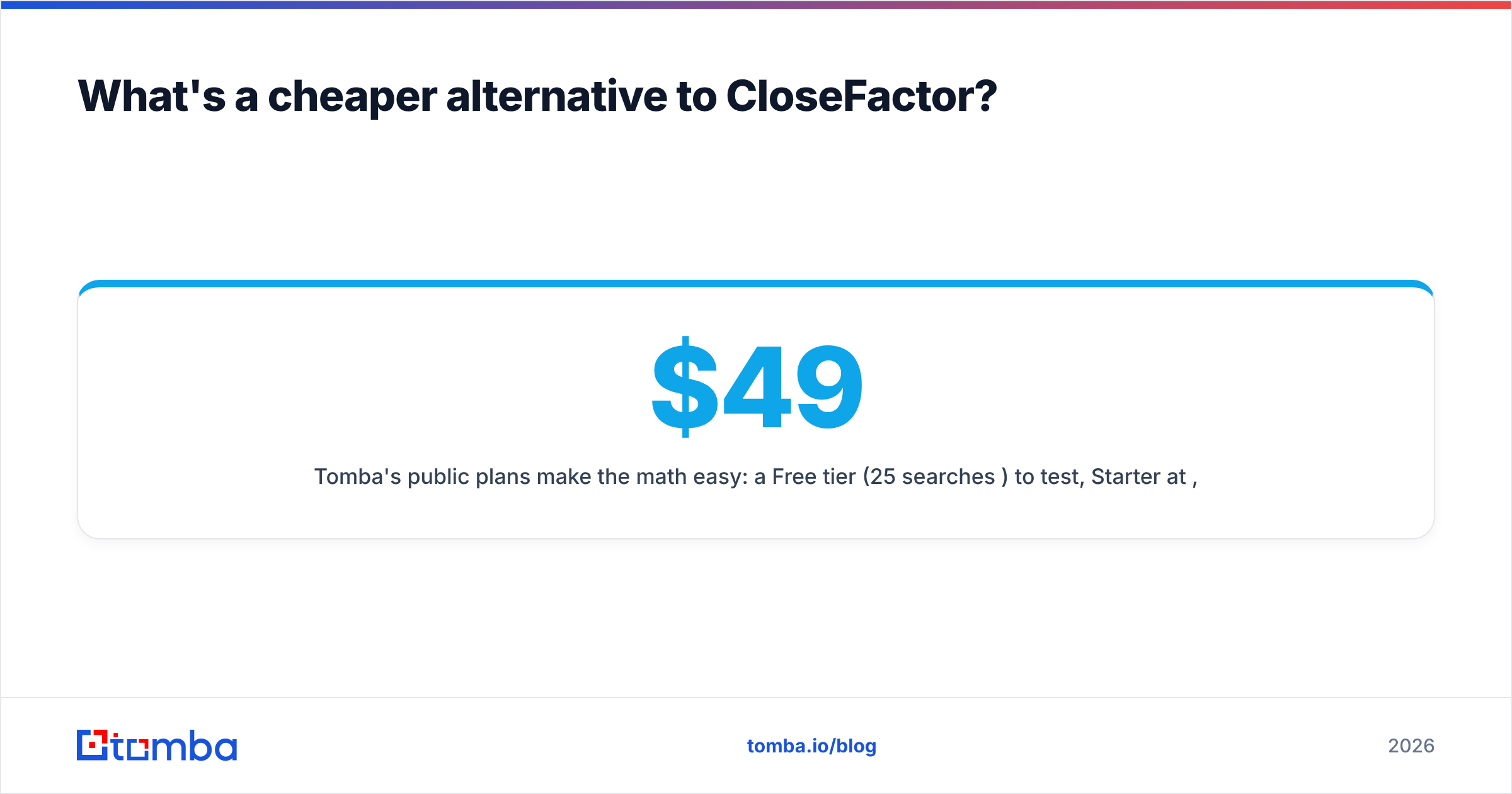
What's a cheaper alternative to CloseFactor?#
If the "con" that stops you is price or accessibility, the smarter move is to unbundle. You don't need an enterprise research platform to fix contact data. You need a fast, accurate email finder and verifier layered onto whatever prospecting list you already build.
A lean, transparent stack looks like this:
- Find the right contacts with an email finder that returns professional addresses by name, company, or domain search — no annual contract, no demo gate.
- Verify before you send using an email verifier so bounces don't wreck your sender reputation.
- Enrich what you keep with data enrichment to add firmographics and role data to a list you own.
Tomba's public plans make the math easy: a Free tier (25 searches/mo) to test, Starter at $49/mo, Growth at $99/mo, and Pro at $249/mo — with an Enterprise option when you scale. That's a rate card you can evaluate in five minutes instead of five meetings. And if you're specifically weighing all-in-one prospecting suites, the Apollo alternative comparison covers where a focused data tool wins versus a broad platform.
None of this makes CloseFactor "bad." It makes the decision honest. Pay enterprise pricing for AI research when research is the constraint — and pay a fraction of it for accurate contact data when reaching people is the constraint. For a broader view of how buyers evaluate this category, Gartner's Digital Markets coverage of sales-intelligence tools is a useful neutral reference.
Frequently asked questions#
Does CloseFactor have a free trial? Not as a standard self-serve option. Access starts with a demo, and qualified teams may get a limited pilot. There's no public free tier the way there is with self-serve tools.
Why doesn't CloseFactor publish pricing? Because it sells seat-based annual contracts tuned to team size, integrations, and data depth. Quote-only pricing lets the vendor tailor deals — but it also means you can't comparison-shop from the website.
Is CloseFactor just an email finder? No. It's an AI account-research and GTM-signals platform. It enriches accounts and surfaces triggers. It is not primarily a contact-data provider, which is why many teams pair it with a dedicated finder and verifier.
Who is CloseFactor best for? Mid-market to enterprise sales orgs with multiple reps, a Salesforce backbone, and budget for GTM tooling. Small teams and solo operators usually find it too heavy and too expensive.
The bottom line#
That wraps our take on CloseFactor pricing, reviews, pros and cons. It's a strong AI research platform with a genuine "wow" in signal detection — and a real barrier in its opaque, enterprise-grade pricing. Judged on the pros and cons, it's an excellent fit for scaled teams and a poor one for anyone whose true need is simply reaching the right contacts.
If that's you, skip the demo cycle and fix the data layer directly. Start free with the Tomba Email Finder, find and verify the contacts your outreach depends on, and keep your budget for the deals — not the software. When your team grows into needing deep account research, you'll know it, and you'll buy it on purpose.
Related guides#
Ready to find emails that actually work?
Join 150,000+ professionals who stopped guessing and started sending. Free credits on signup — no credit card required.
Get the Tomba newsletter
Practical outbound tactics and product updates — once every two weeks.
About the author