Closing Enterprise Deals in 2026: The Complete B2B Playbook
Enterprise deals stall on process, not price. Here is a concrete 2026 playbook for multithreading, mapping buying committees, and closing complex B2B contracts faster.
Closing enterprise deals is less about the final signature and more about everything that happens in the 90 to 270 days before it. If you are used to SMB velocity, the enterprise motion feels like it breaks every rule you learned: more stakeholders, longer silences, legal reviews that appear from nowhere, and a "yes" that quietly turns into "let's revisit next quarter."
This guide is a practical, no-fluff playbook for closing complex, high-value B2B contracts in 2026 — how to map the buying committee, multithread, survive procurement, and forecast honestly.
TL;DR#
- Enterprise deals are won on process discipline, not charisma. The rep who maps the buying committee and multithreads beats the rep with the better pitch almost every time.
- A single champion is a single point of failure. Aim for 3–5 engaged contacts across economic, technical, and user roles before you call a deal "committed."
- Procurement and legal are stages, not surprises. Build them into your timeline from the first call, and pre-empt security reviews with documentation.
- Clean contact data shortens cycles. You cannot multithread if you cannot reach the CFO, the security lead, or the VP who actually signs.
- Mutual action plans (MAPs) are the single highest-leverage tool for keeping a six-figure deal from slipping a quarter.
What counts as an "enterprise deal" in 2026?#
An enterprise deal is any sale where no single person can say yes alone. That is the working definition that matters, more than headcount or contract value.
Think of it like getting a mortgage approved versus buying a coffee. The coffee is one decision by one person in ten seconds. The mortgage involves an applicant, a co-signer, an underwriter, a legal team, and an appraiser — each of whom can stall or kill the deal, and none of whom care about your enthusiasm. Enterprise selling is the mortgage.
In practice, an enterprise deal usually means:
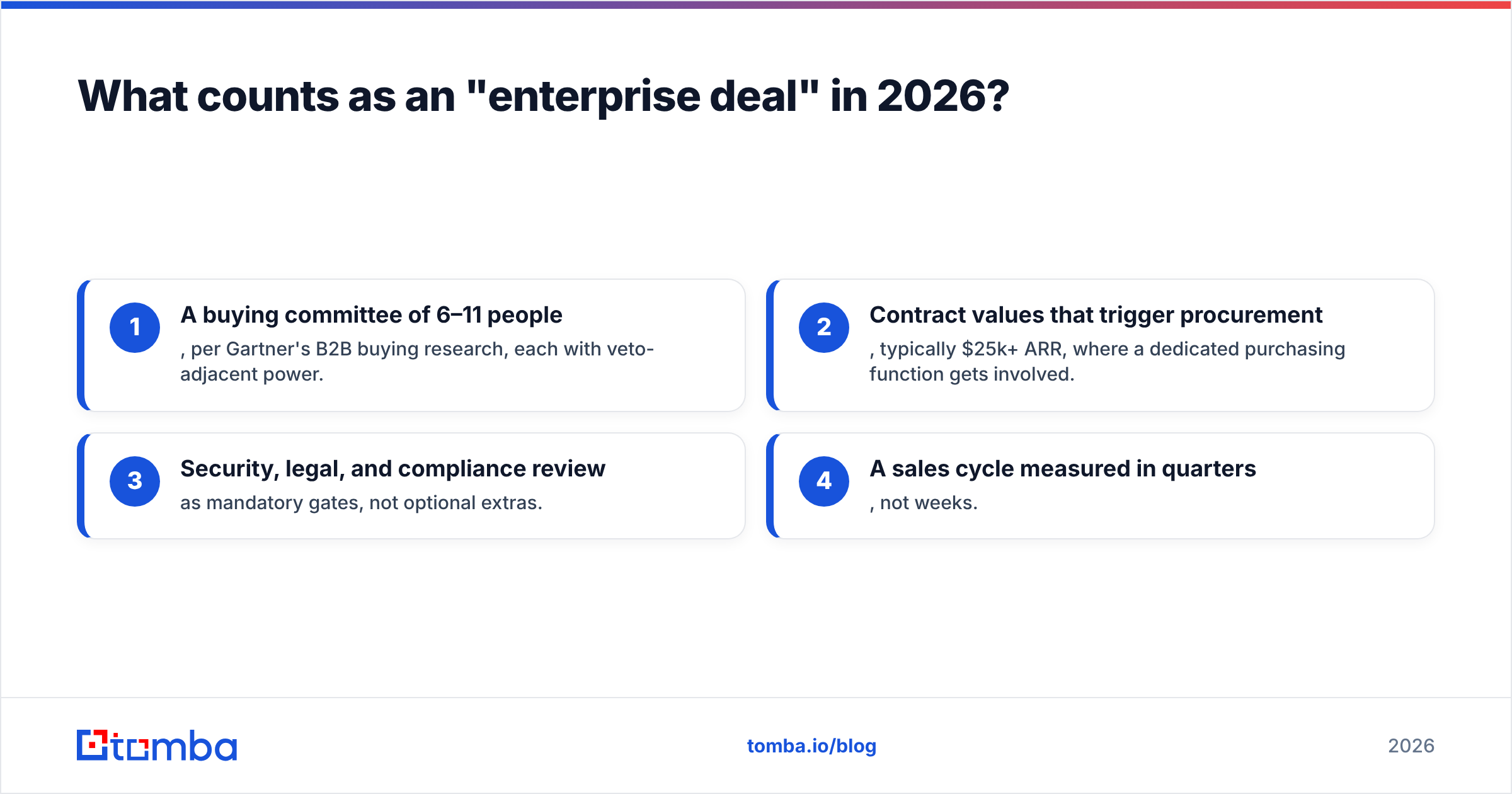
- A buying committee of 6–11 people, per Gartner's B2B buying research, each with veto-adjacent power.
- Contract values that trigger procurement, typically $25k+ ARR, where a dedicated purchasing function gets involved.
- Security, legal, and compliance review as mandatory gates, not optional extras.
- A sales cycle measured in quarters, not weeks.
If two of those four are true, you are running an enterprise motion — even if the logo is mid-market.
Why do enterprise deals stall — and how do you prevent it?#
Deals rarely die from a hard "no." They die from entropy: the champion changes jobs, a competing priority eats the budget, or the deal loses momentum during a three-week legal silence and never recovers.
Here are the five most common stall points and the antidote for each.
- Single-threading. You built a great relationship with one person, and then they got reorganized. Fix: multithread from day one (more below).
- No compelling event. Nothing forces a decision by a specific date, so the deal floats. Fix: anchor to a real business trigger — contract renewal, compliance deadline, fiscal year-end, a board mandate.
- Skipping procurement early. You treat purchasing as a formality and discover a 45-day vendor-onboarding process in week ten. Fix: ask "walk me through how a purchase like this gets approved here" on the first serious call.
- Weak business case. The champion loves you but can't defend the spend to the CFO. Fix: co-build the ROI narrative with them, in their numbers.
- Data gaps. You can't reach the economic buyer or the security reviewer because you never had their contact details. Fix: enrich the account before the deal, not during the fire drill.
How do you map an enterprise buying committee?#
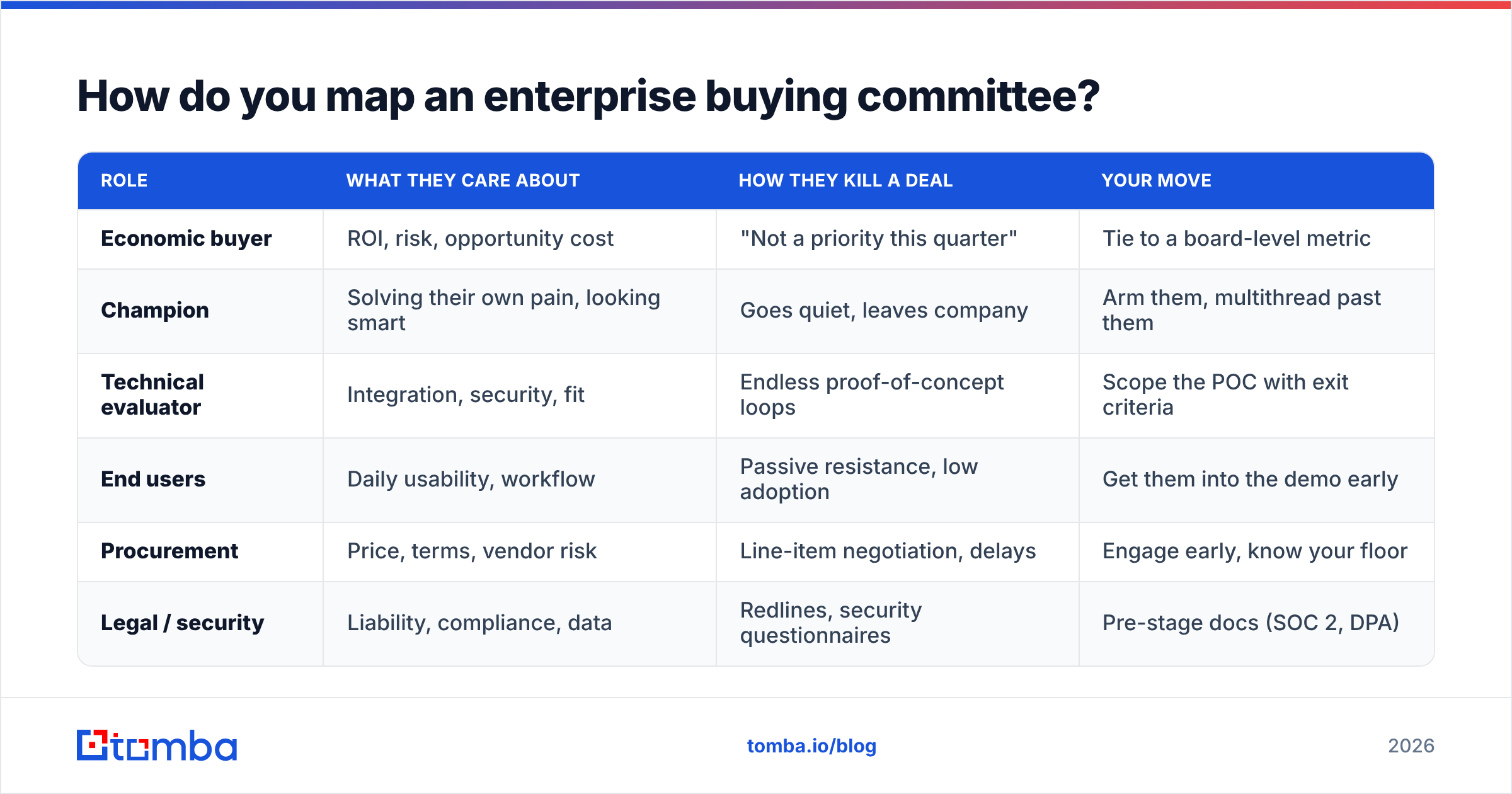
Start by naming roles, not just people. The classic framework — economic buyer, champion, technical buyer, user buyer, and blocker — still holds in 2026, but modern committees add a few:
| Role | What they care about | How they kill a deal | Your move |
|---|---|---|---|
| Economic buyer | ROI, risk, opportunity cost | "Not a priority this quarter" | Tie to a board-level metric |
| Champion | Solving their own pain, looking smart | Goes quiet, leaves company | Arm them, multithread past them |
| Technical evaluator | Integration, security, fit | Endless proof-of-concept loops | Scope the POC with exit criteria |
| End users | Daily usability, workflow | Passive resistance, low adoption | Get them into the demo early |
| Procurement | Price, terms, vendor risk | Line-item negotiation, delays | Engage early, know your floor |
| Legal / security | Liability, compliance, data | Redlines, security questionnaires | Pre-stage docs (SOC 2, DPA) |
To map it, you need reliable contact data across the whole org chart — not just the one inbound lead. This is where a good email finder earns its keep: you can take a company domain and surface the VP of Engineering, the Head of Security, and the CFO, then verify those addresses before you ever hit send. Pair it with a phone finder for the conversations that email can't carry.
The goal is a living account map: names, roles, reporting lines, and a status flag (engaged / aware / dark) for each. Update it every week. If a box is empty, that is your next prospecting task.
Is multithreading really necessary, or can one strong champion carry the deal?#
Multithreading is necessary. A champion is an accelerant, not a substitute.
Here is the uncomfortable data point: reps who engage multiple stakeholders close at materially higher rates than single-threaded reps, and the gap widens as deal size grows. HubSpot's sales research and most enterprise sales leaders converge on the same rule — the more it costs, the more people must feel ownership of the decision.
The everyday analogy: a champion is like one strong support beam. It holds the roof beautifully — until it doesn't, and then the whole thing comes down at once. Multithreading is adding beams so no single failure is fatal.
Practical multithreading moves:
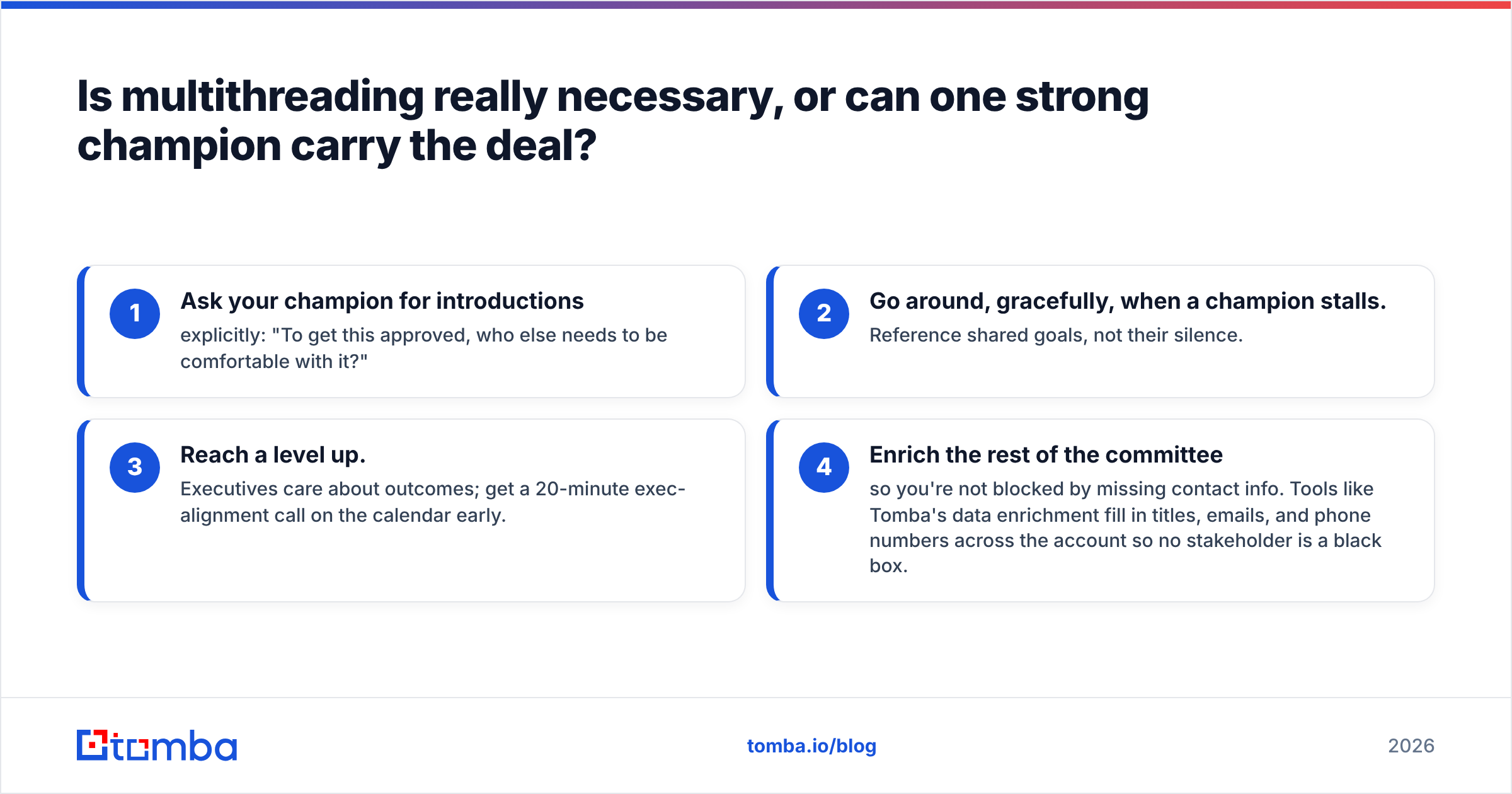
- Ask your champion for introductions explicitly: "To get this approved, who else needs to be comfortable with it?"
- Go around, gracefully, when a champion stalls. Reference shared goals, not their silence.
- Reach a level up. Executives care about outcomes; get a 20-minute exec-alignment call on the calendar early.
- Enrich the rest of the committee so you're not blocked by missing contact info. Tools like Tomba's data enrichment fill in titles, emails, and phone numbers across the account so no stakeholder is a black box.
How do you build a mutual action plan (MAP)?#
A mutual action plan is a shared, written timeline that both you and the buyer own, working backward from their go-live date to today. It is the single best defense against slippage.
A usable MAP includes:
- The target go-live or decision date, tied to a real compelling event.
- Every step in between — technical validation, security review, procurement, legal, exec sign-off.
- Owners on both sides for each step, with dates.
- Dependencies made explicit ("legal can't start until security clears").
The magic isn't the document — it's the conversation you have while building it. When you ask a buyer to commit to dates and owners, you surface hidden gates ("oh, InfoSec needs six weeks") and test whether the deal is real. A buyer who won't co-build a MAP is telling you something.
Share it as a live doc. Review it on every call. When something slips, you have a shared artifact that makes the consequence visible instead of a vague "we're still working on it."
How do you handle procurement and security reviews without losing months?#
Treat procurement and security as parallel workstreams you kick off early, not sequential gates you hit at the end.
For procurement:
- Ask about the process on your first substantive call. Get the vendor-onboarding timeline in writing.
- Know your discounting floor and your non-negotiables before you enter the room.
- Trade concessions for commitments: a discount in exchange for a multi-year term, a case study, or a faster signature.
- Build the relationship with the buyer as a person — they are managing risk, not trying to ruin your quarter.
For security and legal:
- Pre-stage your documentation: SOC 2 report, data processing agreement, penetration test summary, and a completed standard security questionnaire (SIG Lite or CAIQ).
- Offer these proactively. "Here's our security packet — send it to your InfoSec team now so we're not blocked later" buys you weeks.
- Loop in your own legal and security teams early so redlines don't sit in a queue.
Salesforce's own guidance on closing complex deals reinforces the point: the friction is almost always process friction, and process friction is plannable.
What data and tools do you actually need to close enterprise deals?#
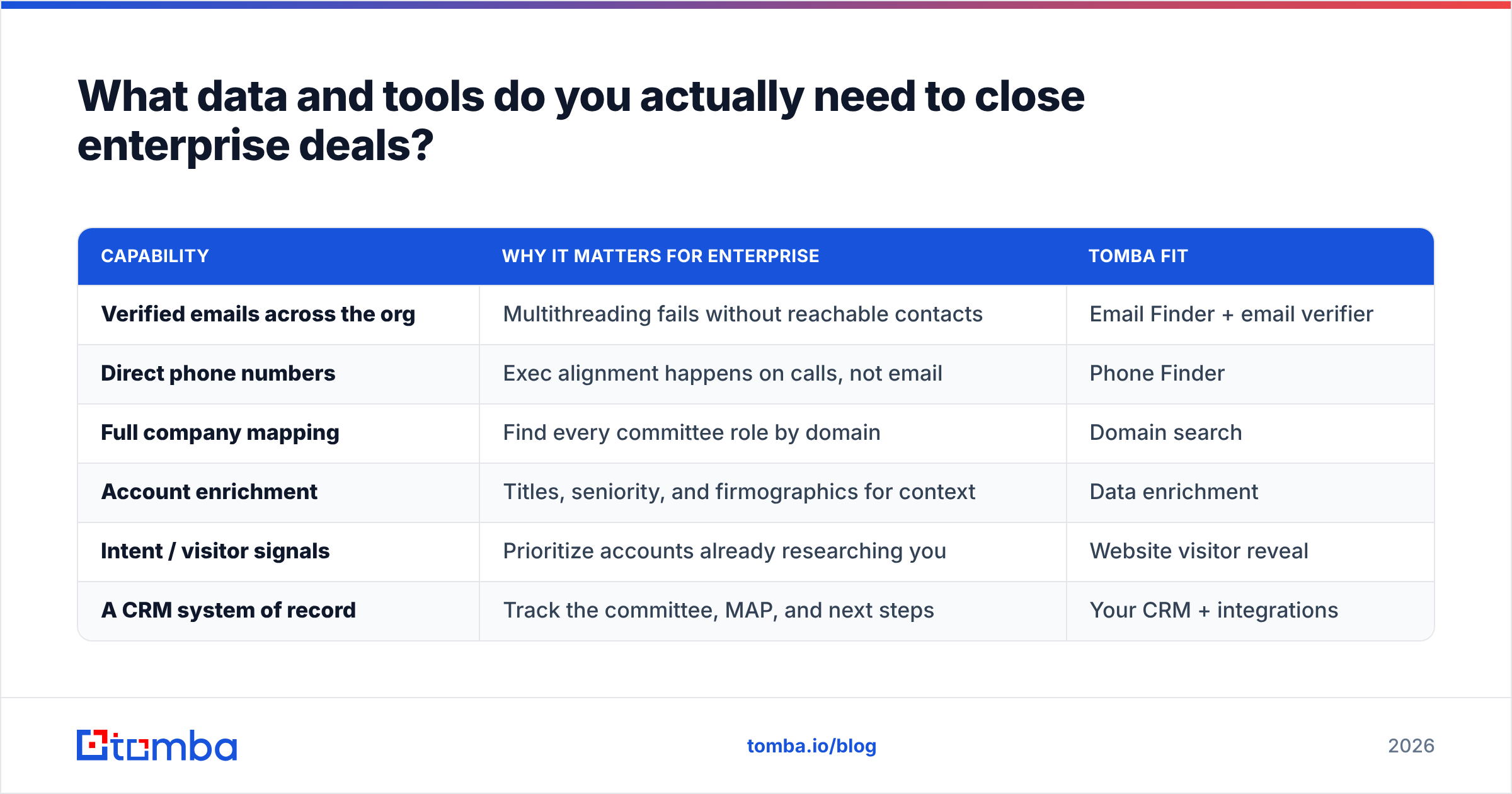
You need three data layers working together: who to reach, how to reach them, and the context to be relevant.
| Capability | Why it matters for enterprise | Tomba fit |
|---|---|---|
| Verified emails across the org | Multithreading fails without reachable contacts | Email Finder + email verifier |
| Direct phone numbers | Exec alignment happens on calls, not email | Phone Finder |
| Full company mapping | Find every committee role by domain | Domain search |
| Account enrichment | Titles, seniority, and firmographics for context | Data enrichment |
| Intent / visitor signals | Prioritize accounts already researching you | Website visitor reveal |
| A CRM system of record | Track the committee, MAP, and next steps | Your CRM + integrations |
The point is not tool sprawl. It's that enterprise deals fail on missing information more than on missing charm. When you can pull an accurate account map in minutes and verify every address before outreach, you spend your energy on strategy instead of chasing bounced emails and wrong extensions.
Accuracy compounds here. A 90%-accurate list at SMB scale is an annoyance; at enterprise scale, one wrong email to a security lead can cost you a two-week detour. Verify first, then send.
How do you forecast an enterprise deal honestly?#
Stop forecasting on feelings and start forecasting on evidence. A deal is "committed" only when you can point to concrete proof, not vibes.
Use an evidence checklist before you call anything above 75%:
- Confirmed compelling event with a date.
- 3+ engaged stakeholders, including the economic buyer.
- A co-owned mutual action plan with buyer-committed dates.
- Procurement and security processes scoped and in motion.
- Verbal agreement on price and terms, not just "it looks good."
If two or more are missing, the deal is not committed — it's optimistic. Being honest with yourself here is what makes your forecast trustworthy to leadership, and it's a core revenue operations discipline. Sandbagging and happy-ears are both forecasting sins; evidence cures both.
What's the fastest way to accelerate a stalled enterprise deal?#
When a deal goes quiet, resist the urge to send another "just checking in" email. Instead, change the pattern:
- Reactivate through a new thread. If your champion is dark, a peer or a level-up contact you enriched earlier can restart momentum.
- Re-anchor to the compelling event. Remind the committee what happens if they don't act by the date.
- Escalate value, not discounts. Bring a new proof point — a customer story, a benchmark, a risk they hadn't considered.
- Make a decision easy. Offer a smaller first phase, a pilot with clear success criteria, or a phased rollout that lowers perceived risk.
The reps who unstick deals are the ones who built enough surface area — enough threads, enough data, enough shared plans — that they always have a next move. That surface area is built early, with good research, not improvised in the eleventh hour.
The bottom line#
Closing enterprise deals in 2026 rewards the disciplined, not the loud. Map the committee, multithread relentlessly, co-build a mutual action plan, plan procurement and security from day one, and forecast on evidence. None of it works without accurate, verified contact data across the entire buying group — because you cannot influence a stakeholder you can't reach.
If your enterprise motion keeps stalling on missing contacts and bounced outreach, start there. Use the Tomba Email Finder to map every role in the buying committee by domain, verify each address before you send, and enrich the full account so no stakeholder is a blind spot. Check the Tomba pricing plans — a free tier to test the accuracy, then Starter at $49/mo when you're ready to scale your enterprise pipeline. Reliable data is the cheapest way to shorten a six-figure sales cycle.
Related guides#
Ready to find emails that actually work?
Join 150,000+ professionals who stopped guessing and started sending. Free credits on signup — no credit card required.
Get the Tomba newsletter
Practical outbound tactics and product updates — once every two weeks.
About the author