How to Write a Closing Sales Email That Actually Gets Replies
A closing sales email should make saying yes easy, not desperate. Here are the frameworks, templates, and timing rules that turn stalled threads into signed deals.
The deal is 90% done. The demo went well, pricing is agreed, and then... silence. The email that carries a prospect over the finish line is a different animal from the one that opened the conversation. Get it wrong and you sound needy; get it right and you make signing feel like the obvious next step.
TL;DR#
- A closing sales email exists to remove friction and make the yes trivial — not to beg, discount, or "just circle back."
- The best closers lead with the buyer's own words, restate value in their terms, and end with a single, specific call to action.
- Timing beats volume: a well-placed nudge on the right day outperforms five generic follow-ups.
- Templates below cover the assumptive close, the deadline close, the breakup email, and the multi-threaded close.
- Your close is only as good as your data — a bounced email never closes anything, so verify before you send.
What is a closing sales email?#
A closing sales email is the message you send to move a warm, late-stage prospect from "interested" to "committed." Think of it like the last 10 meters of a relay race — the baton is already in your hand, and your only job is not to drop it. Everything upstream (discovery, demo, proposal) built the case. The close just asks for the decision, clearly and without new noise.
That distinction matters because most reps treat closing emails like opening emails: more features, more enthusiasm, more exclamation points. But a late-stage buyer does not need to be re-sold on the product. They need friction removed — an unanswered question resolved, a stakeholder looped in, a start date confirmed. The closing email is a logistics message dressed as persuasion.
Three traits separate a real closer from a "just checking in" note:
- It references a specific prior commitment. "You mentioned wanting to launch before Q3" beats "following up on my last email."
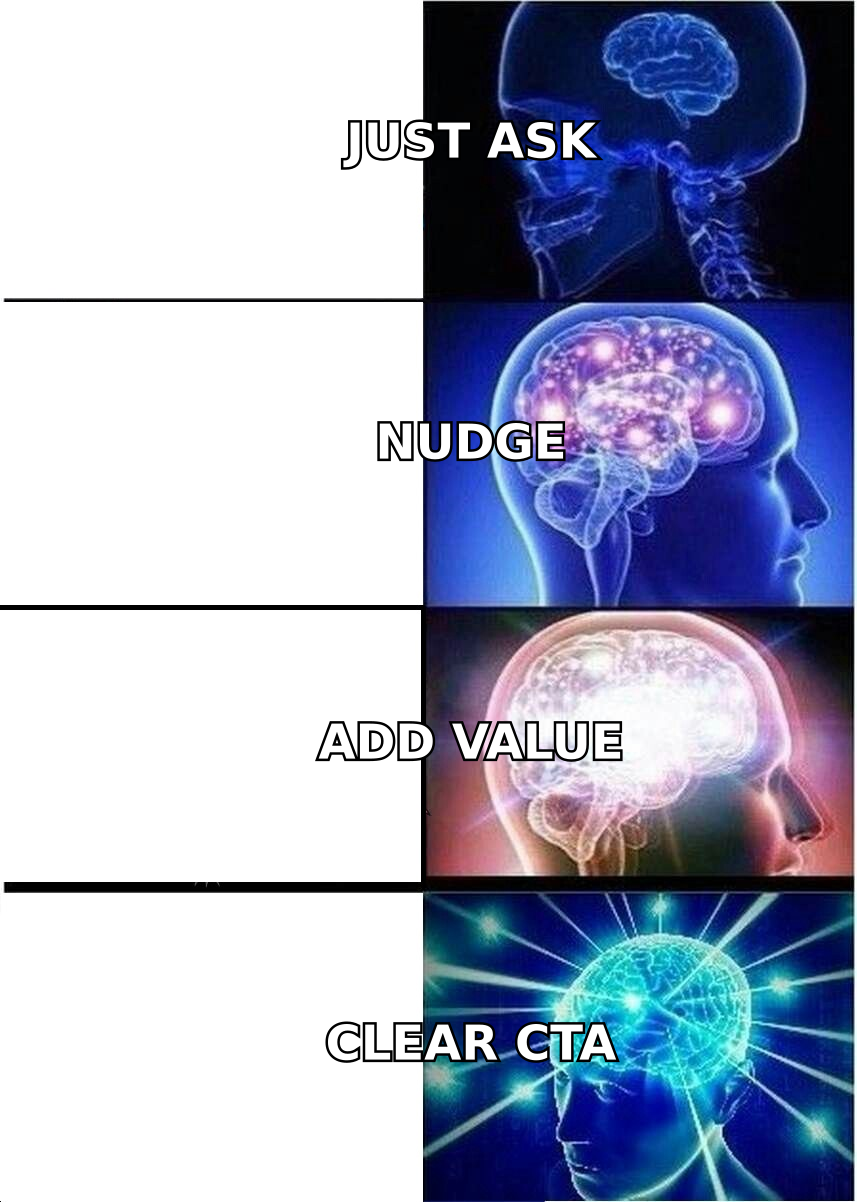
- It has exactly one call to action. Two asks split attention and stall the reply.
- It lowers the cost of saying yes. A pre-filled contract link, a proposed time, a one-line confirmation — the buyer should be able to close in under 30 seconds.
Why do most closing emails fail?#
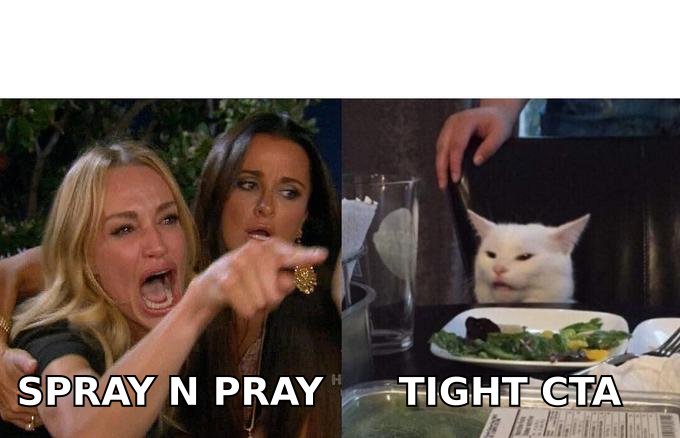
Most closing emails fail because they optimize for the sender's anxiety instead of the buyer's decision. When a rep is nervous about a slipping deal, they tend to do three counterproductive things: send more often, apologize for following up, and pile on new information. All three signal weakness and none of them address why the buyer went quiet.
According to HubSpot's sales research, the difference between top and bottom performers is rarely the pitch — it is disciplined, buyer-centric follow-through. A closing email that respects the buyer's process converts; one that chases the seller's quota does not.
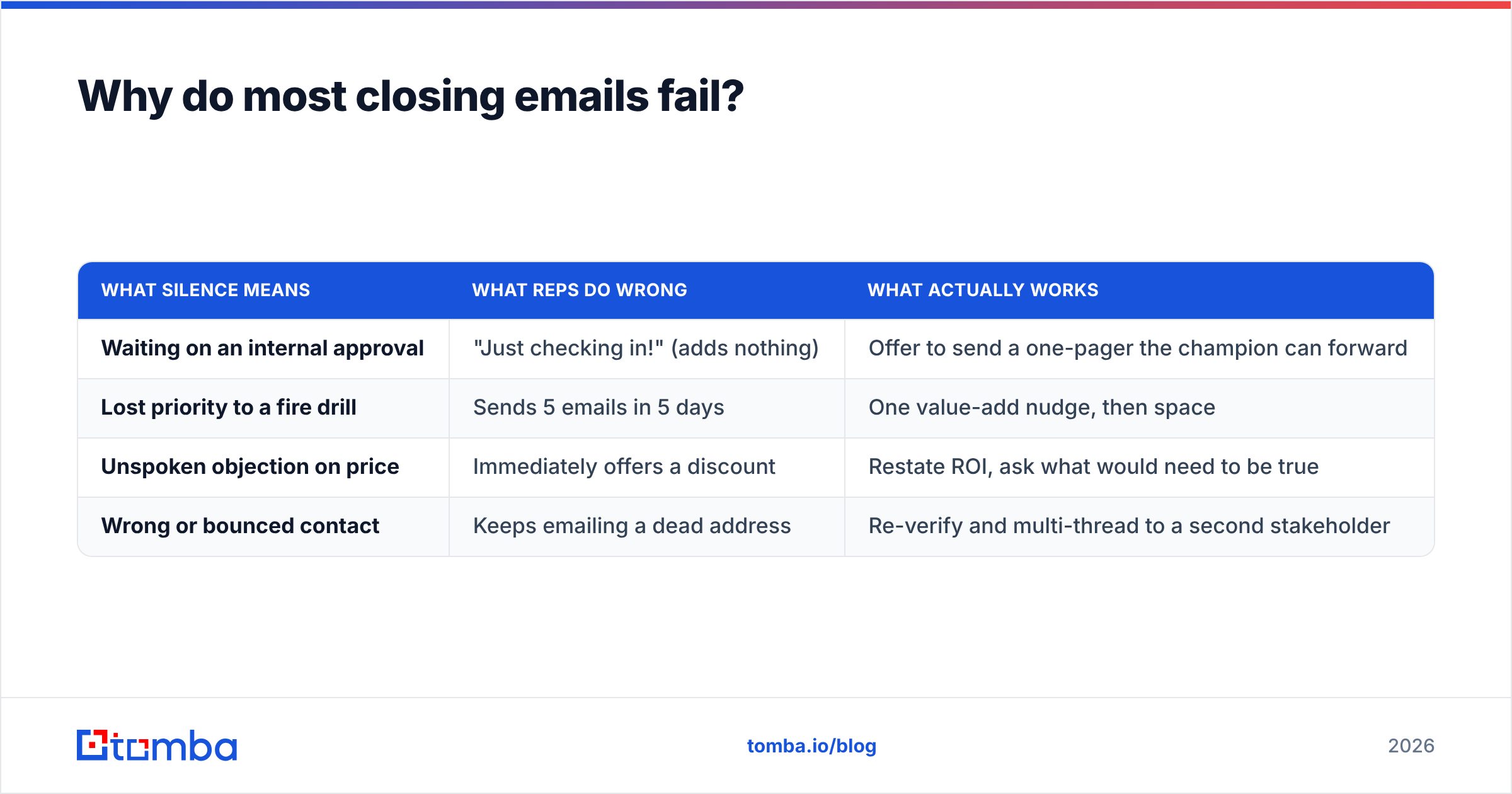
Here is what silence usually means, and what actually moves it:
| What silence means | What reps do wrong | What actually works |
|---|---|---|
| Waiting on an internal approval | "Just checking in!" (adds nothing) | Offer to send a one-pager the champion can forward |
| Lost priority to a fire drill | Sends 5 emails in 5 days | One value-add nudge, then space |
| Unspoken objection on price | Immediately offers a discount | Restate ROI, ask what would need to be true |
| Wrong or bounced contact | Keeps emailing a dead address | Re-verify and multi-thread to a second stakeholder |
Notice the fourth row. A surprising share of "ghosting" is not rejection at all — it is a bad email address or a contact who left the company. Before you assume a buyer is stalling, confirm your message is even landing. Running late-stage contacts through an email verifier takes seconds and saves you from writing brilliant closers to a bounce folder.
How do you structure a closing sales email?#
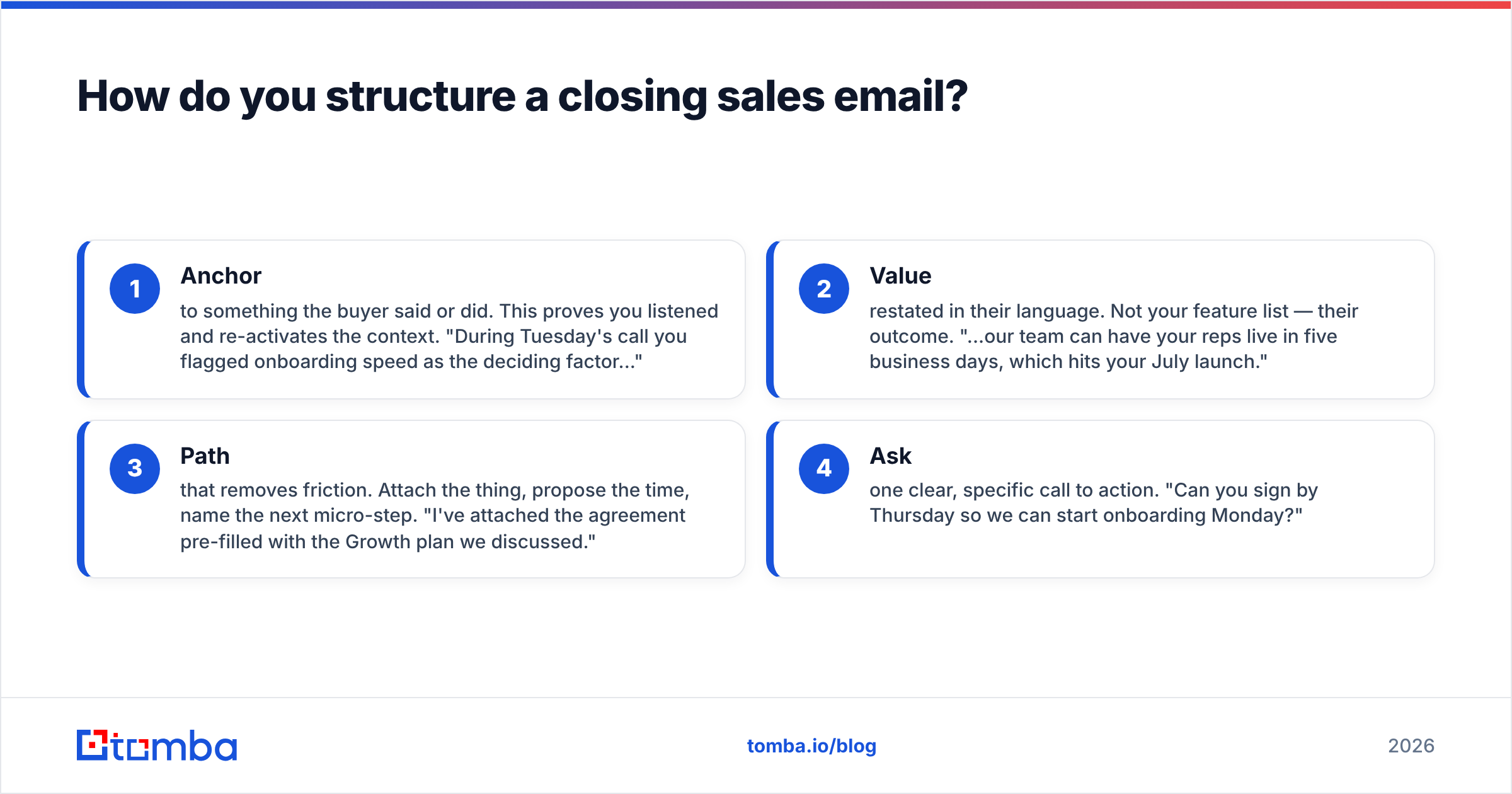
A high-converting closing email follows a four-part structure you can apply to almost any deal: anchor, value, path, ask.
- Anchor to something the buyer said or did. This proves you listened and re-activates the context. "During Tuesday's call you flagged onboarding speed as the deciding factor..."
- Value restated in their language. Not your feature list — their outcome. "...our team can have your reps live in five business days, which hits your July launch."
- Path that removes friction. Attach the thing, propose the time, name the next micro-step. "I've attached the agreement pre-filled with the Growth plan we discussed."
- Ask — one clear, specific call to action. "Can you sign by Thursday so we can start onboarding Monday?"
That order is deliberate. If you lead with the ask, you sound transactional. If you never get to the ask, the buyer has no reason to reply today. The structure carries momentum forward while keeping the message short — most great closers are under 90 words.
For a library of frameworks you can adapt per deal stage, Tomba's cold email templates collection is a useful starting point, and pairing the copy with a tested subject line generator lifts open rates on the messages that matter most.
Which closing email templates actually work?#
Below are four battle-tested patterns. Swap the brackets, keep them short, and never stack two of them in the same message.
The assumptive close (best when the deal is clearly agreed):
Subject: Onboarding start date?
Hi [Name] — great news that the team is aligned. I've attached the Growth plan agreement pre-filled from our call. Once it's signed, I'll book your onboarding for the week of [date]. Does Monday work to kick off, or is Wednesday cleaner on your end?
The deadline close (best when there is a real reason to act):
Subject: Locking your Q3 pricing
Hi [Name] — the Q3 pricing we discussed holds through [date]. To keep that rate and hit your July launch, we'd need the agreement back by [date]. Want me to send it over now so you have it ready?
The breakup email (best when a deal has gone fully cold):
Subject: Should I close your file?
Hi [Name] — I don't want to clutter your inbox. If the timing isn't right, no problem at all — just let me know and I'll close things out. If it's still on your radar, reply "keep open" and I'll follow up in [month].
The multi-threaded close (best when your champion went dark):
Subject: Quick handoff question
Hi [Name] — [Champion] and I had mapped out a July launch. As the [role], you'd be closest to the rollout, so I wanted to make sure the plan still fits your priorities. Would a 15-minute call this week help, or should I send the summary directly?
The breakup email deserves special mention. Counterintuitively, it is often the highest-reply message in the whole sequence. Research from Gong on deal outcomes consistently shows that giving buyers a graceful exit prompts them to re-engage — nobody likes to be the one who lets something die.
When should you send a closing email?#
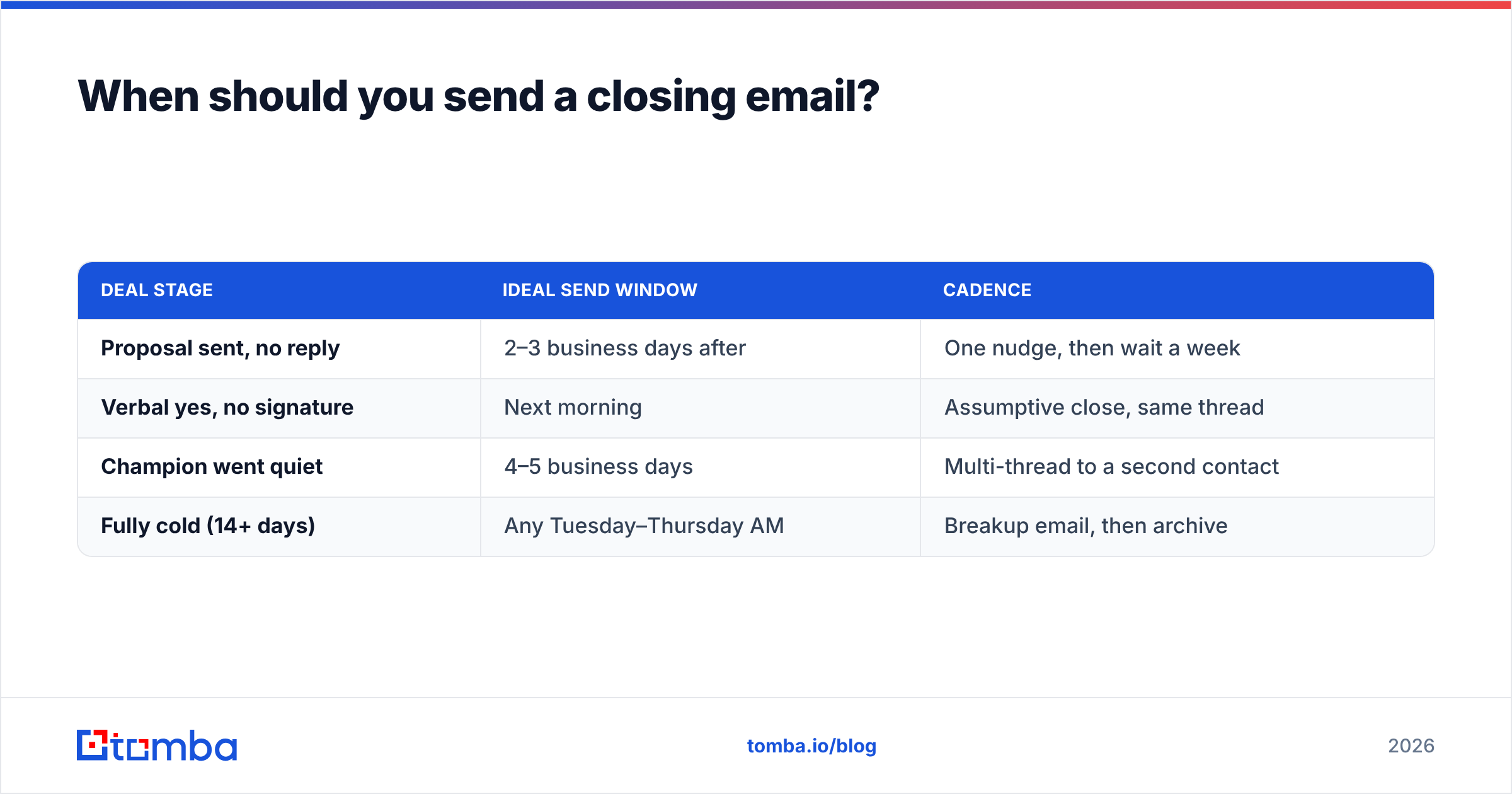
Timing determines whether your close lands as helpful or annoying. The rule of thumb: match your cadence to the buyer's stated timeline, not your pipeline review schedule.
| Deal stage | Ideal send window | Cadence |
|---|---|---|
| Proposal sent, no reply | 2–3 business days after | One nudge, then wait a week |
| Verbal yes, no signature | Next morning | Assumptive close, same thread |
| Champion went quiet | 4–5 business days | Multi-thread to a second contact |
| Fully cold (14+ days) | Any Tuesday–Thursday AM | Breakup email, then archive |
Two practical notes. First, mornings mid-week (Tuesday through Thursday) reliably outperform Monday chaos and Friday checkout. Second, keep late-stage nudges in the same email thread — a fresh subject line resets context and makes you look like a new, colder outreach.
How does data quality affect your close rate?#
Your closing copy can be flawless and still fail if the email never reaches a decision-maker. Data quality is the invisible half of closing. Two failure modes quietly kill late-stage deals: emailing a stale address, and being single-threaded to a champion who leaves or goes silent.
Multi-threading — looping in a second or third stakeholder before the close — is one of the strongest predictors of a deal actually closing, because it insulates you from any one person's inbox habits. But you can only multi-thread if you can reach those other people. That is where accurate contact data turns a hopeful close into a reliable one. When you need to reach a CFO or a VP who was never on the original thread, an email finder lets you find their verified address by name and company in seconds, so a champion's silence no longer stalls the whole deal.
Improving your reply rate is partly copywriting and partly deliverability. It helps to understand what a healthy response rate looks like for your segment so you can tell whether the problem is your message or your list. If verified emails are still bouncing or getting no reply, the issue is usually reachability, not persuasion — and no template fixes a wrong address.
What mistakes should you avoid?#
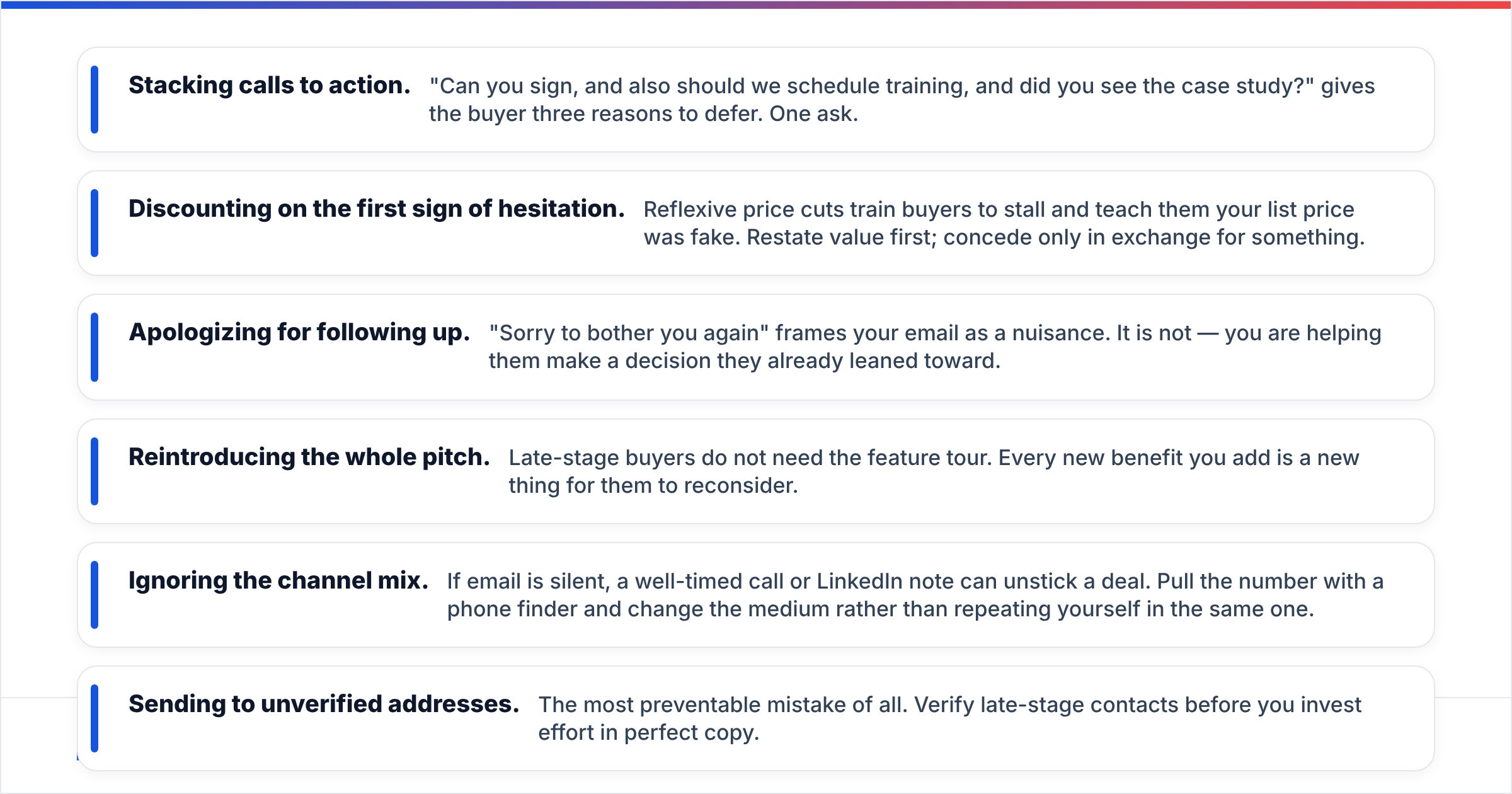
A few habits sabotage otherwise strong closers. Avoid these:
- Stacking calls to action. "Can you sign, and also should we schedule training, and did you see the case study?" gives the buyer three reasons to defer. One ask.
- Discounting on the first sign of hesitation. Reflexive price cuts train buyers to stall and teach them your list price was fake. Restate value first; concede only in exchange for something.
- Apologizing for following up. "Sorry to bother you again" frames your email as a nuisance. It is not — you are helping them make a decision they already leaned toward.
- Reintroducing the whole pitch. Late-stage buyers do not need the feature tour. Every new benefit you add is a new thing for them to reconsider.
- Ignoring the channel mix. If email is silent, a well-timed call or LinkedIn note can unstick a deal. Pull the number with a phone finder and change the medium rather than repeating yourself in the same one.
- Sending to unverified addresses. The most preventable mistake of all. Verify late-stage contacts before you invest effort in perfect copy.
You can compare tooling and workflows against third-party reviews on G2 to see how other teams operationalize these steps at scale.
How do you know your closing email worked?#
Measure the close on two signals, not one. The obvious signal is the signed deal. The subtler and more useful one is reply velocity — how quickly and how substantively buyers respond. A closing email that generates a same-day "let me loop in legal" is doing its job even before the contract lands, because it advanced the decision.
Track these across a quarter:
- Reply rate on late-stage sends — under 40% suggests a data or relevance problem, not a copy problem.
- Time-to-signature after a verbal yes — long gaps usually mean too much friction in your path step.
- Multi-thread ratio — the share of deals where you reached a second stakeholder before closing. Push it up and watch your win rate follow.
When the numbers lag, resist the urge to write more emails. Fix the inputs first: verify the list, add a stakeholder, tighten the single ask. Volume is the last lever to pull, not the first.
Close deals, don't chase them#
The best closing sales email is short, specific, and built on data you can trust. It anchors to what the buyer told you, restates the value in their words, removes the friction, and asks for one clear thing. Everything else is noise that gives a leaning-yes buyer a reason to wait.
Before you obsess over the wording, make sure the message reaches a real, verified decision-maker — and reaches more than one of them. That is where Tomba's Email Finder earns its place in your closing motion: find and verify the exact people who sign, multi-thread with confidence, and stop losing deals to dead addresses. Start free with 25 searches a month, and explore Tomba pricing when you're ready to scale — Starter is $49/mo, Growth $99/mo. Write fewer, sharper closers to the right inboxes, and let the yes take care of itself.
Related guides#
Ready to find emails that actually work?
Join 150,000+ professionals who stopped guessing and started sending. Free credits on signup — no credit card required.
Get the Tomba newsletter
Practical outbound tactics and product updates — once every two weeks.
About the author