Closing the Sale Follow-Up: A 2026 Playbook That Wins Deals
Most deals don't die at the pitch — they die in the silence after it. Here's the follow-up cadence, timing, and messaging that actually turns quiet prospects into signed contracts in 2026.
You nailed the demo. The prospect said "this looks great, let me talk to my team." Then nothing. Two weeks later the deal is cold, and you're wondering whether to send that awkward "just checking in" email again.
That gap — between a great meeting and a signed contract — is where most revenue quietly leaks out. The closing the sale follow up phase is the least glamorous part of selling and the single biggest lever on your win rate. This guide breaks down exactly how to run it in 2026.
TL;DR#
- Most deals need 5–8 follow-up touches to close, yet the majority of reps stop after one or two. Persistence, not charisma, wins the deal.
- Speed and specificity beat volume. A same-day recap referencing the prospect's own words outperforms ten generic "checking in" nudges.
- Multi-channel cadences (email + phone + LinkedIn) close faster than email-only sequences because they meet buyers where they actually respond.
- Every follow-up must carry new value — a case study, an answer to an objection, a next step — never just "any update?"
- Good data is the hidden prerequisite. You can't follow up with a contact whose email bounces or whose phone number is wrong. Verified contact data is step zero.
Why do so many deals die in the follow-up?#
The short answer: reps give up right before the buyer was ready to say yes.
Think of follow-up like watering a plant you've already planted. The pitch put the seed in the ground, but a seed that never gets watered again just sits there and dies. Most of the "growth" in a deal happens in the boring, repeated touches after the exciting first conversation — not in the conversation itself.
Industry research from HubSpot consistently shows that a large share of sales require five or more follow-up attempts after the initial meeting, while a big chunk of reps stop after a single one. That mismatch is the opportunity. If your competitors quit at touch two and you thoughtfully continue to touch six, you win deals you technically had no better claim to.
There are three common reasons follow-up fails:
- Fear of being annoying. Reps imagine the buyer is irritated. In reality, buyers are busy, and a helpful nudge is usually welcome — silence from them rarely means "no."
- No new reason to reach out. "Just circling back" gives the buyer nothing to respond to. Every touch needs a fresh hook.
- Bad contact data. You can follow up perfectly and still fail if the email lands in a dead inbox or the direct dial is out of date.
The first two are mindset and process problems. The third is a data problem — and it's the one most teams ignore.
What does an effective closing follow-up cadence look like?#
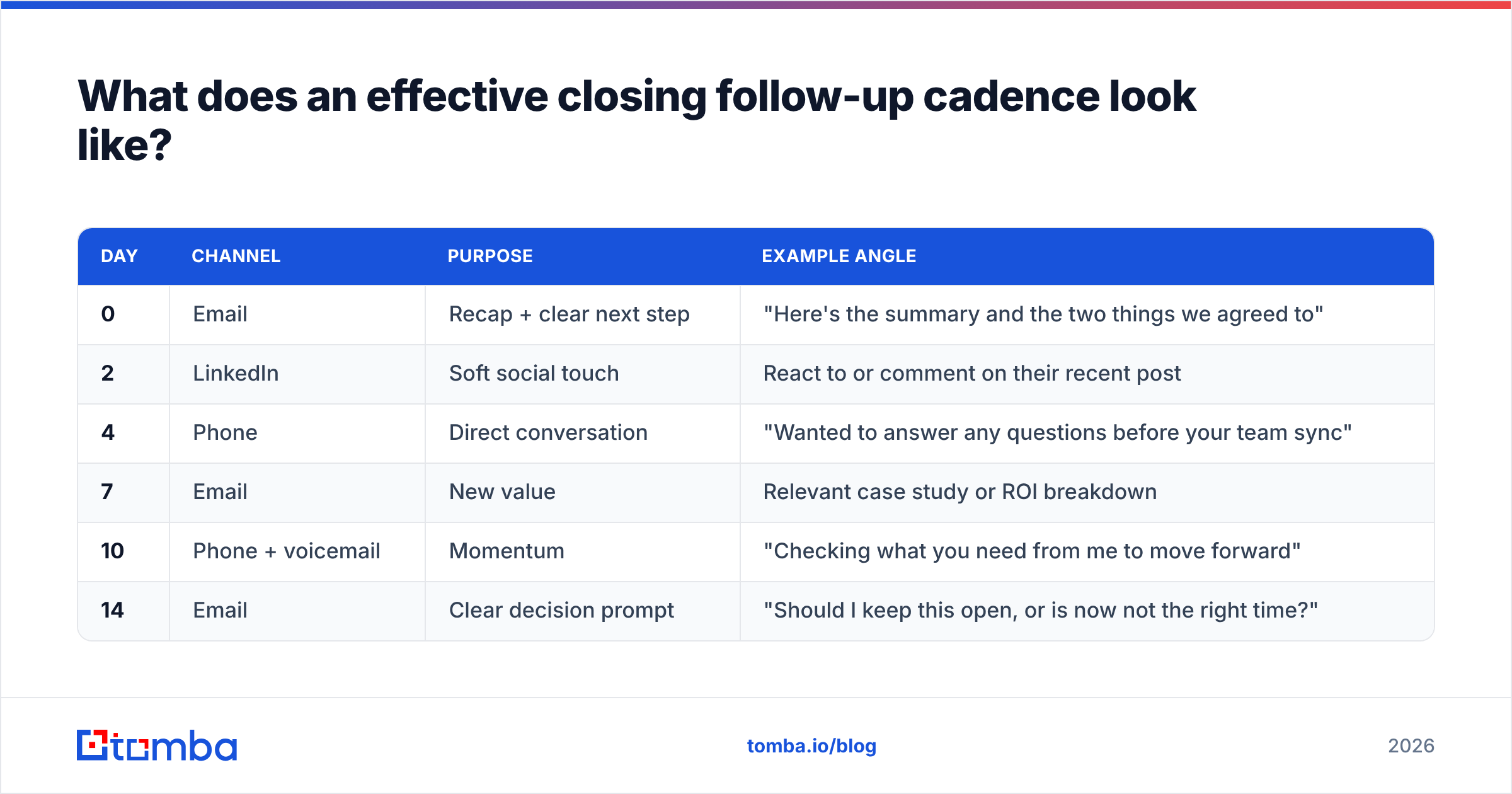
A cadence is just a planned sequence of touches across time and channels. The goal is to stay present without becoming noise. Here's a proven 14-day structure you can adapt after a strong sales conversation or proposal.
| Day | Channel | Purpose | Example angle |
|---|---|---|---|
| 0 | Recap + clear next step | "Here's the summary and the two things we agreed to" | |
| 2 | Soft social touch | React to or comment on their recent post | |
| 4 | Phone | Direct conversation | "Wanted to answer any questions before your team sync" |
| 7 | New value | Relevant case study or ROI breakdown | |
| 10 | Phone + voicemail | Momentum | "Checking what you need from me to move forward" |
| 14 | Clear decision prompt | "Should I keep this open, or is now not the right time?" |
Notice two things. First, no single channel is spammed — the touches are spread across email, phone, and LinkedIn so no one feels bombarded. Second, the final touch isn't a beg; it's a take-away close that gives the buyer an easy, face-saving way to re-engage or bow out. Both outcomes beat indefinite silence.
For phone-heavy sequences, having accurate direct dials matters enormously. A cadence that routes buyers to a dead switchboard number wastes half its touches. This is where a reliable phone finder earns its keep — it turns "I don't have their number" into a real conversation.
How many follow-ups is too many?#
The honest answer: you stop when you get a clear yes, a clear no, or you've delivered genuine value across roughly 6–8 touches without a signal.
The number itself matters less than the quality. Ten lazy "any update?" emails feel like harassment. Eight thoughtful touches — each carrying a new insight, answer, or resource — feel like a diligent partner. Buyers can tell the difference instantly.
A simple rule of thumb: if you'd be comfortable reading your follow-up aloud to the prospect's face, send it. If it would sound needy or empty when spoken, rewrite it until it carries value.
What should each follow-up message actually say?#
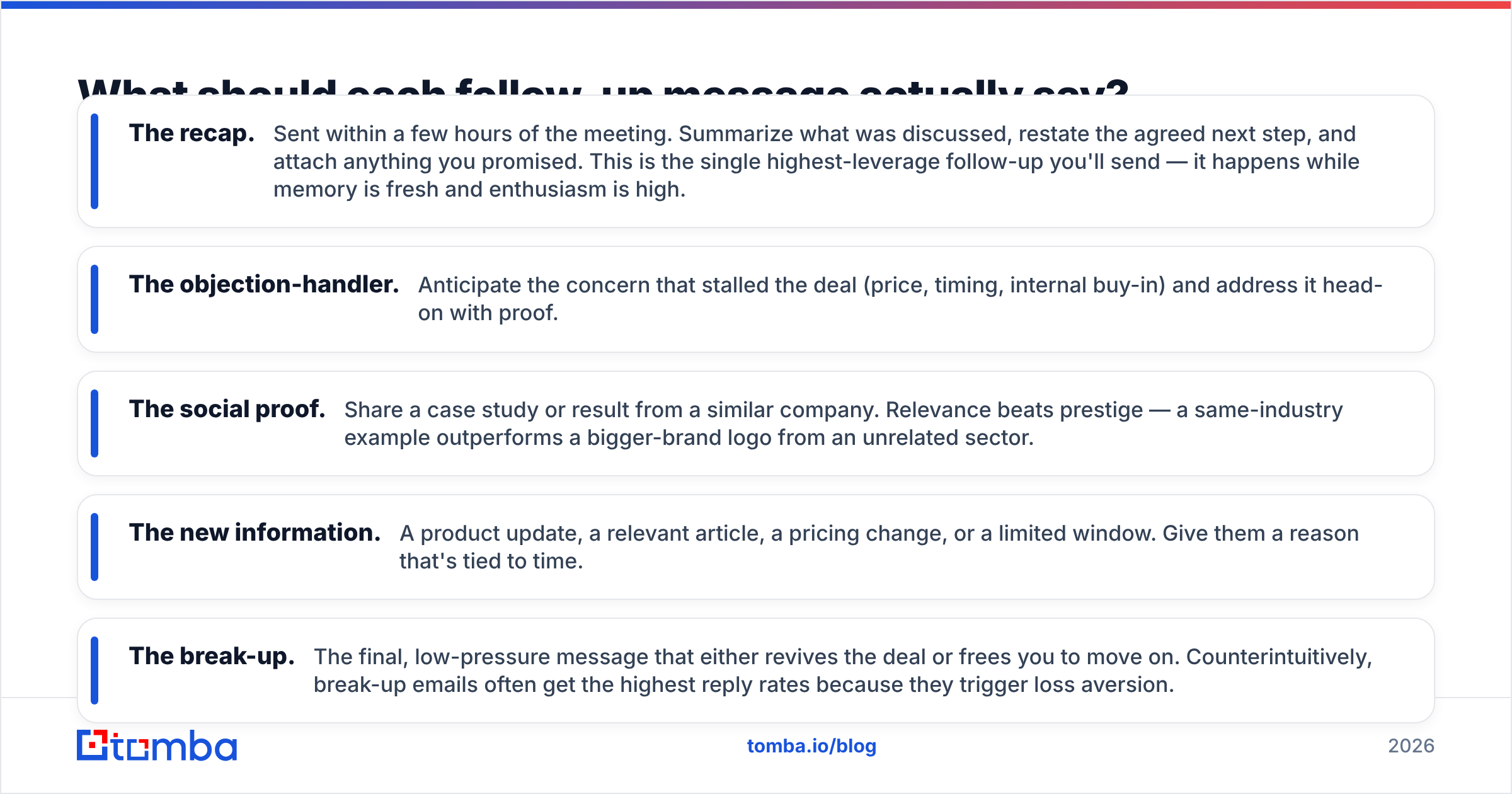
Every message should answer the buyer's silent question: "Why are you contacting me, and what's in it for me?" Structure each touch around one of these value types.
- The recap. Sent within a few hours of the meeting. Summarize what was discussed, restate the agreed next step, and attach anything you promised. This is the single highest-leverage follow-up you'll send — it happens while memory is fresh and enthusiasm is high.
- The objection-handler. Anticipate the concern that stalled the deal (price, timing, internal buy-in) and address it head-on with proof.
- The social proof. Share a case study or result from a similar company. Relevance beats prestige — a same-industry example outperforms a bigger-brand logo from an unrelated sector.
- The new information. A product update, a relevant article, a pricing change, or a limited window. Give them a reason that's tied to time.
- The break-up. The final, low-pressure message that either revives the deal or frees you to move on. Counterintuitively, break-up emails often get the highest reply rates because they trigger loss aversion.
Here's a same-day recap template you can steal:
Subject: Recap + next steps from today
Hi [Name], great talking through [specific problem] today. To recap what we agreed:
- You'll loop in [stakeholder] on [date].
- I'll send the [security doc / pricing sheet] by tomorrow.
I've attached the [resource] you asked about. What's the best way to make [their goal] happen on your side?
Short, specific, and it references their words — not a generic script. That specificity is what separates a follow-up that gets replies from one that gets ignored. If writing these at volume slows you down, an AI cold email writer can draft the first version, which you then personalize with the details only you know from the call.
Email-only vs. multi-channel follow-up: which closes more?#
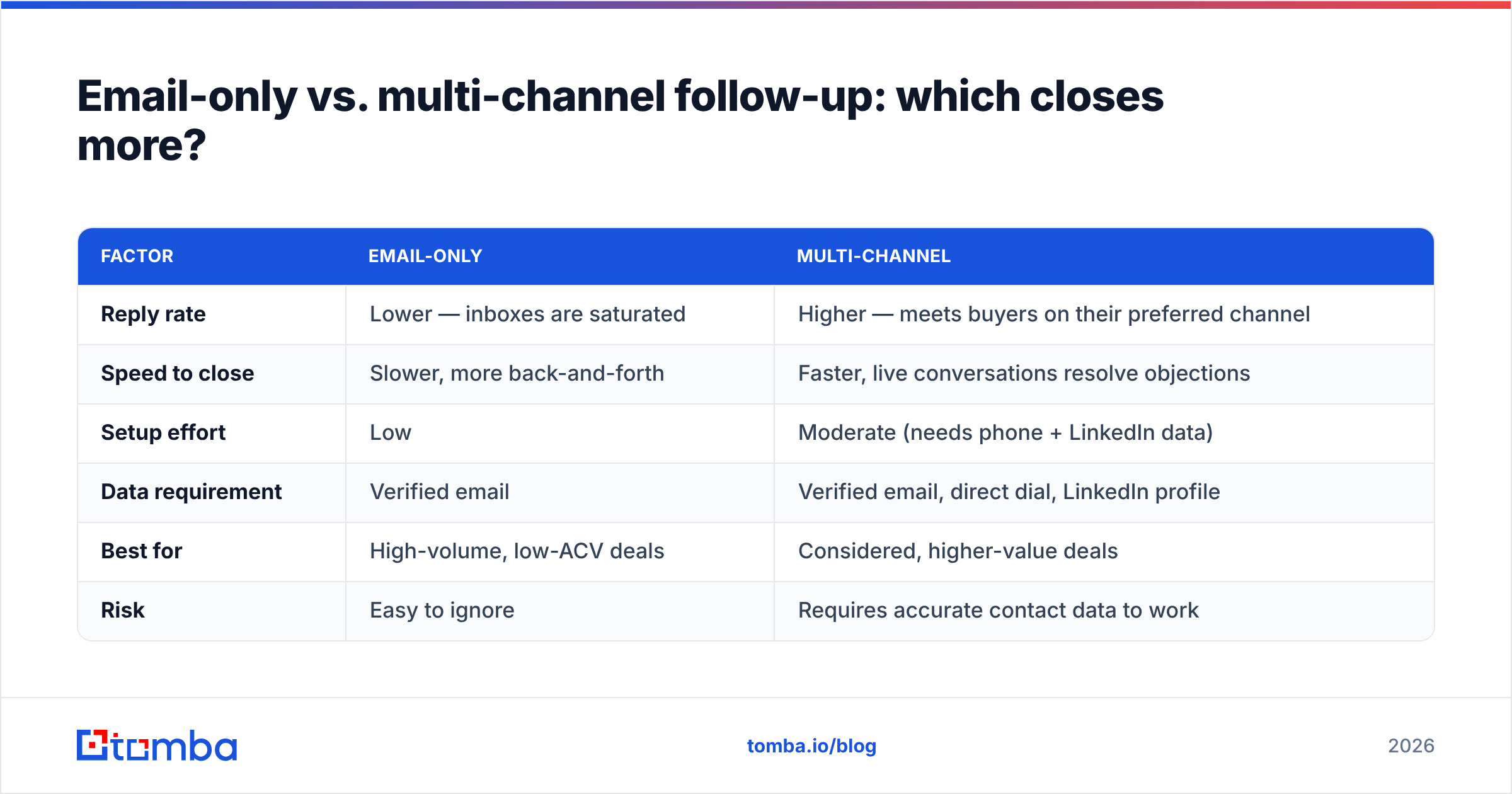
Email is convenient, but buyers are drowning in it. The teams closing the most deals in 2026 run multi-channel cadences that combine email with phone and social touches. Here's how the two approaches compare.
| Factor | Email-only | Multi-channel |
|---|---|---|
| Reply rate | Lower — inboxes are saturated | Higher — meets buyers on their preferred channel |
| Speed to close | Slower, more back-and-forth | Faster, live conversations resolve objections |
| Setup effort | Low | Moderate (needs phone + LinkedIn data) |
| Data requirement | Verified email | Verified email, direct dial, LinkedIn profile |
| Best for | High-volume, low-ACV deals | Considered, higher-value deals |
| Risk | Easy to ignore | Requires accurate contact data to work |
The catch is right there in the data-requirement row: multi-channel only works if your contact data is complete and accurate. A phone touch fails without a real number; a LinkedIn touch fails without the right profile. That's why the highest-performing teams treat data enrichment as part of the follow-up process, not a separate chore — they fill in the missing email, phone, and social fields before the cadence starts, so no touch is wasted on a dead end.
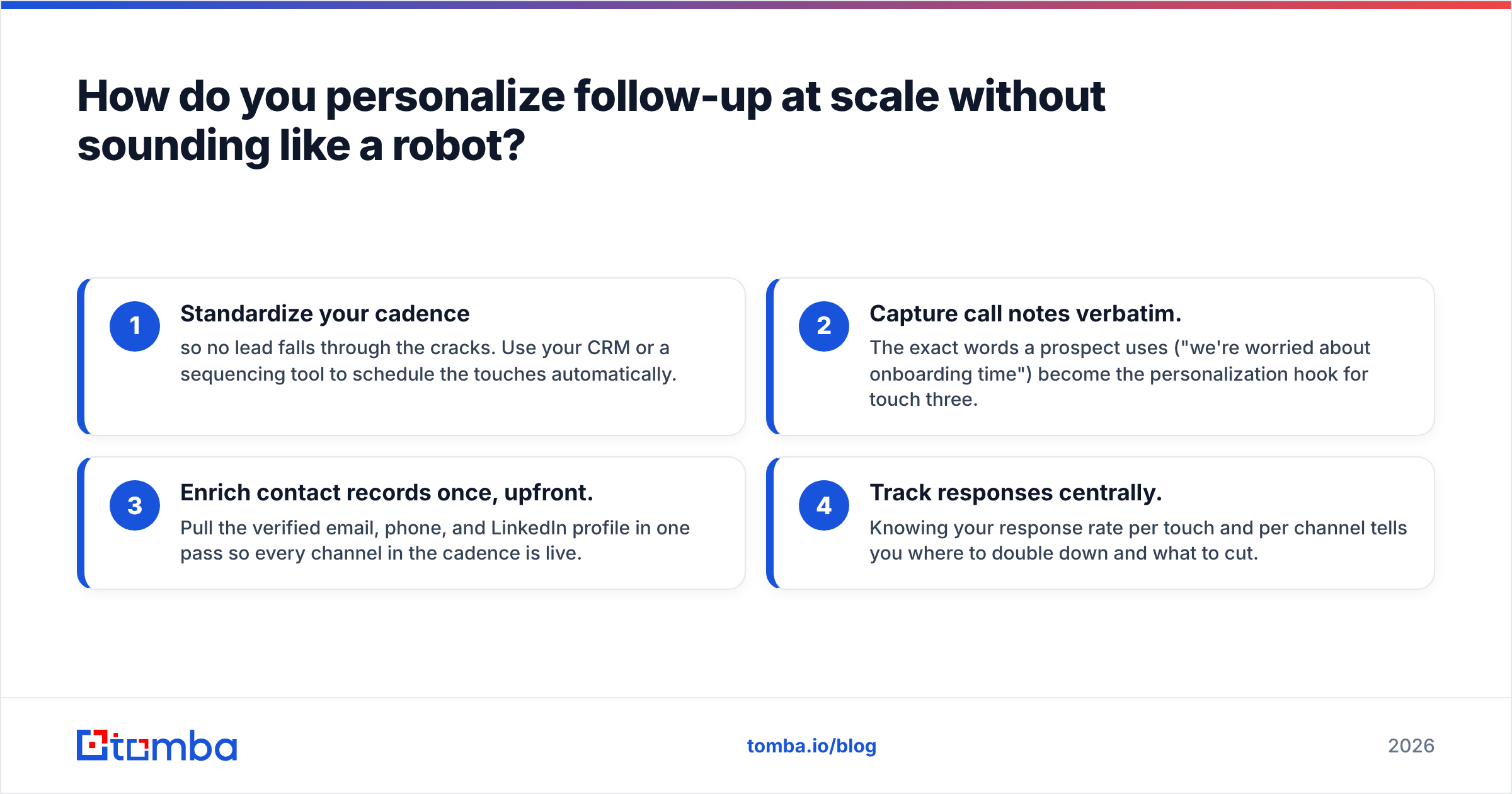
How do you personalize follow-up at scale without sounding like a robot?#
The tension every growing team hits: personalization drives replies, but hand-crafting every message doesn't scale. Resolve it by separating the two halves of a good follow-up.
The structure — cadence timing, message types, sequence order — is a repeatable system. Build it once and reuse it. The specifics — the prospect's name, their stated goal, the objection they raised, the phrase they used — are what make it feel human. Automate the structure; personalize the specifics.
Practically, that means:
- Standardize your cadence so no lead falls through the cracks. Use your CRM or a sequencing tool to schedule the touches automatically.
- Capture call notes verbatim. The exact words a prospect uses ("we're worried about onboarding time") become the personalization hook for touch three.
- Enrich contact records once, upfront. Pull the verified email, phone, and LinkedIn profile in one pass so every channel in the cadence is live.
- Track responses centrally. Knowing your response rate per touch and per channel tells you where to double down and what to cut.
This is also where clean data compounds. According to analyst coverage from Gartner, B2B buying groups now involve multiple stakeholders, which means you're often following up with several contacts per deal. Finding and verifying each of those contacts by hand is brutal. A tool that returns verified professional emails from a name and company — like the Tomba Email Finder — removes the grunt work so your reps spend their time on messaging, not data entry. You can review the Tomba pricing tiers to match volume to your team size, starting free at 25 searches a month.
What follow-up mistakes kill the most deals?#
Even disciplined reps sabotage themselves with a handful of avoidable errors. Watch for these.
- Waiting too long after the meeting. Enthusiasm decays by the hour. A recap sent three days later has a fraction of the impact of one sent the same afternoon.
- Leading with "just checking in." It signals you have nothing new to offer. Always attach a reason.
- Following up with only one stakeholder. Deals stall when the champion goes quiet and you have no one else to reach. Map and contact the full buying group.
- Giving up silently. If you're going to stop, send a break-up message first. It costs nothing and frequently revives dead deals.
- Ignoring bad data. Bounced emails and wrong numbers don't just waste touches — they hurt your sender reputation and skew your metrics. Verifying contacts before you send protects both.
- No clear ask. Every message should end with one specific, easy-to-answer question. "Does Thursday at 2pm work?" beats "let me know your thoughts."
Fix these six and your close rate climbs without adding a single new lead to the pipeline. Follow-up is efficiency, not volume — you're converting demand you already created.
How do you know your follow-up is working?#
Measure it. Track these signals and adjust:
- Reply rate by touch number. If replies crater after touch three, your later messages probably lack fresh value.
- Channel performance. Are phone touches or emails driving more re-engagement? Shift effort toward the winner.
- Time-to-close before and after. A tighter, well-structured cadence should shorten your sales cycle.
- Bounce and connect rates. High bounces mean a data problem, not a messaging problem. Clean the list first.
Treat follow-up like any other part of the funnel: instrument it, read the numbers, and iterate. The teams that win aren't guessing — they know their touch-four case study email pulls a 22% reply rate and their day-10 call connects one in three times, so they lean into what works.
The bottom line#
Closing the sale follow up isn't about being pushy — it's about being present, useful, and reachable across every channel until the buyer decides. Build a structured 6–8 touch cadence, give every message a fresh reason to exist, run it across email and phone, and — critically — make sure the contact data underneath it is accurate so no touch is wasted.
That last piece is where most teams quietly lose. If your reps are burning follow-up attempts on bounced emails and dead phone lines, fix the foundation first. Start with the Tomba Email Finder to pull verified professional emails for every stakeholder in your deals, so every follow-up you send actually lands — and every deal you worked to open gets the chance to close. The free tier gives you 25 searches a month to test it against your own pipeline before you commit.
Related guides#
Ready to find emails that actually work?
Join 150,000+ professionals who stopped guessing and started sending. Free credits on signup — no credit card required.
Get the Tomba newsletter
Practical outbound tactics and product updates — once every two weeks.
About the author