Cloud GTM Strategy in 2026: A Practical Playbook Guide
A cloud GTM strategy only works when data, tooling, and RevOps line up. Here's how to build one in 2026 that actually moves pipeline — without the platform bloat.
TL;DR
- A cloud gtm strategy is your go-to-market motion built on cloud-native data, tooling, and automation — so marketing, sales, and success run off one shared system instead of five disconnected ones.
- The winners in 2026 aren't the teams with the most tools. They're the teams whose data layer is clean, unified, and enriched before it ever hits a rep's screen.
- Most GTM stacks fail at the seams: CRM says one thing, the enrichment vendor says another, and nobody trusts the pipeline number.
- You don't need a seven-figure platform. You need a tight loop: capture → enrich → route → measure, with a reliable data source feeding the top.
- This guide walks the architecture, the stack choices, the RevOps operating model, and the metrics that tell you it's working.
What is a cloud GTM strategy?#
A cloud GTM strategy is the way you take a product to market when your entire revenue engine lives in cloud software and shared data — not in spreadsheets and tribal knowledge.
Think of it like a modern airport. The runway (your product) matters, but throughput depends on the control tower: one system that sees every plane, routes it, and tracks it end to end. A cloud GTM strategy is that control tower for revenue. Every lead, account, and touch flows through a connected set of cloud tools that share the same underlying record.
Technically, it rests on three layers:
- Data layer — a single, enriched source of truth for accounts and contacts. This is where most strategies quietly succeed or fail.
- Activation layer — the CRM, sequencer, and automation tools that act on that data (route leads, trigger plays, personalize outreach).
- Measurement layer — the analytics and revenue operations function that closes the loop and tells you what's working.
The shift from "old" GTM to cloud GTM is mostly about the first layer. When your data is fragmented, every downstream tool inherits the mess. When it's unified and accurate, cheap tools start performing like expensive ones.

Why do most cloud GTM strategies stall?#
Most stall because teams buy activation before they fix data. They add a sequencer, an intent tool, and an AI SDR on top of a CRM full of stale, duplicate, unverifiable records — and then wonder why reply rates drop.
According to Gartner and echoed across most RevOps benchmarks, B2B data decays roughly 25-30% per year as people change jobs, companies rebrand, and domains move. If you're not continuously refreshing, a third of your database is wrong within twelve months. No amount of AI copywriting fixes a bounced email or a wrong-persona send.
The second failure mode is tool sprawl without an owner. Marketing buys one enrichment vendor, sales ops buys another, and the two disagree on the same account. Reps stop trusting the system and go back to LinkedIn tabs and gut feel. A cloud GTM strategy is supposed to reduce cognitive load, not multiply the number of tabs.
The fix isn't more software. It's sequencing: get the data layer right, appoint one owner for it, then layer activation on top.
What does a modern cloud GTM stack look like?#
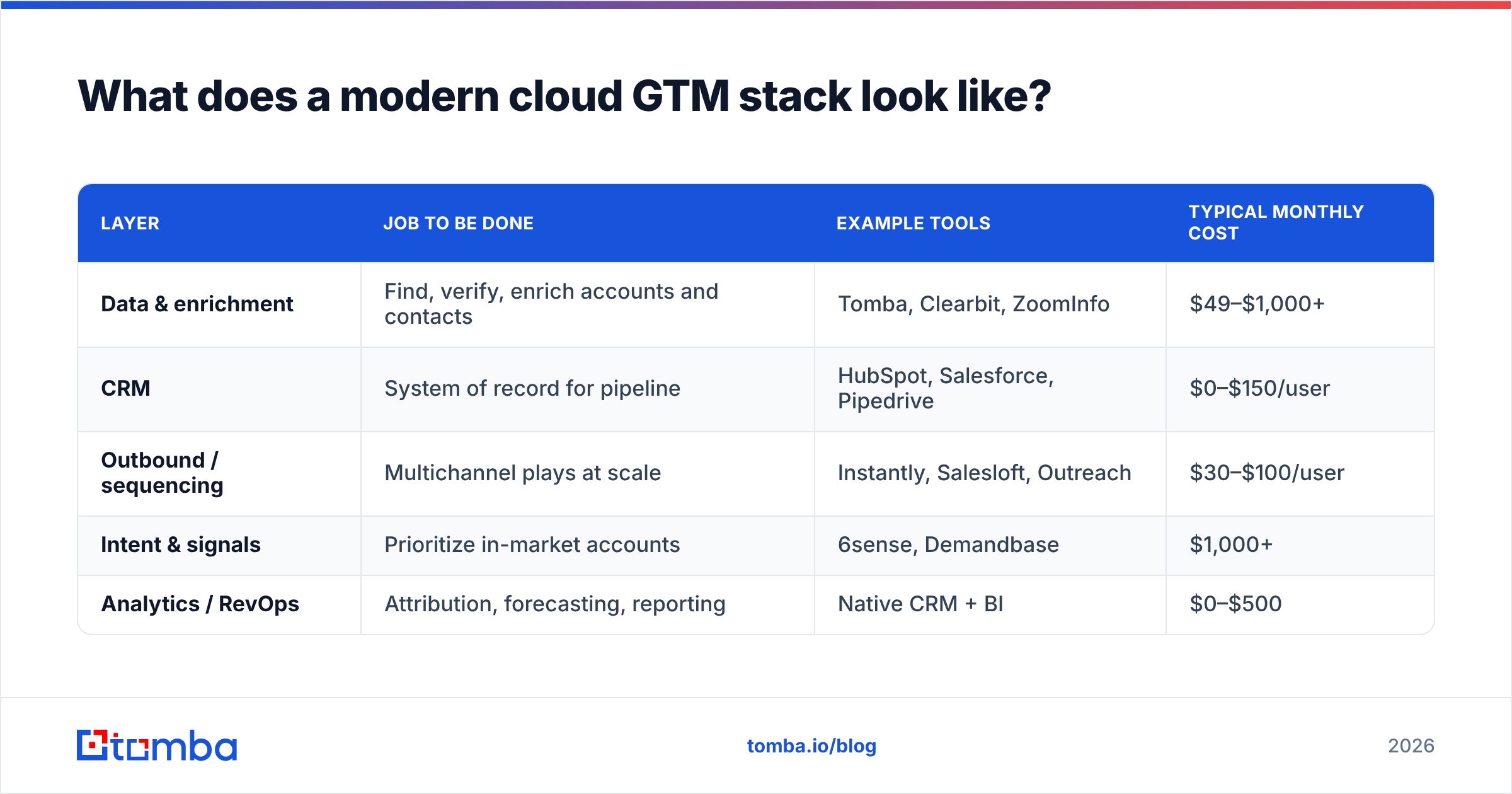
A lean 2026 stack has one tool (or one clear primary) per job, all sharing data through native integrations or a warehouse. Here's a reference architecture and roughly what each layer costs.
| Layer | Job to be done | Example tools | Typical monthly cost |
|---|---|---|---|
| Data & enrichment | Find, verify, enrich accounts and contacts | Tomba, Clearbit, ZoomInfo | $49–$1,000+ |
| CRM | System of record for pipeline | HubSpot, Salesforce, Pipedrive | $0–$150/user |
| Outbound / sequencing | Multichannel plays at scale | Instantly, Salesloft, Outreach | $30–$100/user |
| Intent & signals | Prioritize in-market accounts | 6sense, Demandbase | $1,000+ |
| Analytics / RevOps | Attribution, forecasting, reporting | Native CRM + BI | $0–$500 |
The point of the table isn't "buy all five." It's to show that the data layer is the cheapest place to get a compounding advantage. Spending $49/mo on accurate contact data improves every other row's performance — better routing, better sequencing, cleaner attribution.
If you're just standing up a motion, you can collapse this to three tools: a data source, a CRM, and a sequencer. Add intent and BI once you have volume worth prioritizing.
Where the data layer plugs in#
This is the part teams underestimate. Your CRM is only as good as what flows into it. A cloud GTM strategy needs a reliable way to:
- Find the right contacts at target accounts — using a domain search to pull every relevant email at a company, or an email finder to locate a specific person by name and domain.
- Verify deliverability before you send, so you protect sender reputation and keep bounce rates low.
- Enrich each record with firmographic and role data so routing and personalization actually work — that's what data enrichment is for.
Get those three right at the top of the funnel and everything downstream — routing rules, lead scoring, sequence branching — runs on trustworthy inputs.
How do you build a cloud GTM strategy step by step?#
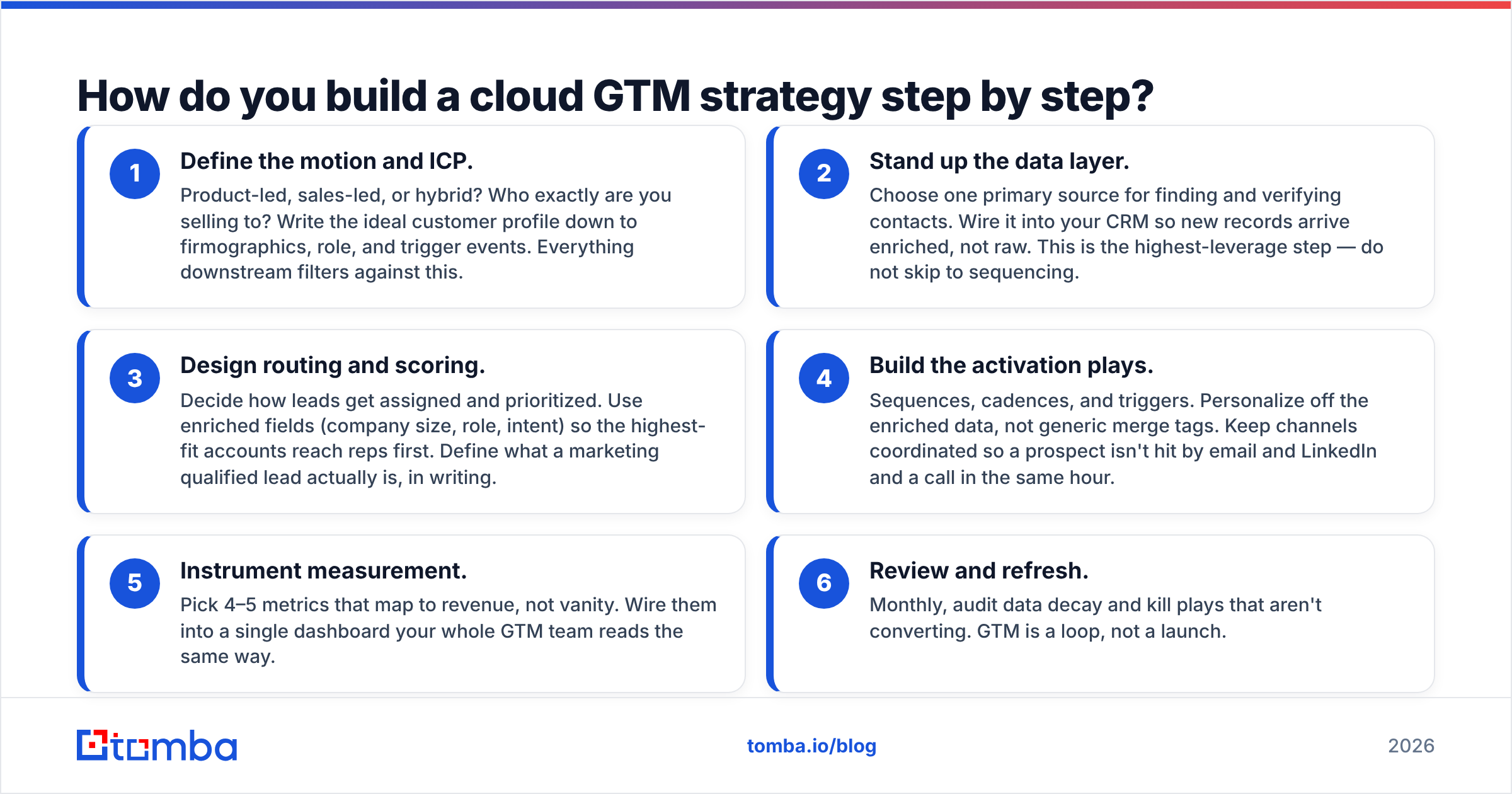
Here's the operating loop. Run it in order; each step assumes the previous one is solid.
- Define the motion and ICP. Product-led, sales-led, or hybrid? Who exactly are you selling to? Write the ideal customer profile down to firmographics, role, and trigger events. Everything downstream filters against this.
- Stand up the data layer. Choose one primary source for finding and verifying contacts. Wire it into your CRM so new records arrive enriched, not raw. This is the highest-leverage step — do not skip to sequencing.
- Design routing and scoring. Decide how leads get assigned and prioritized. Use enriched fields (company size, role, intent) so the highest-fit accounts reach reps first. Define what a marketing qualified lead actually is, in writing.
- Build the activation plays. Sequences, cadences, and triggers. Personalize off the enriched data, not generic merge tags. Keep channels coordinated so a prospect isn't hit by email and LinkedIn and a call in the same hour.
- Instrument measurement. Pick 4–5 metrics that map to revenue, not vanity. Wire them into a single dashboard your whole GTM team reads the same way.
- Review and refresh. Monthly, audit data decay and kill plays that aren't converting. GTM is a loop, not a launch.
The discipline is in step 2. Teams love steps 4 and 5 because they're visible. But a beautiful sequence sent to a stale, unverified list is just an expensive way to burn your domain.

Cloud GTM vs traditional GTM: what actually changed?#
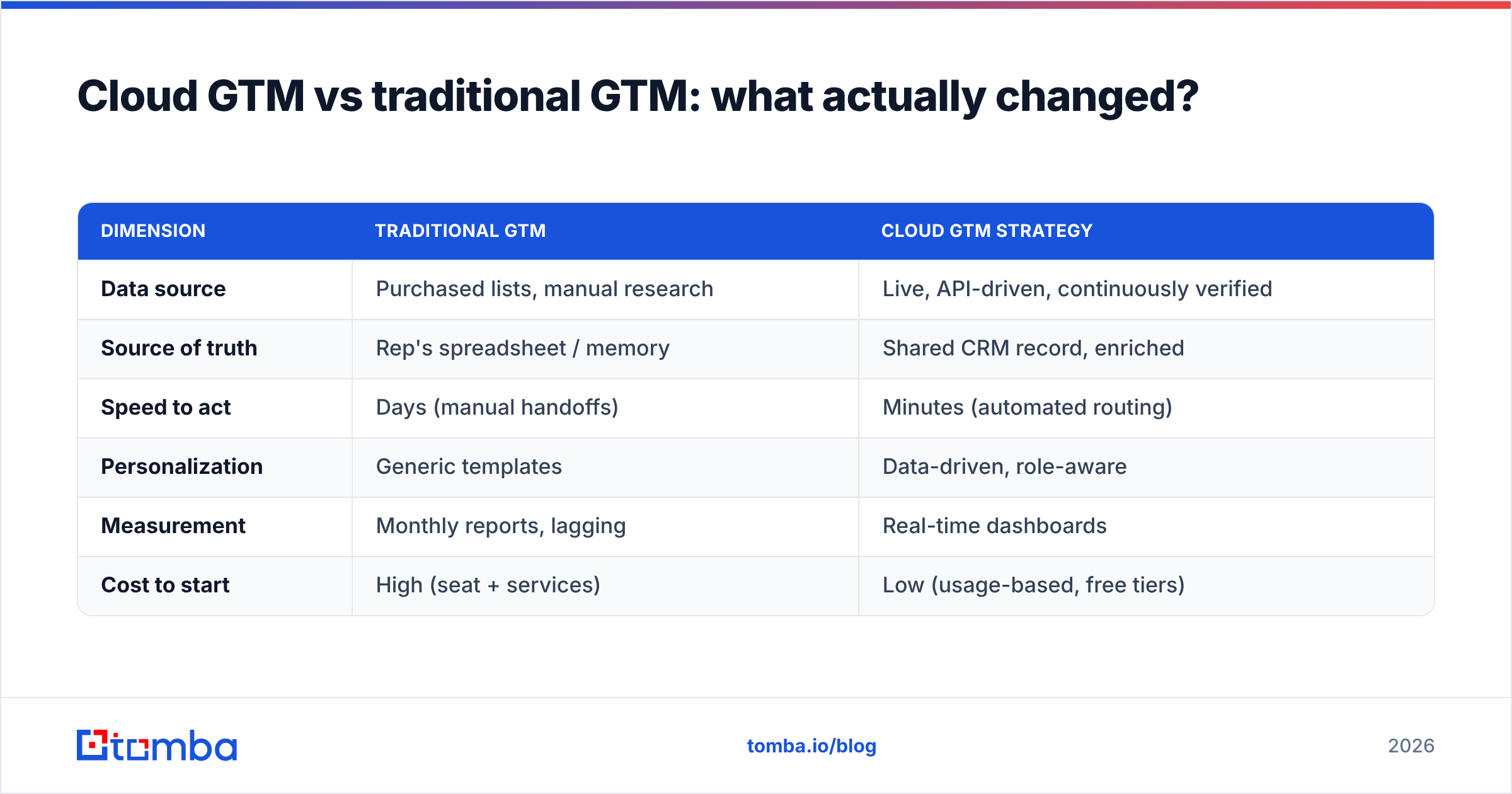
The core jobs — find buyers, reach them, close them — haven't changed. What changed is where the work lives and how fast the feedback loop runs.
| Dimension | Traditional GTM | Cloud GTM strategy |
|---|---|---|
| Data source | Purchased lists, manual research | Live, API-driven, continuously verified |
| Source of truth | Rep's spreadsheet / memory | Shared CRM record, enriched |
| Speed to act | Days (manual handoffs) | Minutes (automated routing) |
| Personalization | Generic templates | Data-driven, role-aware |
| Measurement | Monthly reports, lagging | Real-time dashboards |
| Cost to start | High (seat + services) | Low (usage-based, free tiers) |
The biggest practical difference is speed of iteration. In a cloud GTM strategy, you can test a new segment on Monday, see reply data by Wednesday, and reallocate budget by Friday. That loop is the whole advantage. Traditional GTM couldn't move that fast because the data and the tooling didn't talk to each other.
Vendors like HubSpot and Salesforce built their platforms around exactly this loop — connected records, native automation, shared reporting. You can replicate the same principle with a leaner stack as long as the layers integrate.
How do you measure whether it's working?#
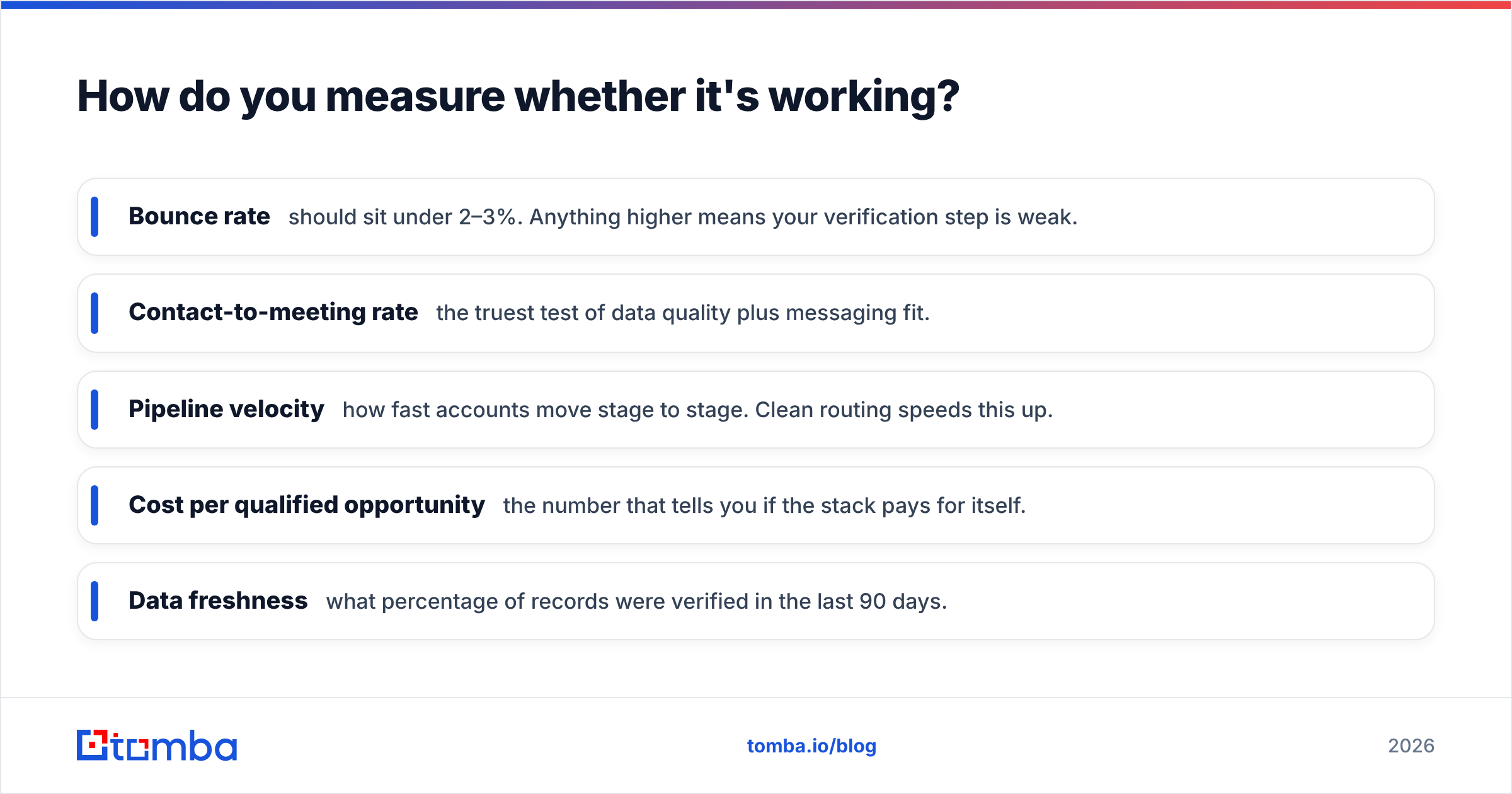
Track the loop, not the tools. If your data layer is doing its job, these five numbers move in the right direction within a quarter:
- Bounce rate — should sit under 2–3%. Anything higher means your verification step is weak.
- Contact-to-meeting rate — the truest test of data quality plus messaging fit.
- Pipeline velocity — how fast accounts move stage to stage. Clean routing speeds this up.
- Cost per qualified opportunity — the number that tells you if the stack pays for itself.
- Data freshness — what percentage of records were verified in the last 90 days.
A quick reality check: if bounce rate is high and freshness is low, no clever sequence or AI writer will save the quarter. Fix the top of the funnel first. That's why a cloud GTM strategy treats data as infrastructure, not as a one-time purchase.
What about integrations and RevOps ownership?#
A cloud GTM strategy is only as strong as its connective tissue. Two things decide whether the stack becomes a system or a pile of subscriptions:
One owner for the data layer. RevOps — or one accountable person — owns definitions, dedup rules, enrichment cadence, and the integration map. Without a single owner, every team optimizes locally and the shared record rots. Compare vendors honestly here; even peers like BookYourData can play a role for specific list-buy use cases, but you still need one system that reconciles all sources into a trusted record.
Native integrations over brittle exports. CSV round-trips are where data quality goes to die. Wire your data source straight into the CRM. Tomba, for example, connects to Salesforce, HubSpot, Pipedrive, Zapier, and Google Sheets so enriched contacts flow in without a manual step. The fewer manual handoffs, the fewer places for the record to drift.
If you want to see how the pieces snap together, browse Tomba's full integrations list and map each one to a layer in the reference stack above. The goal is a closed loop where a new lead is found, verified, enriched, routed, and measured without anyone touching a spreadsheet.
Common mistakes to avoid#
- Buying activation before data. The single most expensive mistake. Sequence quality is capped by list quality.
- No ICP discipline. If everyone is a prospect, your routing and scoring are noise.
- Ignoring data decay. Set a refresh cadence. A database is a perishable asset.
- Tool sprawl without an owner. Every new tool needs a home in the loop and a person accountable for it.
- Vanity metrics. Opens and clicks feel good. Pipeline and cost-per-opportunity pay salaries.
Avoid these five and you're ahead of most teams that spent ten times as much on their stack.
The bottom line#
A cloud GTM strategy wins on data discipline, not tool count. Get the data layer clean, unified, and continuously verified; appoint one owner; wire everything through native integrations; and measure the loop. The stack can be lean and still outperform bloated ones — because accurate inputs make cheap tools look expensive and expensive tools look justified.
If your top of funnel is the weak link, start there. The Tomba Email Finder helps you find and verify professional email addresses by domain, name, or company, so every record entering your CRM is one you can actually trust — and every downstream play in your cloud GTM strategy runs on solid ground. It starts free with 25 searches a month, and paid plans open up at $49/mo; see full Tomba pricing to match a tier to your volume. Fix the data layer first, and the rest of the loop finally starts to compound.
Related guides#
Ready to find emails that actually work?
Join 150,000+ professionals who stopped guessing and started sending. Free credits on signup — no credit card required.
Get the Tomba newsletter
Practical outbound tactics and product updates — once every two weeks.
About the author