Cloudee Alternatives in 2026: 8 Better Cold Email Tools
Cloudee promises inbox placement, but it is not the only option. Here are 8 Cloudee alternatives compared on price, deliverability, and the data quality that actually decides whether your cold email lands and books meetings.
Cloudee sells a clean promise: warm up your mailboxes, rotate sending, and land in the primary inbox instead of spam. That promise is real, but it is also crowded. A dozen platforms do the same job, and several do it cheaper, with better data, or with a saner learning curve. If you are shopping for Cloudee alternatives in 2026, this guide compares the eight that actually matter and shows where each one wins.
TL;DR#
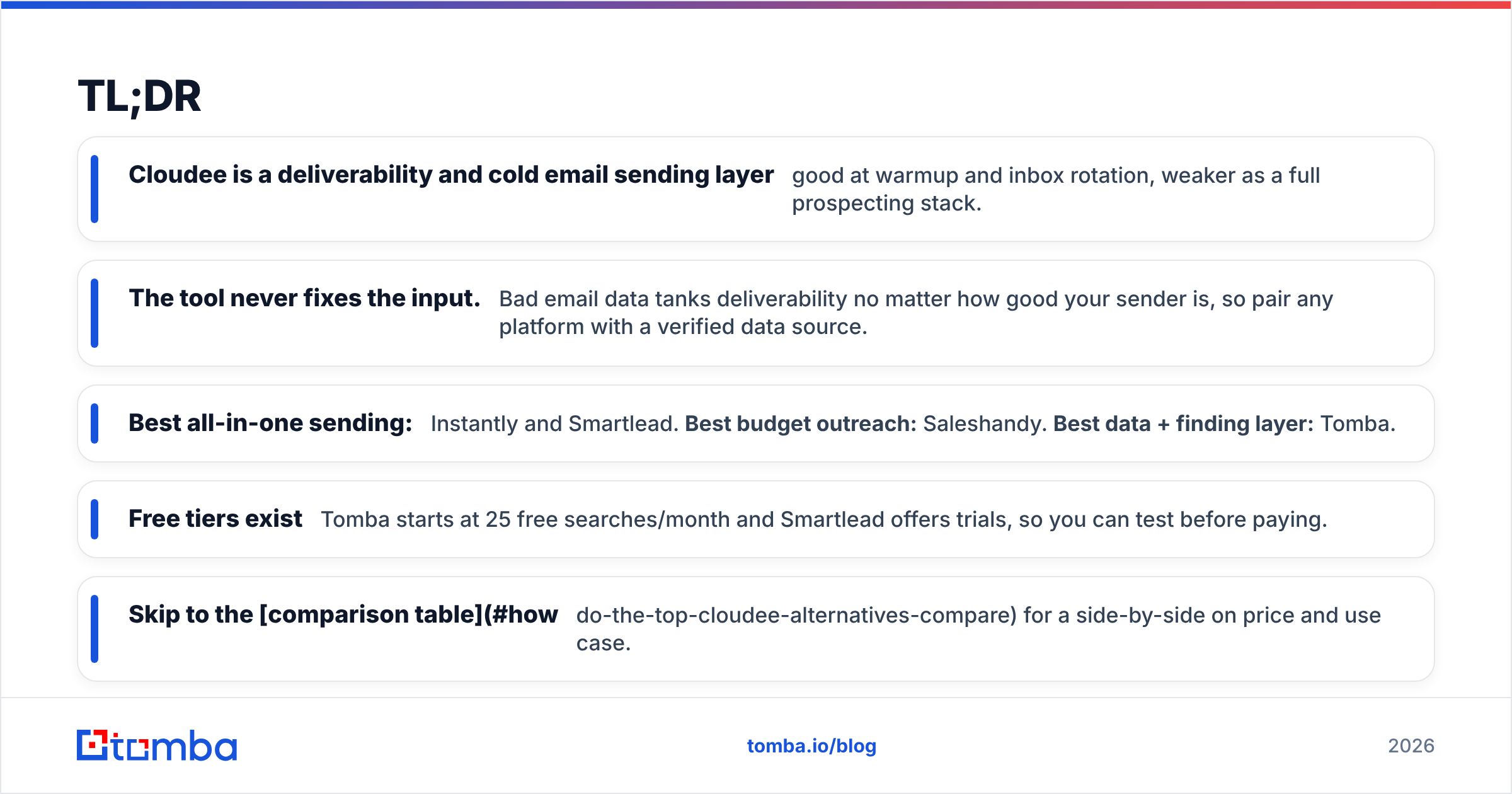
- Cloudee is a deliverability and cold email sending layer — good at warmup and inbox rotation, weaker as a full prospecting stack.
- The tool never fixes the input. Bad email data tanks deliverability no matter how good your sender is, so pair any platform with a verified data source.
- Best all-in-one sending: Instantly and Smartlead. Best budget outreach: Saleshandy. Best data + finding layer: Tomba.
- Free tiers exist — Tomba starts at 25 free searches/month and Smartlead offers trials, so you can test before paying.
- Skip to the comparison table for a side-by-side on price and use case.
What is Cloudee and what does it actually do?#
Cloudee is a cold email infrastructure and deliverability platform. Its core jobs are mailbox warmup, sending rotation across multiple inboxes, and reply management so that high-volume outbound campaigns keep landing in the primary tab instead of getting flagged. Think of it like a delivery-truck fleet manager: it decides which van (mailbox) carries which package (email) so no single vehicle looks suspicious to the postal service (Gmail and Outlook spam filters).
What Cloudee is not is a database or a finder. It moves and protects your email — it does not tell you who to email or whether the address is even real. That gap is exactly why most teams end up combining a sending tool with a data tool. If your list is full of guesses and dead addresses, even flawless warmup produces bounces, and bounces destroy sender reputation faster than anything else.

Why look for a Cloudee alternative?#
Three reasons come up again and again when teams switch:
- Price at scale. Per-mailbox and per-seat pricing adds up fast once you run dozens of inboxes across several domains.
- You want one stack, not five tabs. Cloudee handles sending well, but you still need finding, verification, and enrichment somewhere. An all-in-one or a tightly integrated pair reduces the tool sprawl.
- Data quality is the real bottleneck. Deliverability tooling treats the symptom. If 20% of your list is invalid, you are warming up beautifully and still bouncing into filters. Fixing the input with a real email verifier usually moves the needle more than any warmup tweak.
None of this means Cloudee is bad. It means the right question is "what does my whole outbound motion need," not "what warms up mailboxes."
How do the top Cloudee alternatives compare?#
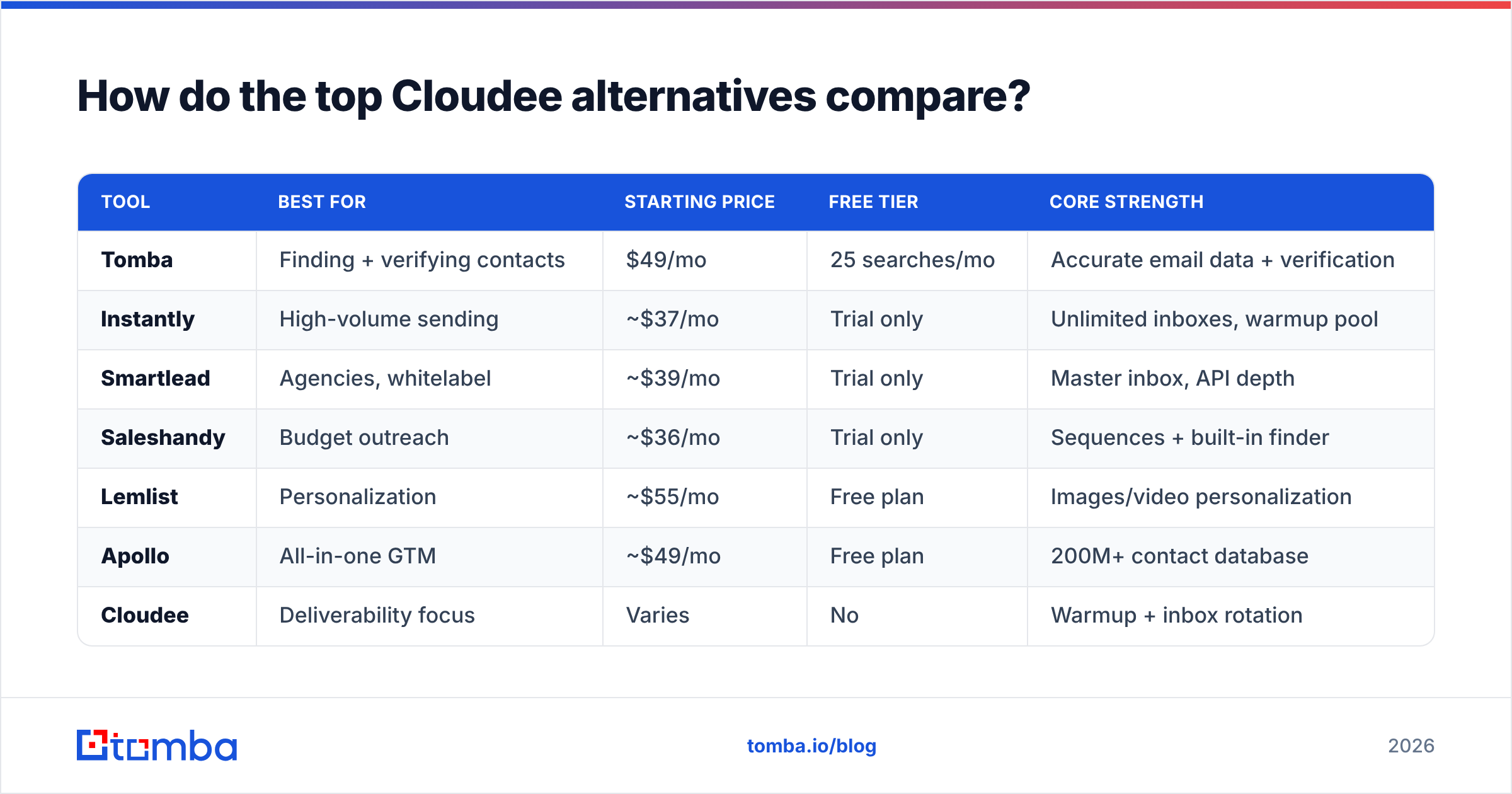
Here is the honest side-by-side. Prices are entry paid tiers as of 2026; always check the vendor for current numbers.
| Tool | Best for | Starting price | Free tier | Core strength |
|---|---|---|---|---|
| Tomba | Finding + verifying contacts | $49/mo | 25 searches/mo | Accurate email data + verification |
| Instantly | High-volume sending | ~$37/mo | Trial only | Unlimited inboxes, warmup pool |
| Smartlead | Agencies, whitelabel | ~$39/mo | Trial only | Master inbox, API depth |
| Saleshandy | Budget outreach | ~$36/mo | Trial only | Sequences + built-in finder |
| Lemlist | Personalization | ~$55/mo | Free plan | Images/video personalization |
| Apollo | All-in-one GTM | ~$49/mo | Free plan | 200M+ contact database |
| Cloudee | Deliverability focus | Varies | No | Warmup + inbox rotation |
| Mailreach | Warmup only | ~$25/mo | Trial only | Standalone deliverability test |
The pattern is clear: sending tools cluster around $36–$55/mo, but they split on whether they include a data layer. Apollo and Saleshandy bundle a finder; Instantly, Smartlead, and Cloudee expect you to bring your own list.
Which Cloudee alternative is best for each use case?#
Best for verified data: Tomba#
If your outbound keeps bouncing, the fix is upstream. Tomba's email finder locates professional addresses by name, domain, or company, and every result runs through verification before it reaches your list. You can also enrich in bulk so a whole prospect list gets found and validated in one pass instead of one row at a time. Tomba is not a sender — it is the clean fuel that makes any sender's warmup actually pay off. Plans start free (25 searches/month) and scale from $49/mo. See full Tomba pricing for the tiers.
Best all-in-one sending: Instantly#
Instantly leans into volume: unlimited mailboxes on higher plans, a large warmup pool, and a simple campaign builder. If your bottleneck is "I need to send a lot without getting throttled," Instantly is the direct Cloudee competitor and often cheaper per mailbox. Check current plans on the Instantly site.
Best for agencies: Smartlead#
Smartlead's master-inbox view and whitelabel options make it the agency favorite. Its API is deep enough to run client campaigns programmatically, and unified reply handling keeps a dozen accounts manageable. Compare it head-to-head on G2 before committing.
Best budget option: Saleshandy#
Saleshandy folds sequences, warmup, and a built-in lead finder into one lower-priced package. For a small team that wants "good enough at everything" without stitching tools together, it is a strong Cloudee alternative. Tomba also publishes a dedicated Saleshandy alternative breakdown if you want the data-quality angle.
Best for personalization: Lemlist#
Lemlist built its name on dynamic images, custom landing pages, and video personalization inside cold emails. If reply rate — not raw volume — is your metric, its personalization tokens do real work.
Best for all-in-one GTM: Apollo#
Apollo bundles a 200M+ contact database with sequencing, so you find and send in one place. The tradeoff is data freshness and usage caps on lower tiers. If you outgrow it, the Apollo alternative comparison covers where a specialist data tool pulls ahead.

Does the sending tool even matter if your data is bad?#
Short answer: no, and this is the mistake that quietly wastes budgets.
Here is the analogy. Warmup and inbox rotation are like tuning a race car's engine. But if you pour dirty fuel into it — invalid addresses, catch-all guesses, role accounts like info@ — the engine still sputters. Every hard bounce is a signal to Gmail and Outlook that you might be a spammer, and a few percent of bounces can drag an entire domain into the spam folder for good addresses too.
That is why the highest-leverage move for most teams is not switching senders — it is cleaning the list. A realistic before/after looks like this:
- Before: 5,000 scraped contacts, no verification, 18% bounce rate, domain reputation tanking by week two.
- After: Same list run through verification, ~2% bounce rate, warmup actually compounding, reply rates measurable instead of noise.
Cloudee, Instantly, and Smartlead all improve the sending side. None of them clean the list side well. Pairing a sender with a verification-first data tool is the combination that actually books meetings — which is where a finder-plus-verifier like Tomba earns its place in the stack.
What should you check before you switch?#
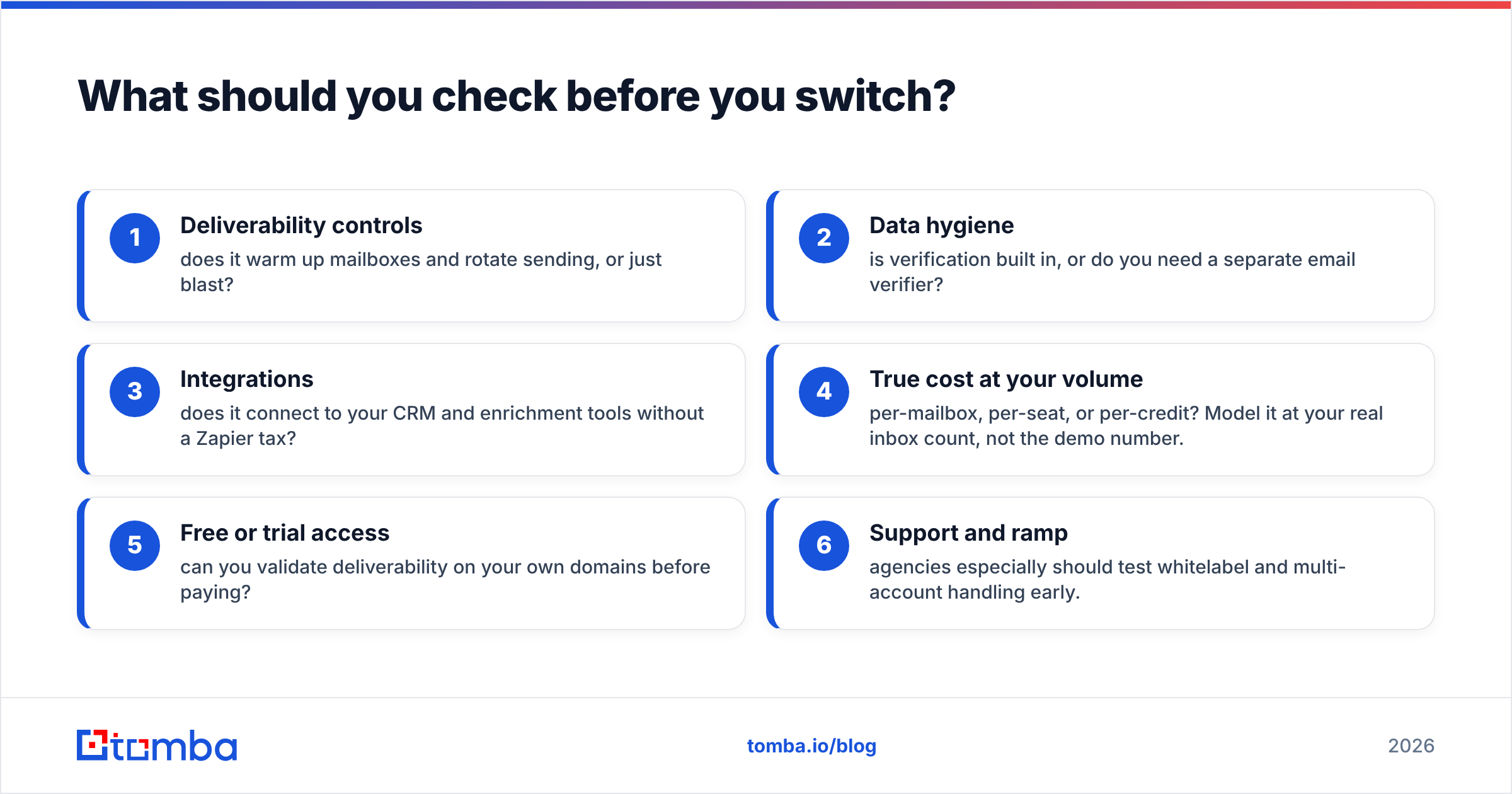
Run any candidate against this quick checklist so you are comparing the same things:
- Deliverability controls — does it warm up mailboxes and rotate sending, or just blast?
- Data hygiene — is verification built in, or do you need a separate email verifier?
- Integrations — does it connect to your CRM and enrichment tools without a Zapier tax?
- True cost at your volume — per-mailbox, per-seat, or per-credit? Model it at your real inbox count, not the demo number.
- Free or trial access — can you validate deliverability on your own domains before paying?
- Support and ramp — agencies especially should test whitelabel and multi-account handling early.
If you skip the data-hygiene line, you will re-learn it the expensive way after your domain reputation drops.
Are the free tiers actually usable?#
Mostly they are trials, not forever-free plans — with two exceptions worth knowing. Apollo and Lemlist offer genuine free tiers with tight caps, useful for kicking the tires. Tomba's free tier gives 25 searches per month, enough to test finding and verification accuracy on your own target accounts before you commit. Most pure-sending tools (Instantly, Smartlead, Mailreach, Cloudee) are trial-only, so plan to pay to run a real test.
The smart play: use a free data tier to build and verify a small, clean list, then run it through a sending tool's trial. That isolates the two variables — if a verified list still lands in spam, the problem is your sender or domain setup, not your data.
The bottom line: which Cloudee alternative wins?#
There is no single winner because Cloudee only covers one layer. For pure high-volume sending, Instantly and Smartlead are the closest and often cheaper swaps. For a bundled GTM motion, Apollo or Saleshandy reduce tool count. But every one of them depends on the same thing to work: accurate, verified contact data going in.
That is the layer teams underinvest in and then blame the sender for. Before you migrate off Cloudee — or onto any of these — fix the fuel. Start with Tomba's Email Finder to build a verified, bounce-resistant list, and whatever sending tool you choose will finally get the deliverability its warmup was promising. Grab the free 25 searches, clean a real target list, and measure the difference in bounce rate yourself.
Related guides#
Ready to find emails that actually work?
Join 150,000+ professionals who stopped guessing and started sending. Free credits on signup — no credit card required.
Get the Tomba newsletter
Practical outbound tactics and product updates — once every two weeks.
About the author