7 Best Cloze Alternatives in 2026 for Smarter CRM Workflows
Cloze is a slick relationship CRM, but it isn't the only option. Here are 7 Cloze alternatives compared on price, automation, and data accuracy so you can pick the right fit.
Cloze built its name on one promise: stop managing your CRM and let it manage itself. It scrapes your inbox, calendar, and social feeds, then quietly assembles contact histories you never had to type. For solo agents, realtors, and relationship-heavy sellers, that magic is real. But "self-updating" is not the same as "right for your team," and plenty of people outgrow Cloze the moment they need pipeline reporting, team seats, or clean data feeding an outbound motion.
If you're weighing Cloze alternatives in 2026, this guide compares seven options on the things that actually decide the switch: price, automation depth, team readiness, and the quality of the contact data underneath it all.
TL;DR#
- Cloze is best for solo relationship-sellers (real estate, consulting, wealth advisors) who want automatic contact history with zero admin. It gets expensive and thin once you need team pipeline reporting.
- Best all-round alternative: HubSpot CRM — generous free tier, real reporting, and an ecosystem Cloze can't match.
- Best for pipeline-first sales teams: Pipedrive — cheaper per seat and built around deals, not relationships.
- Best "smart CRM" like-for-like: Nimble — closest to Cloze's auto-enrichment feel at a lower price.
- The real ROI lever isn't the CRM — it's the data. A tool like Tomba's data enrichment keeps any CRM's contacts accurate, which matters more than which logo you pick.
What is Cloze and why look for alternatives?#
Cloze is a "smart CRM" and relationship-management app. Instead of asking you to log every touch, it ingests your email, calls, texts, and social activity, then builds a unified timeline per contact and nudges you when a relationship is going cold. Pricing runs from roughly $20/user/month (Pro) up to $30–$42 for higher tiers billed annually.
That model is genuinely great for a specific buyer. It's also where the friction starts for everyone else:
- Weak team and pipeline reporting. Cloze thinks in relationships, not revenue forecasts. If your board wants a weighted pipeline, you'll fight the tool.
- Per-user pricing adds up. For a five- or ten-person team, the "smart" tax compounds fast.
- Limited native integrations. Compared with HubSpot or Salesforce, the app marketplace is small.
- Data you didn't verify. Auto-captured contacts are only as clean as your inbox. Bounces, stale titles, and duplicate people creep in.
- Not built for outbound. Cloze nurtures existing relationships well; it does little to help you find net-new contacts.
None of that makes Cloze bad. It makes it specialized. The question is whether your workflow matches that specialization.

What should you look for in a Cloze alternative?#
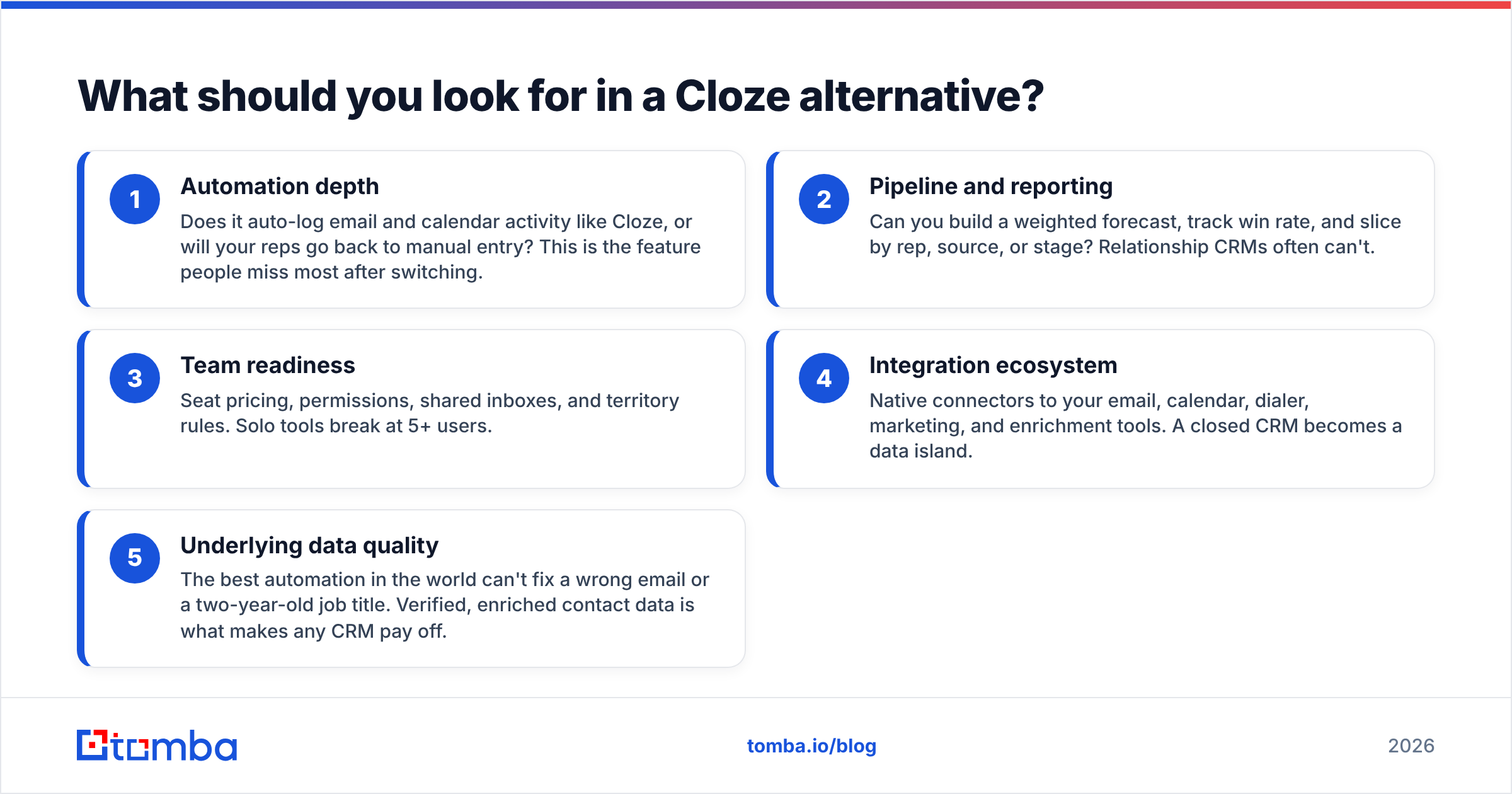
Before you compare logos, get clear on the five variables that actually predict whether you'll be happy in a year. Score each candidate against these:
- Automation depth — Does it auto-log email and calendar activity like Cloze, or will your reps go back to manual entry? This is the feature people miss most after switching.
- Pipeline and reporting — Can you build a weighted forecast, track win rate, and slice by rep, source, or stage? Relationship CRMs often can't.
- Team readiness — Seat pricing, permissions, shared inboxes, and territory rules. Solo tools break at 5+ users.
- Integration ecosystem — Native connectors to your email, calendar, dialer, marketing, and enrichment tools. A closed CRM becomes a data island.
- Underlying data quality — The best automation in the world can't fix a wrong email or a two-year-old job title. Verified, enriched contact data is what makes any CRM pay off.
Keep that last point in mind. Switching CRMs changes the interface; fixing your data changes the results.
The 7 best Cloze alternatives in 2026 compared#
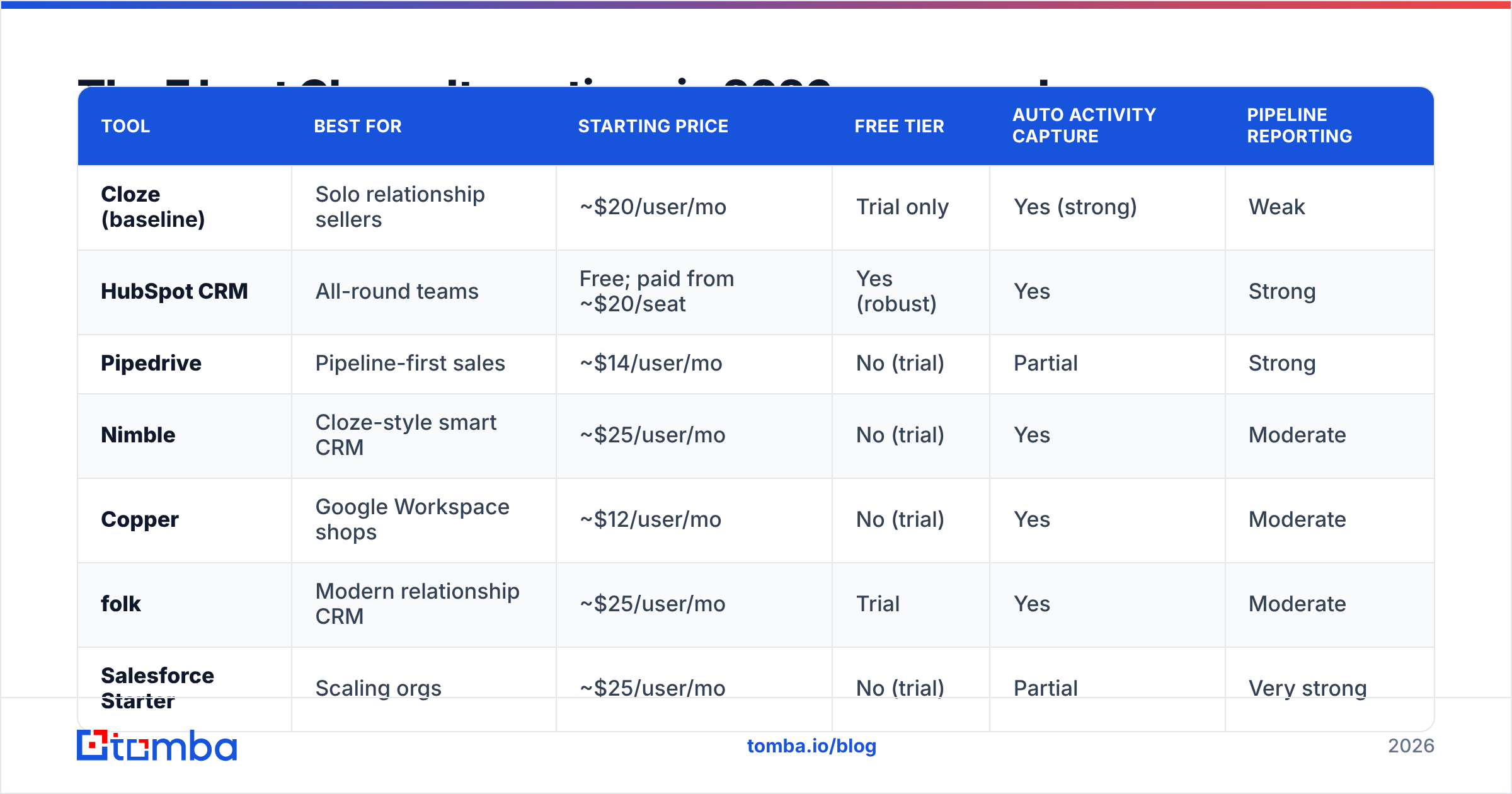
Here's the side-by-side before we go deep on each tool. Prices are entry paid tiers billed monthly and can shift, so confirm on the vendor site.
| Tool | Best for | Starting price | Free tier | Auto activity capture | Pipeline reporting |
|---|---|---|---|---|---|
| Cloze (baseline) | Solo relationship sellers | ~$20/user/mo | Trial only | Yes (strong) | Weak |
| HubSpot CRM | All-round teams | Free; paid from ~$20/seat | Yes (robust) | Yes | Strong |
| Pipedrive | Pipeline-first sales | ~$14/user/mo | No (trial) | Partial | Strong |
| Nimble | Cloze-style smart CRM | ~$25/user/mo | No (trial) | Yes | Moderate |
| Copper | Google Workspace shops | ~$12/user/mo | No (trial) | Yes | Moderate |
| folk | Modern relationship CRM | ~$25/user/mo | Trial | Yes | Moderate |
| Salesforce Starter | Scaling orgs | ~$25/user/mo | No (trial) | Partial | Very strong |
| monday sales CRM | Visual, flexible workflows | ~$12/seat/mo | Free (limited) | Partial | Strong |
1. HubSpot CRM — best all-round alternative#
If you want one safe answer, it's HubSpot. The free tier alone outclasses most paid CRMs on contact management, email tracking, and reporting, and you can grow into marketing, sales, and service hubs without migrating again. Activity capture logs email and calls automatically, and the reporting is the opposite of Cloze's weakness — dashboards, forecasts, and attribution out of the box.
The trade-off is that paid Sales Hub tiers get pricey as you add seats and features, and the platform can feel heavy if all you wanted was a smart address book. For most teams outgrowing Cloze, that's a fair price for real reporting. Tomba's HubSpot integration lets you push verified emails straight into records, which keeps that shiny CRM from filling up with junk.
2. Pipedrive — best for pipeline-first sales teams#
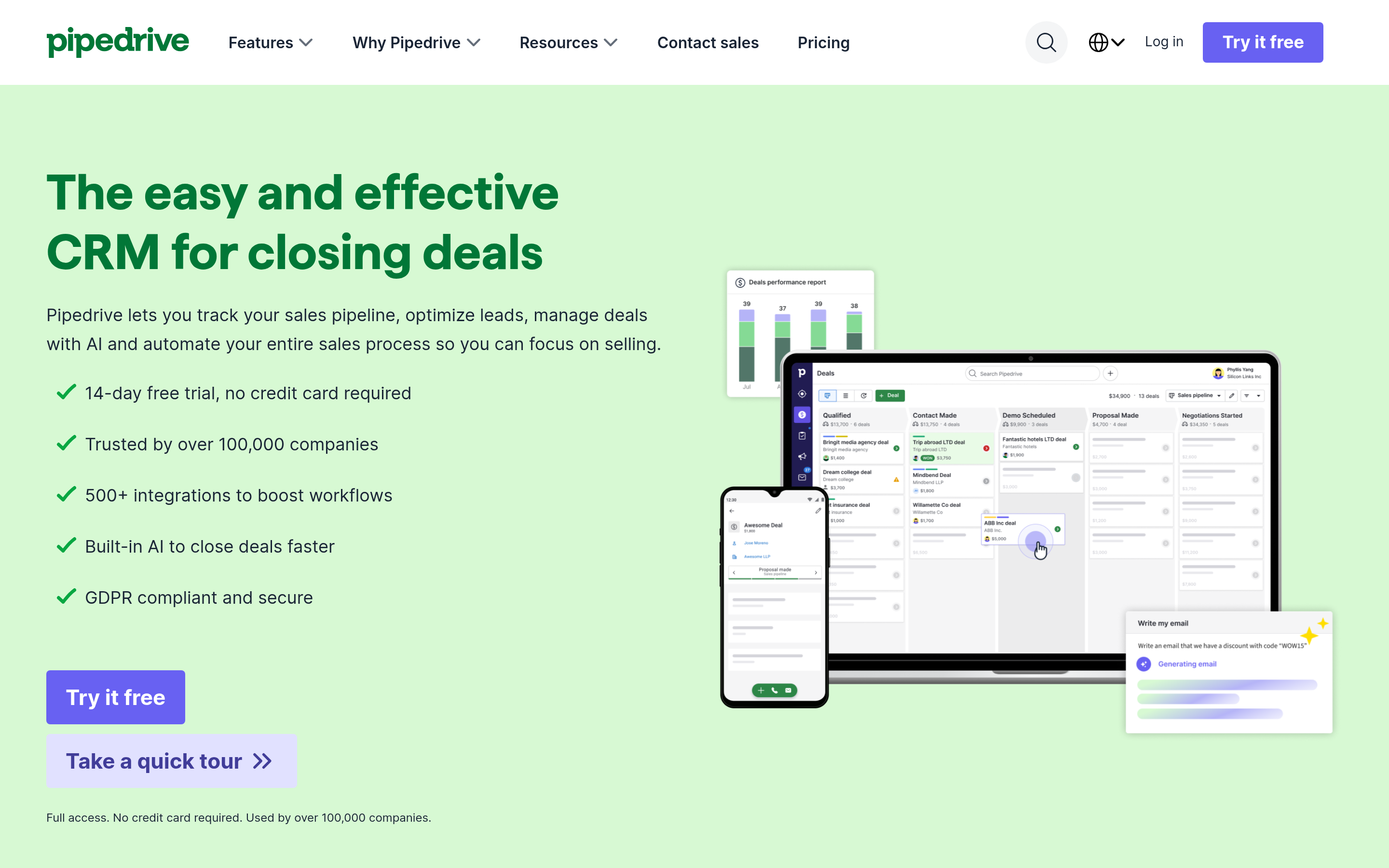
Cloze organizes people; Pipedrive organizes deals. If your day is "move opportunities through stages and hit a number," Pipedrive's visual pipeline is more natural and noticeably cheaper per seat. Automations, an activity-based selling philosophy, and a clean mobile app make it a favorite for SMB sales teams.
It's weaker than Cloze on passive relationship intelligence — you'll do more manual logging — and marketing features are thinner. Pair it with the Pipedrive integration to enrich new deals with contact data automatically.
3. Nimble — the closest "smart CRM" swap#

If you love Cloze's auto-enrichment feel but want a change, Nimble is the nearest match. It builds unified contact profiles from email and social, surfaces "who to reconnect with," and includes a prospecting browser extension. Pricing is straightforward and typically lands under Cloze at scale.
Nimble's reporting and pipeline tooling are moderate — better than Cloze, short of HubSpot — so it suits relationship-led teams that need light deal tracking rather than heavy forecasting.
4. Copper — best for Google Workspace shops#
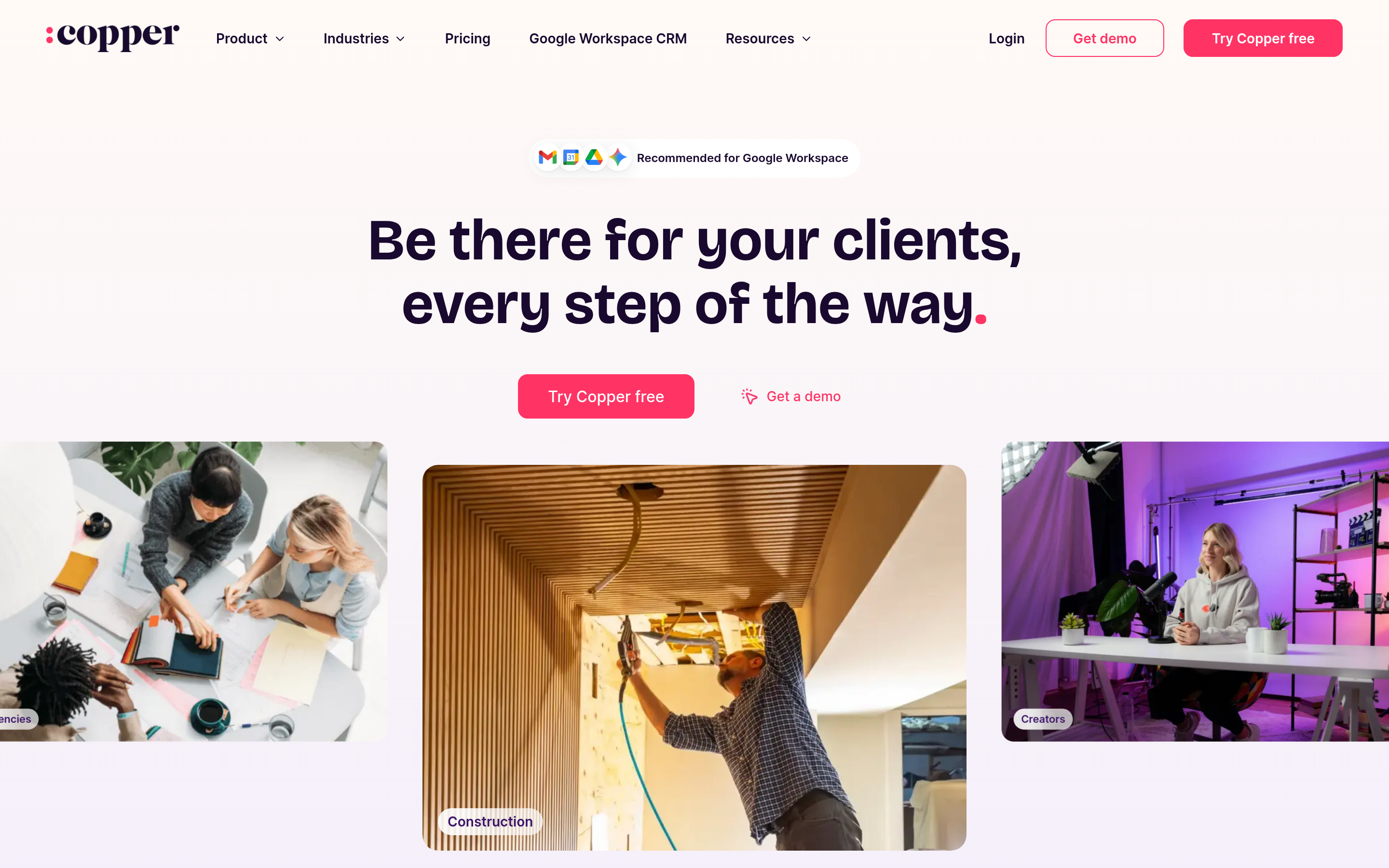
Copper lives inside Gmail and Google Calendar, so if your company runs on Workspace, it feels less like a separate app and more like a native layer. It auto-captures activity from Gmail, mirrors Cloze's "no data entry" pitch, and starts cheaper. The catch: outside the Google ecosystem, the value proposition weakens quickly.
5. folk — modern relationship CRM#
folk is the newer, design-forward take on relationship CRM. It pulls contacts from LinkedIn and email, uses a spreadsheet-meets-CRM interface teams find approachable, and layers in AI for drafting and enrichment. It's a strong pick for agencies, VCs, and founders who found Cloze dated. Reporting is still maturing, so revenue teams needing deep forecasts should look at HubSpot or Salesforce.
6. Salesforce Starter — best for orgs that will scale#
Nobody switches from Cloze to full Salesforce Sales Cloud casually. But Salesforce Starter exists precisely for growing teams who want the ceiling of the world's most extensible CRM without the enterprise complexity on day one. If you expect to add RevOps, custom objects, and serious automation within two years, starting here avoids a painful re-platform later. Expect a steeper learning curve than any other tool on this list.
7. monday sales CRM — most flexible workflows#
Built on monday.com's work-OS, this CRM is for teams who want to shape the tool around their process rather than adopt someone else's. Highly visual boards, flexible automations, and a usable free tier make it friendly for cross-functional teams. Native sales-intelligence and auto-capture are lighter than Cloze, so it leans on integrations to fill the gap.

How much does data quality change CRM ROI?#
More than the CRM does. Here's the uncomfortable truth behind every migration: you can move to the best-reviewed CRM on G2 and still get mediocre results if the contacts inside it are wrong.
Think of a CRM like a car and your contact data like fuel. A faster car doesn't help if the tank is full of water. Cloze's auto-capture is convenient, but it inherits whatever's in your inbox — misspelled addresses, people who changed jobs, catch-all domains that quietly bounce. Industry studies routinely peg B2B data decay at roughly 30% per year. That's a third of your database rotting annually, no matter which logo sits on top.
This is where a dedicated data layer beats any single CRM feature:
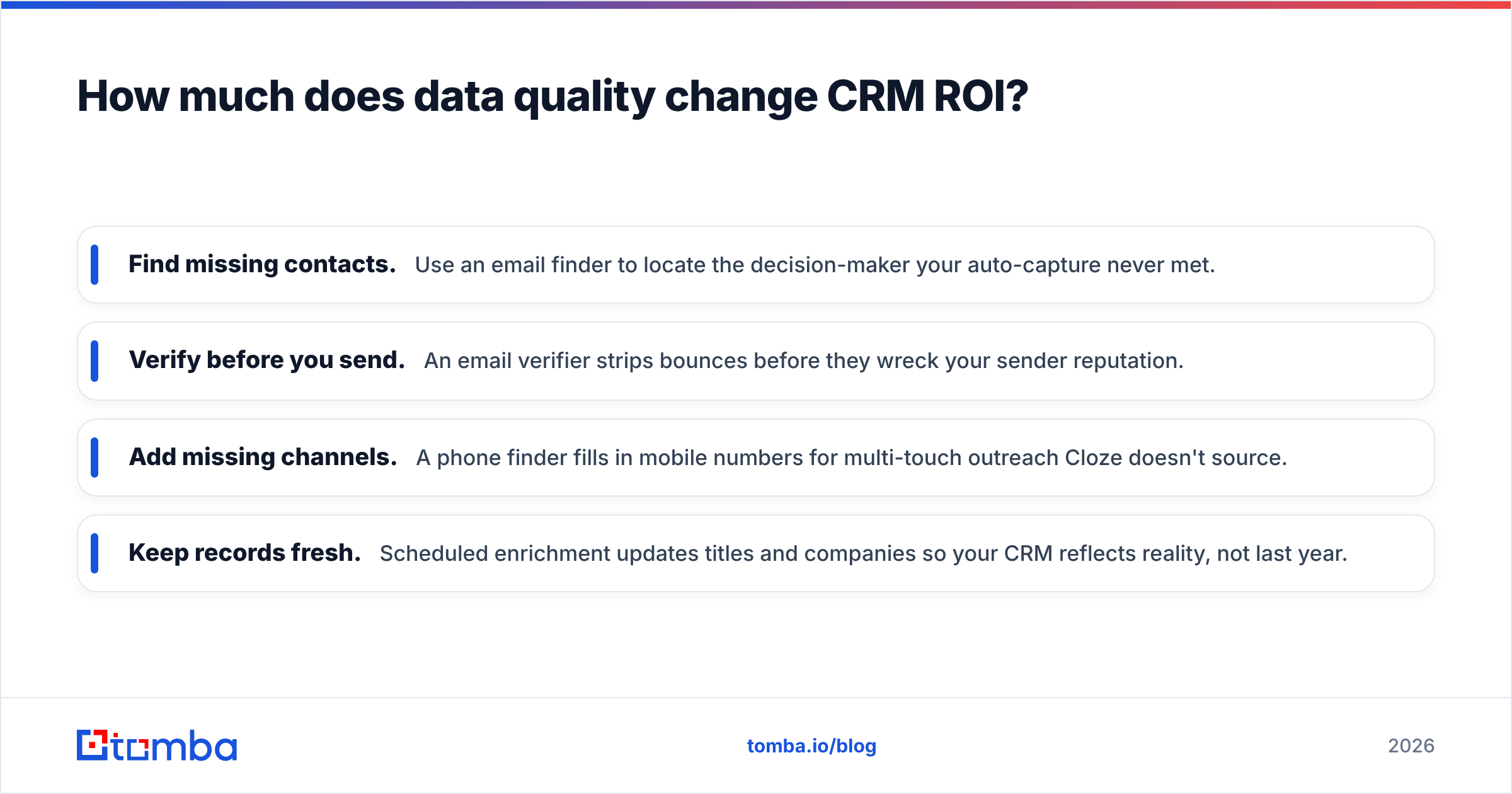
- Find missing contacts. Use an email finder to locate the decision-maker your auto-capture never met.
- Verify before you send. An email verifier strips bounces before they wreck your sender reputation.
- Add missing channels. A phone finder fills in mobile numbers for multi-touch outreach Cloze doesn't source.
- Keep records fresh. Scheduled enrichment updates titles and companies so your CRM reflects reality, not last year.
Whichever Cloze alternative you choose, feeding it verified data is the single change that most reliably lifts reply rates and forecast accuracy. Tomba plugs into HubSpot, Pipedrive, Salesforce, and Sheets through its integrations, so the enrichment layer is portable no matter which CRM wins.
Which Cloze alternative is right for you?#
Match the tool to your actual constraint, not to the flashiest feature:
- You're a solo relationship-seller who just wants a cheaper Cloze → Nimble or Copper (if you're on Google Workspace).
- You have a real sales team and need reporting → HubSpot CRM (free to start) or Pipedrive (pipeline-first, cheaper seats).
- You want a modern, design-led relationship CRM → folk.
- You'll scale into RevOps and custom workflows → Salesforce Starter or monday sales CRM.
- You care most about outbound and net-new contacts → any CRM above, plus a dedicated data tool to source and verify leads.
For most people leaving Cloze, HubSpot's free tier is the lowest-risk landing spot, and Pipedrive is the value pick for deal-driven teams. But the decision that outlasts your CRM choice is committing to clean data underneath it.
Frequently asked questions#
Is there a free Cloze alternative? Yes. HubSpot CRM and monday sales CRM both offer genuinely usable free tiers, and Tomba includes a free plan with 25 searches per month for sourcing and verifying contacts. Check current Tomba pricing for paid tiers.
What's the closest tool to Cloze's automatic contact capture? Nimble is the nearest like-for-like — it builds unified profiles from email and social automatically. Copper is a strong second if you live in Gmail.
Does switching CRMs improve my email results? Not by itself. A new CRM changes how you organize data; it doesn't clean the data. Verifying and enriching contacts is what moves deliverability and reply rates.
Can I keep Cloze and just add enrichment? Absolutely. If Cloze's relationship features work for you, layer a data tool on top instead of migrating. The CRM and the data pipeline are separate decisions.
Pick your CRM, then fix your data#
The best Cloze alternative depends on whether you're a relationship-seller, a pipeline-driven team, or an org built to scale. HubSpot, Pipedrive, and Nimble cover most of those needs at a lower cost than Cloze at scale.
But the CRM is only half the equation. Whatever you choose, keep it stocked with contacts that are actually reachable. Start with the Tomba Email Finder to source verified professional emails by name, company, or domain — then push them straight into your new CRM and let the automation work with data that's real. It's the cheapest upgrade you can make to any sales stack, and it pays off no matter which logo you land on.
Related guides#
Ready to find emails that actually work?
Join 150,000+ professionals who stopped guessing and started sending. Free credits on signup — no credit card required.
Get the Tomba newsletter
Practical outbound tactics and product updates — once every two weeks.
About the author