Co Dynamic Lead Scoring: The Complete 2026 Playbook
Static point systems age the moment you save them. Here's how co dynamic lead scoring uses live behavioral and firmographic signals to rank leads in real time — and what it takes to run it well in 2026.
TL;DR
- Co dynamic lead scoring ranks leads with signals that update in real time — behavior, intent, fit, and freshness — instead of a fixed point table you set once and forget.
- Static scoring decays fast: a lead who was hot in Q1 may be dead by Q2, but a static model still shows the same number.
- The hard part isn't the math, it's the data pipeline. Bad or stale contact data poisons every score downstream.
- A working setup needs three layers: reliable identity/enrichment data, a signal engine, and a decay/recency function.
- Start simple. A dynamic model with five good signals beats a 40-factor static model that no one trusts.
What is co dynamic lead scoring?#
Co dynamic lead scoring is a method of ranking prospects where the score recalculates continuously as new signals arrive, rather than sitting frozen after a one-time assignment. "Dynamic" is the operative word: the model treats a lead's score as a living value that rises and falls with behavior and time.
Think of it like a credit score versus a photo. A static lead score is a photo — accurate the second it was taken, misleading a month later. A dynamic score is a credit score — it moves every time the underlying reality moves. A prospect who opened three emails, visited pricing twice, and got a promotion this week should not carry the same number as one who did all that eight months ago and went quiet.
Traditional scoring hands every action a permanent point value: +10 for a demo request, +5 for an ebook download, +15 for job title match. Those points accumulate and never expire. The result is a leaderboard of leads who were interested at some point in history — not leads who are interested now.
Dynamic scoring fixes three failures of the static approach:
- Recency — recent actions count more than old ones, via a time-decay curve.
- Context — the same action means different things depending on the account (a pricing-page visit from a target-account CFO ≠ a visit from a student).
- Freshness of fit — firmographic data changes; headcount, funding, and tech stack shift, and the score should reflect the current company, not last year's.

If you want the textbook definition of the qualification stage this feeds, Tomba's glossary entry on the marketing qualified lead is a clean primer — dynamic scoring is essentially the mechanism that decides when a lead crosses the MQL line and how long it stays there.
Why does static lead scoring break down?#
Static models break because the world moves and the score doesn't. Here's the failure sequence most teams hit:
- Point inflation. Every campaign adds new "+points" rules. After a year, half your database is "sales-ready" and reps stop trusting the score entirely.
- No expiry. A whitepaper download from 2024 still adds to a 2026 score. Interest has a half-life; static points ignore it.
- Data drift. The lead's company raised a round, doubled headcount, or churned its buying committee. The firmographic points baked in at capture no longer describe reality.
- One-size fit. A single global rule set can't tell that "visited careers page" is noise for an enterprise deal but signal for a staffing product.
Gartner's research on B2B buying has repeatedly shown that buying is non-linear — buyers loop back, go dark, and re-engage. A model that only adds points and never subtracts them can't represent a buyer who cooled off. That's the core mismatch.
The other quiet killer is contact-data quality. A dynamic engine that fires on "email opened" is worthless if 20% of your email addresses bounce or belong to people who left the company. Scoring accuracy is capped by data accuracy — which is why the pipeline matters more than the algorithm.
How does co dynamic lead scoring actually work?#
At a high level, a dynamic score is a weighted sum of signals, each passed through a recency function, recomputed on a schedule or on every event. Break it into four moving parts:
1. Fit score (who they are). Firmographic and demographic match: industry, company size, role seniority, geography, tech stack. This layer leans on enrichment — you need current, structured company and person data. Tools like data enrichment fill the gaps between a raw email and a full profile so the fit layer isn't scoring blanks.
2. Behavioral score (what they do). Email engagement, site visits, pricing views, demo requests, webinar attendance, product usage. Each event has a base weight.
3. Recency decay (when they did it). Every behavioral point is multiplied by a decay factor. A common approach is exponential decay: weight × e^(−λ × days_since_event). A pricing visit today counts full; the same visit 60 days ago counts a fraction.
4. Negative signals (what pushes them down). Unsubscribes, hard bounces, "not a fit" dispositions, long silence. Static models rarely subtract; dynamic models must.
Here's the conceptual formula teams start with:
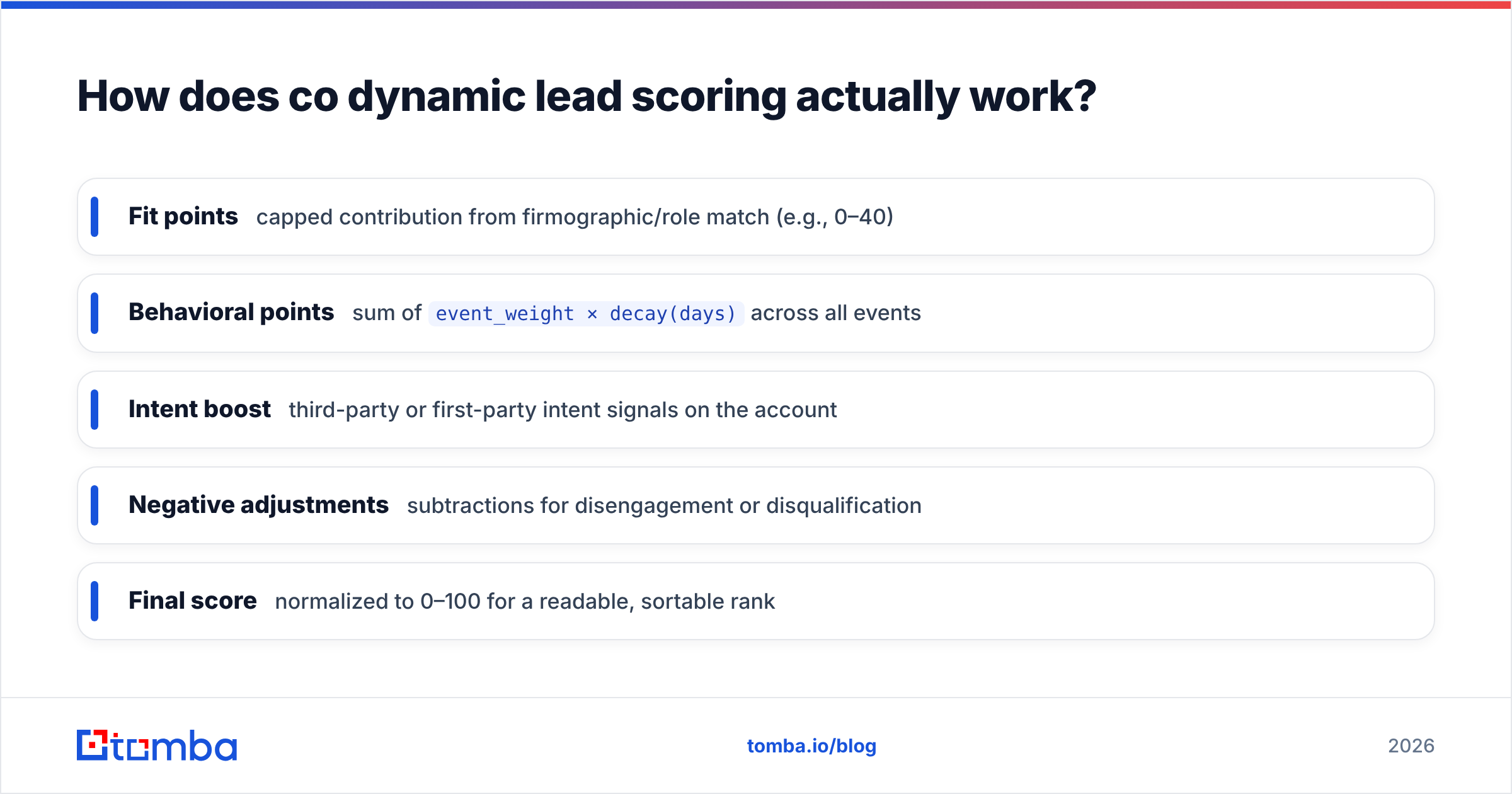
- Fit points — capped contribution from firmographic/role match (e.g., 0–40)
- Behavioral points — sum of
event_weight × decay(days)across all events - Intent boost — third-party or first-party intent signals on the account
- Negative adjustments — subtractions for disengagement or disqualification
- Final score — normalized to 0–100 for a readable, sortable rank
The output isn't a permanent badge. It's a snapshot that changes tomorrow. That's the whole point.
Dynamic vs static lead scoring: which wins?#
Neither is universally "correct," but they optimize for different things. Static is cheap and legible; dynamic is accurate and demanding. Here's the honest comparison.
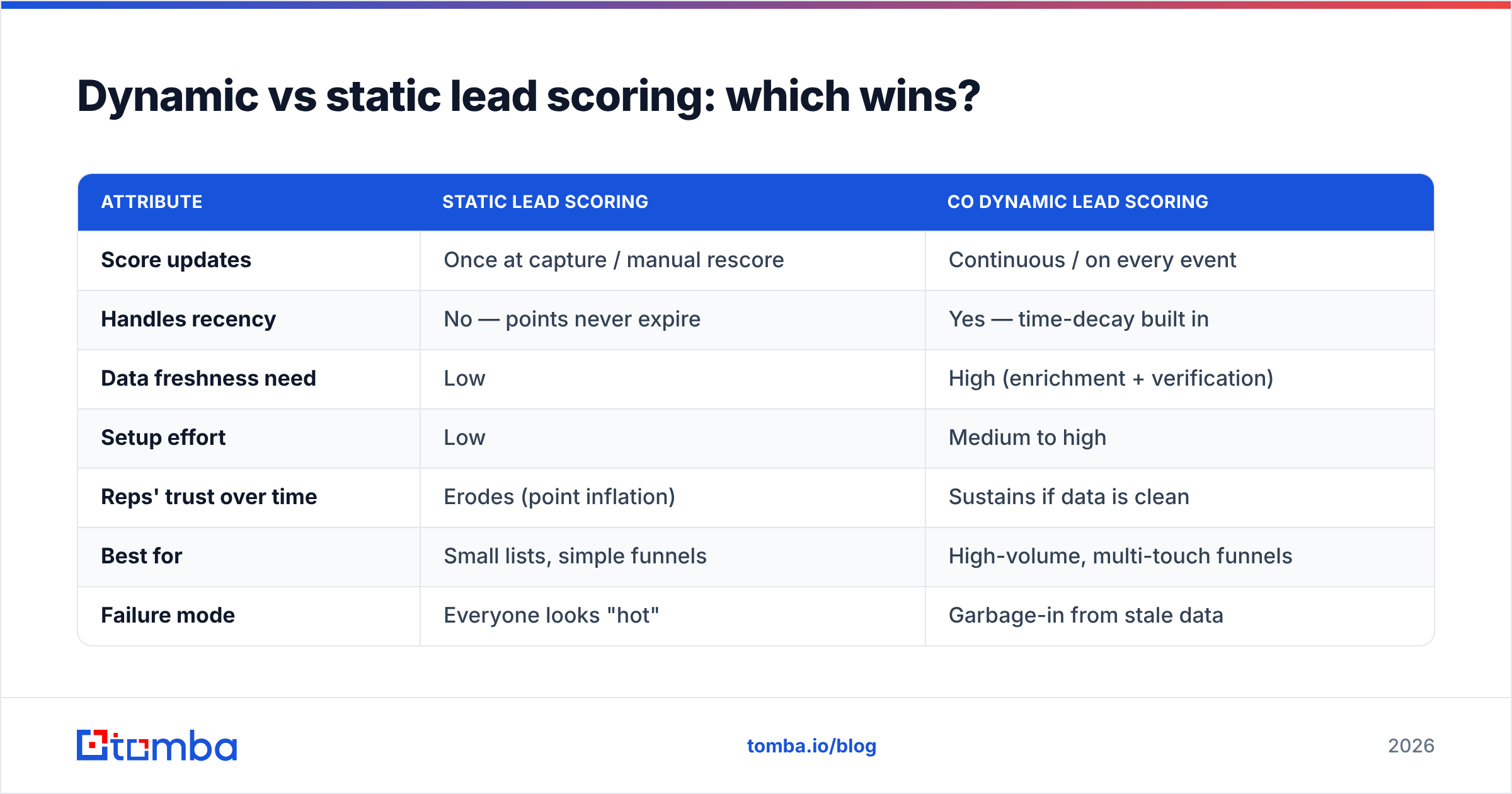
| Attribute | Static lead scoring | Co dynamic lead scoring |
|---|---|---|
| Score updates | Once at capture / manual rescore | Continuous / on every event |
| Handles recency | No — points never expire | Yes — time-decay built in |
| Data freshness need | Low | High (enrichment + verification) |
| Setup effort | Low | Medium to high |
| Reps' trust over time | Erodes (point inflation) | Sustains if data is clean |
| Best for | Small lists, simple funnels | High-volume, multi-touch funnels |
| Failure mode | Everyone looks "hot" | Garbage-in from stale data |
| Tooling cost | Minimal | Enrichment + signal pipeline |
The decision rule: if your funnel has more than a handful of touchpoints and leads re-engage over weeks or months, dynamic wins. If you're a small team closing fast from a short list, static may be all the machinery you need — don't over-engineer.
One caveat worth stating plainly: dynamic scoring amplifies whatever data you feed it. Clean data makes it sharp; dirty data makes it confidently wrong. That's a feature, not a bug — it just means the data layer is non-negotiable.
What data do you need to run it?#
Three data categories, in priority order:
Identity and contact data. You can't score a lead you can't reach or resolve. Verified emails, correct names, and current employer are the spine. If your outreach depends on reaching the right inbox, an accurate email finder and email verifier keep the behavioral layer honest — a "no open" from a dead address is a false negative that quietly drags scores down.
Firmographic enrichment. Company size, industry, revenue band, funding, tech stack, and location power the fit score. This data ages, so it needs periodic refresh, not a one-time append.
Behavioral and intent streams. Web analytics, email engagement, CRM activity, and (optionally) third-party intent. These are your real-time inputs; wire them into your CRM or scoring engine via API so events land within minutes, not on a nightly batch.

For teams building this in-house, the Tomba API is a practical way to enrich and verify contacts programmatically as leads enter the funnel — so the fit layer scores a full, validated profile from the first touch instead of waiting for a manual cleanup pass.
How do you build a dynamic scoring model without over-engineering it?#
Start narrow and expand. The most common mistake is launching with 40 factors and a machine-learning wishlist. A tight five-signal model you can explain to a skeptical AE will outperform a black box no one trusts.
A pragmatic build order:
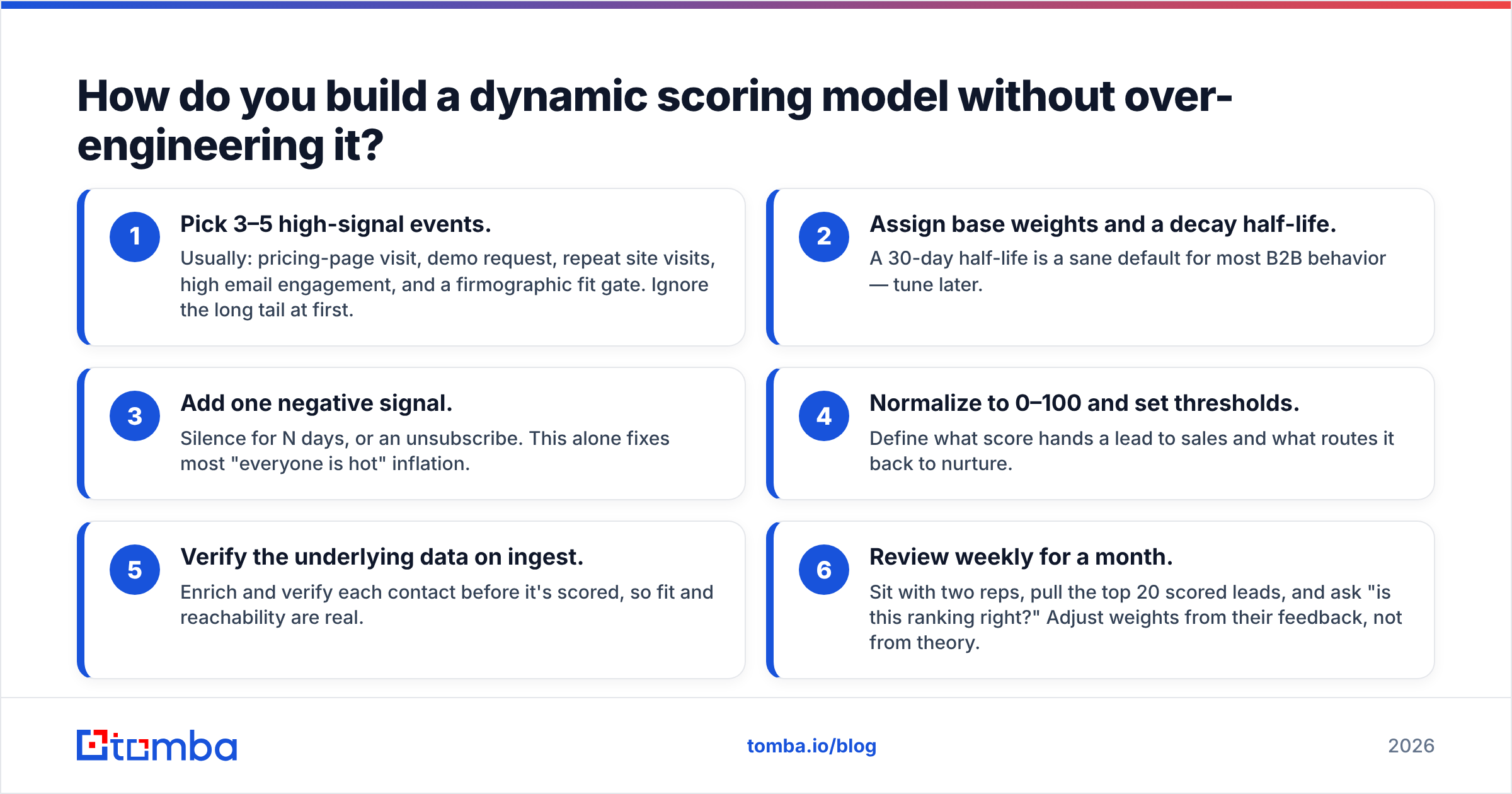
- Pick 3–5 high-signal events. Usually: pricing-page visit, demo request, repeat site visits, high email engagement, and a firmographic fit gate. Ignore the long tail at first.
- Assign base weights and a decay half-life. A 30-day half-life is a sane default for most B2B behavior — tune later.
- Add one negative signal. Silence for N days, or an unsubscribe. This alone fixes most "everyone is hot" inflation.
- Normalize to 0–100 and set thresholds. Define what score hands a lead to sales and what routes it back to nurture.
- Verify the underlying data on ingest. Enrich and verify each contact before it's scored, so fit and reachability are real.
- Review weekly for a month. Sit with two reps, pull the top 20 scored leads, and ask "is this ranking right?" Adjust weights from their feedback, not from theory.
HubSpot's guide to lead scoring is a solid reference for the mechanics of positive and negative attributes if you're implementing inside an existing marketing platform, and Salesforce documents its own scoring approach for teams standardizing in that ecosystem. Read them for the plumbing — but layer the recency decay on top yourself, because most native tools still lean static by default.
Keep the model auditable. Every score should be explainable in one sentence: "82 because they hit pricing twice this week, match ICP, and opened the last three emails." The moment a score can't be explained, reps stop acting on it, and an ignored score is worth zero.
Common mistakes that quietly wreck dynamic scoring#
- Scoring on unverified emails. A behavioral silence from a bounced address looks identical to genuine disinterest. Verify first.
- No decay on firmographic fit. Company data changes; refresh it. A lead's employer from two years ago may be irrelevant.
- Too many signals. Twenty low-signal factors dilute the three that matter. Prune aggressively.
- Never subtracting. If the score only goes up, it's static wearing a dynamic costume.
- Set-and-forget weights. The market moves; a quarterly weight review keeps the model calibrated.
- Ignoring rep feedback. The people acting on scores see when they're wrong first. Build a feedback loop into the model, not around it.
Is co dynamic lead scoring worth it in 2026?#
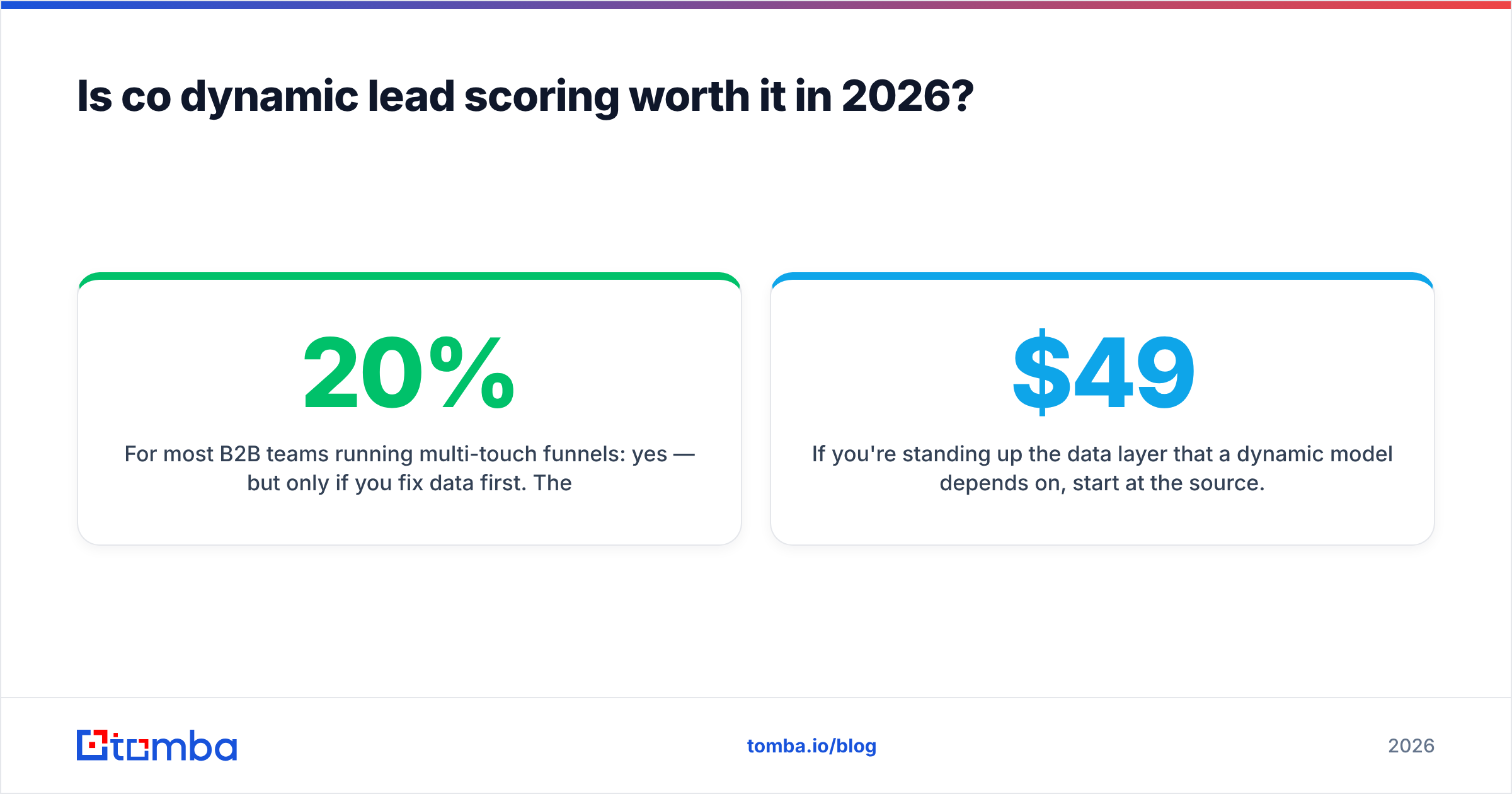
For most B2B teams running multi-touch funnels: yes — but only if you fix data first. The ranking logic is the easy 20%. The 80% is a clean, current, verified data layer feeding it. Teams that skip that step get a sophisticated model producing confident garbage, and they'd have been better off with a simple static rule they at least understood.
Worth it when: you have volume, leads re-engage over time, and reps complain that "sales-ready" leads aren't actually ready. Skip it when: your list is short, your cycle is fast, and a spreadsheet rule already routes leads correctly.
The through-line of this whole discipline is unglamorous: good scores are downstream of good data. Before you tune a single weight, make sure the emails are real, the companies are current, and the profiles are complete. That's where the accuracy actually comes from.
If you're standing up the data layer that a dynamic model depends on, start at the source. Use the Tomba Email Finder to find and verify professional contacts by name, domain, or company, then enrich them into full profiles before they ever hit your scoring engine. The free tier gives you 25 searches a month to test the fit, with paid plans from $49/mo when you're ready to feed the whole funnel. Clean inputs, honest scores — that's the entire game.
Related guides#
// get started
Find, verify and enrich your first contacts today
Start on the free plan with 25 searches a month, then scale when your team is ready.
Free plan · No credit card required · GDPR & CCPA
// about the author