Co Sell Explained: How Partner Co Selling Closes B2B Deals
Co selling promises warm intros, bigger deals, and shorter cycles. Most programs still stall out. Here is how co sell actually works in 2026, what breaks it, and the operating model that makes partner-sourced pipeline convert.
TL;DR — what co sell really is
- Co sell is a joint sales motion, not a referral fee. Two vendors work the same account, share account intelligence, and split the work of getting to a signature — the revenue stays on each company's own paper.
- The math is real when the motion is real. Partner-influenced deals routinely close faster and larger than solo-sourced deals, because you inherit trust instead of building it from zero.
- Most co sell programs die on operations, not strategy. No account mapping, no lead registration, no contact data on the partner's side of the account — the intro never happens.
- You need three artifacts to start: an overlap list, a named contact per overlapping account, and a single co sell play with a defined trigger.
- The unglamorous bottleneck is contact data. A partner hands you a company name; you still need the right buyer, the right email, and a verified send.
What Is Co Sell, Exactly?#
Co sell is when two companies sell into the same account at the same time. They coordinate. Each one keeps its own contract and its own revenue.
Think of it like two contractors on one house renovation. The electrician and the plumber aren't subcontracting to each other — they bill the homeowner separately. But they walk the site together, they schedule around each other, and when the plumber hears the owner complain about the fuse box, he says "talk to my guy, he's here Thursday." That handoff costs nothing and closes work neither would have found alone.
That's co sell. It is distinct from three things it gets confused with:
- Referral / affiliate. One party sends a name and collects a fee. No joint work, no shared account plan. Low effort, low yield.
- Reseller / channel. The partner sells your product on their paper and takes margin. You lose the customer relationship and usually the expansion revenue.
- Integration partnership. You build a connector and put each other in a directory. Marketing gets a logo; sales gets nothing.
Co sell sits above all three in effort and above all three in payoff. Both reps show up on the call. Both companies have quota exposure to the outcome. Nobody is a middleman.
The reason it works is simple. Buyers do not trust vendors. They do trust the vendors they already pay. When your partner's account executive says "these people are worth 30 minutes," you skip the entire cold-open phase of the deal. You start at the point most outbound sequences never reach.
Why Does Co Sell Beat Solo Outbound on Enterprise Deals?#
Three structural advantages, in order of impact.
You inherit trust. A warm intro from an incumbent vendor converts at a rate cold outreach cannot touch. You're not asking for attention. Someone the buyer already pays is handing it to you.
You get inside information. Your partner knows the budget cycle, the internal champion, the political landmine, and the competitor already in the building. That intelligence would take you two discovery calls and a lucky LinkedIn conversation to assemble.
You de-risk the buying committee. Enterprise purchases stall because five people have to say yes. When two vendors present a joint solution, the buyer sees an already-validated stack instead of two more integration risks.
The catch: all three advantages depend on the partner rep actually caring. And partner reps care about exactly one thing — whether working with you helps them hit their own number this quarter. Every design decision in your co sell program has to answer that question first.
What Are the Types of Co Sell Motions?#
Not all co sell looks the same. Pick the one that matches your product's relationship to the partner's.
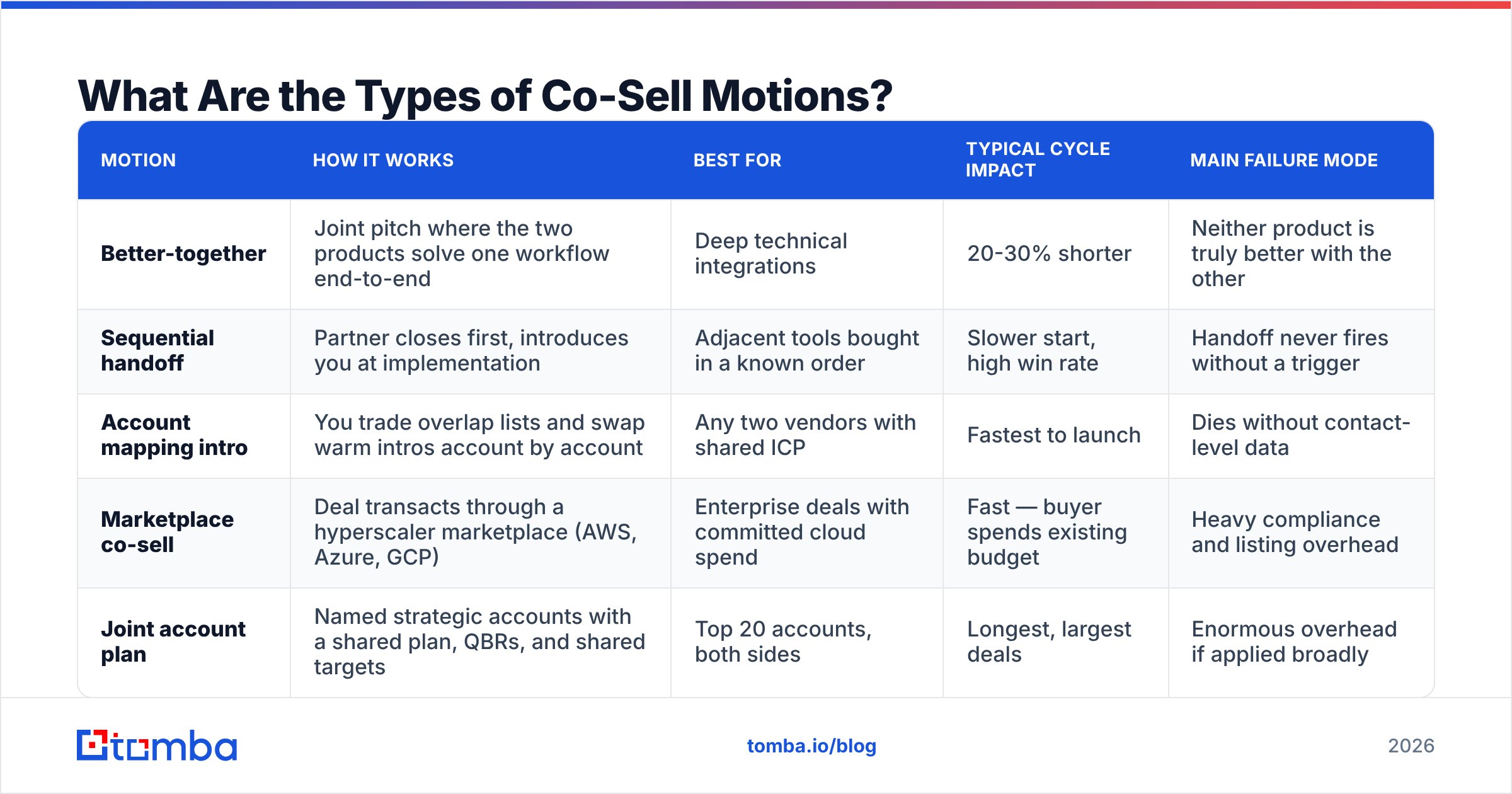
| Motion | How it works | Best for | Typical cycle impact | Main failure mode |
|---|---|---|---|---|
| Better-together | Joint pitch where the two products solve one workflow end-to-end | Deep technical integrations | 20-30% shorter | Neither product is truly better with the other |
| Sequential handoff | Partner closes first, introduces you at implementation | Adjacent tools bought in a known order | Slower start, high win rate | Handoff never fires without a trigger |
| Account mapping intro | You trade overlap lists and swap warm intros account by account | Any two vendors with shared ICP | Fastest to launch | Dies without contact-level data |
| Marketplace co sell | Deal transacts through a hyperscaler marketplace (AWS, Azure, GCP) | Enterprise deals with committed cloud spend | Fast — buyer spends existing budget | Heavy compliance and listing overhead |
| Joint account plan | Named strategic accounts with a shared plan, QBRs, and shared targets | Top 20 accounts, both sides | Longest, largest deals | Enormous overhead if applied broadly |
Most teams should start with account mapping intro. It requires no engineering, no marketplace listing, and no executive alignment beyond "let's trade lists." It also produces the fastest evidence of whether the partnership is worth escalating.
The marketplace motion deserves a note of its own. When a customer has committed cloud spend, buying through Microsoft's partner ecosystem or a similar marketplace lets them draw down budget they've already set aside. That removes the single hardest objection in B2B — procurement. It's operationally heavy. But for deals over six figures it is often the difference between "next fiscal year" and "this quarter."
How Do You Actually Launch a Co Sell Program?#
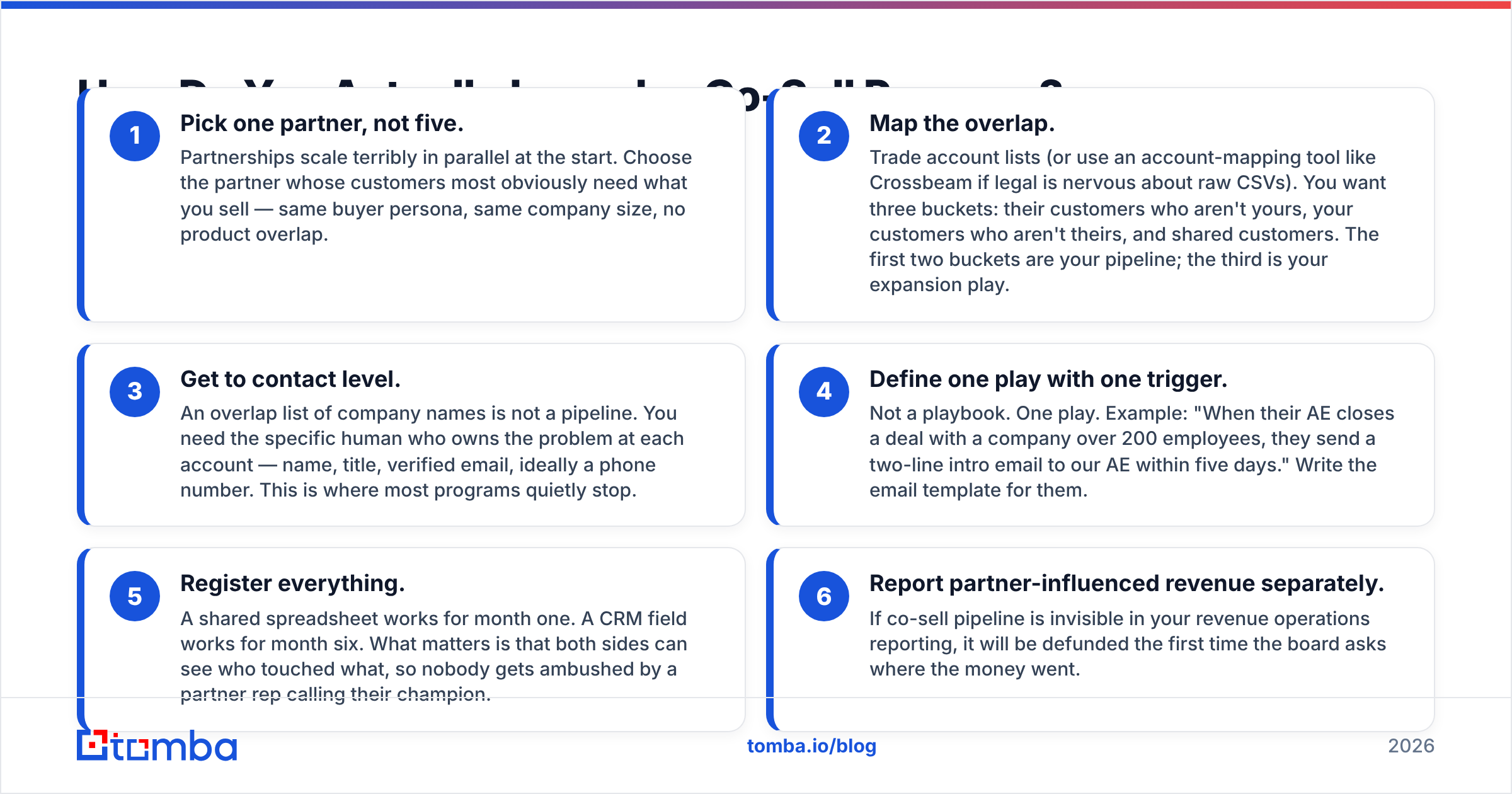
Here is the sequence that survives contact with a real sales floor. It is deliberately unambitious for the first 60 days.
- Pick one partner, not five. Partnerships scale terribly in parallel at the start. Choose the partner whose customers most obviously need what you sell — same buyer persona, same company size, no product overlap.
- Map the overlap. Trade account lists, or use an account-mapping tool like Crossbeam if legal is nervous about raw CSVs. You want three buckets: their customers who aren't yours, your customers who aren't theirs, and shared customers. The first two buckets are your pipeline. The third is your expansion play.
- Get to contact level. An overlap list of company names is not a pipeline. You need the specific human who owns the problem at each account — name, title, verified email, ideally a phone number. This is where most programs quietly stop.
Those first three steps build the raw material. The next three decide whether anyone acts on it.
- Define one play with one trigger. Not a playbook. One play. Example: "When their AE closes a deal with a company over 200 employees, they send a two-line intro email to our AE within five days." Write the email template for them.
- Register everything. A shared spreadsheet works for month one. A CRM field works for month six. What matters is that both sides can see who touched what, so nobody gets ambushed by a partner rep calling their champion.
- Report partner-influenced revenue separately. If co sell pipeline is invisible in your revenue operations reporting, it will be defunded the first time the board asks where the money went.
Notice that steps 1, 2, 4, and 5 are cheap. Step 3 is the one that costs real money and real time — and it's the one that determines whether the other five matter.
Why Does the Contact Data Problem Kill Co Sell Programs?#
Because the intro is a human act, and humans need addresses.
Play out the realistic sequence. Your partner's ops team exports 340 accounts where they have a customer and you don't. Great. Now your AE opens the list and finds: company name, domain, ARR band, account owner. No buyer. No email. No phone.
The partner's AE could make a warm intro to each one. But they have their own quota, and 340 intros is a full-time job they didn't sign up for. So they do six, for their favorite accounts, and the program's conversion rate is computed on those six.
The programs that survive do the unglamorous thing: they turn the overlap list into a contact list before asking the partner for anything. You take the 340 domains, run a domain search to pull the relevant roles at each company, and come back to the partner rep with something they can act on — "here are the 40 accounts where we found your champion's counterpart on our side; can you forward this template to these 40 people?"
Now the ask is five minutes of copy-paste instead of a week of research. That's the difference between a partnership that produces pipeline and a partnership that produces a quarterly call where both sides apologize.
Two operational notes on this:
- Enrich in bulk, not one at a time. A 340-account list run through a bulk email finder takes minutes. The same list handled manually takes an SDR a week, and by then the partner's enthusiasm has expired.
- Verify before you send. Partner-sourced intros go to the partner's customers. A bounce on that list doesn't just cost you a lead — it embarrasses your partner in front of their own account. Run every address through an email verifier first. Here, a 5% bounce rate has political consequences, not just deliverability ones.
Co Sell vs. Referral vs. Reseller: Which Should You Run?#
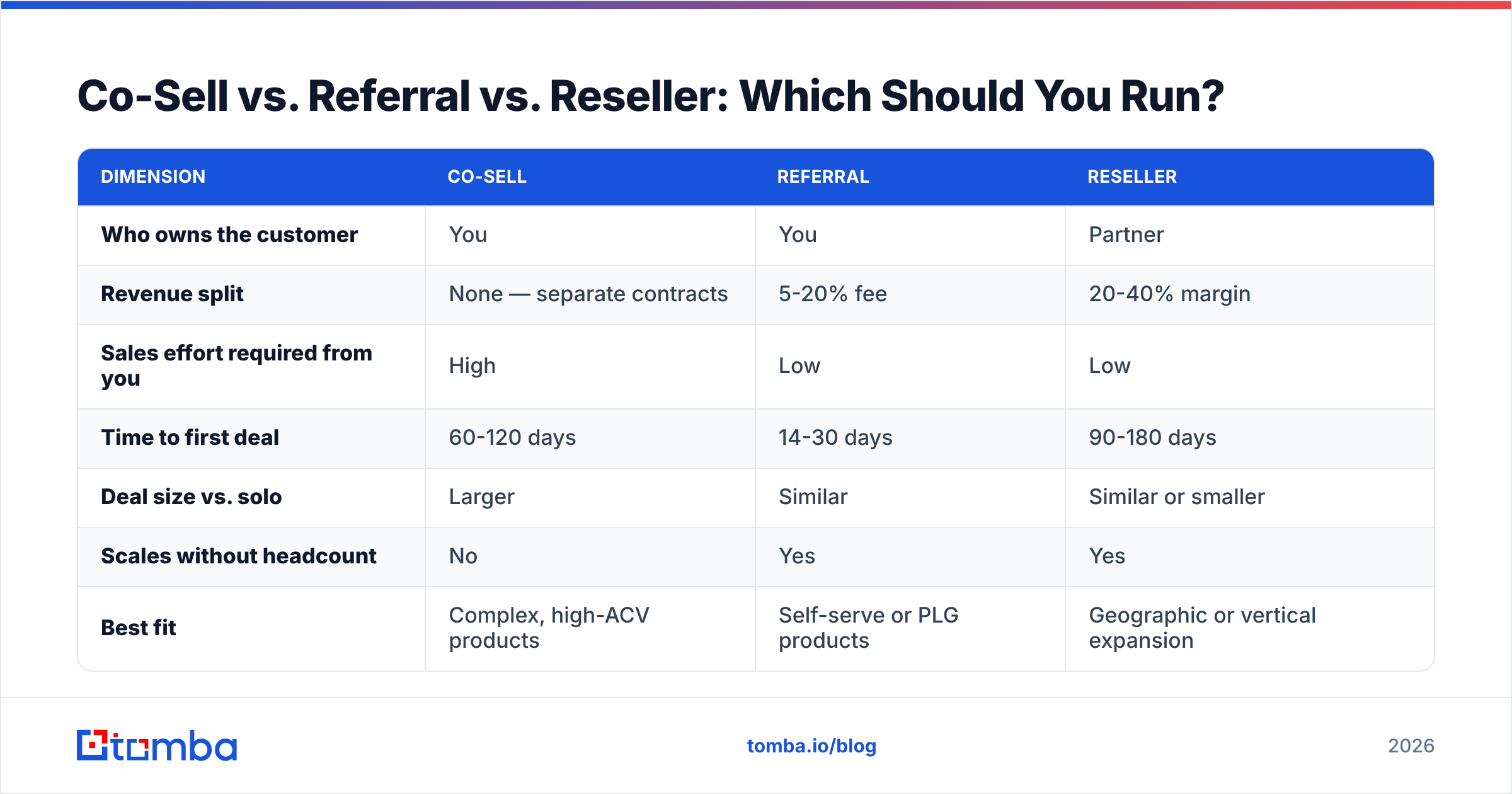
The honest answer depends on how much sales capacity you have and how complex your product is. Here is the trade-off laid out plainly.
| Dimension | Co sell | Referral | Reseller |
|---|---|---|---|
| Who owns the customer | You | You | Partner |
| Revenue split | None — separate contracts | 5-20% fee | 20-40% margin |
| Sales effort required from you | High | Low | Low |
| Time to first deal | 60-120 days | 14-30 days | 90-180 days |
| Deal size vs. solo | Larger | Similar | Similar or smaller |
| Scales without headcount | No | Yes | Yes |
| Best fit | Complex, high-ACV products | Self-serve or PLG products | Geographic or vertical expansion |
| Kills the program | No contact data, no lead reg | Partner forgets you exist | Channel conflict with direct team |
If your average contract value is under $5,000, co sell is almost certainly the wrong motion — the coordination overhead eats the deal. Run referrals instead. Above roughly $25,000 ACV with a multi-stakeholder buying committee, co sell starts to dominate. There, the coordination cost is rounding error against the win-rate lift.
The HubSpot partner ecosystem is a useful public example of how these tiers coexist. App partners, solutions partners, and co sell relationships all run in parallel, each aimed at a different product complexity and deal size. You don't have to pick one forever — you have to pick the right one per partner.
What Metrics Prove a Co Sell Program Is Working?#
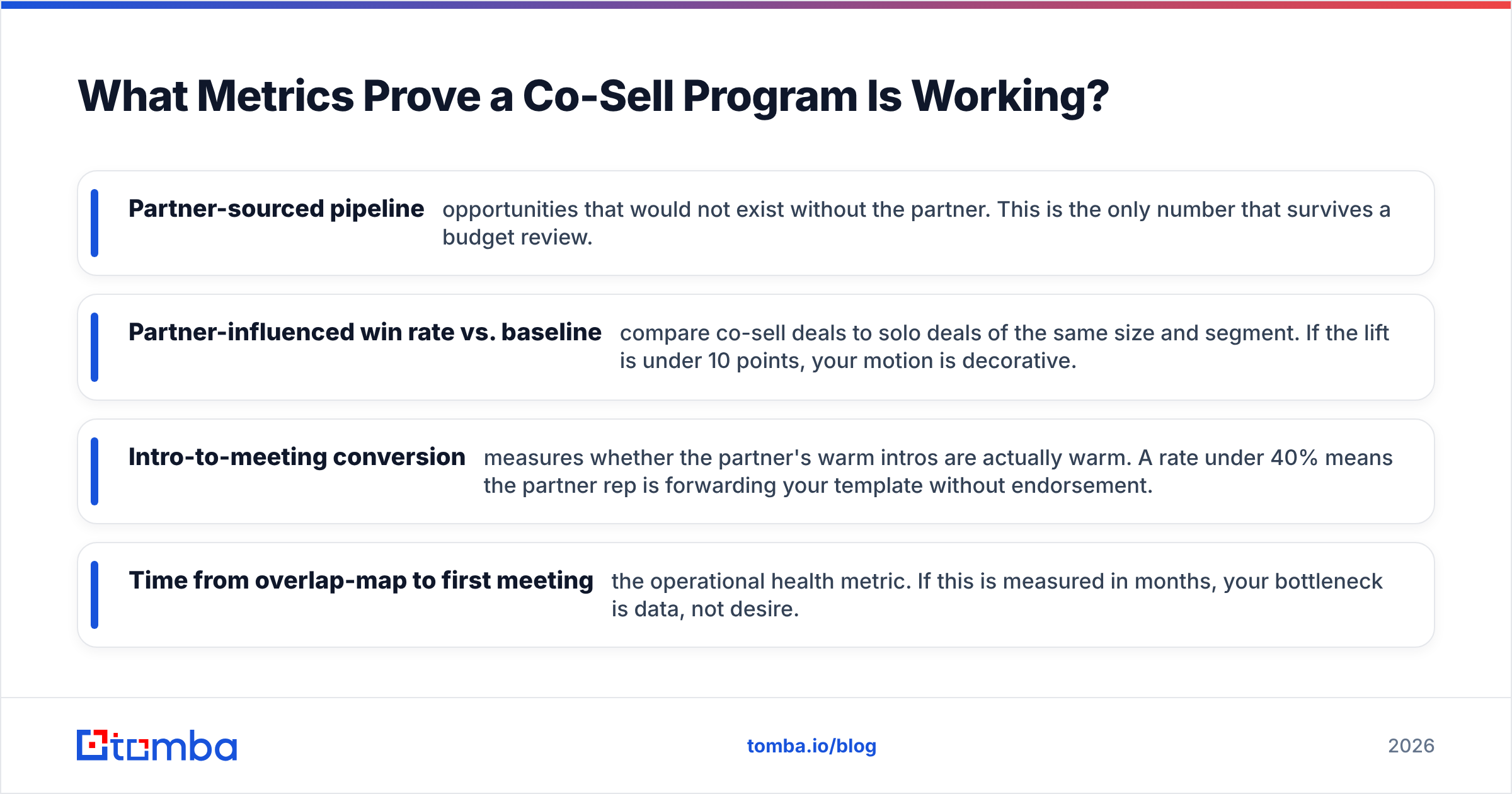
Track these four and ignore the vanity ones.
- Partner-sourced pipeline — opportunities that would not exist without the partner. This is the only number that survives a budget review.
- Partner-influenced win rate vs. baseline — compare co sell deals to solo deals of the same size and segment. If the lift is under 10 points, your motion is decorative.
- Intro-to-meeting conversion — measures whether the partner's warm intros are actually warm. A rate under 40% means the partner rep is forwarding your template without endorsement.
- Time from overlap-map to first meeting — the operational health metric. If this is measured in months, your bottleneck is data, not desire.
What to ignore: number of partners signed, joint webinars run, and logos on the partner page. None of them correlate with revenue, and all of them are easy to manufacture when the real numbers look bad.
When Should You Not Co Sell?#
Three clear no-gos.
Your ICPs don't actually overlap. If the account map returns under 15% overlap, you're forcing a partnership that the market doesn't want. Walk away politely.
Your sales cycle is under three weeks. Co sell coordination adds latency. On a fast transactional cycle, that latency costs more than the trust it buys.
You can't tell the partner what's in it for them this quarter. If your best answer is "long-term ecosystem value," the partner rep will nod and never send an intro. Give them a reason tied to their own number — an expansion angle into their existing account, a competitive displacement, a stalled deal you can unstick.
The Bottom Line#
Co sell is the highest-leverage motion in B2B, and the most operationally fragile. The strategy is not the hard part — every partnerships lead can draw the diagram. The hard part is turning a list of overlapping company names into a list of specific, reachable, verified humans. And doing it fast, while the partner rep still remembers the meeting where you agreed to all this.
Start narrow. One partner, one overlap map, one play, one trigger. Prove the win-rate lift on twenty accounts before you build a program around it.
And solve the contact layer first, because it is the step that everything else waits on. Run your partner overlap list through the Tomba Email Finder to turn domains into named, verified buyers in a single pass — then hand your partner an intro list they can actually forward. The free tier covers 25 searches, enough to test the workflow on a sample account list. Starter runs $49/mo when you're ready to map a real book of business.
Related guides#
Ready to find emails that actually work?
Join 150,000+ professionals who stopped guessing and started sending. Free credits on signup — no credit card required.
Get the Tomba newsletter
Practical outbound tactics and product updates — once every two weeks.
About the author