Co Seller Explained: How Partner Co-Selling Wins Deals in 2026
A co-seller can cut your sales cycle in half — or add three people to a call that closes nothing. Here is how co-selling actually works, what it costs, and how to run it without wrecking your pipeline hygiene.
TL;DR — what a co seller is, and when co-selling pays off:
- A co seller is a partner rep who sells alongside you into the same account — shared call, shared deal, separate paper. Nobody resells anybody. Both companies book their own revenue.
- Co-selling works because of trust transfer and budget access, not because of the product bundle. The partner's AE already has the meeting you have been chasing for six weeks.
- The motion breaks on two things almost every time: attribution fights and bad contact data. Fix the second one first — it's cheaper.
- Hyperscaler programs (AWS, Microsoft, Google Cloud) pay real money via marketplace and MDF, but the compliance overhead is heavy. Boutique co-sell with 3-5 aligned vendors is usually higher ROI for a sub-$20M ARR company.
- Track co-sell sourced pipeline, joint win rate, and cycle length delta against your solo baseline. If joint deals aren't closing at least 15-20% faster or bigger, kill the motion.
What is a co seller?#
A co seller is a salesperson at another company who runs a deal with you into a shared account. Both companies sell their own product, on their own contract.
The everyday version: two contractors show up to the same kitchen renovation. The plumber and the electrician are not subcontracting to each other. They quote separately, bill separately, and the homeowner signs two agreements. But they walk the job together, agree on the sequence, and each vouches for the other. If the electrician tells you the plumber is solid, you believe them more than you believe the plumber.
That last sentence is the entire commercial value of co-selling. You are borrowing someone else's credibility inside an account where you have none.
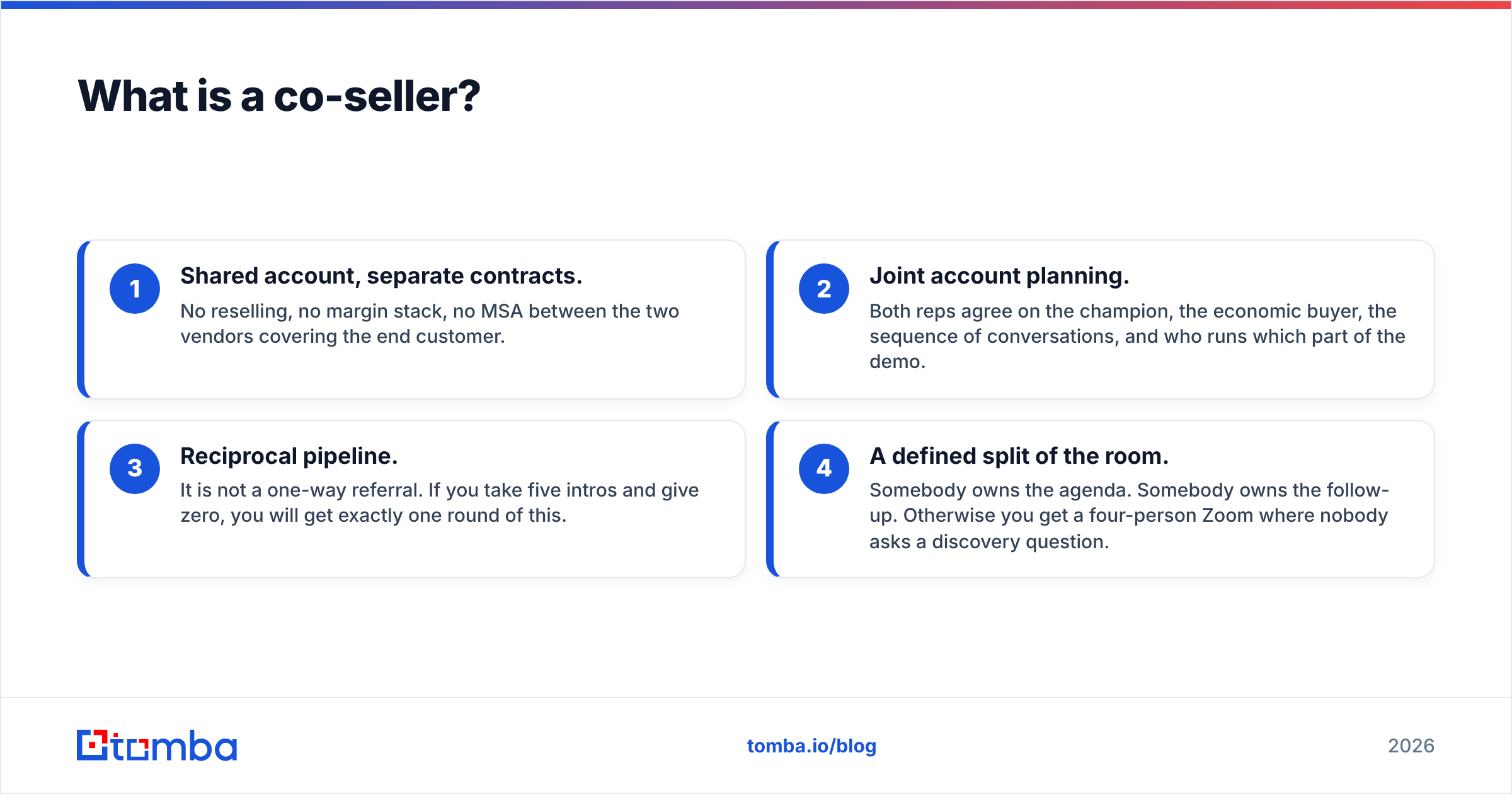
Technically, a co seller relationship has four properties:
- Shared account, separate contracts. No reselling, no margin stack, no MSA between the two vendors covering the end customer.
- Joint account planning. Both reps agree on the champion, the economic buyer, the sequence of conversations, and who runs which part of the demo.
- Reciprocal pipeline. It is not a one-way referral. If you take five intros and give zero, you will get exactly one round of this.
- A defined split of the room. Somebody owns the agenda. Somebody owns the follow-up. Otherwise you get a four-person Zoom where nobody asks a discovery question.
How does a co-sell motion actually run?#
Most people picture co-selling as "we both show up and hope." The teams that make it work run a repeatable sequence. The first three steps are prep:
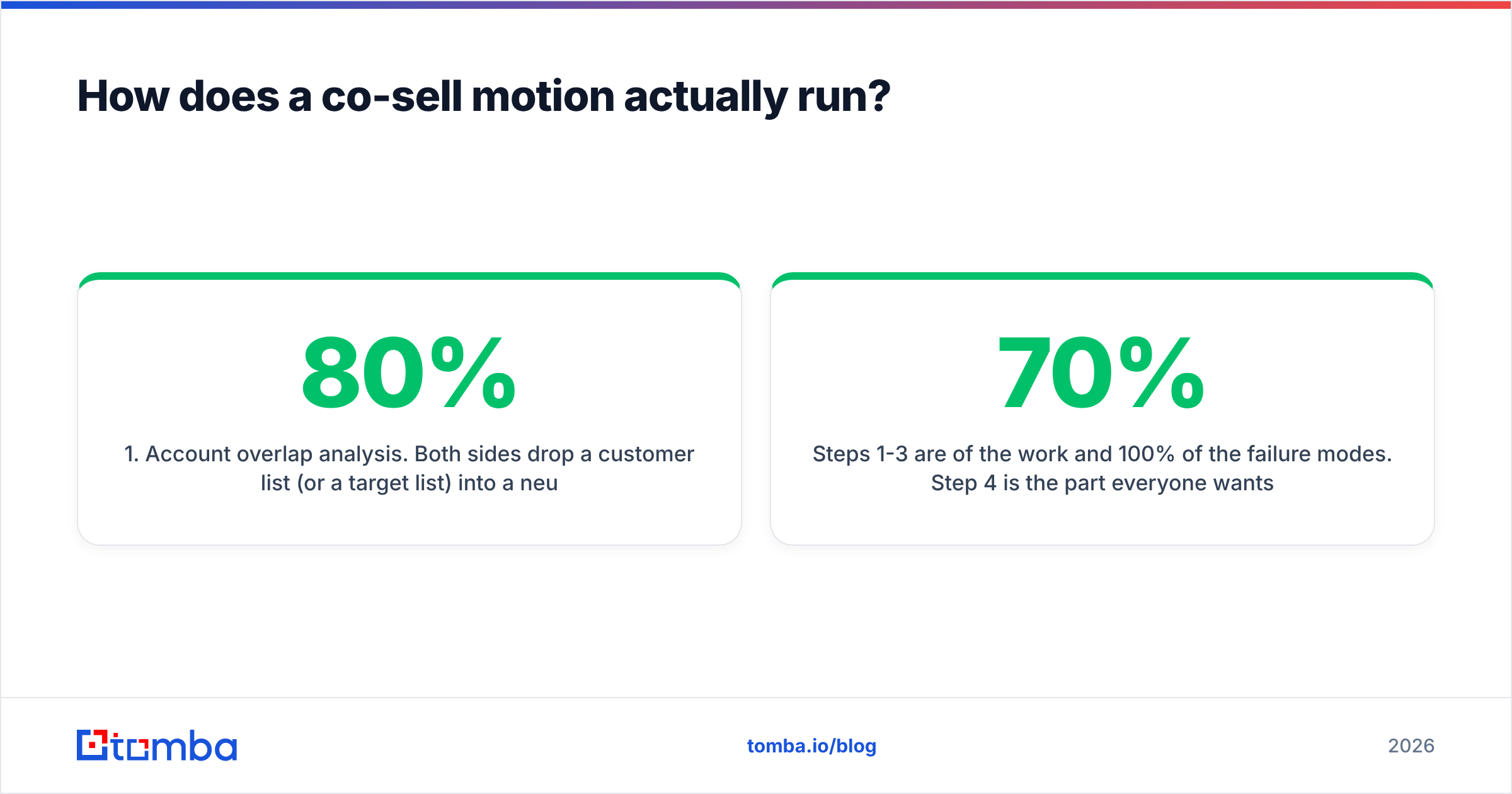
- Account overlap analysis. Both sides drop a customer list (or a target list) into a neutral sheet and find the intersection. This is the whole foundation — no overlap, no co-sell. Modern partner platforms automate it, but a CSV and 20 minutes gets you 80% of the value.
- Warm-lane selection. Rank overlaps by who has the active relationship. A partner's closed-won from 2021 is not a warm lane. Their renewal conversation next quarter is.
- Contact mapping. Identify the exact humans on both sides — the partner's champion, your champion, the economic buyer neither of you has met. Then get verified, current email addresses and direct dials for the gaps. This is where most co-sell motions quietly die.
The next three steps are the motion itself:
- The joint call. One agenda, one owner, ideally three people max on the vendor side. The partner rep opens with why they brought you in. You do discovery. Nobody demos in the first 15 minutes.
- Split follow-up and shared deal notes. Both CRMs get a partner-sourced flag on the opportunity. If you cannot report on it, it did not happen.
- Closed-loop reciprocity. Within 30 days, you bring the partner an intro of comparable value. Track this like a ledger, because your partner absolutely is.
Steps 1-3 are 70% of the work and 100% of the failure modes. Step 4 is the part everyone wants to talk about at the partner summit.

Co-sell vs. reseller vs. referral vs. affiliate: what's the difference?#
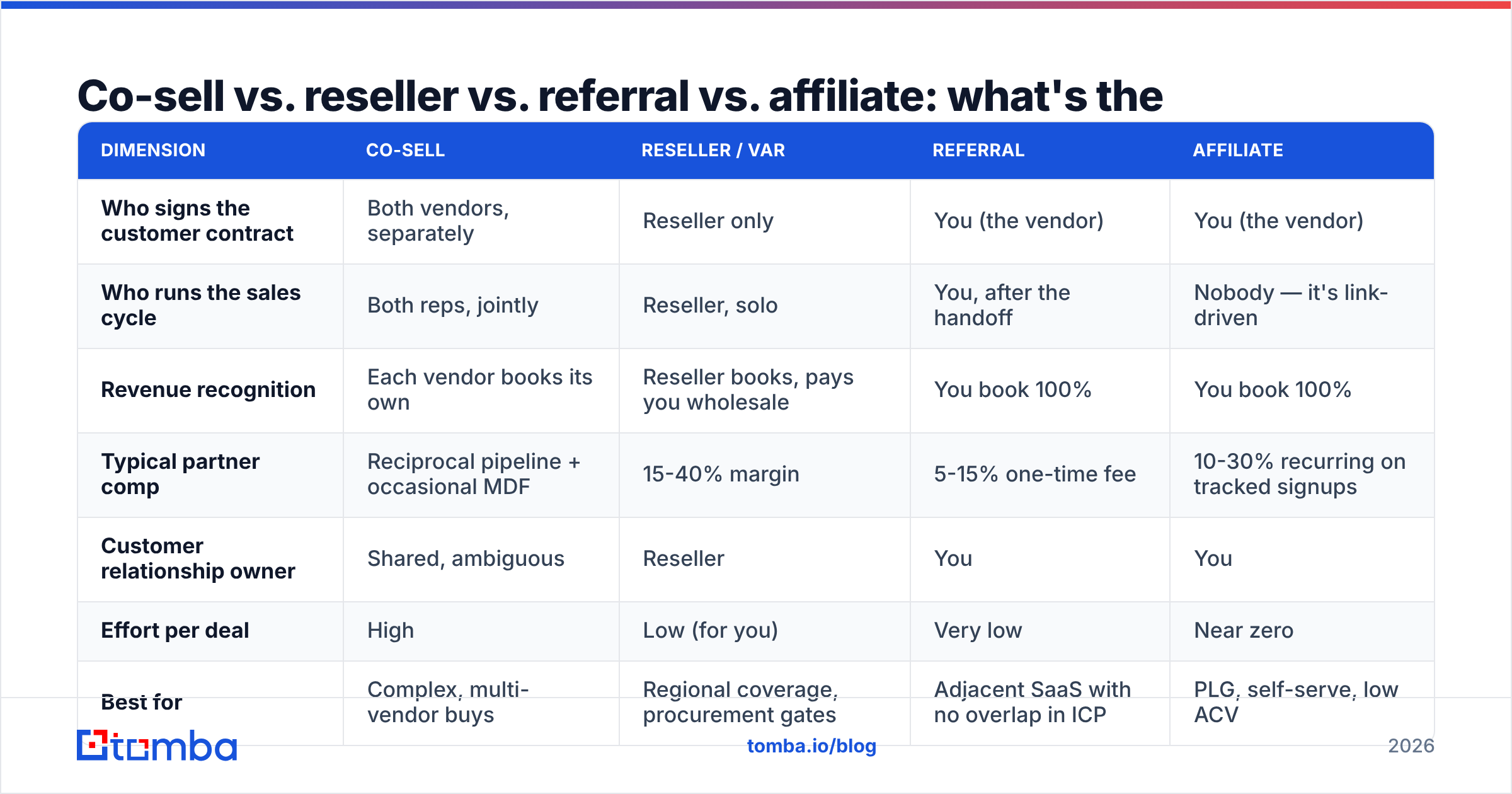
These get used interchangeably in partner decks and they are not remotely the same motion. The contract structure changes who owns the customer relationship, who carries the revenue, and who eats the support burden.
| Dimension | Co-sell | Reseller / VAR | Referral | Affiliate |
|---|---|---|---|---|
| Who signs the customer contract | Both vendors, separately | Reseller only | You (the vendor) | You (the vendor) |
| Who runs the sales cycle | Both reps, jointly | Reseller, solo | You, after the handoff | Nobody — it's link-driven |
| Revenue recognition | Each vendor books its own | Reseller books, pays you wholesale | You book 100% | You book 100% |
| Typical partner comp | Reciprocal pipeline + occasional MDF | 15-40% margin | 5-15% one-time fee | 10-30% recurring on tracked signups |
| Customer relationship owner | Shared, ambiguous | Reseller | You | You |
| Effort per deal | High | Low (for you) | Very low | Near zero |
| Best for | Complex, multi-vendor buys | Regional coverage, procurement gates | Adjacent SaaS with no overlap in ICP | PLG, self-serve, low ACV |
| Where it breaks | Attribution, data hygiene | Margin erosion, no control of the pitch | Partner stops sending | Fraud, cannibalized organic |
The practical rule: bring in a co seller when the customer has to buy both things to solve the problem. If your product is genuinely optional next to the partner's, you have a referral relationship. Stop pretending otherwise. The joint calls will feel like an ambush to the buyer, and they will tell you so by ghosting.
Why do co-sell partnerships fail?#
Four failure modes, in rough order of how often they kill the motion.
1. The attribution fight. Both reps flag the deal as partner-sourced. Both comp plans pay out. Finance notices, and someone in RevOps builds a rule that quietly disqualifies partner deals from accelerators. Now your best AEs avoid co-sell entirely. Fix this before the first joint call. Write down, in one paragraph, what counts as sourced vs. influenced and which one pays. Most companies land on this split: sourced = the partner produced the first meeting; influenced = the partner materially advanced a deal you already had. Only sourced pays a premium.
2. Nobody owns the follow-up. The joint call goes well. The partner rep assumes you'll send the recap. You assume they will, because it's their account. The buyer hears nothing for nine days and the deal loses momentum. Assign an owner in the calendar invite. Literally in the invite body.
3. The contact data is garbage. You have the partner's champion. Neither of you has the VP of Engineering who actually signs. The partner rep says "I'll ask around." Two weeks pass. This is a solved problem. A domain search across the target company, plus a verification pass, gets you the org's email pattern and the right humans in about four minutes. Nobody should be losing two weeks of cycle time to a missing email address in 2026.
4. Mismatched deal sizes. A partner selling a $400K platform deal has no incentive to slow down for your $12K add-on. Co-sell works when ACVs are within roughly one order of magnitude of each other. Outside that band, you are an afterthought on their call, and you will feel it.
Gartner's research on B2B buying explains why any of this matters. Buying groups are now large, and buyers spend most of the cycle not talking to any vendor. A trusted partner in the room is one of the few things that reliably shortens that. It also means one uninvited extra vendor on a call is a real cost, not a neutral event.
What data does a co seller actually need before the first call?#
This is the unglamorous layer. It is also the one that separates a co-sell program that produces pipeline from one that produces LinkedIn posts about "exciting synergies."
Before a joint call, both reps should be able to name:
- The full buying group — not just the champion. Who signs, who blocks, who has to live with the tool afterward.
- Verified contact routes for every name. A bounced intro email from a partner-sourced motion is worse than no intro. It burns the partner's credibility, not just yours.
- Current role and tenure. The partner's champion from 18 months ago may have moved companies. Half the co-sell "warm intros" I have watched go cold were addressed to someone who left.
- Tech stack signals. If the account already runs a competing product to yours, the partner needs to know before they vouch for you.
- Prior touch history on both sides. Nothing kills a joint call like the buyer saying "your SDR emailed me four times last month."
In practice, run the account through a contact enrichment pass and verify every address before anyone hits send. Bulk-check the list, drop the risky ones, and go into the call with a clean map. A five-minute enrichment step routinely saves a two-week discovery detour.

Which co-sell programs are worth joining in 2026?#
Two broad paths. Pick deliberately — they demand very different resourcing.
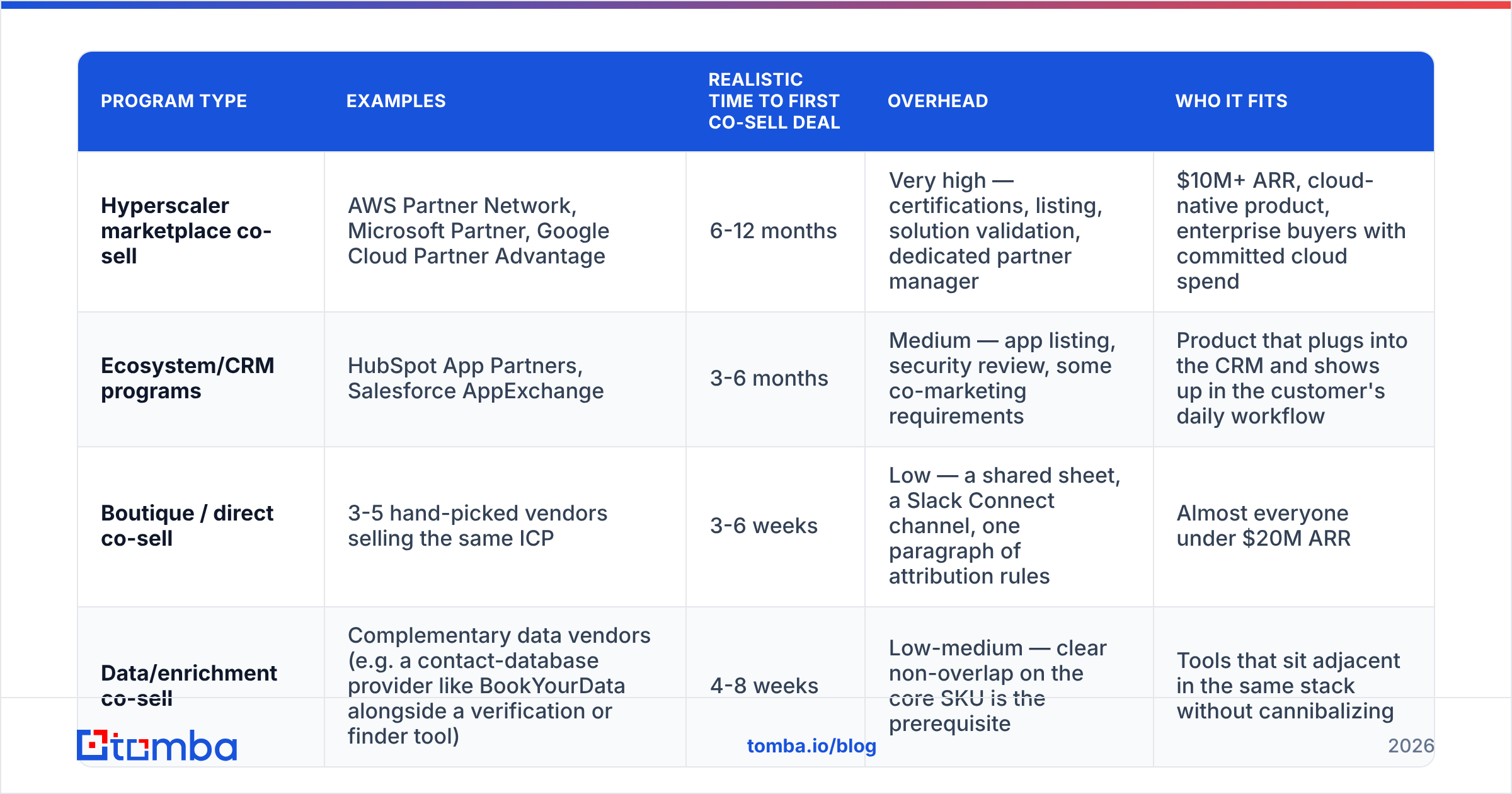
| Program type | Examples | Realistic time to first co-sell deal | Overhead | Who it fits |
|---|---|---|---|---|
| Hyperscaler marketplace co-sell | AWS Partner Network, Microsoft Partner, Google Cloud Partner Advantage | 6-12 months | Very high — certifications, listing, solution validation, dedicated partner manager | $10M+ ARR, cloud-native product, enterprise buyers with committed cloud spend |
| Ecosystem/CRM programs | HubSpot App Partners, Salesforce AppExchange | 3-6 months | Medium — app listing, security review, some co-marketing requirements | Product that plugs into the CRM and shows up in the customer's daily workflow |
| Boutique / direct co-sell | 3-5 hand-picked vendors selling the same ICP | 3-6 weeks | Low — a shared sheet, a Slack Connect channel, one paragraph of attribution rules | Almost everyone under $20M ARR |
| Data/enrichment co-sell | Complementary data vendors (e.g. a contact-database provider like BookYourData alongside a verification or finder tool) | 4-8 weeks | Low-medium — clear non-overlap on the core SKU is the prerequisite | Tools that sit adjacent in the same stack without cannibalizing |
The uncomfortable truth: the hyperscaler badge looks great on your website and produces almost nothing in year one. The boutique motion produces pipeline in a quarter — five partners, one Slack channel, a monthly 30-minute overlap review. Start there, earn the operating muscle, then chase the marketplace listing when you have someone whose actual job it is.
If you want a read on which ecosystem partners are actually credible, G2 category pages and their partner-integration listings are a faster signal than any vendor's own partner directory.
How do you measure whether a co seller is worth it?#
Compare co-sell deals against your solo baseline, not against zero. Four numbers tell you whether a co seller is earning their seat:
- Co-sell sourced pipeline ($). The partner produced the first meeting. This is the only number your CFO cares about.
- Joint win rate vs. solo win rate. If joint deals don't win meaningfully more often, the partner isn't transferring trust. They're just adding a person to the call.
- Cycle length delta. The most reliable co-sell benefit. Expect 15-30% shorter on a healthy motion. If it's longer, you've added a scheduling constraint and nothing else.
- Reciprocity ratio. Intros given ÷ intros received, per partner, rolling 90 days. Anything below 0.7 and you are about to lose that partner, whether or not they've told you.
Set the review cadence at 90 days per partner. Co-sell relationships decay quietly. A rep leaves, a priority shifts, and the channel goes silent for a quarter before anyone notices. A calendared review catches it. Bake this into your revenue operations reporting, not a side spreadsheet, or it will not survive contact with a busy quarter.
Should you build a co-sell motion this year?#
Yes, if: your ACV is above roughly $15K, your buyers evaluate you next to two or three other vendors in the same purchase, and you can name five companies whose reps are already in your target accounts.
No, if: you're pre-product-market-fit, your ACV is under $5K, or your sales cycle is under two weeks. At that end of the market the coordination overhead exceeds the trust transfer, and an affiliate or referral structure gets you most of the upside with none of the meetings.
On the fence? Run the cheapest possible test: one partner, one shared list of 40 overlapping accounts, one month. Enrich and verify the contacts, split the outreach, and count the meetings. That experiment costs a few hundred dollars and a couple of afternoons. It will tell you more than a year of partner-strategy decks.
Get the contact layer right before you get the partner deck right#
Every co seller motion runs on the same substrate: knowing exactly who is in the buying group, and being able to reach them without bouncing. That is not a partnership problem. It's a data problem, and it's the one you can solve this week.
Use the Tomba Email Finder to map the full buying group in your overlapping accounts, verify every address before your partner vouches for you, and walk into the joint call already knowing who signs. The free tier covers 25 searches a month, so you can run that 40-account test before you commit to anything. Tomba pricing starts at $49/mo when you're ready to scale the motion across a partner portfolio.
Clean data first. Joint calls second. The partner deck can wait.
Related guides#
Ready to find emails that actually work?
Join 150,000+ professionals who stopped guessing and started sending. Free credits on signup — no credit card required.
Get the Tomba newsletter
Practical outbound tactics and product updates — once every two weeks.
About the author