Co-Selling in 2026: How Partner-Led Deals Actually Close
Co-selling promises bigger deals and faster cycles — but most programs stall at the account-mapping stage. Here is how partner-led selling actually works in 2026, what to measure, and where it quietly fails.
TL;DR
- Co-selling is two companies working the same deal together — sharing accounts, intros, and sometimes revenue. It is not a referral, and it is not a reseller agreement.
- The math works: deals with a partner attached tend to close faster and larger, mostly because the partner brings warm trust you cannot buy with a cold sequence.
- The math also breaks constantly. Most co-selling programs die at account mapping, contact data, or a missing definition of who owns the deal.
- The three models — referral, co-sell, and channel/resell — have different comp, different motions, and different failure modes. Pick one before you build a partner page.
- Your bottleneck is usually not strategy. It is that your partner hands you a company list, not a contact list, and nobody can reach a human at those accounts.
What is co-selling, exactly?#
Co-selling is when two companies sell into the same account at the same time, on purpose, with a shared plan.
That last clause does the heavy lifting. Plenty of vendors bump into each other in an account and call it a partnership. Co-selling means you have agreed, in advance, on who takes which conversation, who owns the deal in the CRM, what each side gets, and what "we won" looks like for both.
The everyday version: a real estate agent and a mortgage broker. Neither sells the other's product. Both need the same buyer to move forward. When they coordinate — the agent introduces the broker early, the broker pre-approves before the offer — the deal closes faster and both get paid. When they do not coordinate, they annoy the same buyer twice and blame each other when it falls through.
In B2B software, the pattern shows up as:
- A data provider and a sales engagement platform working a shared mid-market account
- A systems integrator bringing in a SaaS vendor to close a migration project
- An ISV co-selling with AWS, Azure, or Google Cloud through their marketplace programs
- Two adjacent point solutions (say, a CRM and a billing tool) tag-teaming a RevOps buyer
The common thread: neither party can win the account alone as cleanly, or as fast, as they can together.
How is co-selling different from referrals and reselling?#
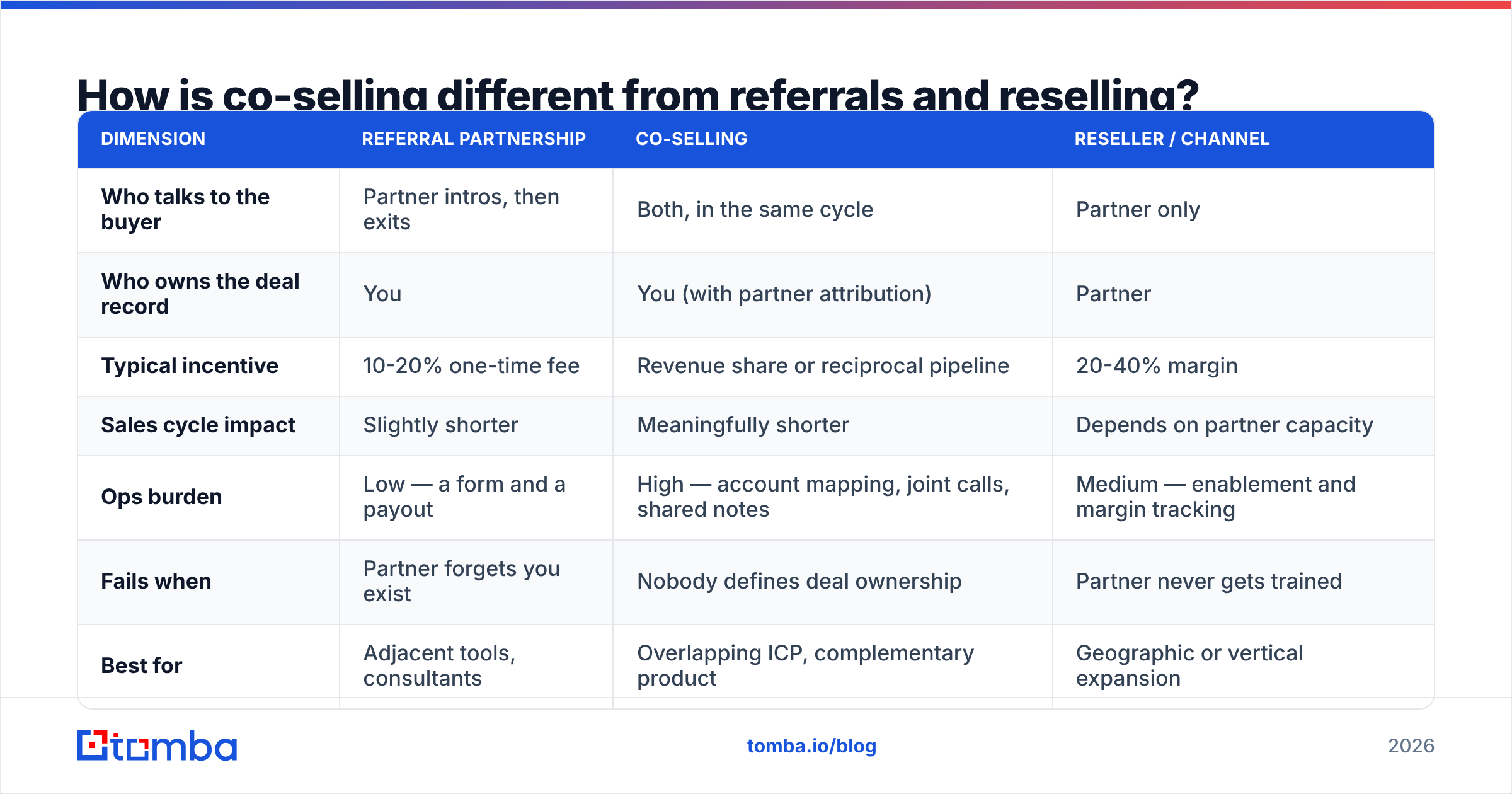
This is where most programs go sideways. Teams launch a "partner program," staff it with one person, and then discover they built three motions in a trench coat. Each one has its own comp plan, its own CRM hygiene, and its own definition of a qualified lead.
| Dimension | Referral partnership | Co-selling | Reseller / channel |
|---|---|---|---|
| Who talks to the buyer | Partner intros, then exits | Both, in the same cycle | Partner only |
| Who owns the deal record | You | You (with partner attribution) | Partner |
| Typical incentive | 10-20% one-time fee | Revenue share or reciprocal pipeline | 20-40% margin |
| Sales cycle impact | Slightly shorter | Meaningfully shorter | Depends on partner capacity |
| Ops burden | Low — a form and a payout | High — account mapping, joint calls, shared notes | Medium — enablement and margin tracking |
| Fails when | Partner forgets you exist | Nobody defines deal ownership | Partner never gets trained |
| Best for | Adjacent tools, consultants | Overlapping ICP, complementary product | Geographic or vertical expansion |
Read that table twice before you build anything. The most common mistake is running a co-sell motion on referral-grade infrastructure: no shared account map, no contact-level coordination, and no rule for what happens when both reps show up in the same inbox.
The second most common mistake is calling everything "co-selling" because it sounds more strategic than "we sent them some leads."
Why does co-selling work when it works?#
Three mechanisms, and they are not equally important.
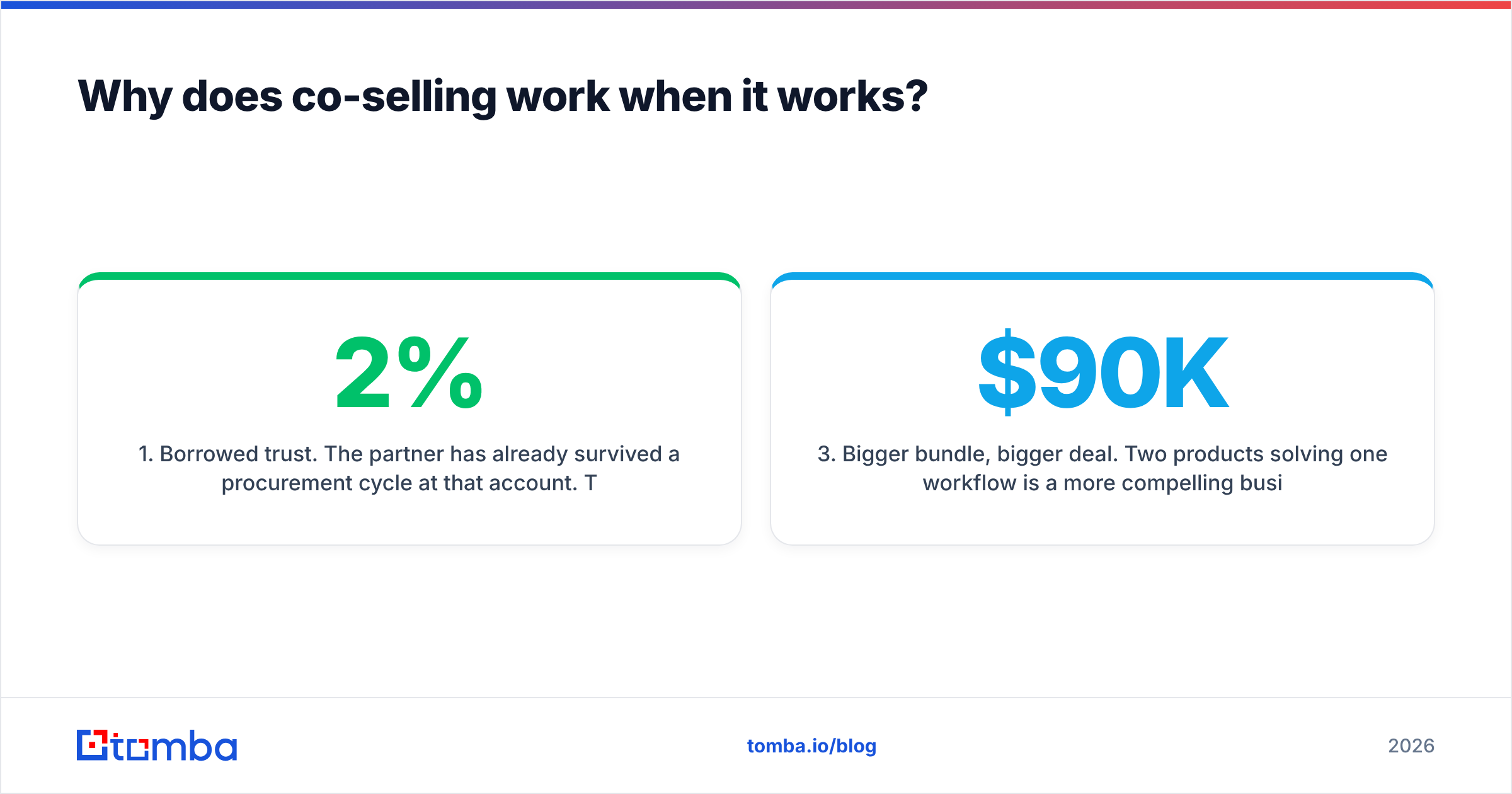
1. Borrowed trust. The partner has already survived a procurement cycle at that account. Their word carries weight your cold email never will. When a trusted vendor says "you should talk to these people," the meeting rate is not 2% — it is closer to 40%. This is the whole ballgame.
2. Shared intelligence. Your partner knows the budget cycle, the political landmine, the exec who killed the last project. That context normally takes you three discovery calls to assemble. Now you start with it.
3. Bigger bundle, bigger deal. Two products solving one workflow is a more compelling business case than either one alone. Procurement is more willing to sign a $90K joint solution than two separate $45K point tools, because it looks like a decision instead of a shopping spree.
What co-selling does not do: fix a weak product, create demand where none exists, or rescue a quarter in the last three weeks. Partner-led pipeline compounds slowly. If you need bookings by Friday, this is not the lever.
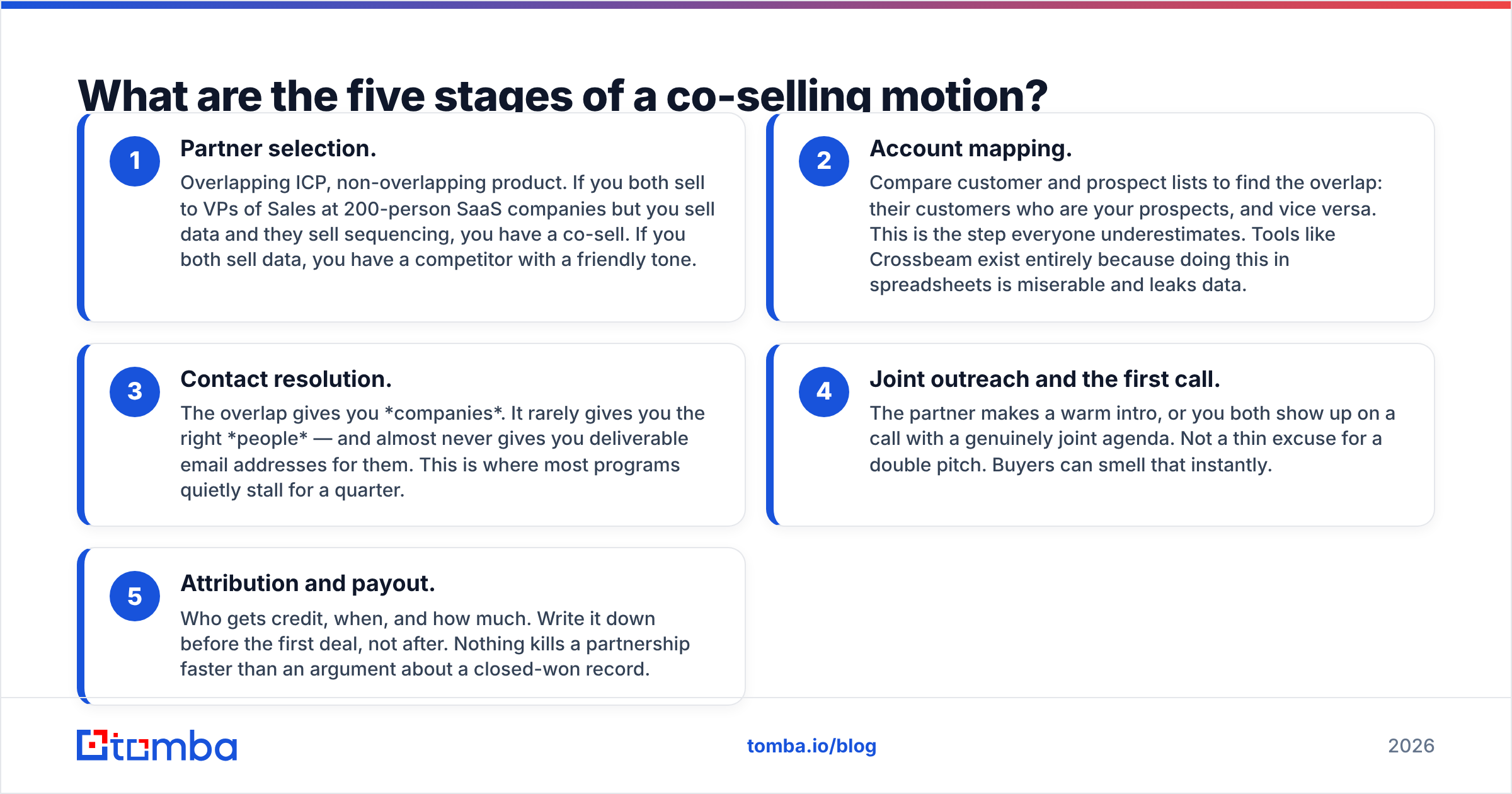
What are the five stages of a co-selling motion?#
Every functioning co-sell program I have seen runs some version of these five stages. Skip one and the whole thing leaks.
Partner selection. Overlapping ICP, non-overlapping product. If you both sell to VPs of Sales at 200-person SaaS companies but you sell data and they sell sequencing, you have a co-sell. If you both sell data, you have a competitor with a friendly tone.
Account mapping. Compare customer and prospect lists to find the overlap: their customers who are your prospects, and vice versa. This is the step everyone underestimates. Tools like Crossbeam exist entirely because doing this in spreadsheets is miserable and leaks data.
Contact resolution. The overlap gives you companies. It rarely gives you the right people — and almost never gives you deliverable email addresses for them. This is where most programs quietly stall for a quarter.
Joint outreach and the first call. The partner makes a warm intro, or you both show up on a call with a genuinely joint agenda. Not a thin excuse for a double pitch. Buyers can smell that instantly.
Attribution and payout. Who gets credit, when, and how much. Write it down before the first deal, not after. Nothing kills a partnership faster than an argument about a closed-won record.
The gap between stage 2 and stage 4 is where the money goes to die. You have a list of 180 overlapping accounts. Your partner's CSM knows the champion at maybe twelve of them. For the other 168, you have a company name and a logo — and no way to reach a human.
Why does contact data break most co-selling programs?#
Because account mapping is a company-level exercise and selling is a person-level activity.
Your partner exports their customer list. You export your prospect list. The overlap comes back as 180 domains. Great. Now someone has to answer: who at acme.com actually owns this decision, and what is their email address?
In practice, that answer comes from one of four places:
- The partner's CRM. Best case. Usually stale — contacts churn at roughly 25-30% a year, so a two-year-old contact record is a coin flip.
- LinkedIn. Accurate on job titles, useless for email addresses.
- Guessing the pattern.
first.last@,flast@,first@. Works often enough to be tempting and fails often enough to torch your sender reputation. - An enrichment step. You take the mapped domains and resolve them into verified, deliverable contacts before anyone sends anything.
The fourth option is the only one that scales past a handful of accounts. A domain search turns each overlapping domain into a list of real people with real roles; an email verifier pass then strips the bounces before your partner's name gets attached to a message that hard-bounces.
That last point matters more than it sounds. In a co-sell, you are borrowing your partner's credibility. If your first touch bounces or lands in spam, you did not just waste a lead — you spent someone else's reputation. Partner managers remember that.

How do you measure co-selling without lying to yourself?#
Partner metrics are the most gamed numbers in GTM. Everything gets called "partner-influenced," a category so elastic it can absorb your entire pipeline.
Use a tighter set:
- Partner-sourced pipeline. The partner brought the account, and you had no prior open opportunity. This is the honest number. It is also the small one. Expect it to be uncomfortable in year one.
- Partner-attached win rate. Compare win rate on deals with a partner involved against your baseline. If it is not materially higher, your co-sell is theater.
- Time-to-first-meeting. How long from mapped account to booked call. This is where co-selling should crush outbound. If it does not, the intros are not actually happening.
- Contact coverage. What percentage of mapped accounts have a verified, deliverable contact for the right persona. Track it. It is usually the constraint, and nobody watches it.
- Deal size delta. Joint deals versus solo deals, same segment.
Notice that "number of partners signed" is not on the list. Partner count is a vanity metric. Five partners who actually map accounts with you beat forty logos on a slide, every time. Both HubSpot and Salesforce run enormous ecosystems, and both will tell you the same thing: a small number of active partners drive nearly all the revenue.
Also worth tracking against your baseline response rate. If a warm partner intro is not outperforming your cold sequence by a wide margin, the intro is not warm — it is a forwarded email with your logo on it.
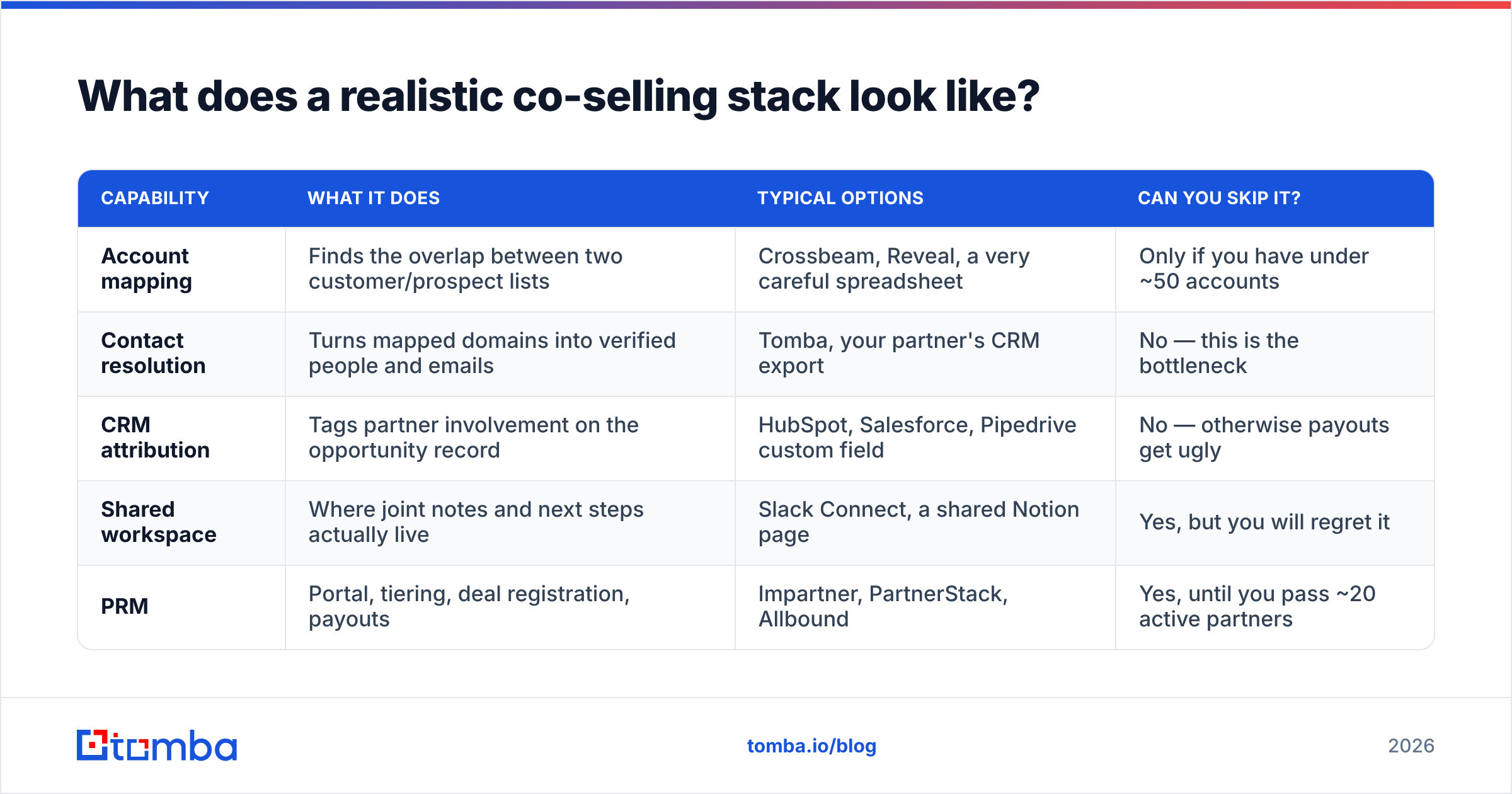
What does a realistic co-selling stack look like?#
You do not need a nine-tool partner tech stack. You need four capabilities, and you probably already own two of them.
| Capability | What it does | Typical options | Can you skip it? |
|---|---|---|---|
| Account mapping | Finds the overlap between two customer/prospect lists | Crossbeam, Reveal, a very careful spreadsheet | Only if you have under ~50 accounts |
| Contact resolution | Turns mapped domains into verified people and emails | Tomba, your partner's CRM export | No — this is the bottleneck |
| CRM attribution | Tags partner involvement on the opportunity record | HubSpot, Salesforce, Pipedrive custom field | No — otherwise payouts get ugly |
| Shared workspace | Where joint notes and next steps actually live | Slack Connect, a shared Notion page | Yes, but you will regret it |
| PRM | Portal, tiering, deal registration, payouts | Impartner, PartnerStack, Allbound | Yes, until you pass ~20 active partners |
The honest advice: start with account mapping plus contact resolution, run it manually with two or three partners for a quarter, and only buy a PRM when the manual process is visibly breaking. Most companies buy the PRM first, and then have an expensive portal with nothing to put in it.
For the contact-resolution layer specifically, price matters because volume is spiky — you enrich 200 accounts the week after a mapping session, then almost nothing for a month. Tomba pricing starts free at 25 searches a month, with Starter at $49/mo and Growth at $99/mo, which covers most co-sell programs before you need a real data contract. If you are already running partner ops out of a spreadsheet, the Google Sheets add-on will resolve a mapped domain list in place without a new tool for anyone to learn.
When should you not co-sell?#
Three clear cases.
Your product is not ready. A partner intro is a one-shot asset. Burn it on a product that churns in ninety days and you do not get another one — and the partner's CSM now has an internal story about how you cost them a renewal conversation.
You have no dedicated owner. Co-selling is coordination work. If it is a side project for a founder or an AE with a quota, it will lose every time to the thing that pays this month. It does not need a big team. It needs one person whose scoreboard it is.
Your ICPs only look similar. "We both sell to SaaS" is not overlap. Overlap is: same company size, same buyer title, same budget cycle, complementary problem. Run the account map before you sign the agreement, not after. If the overlap comes back at 4%, you just saved yourself two quarters.
There is also a subtler failure: partnering with someone whose sales cycle is three times yours. Their enterprise deal takes nine months, yours takes six weeks. Their rep will not prioritize your $30K ACV deal, and you will spend the quarter waiting on a call that never gets booked. Cycle-length symmetry matters more than most people think.
What is the fastest way to run your first co-sell?#
A four-week version that actually ships:
Week 1 — pick one partner. Not five. One. Ideally a company whose customers already ask them about the problem you solve.
Week 2 — map accounts. Trade lists under an NDA, or use a mapping tool if you both have one. Produce a single list of overlapping domains, split into "their customer, your prospect" and "your customer, their prospect."
Week 3 — resolve contacts. Take the domains and find the right people. Titles first, then emails, then verification. Anything that does not verify clean does not get touched. Kill your bounce risk before it touches a partner's name.
Week 4 — run ten intros. Not two hundred. Ten, done well, with a joint agenda and a real reason for both of you to be on the call. Measure meeting rate and pipeline created. Then decide whether to scale.
If ten warm partner intros do not outperform your cold outbound by a wide margin, the problem is not the partner. It is either the fit or the ask — and it is cheaper to learn that in four weeks than in four quarters.
Get the contact layer right first#
Co-selling fails at the contact layer far more often than it fails at the strategy layer. You will not lose the partnership because your revenue-share percentage was wrong. You will lose it because eight weeks in, you still have a spreadsheet of 180 domains and no way to reach a decision-maker at any of them.
Fix that part first. The Tomba Email Finder turns a mapped account list into verified, deliverable contacts — name and domain in, a real person's email out, verified before anyone sends anything. Start on the free tier, run it against your first partner's overlap list, and see how many of those 180 domains turn into actual conversations. That number, more than any partner agreement, tells you whether the co-sell is real.
Related guides#
Ready to find emails that actually work?
Join 150,000+ professionals who stopped guessing and started sending. Free credits on signup — no credit card required.
Get the Tomba newsletter
Practical outbound tactics and product updates — once every two weeks.
About the author